Moving House During Operational Restrictions: Your Planning Guide
By Housey · Last reviewed 18th of May 2026
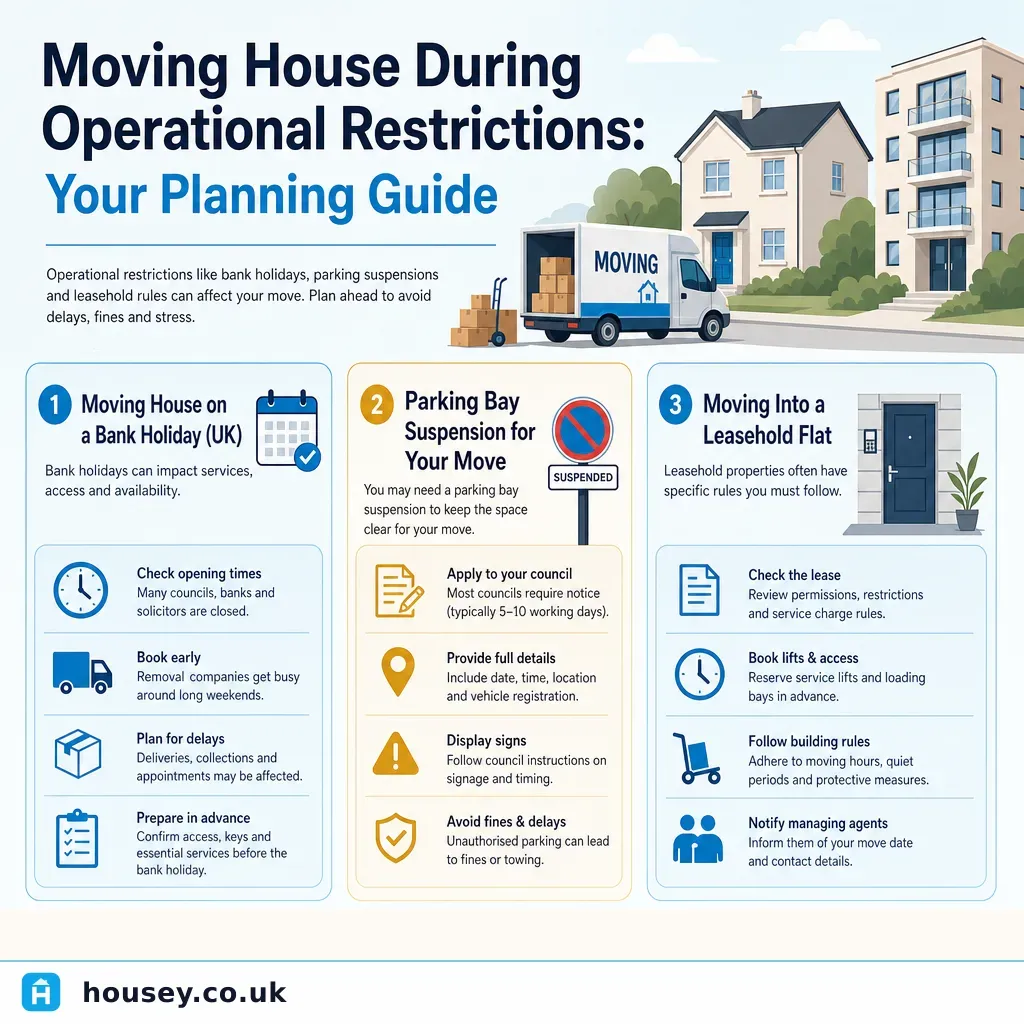
Moving House During Operational Restrictions: Your Planning Guide
Completion day logistics are often finalised under pressure — your solicitor has confirmed a date, the chain is agreed, and the clock is ticking. Operational restrictions, ranging from bank holiday closures and parking rules to leasehold building access hours, can catch buyers out if not anticipated early. The decisions you make about timing and logistics before exchange can save significant cost and stress on moving day itself.
Key points
- UK bank holidays (8 per year in England and Wales, more in Scotland and Northern Ireland) often mean removal firms either close entirely or charge premiums of 20–30%.
- Parking bay suspensions — temporary removal of waiting restrictions to allow a removal lorry to park — must be applied for from your local council; London boroughs typically charge £50–£150 per bay per day, and applications require at least 5 working days' notice.
- Leasehold flat moves commonly require written notice to the managing agent, a service lift booking, and compliance with permitted access hours (often weekdays 8 am–5 pm only).
- June to August is peak UK moving season; Friday completions and end-of-school-holiday moves carry the highest removal costs and the lowest availability.
- Adverse weather — particularly snow or prolonged heavy rain — may cause removal firms to delay or modify the move at short notice under their standard terms.
What counts as an operational restriction for a house move?
The term covers any rule, closure, or physical constraint that prevents or complicates normal moving-day operations. In practice, these fall into five main categories.
Bank holidays and business closures
Most removal firms, solicitors, and mortgage lenders work standard business hours. Bank holidays interrupt the chain of fund transfers needed for completion. Even if your removal firm operates, your solicitor's office may be closed — which means funds cannot be released and keys cannot be handed over. Completions on bank holidays are rare and generally inadvisable.
Peak demand periods
Summer school holidays (late July through early September) generate the highest UK moving demand. Removal firms in popular areas book up weeks in advance, and quotes reflect the demand premium. Flexible buyers willing to move in autumn or winter often secure better rates and greater date choice.
Parking and access restrictions
Streets with residents' parking, yellow lines, or permit zones require a bay suspension for a removal lorry to park legally. Some London boroughs and city councils have online portals for applications; others require telephone or email contact. Failure to obtain the suspension can result in a penalty charge notice for the vehicle or an inability to park close enough to the property to load and unload safely.
Managed and leasehold buildings
Moving into a flat in a managed block involves rules that freehold buyers rarely encounter. Common restrictions include:
- Permitted moving hours (often 8 am–5 pm on weekdays; some buildings prohibit weekend moves entirely)
- Mandatory service lift bookings (the passenger lift is rarely large enough for furniture)
- Refundable damage deposits payable to the management company
- Prior written notification to the managing agent, sometimes requiring 14–28 days' notice
Review your lease terms and contact the managing agent as early as possible — ideally before exchange.
Adverse weather
Snow, ice, and severe flooding can make road access to properties impossible or unsafe for a loaded lorry. Removal firms typically operate on a best-endeavours basis; their standard terms usually allow postponement in extreme weather. Check your removal firm's terms and confirm that your contents insurance covers goods in transit when using a professional firm.
Which moving date should you choose?
Use this guide to select a completion date that balances cost, availability, and risk:
- Choose a mid-week date in October, November, January, or February if minimising cost is the priority. Quieter months mean lower removal quotes and greater flexibility.
- Choose a Monday or Tuesday if moving in peak season — Friday completions attract the highest demand, and a mid-week day gives time to resolve delayed-completion issues before the weekend.
- Avoid bank holidays and the week before Christmas unless your removal firm has confirmed availability in writing and you are comfortable with any surcharge.
- Avoid the last Friday of the summer school holidays — this is traditionally one of the busiest single moving days of the year in the UK.
- Confirm parking suspension availability before agreeing a date — if the local council cannot guarantee a slot for your preferred day, factor this into your negotiations.
- Ask the managing agent about service lift slots before exchange if you are buying a leasehold flat. Some buildings have only one or two bookable slots per week.
Homeowner moving-day checklist
Work through these tasks in the weeks before your move:
Red flags to watch for
- No parking confirmation received — if you have not received written confirmation of a bay suspension, chase the council urgently. A lorry with nowhere to park legally is one of the most common and costly moving-day problems.
- Completion funds not received by early afternoon — if your solicitor has not received cleared funds by their internal cut-off (typically 2–3 pm), the vendor may refuse to release keys that day. Discuss the protocol with your solicitor before moving day.
- Removal firm not a BAR member — the British Association of Removers (BAR) requires member firms to carry appropriate insurance and meet conduct standards. Check membership at bar.co.uk before instructing.
- Service lift not confirmed in writing — a verbal booking with the managing agent can be overlooked. Confirm in writing and keep a copy.
When to get professional help
Most operational restrictions can be managed with early planning. However, consider specialist help if:
- You are buying a listed building or property in a conservation area, where additional access, working-hour, or building works restrictions may apply.
- Your move involves high-value, antique, or specialist items requiring dedicated packing and accredited transport.
- Your chain is long or fragile and you are concerned about co-ordination — a conveyancing solicitor experienced in chain management can help reduce the risk of a collapsed sale.
How Housey can help
Housey connects you with vetted house removals firms across the UK. Submit your move details once and receive quotes from local providers who understand your area's parking rules, access requirements, and managed building protocols — so you can compare with confidence before exchange.
Frequently asked questions
Do I need a parking bay suspension for my removal lorry?
In many areas, yes. If your street has residents' parking, single or double yellow lines, or other waiting restrictions, you must apply to your local council for a temporary suspension before moving day. Fees and notice periods vary by council — check your local authority's highways or parking pages and apply at least five working days in advance, ideally more.
Can I complete on a bank holiday in England and Wales?
In practice, completions rarely happen on bank holidays because solicitors' offices are usually closed and mortgage lenders cannot process fund transfers. Even if a removal firm is available — often at a 20–30% premium — the legal process usually cannot complete. Most buyers and sellers agree to avoid bank holiday completion dates when negotiating with their chain.
What if my completion is delayed and my removal firm is waiting?
If funds are not transferred by the agreed deadline, the vendor's solicitor may refuse to release keys that day. Your removal firm may charge a waiting fee or, if the delay extends beyond operating hours, may need to return the following day at additional cost. Discuss contingency plans with your solicitor and removal firm well before moving day.
How far ahead should I book a removal firm for a summer move?
For a July or August move — particularly on a Friday — book as soon as you have an agreed completion date, ideally six to eight weeks in advance. Removal firms in popular areas book up quickly during peak season. For quieter months, three to four weeks' notice is usually adequate, but confirming availability early is always advisable.
Sources and further reading
- Tell the government you've changed your address — GOV.UK
- British Association of Removers (BAR) — trade association; member firms carry appropriate insurance and meet conduct standards
- Royal Mail Redirection — set up post redirection when moving home
- Apply for a parking permit — GOV.UK starting point for local council parking and bay suspension applications
Useful next reads
 Buying & Moving
Moving House During Temporary Restrictions: Planning Your Relocation
Moving during road works, parking restrictions, or building management rules requires advance planning.
 Buying & Moving
Moving House During Operational Closures: Your Relocation Options
Completions cannot proceed on bank holidays because CHAPS bank transfers only process on Bank of England business days.
 Buying & Moving
How to Plan a House Move: A Practical Guide to Residential Relocations
A UK house move goes more smoothly with planning that starts 6–8 weeks before moving day.
 Buying & Moving
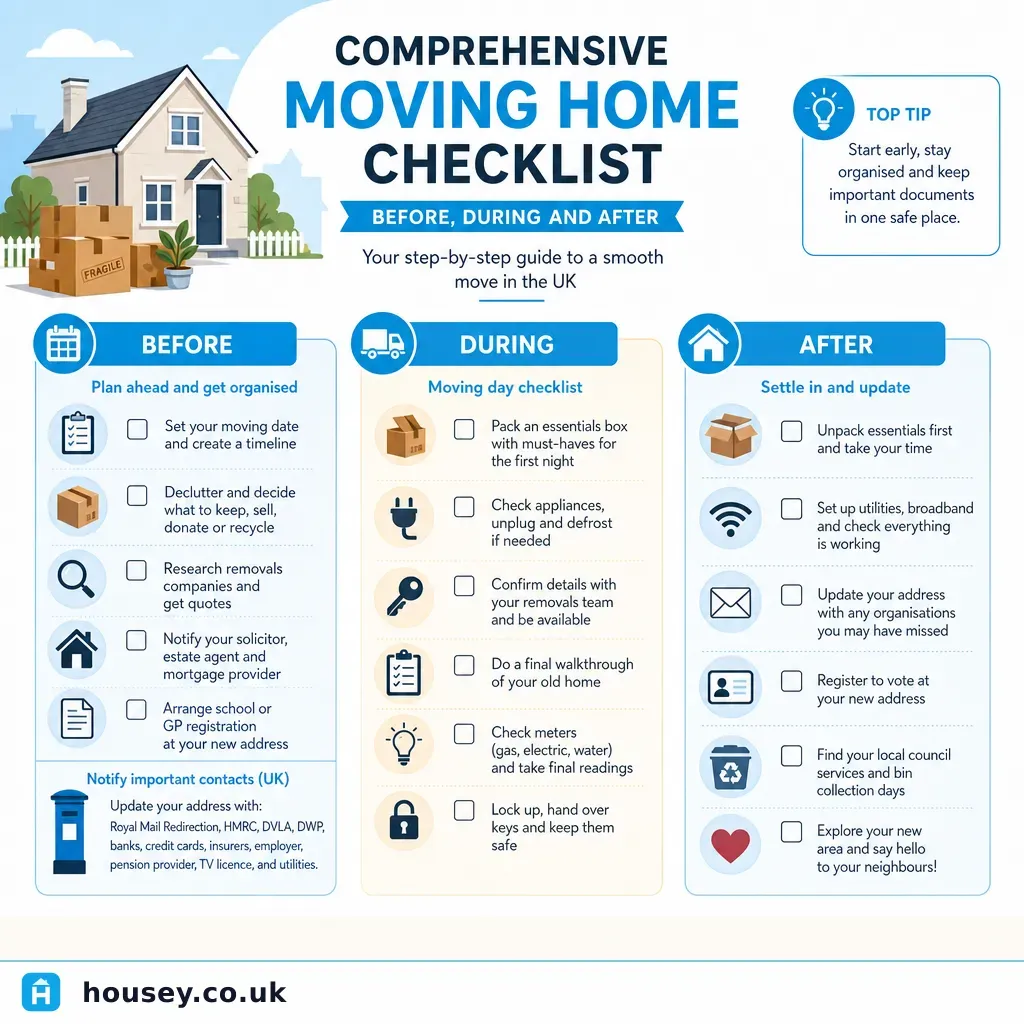
Comprehensive Moving Home Checklist: Before, During and After
Moving house in the UK involves tasks across roughly eight weeks: instructing a conveyancer and removal firm early, systematically notifying organisations of your new address, confirming buildings insurance from exchange, taking meter readings on completion day, and registering with the new council and utilities promptly.
 Buying & Moving
Professional House Removals Services: Choosing the Right Moving Company
A professional house removals company handles loading, transport, and unloading; full-service firms with BAR membership also offer deposit protection and independent dispute resolution.