Preventing Deterioration and Cracking in Concrete Driveways and Flatwork
By Housey · Last reviewed 24th of May 2026
Preventing Deterioration and Cracking in Concrete Driveways and Flatwork
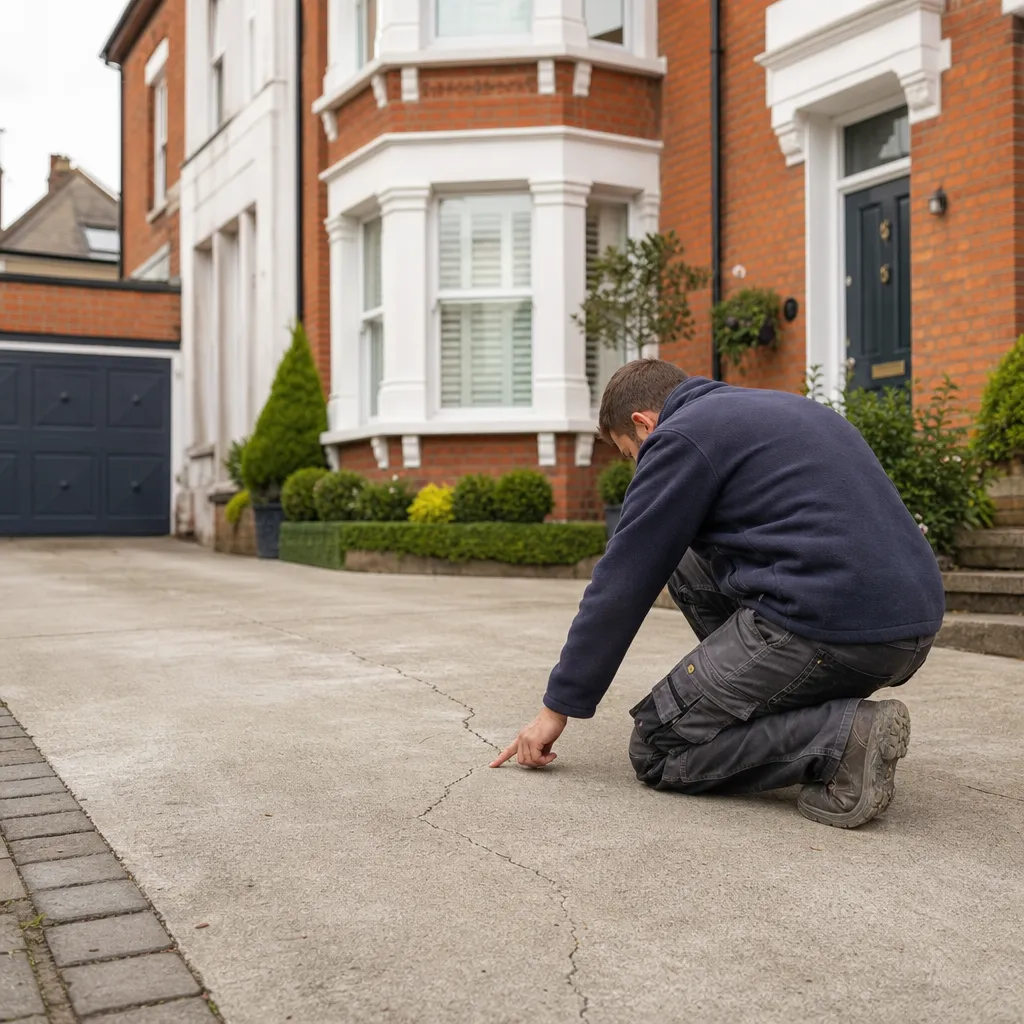
Concrete driveways are a common choice across the UK — from 1930s semis to new-build estate houses — but they can develop cracking and surface deterioration within a few years if not properly specified, installed, or maintained. The question of what causes driveway cracking typically arises when homeowners notice surface scaling after a cold winter, hairline cracks forming across the surface, or deeper fractures near the edges. Getting the specification right at the construction stage, and following a straightforward maintenance routine, can extend the working life of a concrete driveway by decades.
Key points
- Concrete for UK driveways exposed to frost and de-icing salts should meet exposure class XF3 or XF4 under BS 8500-1:2023, typically requiring a C35/45 or stronger mix.
- Control joints (contraction joints) should be cut or formed at intervals of roughly 2.5 to 4 metres for a 100 mm residential slab — cut to at least one-quarter of the slab depth.
- Air entrainment (4–7% entrained air by volume) significantly improves resistance to freeze-thaw cycling and should be specified for all UK outdoor concrete flatwork exposed to frost.
- Sodium chloride de-icing salts applied directly to concrete accelerate surface scaling and should be avoided, particularly on concrete less than two years old.
- Concrete requires a minimum of 7 days of protected curing; inadequate curing is one of the most common causes of surface dusting and premature cracking on residential driveways.
Why concrete driveways crack
Cracking in concrete flatwork is rarely random. Understanding the mechanism helps homeowners and contractors address root causes rather than surface symptoms.
Plastic shrinkage cracking occurs within the first few hours of placing concrete, before it has gained strength. Hot or windy conditions accelerate surface evaporation faster than water rises from below, creating surface tension cracks. In the UK, this is a real risk during warm, breezy summer days.
Drying shrinkage cracking develops over days to weeks as concrete loses moisture and contracts. Concrete shrinks by approximately 0.03–0.08% during curing. Without control joints at planned intervals, this shrinkage stress is released unpredictably, producing irregular cracks across the surface.
Freeze-thaw damage (spalling and scaling) is the most common deterioration mechanism in the UK. When water penetrates the concrete surface, freezes, and expands, it exerts internal pressure on the cement paste. Repeated cycling weakens and eventually fractures the surface. Air-entrained concrete reduces this risk significantly by providing microscopic voids that accommodate ice expansion without damaging the paste matrix.
Overloading and sub-base failure cause structural cracking — wider, deeper fractures that follow load paths rather than joint lines. A residential driveway should be at least 100 mm thick for private car use, over a well-compacted sub-base of at least 100 mm of Type 1 MOT aggregate. Heavier vehicles require greater slab thickness.
Tree root heave and ground movement can cause progressive differential cracking over time, particularly near mature trees on clay soils. This damage is difficult to remedy without addressing the underlying cause.
Choosing the right concrete mix
For driveways in England, Wales, and Scotland, BS 8500-1:2023 is the relevant standard for specifying concrete mixes. The exposure class system defines the conditions the concrete will face in service:
Exposure class | Conditions | Typical application | Minimum strength class |
|---|---|---|---|
XF1 | Moderate water saturation, no de-icing agent | Sheltered paths away from gritted roads | C28/35 |
XF3 | High water saturation, no de-icing agent | Driveways remote from gritted roads | C35/45 (air-entrained) |
XF4 | High water saturation with de-icing agents | Driveways near public roads receiving salt | C35/45 (air-entrained) |
Most residential driveways in the UK should be specified at a minimum of XF3. XF4 is advisable where road grit vehicles use the street, or where personal de-icing products are likely to be applied to the surface. Ask your contractor to confirm the exposure class they are specifying and to provide a concrete delivery ticket showing compliance.
Control joints and expansion joints
Control joints do not prevent concrete from cracking — they channel shrinkage cracks to a predetermined location where they are less noticeable and easier to seal.
Sawn joints are cut with a concrete saw within 4–12 hours of placement, before shrinkage cracks form naturally. This is the preferred method. The joint must be at least one-quarter of the slab depth — for a 100 mm slab, a minimum cut depth of 25 mm.
Tooled joints are formed during finishing using a hand jointing tool, but tend to be shallower and less reliable than sawn joints for controlling crack location.
Expansion joints (isolation joints) are full-depth breaks — typically 10–12 mm wide, filled with compressible filler strip — placed wherever the slab abuts a fixed structure such as a house foundation, garage floor, or path edge. Without these, differential thermal movement causes spalling at the interface.
Driveway maintenance checklist
A simple annual routine can significantly extend driveway life.
- Spring: inspect for cracks that have opened over winter; seal any cracks wider than 1 mm with a flexible polyurethane or epoxy crack filler.
- Spring: check condition of joint sealant; replace cracked or missing sealant to prevent water and debris ingress.
- Summer: apply a breathable penetrating concrete sealer every 2–3 years to reduce water and salt penetration; avoid film-forming sealers that can trap moisture beneath the surface.
- Autumn: clear leaf debris that retains moisture against the concrete surface.
- Winter: avoid sodium chloride (rock salt) directly on the concrete surface; use sharp sand or a calcium magnesium acetate-based de-icing product instead; minimise de-icing chemical use during the first two winters while the concrete gains strength.
- Year-round: address oil stains promptly — prolonged oil contact degrades the cement paste at the surface.
Red flags that need professional attention
Some driveway problems are surface-level and manageable with routine maintenance. Others point to a more serious underlying issue that warrants expert assessment before any repair is carried out.
- Cracks wider than 5 mm, particularly if stepped or uneven across the joint: possible sub-base failure or ground movement; filling without investigating the cause will not provide a lasting repair.
- Progressive cracking after a sustained frost: may indicate the original mix was not sufficiently resistant for the actual exposure class.
- Widespread surface delamination or flaking across large areas: often indicates inadequate curing, too high a water-cement ratio, or calcium chloride-based de-icing products applied to immature concrete.
- Slab sections rocking or settling unevenly: sub-base failure; needs investigation before any resurfacing is attempted.
- Cracking adjacent to large trees on clay soils: possible subsidence or root heave; may require arboricultural and structural assessment before repair.
When to get professional help
Surface hairline cracks (less than 1 mm wide, uniform across the surface) are typically non-structural and can be monitored or sealed with a proprietary filler. Any crack that is widening over time, accompanied by differential movement between slabs, or appearing in a pattern that suggests sub-base failure warrants a professional opinion before repair work is carried out — resurfacing over a failing sub-base will not last.
If you are specifying a new driveway, a qualified contractor should demonstrate familiarity with BS 8500-1 exposure classes and confirm the sub-base specification for your site. For driveways over 5 m² of impermeable surface draining toward a public road, also check whether permeable paving or a soakaway is required under the Town and Country Planning (General Permitted Development) (England) Order 2015, or equivalent rules in Scotland and Wales.
How Housey can help
If your driveway needs replacement or you are planning new concrete flatwork, Housey connects you with vetted driveway installers who can advise on mix specifications, drainage requirements, and joint layouts suitable for your property and local conditions. Request quotes from up to four local contractors and compare them side by side.
Frequently asked questions
How long should a concrete driveway last in the UK?
A correctly specified and installed concrete driveway — using an air-entrained XF3 or XF4 mix, a well-compacted sub-base, and adequate control jointing — should last 25–30 years or more with routine maintenance. Driveways that fail within 5–10 years usually have a mix specification, curing, or sub-base issue at the root.
Can I seal a cracked concrete driveway to stop further damage?
Surface sealers can slow deterioration and reduce water and salt penetration, but they do not repair structural cracks or fix a failing sub-base. Clean and fill any cracks wider than 1 mm before applying sealer. If cracking is widespread or progressive, investigate the cause before applying any surface treatment.
Does a concrete driveway need planning permission?
In England, replacing or laying a driveway under 5 m² of impermeable surface that drains away from a public road is generally permitted development. Larger driveways require a permeable surface or adequate drainage to avoid a full planning application. Rules differ in Scotland, Wales, and Northern Ireland. Check with your local planning authority before starting work.
What is the difference between a control joint and an expansion joint in a concrete driveway?
A control joint (contraction joint) is a partial-depth cut that guides shrinkage cracks to a planned location. An expansion joint is a full-depth break, filled with compressible material, placed where the slab meets a fixed structure such as a house wall or garage floor. Both are necessary in a well-designed residential driveway.
Sources and further reading
- BS 8500-1:2023 — Concrete: complementary British Standard to BS EN 206 — BSI Group
- Town and Country Planning (General Permitted Development) (England) Order 2015 — legislation.gov.uk
- Concrete Society — guidance on concrete for housing and flatwork — The Concrete Society
- CIRIA — Sustainable Drainage Systems guidance — CIRIA
Useful next reads
 Improvement & Build
Winter Damage to Driveways: Repair and Prevention Strategies
Winter freeze-thaw cycles are the leading cause of UK driveway damage, cracking concrete, lifting block paving, and forming potholes in tarmac.
 Improvement & Build
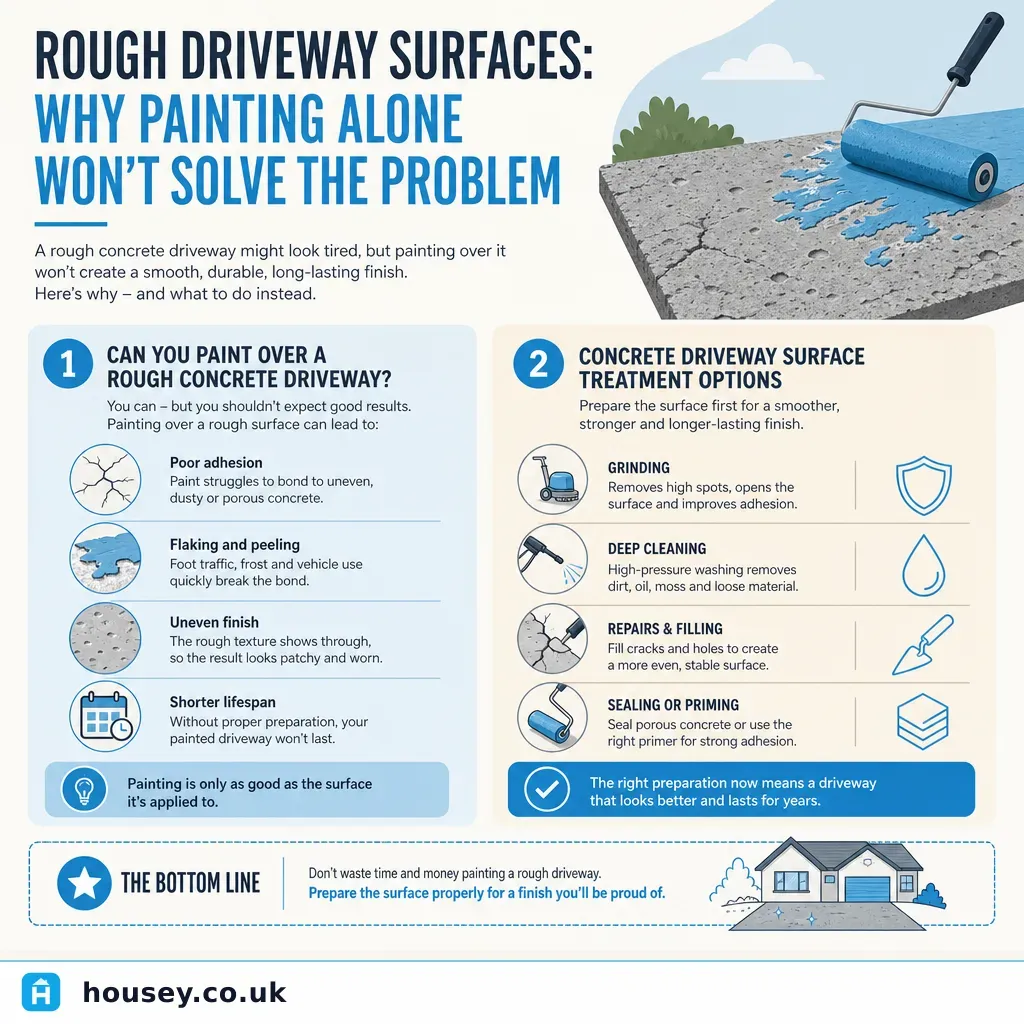
Rough Driveway Surfaces: Why Painting Alone Won't Solve the Problem
Rough driveway surfaces are caused by scaling, aggregate exposure, binder oxidation in tarmac, or sub-base failure — and painting over them won't last.
 Improvement & Build
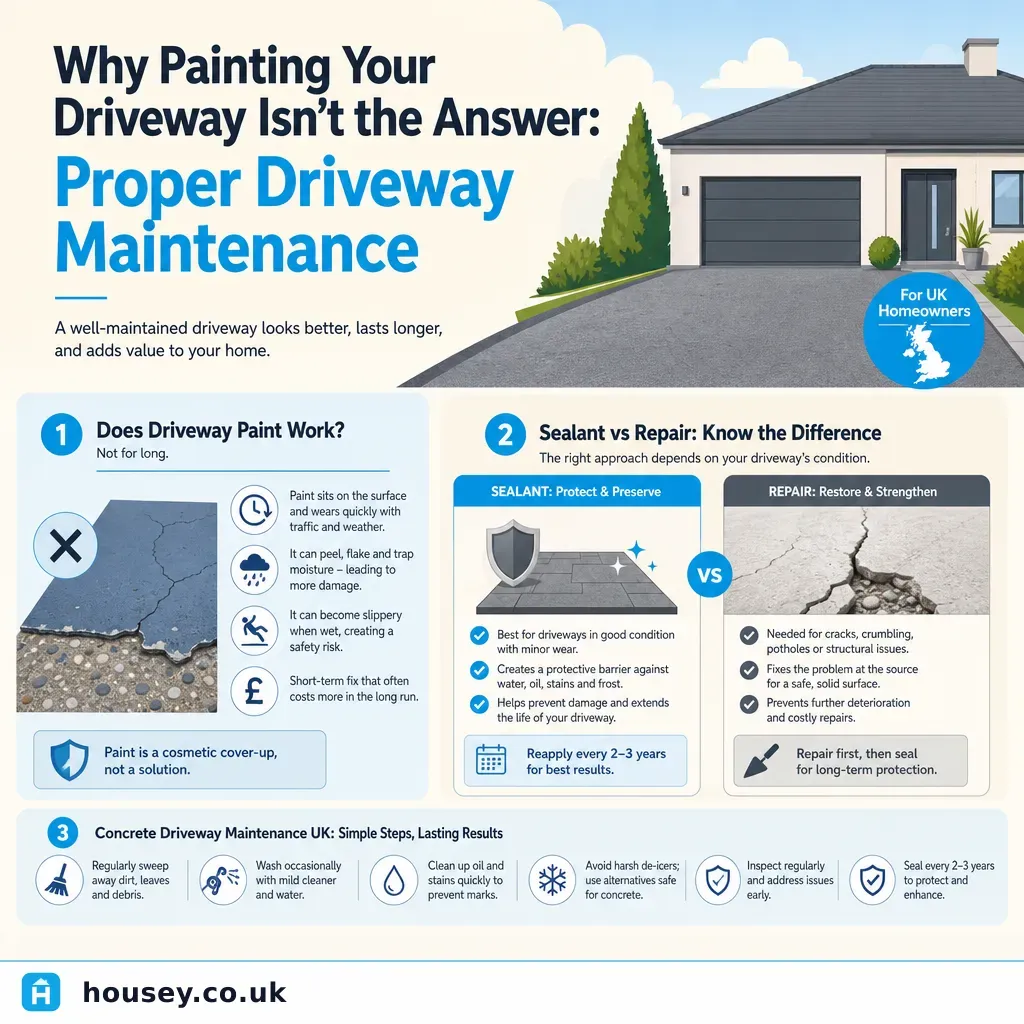
Why Painting Your Driveway Isn't the Answer: Proper Driveway Maintenance
Driveway paint and sealants cannot fix structural cracks, sub-base failure, or freeze-thaw damage — they mask symptoms temporarily.
 Improvement & Build
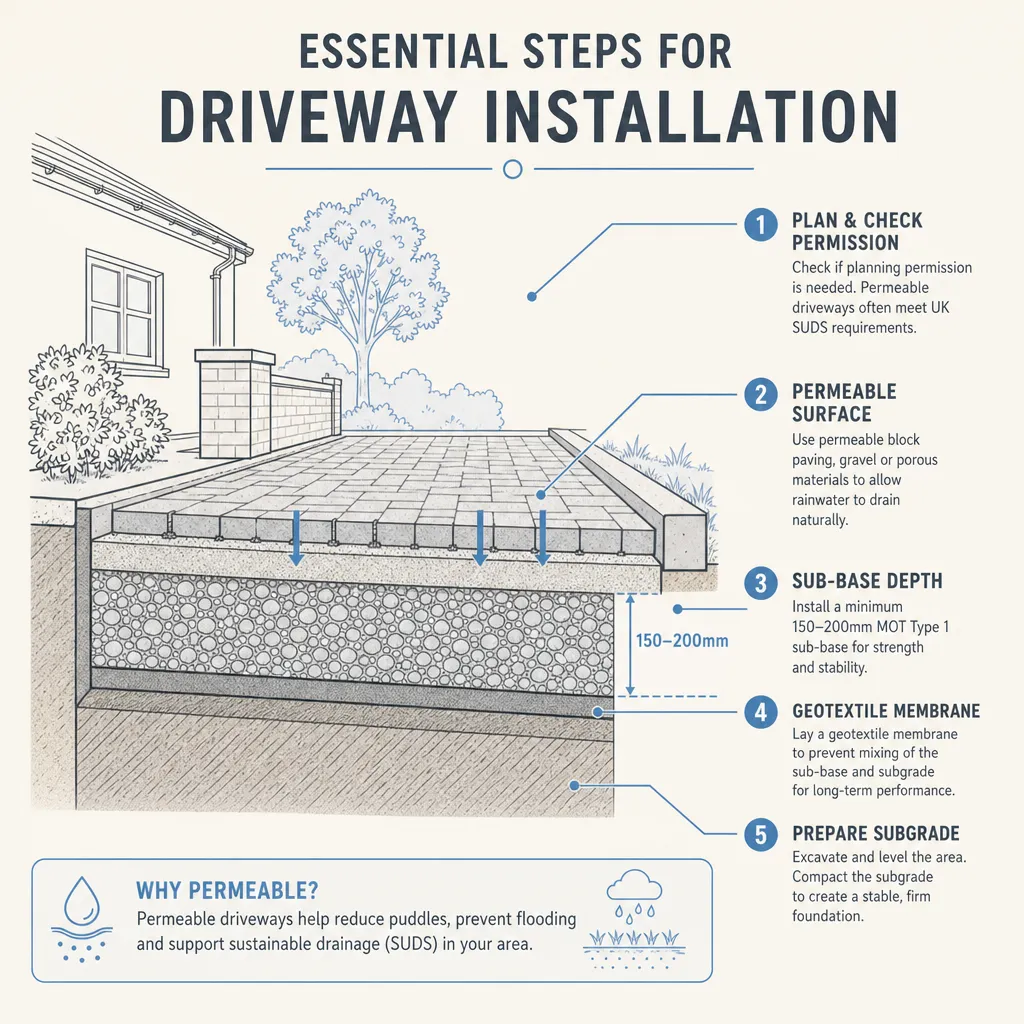
Essential Steps for Driveway Installation
Installing a driveway in England requires planning permission only when using an impermeable surface (standard tarmac, concrete, or block paving) on a front garden area over 5 m².
 Improvement & Build
Preparing Walls for Patching: Surface Preparation Best Practice
Durable wall patching starts with removing all loose material, cutting back to a clean and stable edge, cleaning the substrate, and priming with a construction-grade PVA bonding agent before applying any filler or plaster.