Native Plants for Rain Gardens: Ecological Design and Installation
By Housey · Last reviewed 30th of May 2026

Native Plants for Rain Gardens: Ecological Design and Installation
Rain gardens have moved from specialist ecology projects into mainstream UK residential landscaping, driven partly by Schedule 3 of the Flood and Water Management Act 2010 (in force in Wales since 2018) and by growing local authority pressure on homeowners and developers to manage surface water on-site rather than directing it straight to the public sewer. Whether you are redesigning a front garden, replacing a hard-surfaced driveway, or responding to a planning condition for sustainable drainage, choosing ecologically appropriate native plants is fundamental to a successful, long-lived installation.
Key points
- Schedule 3 of the Flood and Water Management Act 2010 requires Sustainable Drainage Approving Body (SAB) approval for new drainage in developments above the threshold in Wales; equivalent provisions for England are under active consideration.
- The UK has approximately 1,500 native flowering plant species; a well-designed rain garden typically requires 8–15 species with complementary soil-moisture tolerances across three planting zones.
- CIRIA's SuDS Manual (C753, 2015) is the primary technical reference used by UK drainage engineers and landscape architects for rain garden design, covering basin sizing, overflow routes, and species selection criteria.
- Rain gardens should be sited at least 5 m from building foundations and 3 m from existing drains or soakaways to avoid foundation undermining.
- Proximity to protected habitats, or the presence of invasive non-native species such as Japanese knotweed, may require an ecological survey under the Wildlife and Countryside Act 1981 before any ground is disturbed.
What is a rain garden and how does it work in UK conditions?
A rain garden is a planted depression or hollow that receives, temporarily holds, and slowly infiltrates surface runoff from roofs, driveways, and paths. Unlike a conventional border, it is designed to tolerate periodic flooding — typically for 24–48 hours — followed by drier periods between rain events. UK rain gardens work best on soils with an infiltration rate above 10 mm per hour; clay-heavy soils often need an engineered growing medium to perform reliably.
The ecological value of a rain garden comes from its dual function: managing surface water while simultaneously providing habitat, food sources, and connectivity for pollinators, birds, and invertebrates. A rain garden planted exclusively with non-native ornamentals can fulfil the hydraulic role but misses the biodiversity opportunity that makes these features worthwhile in the context of mandatory Biodiversity Net Gain (BNG) requirements under the Environment Act 2021 and local Nature Recovery Strategies.
Why native plants outperform non-native ornamentals in UK rain gardens
Criterion | UK native species | Non-native ornamentals |
|---|---|---|
Biodiversity support | High — support specialist insects, birds, and pollinators evolved alongside them | Variable — some support only generalist insects |
Tolerance of UK rainfall cycles | Evolved for boom-and-bust wet-dry patterns | Often bred for stable moisture conditions |
Establishment cost | Generally lower — available as plugs or certified seed mixes | Variable; some require specialist suppliers |
Ongoing maintenance | Low once established — typically cut once or twice a year | Often higher — deadheading, feeding, winter protection sometimes needed |
Invasive spread risk | None for true native species | Some introduced varieties can spread aggressively |
BNG compliance | Preferred under most local Biodiversity Net Gain metrics | May score lower or not at all in BNG accounting |
Choosing native plants for different rain garden zones
A rain garden has three distinct moisture zones, each suited to different species.
Zone 1 — The basin (periodic inundation, 0–30 cm depth)
Species must tolerate standing water for 24–48 hours and dry-out between events.
- Caltha palustris (marsh marigold) — bright yellow flowers, March–May; attractive to early bumblebees.
- Iris pseudacorus (yellow flag iris) — robust, up to 1.2 m, flowers May–July.
- Filipendula ulmaria (meadowsweet) — fragrant, attracts hoverflies, June–August.
- Juncus effusus (soft rush) — structural year-round interest.
- Mentha aquatica (water mint) — aromatic; supports bumblebees and butterflies.
Zone 2 — The edges (seasonally moist, fluctuating)
- Lythrum salicaria (purple loosestrife) — tall spikes, excellent for pollinators.
- Lysimachia vulgaris (yellow loosestrife — the native species, not the introduced garden variety).
- Epilobium hirsutum (great willowherb) — colonises quickly; useful on larger sites.
- Scirpus sylvaticus (wood club-rush) — shade-tolerant, useful near fences and walls.
Zone 3 — The periphery (free-draining between events)
- Centaurea nigra (common knapweed) — long flowering season, important for bumblebees.
- Primula veris (cowslip) — early spring nectar source.
- Leucanthemum vulgare (oxeye daisy) — reliable and easy to establish from seed.
- Achillea millefolium (yarrow) — drought-tolerant once established; supports many invertebrate species.
- Agrostemma githago (corncockle) — annual, self-seeds readily in disturbed soil.
Planning and ecology considerations before you start
Before installing a rain garden, check the following:
- Permitted development — A rain garden in a rear or side garden is usually permitted development. Replacing an impermeable front garden surface with a permeable one is also generally permitted, but conservation area properties and listed buildings may require consent. Check GOV.UK planning guidance or contact your local planning authority.
- Protected species — If your garden adjoins rough grassland, hedgerow, or has mature trees, a preliminary ecological appraisal may be needed to check for badger setts, bat roost potential, or protected plant communities before ground is disturbed.
- Tree root protection — Do not install a rain garden within the root protection area (RPA) of a protected or preserved tree. The RPA is typically calculated as 12 times the stem diameter measured in metres from the base.
- Invasive non-native species — If Japanese knotweed (Fallopia japonica), Himalayan balsam (Impatiens glandulifera), or giant hogweed (Heracleum mantegazzianum) are present near the site, removal is legally required before ground is disturbed, under the Wildlife and Countryside Act 1981 and the Environmental Protection Act 1990.
Installation: a practical overview
- Commission a percolation test (per CIRIA SuDS Manual C753 guidance) to confirm your soil can accept the expected runoff volume.
- Size the basin — as a rule of thumb, the rain garden area should be approximately 10–20% of the contributing impermeable surface. A 50 m² driveway typically needs a 5–10 m² basin.
- Excavate to 300–500 mm depth and backfill with an engineered growing medium if native soil drainage is insufficient.
- Install an overflow route — a level spreader, gravel channel, or pipe directing excess water to a soakaway or surface water drain.
- Plant in autumn (October–November) for best native plant establishment; water during dry spells in the first spring.
- Mulch the edges with bark or gravel to reduce weed competition while plants establish.
What to ask before hiring a garden designer or landscaper
- Can you confirm previous experience designing SuDS-compliant rain gardens in UK conditions?
- Which native species do you recommend for my soil type, aspect, and local rainfall pattern?
- Will you carry out a soil infiltration (percolation) test before finalising the design?
- Can the design contribute to Biodiversity Net Gain requirements if relevant to my planning consent?
- What maintenance will the rain garden require in years 1–3?
- Are you familiar with CIRIA SuDS Manual C753 design criteria?
- Will you check for invasive non-native species and protected species constraints before starting?
When to get professional help
A landscape architect or garden designer with SuDS experience is advisable if:
- The rain garden forms part of a planning condition or Biodiversity Net Gain obligation.
- The site is adjacent to or within a protected habitat, ancient woodland buffer, or SSSI.
- A front garden installation may require planning consent.
- The soil is heavy clay and an engineered growing medium is needed.
- Invasive non-native species are suspected on or near the site.
An ecological survey from a qualified ecologist is recommended if the site has features that may support protected species — mature trees, hedgerows, ponds, rough grassland, or historic orchard remnants.
How Housey can help
Housey connects you with local professionals for ecological surveys to check for protected species constraints, garden designers with SuDS experience, and landscapers who can manage the full installation from excavation to planting. Describe your project to receive and compare quotes before committing.
Frequently asked questions
Do I need planning permission to install a rain garden?
In most rear and side gardens, a rain garden is permitted development and does not require planning permission. Replacing an impermeable front garden surface with a permeable one is also generally permitted. If the property is listed or in a conservation area, check with your local planning authority. In Wales, Schedule 3 of the Flood and Water Management Act 2010 requires SuDS approval — contact your local Sustainable Drainage Approving Body (SAB).
Can I use wildflower seed mixes for the rain garden periphery?
Yes — a native wildflower seed mix suited to your soil type and aspect is an effective and economical way to plant Zone 3. Look for mixes using UK provenance seed from suppliers accredited through the Flora locale network. Avoid mixes containing cultivars or non-native species, as these offer less ecological value and may not qualify under Biodiversity Net Gain calculations carried out to local authority specifications.
How deep should a rain garden be?
A typical residential rain garden is 150–500 mm deep, depending on soil infiltration rate and the size of the contributing impermeable catchment. Shallower basins suit well-draining soils and small catchments; deeper basins may need an overflow outlet to manage heavy rainfall safely. The CIRIA SuDS Manual C753 provides design guidance for calculating the appropriate basin volume and invert depth for UK rainfall conditions.
Will a rain garden attract mosquitoes?
A properly designed rain garden drains within 24–48 hours of a rain event — too short for mosquito larvae to develop, which require at least 7–10 days of standing water. Correct basin grading, installation of an overflow route, and avoiding soil compaction during planting all help ensure rapid drainage and effectively eliminate mosquito risk in a well-maintained residential rain garden.
Sources and further reading
- Flood and Water Management Act 2010 — legislation.gov.uk
- CIRIA SuDS Manual C753 (2015) — CIRIA
- Biodiversity Net Gain: overview — GOV.UK
- Wildlife and Countryside Act 1981 — legislation.gov.uk
- Invasive non-native species: guidance — GOV.UK
- Flora locale: UK provenance native plants — Flora locale
Useful next reads
 Planning & Pre-Build
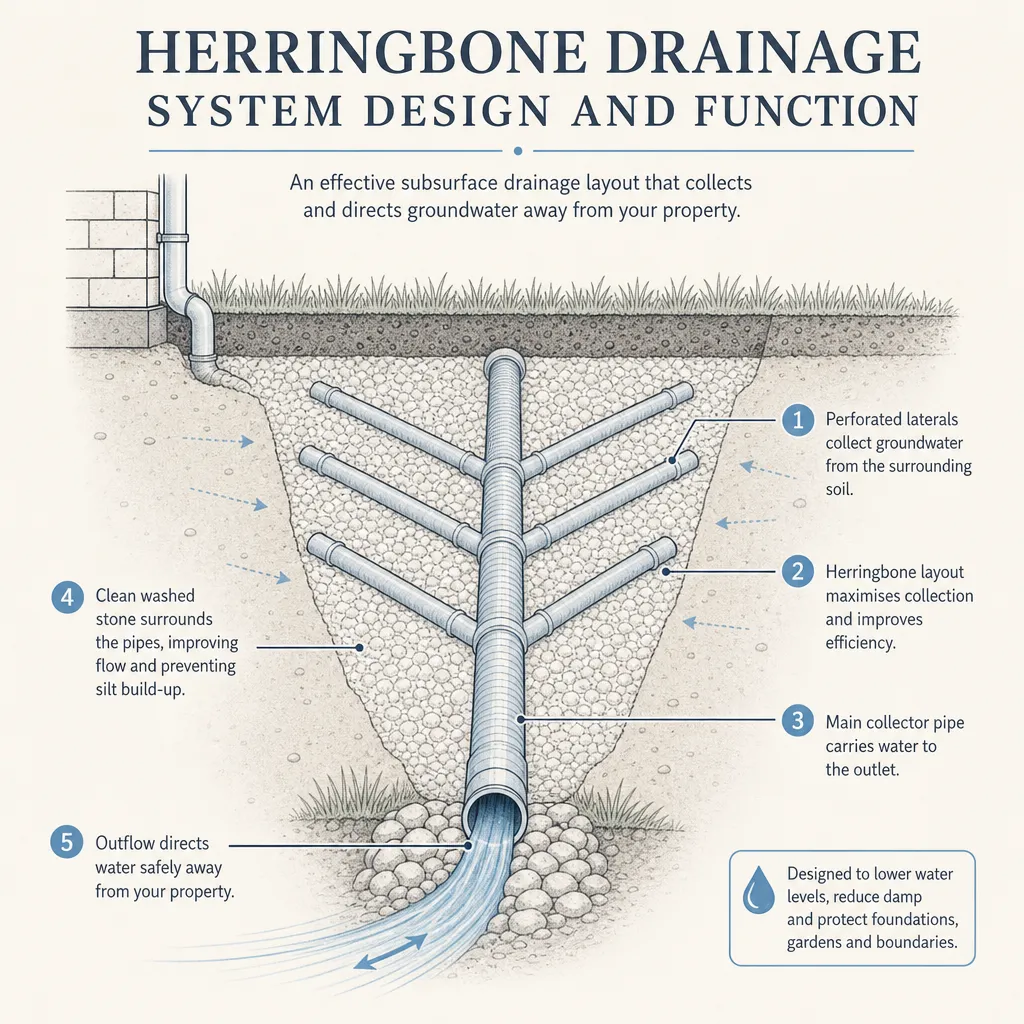
Herringbone Drainage System Design and Function
A herringbone drainage system uses a central collector drain with angled lateral branches — like a fishbone — to carry subsurface water away from a site by gravity.
 Planning & Pre-Build
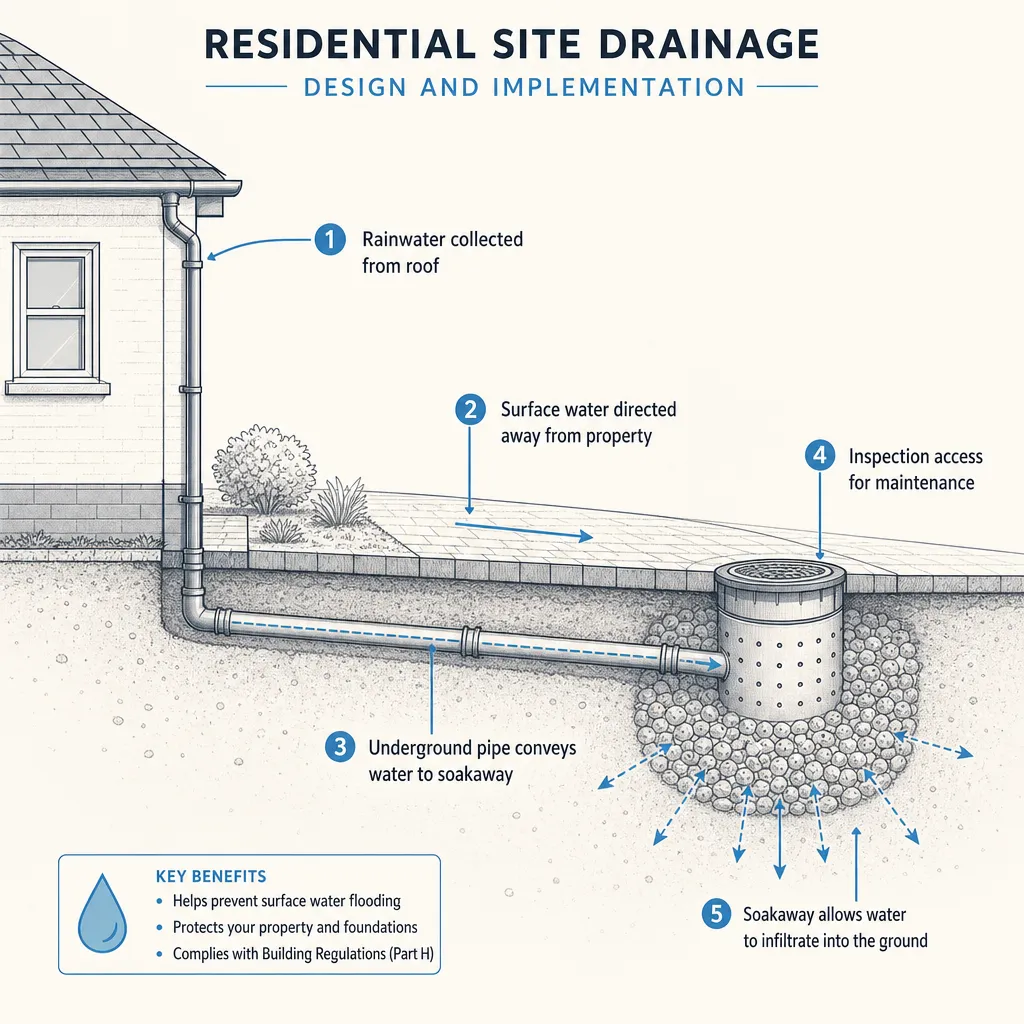
Residential Site Drainage Design and Implementation
Residential site drainage covers three distinct systems — surface water, subsoil water, and foul water — each requiring separate design and regulatory compliance.
 Planning & Pre-Build
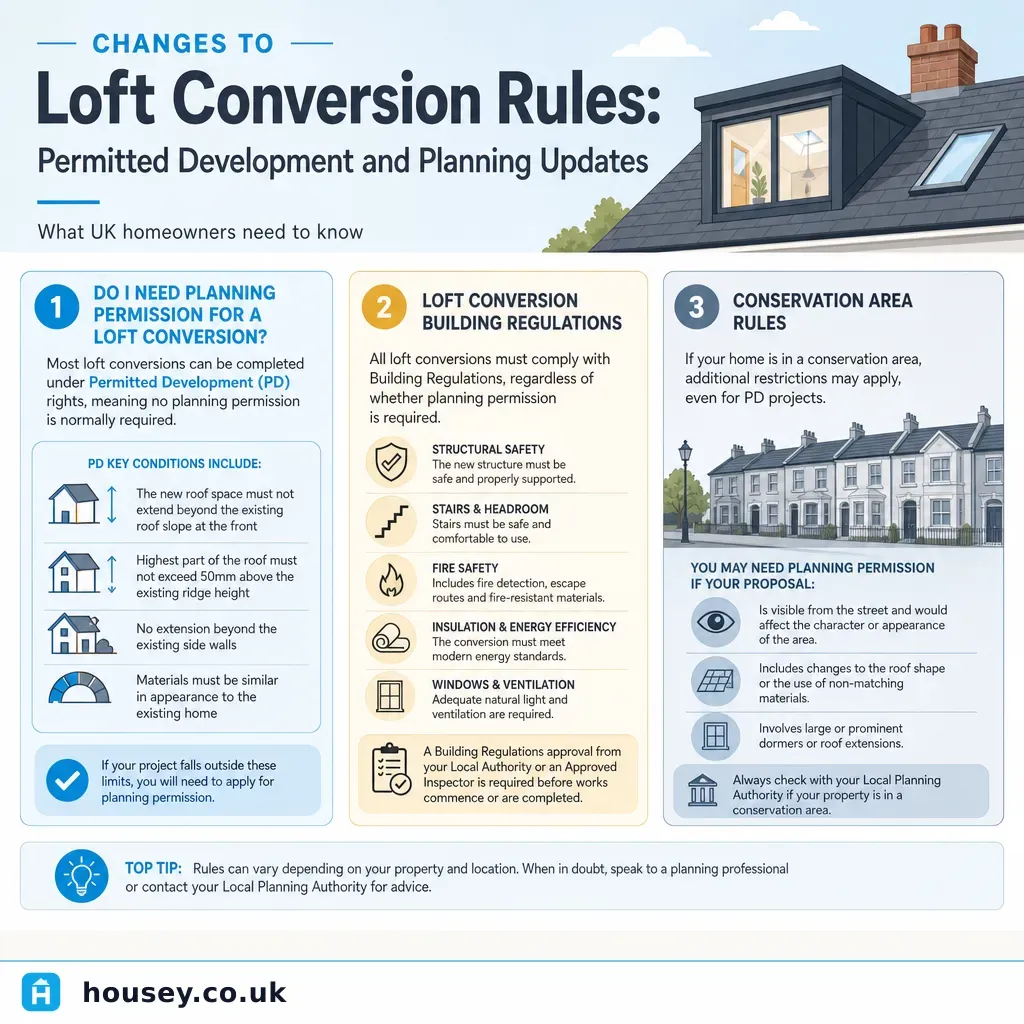
Changes to Loft Conversion Rules: Permitted Development and Planning Updates
In England, most loft conversions on standard houses qualify as Permitted Development under Class B of the GPDO 2015, allowing up to 40 cubic metres (terraced) or 50 cubic metres (detached or semi-detached) without a planning application — if conditions are met.
 Planning & Pre-Build
Residential Properties Built with Concrete Construction Methods
UK homes are built using several concrete methods: in-situ cast concrete, precast panel systems, insulating concrete formwork (ICF), and older non-traditional types such as Wimpey No-Fines and Laing Easiform.
 Planning & Pre-Build
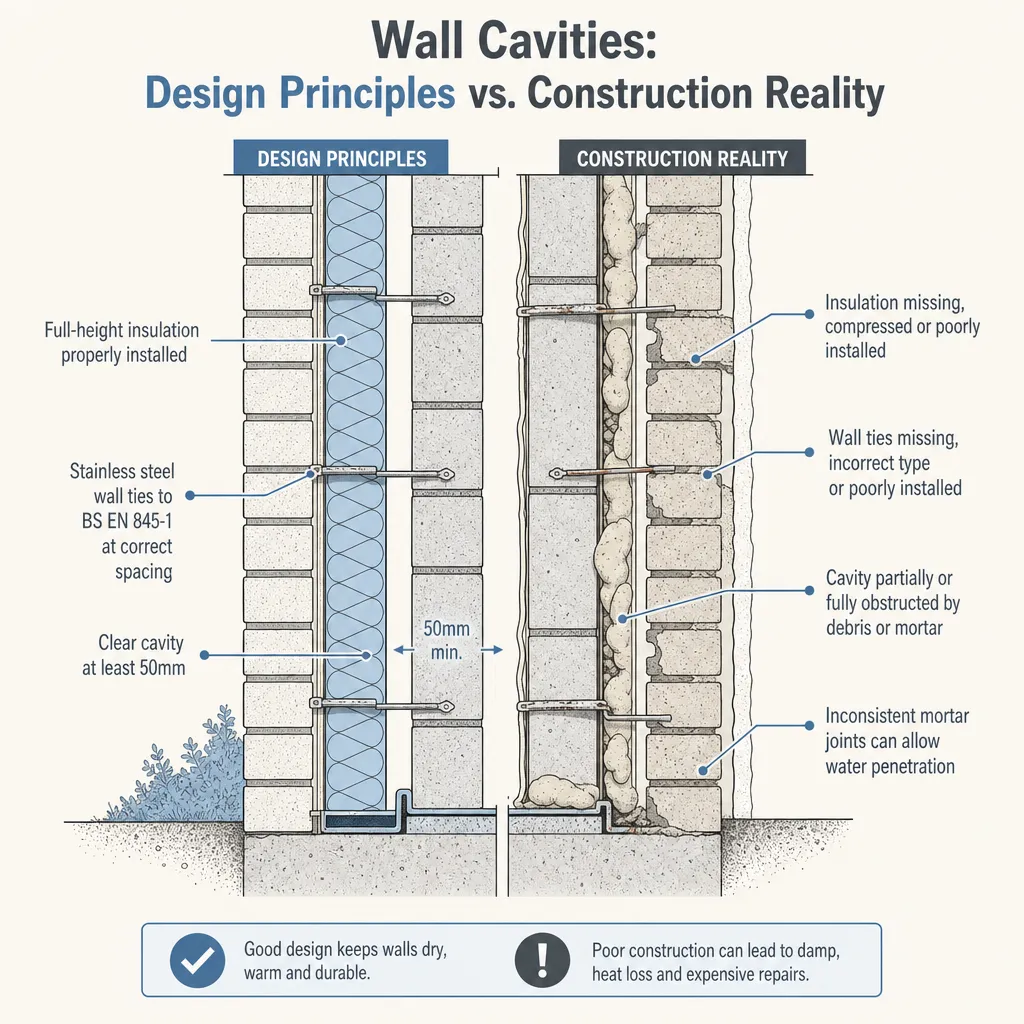
Wall Cavities: Design Principles vs. Construction Reality
A UK cavity wall is designed to resist weather, control heat loss, and structurally link two masonry leaves.