Retaining Walls: Landscape Support Structures and Garden Construction
By Housey · Last reviewed 25th of May 2026
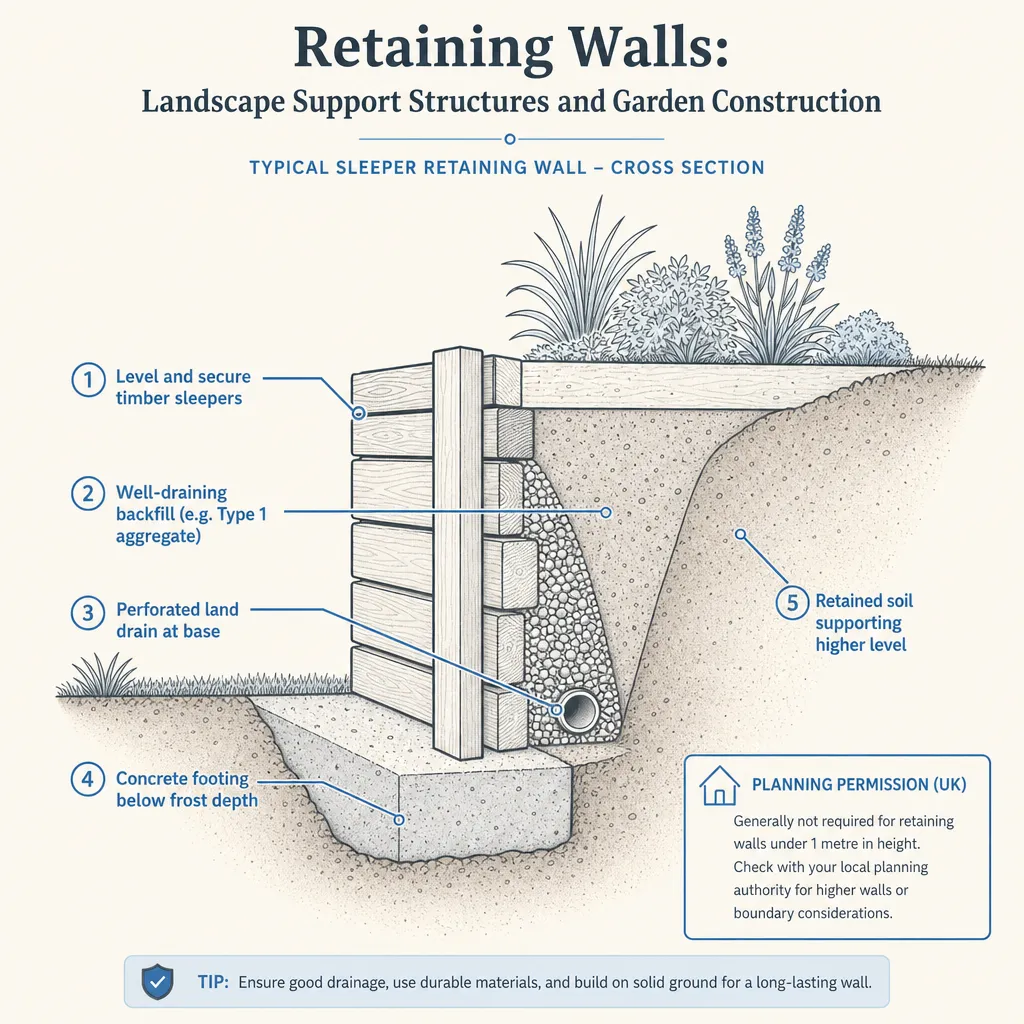
Retaining Walls: Landscape Support Structures and Garden Construction
Retaining walls manage level changes in gardens, hold back soil on slopes, and can transform an awkward or unusable area into functional outdoor space. They range from a 600mm timber sleeper edge to a 2-metre reinforced concrete structure — and the structural, drainage, and legal stakes rise considerably with height. Getting the design, materials, and drainage specification right from the start prevents costly failure and potential harm to neighbouring properties.
Key points
- Retaining walls over 1.5 metres adjacent to a highway or public open space typically require Building Regulations approval under Approved Document A (structure); walls over 1.2 metres in any location should be assessed by a structural engineer before construction begins.
- Inadequate drainage is the primary cause of retaining wall failure in the UK: hydrostatic water pressure from saturated soil can exceed a wall's design load — weepholes or perforated land drains with a gravel drainage layer are standard practice.
- The Party Wall etc. Act 1996 may apply where excavation for a wall's foundations is within 3 metres of a neighbouring building, or within 6 metres if the excavation depth exceeds the depth of the neighbour's foundations.
- Common domestic retaining wall materials include concrete blocks, engineering brick, natural stone, timber sleepers, and gabion baskets — each with different height limits, drainage requirements, and lifespans.
- Planning permission is not usually required for garden retaining walls within permitted development height limits (up to 2 metres in most cases, or 1 metre adjacent to a highway), but walls in conservation areas, on listed building curtilages, or affecting a highway may need consent.
Do retaining walls need planning permission or building control?
In most UK domestic gardens, a retaining wall does not need planning permission under permitted development rights. The Town and Country Planning (General Permitted Development) (England) Order 2015 sets limits: boundary walls adjacent to a highway must not exceed 1 metre; walls elsewhere may reach 2 metres without consent. Whether a retaining wall falls within these limits depends on its specific location, form, and whether it also functions as a boundary feature.
Building Regulations may apply under Approved Document A for walls over 1.5 metres adjacent to a highway or public open space, and for any wall forming part of or supporting a structure. In practice, it is always advisable to check with your local authority building control team for any wall over 1.2 metres, especially in urban gardens, near boundaries, or on made-up ground.
When to seek professional advice: a decision guide
- Choose a landscaper or groundworker for walls under 1.0m in height, on stable ground, away from buildings, highways, and boundaries, with straightforward drainage requirements.
- Commission a structural engineer's assessment for any wall over 1.2m, walls supporting a surcharge load such as a driveway, terrace, or outbuilding above, or walls on sloped, made-up, or suspected unstable ground.
- Consult a party wall surveyor if excavation for the wall's foundations will be within 3 metres of a neighbour's building, or within 6 metres if the excavation is deeper than the neighbour's foundations.
- Contact your local authority building control before starting if the wall exceeds 1.5m adjacent to a highway, or if you are unsure whether an engineering operations consent is required.
Retaining wall material comparison
Material | Best for | Not ideal for | Typical max height without structural design | Drainage requirement | Approximate lifespan |
|---|---|---|---|---|---|
Concrete blocks (mortared) | Robust utility walls, larger gardens, terraced areas | Heritage gardens, conservation areas | 1.0–1.2m | Weepholes and gravel backfill essential | 50+ years |
Natural stone (dry or mortared) | Rural and period settings, conservation areas | Very high loads, tight urban plots | 1.0m dry-stone; higher with design | Dry-stone is inherently free-draining | Indefinite if maintained |
Timber sleepers | Contemporary and cottage gardens, modest heights | Walls over 1.0m without engineering; persistently wet conditions | 0.9–1.0m | Drainage layer behind recommended | 15–25 years (pressure-treated) |
Engineering brick | Formal and urban gardens | Informal or rustic aesthetics | 1.0–1.2m | Weepholes required | 50+ years |
Gabion baskets | Steep slopes, naturalistic or contemporary gardens | Small or formal gardens | 2.0m+ with correct sizing | Inherently free-draining | 50–70 years (galvanised wire) |
Reinforced or mass concrete | Heights over 1.5m, high surcharge, highway proximity | Most domestic gardens | Engineered to requirement | Full drainage design required | 50–100 years |
Drainage: the critical detail
Poor drainage causes the majority of domestic retaining wall failures in the UK. When soil becomes saturated — common in wet UK winters — hydrostatic water pressure on the back of the wall increases dramatically. A wall designed to hold dry soil can fail when the retained material is waterlogged clay.
Standard drainage provision for a domestic retaining wall:
- A free-draining granular backfill layer (minimum 150–300mm thick) immediately behind the wall.
- Weepholes (typically 75–100mm diameter, at 1.0–1.5m horizontal centres) at or near the base of the wall, or a perforated land drain pipe at the base of the gravel layer directed to a suitable outfall.
- A geotextile fabric separating the gravel layer from the retained soil, preventing fine particles from silting up the drainage over time.
- Surface water interception at the top of the retained area — a channel drain or gravel strip prevents runoff from the garden above from saturating the retained soil.
On clay-heavy soils — prevalent across much of lowland England — drainage provision should be generous, as clay retains water, expands when wet, and generates significant lateral pressure on the back of the wall.
Red flags on existing retaining walls
These signs indicate a wall may be failing and should be assessed by a professional before any remediation work is attempted:
- Visible leaning, bulging, or horizontal cracking in the wall face
- Stepped cracking through brickwork or blockwork, particularly near the base
- No visible weepholes, or weepholes that have been blocked or pointed over
- Efflorescence (white salt deposits) on the wall face, indicating persistent water movement through the masonry
- Settlement or sinking of paving, lawn, or structures immediately behind the top of the wall
- Tree or shrub roots growing through or into joints in the wall
Any of these signs in a wall over 0.8m high warrants a structural inspection before any repair or reconstruction is attempted.
Important limitations
This article provides general information about domestic retaining wall construction in the UK. Retaining wall design is highly site-specific: soil type, groundwater conditions, surcharge loads, proximity to structures and boundaries, and local authority requirements all affect what is appropriate. A general guide cannot substitute for a site assessment by a qualified structural engineer or chartered landscape engineer. Always seek professional advice for walls over 1.2 metres, walls near buildings or boundaries, or where there is any doubt about ground conditions.
What to ask a qualified professional
Before instructing a contractor or structural engineer for a retaining wall project, ask:
- What structural calculations or site investigation do you recommend for a wall of this height and position?
- How will drainage be provided, and where will water discharged from weepholes be directed?
- Will this project require a building control notification or a full application, and who will submit it?
- Does the Party Wall etc. Act 1996 apply given the proximity of my neighbours' foundations, and will you advise me on the process?
- What guarantee or warranty do you provide on the completed structure?
- Is VAT included in your quote, and what is the payment schedule?
- What could change the scope or cost — for example, unexpected ground conditions or drainage difficulties?
When to get professional help
Retaining walls that look like routine landscaping can involve structural and legal risks if incorrectly designed or built. Always involve a professional when:
- The wall will be over 1.2m high, or over 0.8m if it supports a significant surcharge such as a driveway, terrace, or structure above
- The ground shows signs of previous movement, is made-up (filled), or is predominantly clay
- Any part of the structure is within 3–6 metres of a neighbouring building's foundations
- The wall runs adjacent to a highway, public footpath, or public open space
- There is any uncertainty about drainage, groundwater, or the wall's effect on neighbouring land
How Housey can help
Housey connects you with vetted landscapers and groundworkers experienced in garden construction and retaining wall projects across the UK. For more complex or larger walls, you can specify that you need a contractor with demonstrable experience of structural retaining features and confirmation that they work alongside qualified engineers where the project requires it.
Frequently asked questions
Do I need planning permission for a retaining wall in my garden?
Most domestic garden retaining walls do not require planning permission under permitted development rights, provided they fall within permitted height limits — generally up to 2 metres, or 1 metre adjacent to a highway. However, walls in conservation areas, on listed building curtilages, or forming part of an engineering operation affecting drainage or a highway may require consent. Always confirm with your local planning authority if any doubt exists.
How deep should retaining wall foundations be?
A general rule of thumb is that foundation depth should be at least one-third of the exposed wall height, though this varies with soil type, groundwater level, frost penetration, and surcharge loads. In the UK, a minimum depth of 450–600mm is common for frost protection. Walls over 1.0 metre in height should have their foundation design reviewed by a structural engineer rather than sized by rule of thumb alone.
Can I build a retaining wall myself?
Modest walls up to around 600–750mm in height, built on stable ground well away from buildings and boundaries, may be within the scope of a competent homeowner using appropriate materials such as dry-stone, pressure-treated sleepers, or concrete blocks with weepholes. Anything taller, near structures, on poor ground, or involving drainage complications should be built by a qualified contractor with structural input. Never attempt walls over 1.2m without professional advice.
How long do timber sleeper retaining walls last?
New pressure-treated softwood sleepers typically last 15–25 years in UK conditions. Hardwood sleepers can last 25–40 years with proper installation. Reclaimed railway sleepers are popular for their appearance, but some contain creosote — a regulated substance subject to restrictions on domestic use. Check Health and Safety Executive (HSE) guidance on creosote-treated timber before using reclaimed sleepers in gardens where children or pets are present.
Sources and further reading
- Building Regulations Approved Document A: Structure — HM Government
- Planning Portal: Fences, gates and garden walls — Planning Portal
- Party Wall etc. Act 1996 — legislation.gov.uk
- Landscape Institute professional standards — Landscape Institute
- CIRIA: guidance on embedded retaining walls — CIRIA
Useful next reads
 Improvement & Build
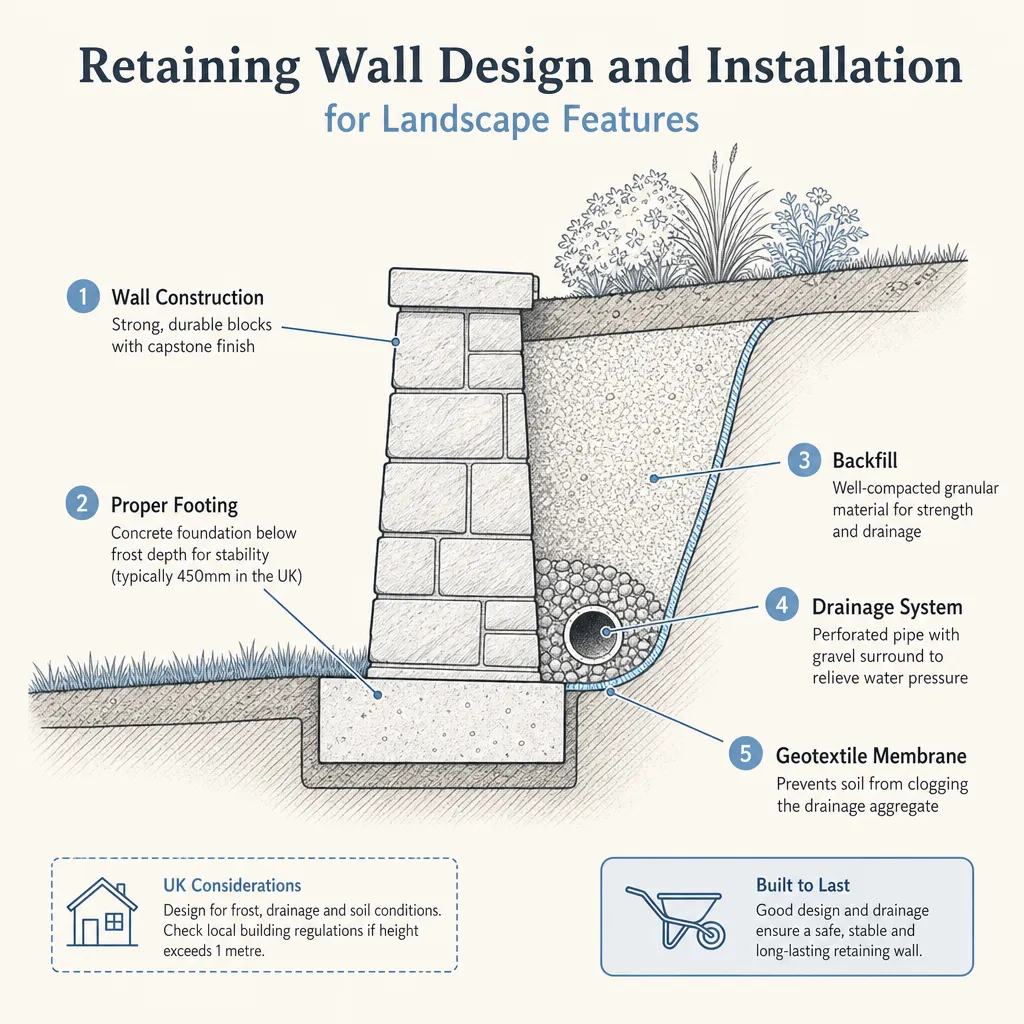
Retaining Wall Design and Installation for Landscape Features
A garden retaining wall holds back soil on a sloped plot using concrete blocks, stone, or timber.
 Improvement & Build
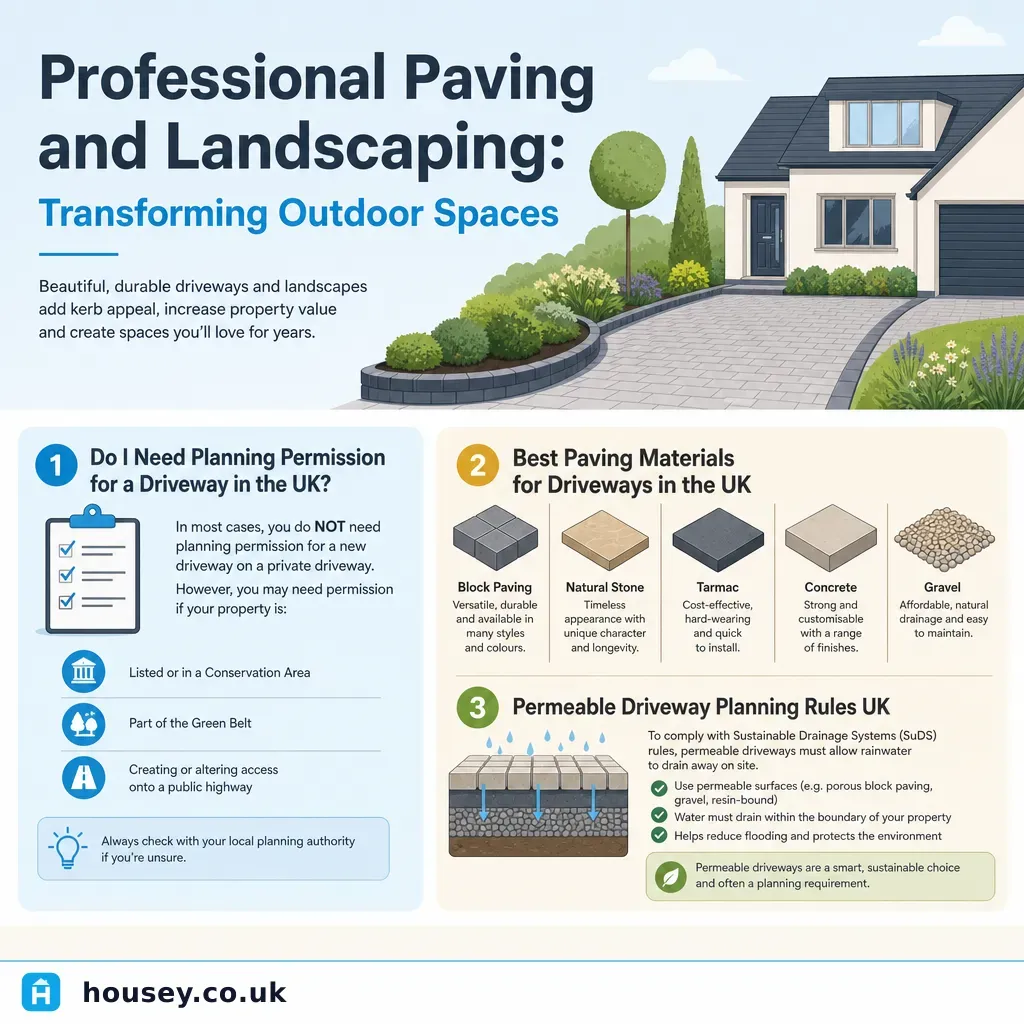
Professional Paving and Landscaping: Transforming Outdoor Spaces
Professional paving and landscaping can transform a garden or driveway, improving kerb appeal and adding usable outdoor space.
 Improvement & Build
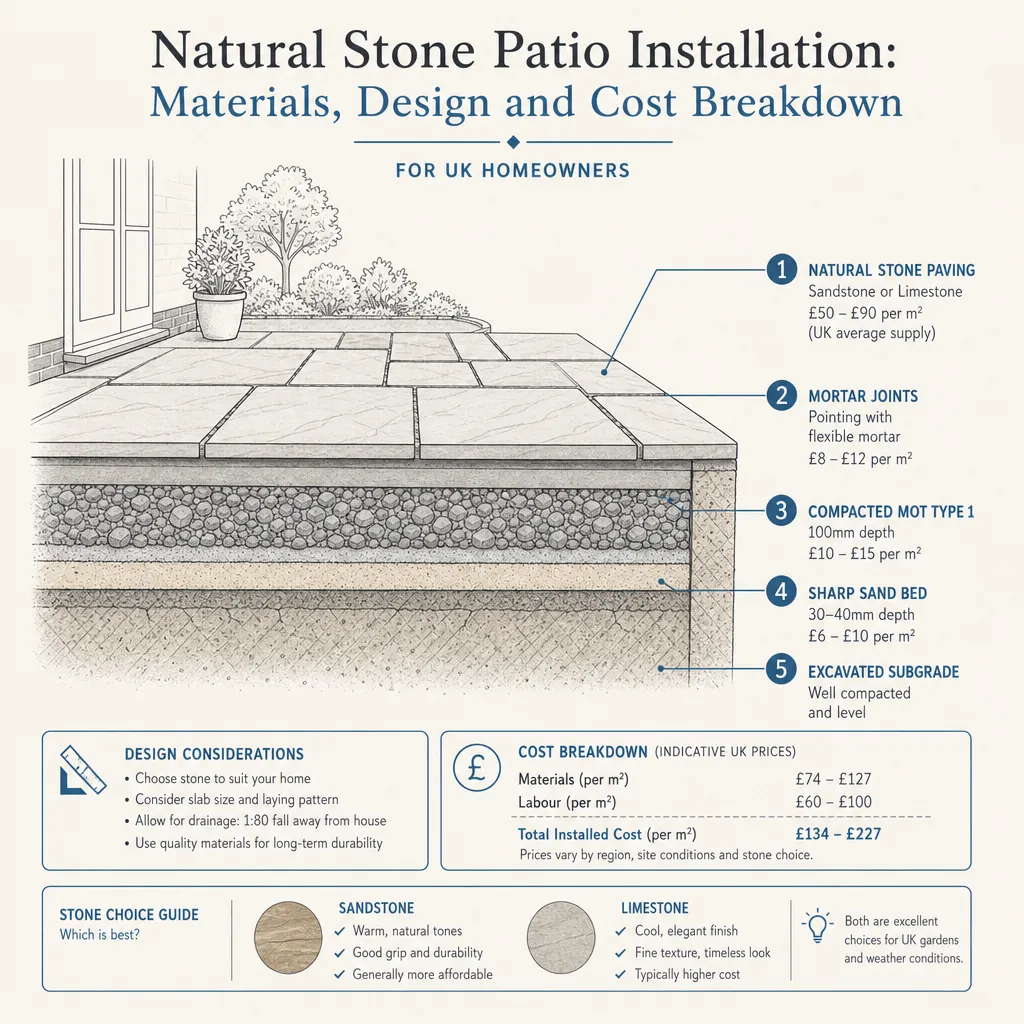
Natural Stone Patio Installation: Materials, Design and Cost Breakdown
A natural stone patio typically costs £100–£200 per square metre installed in the UK, depending on stone type, subbase preparation, and site access.
 Improvement & Build
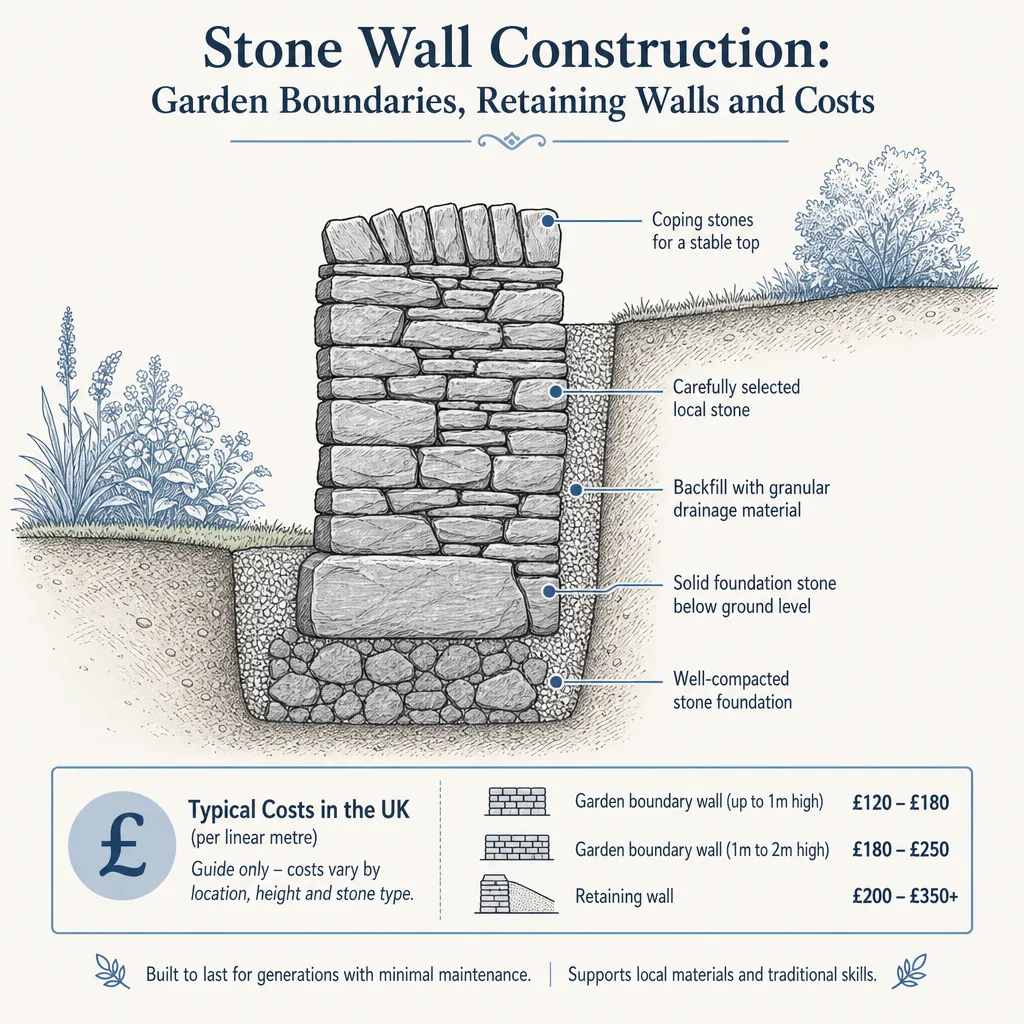
Stone Wall Construction: Garden Boundaries, Retaining Walls and Costs
Stone walls in UK gardens serve as boundary markers, retaining structures, or decorative features.
 Improvement & Build
Landscaping and Garden Design for Property Enhancement
Landscaping and garden design involve planning and building outdoor spaces — from patios and raised beds to planting schemes and drainage.