Net-Zero Sustainable Homes: Energy-Efficient Building and Retrofit Standards
By Housey · Last reviewed 25th of May 2026
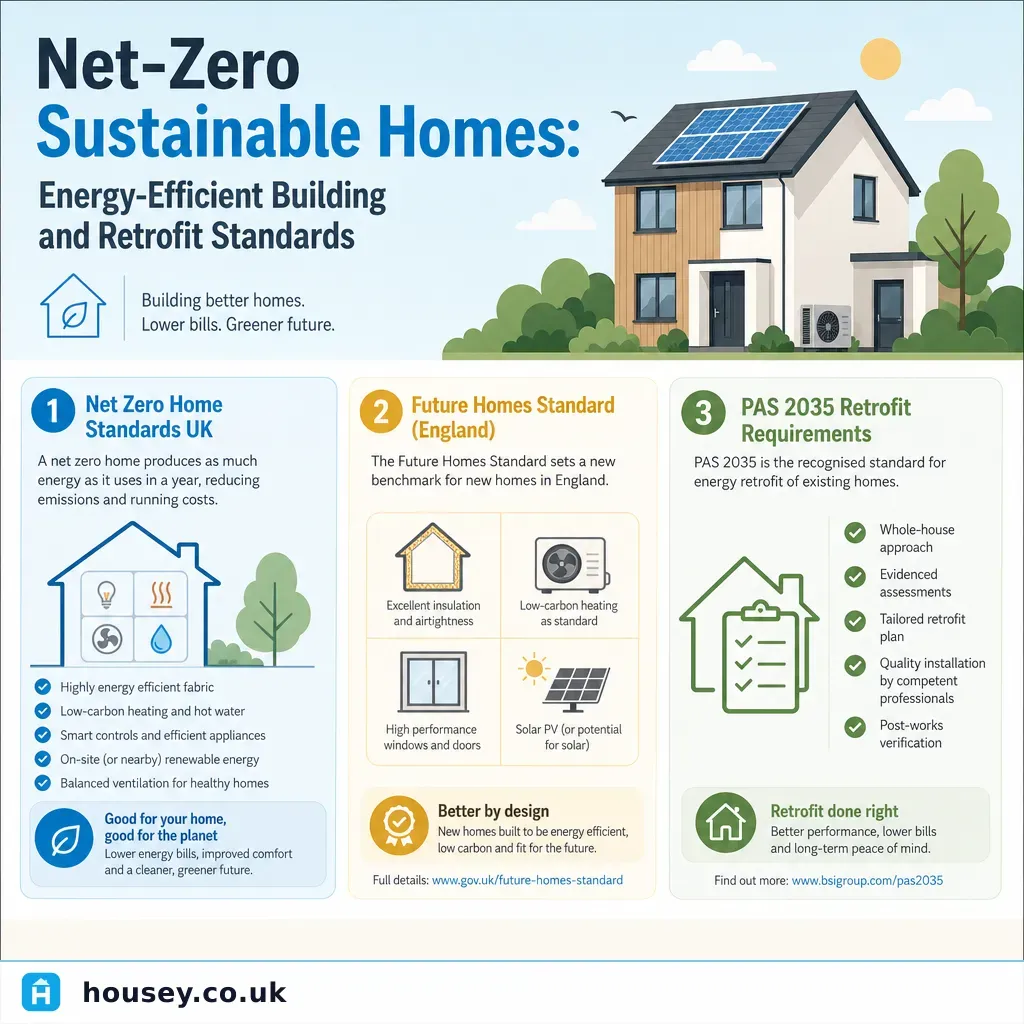
Net-Zero Sustainable Homes: Energy-Efficient Building and Retrofit Standards
Whether you are commissioning a new build or trying to cut the carbon footprint of an existing Victorian terrace, net zero has become central to UK property and energy policy. The government's targets under the Climate Change Act, the incoming Future Homes Standard, and the expansion of domestic retrofit frameworks have created a more defined — if still complex — roadmap for homeowners, developers, and designers alike. Understanding the standards that apply to your project is the essential first step.
Key points
- The Future Homes Standard (England) requires new homes to produce 75–80% fewer carbon emissions than those built to 2013 Part L standards; gas boilers will be prohibited in new homes once it takes effect.
- Part L (Conservation of Fuel and Power) of the Building Regulations was significantly tightened in 2021, raising minimum energy performance for new homes in England as an interim measure.
- Net-zero-ready homes typically achieve EPC A or B with a space heating demand below 15 kWh/m²/year — the Passivhaus Institute's target threshold.
- PAS 2035 is the quality framework governing whole-house retrofit in the UK, requiring a qualified Retrofit Assessor and Retrofit Coordinator for all ECO4-funded projects.
- The UK's approximately 29 million existing homes account for around 20% of national carbon emissions, making retrofit of existing stock as strategically important as building new net-zero homes.
What does net zero mean for a home?
Net zero for a home generally means the property produces no more carbon emissions over a year than it absorbs or offsets. In practice, this requires very high fabric performance, low-carbon heating (usually a heat pump), and often on-site renewable generation. True net-zero homes are rare in existing UK housing stock; net-zero ready describes a home designed so that it can reach net zero once the electricity grid decarbonises fully. The distinction matters when planning a retrofit project or specifying a new build.
New build versus whole-house retrofit: comparing the routes
Route | Key standard | Who oversees it | Typical professionals | Main challenge |
|---|---|---|---|---|
New build net-zero home | Future Homes Standard (England); Section 6 (Scotland) | Building Control Body | Architect; SAP/SBEM assessor | Developer buy-in; cost premium over minimum compliance |
Passivhaus new build | Passivhaus Institute standard | Passivhaus-certified assessor | Passivhaus-certified architect and services engineer | Higher upfront design cost; specialist subcontractors |
Deep whole-house retrofit | PAS 2035 | Retrofit Coordinator (TrustMark) | Retrofit Assessor; specialist installers | Moisture risk; occupant disruption; complex sequencing |
Phased retrofit over 5–15 years | EPC roadmap; medium-term improvement plan | Energy-efficiency consultant | Energy assessor; individual trade contractors | Risk of stranded assets; gaps between measures |
The Future Homes Standard: what new builds must achieve
The Future Homes Standard (FHS) is the government's regulatory framework for new residential buildings in England, expected to apply to homes with planning permission granted from 2025 onwards. Key requirements include:
- New homes to produce 75–80% fewer carbon emissions than those built to 2013 Part L standards.
- Gas boilers prohibited in new homes once the Standard is in force.
- Low-carbon heating — typically air source or ground source heat pumps — required as the design baseline.
- Higher fabric performance targets for walls, roofs, floors, and glazing throughout.
Scotland sets its own equivalent requirements through updates to Section 6 of the Scottish Building Standards. Wales has a separate building regulations trajectory. Always check the requirements applicable to your region and project type.
Fabric performance: the numbers that matter
For a home to perform at net-zero or near-net-zero level, fabric performance is the critical foundation. Key benchmarks to understand:
- External wall U-value: ≤0.18 W/m²K is a reasonable new-build target; Passivhaus targets ≤0.15 W/m²K. Uninsulated solid walls in pre-1930 homes often perform at 1.7–2.1 W/m²K.
- Roof insulation: well-insulated roofs should achieve ≤0.11 W/m²K.
- Air permeability: Part L (2021) requires ≤8 m³/(h·m²) at 50 Pa for new build; Passivhaus targets ≤0.6 air changes per hour at 50 Pa.
- Windows: triple glazing with U-value ≤0.8 W/m²K is the Passivhaus standard; double glazing at ≤1.6 W/m²K is a common retrofit target.
These figures guide design and specification but must always be applied by a qualified professional who has assessed your specific property or project.
Which route is right for your situation?
Use this decision tree to identify the most appropriate starting point:
- You are building a new home: engage an architect familiar with the Future Homes Standard from the outset and brief them explicitly on net-zero ambitions to avoid designing to minimum compliance only.
- You own a pre-1930 solid-wall home: commission a PAS 2035 Retrofit Assessment before any works — moisture risk is significant and must be professionally assessed before any insulation is specified.
- You own a 1940s–1990s cavity-wall home: cavity wall insulation is usually the most cost-effective first step; get an insulation assessment to confirm the existing cavity is suitable.
- You want to install a heat pump: ensure fabric performance is sufficient first (EPC C or above is generally recommended); an MCS-certified installer must carry out a heat loss calculation before sizing.
- You are unsure where to start: obtain an up-to-date EPC plus a Retrofit Assessment to produce a costed medium-term improvement plan for your specific property.
- Your property is listed or in a conservation area: check with your local planning authority before any external changes — some standard retrofit measures may not be permitted.
Important limitations
This article provides general information about net-zero home standards and energy-efficient building in the UK as of 2026. Technical performance figures, regulatory thresholds, and grant conditions change regularly. The right approach for any specific property depends on its construction, location, condition, and tenure. Nothing in this article constitutes professional technical, legal, or financial advice. A qualified professional should assess your property or project before you commit to any significant works.
When this becomes urgent
Seek professional advice promptly if:
- Condensation, damp, or mould appears after any insulation or airtightness improvement.
- A new heating system is failing to reach target temperatures despite being reportedly correctly sized.
- You are about to submit a planning permission or building control application for a net-zero project — specialist input at design stage avoids costly revisions later.
- A contractor is recommending an approach that conflicts with PAS 2035 or Part L requirements.
What to ask a qualified professional
Before instructing an architect, energy consultant, or Retrofit Coordinator, ask:
- Are you familiar with Future Homes Standard requirements or PAS 2035 for retrofit, as applicable to this project?
- How will you assess and manage moisture risk during and after any retrofit works?
- What air permeability target are you designing to, and how will it be pressure-tested on completion?
- Which heating system do you recommend, and is the fabric performance sufficient to support it efficiently?
- Will the design or retrofit plan be submitted for building regulations approval, and how will sign-off be obtained?
- What post-completion monitoring or assessment is included?
When to get professional help
Net-zero and near-net-zero improvements almost always require professional input from the earliest stages. The technical interdependencies between fabric, ventilation, and heating mean that amateur sequencing or specification frequently causes problems. Engage a professional when:
- You are designing a new home with low-energy or net-zero ambitions.
- You are planning whole-house retrofit or any combination of more than one significant measure.
- The property has existing damp, condensation, or structural issues.
- You want to apply for grants or funding that require PAS 2035 compliance.
How Housey can help
Housey can connect you with qualified energy-efficiency consultants and professionals offering retrofit assessments who understand both new-build energy standards and existing-home retrofit — helping you build or adapt your home to net-zero standards with the right professional guidance from the outset.
Frequently asked questions
Is a Passivhaus home the same as a net-zero home?
Not exactly. Passivhaus is a specific building performance standard focused on minimising space heating demand — typically below 15 kWh/m²/year — through very high insulation, airtightness, and mechanical ventilation with heat recovery. A net-zero home also accounts for all energy-related carbon emissions, typically offset by on-site renewable generation. Many Passivhaus homes are effectively net-zero ready, but the certifications are distinct.
Do I need building regulations approval for major retrofit works?
It depends on the work. Replacing a boiler like-for-like generally requires notification to building control. Installing a heat pump, adding significant structural insulation, or making substantial changes to ventilation usually requires full building regulations approval. Always check with your local authority building control before starting work to avoid enforcement issues later.
Can a Victorian terrace realistically reach net zero?
In principle, yes — but it requires a comprehensive approach: solid wall insulation (internal or external), upgraded windows, improved airtightness with mechanical ventilation, and a low-carbon heating system. The process is technically complex, potentially disruptive, and expensive. A phased plan developed by a Retrofit Coordinator under PAS 2035 is the most practical route for most homeowners.
Sources and further reading
- Future Homes and Buildings Standards consultation — GOV.UK
- Approved Document L: Conservation of Fuel and Power — GOV.UK
- PAS 2035:2023 — BSI Group
- Passivhaus Trust — Passivhaus Trust
- TrustMark — retrofit quality assurance — TrustMark
- Energy Saving Trust — retrofit guidance — Energy Saving Trust
Useful next reads
 Energy & Retrofit
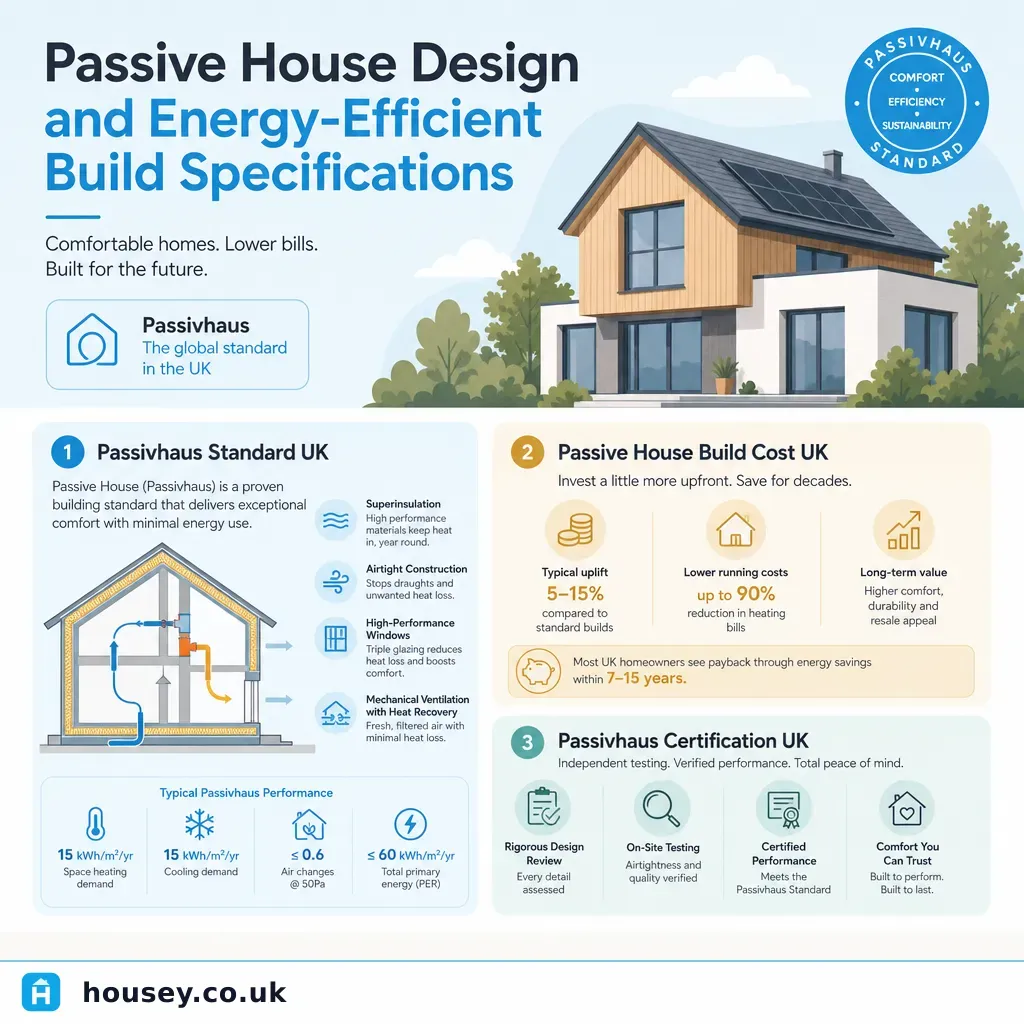
Passive House Design and Energy-Efficient Build Specifications
Passive house (Passivhaus) design limits a building's space heating demand to a maximum of 15 kWh/m² per year through super-insulation, airtight construction, triple-glazed windows, and mechanical heat-recovery ventilation.
 Energy & Retrofit
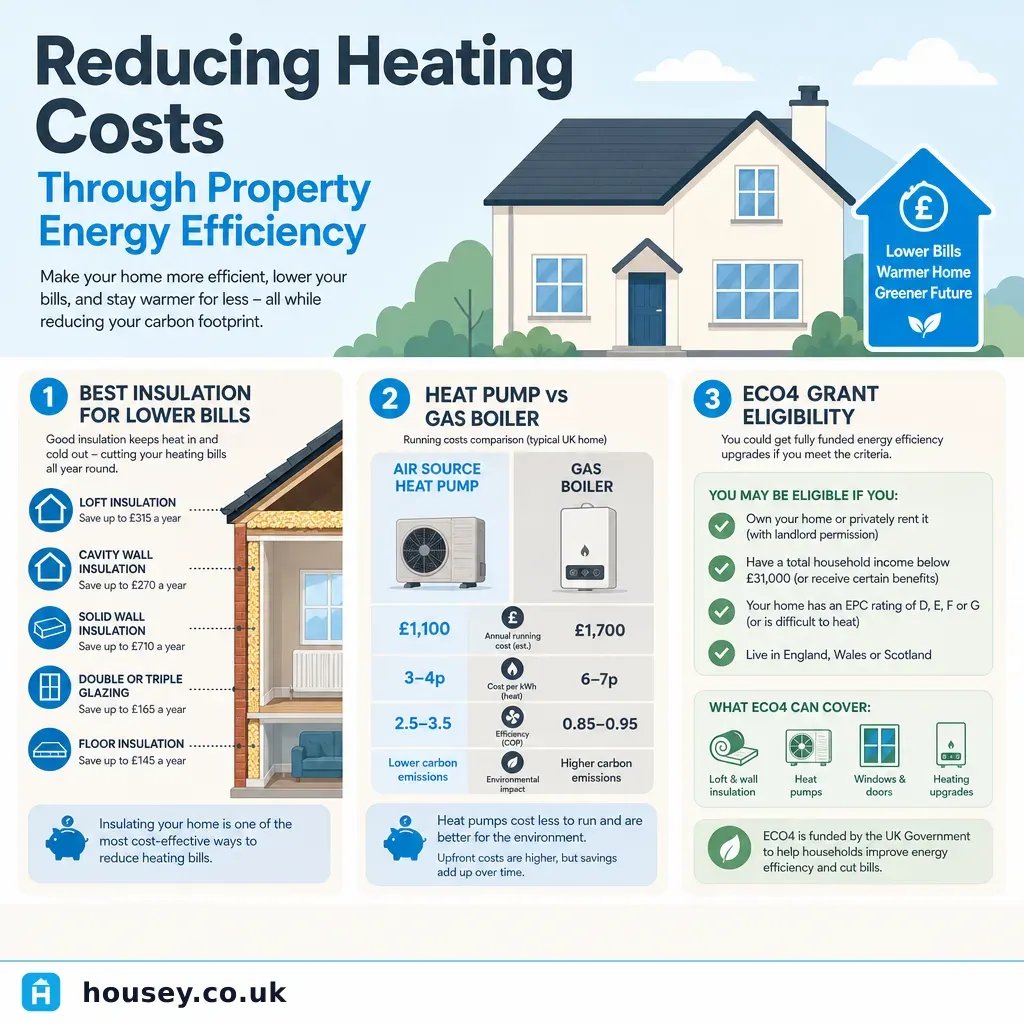
Reducing Heating Costs Through Property Energy Efficiency
Reducing heating costs starts with identifying where heat is lost — typically walls (30–35%), roof (20–25%), and windows.
 Energy & Retrofit
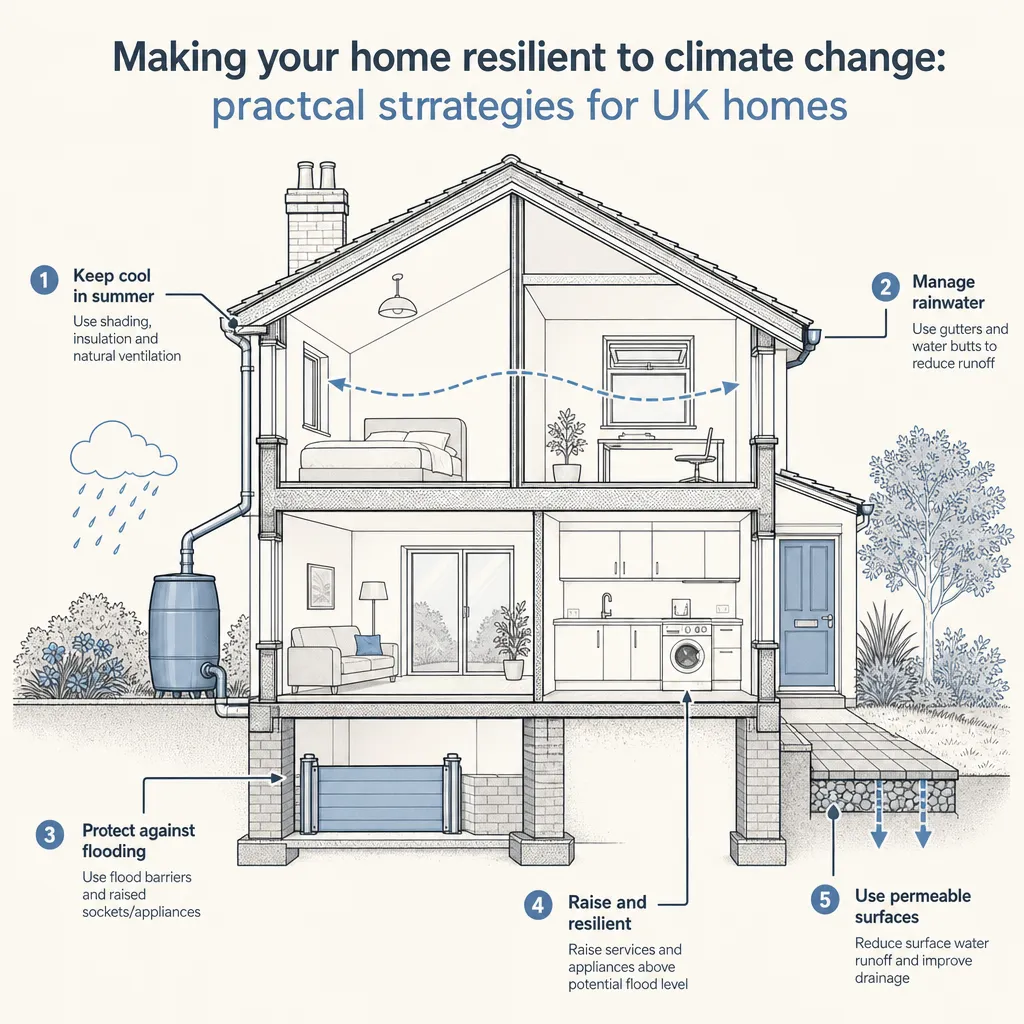
Making your home resilient to climate change: practical strategies
UK homeowners can improve climate resilience by addressing flood risk, overheating, and energy efficiency together.
 Energy & Retrofit
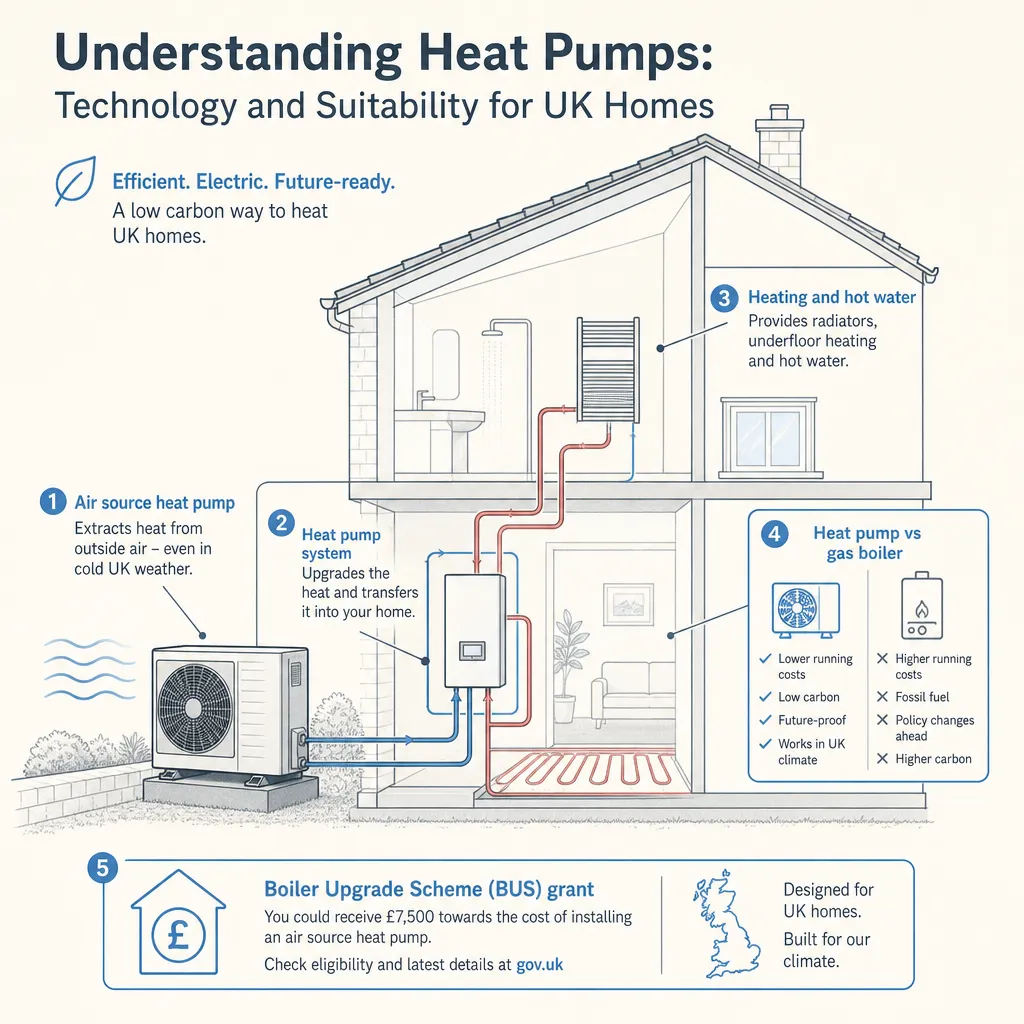
Understanding Heat Pumps: Technology and Suitability for UK Homes
Heat pumps extract heat from the air or ground and transfer it indoors, typically achieving efficiencies of 250–400% compared to a conventional boiler's near 100%.
 Energy & Retrofit
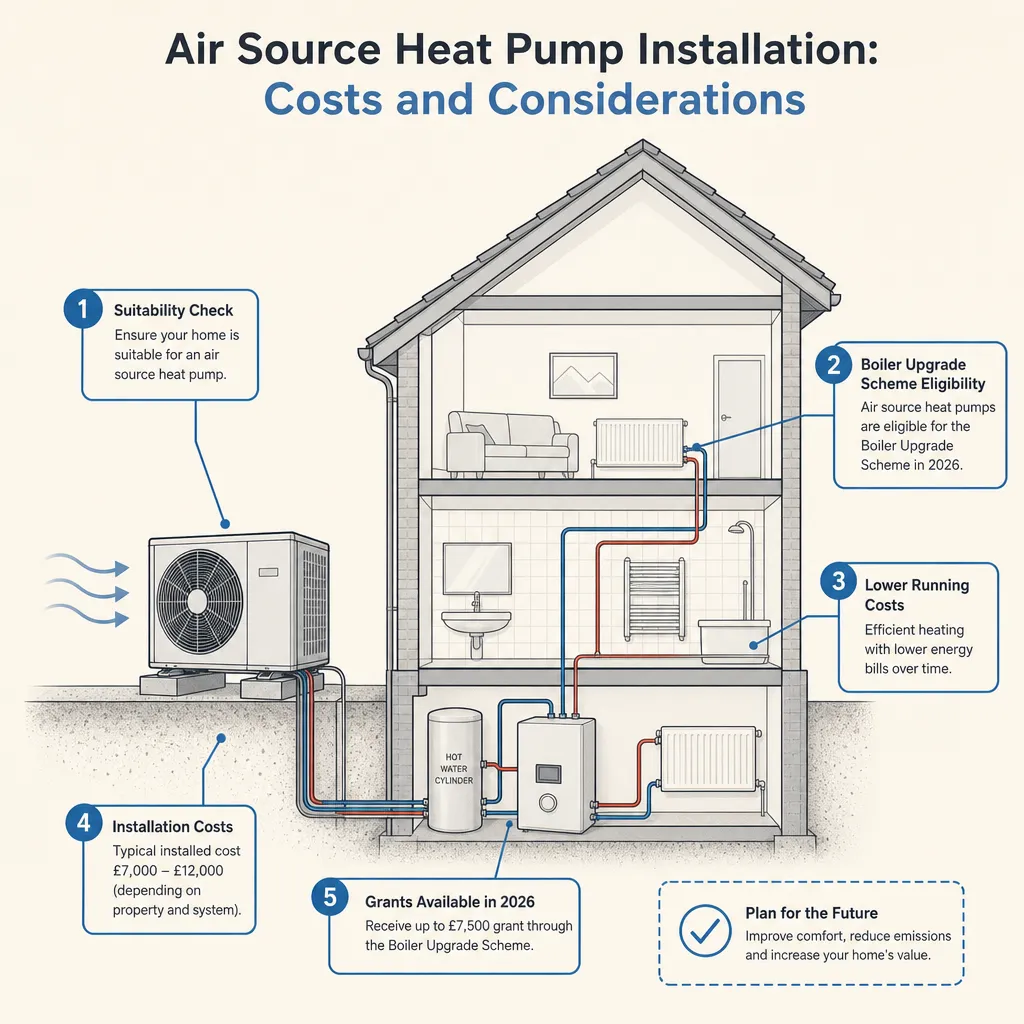
Air Source Heat Pump Installation: Costs and Considerations
Air source heat pump installation in the UK typically costs £8,000–£15,000 before the £7,500 Boiler Upgrade Scheme grant, available through MCS-certified installers in England and Wales.