New Build Home: Key Questions to Ask Your Builder
By Housey · Last reviewed 7th of May 2026
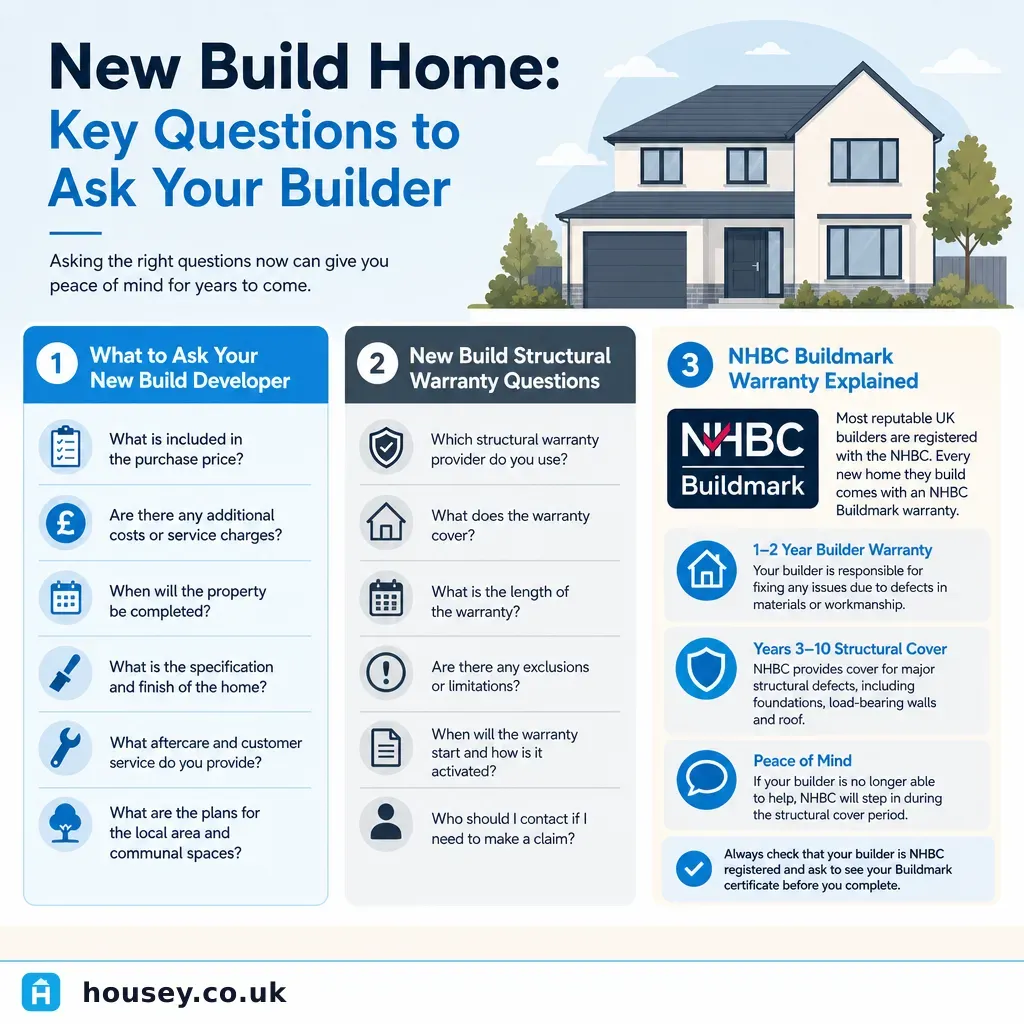
New Build Home: Key Questions to Ask Your Builder
Buying a new build home involves a different set of risks from purchasing an older property. Unlike a resale home with years of visible wear, a new build may look immaculate while concealing construction defects, incomplete snagging, or gaps in compliance paperwork — and the decisions you make before exchange of contracts can be difficult to reverse.
Key points
- New build homes in England, Scotland, and Wales typically carry a 10-year structural warranty, most commonly the NHBC Buildmark warranty, covering major structural defects after the builder's own two-year liability period ends.
- The builder is responsible for rectifying defects reported during the first two years (the "defects liability period") under most new build warranty schemes in England and Wales.
- A building regulations completion certificate from the local authority or an approved inspector must be issued at or before legal completion — this is separate from planning permission and from the structural warranty.
- Reservation fees are generally non-refundable; confirming the long-stop date and build programme milestones in writing reduces the risk of losing your fee if the developer delays.
What structural warranty does the property carry?
The NHBC Buildmark warranty is the most common 10-year structural warranty for new builds in Great Britain. Years one and two are the builder's responsibility period; NHBC covers major structural defects from years three to ten. Other recognised providers include Premier Guarantee, LABC Warranty, and Build-Zone. Always ask for the policy reference number and confirm the property is already registered — not merely "applied for".
What to ask:
- Which warranty provider is used, and is the plot already registered?
- How do I formally report defects during the builder's liability period?
- Are there exclusions in the warranty I should know about before exchange?
Who is responsible for snagging and defects?
Snagging covers minor and sometimes significant defects — scratched paintwork, ill-fitting doors, incomplete grouting, drainage that fails to drain correctly. The builder must rectify these within the defects liability period, typically two years from legal completion under NHBC standards. An independent snagging surveyor will usually identify substantially more defects than buyers find themselves; some builders permit pre-completion access for an independent inspection, others do not.
What to ask:
- Will you allow an independent snagging inspector access before legal completion?
- How do I submit a defect report, and what is your target response time?
- What is your procedure if defects remain unrectified after the liability period ends?
What compliance documents will I receive at completion?
The following documents should be in your solicitor's hands before or at legal completion:
- Building regulations completion certificate (issued by local authority or approved inspector).
- Gas Safe certificates for all gas installations, if applicable.
- FENSA or CERTASS certificates for windows and doors included in the build.
- Energy Performance Certificate (EPC) — a legal requirement for sale.
- Electrical installation certificates for all fixed wiring.
Missing certificates create problems at remortgage and resale. Instruct your solicitor to confirm receipt of each before contracts are exchanged.
How is the build programme managed, and what if handover slips?
New build timelines regularly slip due to material supply, subcontractor availability, or weather. If you have sold your previous home and are renting in the interim, delays translate directly into cost.
What to ask:
- What is the estimated legal completion date, and is it in the reservation agreement?
- How much notice will I receive before exchange of contracts is required?
- Is there a long-stop date, and what are my rights if that date passes?
- Who is my named contact for build progress updates?
The Consumer Code for Home Builders, which applies to builders registered with NHBC and several other warranty providers, sets minimum standards for communication and provides access to an independent dispute resolution scheme.
Comparing builder accountability routes
Scenario | Contact first | Escalation |
|---|---|---|
Defect within first 2 years | Developer directly | NHBC Resolution Service or equivalent |
Major structural defect, years 3–10 | NHBC or warranty provider | Financial Ombudsman Service if unresolved |
Reservation fee dispute | Your solicitor | Consumer Code adjudication |
Building Regulations non-compliance | Local authority building control | HSE or local planning authority |
Misrepresentation or mis-selling | Your solicitor | Trading Standards or Property Ombudsman |
Red flags when vetting a builder or developer
- Cannot confirm which structural warranty provider is used, or the plot is unregistered.
- Pressure to exchange contracts within fewer than 28 days without a realistic completion date.
- Show home finishes differ noticeably from the plot specification — get everything in writing.
- No building control inspector or approved inspector has been appointed.
- Resistance to allowing an independent snagging survey before legal completion.
- No Consumer Code for Home Builders membership or equivalent consumer protection.
- Reservation agreement contains no long-stop date.
When to get professional help
Consider independent professional support alongside your solicitor when buying a new build:
- A new-build snagging survey before or immediately after legal completion to document defects during the liability period.
- A building control consultant if you have concerns about regulatory compliance or the completeness of documentation.
- A project manager if you are procuring a bespoke or self-build property rather than an off-plan developer unit.
Seek urgent solicitor advice if the builder refuses to provide completion certificates before legal completion, or if exchange is demanded before key compliance documents are confirmed.
How Housey can help
Housey connects you with independent professionals to support your new build purchase. Whether you need a new-build snagging survey to document defects formally, independent build cost estimating to sense-check the specification and pricing, or a building control consultant to review compliance documentation, you can request quotes from qualified UK providers through Housey.
Frequently asked questions
Can I instruct my own snagging surveyor before legal completion?
Whether the developer allows pre-completion access varies. Some NHBC-registered builders permit it; others do not. Request this right in writing when negotiating the reservation agreement. If access is refused, instruct a snagging surveyor immediately after legal completion to document defects formally within the two-year defects liability period.
What is the difference between an NHBC certificate and a building regulations completion certificate?
They serve different purposes. NHBC Buildmark registration confirms the property meets NHBC technical standards and triggers the 10-year warranty. A building regulations completion certificate is issued by building control and confirms compliance with the Approved Documents in force at construction. You need both documents at legal completion.
Is the reservation fee refundable if I pull out?
Usually not. Reservation fees — typically £500–£2,000 (indicative, last reviewed 2026-05-07) — are generally non-refundable if the buyer withdraws without a valid reason. Some builders refund part or all of the fee if there is a material specification change, a delay beyond the long-stop date, or a failed mortgage. Clarify refund terms in writing before paying.
Do new build homes need a RICS survey?
A RICS home survey is not standard practice for new builds. However, an independent snagging survey is strongly recommended. It focuses on construction defects and incomplete items rather than structural condition or market value, and should ideally be carried out before or shortly after legal completion while the builder is obliged to rectify defects.
What consumer protection applies to new build purchases in England?
The Consumer Code for Home Builders — mandatory for builders registered with NHBC, Premier Guarantee, LABC, and others — sets minimum standards for pre-purchase information, contracts, and after-sales service. The New Homes Quality Board has also introduced the New Homes Quality Code as a voluntary standard for participating developers, offering an additional consumer protection layer.
Sources and further reading
- NHBC Buildmark warranty — what it covers — NHBC
- Consumer Code for Home Builders — Consumer Code for Home Builders
- New Homes Quality Board — New Homes Quality Code — New Homes Quality Board
- Building regulations approval — GOV.UK
- Buying a new build home — Citizens Advice
Useful next reads
 Planning & Pre-Build
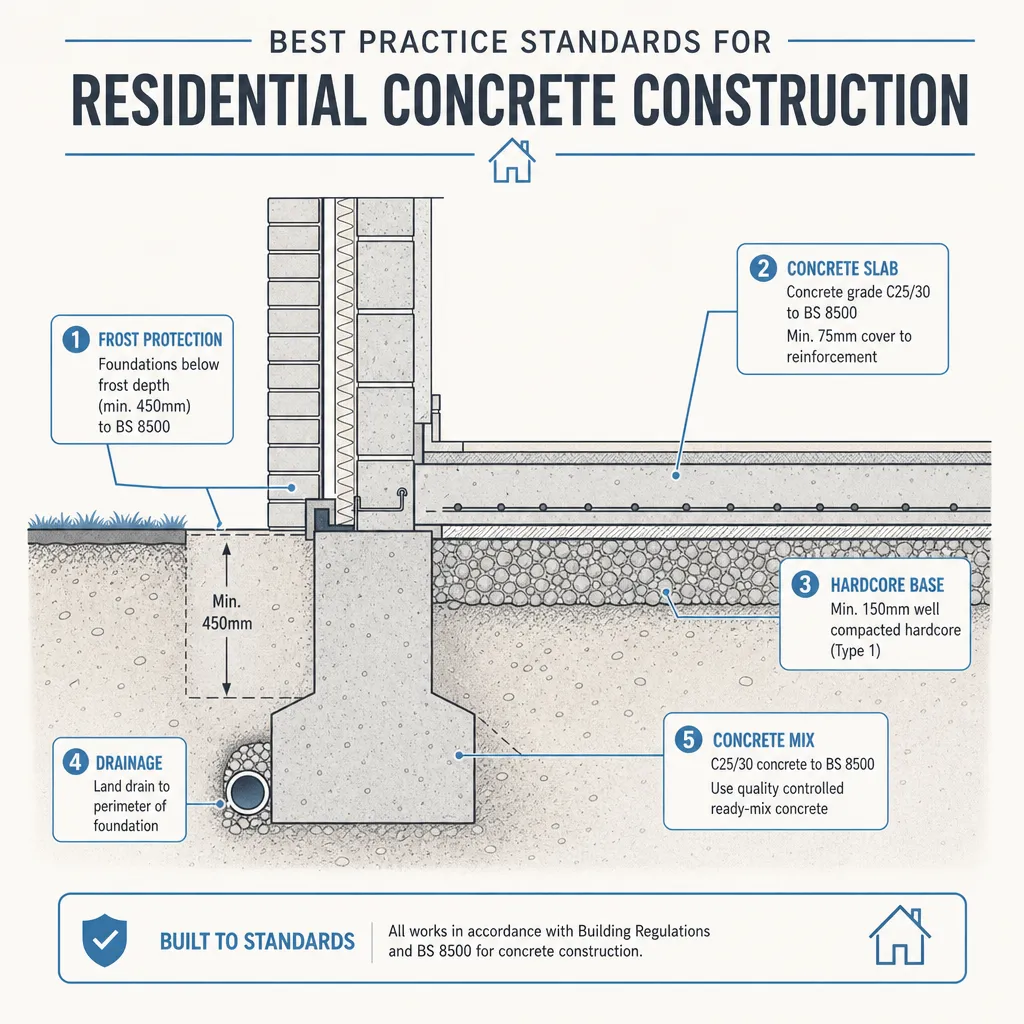
Best Practice Standards for Residential Concrete Construction
Residential concrete in the UK must comply with BS EN 206 and BS 8500, which define mix designations, cement types, and durability requirements for each application.
 Planning & Pre-Build
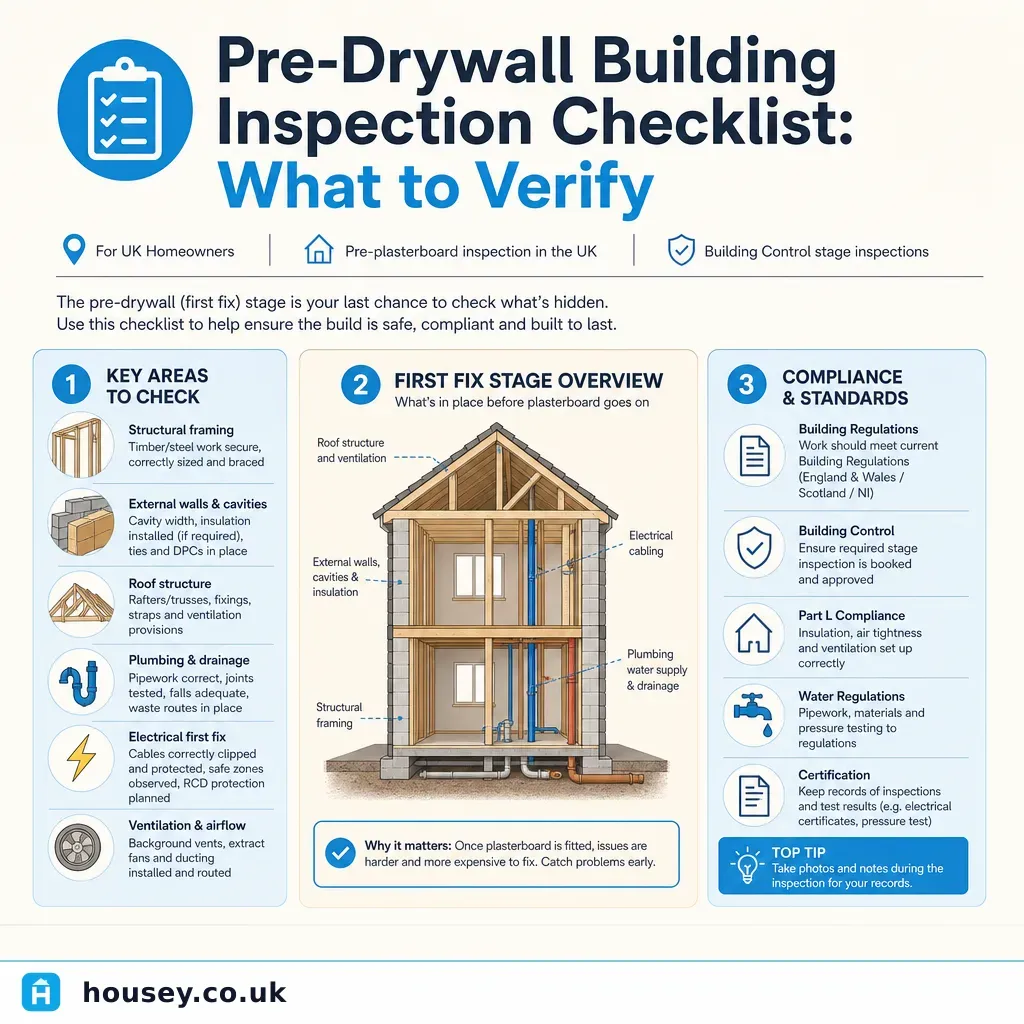
Pre-Drywall Building Inspection Checklist: What to Verify
Before plasterboarding or drylining a UK extension or new build, a building control inspector checks structural elements, first-fix wiring, pipework, gas, insulation, and fire stopping.
 Planning & Pre-Build
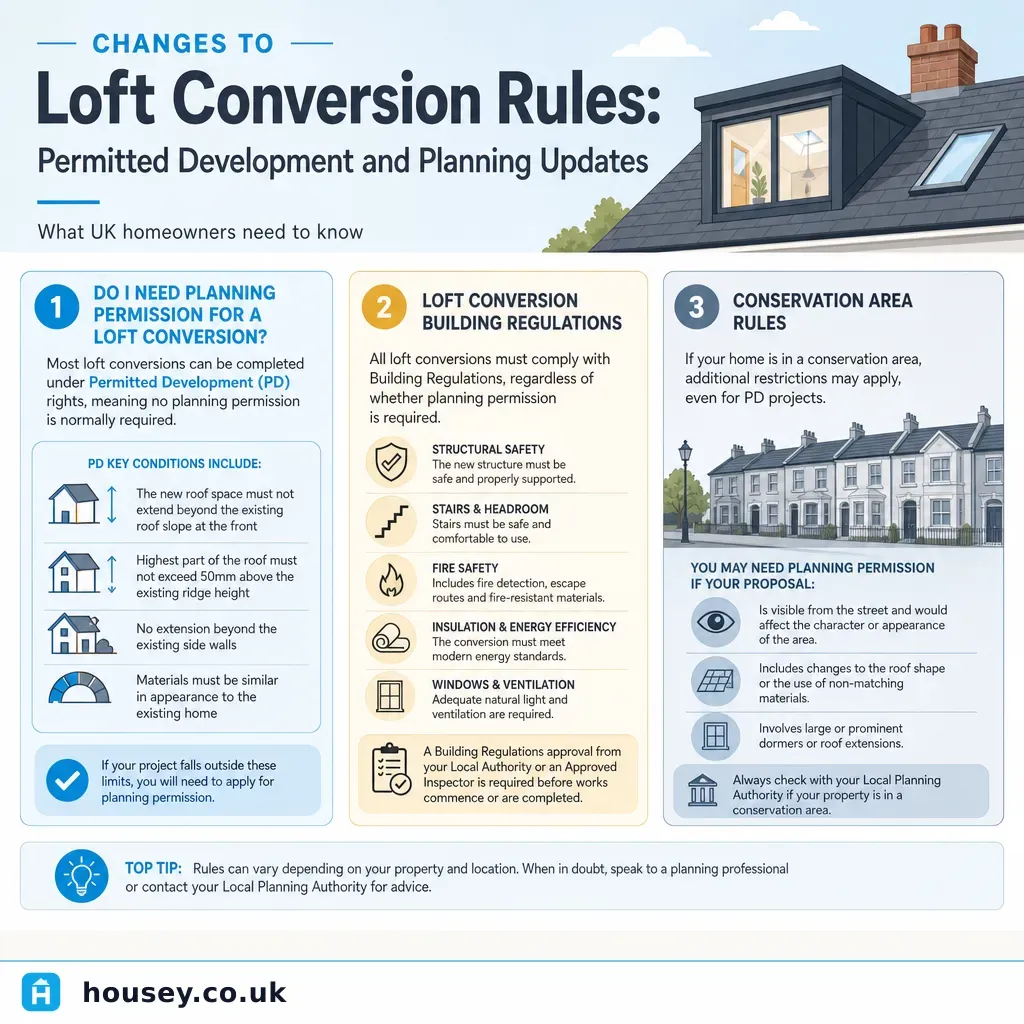
Changes to Loft Conversion Rules: Permitted Development and Planning Updates
In England, most loft conversions on standard houses qualify as Permitted Development under Class B of the GPDO 2015, allowing up to 40 cubic metres (terraced) or 50 cubic metres (detached or semi-detached) without a planning application — if conditions are met.
 Planning & Pre-Build
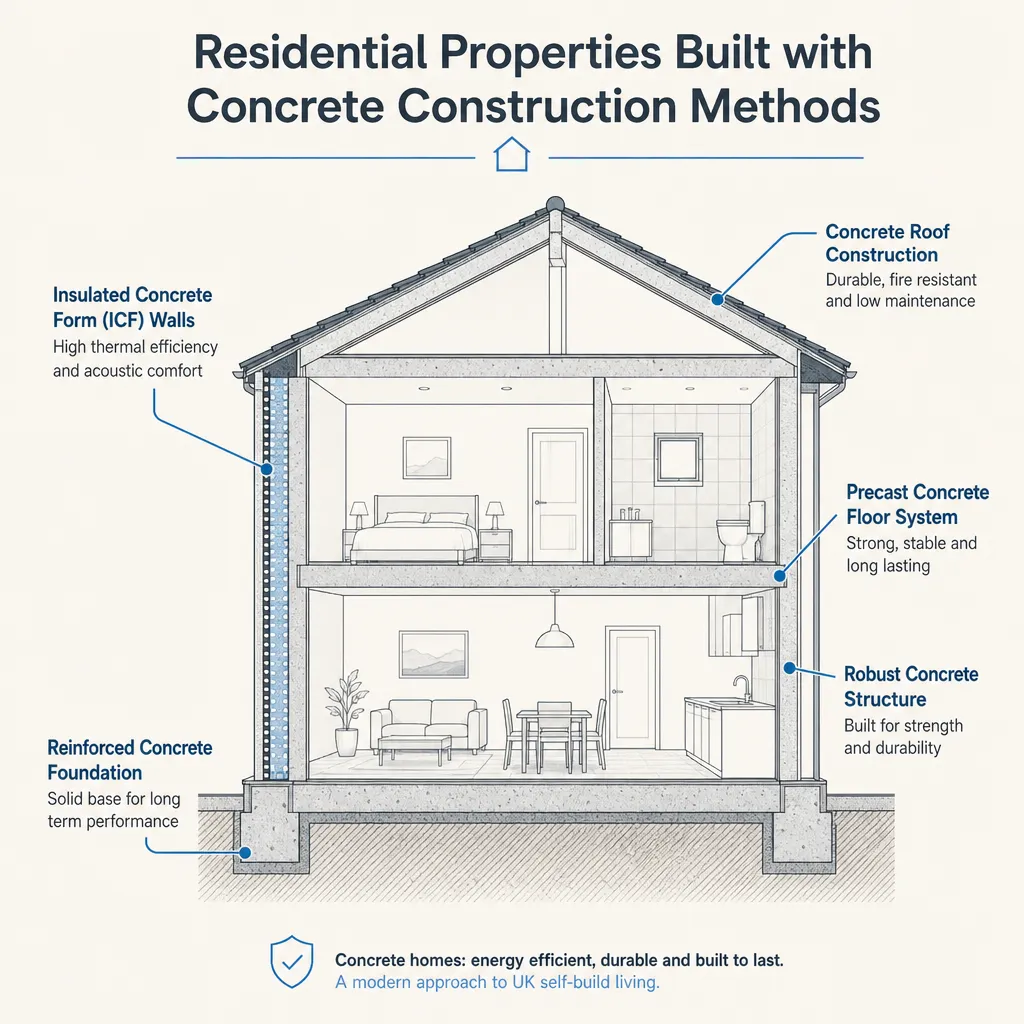
Residential Properties Built with Concrete Construction Methods
UK homes are built using several concrete methods: in-situ cast concrete, precast panel systems, insulating concrete formwork (ICF), and older non-traditional types such as Wimpey No-Fines and Laing Easiform.
 Planning & Pre-Build
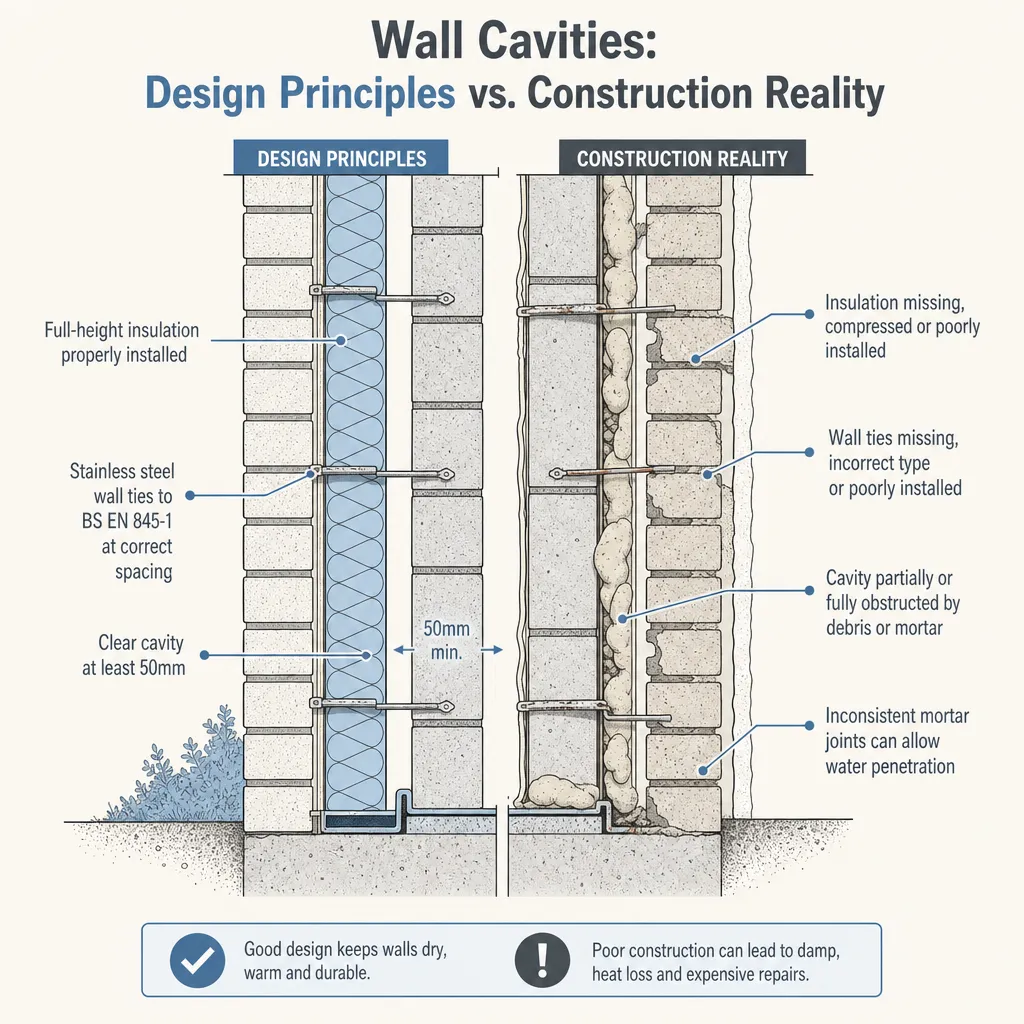
Wall Cavities: Design Principles vs. Construction Reality
A UK cavity wall is designed to resist weather, control heat loss, and structurally link two masonry leaves.