Pre-Drywall Building Inspection Checklist: What to Verify
By Housey · Last reviewed 1st of June 2026
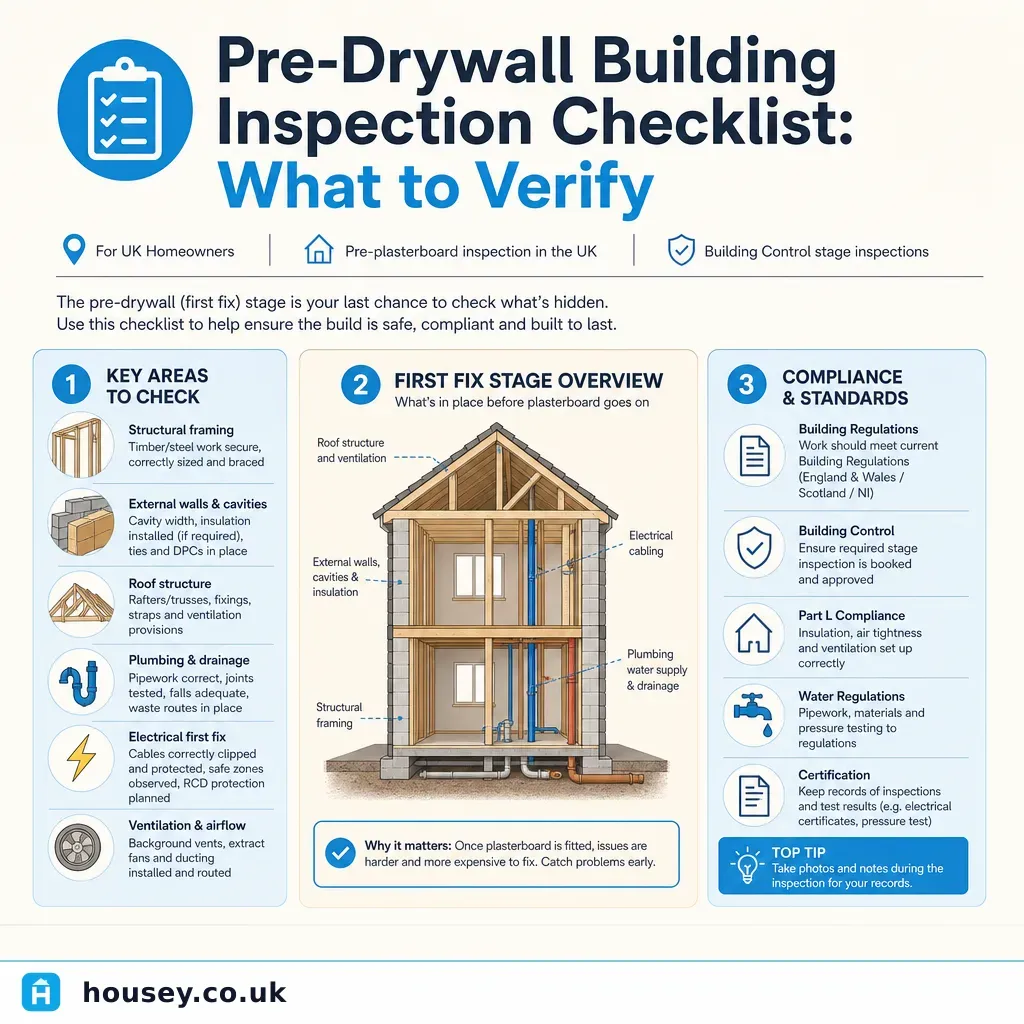
Pre-Drywall Building Inspection Checklist: What to Verify
In UK construction, the stage just before plasterboarding begins — commonly called the pre-drylining or first-fix stage — is one of the most critical inspection points in any build or extension. Once walls and ceilings are boarded and plastered, structural, mechanical, and electrical work becomes inaccessible and very costly to re-expose. Building Regulations require your building control body (BCB) to be notified and given a reasonable opportunity to inspect before this work is concealed.
Key points
- Under the Building Regulations 2010 (as amended), a building control body must be given at least 24 hours' written notice before covering structural elements, DPC, insulation, or drainage.
- The Building Safety Act 2022 replaced Approved Inspectors with Registered Building Inspectors (RBIs) working for registered building control approvers (RBCAs).
- First-fix electrical work must be carried out or supervised by a Part P-registered electrician (such as NICEIC or NAPIT) before boarding, or separately notified to building control.
- Cavity barriers and fire stopping at floor zones must be correctly installed before drylining; missing these is one of the most commonly identified failures at post-completion audits.
- For timber-frame construction, a structural warranty provider such as NHBC or Premier Guarantee may require their own pre-drylining inspection separately from building control.
What 'pre-drywall' means in a UK build
The US term 'pre-drywall inspection' refers to checks carried out before drywall (plasterboard) is fixed. In the UK, the equivalent stage is usually called:
- Pre-drylining inspection — the most common UK construction industry term
- First-fix inspection — focusing on services before boarding
- Pre-boarding check — used by some structural warranty providers
Regardless of terminology, the principle is identical: once plasterboard, render, or cladding is fixed, work concealed behind it cannot be checked without expensive opening up. Building Regulations explicitly require that concealment is not carried out before the BCB has had a reasonable opportunity to inspect.
Structural and fabric elements to verify
Before any boarding takes place, the following structural and fabric items should be checked or signed off:
Element | What to look for | Who typically checks |
|---|---|---|
Structural frame (timber or steel) | Correct sizing, noggins, bracing, connections to specification | Building control inspector, structural warranty surveyor |
Masonry and blockwork | Correct leaf thickness, wall ties, DPC, lintel bearing | Building control |
Roof structure | Correct truss or rafter sizes, bracing, strapping to wall plates | Building control |
Wall ties | Present and correctly spaced in cavity construction | Building control |
Cavity closers and DPCs | Correctly fitted at all openings and junctions | Building control |
Air-tightness membrane | Correctly lapped, taped, and sealed at junctions | Building control (Part L), air-tightness tester at pre-completion |
Insulation | Correct type, thickness, and continuity — no cold bridges | Building control (Part L compliance) |
Fire stopping and cavity barriers | Correctly installed at floor zones, around pipes and ducts | Building control (Part B compliance) |
First-fix services checklist
First-fix services — everything that runs inside the building fabric before enclosure — must be correct before boarding. Changes after plasterboarding are expensive and sometimes impossible without significant disruption.
Electrical (Approved Document P)
Plumbing and heating (Approved Documents H and L)
Gas (Gas Safe Register)
Building control notification requirements
Under Regulation 16 of the Building Regulations 2010, you or your contractor must give the BCB at least 24 hours' written notice before covering:
- Foundations
- Any DPC or DPM
- Any structural element
- Any drainage pipe that will be concealed
- Insulation in walls, roofs, or floors
Failure to give notice — or covering the work before inspection — can result in the BCB issuing an enforcement notice requiring you to open up the work at your own cost. Keep written records of all inspection notifications and any sign-offs received.
Which inspection do you need?
- Choose standard building control notification if you are carrying out a new build house or extension of three storeys or fewer — give 24 hours' written notice before covering.
- Choose a full plans application if your project is complex or large; this allows the BCB to check drawings in advance and reduces the risk of issues arising on site.
- Arrange a structural warranty stage inspection if your lender or insurer requires NHBC, Premier Guarantee, or a similar warranty — this runs in parallel with, but separately from, building control.
- Contact the Building Safety Regulator (HSE) if your project involves a higher-risk building (seven storeys or 18 m or more in height) under the Building Safety Act 2022.
- Speak to the local planning authority's conservation officer if the building is listed, as additional consents may be required before concealing any historic fabric.
Important limitations
This checklist is for general guidance only. Building Regulations requirements vary depending on the nature of the work, the building type, whether a full plans application or building notice applies, and the specific Approved Documents in force. Only a qualified building control professional who has reviewed your specific drawings and specifications can confirm compliance.
What to ask a qualified professional
- Which stage inspections does my project trigger, and when exactly should I notify you?
- Does the work require a full plans application or will a building notice suffice?
- Who should carry out first-fix electrical sign-off — a Part P-registered electrician, or do I need to notify building control separately?
- Are there structural warranty stage inspection requirements I need to co-ordinate with building control?
- What written evidence of sign-off will I receive after each inspection?
- What happens if issues are found — what is the process for corrective work and re-inspection?
When to get professional help
Building control inspections are a legal requirement under the Building Regulations 2010, not an optional extra. Seek professional help if:
- Your contractor suggests boarding before a building control inspection has taken place
- You are unsure whether a full plans application or a building notice applies to your project
- Any structural element has been altered from the approved drawings mid-build
- You have received a notice from building control requiring you to open up completed work
- The project involves a higher-risk building requiring Building Safety Regulator involvement
How Housey can help
Housey connects you with qualified building control consultants who understand UK Building Regulations and can guide you through stage inspection requirements, co-ordinate notifications, and confirm compliance before boarding begins.
Frequently asked questions
Do I legally have to have a pre-drylining inspection in the UK?
Yes. Under Regulation 16 of the Building Regulations 2010, you must give your building control body at least 24 hours' notice before covering any structural work, insulation, drainage, DPC, or foundations. Failure to do so can result in an enforcement notice requiring you to open up and re-expose completed work at your own cost.
Can my builder carry out the pre-drylining inspection themselves?
No. The inspection must be carried out by a Registered Building Inspector — either a local authority inspector or an RBI employed by a registered building control approver. Certain limited works can be self-certified by competent-person scheme members, such as Part P electrical, but general stage inspections cannot be delegated to the contractor.
What happens if issues are found at the pre-drylining stage?
The building control inspector will typically issue a written list of items to be remediated before boarding is permitted. Your contractor must address each point and re-notify the BCB. This can add time to the programme, which is why thorough checking before the inspection visit is strongly advised.
Is a structural warranty inspection the same as a building control inspection?
No. They are separate processes. Structural warranty providers such as NHBC or Premier Guarantee carry out their own stage inspections to validate the warranty, in addition to building control. Both sets of records should be retained as a mortgage lender or solicitor may request them when the property is sold.
Sources and further reading
- Building Regulations 2010 — legislation.gov.uk
- Building Safety Act 2022 — legislation.gov.uk
- Approved Document B: Fire Safety — GOV.UK
- Approved Document L: Conservation of Fuel and Power — GOV.UK
- Approved Document P: Electrical Safety in Dwellings — GOV.UK
Useful next reads
 Planning & Pre-Build
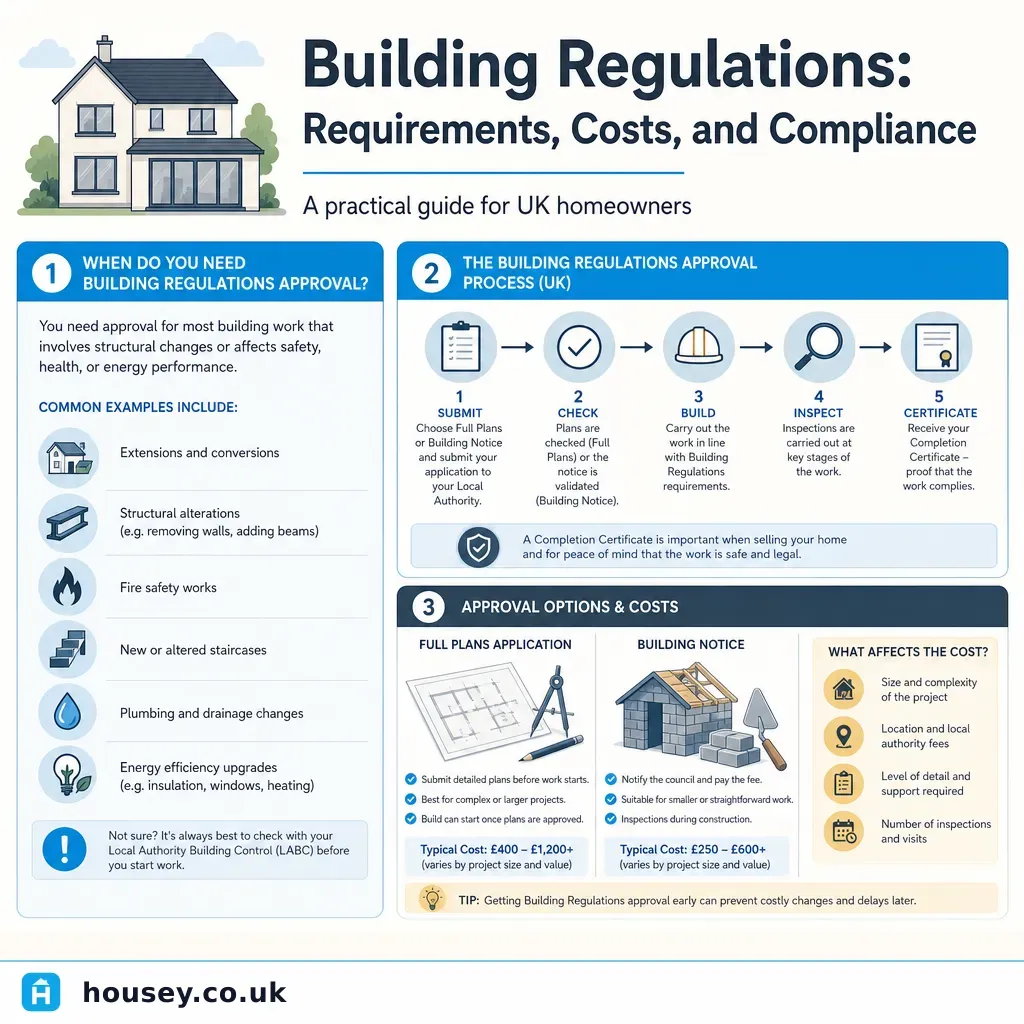
Building Regulations: Requirements, Costs, and Compliance
Building regulations set minimum standards for how construction work is carried out in the UK, covering structural stability, fire safety, energy efficiency, and ventilation.
 Planning & Pre-Build
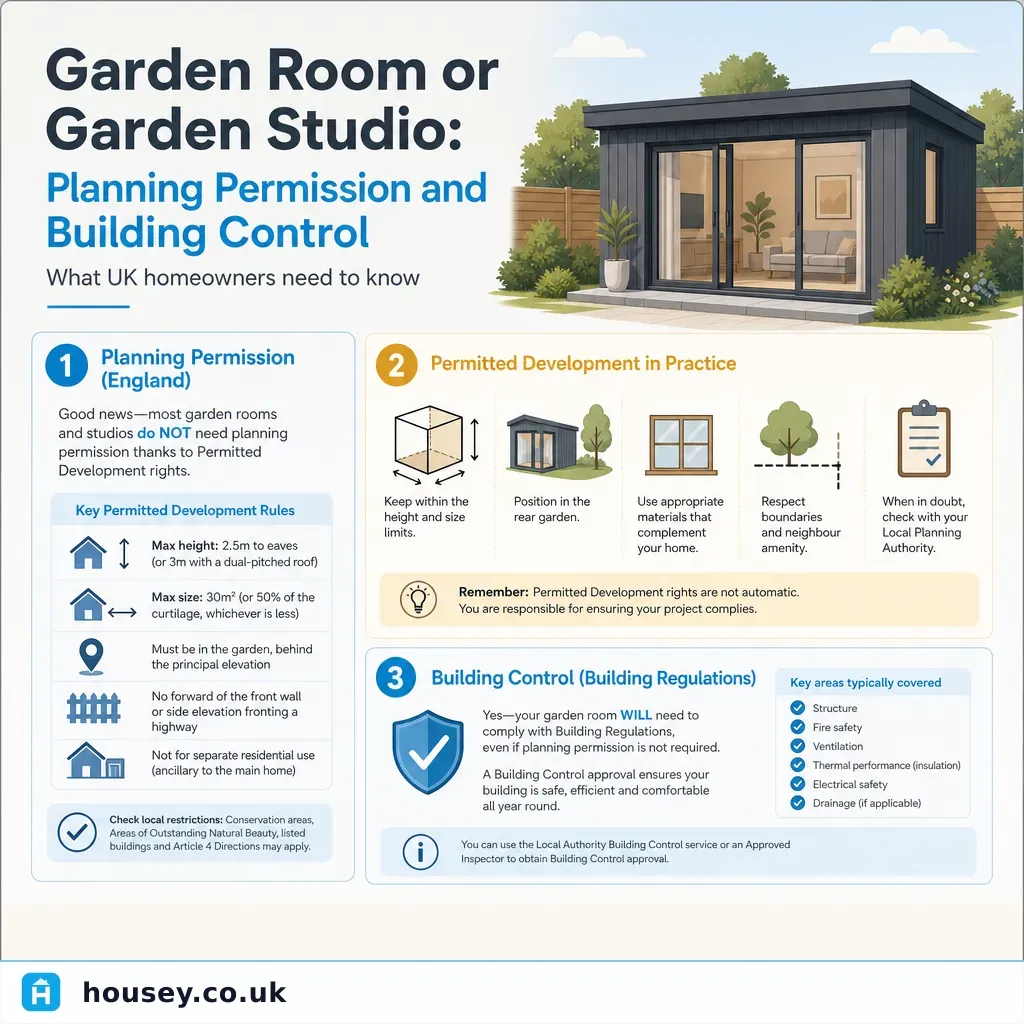
Garden Room or Garden Studio: Planning Permission and Building Control
A garden room or studio often qualifies as permitted development in England, meaning no planning application is needed — provided it occupies no more than 50% of the total curtilage, sits within height limits, and is not used as a separate dwelling.
 Planning & Pre-Build
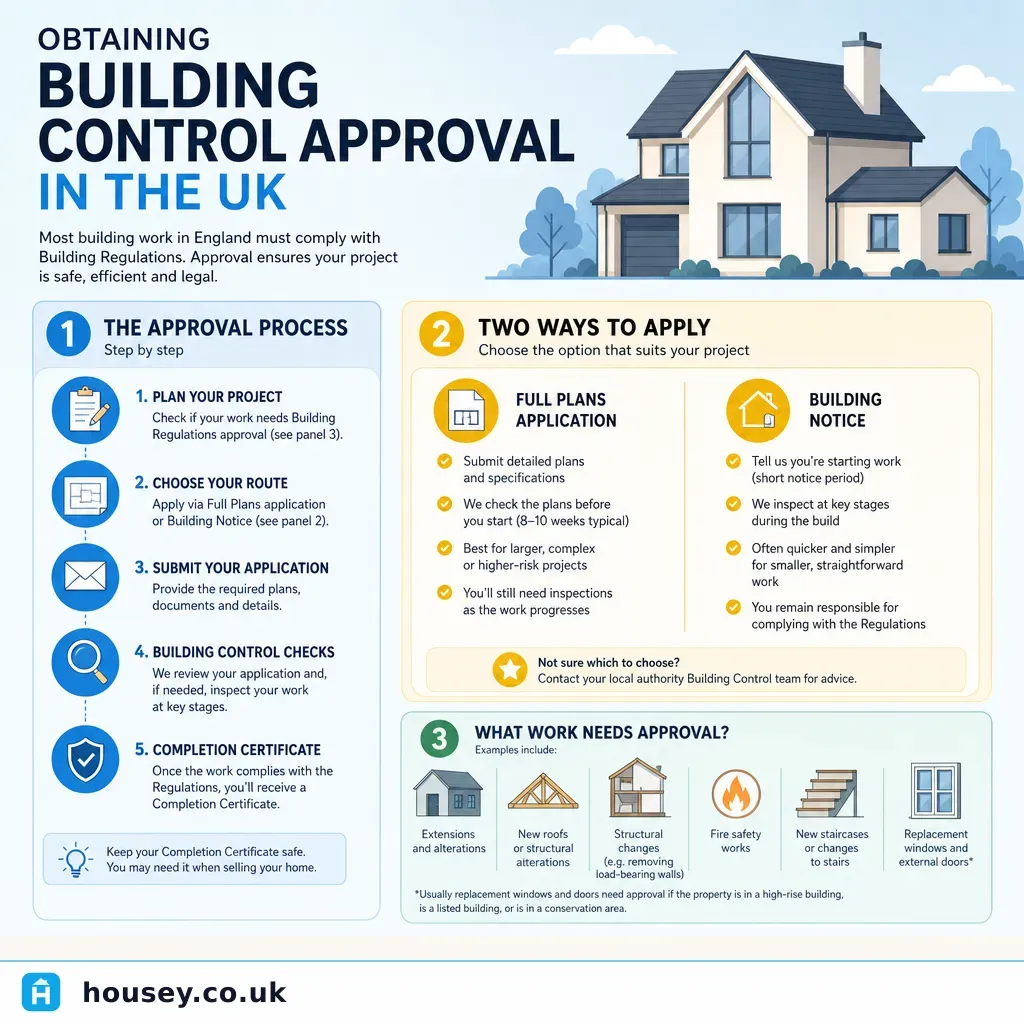
Obtaining Building Control Approval in the UK
Building control approval in the UK is required for most structural changes, extensions, loft conversions, and new builds.
 Planning & Pre-Build
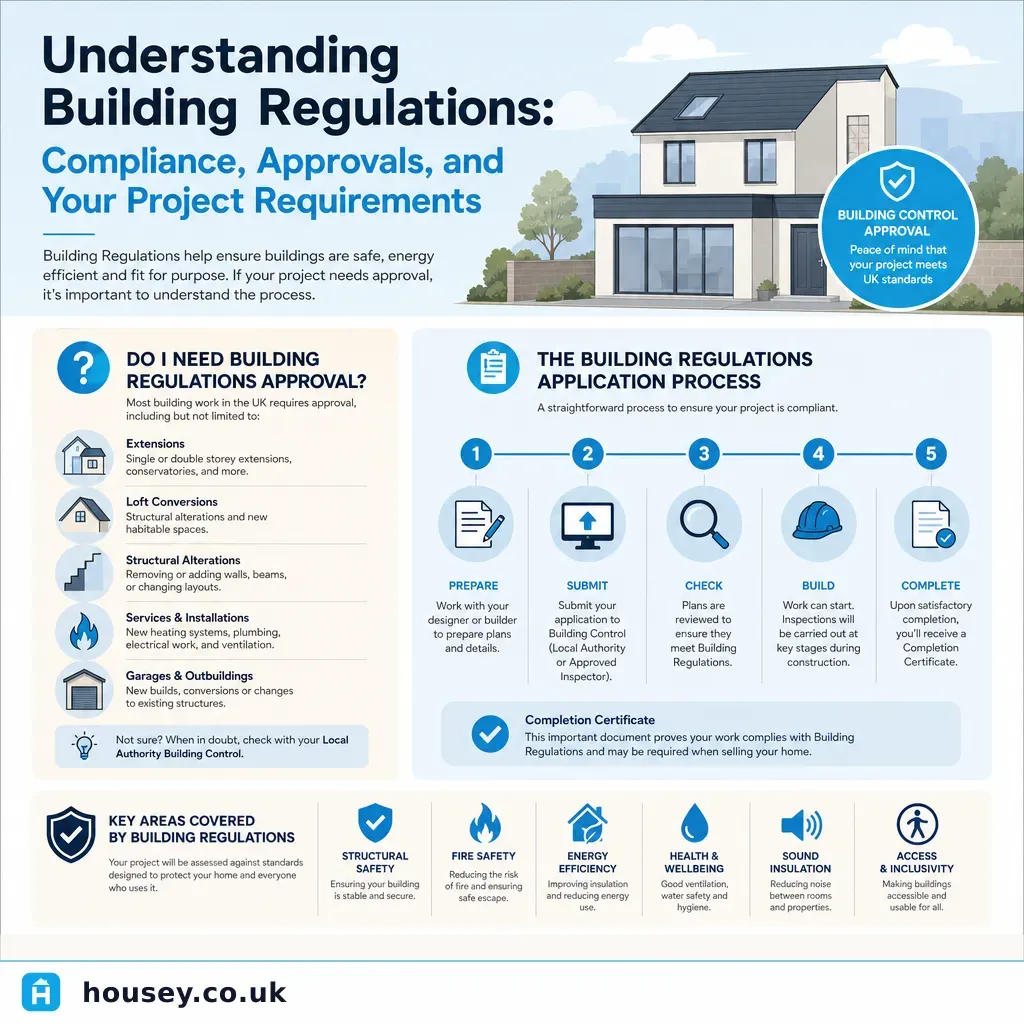
Understanding Building Regulations: Compliance, Approvals, and Your Project Requirements
Building regulations set minimum standards for design, construction, and alterations to buildings in England and Wales.
 Planning & Pre-Build
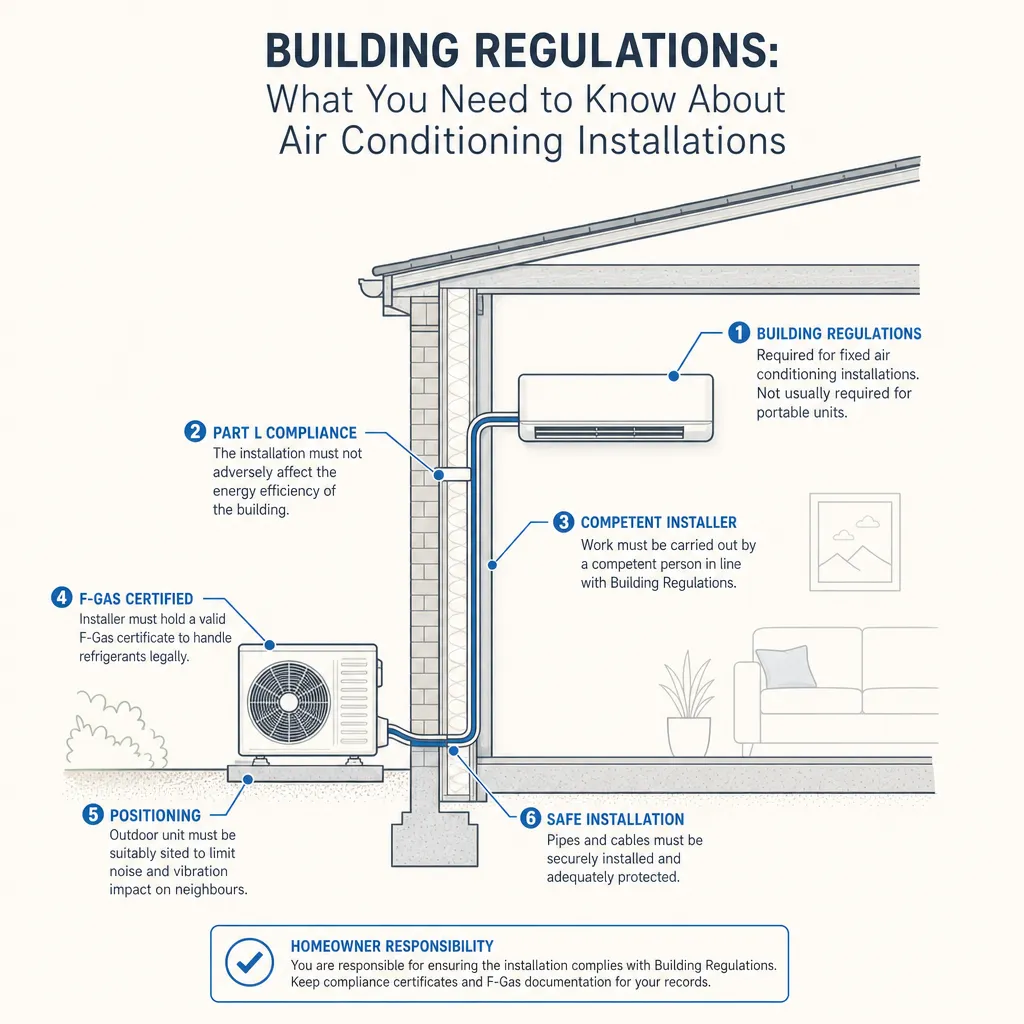
Building Regulations: What You Need to Know About Air Conditioning Installations
Most domestic air conditioning installations in England must comply with Building Regulations Part L (energy efficiency) and Part F (ventilation).