Transforming New Build Properties: Design and Customisation Costs
By Housey · Last reviewed 6th of May 2026
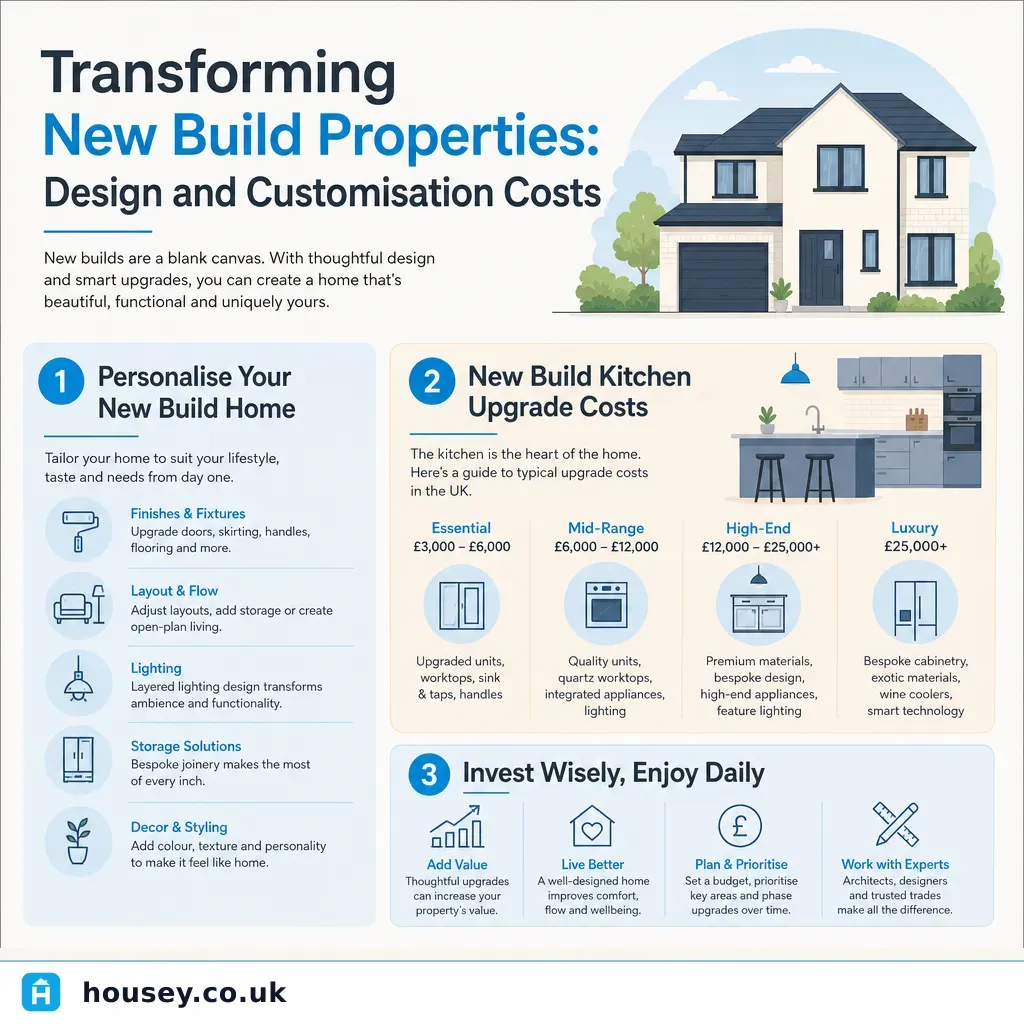
Transforming New Build Properties: Design and Customisation Costs
New build homes often arrive in a uniform, developer-standard specification — magnolia walls, basic kitchen units, and carpet throughout. While this blank-canvas approach suits some buyers, many homeowners want to personalise or significantly upgrade their new property to reflect their tastes, lifestyle, or plans to increase long-term value. Understanding the realistic costs, the right order of works, and when professional design input genuinely pays off can save considerable time and money.
Key points
- Developer upgrade packages offered at reservation are typically 30–50% more expensive than equivalent aftermarket work arranged directly by the homeowner, though they can be financed as part of the mortgage (indicative UK market observation, last reviewed 2026-05-06).
- Structural changes inside a new build — removing walls, creating openings, or adding extensions — require Building Regulations approval and must not compromise the NHBC Buildmark warranty, which covers structural defects for 10 years from legal completion.
- Interior designers in the UK typically charge 10–20% of the project budget as a fee, or a day rate of £300–£800 depending on experience and scope (indicative UK costs, last reviewed 2026-05-06).
- Some external changes to new builds — outbuildings, driveways, or extensions — may require planning permission even where permitted development rights would otherwise apply; confirm with your local planning authority before starting any external work.
- Flooring, kitchen upgrades, and bathroom changes are the most common transformation priorities and together typically account for 50–70% of total interior customisation budgets.
What does transforming a new build typically mean?
Homeowners approach new build transformation in broadly three ways:
Cosmetic upgrades — replacing developer-standard flooring, repainting throughout, upgrading light fittings, changing door furniture, adding tiling, and fitting bespoke window dressings. These rarely require formal consents and can be phased over time as budget allows.
Kitchen, bathroom, and utility upgrades — swapping developer kitchens and bathrooms for bespoke or higher-specification alternatives. This is the most common large-spend category. Work typically involves a builder or kitchen fitter alongside plumbing and electrical contractors, and costs can escalate quickly when tiling, replumbing, and snagging are factored in.
Structural and spatial changes — removing non-load-bearing partitions to create open-plan layouts, adding a rear extension, or converting an integral garage. These require Building Regulations approval and careful management in relation to the NHBC warranty.
Typical costs for new build transformation
The following ranges reflect common project types in England, based on indicative UK market rates.
Transformation type | Indicative cost range | Notes |
|---|---|---|
Full repaint, all rooms (professional) | £2,000–£6,000 | Depends on property size and finish specification |
Flooring replacement, whole house | £3,000–£10,000 | Engineered wood, LVT, or carpet; excludes tiling |
Kitchen replacement (mid-range) | £5,000–£15,000 | Supply and fit; excludes structural alterations |
Bathroom replacement (per room) | £3,000–£8,000 | Standard en suite or main bathroom; varies by specification |
Full interior design service | £5,000–£25,000+ | Depends on rooms covered, designer rate, and procurement model |
Rear single-storey extension | £25,000–£60,000+ | Includes planning, Building Regulations, and build cost |
Integral garage conversion | £8,000–£20,000 | Building Regulations required; planning usually permitted development |
Indicative UK costs, last reviewed 2026-05-06. Actual costs vary by region, specification, and contractor.
Developer upgrade package or aftermarket work: which should you choose?
This is one of the most common decisions new build buyers face. Developer upgrade packages are offered at reservation and can be financed as part of the mortgage — which has genuine appeal when cash is limited at completion. However, the price premium can be significant.
Decision tree:
- Choose developer upgrades if the change is structural or requires work before plasterboard and floor screed are poured — changes of this type are far cheaper to make during construction than after completion.
- Choose developer upgrades if mortgage finance makes the cost more manageable and the specification on offer is acceptable.
- Choose aftermarket work if you want a genuinely bespoke finish beyond the developer's available options or want better cost efficiency.
- Choose aftermarket work if you want to live in the property for 6–12 months before committing to significant changes — layout habits and storage needs only become clear after occupation.
- Instruct a design-and-build firm if you want a single point of contact managing design and construction across multiple trades.
- Consult an architectural technologist if structural changes or Building Regulations drawings are required.
- Check with your local planning authority if any external alterations are planned — particularly within the first two years of completion, when conditions on the original planning consent may still restrict permitted development.
NHBC warranty and Building Regulations: what you must not overlook
New builds completed by NHBC-registered developers typically come with a 10-year Buildmark warranty. This covers structural defects for the full 10 years and defects in non-structural elements during the first 2 years.
Homeowners who carry out structural work — including removing walls, adding openings, or building extensions — must ensure that:
- The work has full Building Regulations approval, with a completion certificate issued by a building control body.
- The contractor is competent and appropriately qualified for the work type.
- The work does not compromise the original structure covered by the NHBC warranty.
Unauthorised structural changes can void relevant sections of the warranty and create complications on resale. Always obtain a Building Regulations completion certificate and retain it with your property documents.
For electrical work beyond replacing like-for-like fittings, installers must either be registered with a Part P competent person scheme — such as NICEIC or NAPIT — or the work must be notified to and inspected by building control.
Working with an interior designer or design-and-build firm
For homeowners who want a coordinated transformation rather than managing multiple trades independently, an interior designer or design-and-build firm offers a more structured approach.
What an interior designer typically provides:
- Space planning and layout recommendations
- Material, finish, and colour specification
- Furniture and lighting procurement
- Coordination of trades: builders, joiners, electricians, tilers
- Project management and contractor oversight
What to ask before appointing an interior designer:
- Do you provide a full specification document and schedule of works for each contractor?
- What is your fee structure — percentage of budget, day rate, or fixed fee?
- How do you manage trade procurement — do you have preferred suppliers, or is specification open to competitive quotes?
- Can you provide references from comparable new build transformation projects?
- What project management involvement do you provide on site during works?
- Are you a member of the British Institute of Interior Design (BIID) or a recognised equivalent body?
- Is VAT included in your fee, and what expenses are charged additionally?
For more complex projects involving extensions or structural alterations, an architectural technologist can prepare Building Regulations drawings and manage the consent process, while a design-and-build firm can handle both design and construction under a single contract.
Common mistakes when transforming a new build
Rushing changes before living in the space Layout habits, natural light patterns, and storage needs only become clear after occupation. Homeowners who commit to structural changes in the first weeks sometimes find their decisions do not suit their actual daily routines.
Overlooking the NHBC warranty implications Structural work carried out without Building Regulations approval can affect warranty coverage. Always confirm the position with your NHBC documentation before instructing any contractor for work beyond cosmetic changes.
Choosing developer upgrades for items easily changed later Flooring, paint, light fittings, and ironmongery are straightforward to change aftermarket at lower cost. The developer upgrade premium is most worthwhile for structural or in-slab changes that cannot easily be reversed.
Underestimating the full project cost Kitchen and bathroom transformations consistently run over initial estimates when tiling, electrical upgrades, replumbing, decoration, and post-works snagging are included. Always obtain a detailed, itemised quote before proceeding and build in a contingency of at least 10–15%.
When to get professional help
- Any work involving removal or alteration of load-bearing walls requires a structural engineer's calculations and Building Regulations approval — do not proceed based on a contractor's verbal assessment alone.
- Electrical work beyond replacing like-for-like fittings must be carried out by a Part P-registered electrician or notified to building control under the Building Regulations.
- If you are planning an extension to a new build, consult a planning consultant or architectural technologist early — permitted development rights for new builds can be more restricted than for older properties due to conditions attached to the original planning consent.
- For high-value or complex transformation projects, a project manager or design-and-build firm can prevent costly coordination errors between trades and help maintain programme.
How Housey can help
Housey connects UK homeowners with vetted professionals for new build transformation projects. Whether you need a design-and-build firm to manage the full project, an architectural technologist to prepare Building Regulations drawings for structural work, or extension builders for a rear or side addition, Housey can help you request comparable quotes and find the right professional for your scope and budget.
Frequently asked questions
Do I need planning permission to change the inside of a new build?
Internal changes — repainting, replacing flooring, fitting a new kitchen, or removing non-load-bearing partitions — do not require planning permission. However, Building Regulations approval is required for structural alterations, electrical work beyond like-for-like replacement, and changes to heating systems. External changes such as extensions or new driveways may require planning permission depending on the property and local authority conditions.
Can I replace the kitchen in a new build straight away?
Yes, you can replace the developer kitchen at any point after legal completion. Many homeowners choose to wait 6–12 months to understand how they actually use the space before committing to a significant spend. Ensure any gas or electrical work within the kitchen replacement is carried out by appropriately registered tradespeople — Gas Safe for gas and a Part P-registered electrician for wiring.
Will making changes to my new build affect the NHBC warranty?
Cosmetic changes will not affect your NHBC Buildmark warranty. Structural alterations that have full Building Regulations approval and are carried out by competent contractors will not invalidate warranty coverage for unrelated elements. Unauthorised structural work — carried out without Building Regulations consent — can affect relevant warranty coverage and may cause complications when selling the property.
How do I find a reliable interior designer for a new build project?
Look for designers who are members of the British Institute of Interior Design (BIID) or the Chartered Society of Designers. Ask for references from comparable projects and a clearly structured fee proposal before appointment. Clarify whether the fee is a percentage of budget, a day rate, or a fixed project fee, and confirm what project management involvement is included on site.
Is it worth getting an architectural technologist involved in a new build transformation?
For projects involving structural changes, extensions, or anything requiring Building Regulations drawings, yes — an architectural technologist can prepare technical drawings, liaise with building control, and ensure the design is compliant. For purely cosmetic interior projects such as repainting or new flooring, their involvement is generally not necessary and the cost would not be justified.
Sources and further reading
- NHBC Buildmark Warranty — What It Covers — NHBC: what the 10-year warranty includes and excludes for new build homeowners
- Planning permission: when you need it — GOV.UK: overview of when planning permission is required in England and Wales
- Building regulations approval — GOV.UK: when Building Regulations approval is required and how to obtain it
- Permitted development rights for householders: technical guidance — Ministry of Housing, Communities and Local Government: technical guidance on permitted development rights
- British Institute of Interior Design — BIID: professional body for interior designers; member search and standards guidance
Useful next reads
 Improvement & Build
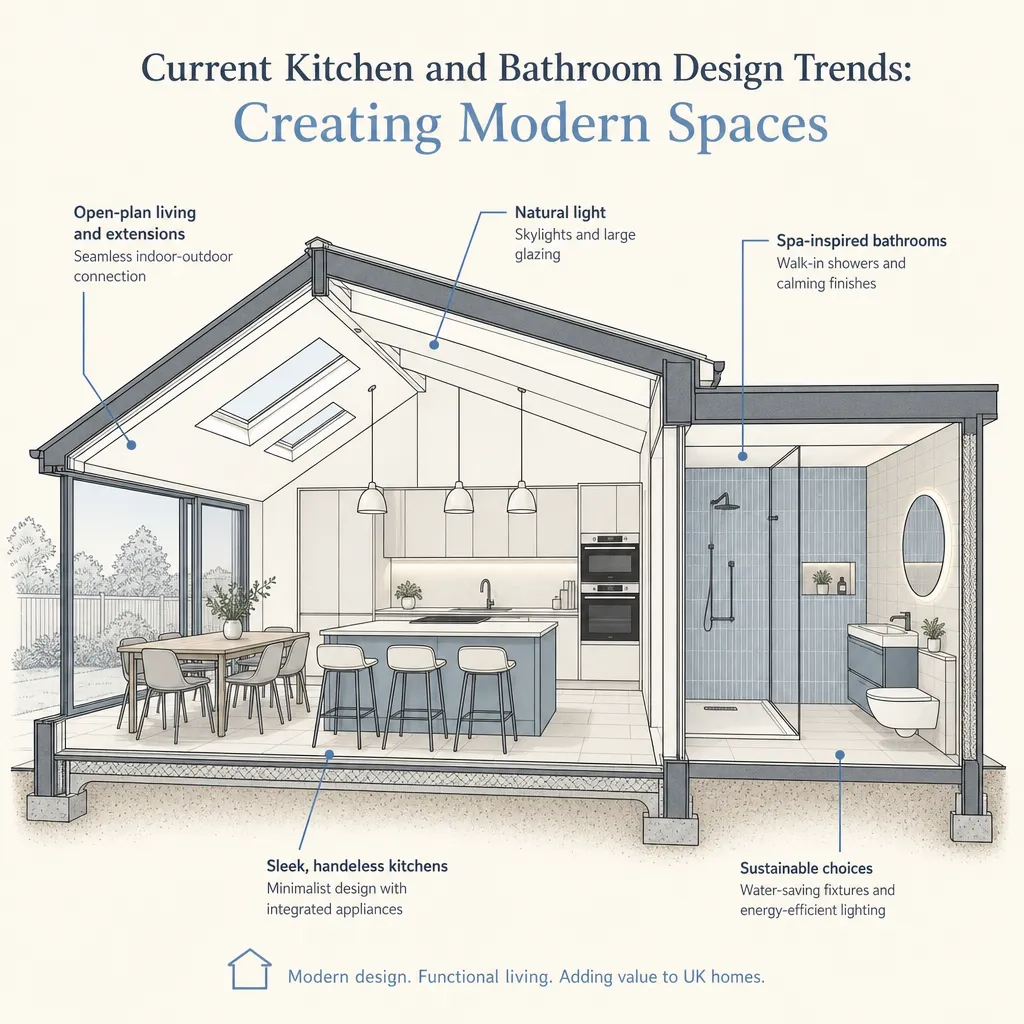
Current Kitchen and Bathroom Design Trends: Creating Modern Spaces
In 2026, UK kitchen design favours open-plan layouts, handleless cabinetry, and quartz composite worktops, while bathrooms trend towards walk-in showers, freestanding baths, and fluted tiles.
 Improvement & Build
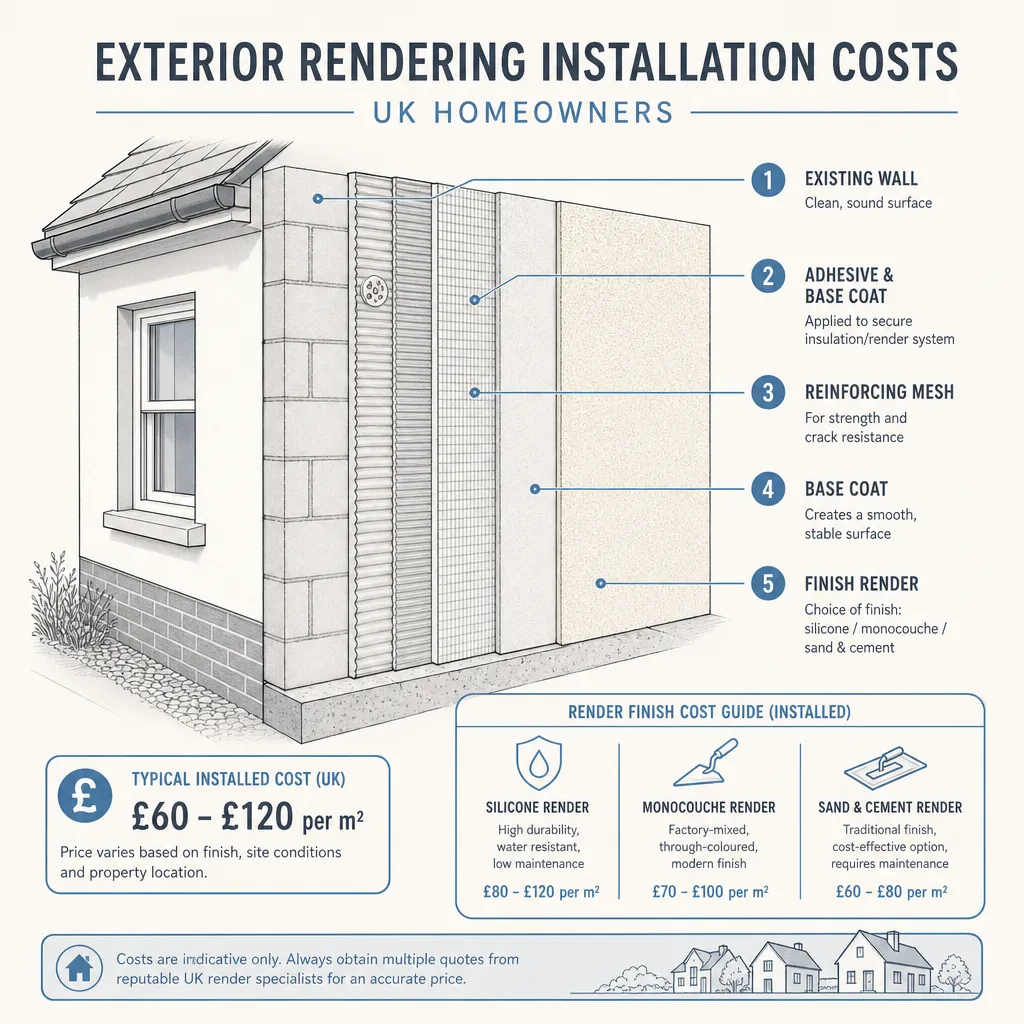
Exterior Rendering Installation Costs
Exterior rendering in the UK typically costs £20–£60 per square metre for standard render systems, or £80–£150 per square metre for External Wall Insulation with a render finish.
 Improvement & Build
Designing an outdoor kitchen for entertaining and garden living
An outdoor kitchen in a UK garden needs a stable, level base — typically a concrete slab or quality paving — with weather-rated materials such as stainless steel grade 316 or frost-rated porcelain.
 Improvement & Build
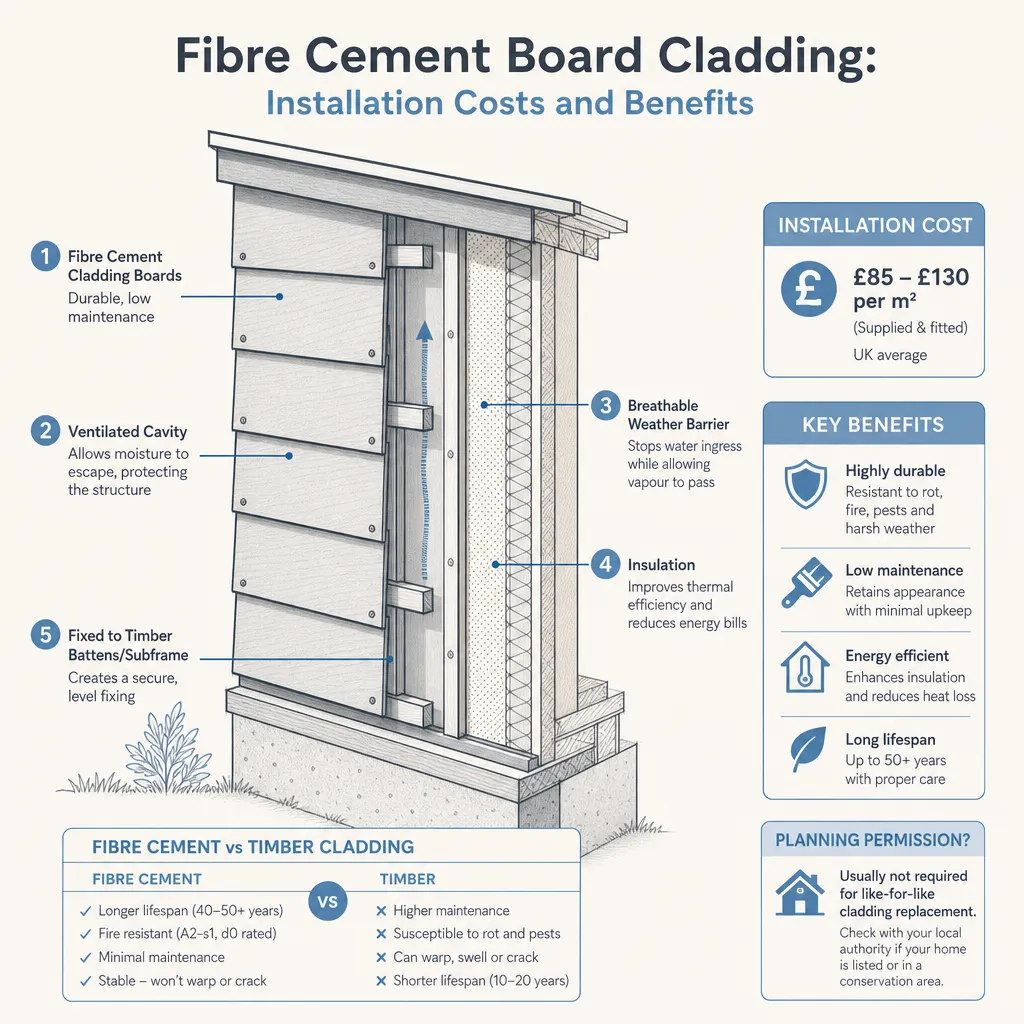
Fibre Cement Board Cladding: Installation Costs and Benefits
Fibre cement board cladding typically costs £80–£180 per m² installed in the UK, including boards, battens, breather membrane, and labour.
 Improvement & Build
Installing Peel-And-Stick Wallpaper: Application Techniques
Peel-and-stick wallpaper works best on smooth, emulsion-painted walls cured for at least 30 days, in rooms between 13°C and 30°C.