New-Build Property Inspections: What to Expect and Key Focus Areas
By Housey · Last reviewed 31st of May 2026
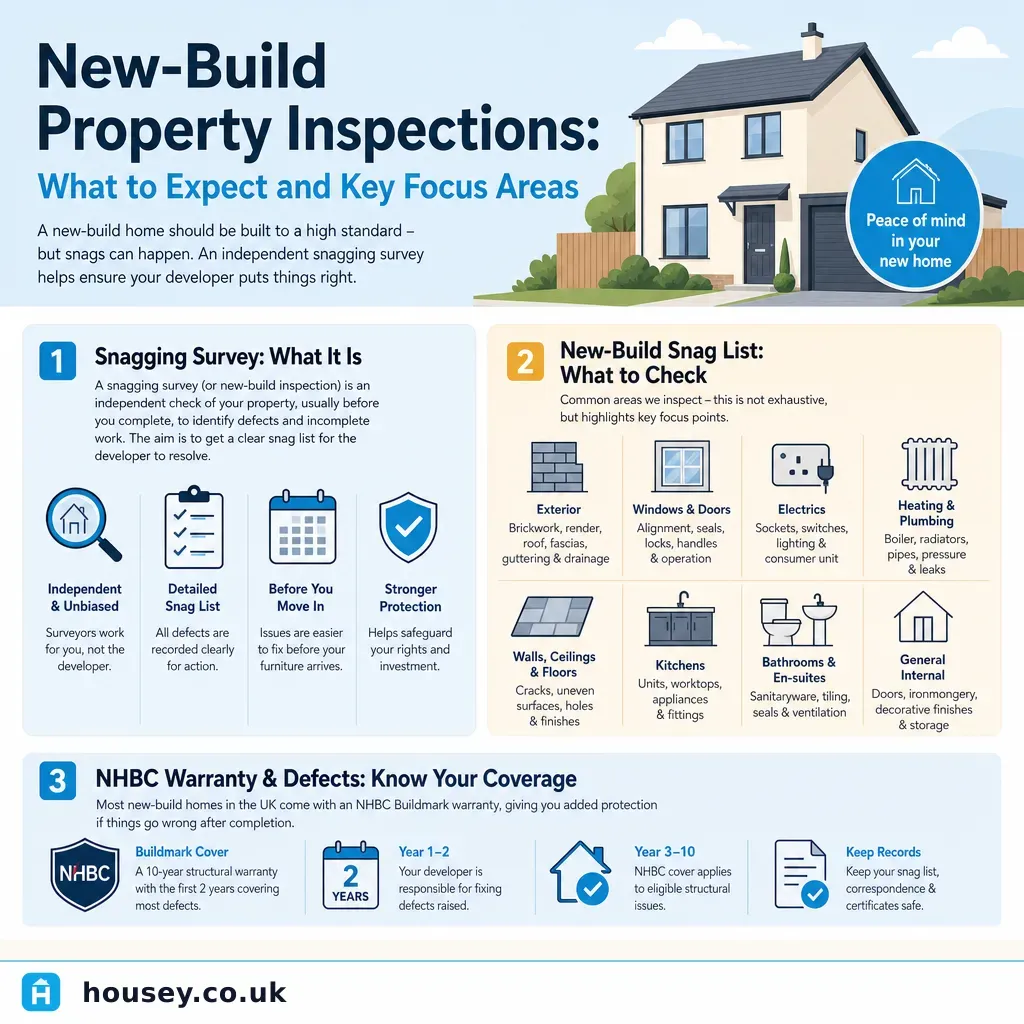
New-Build Property Inspections: What to Expect and Key Focus Areas
Collecting the keys to a new-build home feels like the end of the journey, but for many buyers it marks the start of a critical snagging period. Developers work to tight handover schedules, and even well-run sites routinely produce properties with dozens of minor defects — and occasionally more serious build-quality issues. Understanding how inspections work, and what protection you have under your NHBC Buildmark warranty or equivalent, puts you in a stronger position before and after you complete.
Key points
- NHBC Buildmark provides a 2-year builder fix period followed by 8 years of structural insurance cover — but you must report defects promptly to preserve your rights.
- An independent snagging survey should ideally be carried out before legal completion, so defects are formally recorded before you take ownership.
- The average new-build snag list contains between 100 and 200 items on a typical three-bedroom house, ranging from paint blemishes to missing seals and poorly fitted doors.
- Your builder is required under Building Regulations to provide a completion certificate and an Energy Performance Certificate (EPC) before handover.
- NHBC Standards set minimum construction requirements; if a builder falls short, the warranty insurer can require remediation even if the builder disputes responsibility.
What is a new-build snagging inspection?
A snagging inspection is a detailed assessment of a newly built property carried out specifically to identify defects, incomplete work, and deviations from the agreed specification or Building Regulations. Unlike a standard RICS Home Survey — which assesses an existing property's condition and value — a snagging survey focuses on what the builder has or has not done correctly.
Defects found during snagging typically fall into two categories.
Cosmetic snagging items:
- Scuffed paintwork or missed areas
- Poorly fitted skirting boards, architraves, or coving
- Gaps in tiling or grouting
- Scratched glazing or window fittings
Technical snagging items:
- Doors or windows that do not open, close, or seal correctly
- Missing or incorrectly installed insulation
- Plumbing fittings that drip or run under pressure
- Electrical sockets or switches not flush or not functioning
- Drainage falls that do not meet Building Regulations Part H
Technical items carry more risk and are more likely to deteriorate or cause secondary damage if left unaddressed.
When should you arrange an inspection?
Timing | Approach | Advantage | Limitation |
|---|---|---|---|
Before legal completion | Independent snagging surveyor with developer permission | Defects recorded before ownership transfers; leverage at its highest | Developer must grant access; some refuse |
At legal completion / handover | Walkthrough with developer site manager | Immediate and convenient | Rushed; no independent record |
Within 2 years of completion | NHBC 2-year builder fix period still active | Covers items missed at handover | Developer may dispute or delay |
After 2 years | NHBC structural cover only | Structural defects still protected for 8 years total | Very limited recourse for non-structural items |
Arranging an inspection before completion is strongly recommended. The developer retains the most incentive to resolve issues while the sale is still pending.
Which professional should carry out the inspection?
Most independent snagging inspectors are not regulated under RICS, so the market is relatively open. When selecting an inspector, look for:
- Membership of a recognised body such as the New Homes Quality Board (NHQB), the Chartered Institute of Building (CIOB), or a comparable professional organisation
- A detailed sample report — a thorough snagging report includes annotated photographs, location references, and a categorised defect list
- Familiarity with NHBC Standards, which set the technical benchmarks builders must meet
- A clear, written scope of inspection with defined deliverables
A RICS surveyor can also carry out a snagging-focused inspection. For larger or more complex properties — or where structural or drainage concerns have already emerged — this level of professional oversight may be appropriate.
New-build homeowner checklist
Use this checklist before or at your legal completion walkthrough:
Structure and envelope
Internal finishes
Plumbing and drainage
Electrical and mechanical
Documents you should receive
Red flags: when to escalate beyond a standard snag list
Most snagging defects are cosmetic or minor technical issues. The following findings suggest more serious problems and should be escalated immediately:
- Visible cracking in blockwork or brickwork — especially if stepped or diagonal — may indicate structural movement or inadequate substructure
- Damp patches, staining, or condensation on walls, ceilings, or floors could indicate missing insulation, inadequate waterproofing, or thermal bridging
- Doors or windows that bind or cannot close may indicate frame distortion or structural movement rather than a normal fitting tolerance
- Uneven floors beyond NHBC's defined acceptable tolerances
- Gas odour — stop, ventilate, leave the property, and call the National Gas Emergency Service on 0800 111 999
- Missing fire doors or non-compliant ironmongery in flats or houses over two storeys: a Building Regulations Part B compliance issue
If any of these are present, ask the developer for a written response and, if in doubt, instruct a RICS surveyor or structural engineer for an independent assessment before accepting the property.
When to get professional help
Contact an independent snagging inspector or RICS surveyor before accepting your new-build if:
- The developer has declined to act on defects raised at handover
- You have identified damp, structural movement, or apparent non-compliance with Building Regulations
- You are approaching the end of your 2-year builder fix period with outstanding defects still unresolved
- The developer has gone into administration and the NHBC structural warranty is your primary recourse
The New Homes Ombudsman Service (NHOS) can investigate complaints where the developer is registered with the New Homes Quality Board and a resolution cannot be reached.
How Housey can help
Housey connects you with qualified professionals for new-build snagging surveys and RICS home surveys. Submit your property details and receive quotes from vetted local inspectors who understand NHBC Standards and can produce a comprehensive, evidenced defect report.
Frequently asked questions
Do I have to use an independent snagging inspector, or can I do it myself?
There is no legal requirement to use a professional inspector. However, a trained snagging inspector will identify technical defects that buyers typically miss — drainage gradients, thermal bridging, or substandard electrical installations among them. Given that surveys typically cost £300–£600 for a three-bedroom house, most buyers find the cost worthwhile relative to the remediation leverage it provides.
Can the developer refuse access for a pre-completion snagging survey?
Yes. Developers are under no legal obligation to allow access before exchange or completion. Many do allow it if you make the request formally in writing. If access is refused, arrange the survey as close to legal completion as possible and compile your own photographic record during the handover walkthrough.
What if the developer ignores my snag list?
Under NHBC Buildmark, defects reported within the first two years must be addressed by the builder. If the builder fails to act, you can escalate directly to NHBC. Persistent unresolved defects may also be referred to the New Homes Ombudsman Service if the developer is registered with the New Homes Quality Board.
Does an EPC rating below the advertised figure count as a snag?
An EPC is a calculated estimate and minor variations are not unusual. However, if the as-built property differs significantly from specification — for example, if specified insulation has not been installed — this is a technical defect that should appear on the snag list. The Building Regulations completion certificate confirms compliance with Part L energy efficiency requirements.
Sources and further reading
- NHBC Buildmark warranty information — NHBC
- New Homes Quality Board: consumer code and ombudsman — New Homes Quality Board
- Building Regulations approval — GOV.UK
- Energy Performance Certificates — GOV.UK
- Gas Safe Register — Gas Safe Register
Useful next reads
 Surveys & Inspections
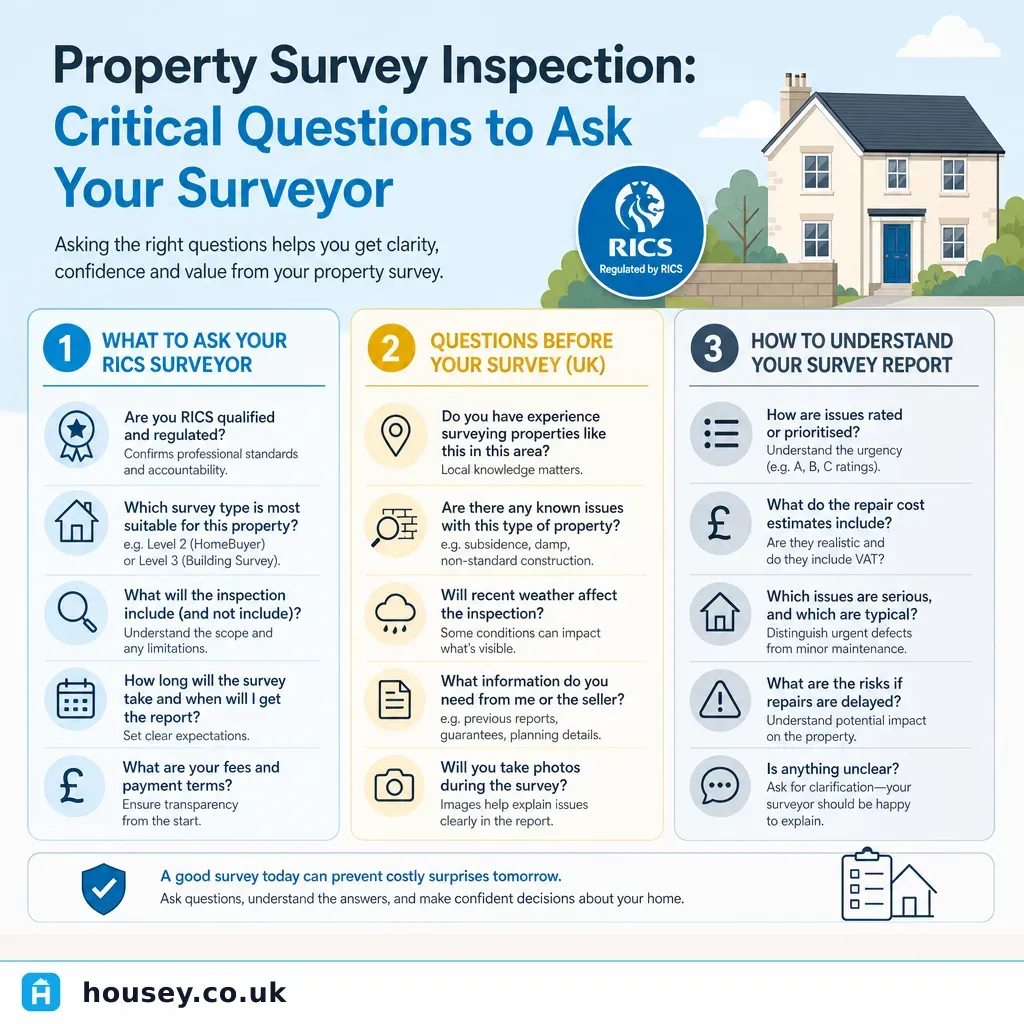
Property Survey Inspection: Critical Questions to Ask Your Surveyor
Before instructing a surveyor, ask which RICS level suits your property and what the report will and will not cover.
 Surveys & Inspections
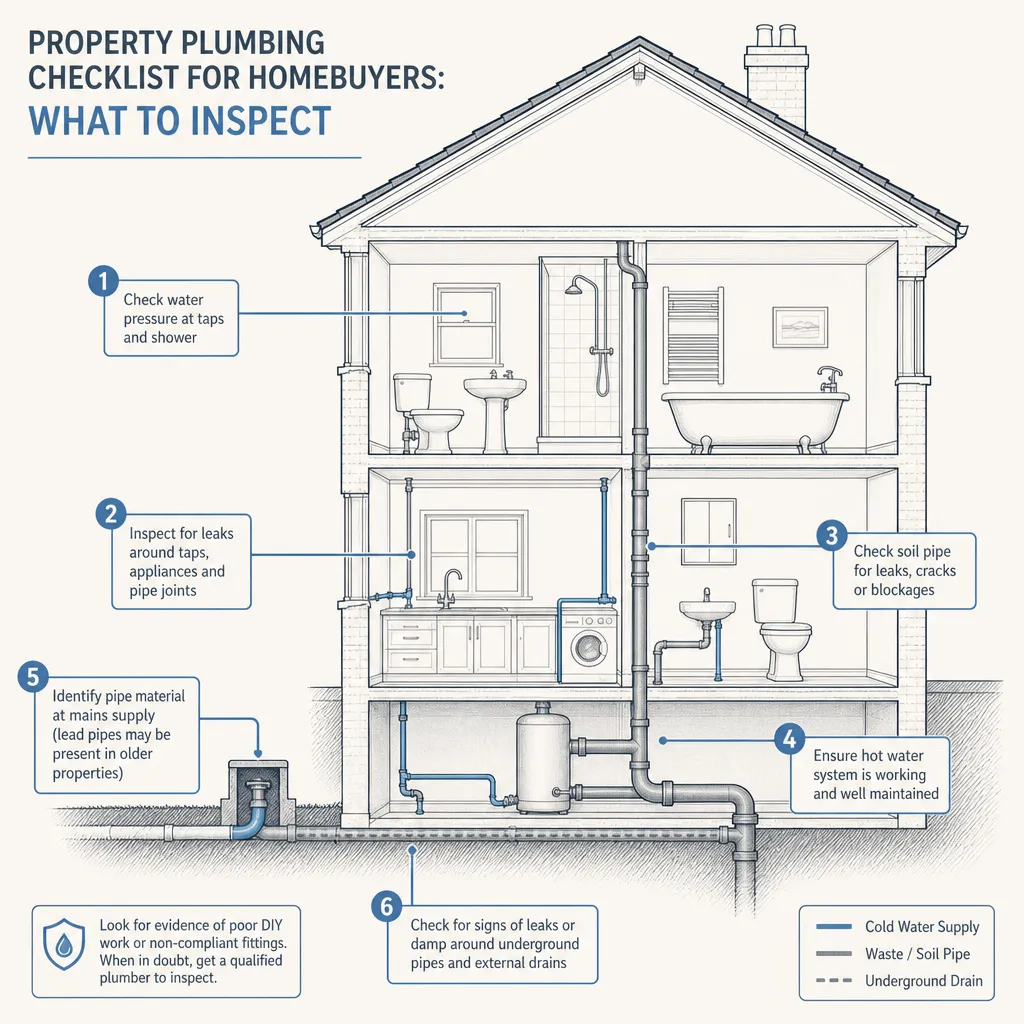
Property Plumbing Checklist for Homebuyers: What to Inspect
Before exchanging on a UK property, check water pressure at multiple outlets, look for signs of damp or staining around pipes, confirm whether any lead pipework remains, inspect the boiler age and service history, and ask your surveyor about drainage.
 Surveys & Inspections
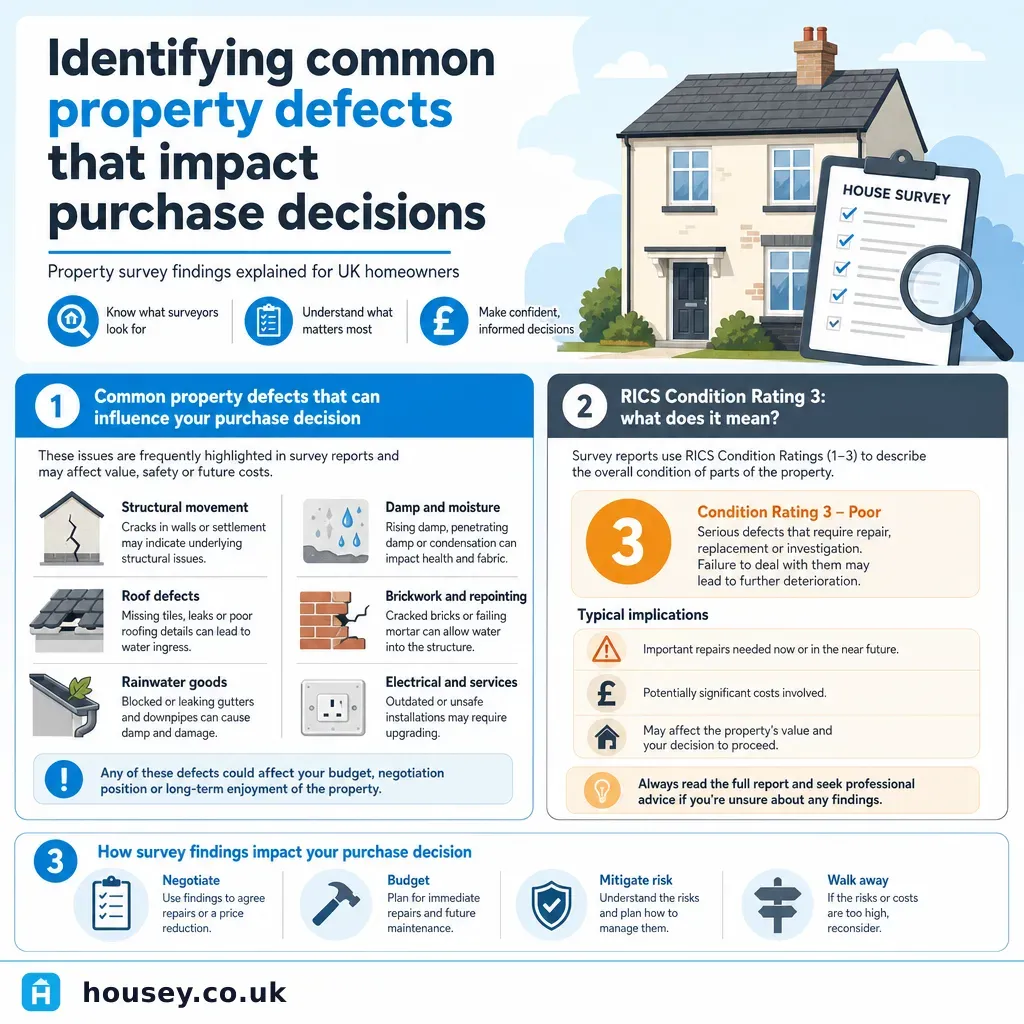
Identifying common property defects that impact purchase decisions
The defects most likely to affect a UK house purchase are structural movement, active damp, Japanese knotweed, asbestos, and failing electrics or roofs.
 Surveys & Inspections
New Build Properties: Snagging and Quality Assurance for New Homes
A snagging survey identifies defects and unfinished work in a newly built home, ideally before legal completion.
 Surveys & Inspections
Rental Property Inspection Checklist: What Landlords Should Assess
A landlord inspection should cover statutory safety checks (gas, electrical, smoke alarms), structural condition, services, and interior fabric.