New Systems for Residential Floor and Roof Construction
By Housey · Last reviewed 24th of May 2026
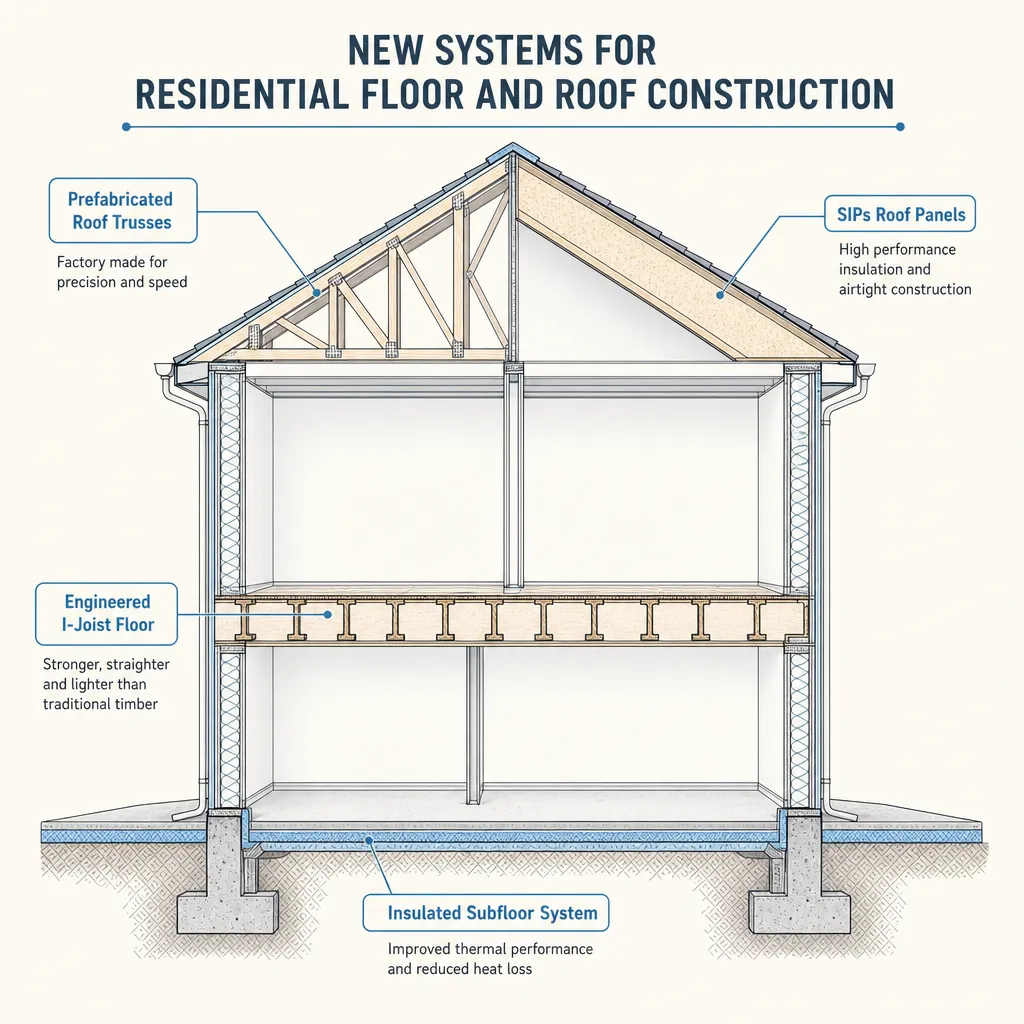
New Systems for Residential Floor and Roof Construction
Whether you're planning a loft conversion, a rear extension, or a full self-build, the structural system you choose for floors and roofs shapes everything from span lengths and insulation performance to build programme and long-term maintenance costs. UK homeowners and their contractors now have a broader range of engineered and prefabricated options than were available a decade ago, and the choice carries real consequences for thermal performance, compliance with Building Regulations, and long-term durability.
Key points
- Engineered timber I-joists can achieve clear spans of 6 m or more, compared with roughly 4–4.5 m for equivalent solid timber joist sections of the same depth.
- Building Regulations Approved Document A (Structure) governs structural performance; Approved Document L sets thermal performance standards — check the current version for U-values applicable to your project type.
- Prefabricated roof trusses are manufactured to BS EN 14250 and are typically 10–20% less expensive in labour than an equivalent site-cut roof.
- Warm roof assemblies — where all insulation sits above the structural deck — generally outperform cold roofs in both thermal performance and condensation risk management.
- Structural Insulated Panels (SIPs) combine structure and insulation in a single factory-made panel and can achieve roof U-values as low as 0.13 W/m²K.
What floor construction systems are available for residential projects?
Solid timber joists
Sawn or regularised C16/C24 grade timber joists remain common in domestic extensions. Practical for spans up to around 4 m, familiar to most carpenters, and cost-effective for straightforward layouts. Limitations include susceptibility to shrinkage noise, modest acoustic performance between floors, and the need to drill for pipe and cable runs.
Engineered I-joists
I-joists — with timber flanges bonded to an OSB web — are dimensionally stable, lighter than solid timber, and capable of clear spans of 6 m and beyond using manufacturer span tables. Pre-punched knock-out holes simplify service routing. They are standard in modern timber-frame homes and larger open-plan extensions.
Metal web joists
Metal web joists replace the timber web with an open steel lattice, creating a large void through which pipes, ducts, and cables pass without drilling. This is particularly useful in low-energy or passivhaus builds where a managed service zone above a continuous airtight membrane is required. Clear spans of 7 m and beyond are achievable.
Beam and block
Prestressed concrete beams with infill aggregate or dense-block panels form the structural deck, topped with a screed or floating finish. Standard for masonry ground floors, particularly over contaminated ground or in radon-affected areas, and a robust base for underfloor heating systems.
System | Typical clear span | Services integration | Common use case |
|---|---|---|---|
Solid timber joist | Up to ~4.5 m | Drilling required | Simple masonry extensions |
Engineered I-joist | Up to ~6 m+ | Pre-punched holes | Timber-frame, wide-span floors |
Metal web joist | Up to ~7 m+ | Open web zone | Low-energy builds, complex M&E |
Beam and block | Up to ~5 m | Screed zone | Masonry ground floors, UFH bases |
What roof construction systems are used in residential buildings?
Traditional cut roof
Built on site from rafters, ridge boards, purlins, and ceiling joists. Highly adaptable for complex geometries — hips, valleys, dormers, and irregular plans — but labour-intensive and dependent on carpenter skill. Most appropriate for bespoke extensions where prefabrication is impractical.
Prefabricated roof trusses
Factory-fabricated from stress-graded timber with gang-nail plate connectors, trusses are designed to the specific span, pitch, and imposed load of your project. Faster to erect, structurally consistent, and generally more cost-effective than cut roofs for straightforward rectangular plans. The standard choice for volume house builders and most extensions.
Structural Insulated Panels (SIPs)
SIPs consist of two OSB skins bonded to a rigid foam core. A 172 mm SIP typically achieves approximately 0.18 W/m²K; thicker panels can reach 0.13 W/m²K or better. Best suited to simple pitched or mono-pitch roofs, and popular for high-performance self-builds where a fabric-first thermal strategy is a priority.
Flat roof systems: cold roof versus warm roof
Type | Insulation position | Ventilation required | Condensation risk |
|---|---|---|---|
Cold roof | Between joists, below deck | Yes — 50 mm clear air gap above insulation | Higher if ventilation paths are blocked |
Warm roof | Above structural deck, below membrane | No | Low |
Inverted warm roof | Above waterproof membrane under ballast | No | Very low |
Approved Document L sets limiting U-values for flat roofs in extensions — check the current version of ADL1B for the applicable figure. Warm roof and inverted warm roof assemblies are generally the preferred specification because cold roof ventilation paths are frequently partially blocked during or after construction, increasing condensation and rot risk.
Which system should you choose?
- Choose solid timber joists if the span is under 4 m, the project is a conventional masonry extension, and cost is the primary driver.
- Choose I-joists or metal web joists if you need clear spans over 4.5 m, an open-plan layout, or full-depth insulation without compromising floor zone depth.
- Choose beam and block for ground floors on contaminated or radon-affected sites, or where a robust concrete substrate is needed for underfloor heating or heavy tile finishes.
- Choose prefabricated trusses for most straightforward pitched roofs — they are faster, structurally engineered to the load, and cost-competitive.
- Choose SIPs if fabric-first thermal performance and reduced on-site labour are priorities and the roof geometry is simple.
- Consult a structural engineer if you are changing any load-bearing element, removing walls, building on made or variable ground, or if any span or loading falls outside standard manufacturer span tables.
When to get professional help
A structural engineer or RIBA-registered architect should be involved if:
- You are removing or modifying a load-bearing wall or floor element
- The roof geometry is complex — hips, valleys, large dormers, or substantial glazed areas
- The site is on a slope, made ground, or ground with variable bearing capacity
- The project involves a listed building or is in a conservation area
- You are unsure whether a joist section is adequate — never substitute a smaller depth without recalculation
Building control approval (local authority or an approved inspector) is required for structural floor and roof work in virtually all circumstances. Confirm Part A and Part L compliance before work begins.
How Housey can help
Housey connects you with vetted qualified roofers and experienced extension builders who can advise on structural system selection, prepare building regulations submissions, and manage specialist trades throughout your project.
Frequently asked questions
Do prefabricated roof trusses cost more than a traditional cut roof?
Generally no — trusses are typically less expensive overall because they reduce on-site labour and are engineered precisely for the span, pitch, and loading involved. The saving is mainly in labour time. For complex geometries that cannot be prefabricated, a traditional cut roof is sometimes the only practical option and usually carries a higher labour cost.
Can I mix floor systems in the same project?
Yes, this is common in masonry house types. Ground-floor beam and block provides a robust, moisture-resistant base, while lightweight I-joists on upper floors suit longer spans and allow deeper insulation. Your structural engineer's drawings will specify each floor level separately, and building control will check each element for compliance with Approved Document A.
What is the minimum ventilation gap in a cold flat roof?
BS 5250 requires a clear ventilated air path of at least 50 mm above the insulation in a cold roof, with ventilation openings equivalent to a continuous 25 mm gap at eaves level. Blocked ventilation paths are a common cause of interstitial condensation and timber rot in cold flat roofs — warm roofs eliminate this risk by placing all insulation above the structural deck.
Do I need a structural engineer to specify I-joist spans?
For standard domestic loading, manufacturers' published span tables are widely used by competent contractors without a separate structural engineer. However, for irregular loading, significant point loads, large openings, or any uncertainty about wall or ground conditions, structural engineer confirmation is prudent. Building control may also request calculations for unusual span or loading situations.
Sources and further reading
- Approved Document A — Structure — GOV.UK
- Approved Document L — Conservation of Fuel and Power — GOV.UK
- Structural Timber Association — technical guidance — Structural Timber Association
- BS EN 14250 — Prefabricated structural timber products — BSI Group
Useful next reads
 Improvement & Build
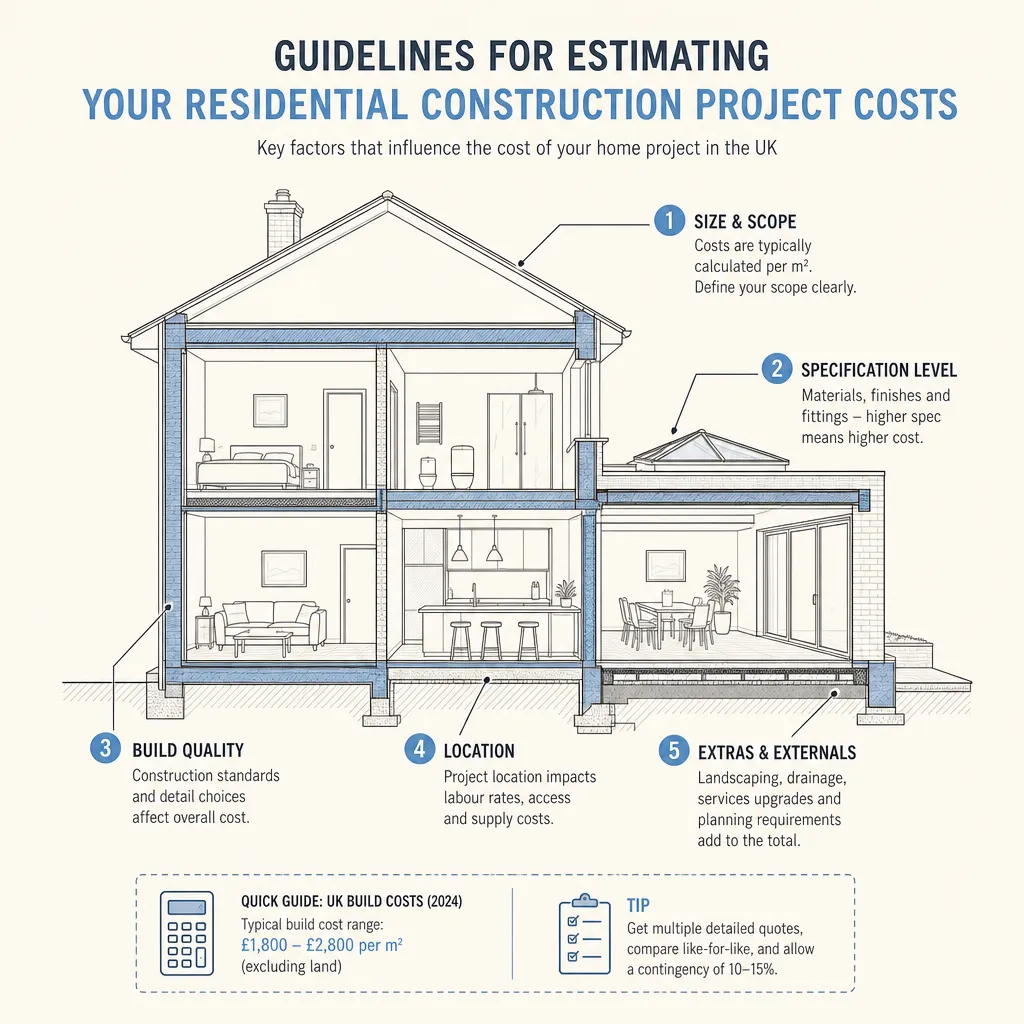
Guidelines for Estimating Your Residential Construction Project Costs
Estimating residential construction costs in the UK starts with BCIS cost-per-square-metre benchmarks, adjusted for region, specification, and site conditions.
 Improvement & Build
Custom Concrete Homes: Design, Building, and Considerations
Custom concrete homes in the UK are typically built using insulated concrete formwork (ICF), precast panels, or in-situ poured concrete.
 Improvement & Build
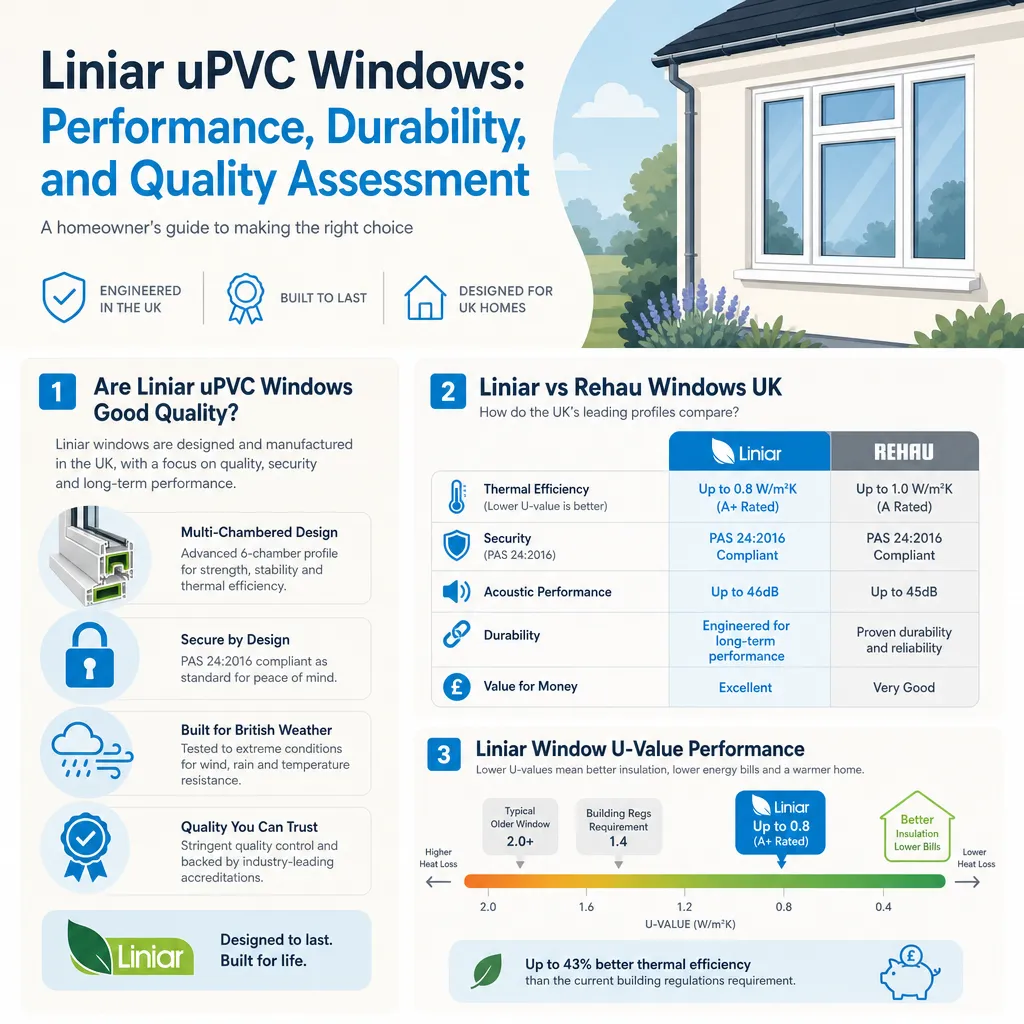
Liniar uPVC Windows: Performance, Durability, and Quality Assessment
Liniar uPVC window profiles are manufactured in the UK using multi-chambered, foamed frames.
 Improvement & Build
Garden Tap Installation with Hot and Cold Water: Plumbing Options
Adding a cold garden tap is a common DIY project, but routing hot water outdoors requires a plumber to connect to your domestic hot water system and comply with the Water Supply (Water Fittings) Regulations 1999.
 Improvement & Build
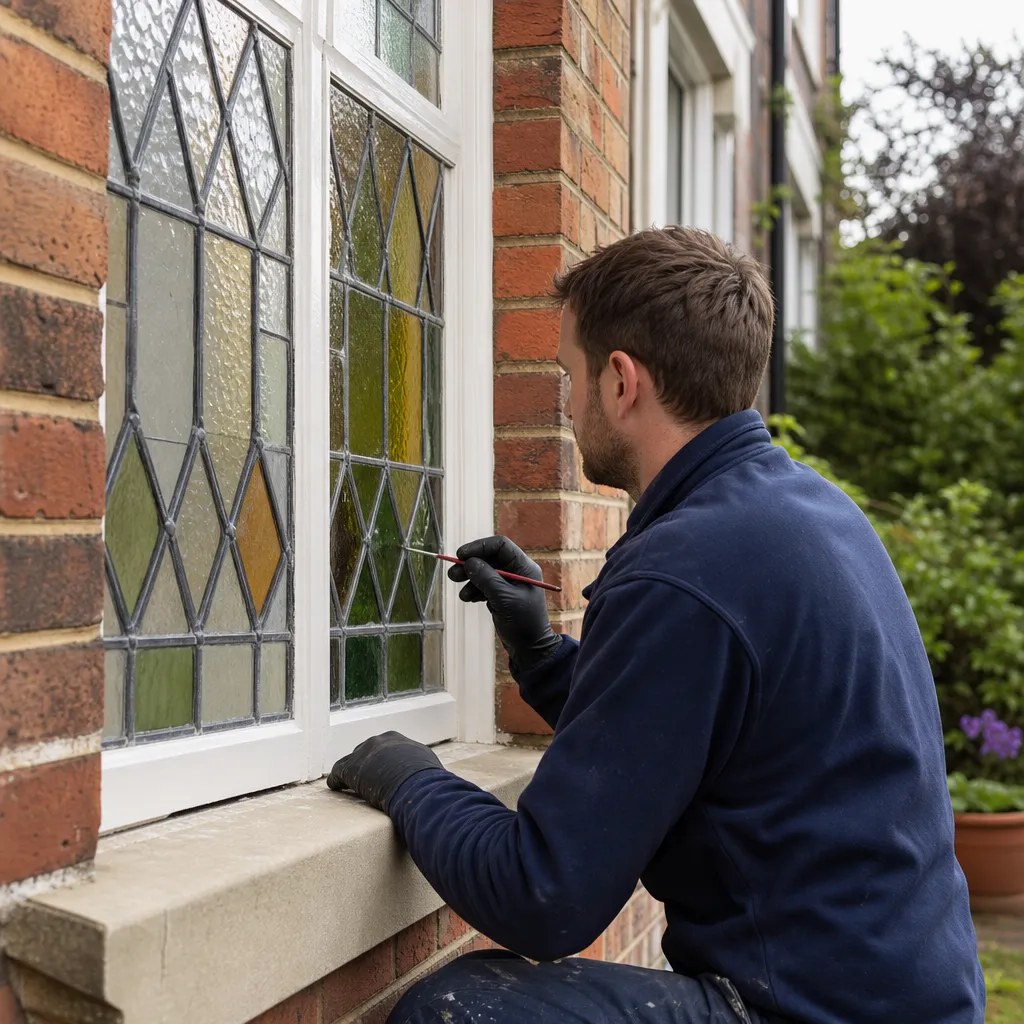
Sealing and Maintaining Historic Leaded Glass Windows: Preservation and Performance
Leaded glass windows are maintained using traditional linseed oil cement — not silicone or modern sealants, which prevent natural movement in the lead came.