Living in Converted Commercial Spaces: Office-to-Residential Transformations
By Housey · Last reviewed 8th of May 2026
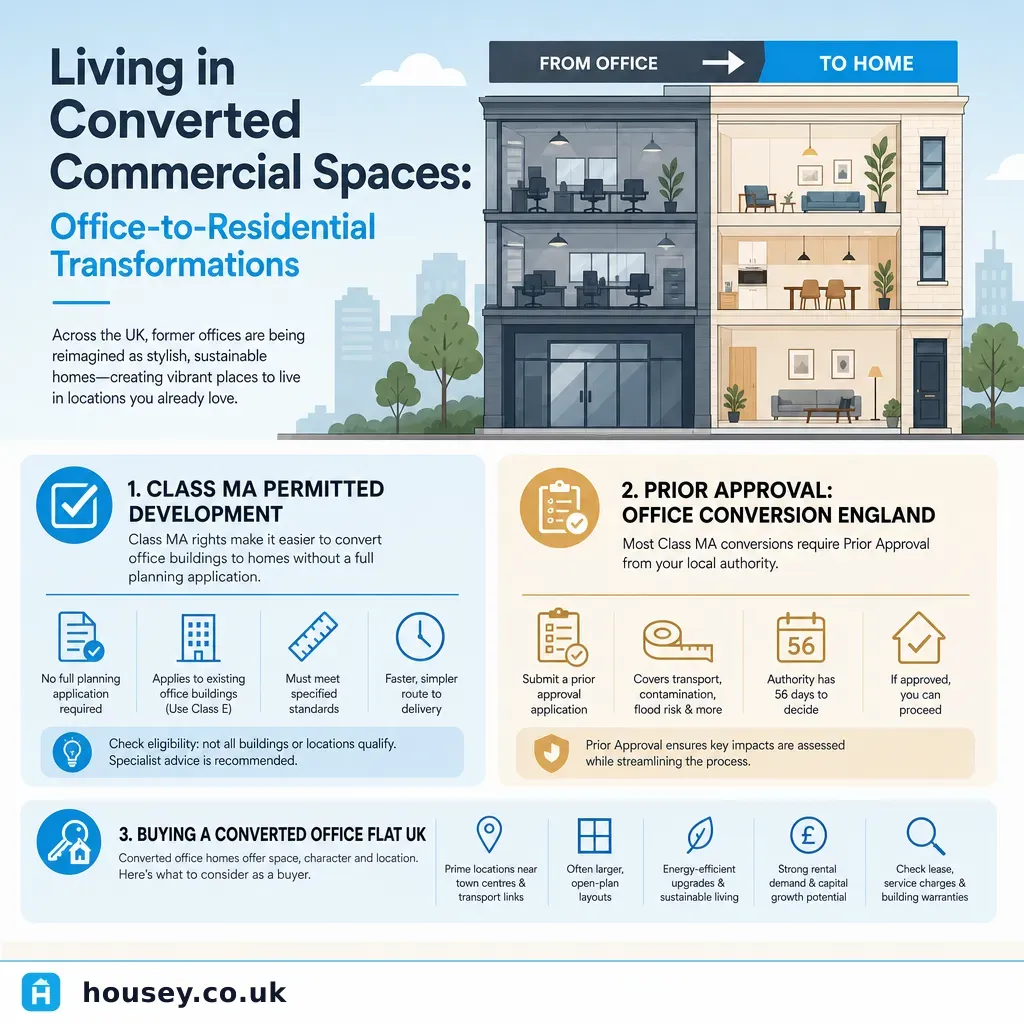
Living in Converted Commercial Spaces: Office-to-Residential Transformations
The conversion of offices and other commercial buildings into homes has accelerated significantly since the expansion of permitted development rights in 2021. Across many UK towns and cities, former office blocks, commercial units, and light industrial premises have become flats, studios, and family homes — offering buyers and renters access to urban locations, distinctive spaces, and lower entry prices than equivalent new-build properties nearby. Whether you are a developer commissioning a conversion, a homeowner buying a converted flat, or an investor exploring development opportunities, understanding the planning route, Building Regulations requirements, and practical risks is essential before committing.
Key points
- Most office-to-residential conversions in England fall under Class MA Permitted Development, requiring Prior Approval from the local planning authority rather than full planning permission — but Prior Approval is not automatic.
- Prior Approval applications under Class MA are assessed on five matters: transport and highways impact, contamination risk, flooding risk, availability of natural light for habitable rooms, and noise from commercial neighbours.
- Building Regulations approval is always required, regardless of the planning route taken — covering structural integrity, fire safety, ventilation, thermal performance, and means of escape.
- Part O of the Building Regulations (overheating prevention), which came into force in England in June 2022, applies to new dwellings created from conversions and requires measures to limit and remove unwanted heat gains.
- Some local planning authorities have removed Class MA permitted development rights for specific areas using Article 4 Directions — always check with the relevant LPA before assuming the permitted development route is available.
Planning routes for office-to-residential conversion
There are two main planning routes for converting an office to residential use. The applicable route depends on the building, its use class, its location, and whether the local authority has issued an Article 4 Direction removing permitted development rights.
Class MA Permitted Development was introduced by amendments to the Town and Country Planning (General Permitted Development) (England) Order 2015, replacing the earlier Class O and Class PA rights from August 2021. It allows change of use from commercial, business, and service use (Use Class E) to residential use (Use Class C3), subject to a Prior Approval application to the local planning authority.
Full planning permission is required where:
- An Article 4 Direction has removed Class MA rights in the relevant area
- The building is a listed building (Listed Building Consent is also required for any works affecting the building's special interest)
- The building is within a scheduled ancient monument
- Significant external alterations are proposed that go beyond what the permitted development right allows
Which planning route applies to your conversion?
- Is the building a listed building? → Full planning permission and Listed Building Consent are required regardless of use class.
- Is there an Article 4 Direction removing Class MA rights in this area? → Full planning permission required; check with your local planning authority or review the authority's website.
- Is the building currently in Class E commercial use and not subject to any of the above? → Class MA Prior Approval route likely applies.
- Are significant external alterations proposed alongside the change of use? → Additional planning consent may be needed in parallel with Prior Approval.
- Is the building in a flood risk zone? → Prior Approval will be assessed on flood risk; check the Environment Agency Flood Map for Planning before applying.
What Prior Approval involves
Prior Approval is sometimes described as a lighter-touch process, but it is not automatic approval. The local planning authority has 56 days to determine a Prior Approval application. If no decision is issued within this period, the applicant may treat it as granted, subject to any conditions indicated in the application.
Under Class MA, the LPA assesses five matters:
- Transport: whether the proposal creates unacceptable transport or highways impacts
- Contamination: whether the site or building has contamination requiring remediation before residential use is safe
- Flooding: whether the site is at risk and whether proposed mitigation is adequate
- Natural light: whether habitable rooms will receive adequate natural light from windows or rooflights
- Noise: whether noise from commercial or industrial uses in the vicinity would have an unacceptable impact on future occupiers
A successful Prior Approval does not constitute Building Regulations consent — these are entirely separate processes, and both must be obtained before the conversion is lawfully complete.
Building Regulations requirements
Building Regulations approval is required for all material changes of use from commercial to residential, regardless of the planning route taken. A measured building survey of the existing structure is often needed to prepare accurate drawings for Building Regulations submission, particularly where the as-built condition may differ from any available historic drawings.
Approved Document | Requirement for office-to-residential conversion |
|---|---|
Part A (Structure) | Structural assessment confirming the existing building can support residential loads |
Part B (Fire safety) | Fire detection and alarm systems, means of escape, compartmentation between dwellings |
Part F (Ventilation) | Adequate ventilation of all habitable rooms and bathrooms |
Part L (Conservation of fuel and power) | Thermal performance of walls, roof, and floors; SAP energy calculation |
Part O (Overheating) | Limiting and removing unwanted heat gains — mandatory for new dwellings since June 2022 |
Part M (Access) | Accessibility requirements for new dwellings |
Part P (Electrical safety) | Notification of electrical installation work |
Space standards and local requirements
The Nationally Described Space Standard (NDSS) sets minimum floor areas for new dwellings in England. However, it applies only where the local planning authority has adopted it as a policy requirement — not all LPAs have done so, and the standard does not automatically apply to all Prior Approval conversions.
Where the NDSS does apply, indicative minimum floor areas include:
- Studio flat (1 person): 37 m²
- 1-bedroom flat (2 persons, 1 storey): 50 m²
- 2-bedroom flat (3 persons, 1 storey): 61 m²
Check your LPA's adopted local plan and any supplementary planning documents to confirm whether NDSS applies to the scheme before designing room layouts and unit sizes.
Red flags when buying a converted office flat
- No evidence of a Prior Approval decision notice or full planning permission in the title documents — your solicitor should request copies before exchange of contracts
- No Building Regulations completion certificate — without this, mortgage lenders may refuse to lend, buildings insurance can be affected, and resale is often complicated
- Very low floor-to-ceiling heights in habitable rooms — below 2.4 m is uncommon in standard commercial office space but can occur in mezzanine areas or near structural beams
- Poor natural light — deep-plan office buildings converted to studios may have rooms with no direct external window, or only borrowed light through glazed internal partitions
- No mechanical ventilation in place, or evidence that former commercial HVAC plant has been removed without being replaced by a compliant residential ventilation system
- Service charges calibrated for commercial occupancy — covering plant rooms, passenger lifts, or shared commercial areas — that are disproportionately high for residential use
- Unresolved ground contamination on brownfield or mixed-use sites adjacent to former industrial uses
Important limitations
This article provides general information about office-to-residential conversions in England as at May 2026. Planning policy, Article 4 Directions, permitted development rights, and Building Regulations requirements change over time and vary by location, property type, and local authority. This article is not a substitute for professional planning advice, legal advice, structural assessment, or building control advice specific to your property. The rules applicable to any given building should always be confirmed with your local planning authority, a qualified planning consultant or architect, and a building control body before any works commence or contracts are exchanged. Scotland, Wales, and Northern Ireland operate under separate planning and building regulations regimes.
What to ask a qualified professional
Before committing to an office-to-residential conversion — or purchasing a converted office flat — ask:
- Planning consultant or architect: Has Class MA been applied to this building or area before? Are there any Article 4 Directions in force here? What conditions were attached to any existing Prior Approval?
- Building control body or structural engineer: Is the existing structure adequate for residential loading? What fire safety and means-of-escape works will be required? Has Part O compliance been assessed?
- Project manager or contractor: What is the realistic programme from Prior Approval submission to Building Regulations completion certificate? What are the main programme risks?
- Solicitor: Does the title include a Prior Approval decision notice and a Building Regulations completion certificate? Are there any outstanding enforcement notices or unresolved planning conditions?
- Surveyor: Has a measured building survey been carried out? Are there known contamination, drainage, or structural issues?
When to get professional help
If you are planning a conversion, engage a planning consultant and architect before purchasing the building or submitting any application. If you are buying a converted flat, instruct a conveyancing solicitor to verify a Prior Approval decision notice and Building Regulations completion certificate before exchange. For properties with structural concerns, unusual construction, or suspected contamination, a structural engineer and environmental consultant should assess the building before works begin. A project manager can coordinate the full scope of professional inputs on complex conversion schemes, reducing the risk of programme overruns and compliance gaps.
How Housey can help
Housey connects homeowners and developers with specialists across the conversion process. Our building control consultants service helps you find qualified building inspectors to manage Regulations compliance from initial application through to completion certificate. For end-to-end project oversight, our project managers service connects you with experienced professionals to coordinate trades and manage the programme. If you need accurate existing drawings as a starting point for your design or Building Regulations submission, our measured building surveys service connects you with surveyors who can record the building precisely as found.
Frequently asked questions
Do I need planning permission to convert an office into a home in England?
In most cases, Class MA Permitted Development rights allow the change of use from a Class E commercial building to residential, subject to Prior Approval from the local planning authority. Prior Approval is not automatic — the LPA assesses transport, contamination, flooding, natural light, and noise. If an Article 4 Direction is in place for the area, or the building is listed, full planning permission is required. Always check with your local planning authority before proceeding.
What is the difference between Prior Approval and full planning permission?
Prior Approval is a streamlined process under permitted development rights. The LPA assesses specific matters only — contamination, flooding, natural light, noise, and transport — and has 56 days to respond. Full planning permission involves broader assessment of design, character of area, and amenity, with an 8-week statutory determination period for minor applications. Full planning permission gives the LPA greater discretion to refuse or impose conditions.
Does a converted office flat need a Building Regulations completion certificate?
Yes. All material changes of use from commercial to residential require Building Regulations approval and a completion certificate once works are inspected and signed off. Without a completion certificate, mortgage lenders may decline to lend, buildings insurance may be affected, and resale can be significantly complicated. If buying a converted flat, your solicitor should confirm a completion certificate has been obtained before exchange.
What is Part O of the Building Regulations?
Part O (Overheating) came into force in England in June 2022. It requires new dwellings — including those created from conversions — to limit unwanted heat gains and provide means of removing excess heat. This is particularly relevant for office conversions with large south- or west-facing glazed facades. Compliance may require solar-control glazing, external shading, or mechanical ventilation with heat recovery.
Can all offices be converted under permitted development?
No. Class MA applies to buildings in Class E commercial use. Buildings outside Class E (such as B2 general industrial or B8 storage), listed buildings, scheduled ancient monuments, and buildings in areas covered by an Article 4 Direction removing Class MA rights are not eligible. Scotland, Wales, and Northern Ireland have separate planning regimes and do not use the same permitted development framework as England.
Sources and further reading
- GOV.UK: When is permission required? — GOV.UK
- Planning Portal: Prior Approval — Planning Portal
- GOV.UK: Approved Document O — Overheating — GOV.UK
- GOV.UK: Nationally Described Space Standard — GOV.UK
- GOV.UK: Building regulations approval — GOV.UK
- Historic England: Planning permission and listed buildings — Historic England
Useful next reads
 Planning & Pre-Build
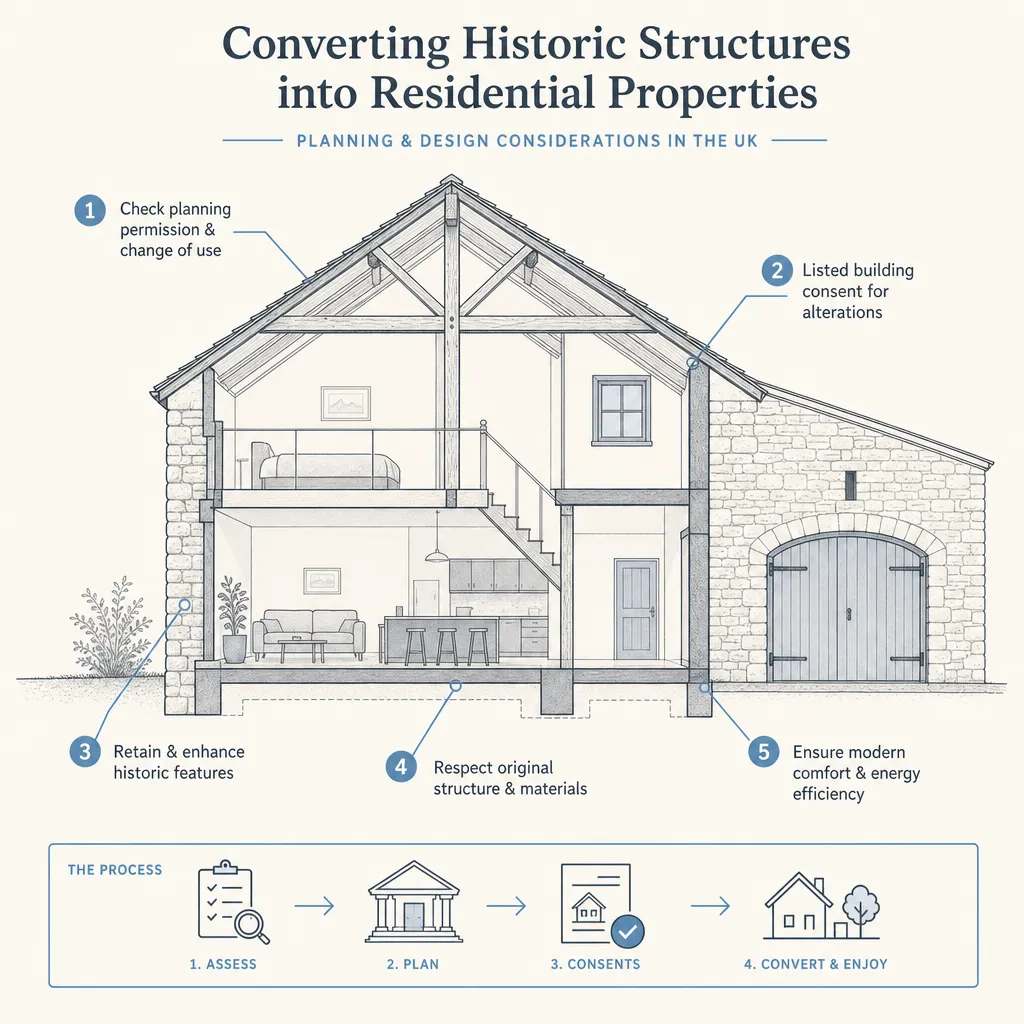
Converting Historic Structures into Residential Properties
Converting a historic barn, chapel, or industrial building into a home in the UK requires planning permission and, where the building is listed, Listed Building Consent as a separate application.
 Planning & Pre-Build
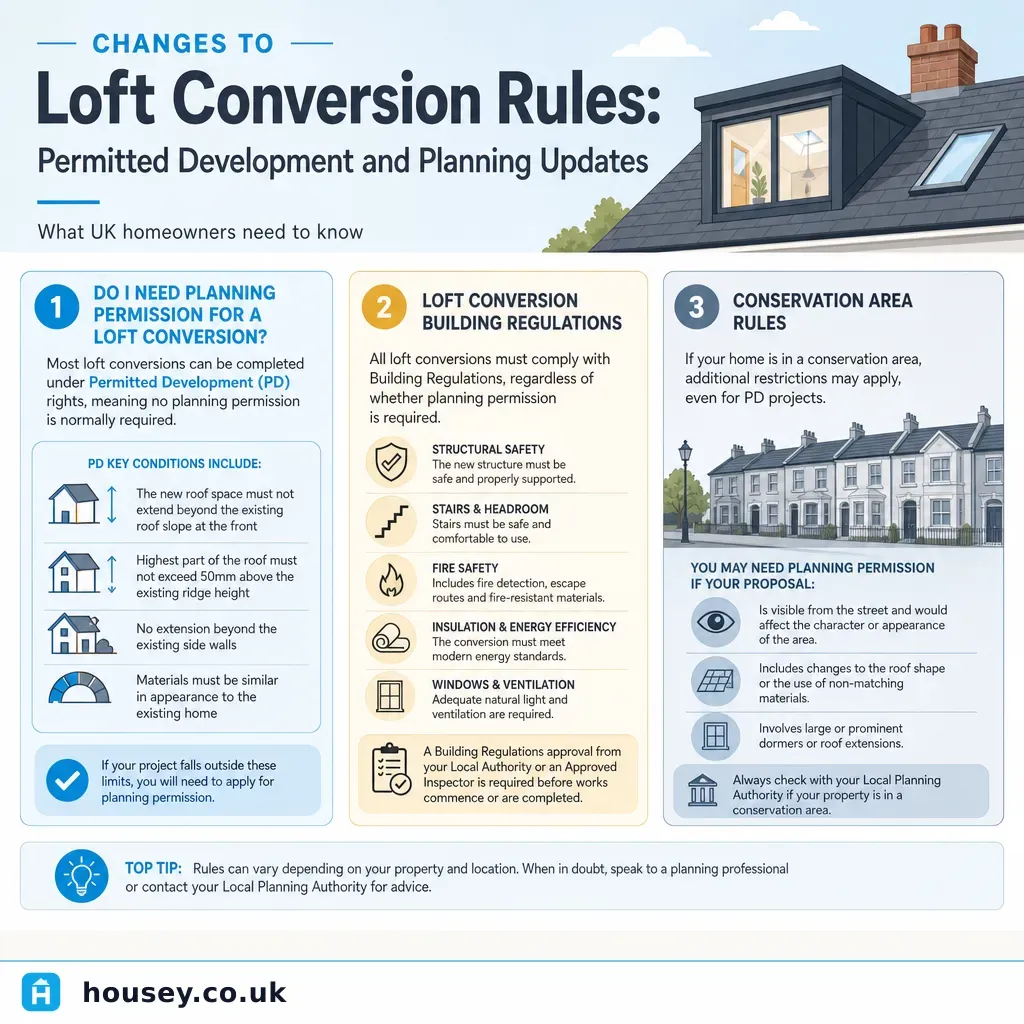
Changes to Loft Conversion Rules: Permitted Development and Planning Updates
In England, most loft conversions on standard houses qualify as Permitted Development under Class B of the GPDO 2015, allowing up to 40 cubic metres (terraced) or 50 cubic metres (detached or semi-detached) without a planning application — if conditions are met.
 Planning & Pre-Build
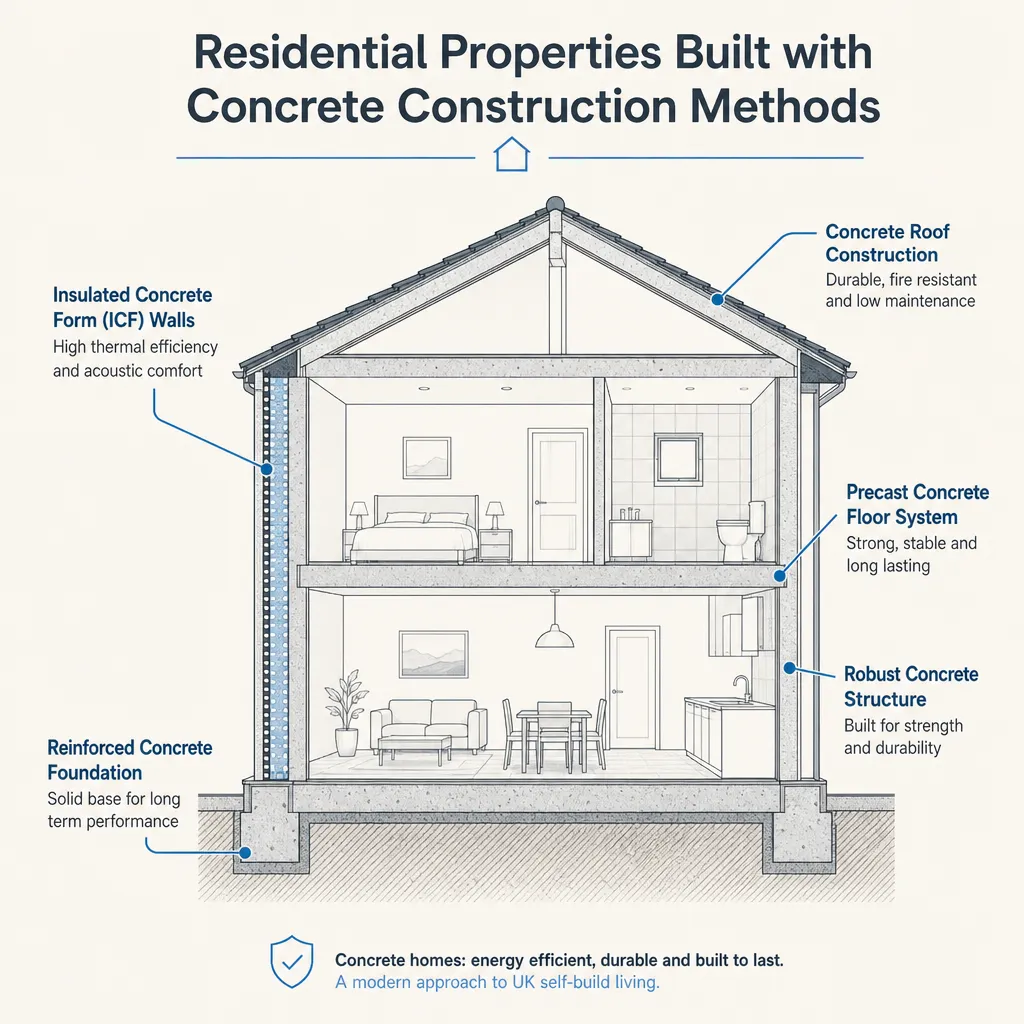
Residential Properties Built with Concrete Construction Methods
UK homes are built using several concrete methods: in-situ cast concrete, precast panel systems, insulating concrete formwork (ICF), and older non-traditional types such as Wimpey No-Fines and Laing Easiform.
 Planning & Pre-Build
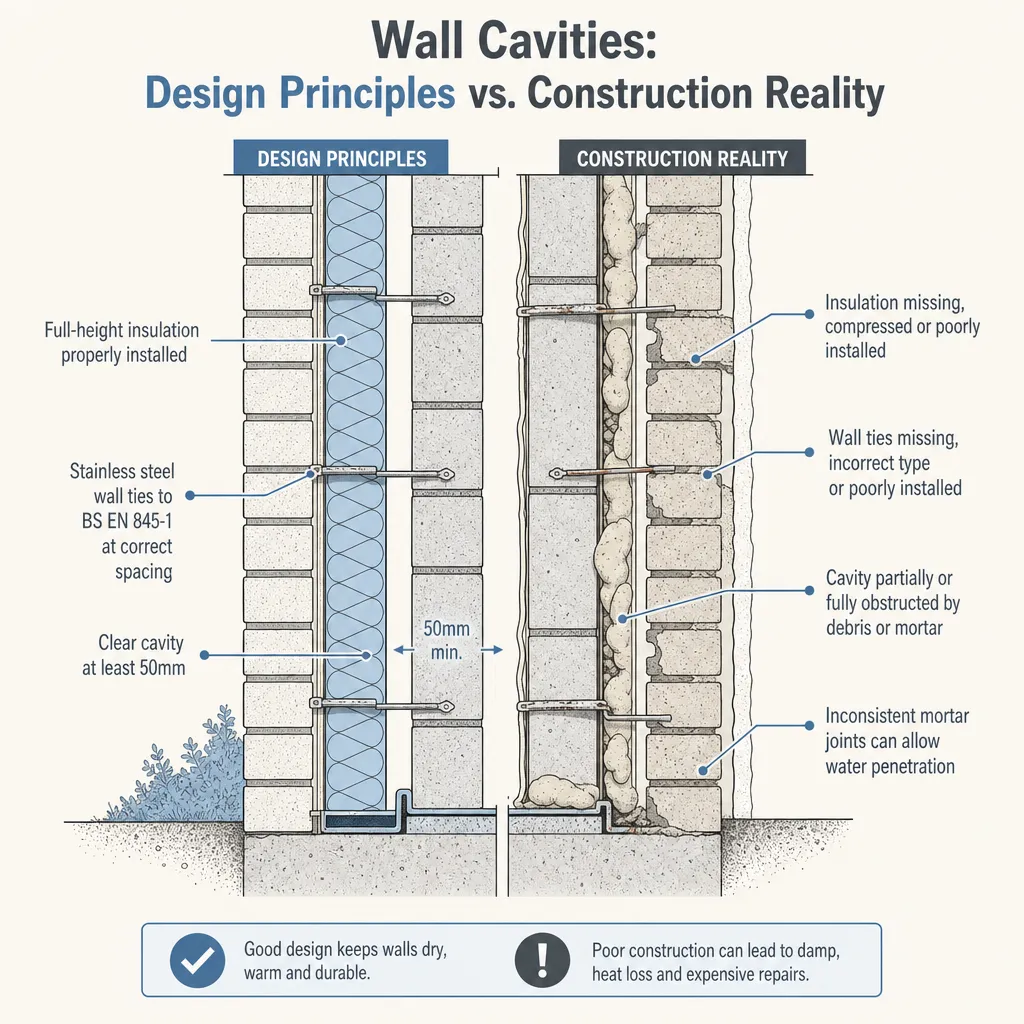
Wall Cavities: Design Principles vs. Construction Reality
A UK cavity wall is designed to resist weather, control heat loss, and structurally link two masonry leaves.
 Planning & Pre-Build
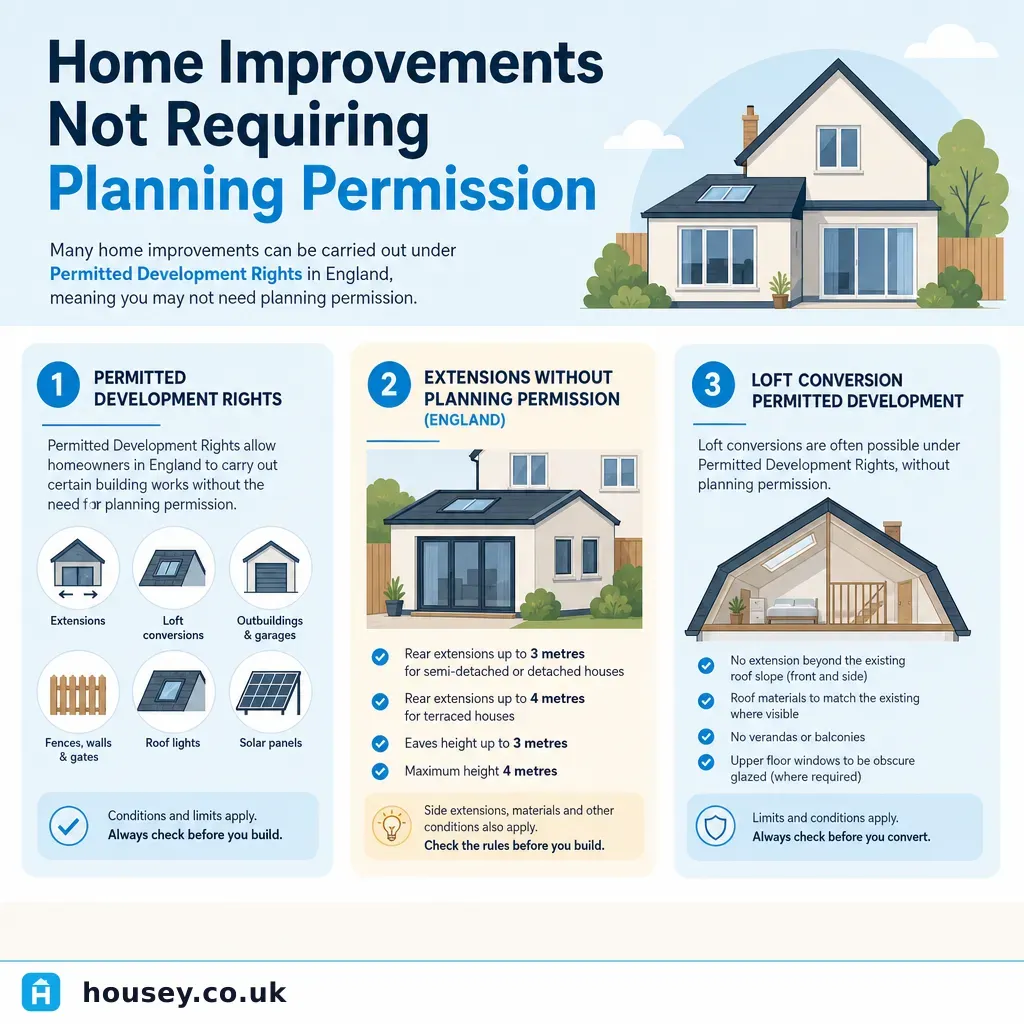
Home Improvements Not Requiring Planning Permission
Many common home improvements in England fall under Permitted Development Rights and do not require a planning application.