Removing a Fireplace: Costs and Structural Considerations
By Housey · Last reviewed 7th of May 2026
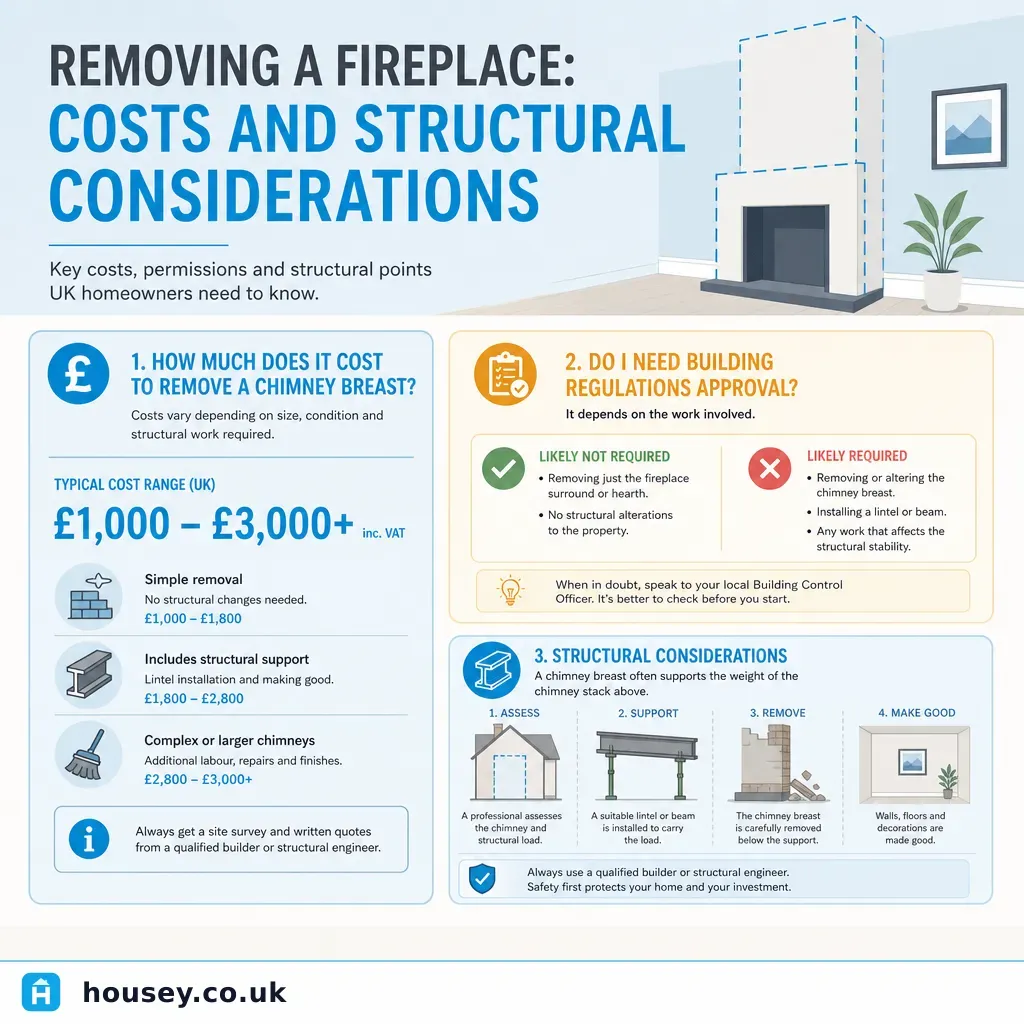
Removing a Fireplace: Costs and Structural Considerations
Removing a fireplace is one of the more common home alteration projects in UK properties, whether to reclaim floor space, modernise a room, or reduce draughts. But the scope of work — and the regulatory obligations — vary significantly depending on whether you are removing only the decorative surround or taking out the chimney breast entirely. Getting this wrong can create structural problems, difficulties at resale, or a safety hazard if a gas appliance is not properly decommissioned.
Key points
- Removing a fireplace surround and hearth is generally non-structural and does not require Building Regulations approval; removing a chimney breast is notifiable structural work under Part A (Structure) of the Building Regulations.
- Any gas fire must be disconnected by a Gas Safe registered engineer before work begins — a legal requirement under the Gas Safety (Installation and Use) Regulations 1998.
- If a chimney breast sits on a shared wall between two properties, the Party Wall etc. Act 1996 requires formal notice to be served on the adjoining owner at least two months before work starts.
- A structural engineer's calculations are required before chimney breast removal, and building control must inspect the new steel beam before the ceiling or wall is closed.
- Planning permission is not normally required for internal fireplace removal, but listed building consent is required for any alterations to a listed building.
What are you actually removing? A decision guide
Before estimating costs or planning the work, be precise about what the project involves.
- Choose surround-and-hearth removal only if you want to open up the room aesthetically without structural work. No Building Regulations application needed; cap the flue to prevent damp ingress.
- Include the firebox if there is no appliance connected and you want a clean wall finish. Still non-structural; no Building Regulations required.
- Choose chimney breast removal if you want to reclaim the full structural footprint. This requires a structural engineer, a Building Regulations application, and building control inspection.
- Ask a Gas Safe engineer first if any gas appliance — including a decorative gas fire — is connected. Disconnection must happen before any other work begins.
- Check with a party wall surveyor if the chimney breast sits on or close to the boundary with a neighbouring property.
Structural considerations for chimney breast removal
In most UK terraced and semi-detached homes, the chimney breast runs through multiple floors and supports the masonry above it. Removing the ground-floor chimney breast while leaving the first-floor section in place requires the upper section to be supported — typically by a steel beam (RSJ) fixed to the party or outer walls.
A structural engineer must calculate the load path and specify the beam size, padstone dimensions, and connection details. Building control will require sight of these calculations and will inspect the installed beam before plastering.
Party wall implications: If the chimney breast is on a shared wall — common in Victorian terraces and Edwardian semis — the Party Wall etc. Act 1996 applies. You must serve notice on adjoining owners at least two months before work begins. If they dissent, a party wall surveyor must be appointed. Informal written consent is not sufficient; the formal notice must be served.
Cost guide for fireplace and chimney removal
Indicative UK costs, last reviewed 2026-05-07. Costs vary by property, location, access, and contractor. Obtain at least two or three quotes.
Scope of work | Indicative cost range | Building regs needed? | Structural engineer needed? |
|---|---|---|---|
Remove surround and hearth only | £200 – £600 | No | No |
Remove surround, hearth, and firebox (no appliance) | £400 – £900 | No | No |
Gas fire disconnection (Gas Safe engineer) | £80 – £200 | No | No |
Chimney breast removal — one floor | £1,500 – £3,000 | Yes | Yes |
Chimney breast removal — two floors | £3,000 – £6,000 | Yes | Yes |
Structural engineer fee (calculations) | £300 – £800 | — | — |
Building control application fee | £200 – £500 | — | — |
Party wall surveyor (if required) | £700 – £1,500 | — | — |
Worked UK property scenario
Victorian mid-terrace in the East Midlands — two-bedroom, ground-floor chimney breast removal
The owners want to remove the ground-floor chimney breast to create an open-plan kitchen-diner. The chimney breast sits on the shared party wall.
- Party wall notice served on both adjoining owners (two months' notice under the Party Wall etc. Act 1996)
- Structural engineer appointed to design the RSJ beam and padstones
- Building Regulations Full Plans application submitted to the local authority
- Gas Safe engineer disconnects the redundant gas supply pipe
- Contractor removes the chimney breast, installs the RSJ, and makes good
- Building control officer inspects the installed beam before plastering
- Completion certificate issued
Indicative total project cost: £5,500 – £10,000, including structural engineer, building control, Gas Safe disconnection, party wall surveyor, and building work. Costs vary significantly by location and property condition.
Does fireplace removal need planning permission?
In most cases, no. Removing a fireplace or chimney breast is internal work and falls outside the scope of planning permission under permitted development rights. However, you may need consent if:
- The property is a listed building — listed building consent is required for any internal alteration affecting original fabric
- The property is in a conservation area and external alterations are involved (for example, removing the chimney stack above the roofline)
- The local planning authority has removed permitted development rights via an Article 4 Direction
Check with your local planning authority before starting if you have any doubt.
Red flags: when to stop and get professional advice
- The chimney breast sits on a party wall and no party wall notice has been served — do not start work without completing this step
- Cracks are visible above the proposed removal area, which may indicate existing structural stress
- A gas or solid fuel appliance is connected to the fireplace and has not been formally decommissioned
- The property is listed — do not remove any original feature without written listed building consent
- A previous owner has partially removed the chimney breast without a completion certificate — this can complicate your resale and your buyer's mortgage application
Important limitations
This article provides general guidance on fireplace and chimney breast removal in England and Wales. Structural requirements, Building Regulations obligations, and party wall considerations vary significantly by property. This article is not a substitute for a site-specific assessment by a structural engineer, qualified contractor, or party wall surveyor. Rules may differ in Scotland under the Building (Scotland) Regulations 2004 and in Northern Ireland. Always check with your local authority before commencing structural work.
What to ask a qualified professional
Before instructing a contractor or structural engineer:
- Is this work structural, and does it require a Building Regulations application?
- Do I need a structural engineer's calculations, and can you manage this?
- Does the chimney breast sit on a party wall, and do I need to serve a party wall notice?
- Is there a gas or solid fuel appliance that needs formal decommissioning?
- How will the upper chimney breast be supported if only the lower section is removed?
- Who will liaise with building control, and what inspection stages are there?
- What completion certificate will I receive, and how long will it take?
- Is VAT included in your quote, and what could change the price?
When to get professional help
Involve a structural engineer before any chimney breast removal work begins. If you are uncertain whether the chimney breast is load-bearing — in most UK residential properties it will be — commission a structural inspection first.
Engage a Gas Safe registered engineer as soon as you know a gas appliance is connected. Involve a party wall surveyor if there is any indication the chimney breast is on or near a shared boundary. Your building contractor should coordinate building control submissions, but the structural engineer, Gas Safe engineer, and party wall surveyor are separate professional appointments.
How Housey can help
Housey connects you with experienced contractors who carry out fireplace and chimney breast removals across the UK. Use our demolition contractors service page to request quotes from vetted local professionals and ensure the work is completed with the correct approvals in place.
Frequently asked questions
Do I need building regulations for removing a fireplace surround?
Not usually. Removing the fireplace surround and hearth, without affecting the chimney breast or any structural element, is generally not notifiable under Building Regulations. However, if a gas appliance is involved, a Gas Safe registered engineer must disconnect it, and you should cap the flue properly to prevent moisture ingress and downdraught.
Can I remove a chimney breast myself?
This is strongly inadvisable. Chimney breast removal is structural work requiring a structural engineer's design, a Building Regulations application, and building control inspection. Carrying out this work without the correct approvals risks structural failure and will cause problems when you sell — your buyer's solicitor will require the completion certificate.
How long does chimney breast removal take?
The physical work typically takes two to five days for a single-floor removal, but the full project — including structural calculations, building regulations application, any party wall notice period, and building control sign-off — commonly runs to eight to twelve weeks or more from start to completion certificate.
Will removing a chimney breast affect my home's value?
Done correctly with building control approval, it can add value by creating open-plan space, particularly in smaller properties. If carried out without proper approvals, it may reduce value and create difficulties when you sell or remortgage. Always obtain a completion certificate before marketing the property.
Sources and further reading
- Building regulations approval: when you need it — GOV.UK
- Party Wall etc. Act 1996 explanatory booklet — GOV.UK
- Gas Safety (Installation and Use) Regulations 1998 — legislation.gov.uk
- Gas Safe Register: find a registered engineer — Gas Safe Register
- HETAS: solid fuel and biomass appliances — HETAS
- Planning Portal: permitted development for householders — Planning Portal
Useful next reads
 Improvement & Build
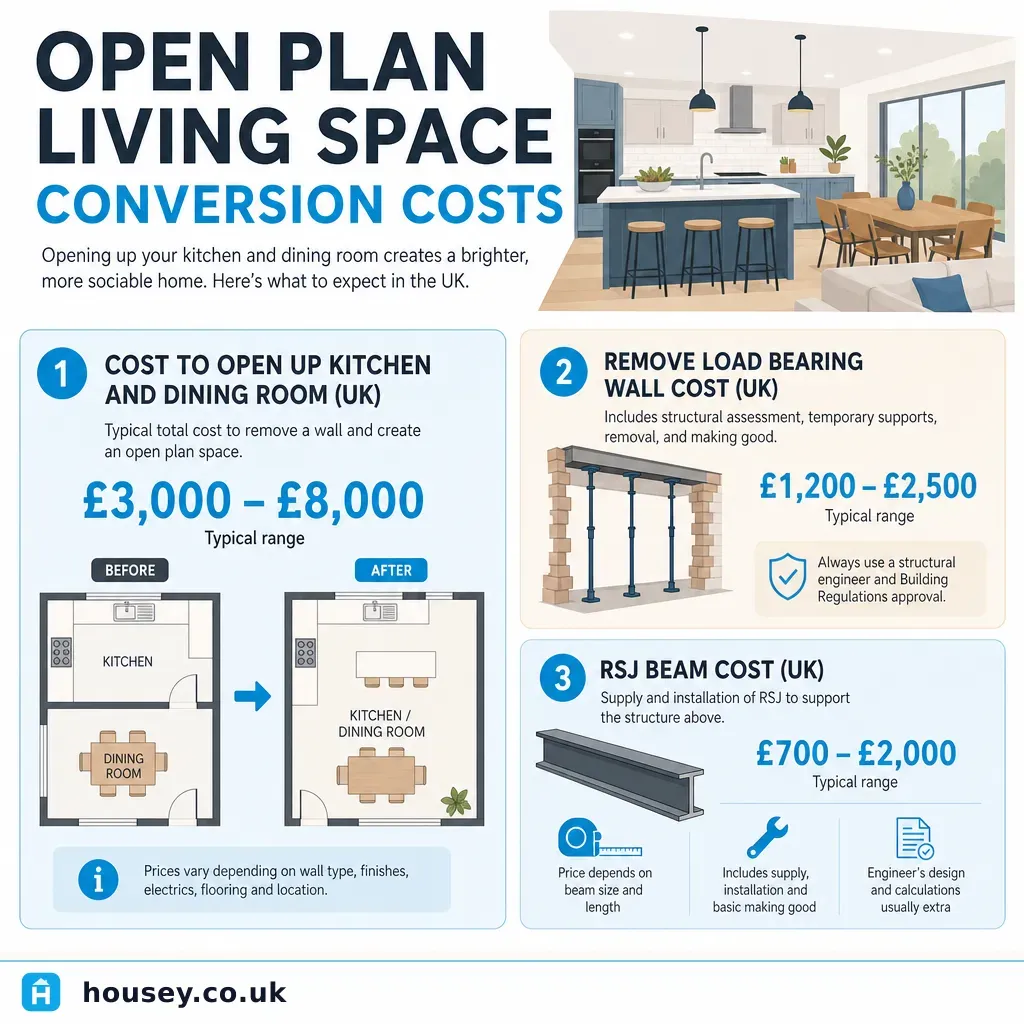
Open Plan Living Space Conversion Costs
Opening up a living space in the UK typically costs £3,000–£15,000+ depending on whether walls are load-bearing, the beam specification required, and the extent of remodelling.
 Improvement & Build
Who Provides House Demolition Services
House demolition in the UK is carried out by specialist demolition contractors, often members of the National Federation of Demolition Contractors (NFDC).
 Improvement & Build
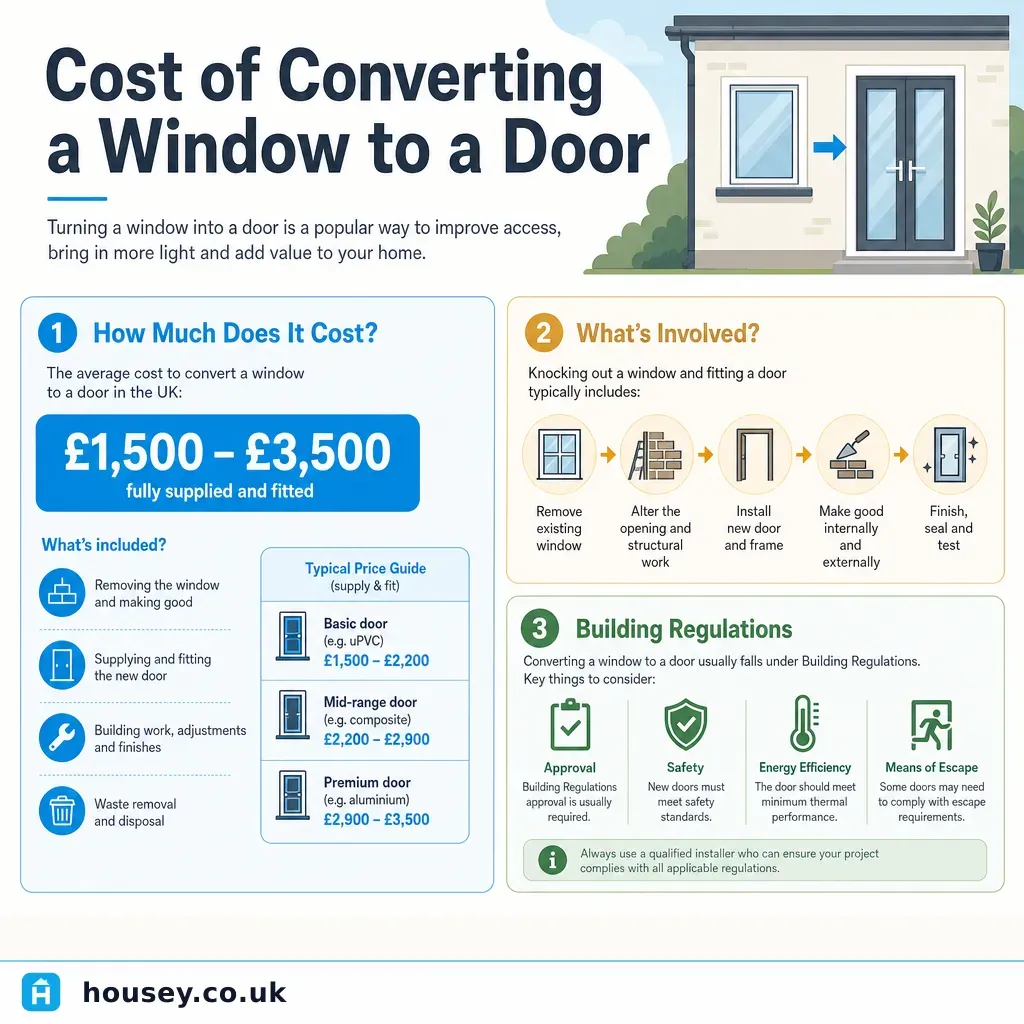
Cost of converting a window to a door
Converting a window to a door in the UK typically costs £1,500–£5,000 or more, depending on wall construction (cavity, solid, or timber frame), the type of door fitted, and whether a new or enlarged lintel is required.
 Improvement & Build
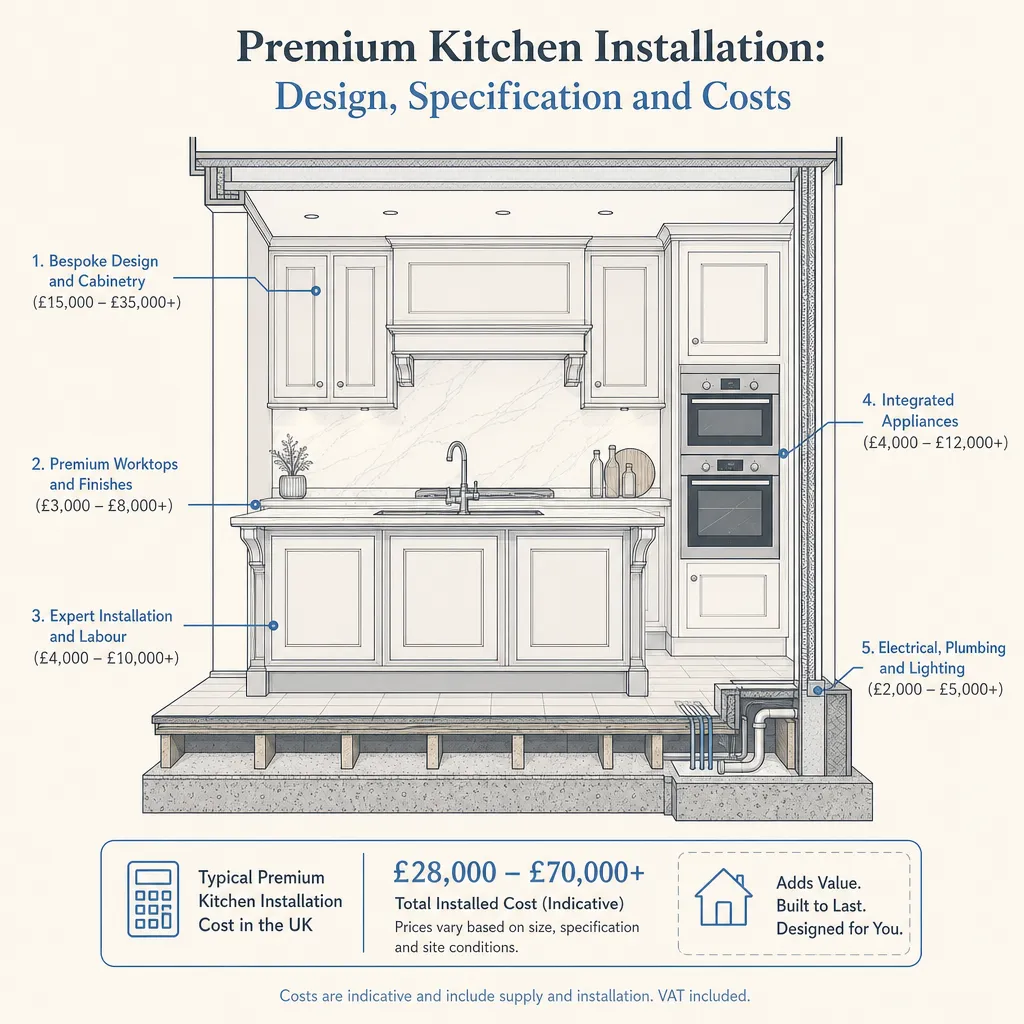
Premium Kitchen Installation: Design, Specification and Costs
A premium kitchen in the UK typically costs £20,000–£80,000 or more installed, depending on cabinetry specification, worktop material, appliance brands, and whether structural changes are needed.
 Improvement & Build
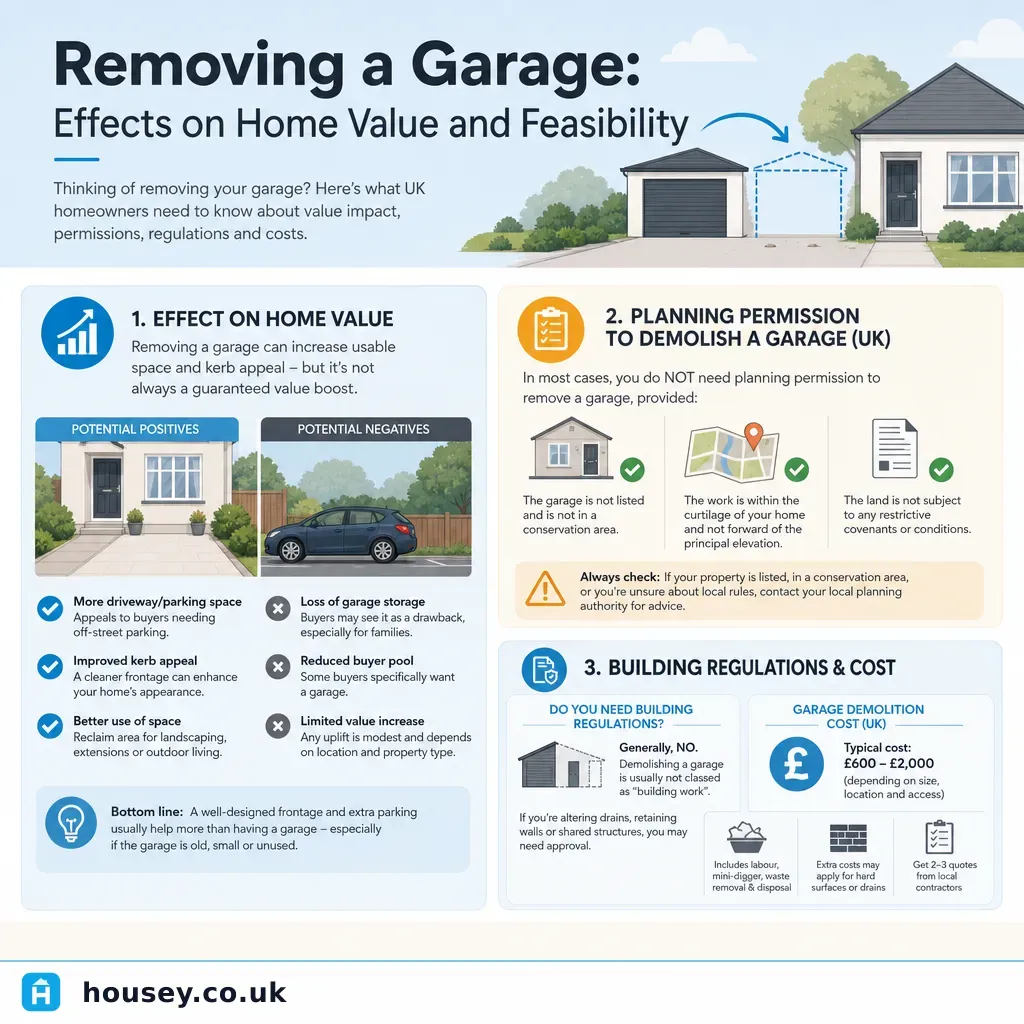
Removing a Garage: Effects on Home Value and Feasibility
Demolishing a garage in England may require prior notification to the local planning authority, and structural or building regulations assessments are often needed if the garage is attached to or integral with the house.