Optimising Loft Space: Conversion and Storage Solutions
By Housey · Last reviewed 11th of May 2026
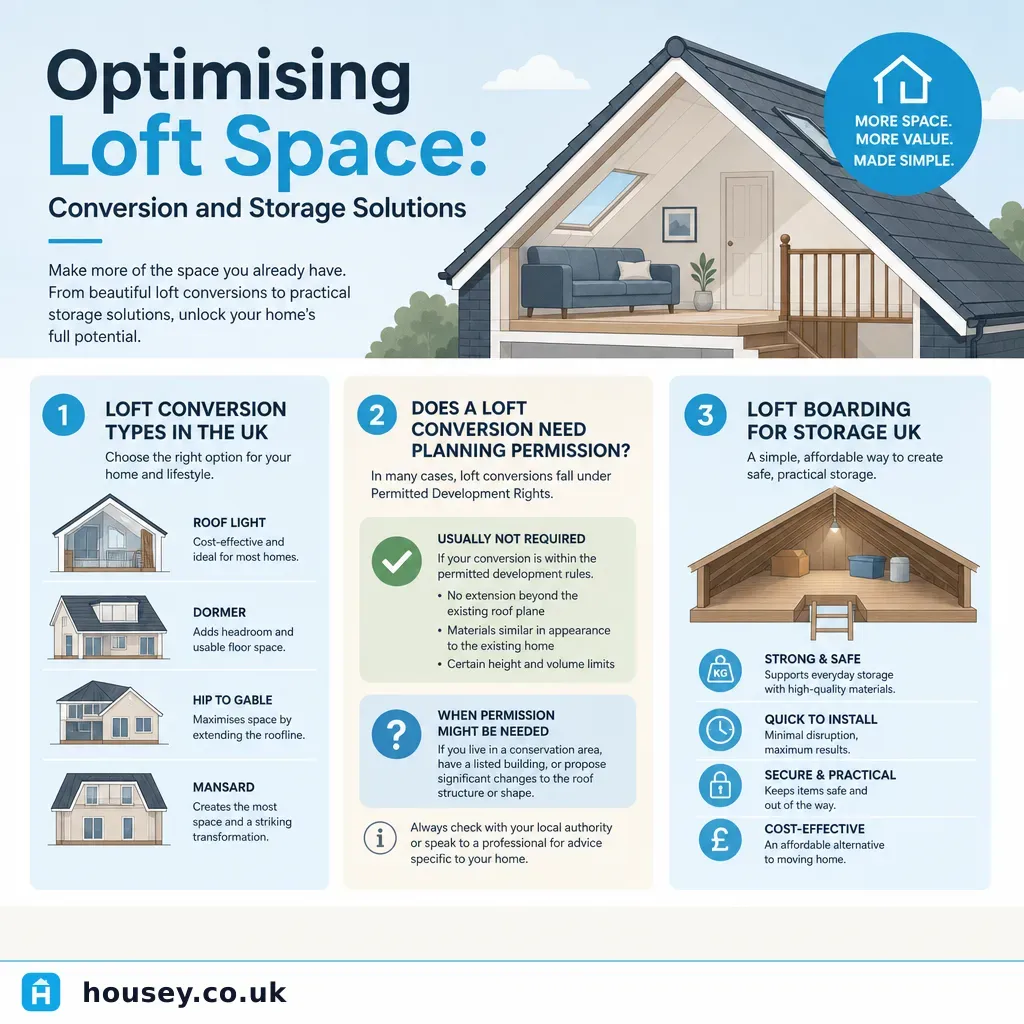
Optimising Loft Space: Conversion and Storage Solutions
A loft represents some of the most accessible unused square footage in a typical UK home — yet the right approach depends heavily on your roof structure, available headroom, and what you actually need the space for. Whether you want a new bedroom, a home office, or simply somewhere organised to keep seasonal belongings, your first decision is whether you are converting the space into habitable accommodation or optimising it for storage.
Key points
- Minimum headroom for a habitable loft conversion is typically 2.2 m from floor to the highest point of the ridge.
- Most loft conversions fall under Permitted Development rights and do not require planning permission, but additions must not exceed 40 m³ (terraced) or 50 m³ (detached or semi-detached) in volume.
- All loft conversions creating habitable space must comply with Building Regulations, including fire escape routes, structural loading, insulation to Part L, and staircase requirements.
- Loft boarding for storage does not require planning permission or Building Regulations approval, but compressing existing insulation reduces its effectiveness — raised boarding systems are the correct solution.
- Estate agent research consistently suggests well-executed loft conversions can add 10–20% to a UK property's value, though the uplift varies significantly by location and specification.
Conversion or storage: which approach suits you?
- Choose a storage-only solution if headroom is below 2.2 m, you want to avoid planning or building control involvement, and your goal is accessible, organised storage rather than a usable room.
- Choose a loft conversion if headroom meets the minimum threshold, you need a functioning room (bedroom, office, or bathroom), and you are willing to invest in structural work, a fixed staircase, and building control sign-off.
- Get a structural engineer or RICS surveyor to assess the space before assuming either route is straightforward — roof structure (cut rafter versus trussed rafter), existing insulation, floor joist sizing, and access all affect feasibility and cost.
- Check with your local planning authority if the property is listed, in a conservation area, or in an Article 4 Direction area — Permitted Development rights may be restricted or removed entirely.
Loft conversion types: a comparison
Conversion type | Best for | Headroom needed | Planning permission usually required? | Indicative cost range |
|---|---|---|---|---|
Velux or rooflight | Most roof types; minimal structural change | 2.2 m+ at ridge | No (Permitted Development) | £15,000–£25,000 |
Rear dormer | Semi-detached, detached, terraced | 2.2 m+ | Usually no (PD) | £30,000–£60,000 |
Hip-to-gable | Semi-detached or detached with hipped roof | 2.2 m+ | Usually no (PD) | £35,000–£60,000 |
Mansard | Maximum space; significantly alters roof profile | Variable | Usually yes (full planning) | £45,000–£70,000+ |
L-shaped dormer | Victorian or Edwardian terraces with a rear addition | 2.2 m+ | Usually no (PD) | £40,000–£70,000 |
Indicative UK costs, last reviewed 2026-05-11. Costs vary significantly by region, specification, and existing roof structure. Obtain at least three quotes.
Trussed rafter roofs: the storage and conversion challenge
Many UK homes built after approximately 1965 use trussed rafter (prefabricated) roof structures rather than traditional cut rafter construction. Trussed rafter roofs are engineered to act as a single unit — removing or cutting members to create space requires full structural redesign, which adds cost and complexity.
For storage in a trussed rafter loft: do not remove trusses without structural engineer approval. Use low-level boarding systems that sit above the insulation — purpose-made loft legs or raised boarding kits allow safe, accessible storage without compromising structural integrity or thermal performance.
For a habitable conversion of a trussed rafter loft: a structural engineer must design the replacement structure. This is a significant and often expensive piece of work, and typically makes trussed rafter conversions costlier than those in traditionally constructed roofs.
Loft insulation and storage: the common mistake
Many homeowners board over their loft insulation at joist level, compressing it and dramatically reducing its effectiveness. Current guidance recommends a total insulation depth of around 270 mm for a cold loft (mineral wool between and over the joists). Compressing this to 100 mm or less to create a flat boarding surface eliminates much of the thermal benefit.
The correct approach:
- Use loft legs or proprietary raised boarding systems to lift boards above the insulation.
- Ensure the insulation remains uncompressed across the full floor area.
- If the existing insulation is old or sparse, this is a good opportunity to top it up — the Energy Saving Trust guidance on loft insulation sets out current recommendations.
Building Regulations requirements for a habitable loft conversion
Converting loft space into a room people sleep or work in triggers Building Regulations approval in England and Wales. Key areas inspected by local authority building control (or an Approved Inspector) include:
- Structure: floor joists must be upgraded to carry domestic floor loading; the existing roof structure must be assessed or redesigned.
- Fire safety: a protected escape route from the new room to the outside; mains-wired interconnected smoke alarms; fire doors where required by the design.
- Staircase: a fixed staircase meeting minimum width, pitch, and headroom requirements — often challenging in tight floor plans.
- Insulation: Part L compliance for the thermal performance of the new room.
- Ventilation: adequate background and purge ventilation for habitable rooms.
- Electrical work: new circuits must comply with Part P and be certified by a competent person (NICEIC or NAPIT registered).
Building Regulations approval is separate from planning permission. Building control sign-off is almost always required for habitable conversions regardless of planning status.
What to ask before accepting a loft conversion quote
- Is the quote based on a site visit, or is it a desktop estimate?
- Does the price include structural engineer fees, building control fees, and scaffolding?
- Who will manage building control applications and inspections — you or the contractor?
- What roof structure does the property have, and does this affect the conversion type or cost?
- What is the proposed fire escape strategy, and does it require a new staircase configuration?
- Is VAT included in the quoted price?
- What party wall implications are there if you share a roof or wall with a neighbour?
When to get professional help
- If headroom measurement is borderline (close to 2.2 m), have a structural engineer measure and assess — not just a contractor providing a commercial estimate.
- If the property has a trussed rafter roof, instruct a structural engineer before accepting any conversion quote.
- If you share a roof or wall with a neighbour, the conversion may trigger the Party Wall etc. Act 1996 — seek advice from a party wall surveyor before any works start.
- If the property is listed or in a conservation area, consult your local planning authority before any works.
How Housey can help
Housey connects homeowners with specialist loft conversion companies across the UK who can carry out a site assessment, advise on planning and building control, and provide a detailed fixed-price quote. If you need short-term storage solutions while your loft conversion is underway, Housey can help with that too.
Frequently asked questions
Do I need planning permission for a loft conversion?
Most loft conversions in England fall under Permitted Development rights and do not need a planning application, provided they stay within volume limits (40 m³ for terraced homes, 50 m³ for semi-detached and detached) and other PD conditions. Planning permission is usually needed for mansard conversions, properties in Article 4 Direction areas, listed buildings, and many conservation areas. Always confirm with your local planning authority before starting.
How long does a loft conversion take?
A straightforward Velux conversion typically takes 4–6 weeks on site. A rear dormer conversion usually takes 6–10 weeks. Larger or more complex conversions — mansard, L-shaped — may take 10–14 weeks or more. These timescales assume planning (where needed) and building control are in place before work starts; allow additional pre-start time for those approvals.
Will my neighbour need to be notified?
If the conversion involves work on or near a shared wall or a roof structure adjoining a neighbour's property, the Party Wall etc. Act 1996 may apply. You would need to serve a party wall notice at least two months before structural work begins. A party wall surveyor can advise whether the Act applies and help draft notices if required.
Is a loft conversion worth it financially?
It depends on your local property market, the type of conversion, and the quality of the finish. Estate agent research commonly cites 10–20% value uplift for well-executed conversions, but this varies considerably — adding a bedroom in a high-demand area with limited housing stock tends to show the greatest return. A RICS-regulated surveyor or local estate agent can offer a view specific to your property.
Sources and further reading
- Planning permission in England and Wales — GOV.UK
- Building regulations approval — GOV.UK
- Roof and loft insulation guidance — Energy Saving Trust
- Loft conversions — common projects — Planning Portal
- Party Wall etc. Act 1996 — legislation.gov.uk
Useful next reads
 Improvement & Build
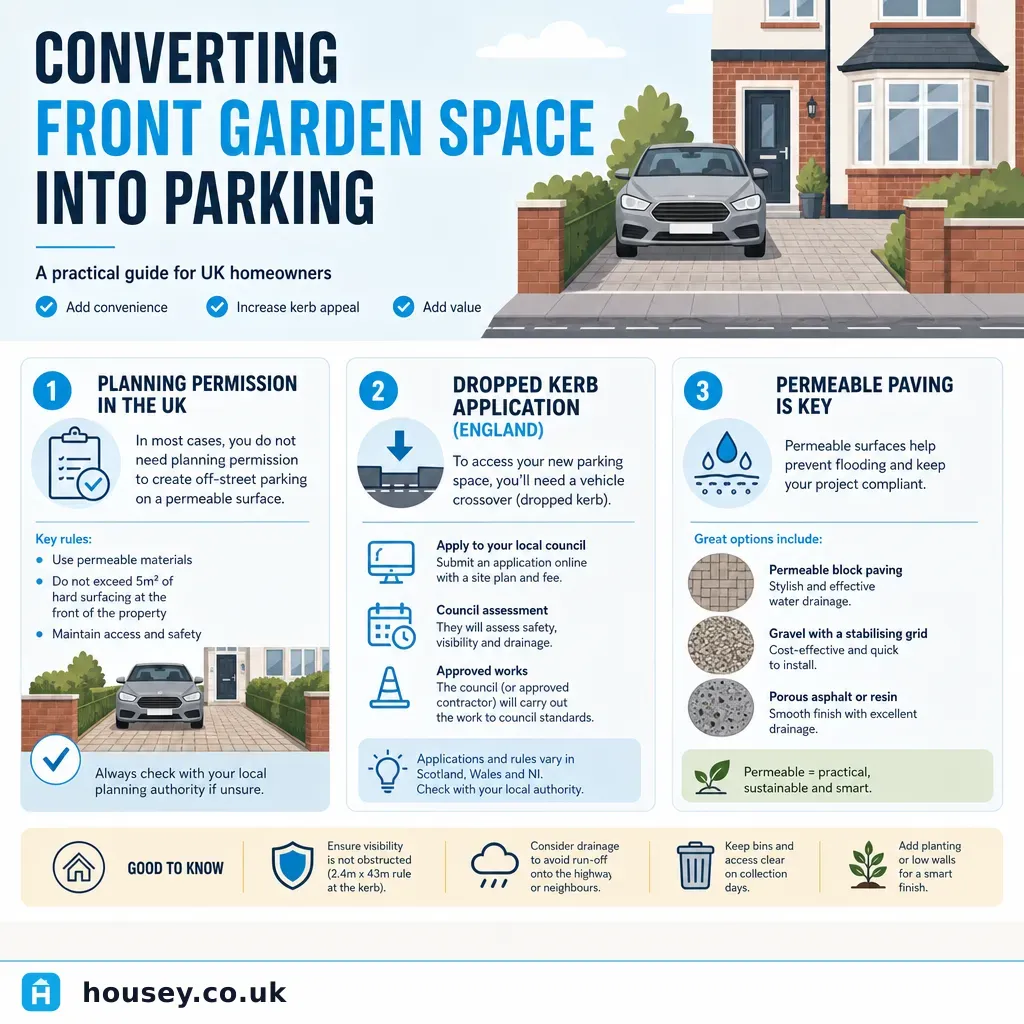
Converting Front Garden Space into Parking
Converting a front garden to parking in England requires permeable surfacing or planning permission if the area exceeds 5 m², plus a separate dropped kerb application to your local highway authority.
 Improvement & Build
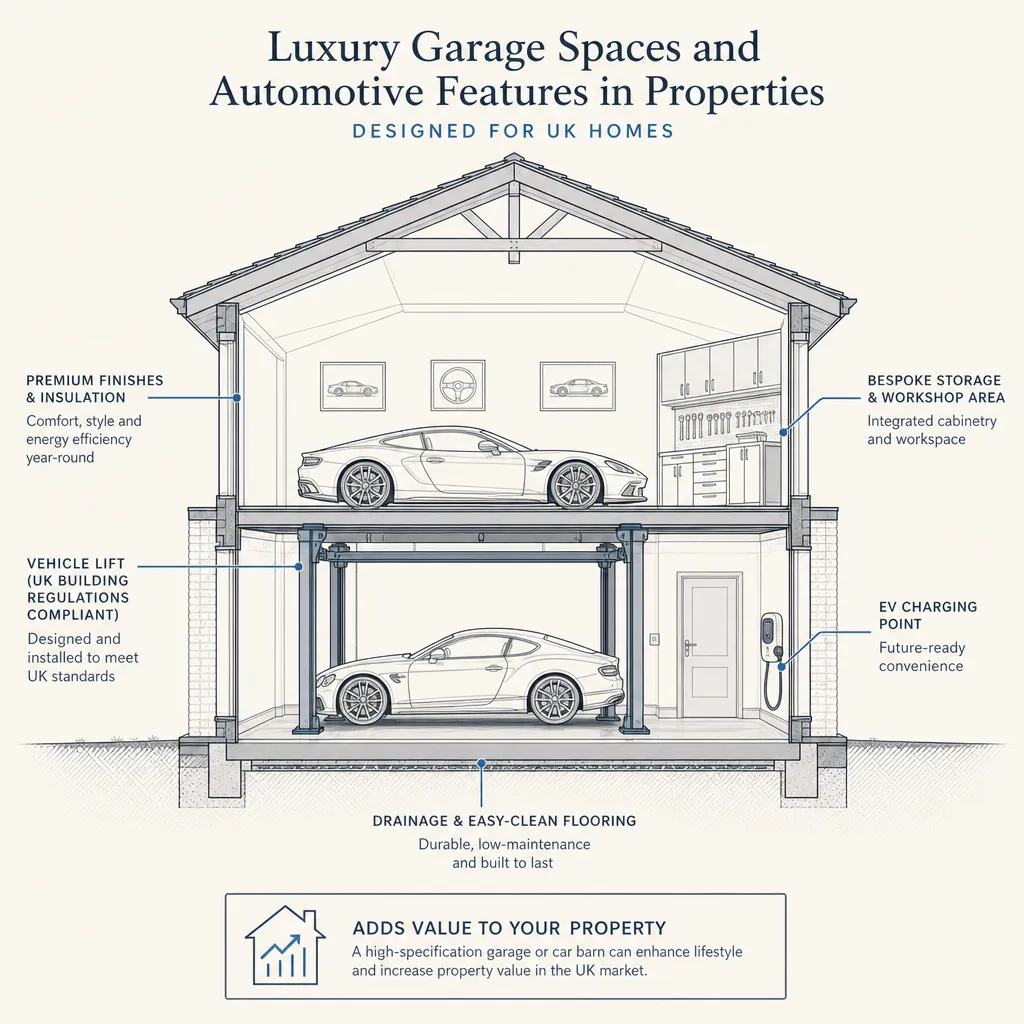
Luxury Garage Spaces and Automotive Features in Properties
Luxury garage spaces — including car lifts, climate-controlled car barns, and multi-bay parking — are increasingly valued in premium UK properties.
 Improvement & Build
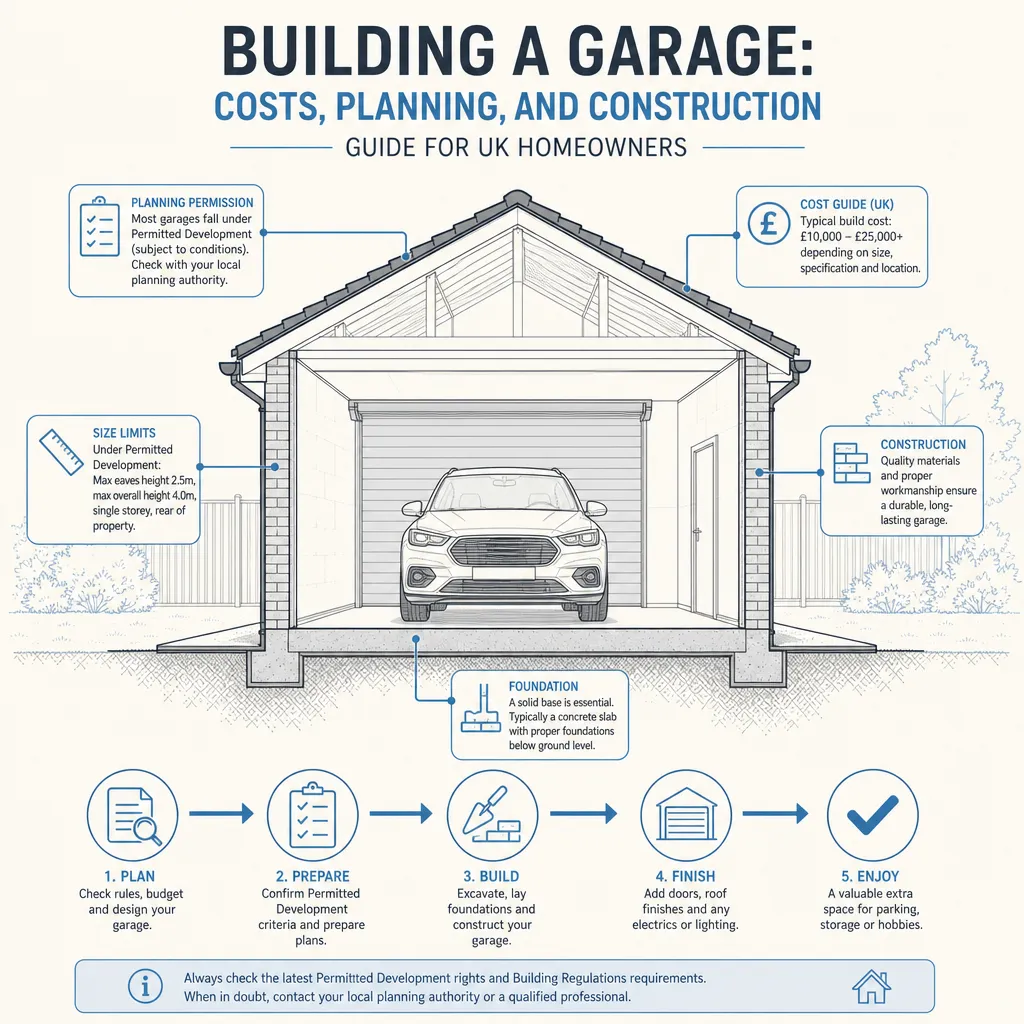
Building a Garage: Costs, Planning, and Construction
Building a new garage in the UK typically costs between £15,000 and £45,000 depending on size, materials, and whether it is attached or detached.
 Improvement & Build
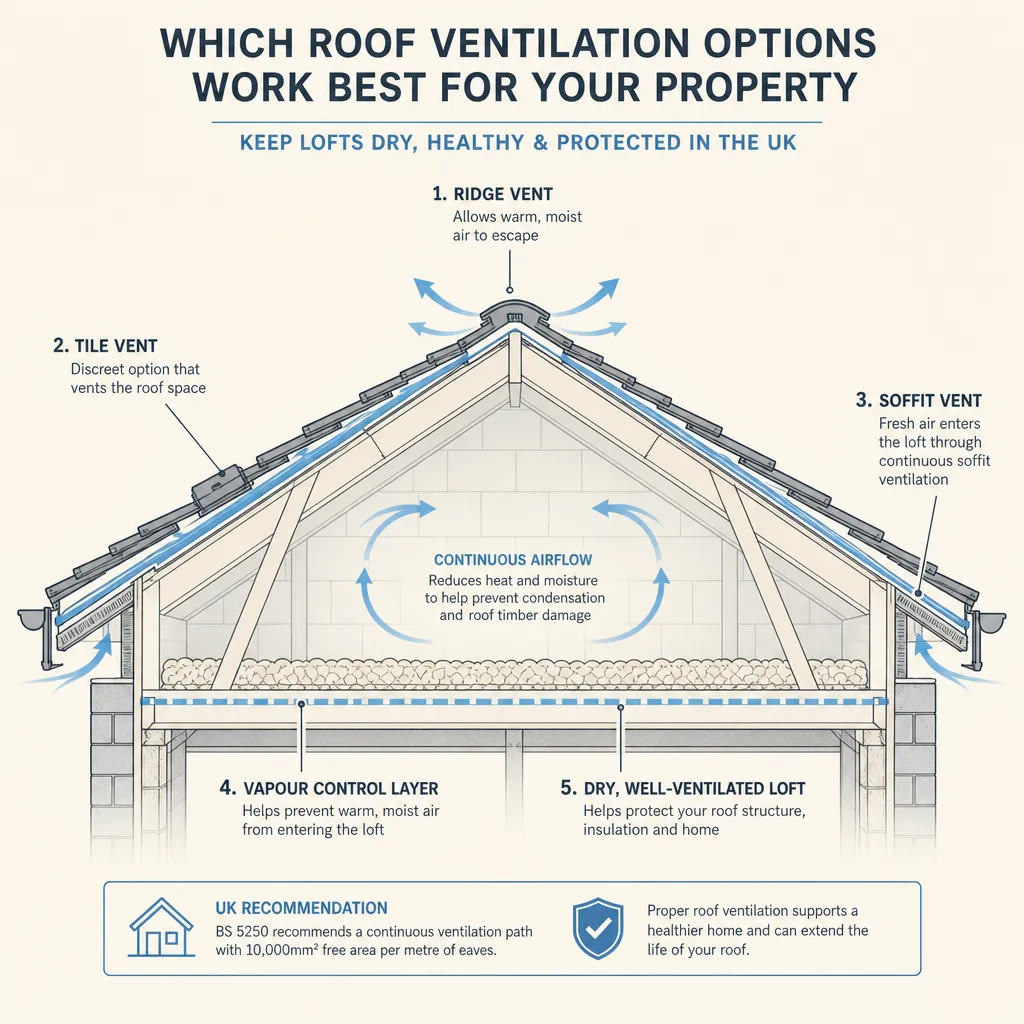
Which Roof Ventilation Options Work Best For Your Property
The right roof ventilation depends on your roof construction.
 Improvement & Build
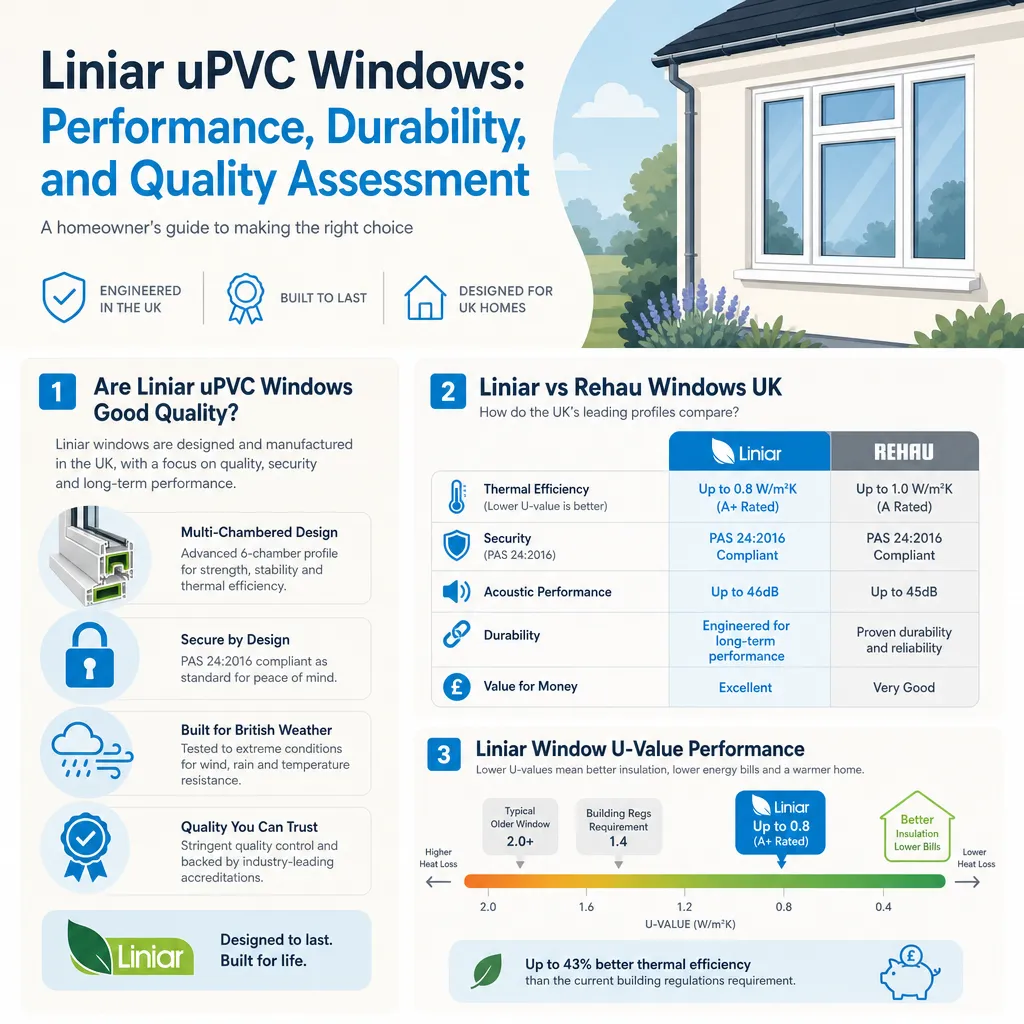
Liniar uPVC Windows: Performance, Durability, and Quality Assessment
Liniar uPVC window profiles are manufactured in the UK using multi-chambered, foamed frames.