Overseas Property Investment: International Demand and Opportunities for UK Buyers
By Housey · Last reviewed 10th of May 2026

Overseas Property Investment: International Demand and Opportunities for UK Buyers
For many UK homeowners and investors, owning property abroad — whether as a holiday retreat, a long-term rental asset, or a retirement base — holds enduring appeal. The decision typically arises after a positive holiday experience, following financial planning advice on portfolio diversification, or as part of broader retirement planning. However, international property purchase sits at the intersection of at least two legal systems and often two tax regimes, with risks that differ meaningfully from buying in England and Wales.
Key points
- UK residents must declare overseas rental income to HMRC via Self Assessment, even if tax has already been paid in the country where the property is located.
- UK Capital Gains Tax (CGT) may apply when selling an overseas property, in addition to any local disposal taxes — double taxation treaties may reduce but do not always eliminate dual liability.
- Stamp Duty Land Tax (SDLT) does not apply to overseas purchases, but local transfer taxes, notarial fees, and registration costs vary widely by country and should be budgeted for separately.
- Post-Brexit, UK citizens purchasing property in EU countries are treated as third-country nationals — some member states restrict non-EU ownership in certain zones or require specific permits.
- Exchange rate movements can significantly erode sterling-denominated returns even when the local property price is stable or rising.
Why UK buyers consider overseas property
Demand from UK buyers tends to be driven by a mix of lifestyle and financial motivations:
- Lifestyle and retirement: access to warmer climates, lower living costs, or proximity to family abroad.
- Holiday letting income: generating rental receipts during periods of non-owner use.
- Capital growth: expectation of price appreciation in markets with strong tourism or economic growth.
- Portfolio diversification: reducing dependence on the UK residential market.
The weight given to each motivation matters when assessing risk: a property held primarily for personal use is evaluated very differently from one acquired purely as a financial asset.
Popular overseas markets for UK buyers
Country | Typical appeal for UK buyers | Key considerations |
|---|---|---|
Spain | Warm climate, established expat communities, active holiday-let market | Non-resident income tax, Plusvalía on disposal, post-Brexit residency rules |
France | Proximity, lifestyle, rural and coastal property | Notaire system, French succession law, Taxe foncière |
Portugal | Lifestyle demand in Lisbon and the Algarve, historically popular for retirees | IMT transfer tax, condominium charges, NHR tax regime changes from 2024 |
Italy | Rural regeneration schemes, lifestyle appeal | Regional transfer taxes, building regulation complexity, language barriers |
UAE (Dubai) | No local income or CGT, strong rental yields cited by agents | Leasehold vs freehold zone distinctions, RERA regulation, USD currency peg |
United States | Large market, dollar-denominated asset | FIRPTA withholding on sale, US estate tax exposure for non-US citizens, state-level rules |
Note: tax rules, local regulations, and market conditions change. Always obtain current legal and tax advice specific to the destination country before committing.
What not to assume when buying overseas
Do not assume the legal process mirrors England and Wales. In many countries, the equivalent of exchange of contracts happens earlier and is legally binding from that point. In France, the compromis de vente commits both parties; in Spain, the contrato de arras typically does likewise. Missing this distinction can result in losing a deposit.
Do not assume UK mortgage providers will lend. Most high-street lenders do not offer mortgages on overseas properties. Finance may require using a local lender in the destination country, often on less favourable terms and in local currency, adding exchange rate risk to the borrowing.
Do not assume your UK will governs the property. Many countries have their own forced heirship rules that may override a UK will. Legal advice on succession in the destination country is essential, particularly for married couples and those with complex family situations.
Do not assume rental income is lightly taxed. Non-resident landlords in many popular markets face withholding tax on rental income. Failure to declare this income to HMRC in addition to paying it locally can result in penalties, even where a double taxation treaty applies.
Do not assume remote property management is straightforward. Tourist licence requirements, local letting agent quality, maintenance oversight, and regulatory compliance all require active attention from abroad.
Worked UK property scenario
The following is a hypothetical illustration only — it is not financial or tax advice.
A homeowner in Bristol purchases a two-bedroom apartment on the Algarve for €250,000. They let it for 20 weeks a year.
- Portuguese tax: as a non-resident, rental income is subject to Portuguese non-resident income tax — rates vary, so check current guidance from the Portuguese Tax and Customs Authority or a local adviser.
- UK tax: the same rental income must be declared to HMRC. The Portugal–UK double taxation treaty may allow credit for tax paid in Portugal against the UK liability, but the interaction is not automatic and depends on individual circumstances.
- CGT on sale: if sold at a profit, both Portuguese disposal rules and UK CGT rules may apply. UK private residence relief does not apply unless the property has been the owner's only or main home.
- Currency: if the purchase was made in euros and sterling weakens between purchase and sale, the sterling-equivalent gain — and therefore the UK CGT liability — may be larger than the euro-denominated gain suggests.
Overseas property buyer checklist
Before committing to an overseas purchase:
When to get professional help
Always appoint independent legal representation in both the UK and the destination country. Do not rely on a developer's solicitor or an agent's recommended lawyer. Seek specialist advice from:
- A UK-qualified tax adviser or accountant experienced in overseas property and HMRC Self Assessment.
- A solicitor or notary qualified in the destination country's property law.
- A regulated financial adviser if the purchase forms part of a broader investment or retirement strategy.
If you are considering funding the purchase by releasing equity from a UK property, speak to a UK mortgage adviser before proceeding, as this creates a secured liability against your home.
How Housey can help
Housey covers the full UK property lifecycle. If an overseas investment connects with UK decisions — such as preparing a UK home for sale or let before relocating, or commissioning a survey before buying or selling here — explore Housey's guides and services to find vetted local professionals.
Frequently asked questions
Do I need to pay UK tax on overseas rental income?
Yes. UK residents are taxed on worldwide income. Rental income from an overseas property must be declared to HMRC on a Self Assessment return. A double taxation treaty with the relevant country may allow credit for tax paid abroad against your UK liability, but both must typically be calculated separately. HMRC's guidance on foreign income sets out the rules in detail.
Can I use a UK mortgage to buy property abroad?
Most UK high-street lenders do not offer mortgages on overseas properties. Specialist international mortgage brokers can sometimes arrange finance through UK lenders with overseas products or through local lenders in the destination country. Borrowing in a foreign currency introduces exchange rate risk on the debt as well as on the asset value.
Does buying overseas property affect my UK Capital Gains Tax position?
Yes. If you are UK tax resident and sell an overseas property at a profit, you are generally liable to UK CGT on the gain, subject to available reliefs and any double taxation treaty credit. The gain is calculated in sterling at the dates of purchase and sale, meaning currency movements affect the taxable amount even if the local price has not changed.
What is the post-Brexit position for UK buyers purchasing in EU countries?
UK citizens are now treated as third-country nationals across the EU. Most member states still permit non-EU buyers to purchase property freely, but some restrict non-EU ownership in border zones, coastal areas, or agricultural land. Bureaucratic requirements and permit processing times vary by country. Always check the specific rules with a local lawyer before proceeding.
Sources and further reading
- Tax on foreign income — GOV.UK / HMRC
- Capital Gains Tax: what you pay it on — GOV.UK / HMRC
- UK double taxation treaties — GOV.UK / HMRC
- Self Assessment tax returns — GOV.UK
Useful next reads
 General property advice
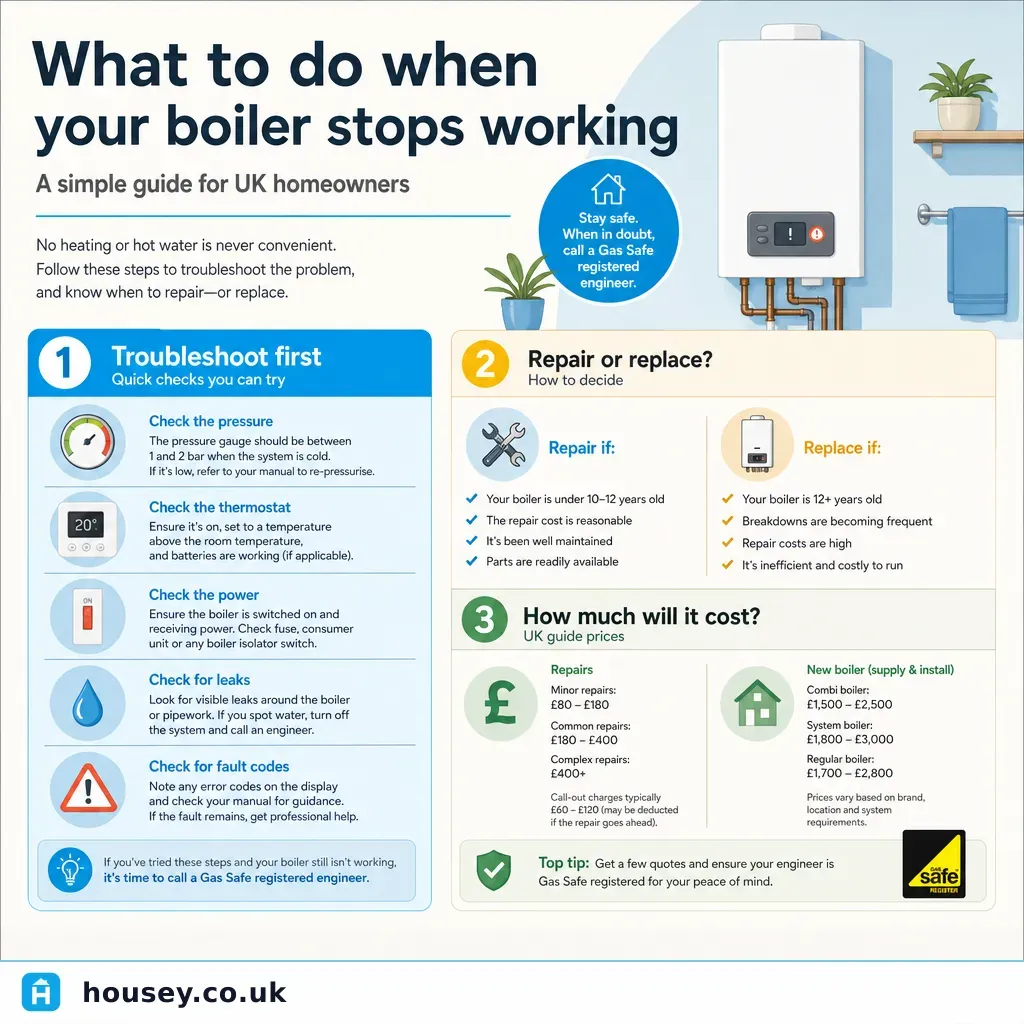
What to do when your boiler stops working
When your boiler stops working, check the pressure gauge (should read 1–1.
 General property advice
Property Market Trends: Activity Growth and Price Movements
UK property market activity is measured through completed sale registrations (HM Land Registry), lender mortgage data, and transaction volumes from HMRC.
 General property advice
Installing a water main shut-off valve for your property
A water main shut-off valve — commonly called a stopcock — controls all water entering your home from the mains.
 General property advice
Monthly House Price Index: August Market Report and Analysis
The UK House Price Index is published monthly using completed Land Registry transaction data, meaning August figures typically reflect sales agreed months earlier.
 General property advice
Scottish Property Market: Activity and Regional Trends
Scotland's property market operates under distinct legal rules: sellers must provide a Home Report before marketing, transactions become legally binding at conclusion of missives rather than exchange of contracts, and Land and Buildings Transaction Tax replaces Stamp Duty.