Partition Wall Installation and Room Division Costs
By Housey · Last reviewed 7th of May 2026
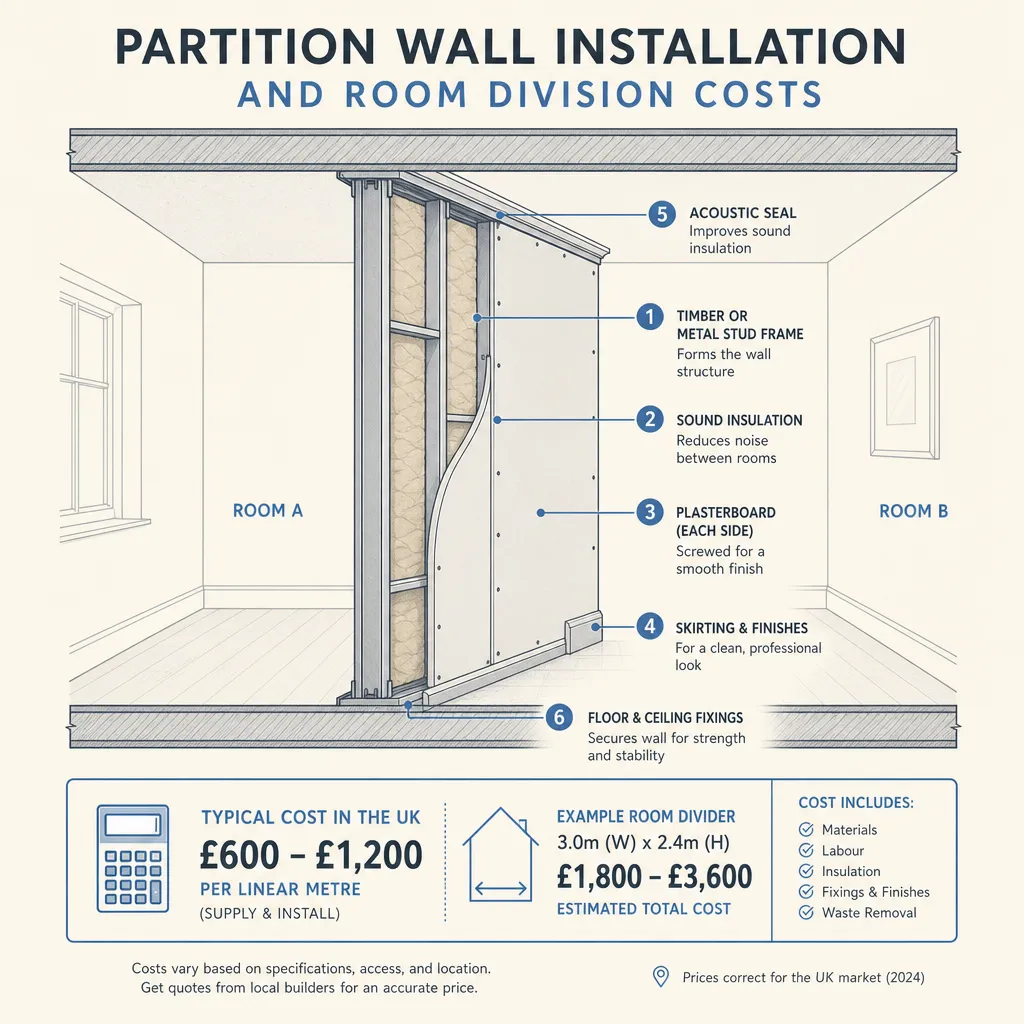
Partition Wall Installation and Room Division Costs
Dividing a room — whether to create a home office, an additional bedroom, or a separate utility space — is one of the most common internal alterations UK homeowners carry out. The cost and complexity depend on the wall type, the room's existing layout, and whether the work triggers building regulations requirements around fire safety, ventilation, or electrical installations.
Key points
- A standard timber stud partition wall typically costs £800–£2,500 installed for a single room divider, with per-m² rates usually between £30 and £80.
- Glass partition systems cost significantly more — commonly £300–£800 per m² or higher — and are suited to spaces where borrowed light or visual connection between areas matters.
- Building Regulations approval is likely required if the new wall affects a means of escape, fire compartmentation, or the ventilation of a habitable room under Approved Document B or Approved Document F.
- Partition walls are, by definition, non-load-bearing — but confirming that the structure above the proposed partition line is not load-bearing requires a professional assessment before work starts.
- Adding electrical sockets, switches, or lighting involves a Part P-notifiable electrical installation, which must be carried out or certified by a NICEIC, NAPIT, or ELECSA-registered contractor.
What types of partition wall are there?
The right partition type depends on your budget, the visual outcome you want, the acoustic performance required, and whether the wall needs to contain services such as pipes or wiring.
Partition wall types: comparison (indicative UK costs, last reviewed 2026-05-07)
Type | Typical installed cost (per m²) | Best for | Key limitations |
|---|---|---|---|
Timber stud (plasterboard both sides) | £30–£80 | Most domestic uses: bedrooms, home offices, utility rooms | Modest sound insulation unless acoustic fill is specified |
Metal stud (plasterboard both sides) | £35–£90 | Straight, level walls; commercial-style finishes | Slightly more expensive than timber; similar acoustic limits |
Acoustic stud partition | £60–£120 | Home studios, cinema rooms, adjoining bedrooms | Requires correct specification; adds to overall wall depth |
Glass partition (aluminium frame) | £300–£800+ | Open-plan offices, glazed screens, borrowed light | Expensive; limited privacy without film or blinds |
Solid blockwork (non-structural) | £80–£140 | Utility rooms, garages, durable fire-rated divisions | Heavy; requires structural check of the floor; slower to build |
Moveable/demountable partition | £100–£300+ | Flexible office or commercial spaces | Less common domestically; specialist installation |
Indicative costs based on UK market conditions. Costs rise with wall height, complexity of finish, and any specialist acoustic or fire-rated requirements.
What are the main cost drivers?
Wall dimensions: Cost is typically quoted per m² or as a day rate. A floor-to-ceiling partition in a standard 2.4 m room costs less per linear metre than one in a Victorian property with 3 m+ ceilings, where additional material and bracing are needed.
Finish: Plasterboard taped and jointed ready for decoration is the standard finish for most domestic partition walls. A full skim-plaster finish adds cost but provides a harder, more durable surface that is often preferred in period homes.
Acoustic performance: A basic stud wall with no insulation achieves around 35–38 dB sound reduction — insufficient for most bedroom-to-bedroom or home-studio applications. Adding acoustic mineral wool (such as Rockwool RW3 or equivalent), resilient bars, and a double layer of plasterboard can achieve 45–50 dB or more, but increases both material cost and wall depth.
Door opening: Including a door opening in the partition adds framing, labour, and materials. The door leaf, lining, and ironmongery are typically priced separately.
Electrical work: Adding sockets, switches, or lighting to a new partition wall involves a notifiable electrical installation under Part P of the Building Regulations in England. This must be carried out or certified by a NICEIC, NAPIT, or ELECSA-registered contractor.
Existing services: If the proposed wall line crosses existing pipes, cables, or ducts, their relocation adds cost and may require specialist trades beyond a general builder.
Location: Labour rates in London and the South East are typically 20–40% higher than in the Midlands or North of England. Indicative UK costs, last reviewed 2026-05-07.
Does a partition wall need building regulations approval?
In most cases, a simple stud partition installed in a domestic property does not require Building Regulations approval — but there are important exceptions.
Building Regulations are likely required if:
- The new wall affects a means of escape in case of fire (Approved Document B)
- The work reduces the ventilation of a habitable room (Approved Document F)
- The partition is in a licensed HMO or changes the number of rooms used for habitation purposes
- Electrical work is added (Part P — notifiable unless carried out under a competent person scheme)
- The property is leasehold and your lease requires freeholder consent for alterations
Check with your local building control body before starting work if any of these circumstances apply. In Scotland and Wales, consult the relevant building standards authority, as the regulations differ from those in England.
Decision tree: which partition type should you choose?
- Choose a timber stud partition if the room is domestic, budget is the primary consideration, and standard bedroom or home office acoustic performance is sufficient.
- Choose a metal stud partition if you need very straight, plumb walls over longer runs or prefer a commercial-style finish.
- Specify an acoustic stud partition if the room will be used for music, home cinema, or as a bedroom adjacent to a noisy space; ask your contractor to specify acoustic mineral wool, resilient bars, and mass-loaded plasterboard and confirm the target dB rating in writing.
- Choose a glass partition if maintaining borrowed light matters — for example, creating a home office within a living space or dividing an open-plan kitchen-diner without blocking natural light.
- Ask a structural engineer or chartered surveyor first if you are unsure whether the ceiling, joists, or wall above the proposed partition line is load-bearing, or if the building pre-dates 1920 and the floor or ceiling construction is unclear.
- Check your lease before starting if the property is a leasehold flat; most leases require written freeholder consent for internal alterations.
Homeowner checklist: before the work starts
What to ask when comparing quotes
Before accepting a quote, ask each contractor:
- What is the plasterboard specification — standard 12.5 mm, moisture-resistant, or acoustic mass-loaded?
- Is acoustic insulation included, and if so, what product, what density, and what predicted dB reduction?
- Is electrical first fix included or excluded from the price?
- What is the finish — taped and jointed, or full skim?
- Is waste removal included?
- Does the quote assume a clear, accessible room?
- Will the contractor apply for building regulations if required, or is that the homeowner's responsibility?
When to get professional help
A competent builder or joiner can install most domestic stud partitions without specialist support — but seek professional advice in these situations:
- You suspect the ceiling, joists, or wall above may be load-bearing: ask a structural engineer or RICS-chartered surveyor to confirm before any work starts
- The property is a listed building: listed building consent may be required for internal alterations
- The property is an HMO or will become one: fire compartmentation and ventilation requirements under the Housing Act 2004 and Approved Document B apply
- Electrical work is needed: use only a NICEIC, NAPIT, or ELECSA-registered electrician, or confirm that your general contractor uses a sub-contractor registered under a competent person scheme
How Housey can help
For partition wall installation as part of a wider renovation or extension project, extension builders on Housey can coordinate internal fit-out work alongside structural and finishing trades, helping you avoid the delays and cost overruns that come from managing multiple contractors independently.
Frequently asked questions
Do I need planning permission to install a partition wall?
In most cases, no. Internal partition walls in domestic properties are usually permitted development. However, if the property is a listed building, or if the work changes the number of dwellings — for example, subdividing a house into flats — planning permission or listed building consent may be required. Check with your local planning authority if in doubt.
How long does it take to install a stud partition wall?
A standard stud partition in a domestic room — approximately 3.5 m wide by 2.4 m high — can usually be framed and boarded in one to two days. Taping, jointing, or skim plastering adds a further one to two days, plus drying time before decoration. Acoustic partitions with a more complex specification may take an additional day.
Can I remove a partition wall myself?
Non-load-bearing stud partitions can generally be removed by a competent DIYer, but you must first confirm the wall is non-load-bearing and check for hidden pipes, cables, or asbestos, which is relevant in properties built before 2000. If in doubt, ask a professional to assess the wall before starting work. Never assume a wall is non-structural without checking.
Will a partition wall add value to my home?
It depends. Adding a usable extra bedroom in a property with sufficient space can increase value. Subdividing rooms arbitrarily — reducing a generous double bedroom to two very small rooms, for example — may not add value and could detract from it. Take advice from a local estate agent or RICS valuer before committing to the layout change.
Sources and further reading
- GOV.UK — Approved Document B: Fire safety — GOV.UK
- GOV.UK — Approved Document F: Ventilation — GOV.UK
- NICEIC — Part P competent person scheme — NICEIC
- GOV.UK — Listed buildings guidance — GOV.UK
- Citizens Advice — Leasehold property rights — Citizens Advice
Useful next reads
 Improvement & Build
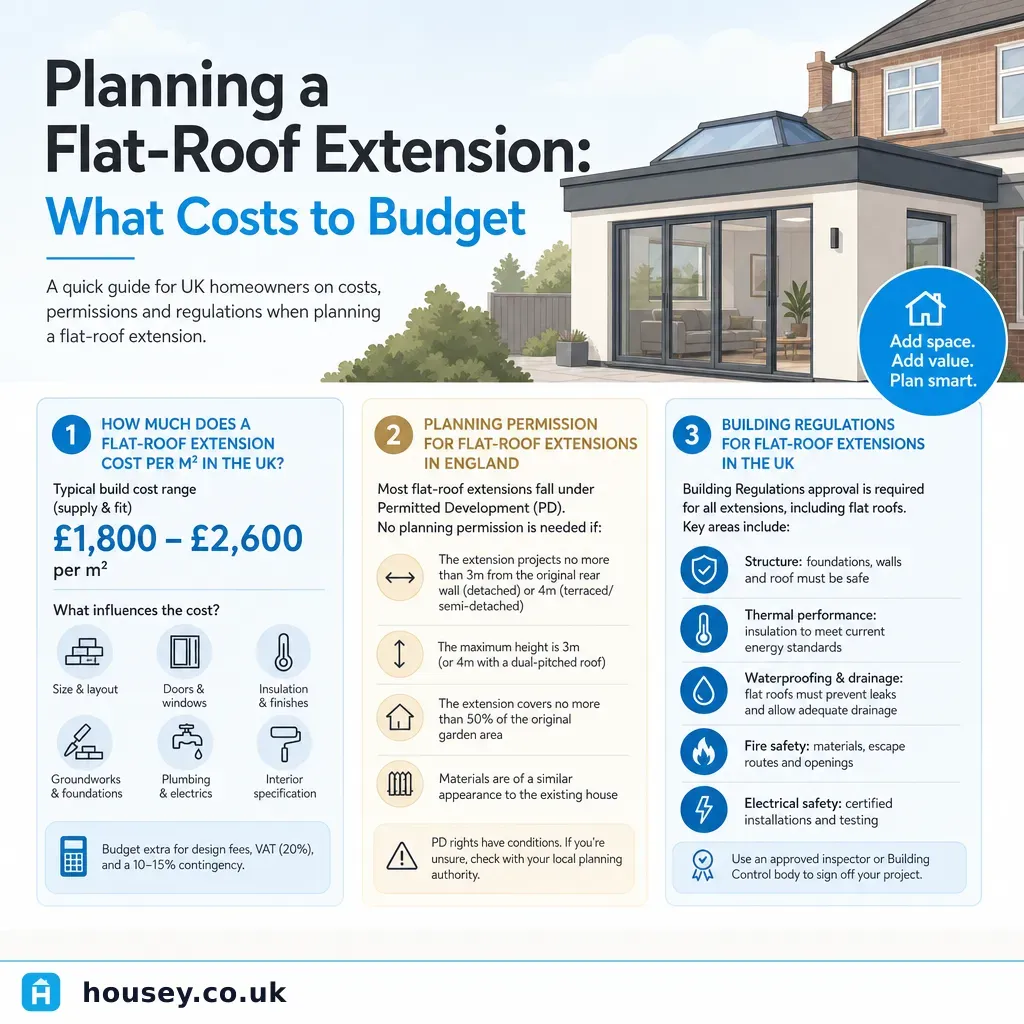
Planning a Flat-Roof Extension: What Costs to Budget
A flat-roof single-storey extension typically costs £1,500–£3,000 per m² in the UK, depending on size, specification, location, and roof membrane choice.
 Improvement & Build
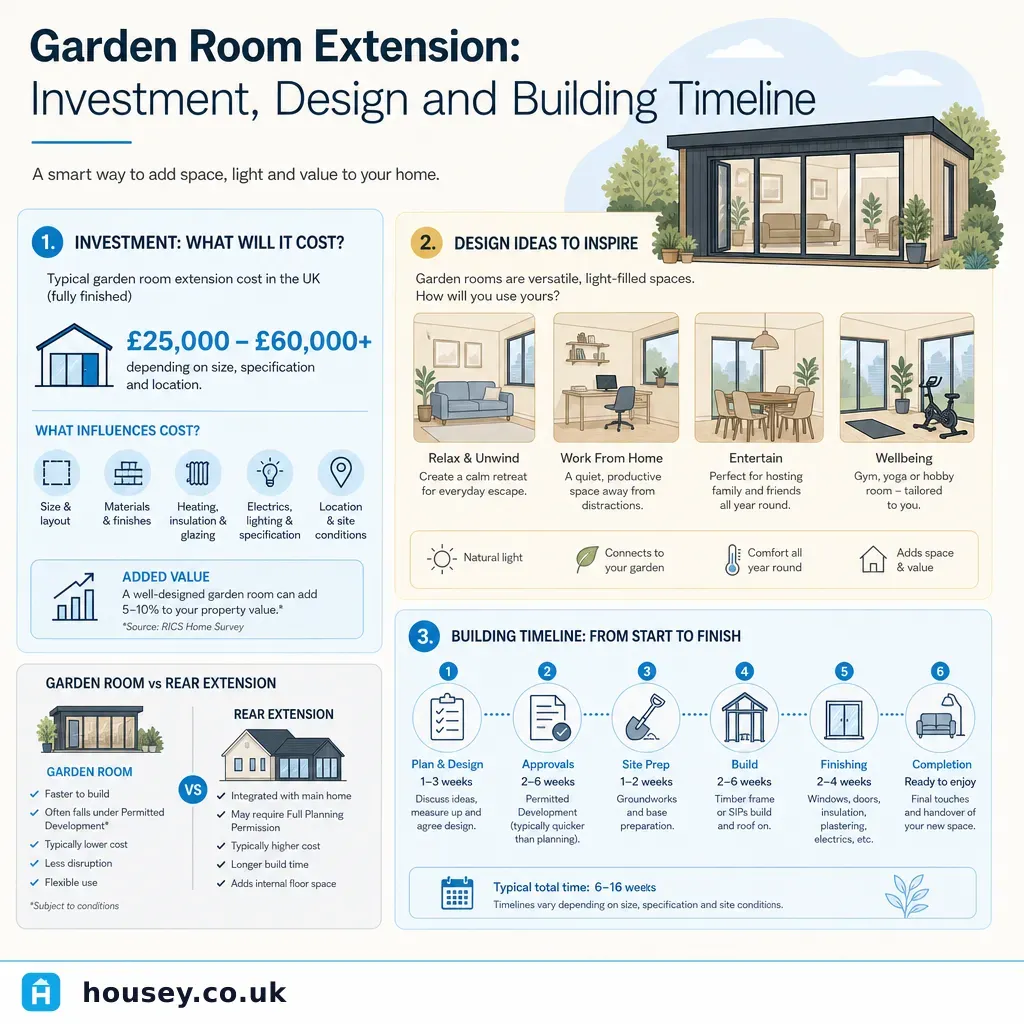
Garden Room Extension: Investment, Design and Building Timeline
A garden room or garden extension can add usable year-round space without always requiring planning permission.
 Improvement & Build
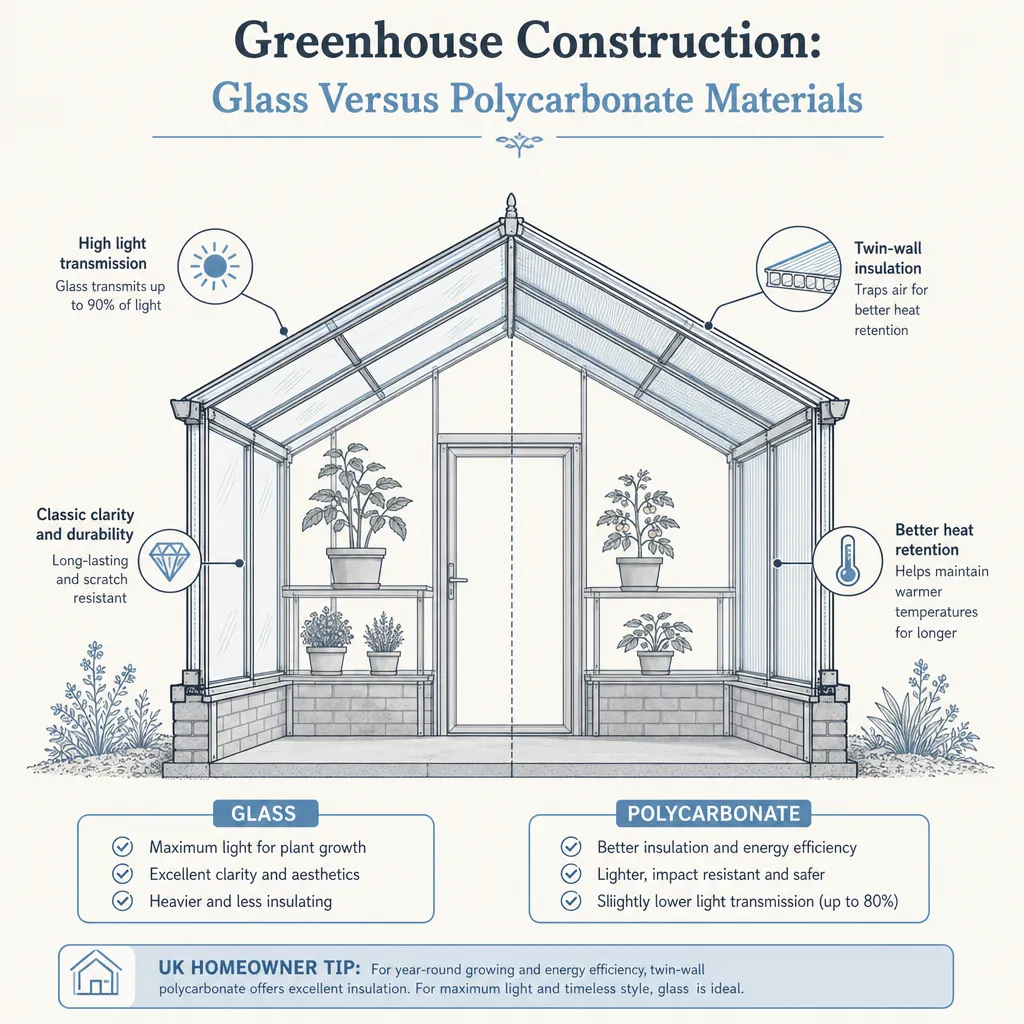
Greenhouse Construction: Glass Versus Polycarbonate Materials
Glass transmits around 90% of available light and lasts indefinitely if unbroken, but insulates poorly and shatters into sharp fragments.
 Improvement & Build
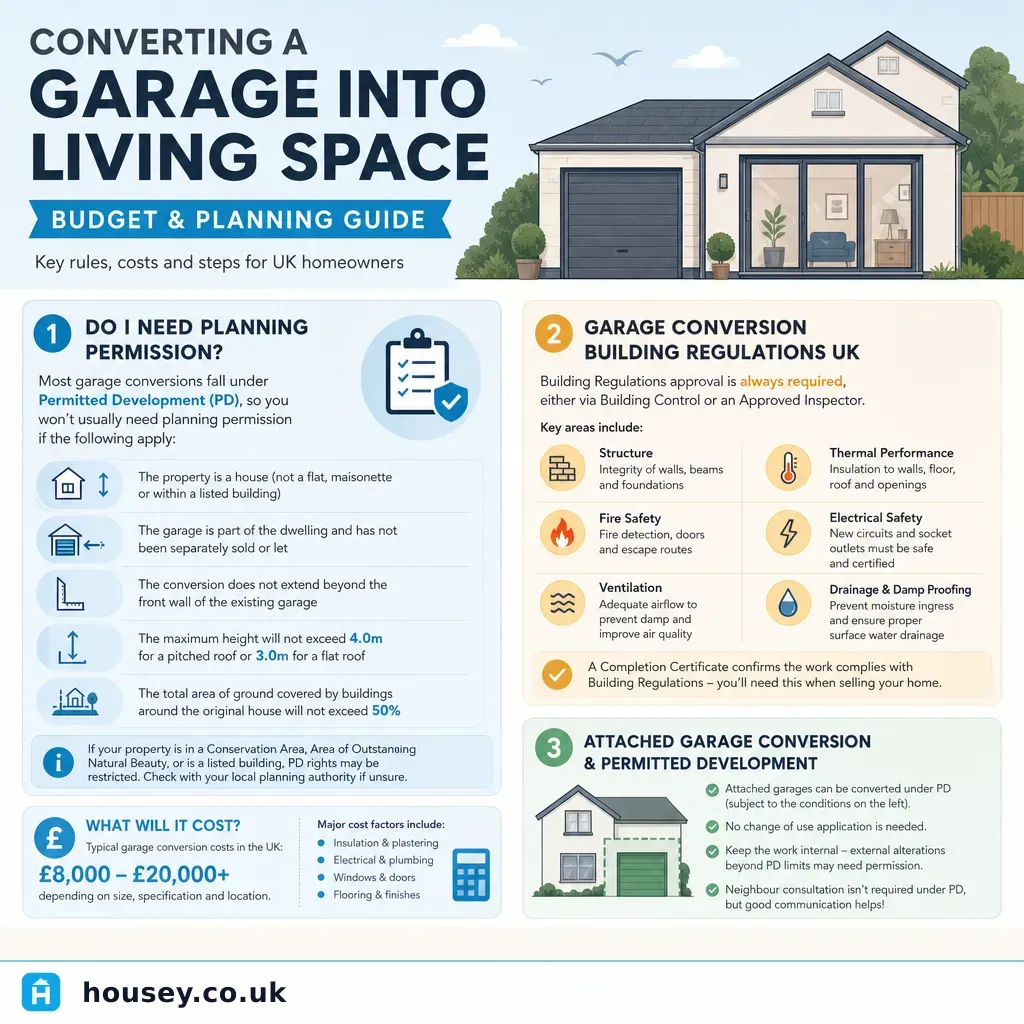
Converting a Garage into Living Space: Budget and Planning Guide
A single-garage conversion typically costs £8,000–£20,000 in the UK.
 Improvement & Build
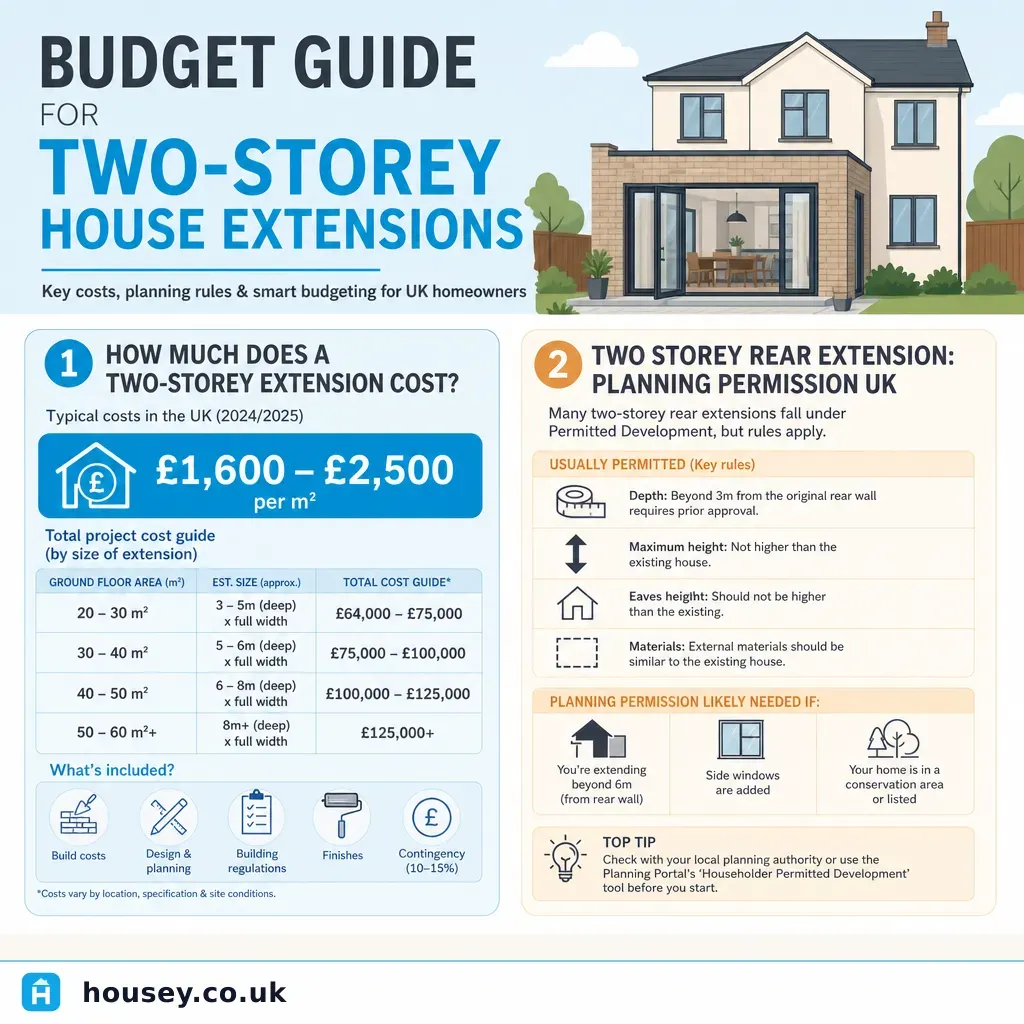
Budget Guide for Two-Storey House Extensions
A two-storey house extension in the UK typically costs £1,800–£3,000+ per square metre for the build alone.