Party Wall Surveyor Fees and Professional Costs
By Housey · Last reviewed 7th of May 2026
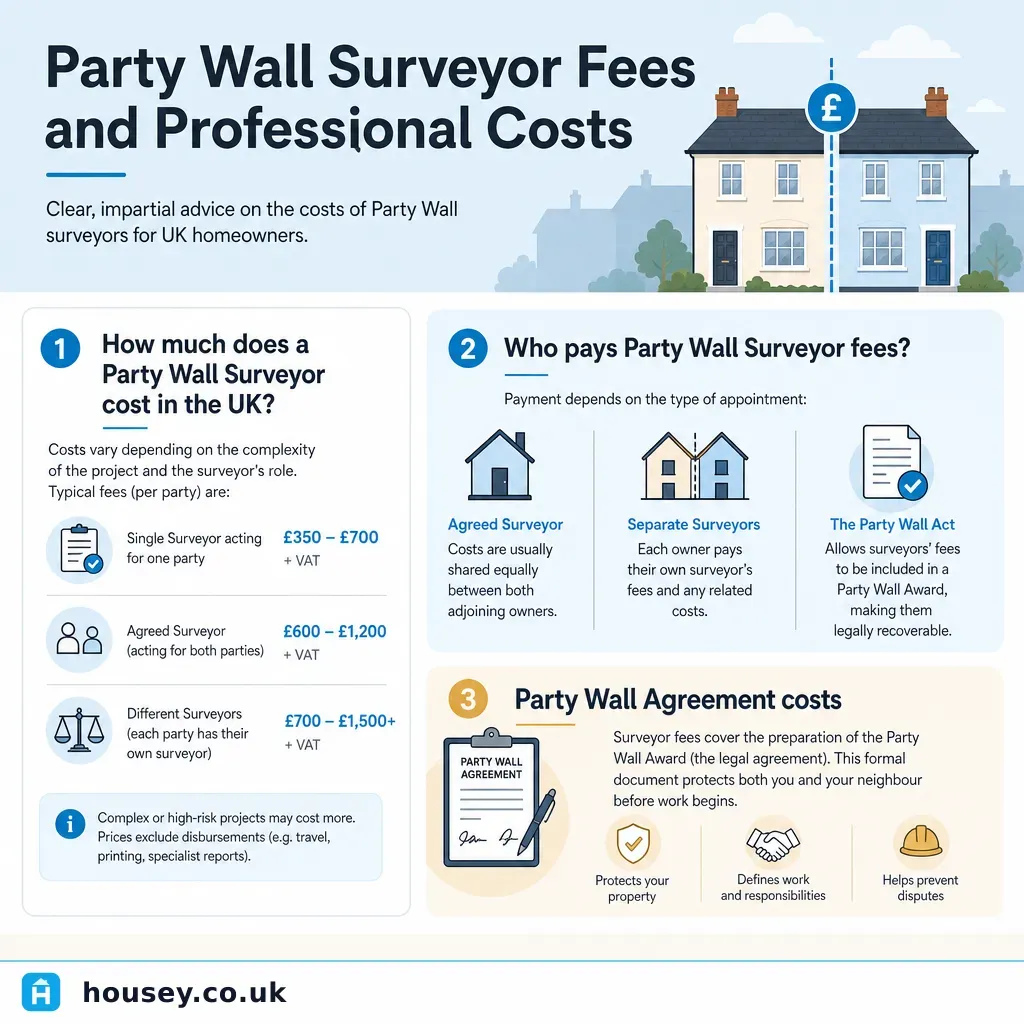
Party Wall Surveyor Fees and Professional Costs
Party wall matters arise most often when homeowners plan extensions, loft conversions, or basement excavations close to a shared boundary. The Party Wall etc. Act 1996 gives both building owners and their neighbours specific rights and obligations — and engaging a qualified party wall surveyor is frequently unavoidable once a notice is disputed. Understanding the fee structure before you serve a notice helps you budget accurately, programme the works sensibly, and avoid costly delays.
Key points
- The Party Wall etc. Act 1996 requires building owners to give formal notice before carrying out notifiable works on or near a shared wall, boundary, or within 3–6 metres of a neighbour's foundations (depending on excavation depth).
- A single "agreed surveyor" appointed jointly by both parties typically costs £700–£1,500 for a straightforward case; two separately appointed surveyors may push total fees to £1,500–£3,000 or more. Indicative UK costs, last reviewed 2026-05-07.
- The building owner — the person carrying out the works — is generally responsible for paying all reasonable surveyor fees, including those of the adjoining owner's surveyor, under Section 10 of the Act.
- If a neighbour dissents and the parties cannot agree on a single surveyor, each appoints their own; those two surveyors can then appoint a third to resolve any disagreement between them.
- Party wall awards are legally binding documents setting out how and when work may proceed; they protect both parties and can be relied upon if damage claims arise later.
What does a party wall surveyor charge?
Party wall surveyor fees are not fixed by law. They vary according to the complexity of the case, the surveyor's location and experience, and whether one or two surveyors are involved. The figures below are indicative UK costs, last reviewed 2026-05-07.
Appointment type | Typical fee range | Who appoints | Who usually pays |
|---|---|---|---|
Agreed surveyor (joint appointment) | £700–£1,500 | Both parties agree | Building owner |
Building owner's own surveyor | £600–£1,200 | Building owner | Building owner |
Adjoining owner's own surveyor | £600–£1,200 | Adjoining owner | Building owner |
Third surveyor (dispute resolution) | £500–£1,500+ | The two appointed surveyors | Usually building owner |
Schedule of condition only | £300–£700 | Either party | Varies |
Many party wall surveyors charge hourly rates of £150–£300 rather than a fixed fee. Complex cases — deep basement excavations, works affecting multiple neighbours, or disputed awards — can significantly exceed these ranges. Always request a written fee estimate or terms of engagement before instructing a surveyor.
Who pays party wall surveyor fees?
Under Section 10 of the Party Wall etc. Act 1996, the building owner is generally liable for the reasonable fees of all surveyors involved — including those appointed by the adjoining owner. The rationale is that the building owner initiates the works that trigger the statutory process.
There are limited exceptions. If the adjoining owner's conduct is found unreasonable — for example, refusing to consider a qualified agreed surveyor without cause, or where the appointed surveyor's fees are disproportionate to the work involved — the party wall award can apportion costs differently. The two appointed surveyors, or the third surveyor if one is called upon, determine what is reasonable.
Practical note: If you receive an invoice from the adjoining owner's surveyor that appears excessive, raise it formally with your own surveyor before paying. Fees are reviewable as part of the award process.
Worked example: a rear extension in a Victorian terrace
A homeowner in South London plans a single-storey rear extension that will cut into the party wall shared with both neighbours.
- Two party wall notices are served — one to each neighbour.
- Neighbour A consents in writing. No surveyor is required for that boundary.
- Neighbour B dissents and appoints their own surveyor.
- The building owner appoints their own surveyor.
- The two surveyors agree on the works and produce a party wall award.
Indicative costs to the building owner (last reviewed 2026-05-07):
- Building owner's surveyor: approximately £900
- Neighbour B's surveyor: approximately £850
- Total: approximately £1,750
Had both neighbours dissented and each appointed their own surveyor, total fees could easily have exceeded £3,000. Had both parties agreed to a single agreed surveyor, total fees may have been closer to £1,200.
What affects party wall surveyor costs?
Several factors push fees higher or lower:
Factors that increase fees:
- Deep excavations — basement works trigger the 3-metre and 6-metre excavation notice provisions under Section 6 of the Act, requiring more detailed assessments
- Multiple adjoining owners, each requiring a separate award
- Disputes that escalate to a third surveyor
- Slow communication or obstructive behaviour by any party, increasing administration time
- Significant existing damage to the adjoining property requiring a detailed schedule of condition
- Location in London or the south-east, where surveyors typically charge higher rates
Factors that reduce fees:
- Simple works with limited structural impact on the neighbouring property
- An agreed surveyor appointment, avoiding duplication of work
- Prompt responses from all parties throughout the process
- Properties where the schedule of condition is straightforward and brief
Red flags when instructing a party wall surveyor
- No written fee agreement before starting work. A professional surveyor provides written terms of engagement or a fee estimate before acting.
- Claiming the Act applies when it does not. Not every boundary or wall issue triggers the Party Wall etc. Act 1996; the Act covers specific notifiable works only.
- Pressure to instruct immediately. The Act gives adjoining owners 14 days to respond to a notice; that window should not be circumvented.
- No verifiable professional membership. Check that the surveyor holds RICS membership or is a member of the Faculty of Party Wall Surveyors (FPWS) before instructing.
- Fees quoted as a percentage of the build cost. Party wall fees should reflect surveyor time and complexity, not the contract value of the works.
Important limitations
This article provides general information about party wall surveyor fees applicable in England and Wales, where the Party Wall etc. Act 1996 applies. Scotland and Northern Ireland operate under different legal frameworks and have no equivalent party wall statute. Rules, timescales, and professional obligations vary with the nature of the works, the property's history, and any existing agreements. This article is not a substitute for advice from a qualified party wall surveyor or solicitor. For complex or disputed matters, professional advice should be sought promptly.
What to ask a qualified professional
Before instructing a party wall surveyor, ask:
- Are you a member of RICS or the Faculty of Party Wall Surveyors (FPWS)?
- Can you provide a written fee estimate or schedule of rates before starting work?
- How do you charge — fixed fee, hourly, or a combination — and what triggers additional charges?
- What does your fee include, and is VAT charged on top?
- How long do you expect the award process to take for my type of works and property?
- Have you handled similar cases — for example, basement excavations or extensions in this type of construction?
- If both neighbours dissent, are you able to act as agreed surveyor, or will you act only for one party?
When to get professional help
Instruct a qualified party wall surveyor if:
- You are planning works that affect a party wall, party fence wall, or involve excavation within 3 metres of an adjoining owner's building.
- A neighbour has served a party wall notice on you and you are unsure whether to consent or dissent.
- You believe works carried out by a neighbour have caused damage to your property.
- A notice has been served and the 14-day response window is approaching.
Do not rely on this article alone if you have received a formal party wall award, a legal letter, or a claim for damage — seek professional advice promptly.
How Housey can help
Housey can connect you with qualified party wall surveyors across England and Wales. Submit your project details and receive quotes from professionals who can advise on which notices to serve, carry out a schedule of condition, and draft a legally binding party wall award — helping you manage the process before works begin.
Frequently asked questions
Who pays for a party wall surveyor?
The building owner — the party carrying out the notifiable works — is generally responsible for all reasonable party wall surveyor fees under the Party Wall etc. Act 1996. This includes the costs of any surveyor appointed by the adjoining owner. Costs can be apportioned differently if the adjoining owner's demands are found unreasonable by the surveyors involved.
Can both neighbours use one party wall surveyor?
Yes. An agreed surveyor can be jointly appointed by both the building owner and the adjoining owner under Section 10 of the Act. This is usually the most cost-effective route. The agreed surveyor must act impartially. Either party can withdraw from the arrangement and appoint their own surveyor if they feel the process is not working properly.
What if my neighbour ignores a party wall notice?
If a neighbour fails to respond within 14 days of receiving a party wall notice, they are deemed to have dissented under the Act. This triggers the dispute resolution process: both parties must appoint surveyors, or agree on a single one. The notifiable works cannot proceed on that boundary until a formal party wall award is in place.
How long does the party wall process take?
For straightforward cases with a cooperative adjoining owner, the notice and award process can typically be completed in four to eight weeks. More complex cases, multiple adjoining owners, or disputes involving a third surveyor can take several months. Factor this into your project programme before starting any notifiable works.
Can I negotiate party wall surveyor fees?
You can request a fixed fee rather than an open-ended hourly rate. For the adjoining owner's surveyor, fees are subject to reasonableness — if they appear excessive, the building owner's surveyor can formally challenge them. Using an agreed surveyor rather than two separately appointed surveyors generally results in lower total costs for the building owner.
Sources and further reading
- Party Wall etc. Act 1996 — legislation.gov.uk
- Party walls and building work — GOV.UK
- Party wall legislation guidance — RICS
- Faculty of Party Wall Surveyors — FPWS
Useful next reads
 Surveys & Inspections
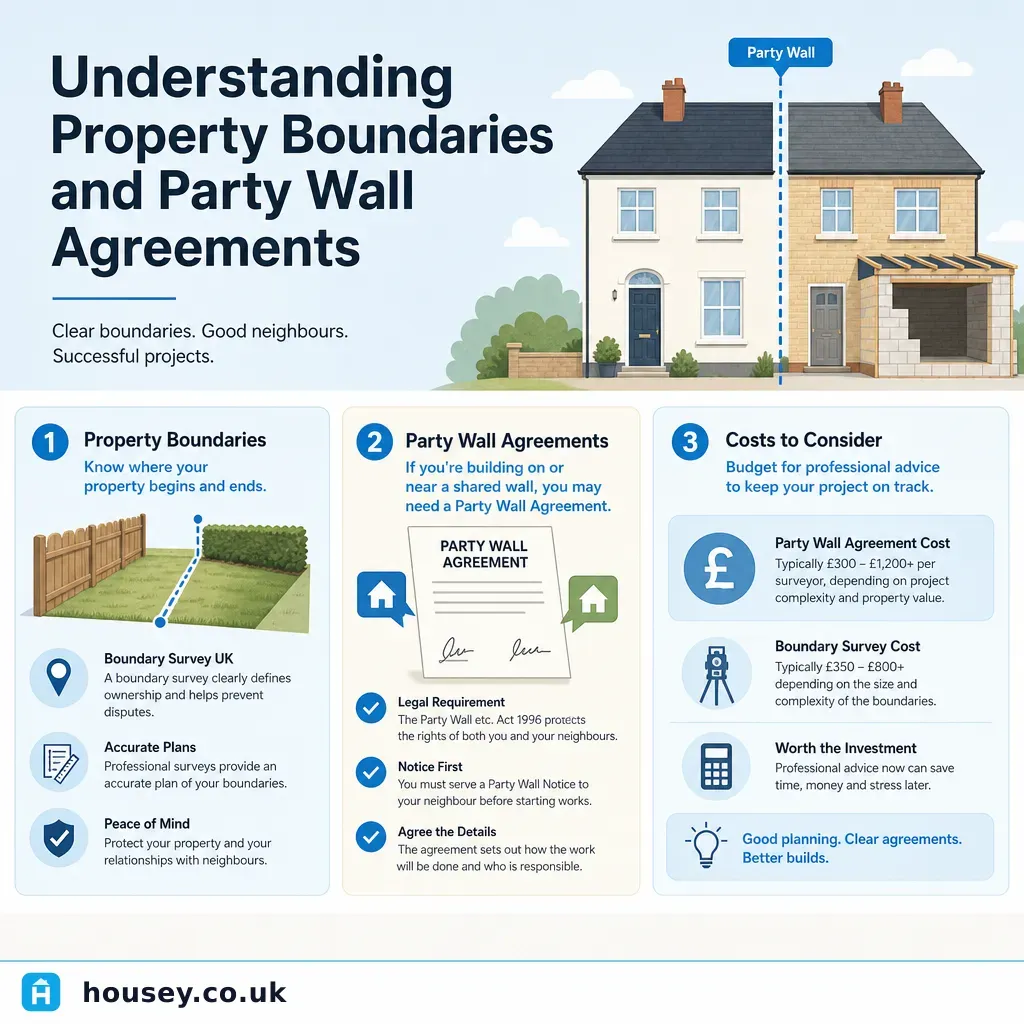
Understanding Property Boundaries and Party Wall Agreements
Property boundaries define the legal extent of your land; the Party Wall etc.
 Surveys & Inspections
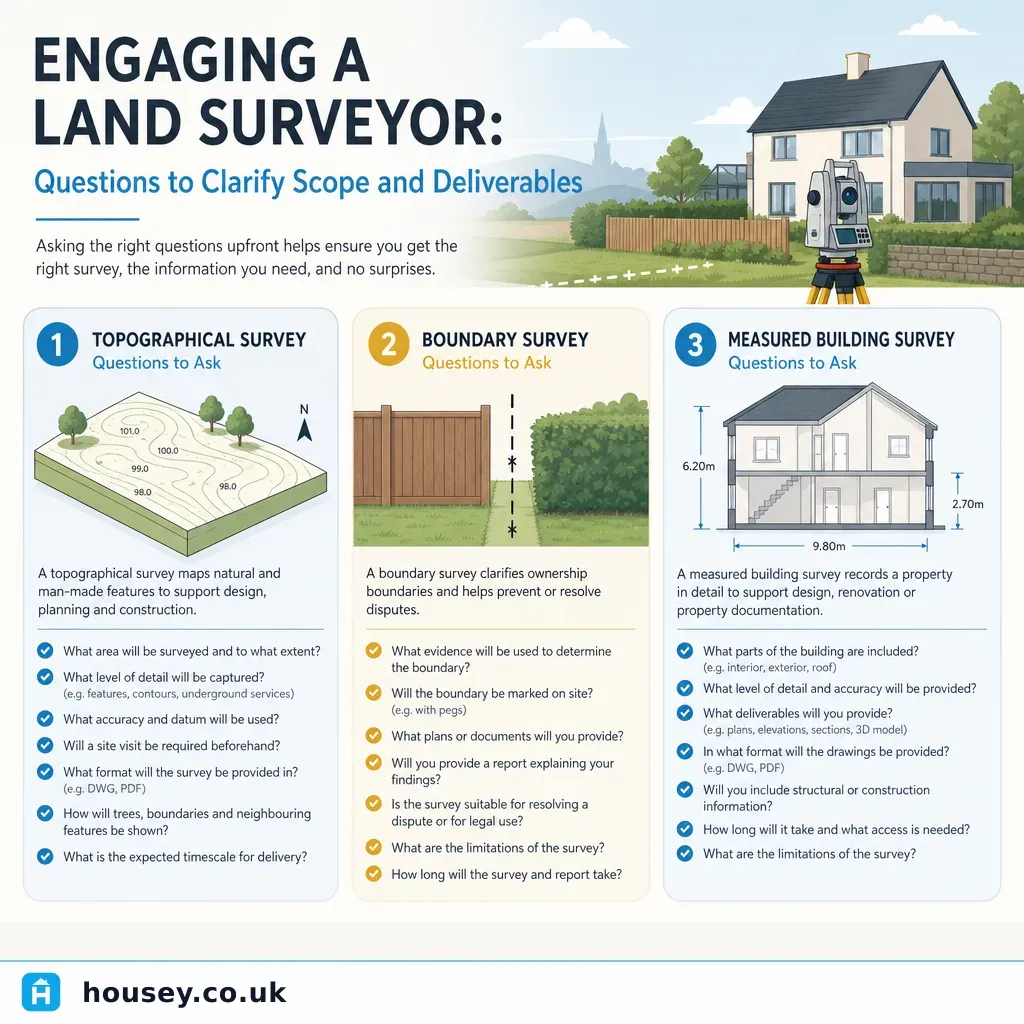
Engaging a Land Surveyor: Questions to Clarify Scope and Deliverables
When engaging a land surveyor, clarify exactly which type of survey you need — topographical, boundary, or measured building — before agreeing a fee.
 Surveys & Inspections
Property Survey Costs: What Buyers Need to Budget
A RICS Level 1 survey typically costs £300–£500, a Level 2 Home Survey £400–£900, and a Level 3 Building Survey £600–£1,500 or more.
 Surveys & Inspections
Land and Property Surveying Costs
Land survey costs in the UK typically range from around £400 for a simple boundary check to £3,000 or more for a detailed topographical or measured building survey of a large site.
 Surveys & Inspections
Surveying Large Estates and Acreage: What Property Owners Should Know
Large estates and acreage typically require a combination of surveys: a topographical survey to map contours and features, a boundary survey to confirm legal extents, and often an ecological or environmental assessment.