Percolation Testing for Property Development
By Housey · Last reviewed 9th of May 2026
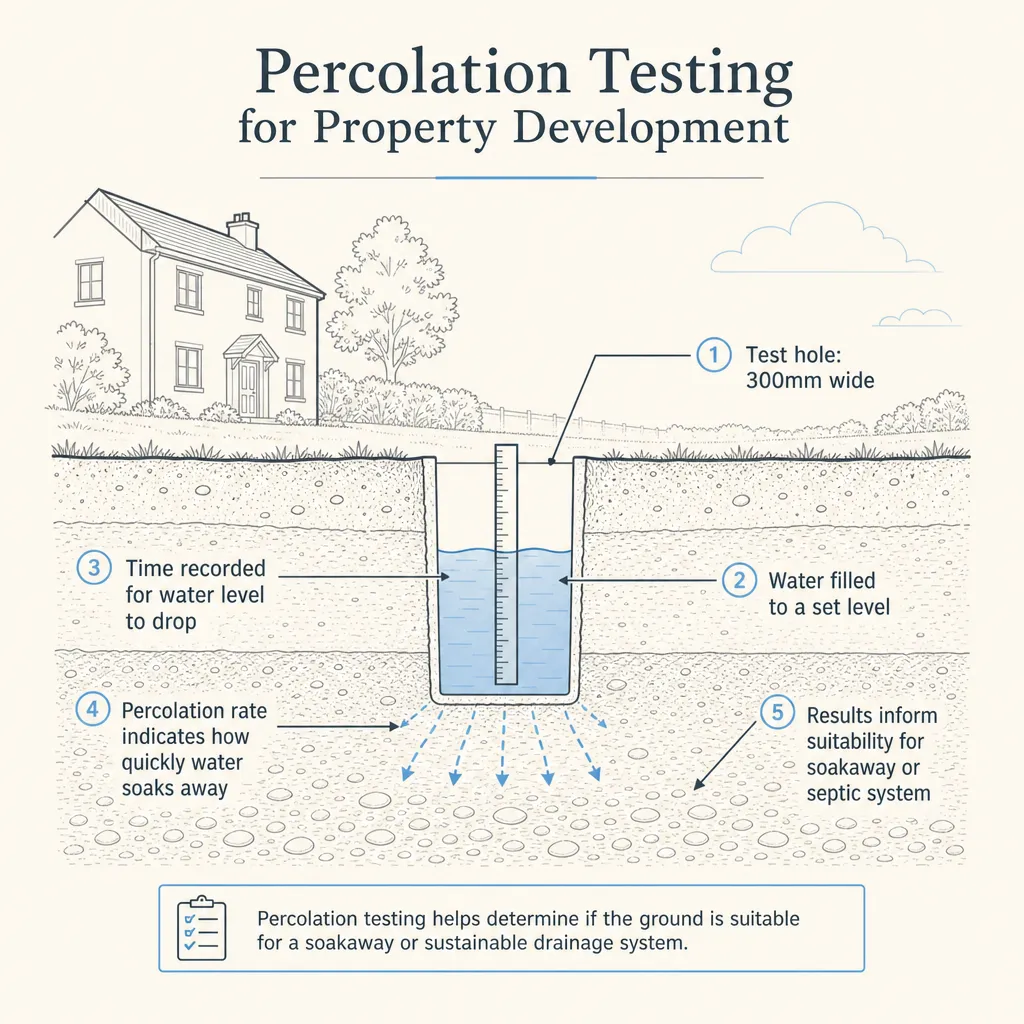
Percolation Testing for Property Development
Percolation testing is a routine but important part of site investigation for any UK property development that cannot connect to a public sewer. Whether you are planning a new rural dwelling, installing a replacement drainage system, or supporting a planning application with a drainage strategy, the results of a percolation test will determine which drainage solutions are viable — and which are not. Getting the test done correctly, and at the right stage, avoids costly redesigns later.
Key points
- Building Regulations Approved Document H requires a percolation test before a soakaway can be designed for foul or surface water drainage on a new or replacement system.
- BRE Digest 365 sets out the standard UK methodology: soil must achieve a percolation value (Vp) of between 15 and 100 seconds per millimetre for a soakaway to be appropriate.
- Tests must be conducted in the location and at the depth of the proposed soakaway — not elsewhere on the site.
- A Vp below 15 indicates drainage that is too rapid (flooding or pollution risk); above 100 indicates soil too impermeable for a soakaway to function.
- Many local planning authorities require a drainage impact assessment — which includes percolation test results — as a planning condition or pre-condition for approval.
What is a percolation test and why is it required?
A percolation test (sometimes called a perc test) measures how quickly water is absorbed by the soil at a given depth. The result tells engineers whether the ground can accommodate the volume of drainage expected from a building — whether that is foul water from a septic tank or surface water from roofs and driveways.
Under Approved Document H of the Building Regulations, a drainage field or soakaway system for foul water must be based on verified soil percolation data. You cannot simply assume the ground will drain adequately — the test is a formal requirement where no mains sewer connection is available or used.
Local planning authorities in England, Scotland, and Wales also frequently attach drainage conditions to planning permissions for rural development. The Environment Agency (EA) has separate requirements if a drainage system discharges to controlled waters or requires an environmental permit.
How the test is carried out
The standard UK methodology is described in BRE Digest 365 (Soakaway Design). The procedure involves the following steps:
- Excavate trial holes to the proposed invert depth of the soakaway — typically 300 mm square, or as specified by the engineer.
- Saturate the soil by filling the hole with water multiple times and allowing it to drain completely; this removes the effect of dry soil, which would give artificially fast results.
- Fill to 300 mm and record the time for the water level to fall 25 mm.
- Repeat this measurement and calculate the average time in seconds per millimetre — the Vp value.
- Interpret results against the BRE Digest 365 thresholds.
Tests should be conducted at the start of the construction season, ideally in winter or after prolonged rainfall, so results reflect realistic worst-case conditions. Spring or summer testing on dried-out soil can give misleading Vp values.
What do percolation test results mean?
Vp result (seconds/mm) | What it means | Typical next step |
|---|---|---|
Less than 15 | Soil drains too rapidly — pollution or flooding risk | Specialist drainage design; possible EA consultation |
15 to 100 | Suitable for soakaway — acceptable absorption rate | Proceed with soakaway design to BRE Digest 365 |
More than 100 | Soil too impermeable — soakaway will not function | Consider mains connection, package treatment plant, or reed bed |
Highly variable across site | Non-uniform soil — further investigation needed | Additional boreholes or trial pits recommended |
A percolation value within range does not guarantee a soakaway will work. The designer must also account for catchment area, groundwater depth (the base of the soakaway must sit at least 1 m above the seasonally highest groundwater level), and proximity to buildings and boundaries.
When do you need a percolation test?
Use this decision guide to check whether a percolation test is likely to apply to your project.
- Commission a percolation test if you are building a new dwelling with no mains sewer connection — it is required before a soakaway or drainage field can be designed or approved.
- Commission a percolation test if replacing a septic tank or drainage field — Building Regulations require evidence that the ground is suitable for the new system.
- Check with a drainage engineer if an extension or conversion will add foul water load to an existing soakaway, to confirm whether re-testing is needed.
- Test as good practice, and check local authority requirements, if planning a surface water soakaway for roof or driveway runoff.
- A percolation test is unlikely to be required if all drainage — foul and surface water — will connect to a public mains sewer.
- Consult the Environment Agency before relying on ground drainage if the site is in a Source Protection Zone (SPZ) or within 50 m of a watercourse or borehole — restrictions may apply regardless of Vp results.
Which professional carries out the test?
Professional | When to use |
|---|---|
Geotechnical engineer or site investigator | Standard percolation testing as part of a broader site investigation; preferred for planning submissions |
Civil or drainage engineer | When the test forms part of a drainage strategy design |
Qualified building control inspector | May carry out or witness tests for building regulations compliance on smaller residential projects |
Specialist drainage contractor | Some contractors offer testing, but verify they follow BRE Digest 365 methodology and can produce a written report |
For planning submissions, a written report from a qualified professional holding professional indemnity insurance is usually expected. A verbal result or site note is unlikely to satisfy a planning condition.
What to ask before commissioning a percolation test
- Will you carry out the test in accordance with BRE Digest 365?
- At what depth will the test be conducted, and how many trial holes are included in the fee?
- Will the test be conducted after soil saturation, or only in dry conditions?
- What will the written report include, and is it suitable for a planning or building regulations submission?
- What happens if results are borderline or variable across the site — will additional holes be tested at no extra charge?
- Does the fee include a groundwater depth assessment?
- What professional indemnity insurance do you hold?
- Will you recommend next steps if the site fails the test?
When to get professional help
A percolation test should always be carried out by a qualified professional when results will be used to support a planning application or building regulations submission. Issues that particularly warrant expert involvement include:
- Sites in or near Source Protection Zones, floodplains, or within 50 m of a watercourse or borehole
- Ground conditions that appear variable, waterlogged, or heavily made-up (filled or disturbed ground)
- Sites where previous drainage has failed or is under-performing
- Any project requiring an Environment Agency environmental permit for discharge to groundwater or surface water
If you are unsure whether your site needs a percolation test or what the results mean for your planning application, a geotechnical and soil investigation professional can advise from the outset.
How Housey can help
Housey connects you with qualified professionals who carry out percolation testing and site drainage assessments across the UK. If your project needs a geotechnical and soil investigation or a broader environmental survey to support a planning application or building regulations submission, you can request quotes from local specialists through Housey.
Frequently asked questions
Does a percolation test guarantee planning permission for drainage?
No. A passing percolation test shows the soil is capable of accepting drainage at the tested rate — it does not guarantee planning permission. The local planning authority and, where applicable, the Environment Agency will assess the full drainage strategy, including proximity to watercourses, source protection zones, and cumulative drainage impact on the area.
How many trial holes do I need for a percolation test?
BRE Digest 365 recommends a minimum of three trial holes, tested separately, with results averaged. On larger or variable sites, more holes may be needed to demonstrate consistency across the plot. Your geotechnical engineer will advise on the number appropriate for your site conditions and the requirements of the drainage design.
Can I carry out a percolation test myself?
You can carry out a basic test following the BRE Digest 365 procedure, but the result is unlikely to be accepted for planning or building regulations purposes unless conducted and reported by a qualified professional with appropriate insurance. Self-testing is sometimes used as an initial feasibility check before commissioning formal testing.
What is the difference between a percolation test and a soakaway test?
The terms are often used interchangeably. A percolation test refers specifically to the soil absorption measurement; a soakaway assessment may also include groundwater depth, site layout constraints, and the sizing calculation for the soakaway structure. BRE Digest 365 covers both elements as part of soakaway design.
Sources and further reading
- Approved Document H: Drainage and Waste Disposal — Ministry of Housing, Communities & Local Government
- BRE Digest 365: Soakaway Design — Building Research Establishment
- The Building Regulations 2010 — legislation.gov.uk
- Groundwater protection: position statements — Environment Agency
Useful next reads
 Planning & Pre-Build
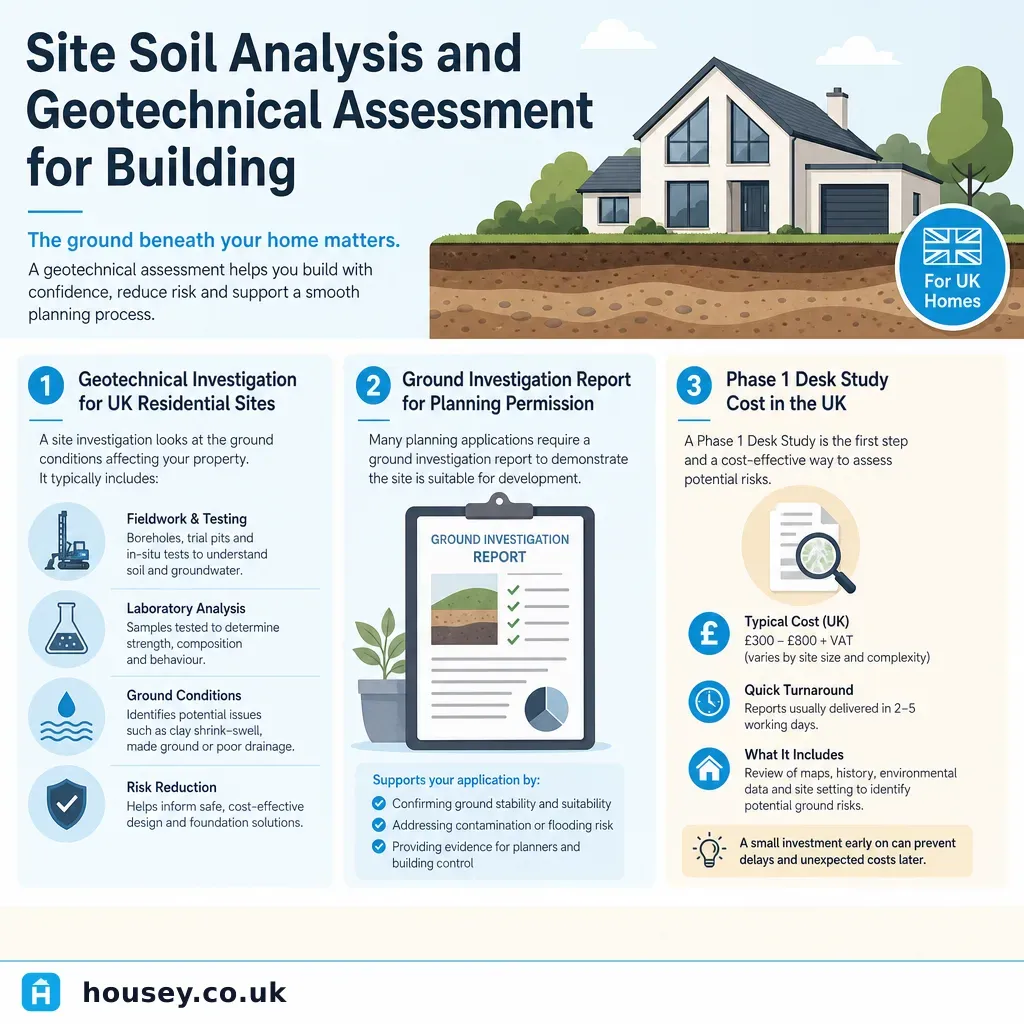
Site Soil Analysis and Geotechnical Assessment for Building
A geotechnical investigation assesses soil type, bearing capacity, groundwater, and contamination risk beneath a building site.
 Planning & Pre-Build
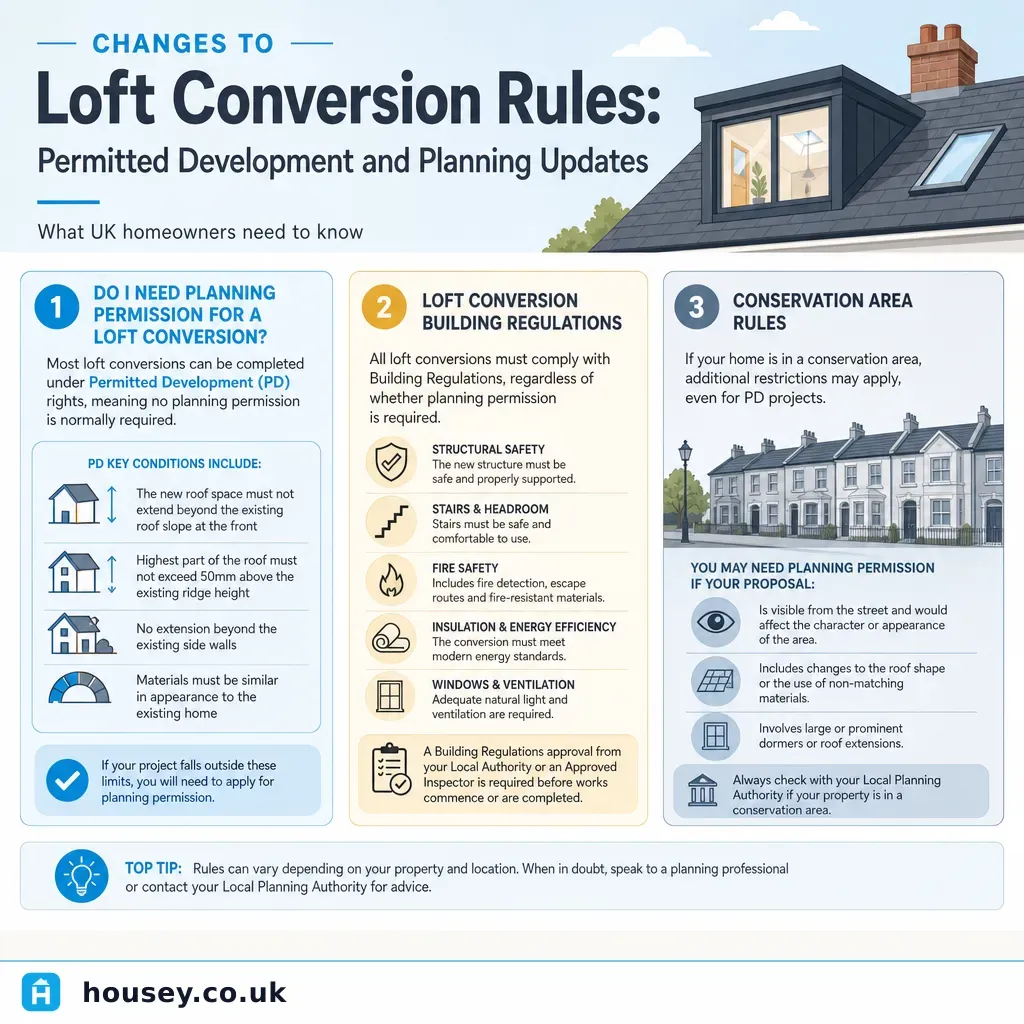
Changes to Loft Conversion Rules: Permitted Development and Planning Updates
In England, most loft conversions on standard houses qualify as Permitted Development under Class B of the GPDO 2015, allowing up to 40 cubic metres (terraced) or 50 cubic metres (detached or semi-detached) without a planning application — if conditions are met.
 Planning & Pre-Build
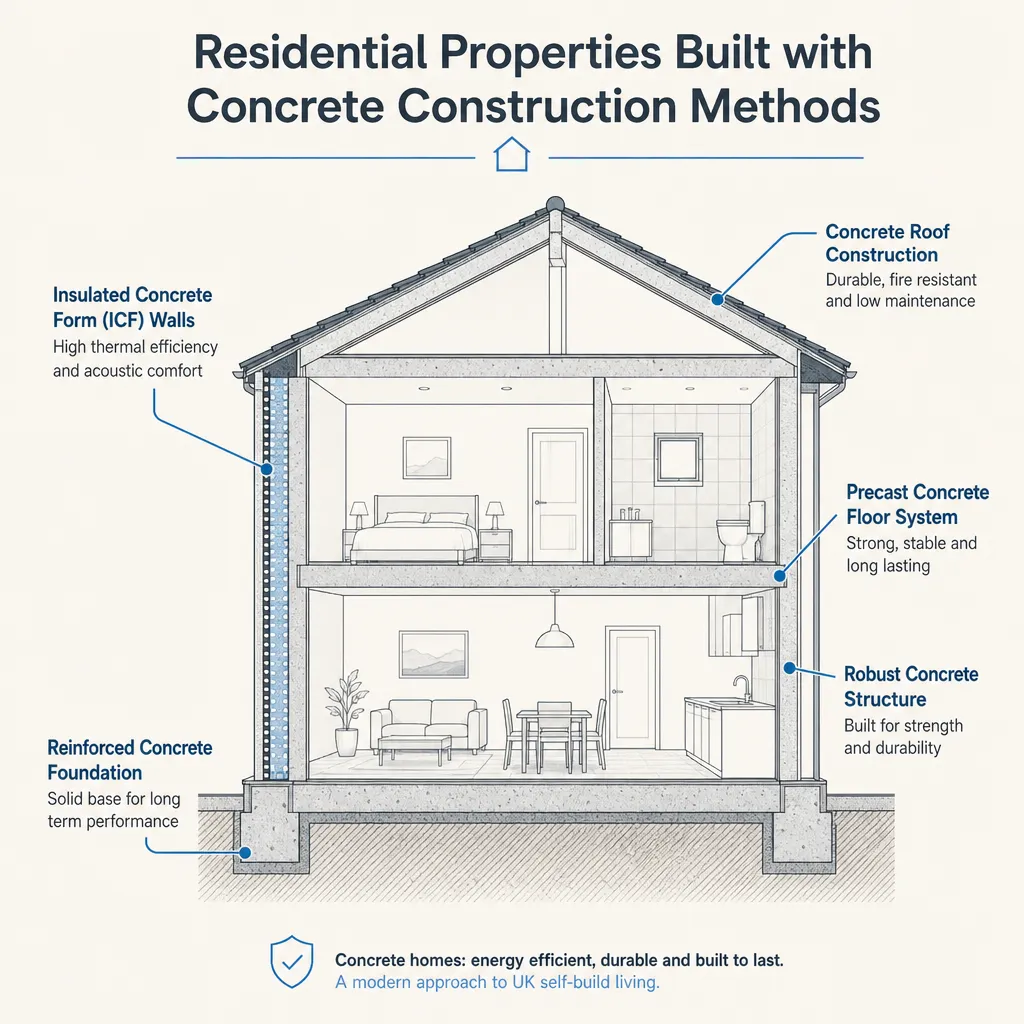
Residential Properties Built with Concrete Construction Methods
UK homes are built using several concrete methods: in-situ cast concrete, precast panel systems, insulating concrete formwork (ICF), and older non-traditional types such as Wimpey No-Fines and Laing Easiform.
 Planning & Pre-Build
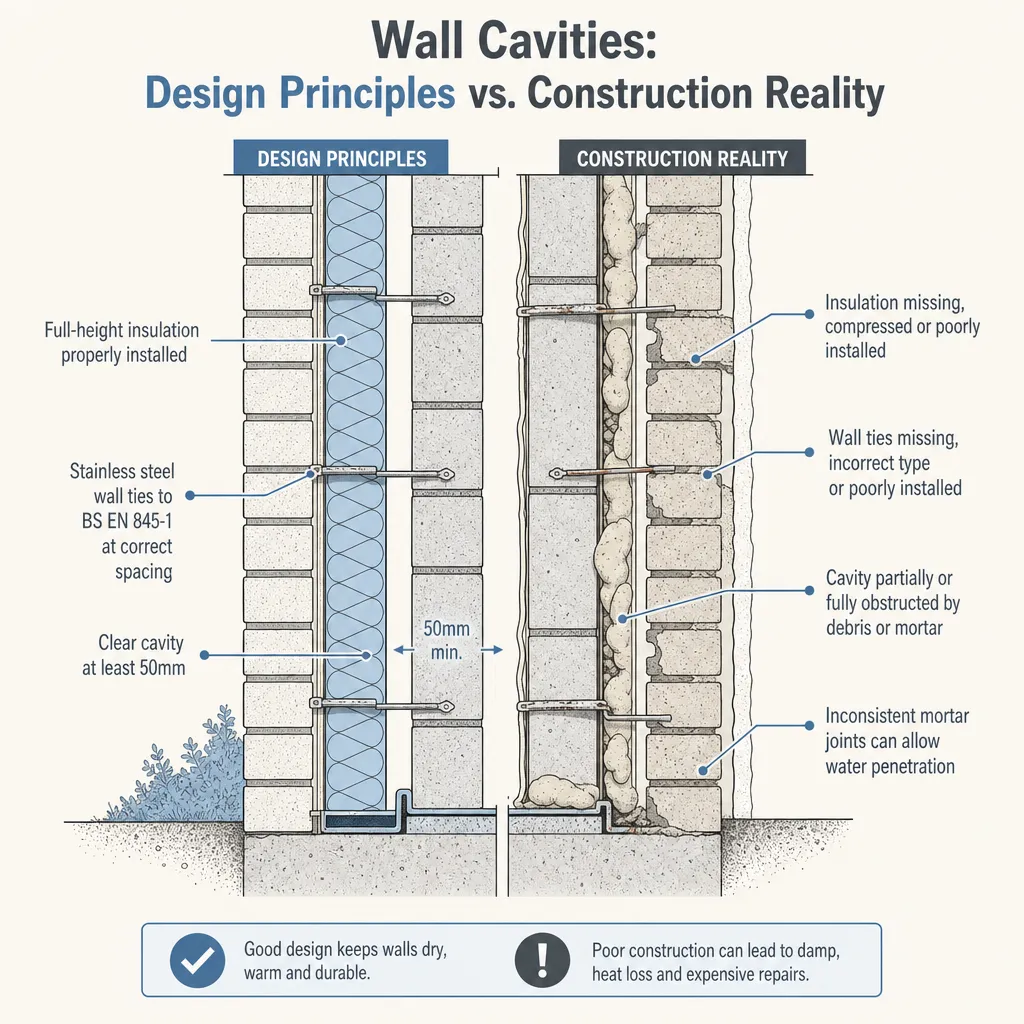
Wall Cavities: Design Principles vs. Construction Reality
A UK cavity wall is designed to resist weather, control heat loss, and structurally link two masonry leaves.
 Planning & Pre-Build
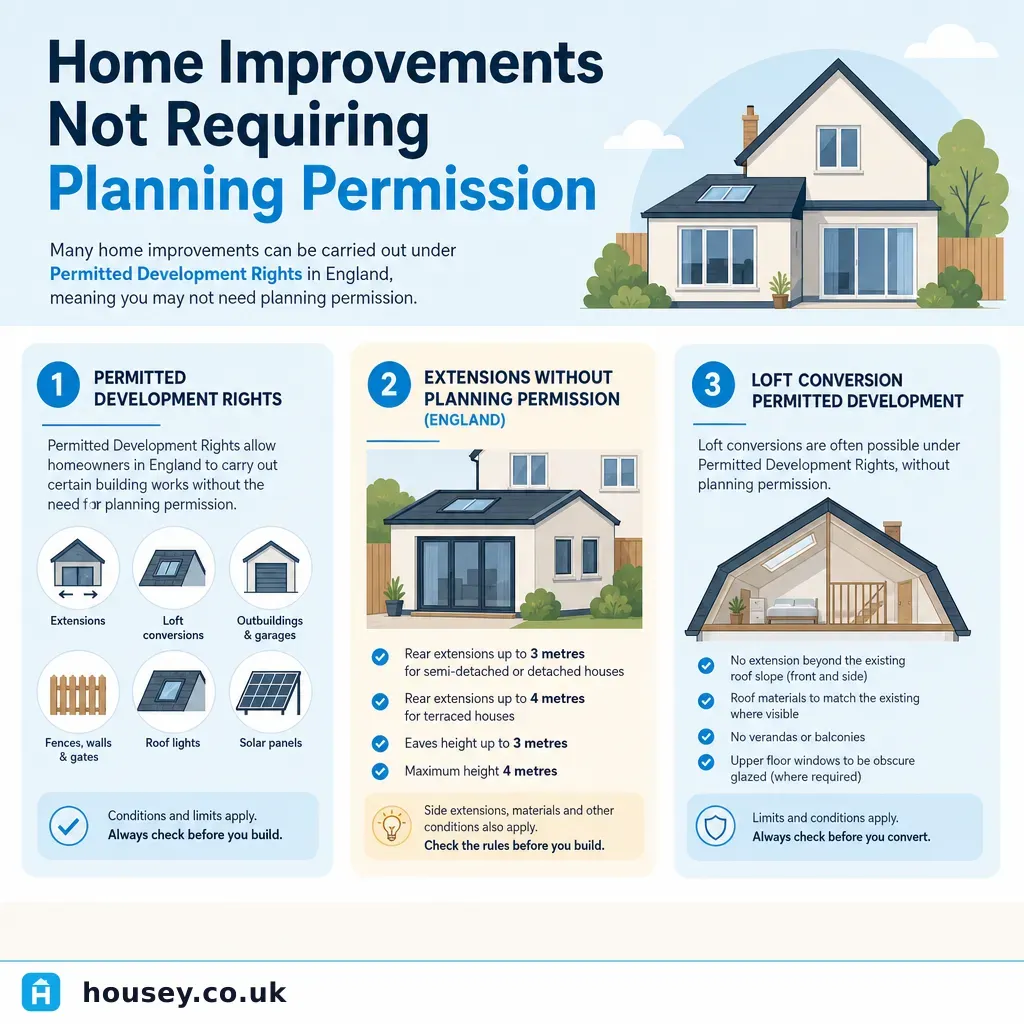
Home Improvements Not Requiring Planning Permission
Many common home improvements in England fall under Permitted Development Rights and do not require a planning application.