Perennial Garden Design: Planting Schemes and Ideas
By Housey · Last reviewed 30th of May 2026
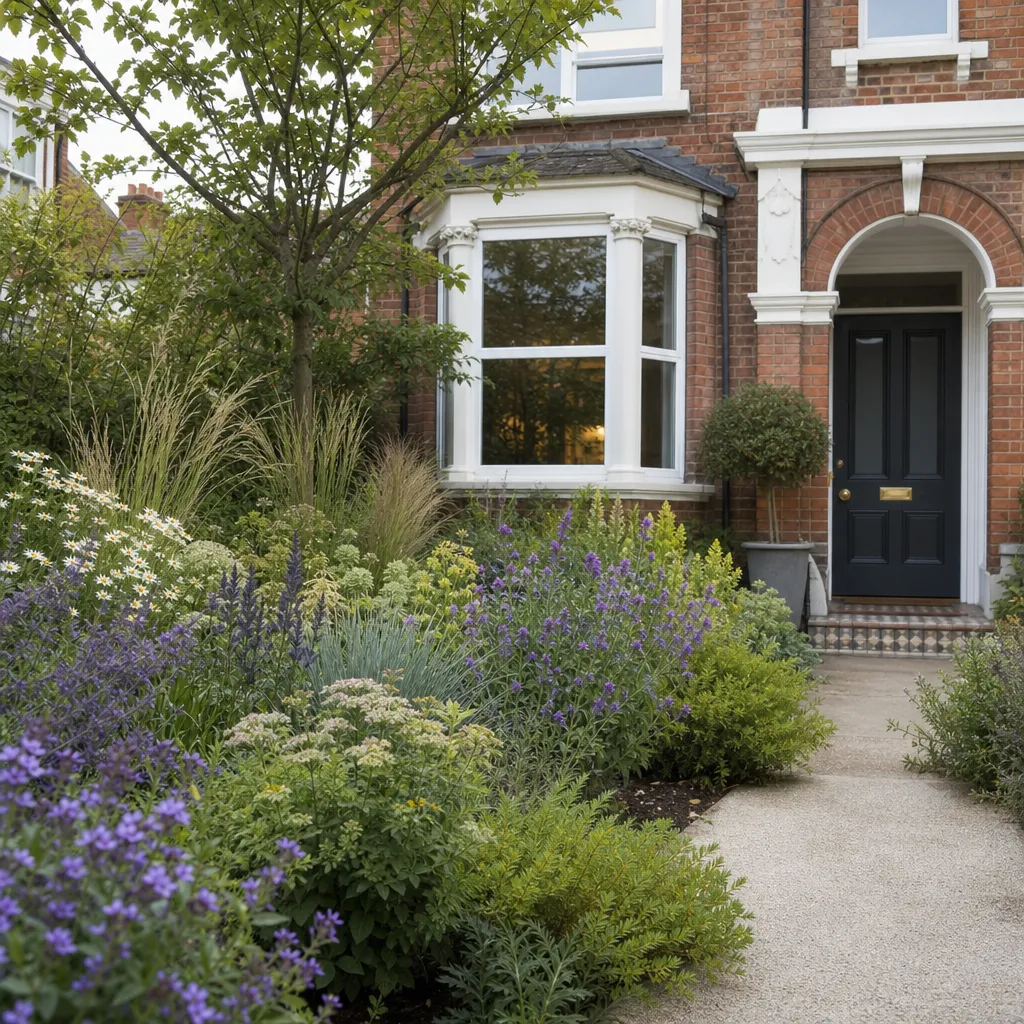
Perennial Garden Design: Planting Schemes and Ideas
A well-designed perennial border can transform a garden from a seasonal maintenance task into a year-round living feature that improves with age rather than requiring complete replanting. Homeowners most often think seriously about perennial design when they take on a new property with neglected beds, when they want to reduce the cost and effort of annual bedding, or when a renovation project has cleared the way for a garden rethink. Getting the design right from the start saves years of remediation and repeated purchasing.
Key points
- Most UK perennial borders benefit from soil preparation in autumn or spring — incorporating 5–10 cm of organic matter such as garden compost or well-rotted manure significantly improves drainage in clay and moisture retention in sandy soils before any planting begins.
- The RHS recommends a planting density of approximately five to seven plants per square metre for a mixed perennial border to achieve good ground coverage and reduce weeding pressure in years two and three.
- For year-round garden interest, aim for roughly one-third of your planting to provide winter structure — ornamental grasses such as Miscanthus or Calamagrostis, or seed-head perennials such as Echinacea and Rudbeckia, contribute well after the growing season ends.
- A professional garden designer typically charges £500–£3,000 for a residential planting plan depending on garden size and complexity; some work to a day rate of £300–£600.
- Under the UK's Biodiversity Net Gain requirements — mandatory for major planning applications from February 2024 — wildlife-friendly planting principles are now a formal planning consideration, and the same approach benefits domestic borders across all garden sizes.
Understanding perennial planting: the key principles
Perennials are plants that return each year from an established root system, building in vigour over time. Unlike annuals, which complete their life cycle in a single season, perennials invest in root development early and reward patience with increasingly impressive displays. In a UK context, this suits homeowners who want a productive, colourful border without the annual cost of buying and planting bedding.
Four principles underpin most successful perennial schemes:
Layered structure: Place taller structural plants at the rear of a one-sided border (or the centre of an island bed), mid-height flowering plants in the main zone, and lower ground-covering or edging plants at the front. This creates depth and ensures no single layer dominates or obscures the others.
Seasonal continuity: Map the scheme across spring, early summer, late summer, and autumn. Many UK borders peak in June and July then decline sharply — deliberate late-season planting using Asters, Persicaria, and Helenium prevents this.
Soil and aspect matching: No scheme succeeds if it ignores site conditions. Identify your soil type and pH (a basic test kit costs under £10 from a garden centre), and note whether the border is north-, south-, east-, or west-facing and whether it is sheltered or exposed.
Repetition and rhythm: Repeating one or two key plants or grasses along the length of a border ties the scheme together visually and reduces the patchwork effect that results from planting one of everything.
Choosing a planting style
Style | Characteristics | Best for | Example UK plants |
|---|---|---|---|
Traditional English border | Dense and layered, colour-led; often includes shrubs and roses as structure | Formal or cottage gardens, south-facing aspects | Delphinium, Phlox paniculata, Hardy Geranium, Veronicastrum |
Prairie or naturalistic | Grasses and perennials in flowing drifts; seed heads retained through winter | Large gardens, wildlife-friendly schemes, lower maintenance | Molinia, Echinacea, Sanguisorba, Persicaria amplexicaulis |
Shade and woodland | Foliage-led with spring-dominant flowers; tolerates north-facing aspects | Shaded urban gardens, north-facing borders under trees | Hosta, Astilbe, Digitalis, Pulmonaria, Epimedium |
Contemporary minimal | Repeated planting of a limited palette; clean geometric lines | Courtyard gardens, modern properties | Agapanthus, Salvia nemorosa, Festuca, Allium |
Wildlife and pollinator | Native or near-native species; open flower forms for pollinator access | Any garden; fulfils Biodiversity Net Gain planting intentions | Achillea, Scabiosa, Verbascum, Stachys byzantina |
Planning your scheme: a practical checklist
Before buying a single plant, record the following for your border:
With this information, you can match plants to conditions rather than conditions to plants — which is the single most common mistake first-time perennial gardeners make.
Worked UK property scenario
Property: 1972 semi-detached in the East Midlands with a 6 m × 1.8 m south-facing border running alongside a close-board fence. Soil is heavy clay; previous owner maintained annual bedding.
Goal: Low-maintenance perennial border with pollinator interest and continuous colour from May to October.
Design approach: In autumn, the border was double-dug and improved with horticultural grit and two barrowloads of composted bark to open up the clay structure. Plant selection focused on clay-tolerant species: Persicaria amplexicaulis 'Fat Domino' for September colour and height, Geranium × oxonianum 'Wargrave Pink' for June–August ground coverage, Helenium 'Moerheim Beauty' for July–September warm tones, Calamagrostis × acutiflora 'Karl Foerster' for structural winter presence, and Salvia nemorosa 'Caradonna' for May–June vertical spikes. Plants were placed at six per square metre and the bed was mulched with 5 cm of bark chip.
Outcome: From year two, the border required only an annual spring cut-back and a single mulch top-up. Slug pressure was markedly lower than with the previous bedding scheme, and the border supported visible pollinator activity from May through October.
DIY versus hiring a garden designer
- Choose DIY if your border is under 20 m², you have a clear plant preference and good knowledge of your soil, and you enjoy the experimental process of building a scheme over time.
- Choose a professional garden designer if the project involves restructuring existing beds, integrating with hard landscaping, resolving a drainage problem, or if you want a detailed scaled planting plan that coordinates colour, height, and seasonality across a larger garden.
- Appoint a landscaper if the project requires significant physical work — soil improvement at scale, bed formation, turf removal, or large-volume planting.
- Check with the local planning authority before removing trees in your garden or altering hard boundaries in a conservation area.
What to ask a garden designer before hiring
- Will you produce a scaled planting plan drawing with individual plant names, spacings, and quantities — not just a mood board or verbal recommendation?
- How do you approach plant selection for my specific soil type and aspect — will you visit the site before drawing up a scheme?
- How many site visits are included in your fee, and what happens if the scheme needs revising after the first proposal?
- Will you specify plants available from UK nurseries, and will you source them on my behalf or provide a plant list for me to order?
- What is your approach to low-maintenance design — how demanding is this scheme in years one and two?
- Do you offer a follow-up aftercare visit in the first growing season?
- Are you a member of the Society of Garden Designers (SGD) or do you hold an RHS qualification in horticulture or garden design?
When to get professional help
Most perennial planting projects are well within a motivated gardener's reach as a DIY project. Consider engaging a professional garden designer or landscaper if:
- The project forms part of a wider garden redesign involving hard landscaping, drainage, retaining walls, or tree work.
- The garden is subject to a planning condition, is adjacent to a listed building, or sits within a conservation area where changes to garden layout may need consent.
- Repeated planting attempts have failed due to unresolved soil or drainage issues that require professional diagnosis.
- The scheme needs to demonstrate measurable Biodiversity Net Gain value as part of a planning condition on a new-build or extension project.
How Housey can help
Housey connects you with experienced garden designers who can produce a full planting plan and species list tailored to your soil conditions, aspect, and maintenance expectations. For larger projects that require soil preparation, bed formation, or physical planting at scale, you can also find experienced landscapers through the platform.
Frequently asked questions
When is the best time to plant perennials in the UK?
Late September to early November and March to May are generally the best planting windows across most UK regions — the soil is warm and moist enough for root establishment without summer drought stress. Container-grown perennials can be planted year-round, but avoid planting into frozen, baked-hard, or waterlogged ground, as root establishment will be severely hampered.
How long does a perennial border take to establish?
Most perennial borders take two to three years to reach their intended density and visual impact. Year one often looks sparse as plants focus on root development. Year two brings significant above-ground growth. Year three typically delivers the full design intent. Mulching in year one significantly reduces weed competition during establishment and retains soil moisture through summer.
Do perennials need to be divided?
Most clump-forming perennials benefit from division every three to five years to maintain vigour and prevent the centre of the clump dying out. Geranium, Helenium, Hosta, and Aster are typical candidates. Division is usually done in early spring or early autumn, and the resulting divisions can be replanted to fill gaps or passed on to other gardeners.
Is a planting plan the same as a full garden design?
No. A planting plan specifies plant species, positions, and quantities within a defined bed or border area. A full garden design typically also covers hard landscaping, levels, structures, drainage, lighting, and the spatial relationship between all elements. Many garden designers offer a planting-plan-only service at a lower fee — useful when the bones of the garden are already established.
Sources and further reading
- RHS Advice: Herbaceous Perennials — Royal Horticultural Society
- RHS Plants for Places: Clay Soil — Royal Horticultural Society
- Society of Garden Designers: Find a Designer — Society of Garden Designers
- Biodiversity Net Gain: Overview — GOV.UK
Useful next reads
 Improvement & Build
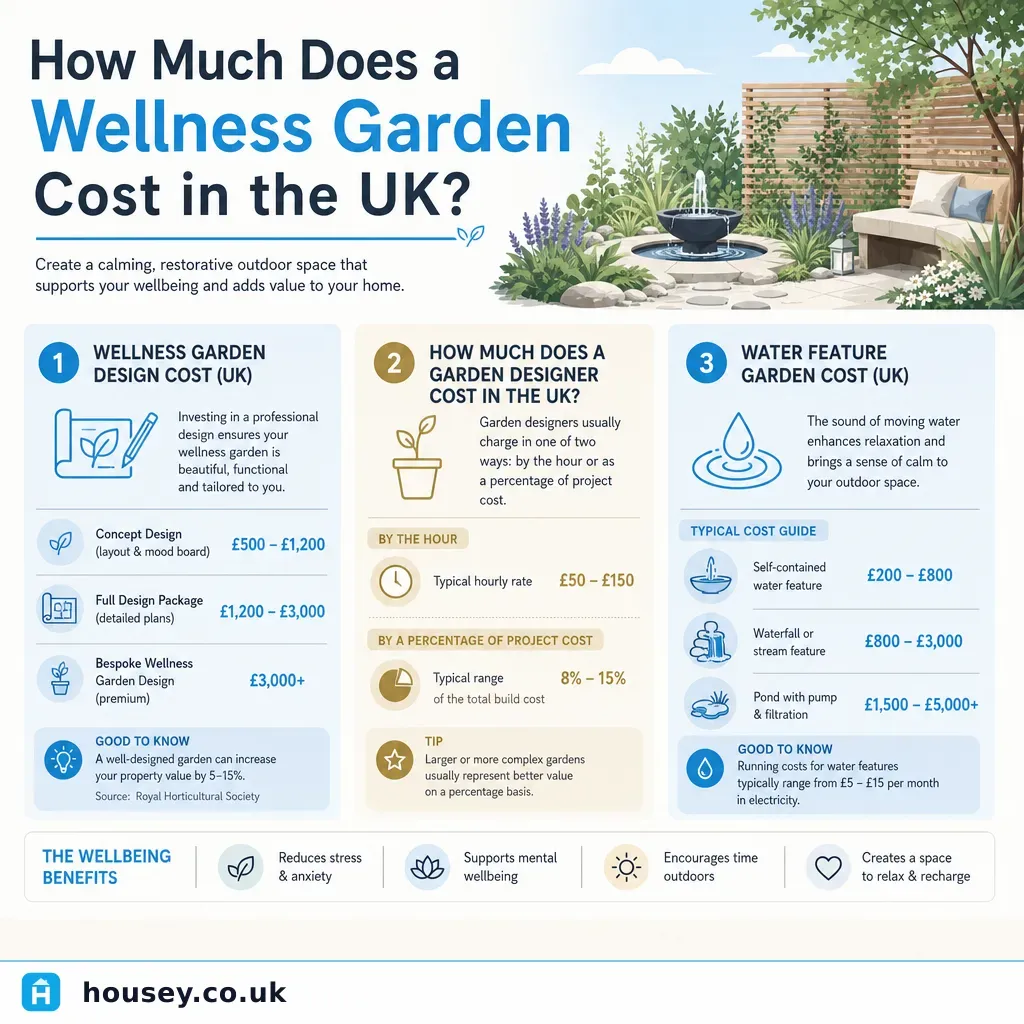
How Much Does a Wellness Garden Cost in the UK?
A wellness garden in the UK typically costs £8,000–£40,000 for a mid-sized design-and-build project.
 Improvement & Build
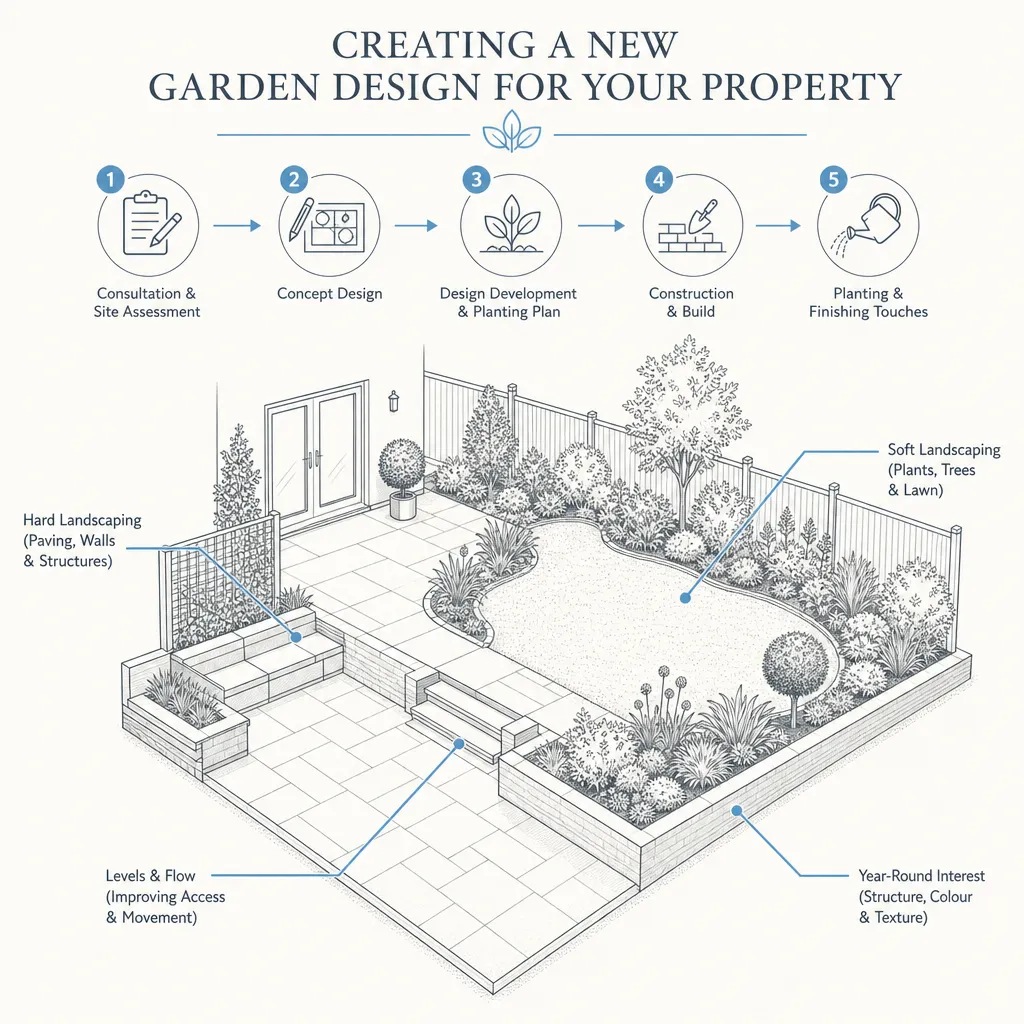
Creating a New Garden Design for Your Property
Creating a new garden design involves assessing your space, setting a realistic budget, deciding on hard and soft landscaping, and choosing a planting scheme suited to your soil and aspect.
 Improvement & Build
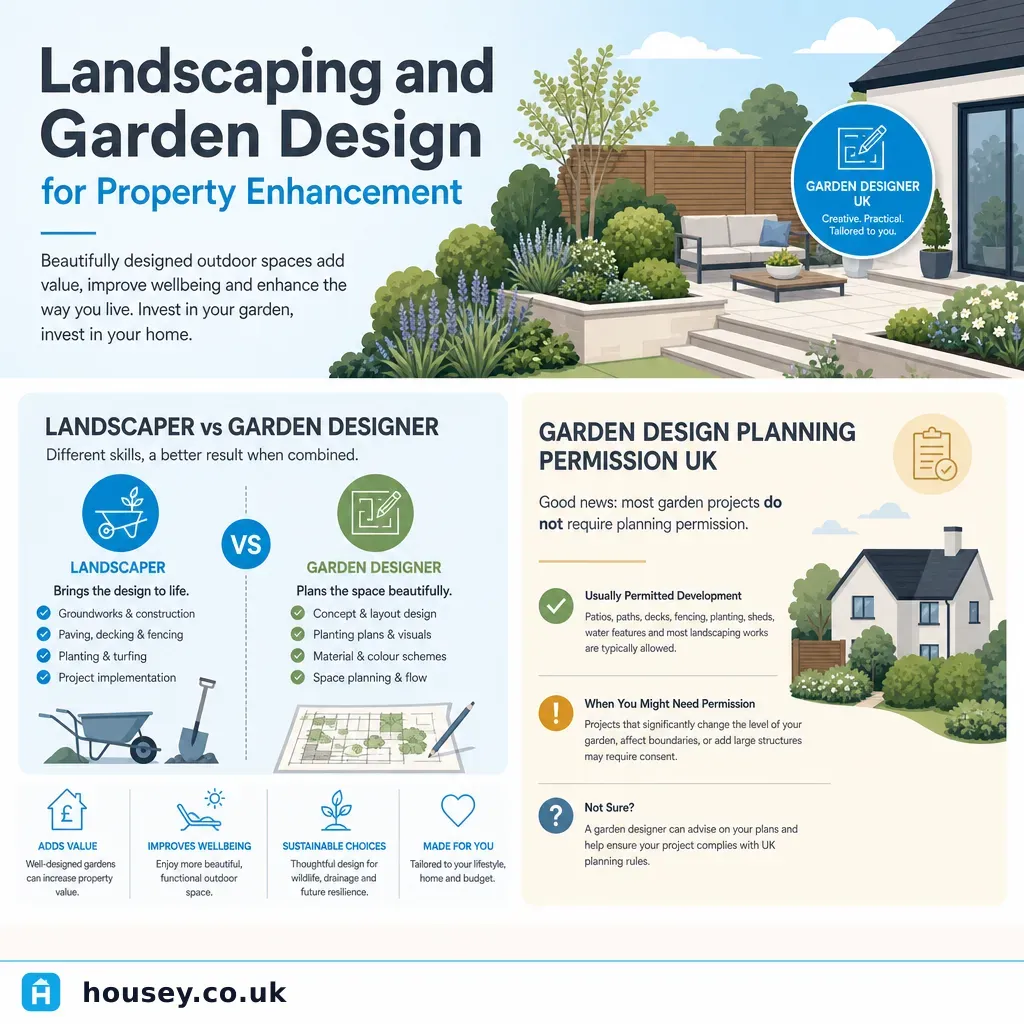
Landscaping and Garden Design for Property Enhancement
Landscaping and garden design involve planning and building outdoor spaces — from patios and raised beds to planting schemes and drainage.
 Improvement & Build
Installing a Fire Pit: Garden Features and Outdoor Space Design
Installing a garden fire pit in the UK is generally permitted, but Smoke Control Area rules prohibit open wood-burning in most towns and cities.
 Improvement & Build
Seasonal Garden Transformations and Outdoor Design Ideas
A successful garden transformation in the UK works with the seasons rather than against them — establishing structure and hard landscaping in autumn or winter, planting in spring, and enjoying the results through summer.