Pergola Design and Installation Costs
By Housey · Last reviewed 7th of May 2026
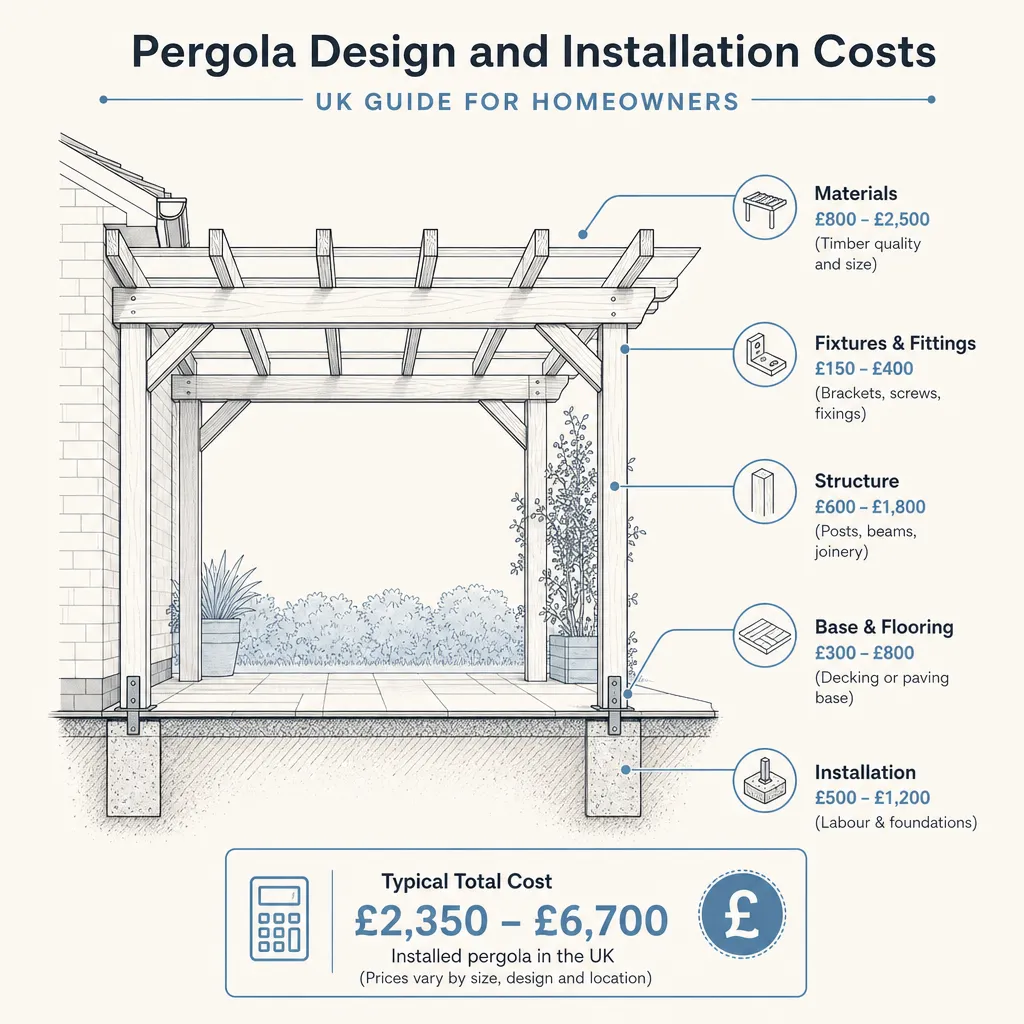
Pergola Design and Installation Costs
A pergola can transform a garden into a usable outdoor room, providing shade, structure, and a framework for climbing plants. For many UK homeowners, the question of cost arises when planning a garden makeover or looking to extend living space outdoors — particularly since pergola prices vary enormously depending on material, size, and whether the structure is a kit assembly or a bespoke design built from scratch. The decision involves both budget and planning considerations that are worth understanding before you approach a contractor.
Key points
- Timber pergolas typically cost £1,500–£5,000 installed in the UK; powder-coated aluminium or steel structures usually range from £3,000–£15,000+, depending on size and specification (indicative UK costs, last reviewed 2026-05-07).
- Most garden pergolas in England fall within permitted development rights under Schedule 2, Part 1, Class E of the Town and Country Planning (General Permitted Development) (England) Order 2015, but a structure within 2 metres of a boundary must not exceed 2.5 metres in height.
- Pressure-treated softwood (e.g. Scandinavian redwood or pine) is the most budget-friendly structural timber; hardwoods such as oak or iroko cost significantly more but require less maintenance and last considerably longer.
- A pergola attached directly to a house wall may be treated as an extension for building regulations purposes if it has a roof that provides weatherproofing — always check with your local building control body before construction.
- Ongoing maintenance costs for a softwood pergola typically run £100–£400 per year in treatment, sanding, and staining; hardwood and aluminium structures require noticeably less annual intervention.
What is a pergola and how does it differ from a gazebo?
A pergola is an open-framed garden structure — typically four or more posts supporting horizontal rafters or beams, with or without a slatted or solid roof covering. It is open on at least two sides. A gazebo is an enclosed pavilion with a solid roof and sometimes partial side walls, offering full weather protection. A garden room or summerhouse has full weatherproofing and is typically classed as an outbuilding for planning purposes. These distinctions matter: planning permission thresholds, building regulations requirements, and insurance implications can differ between a basic pergola and a fully enclosed garden structure.
How much does a pergola cost in the UK?
Costs vary significantly by material, size, complexity, ground conditions, and whether you choose a flat-pack kit or a bespoke design installed by a landscaper or specialist contractor.
Pergola cost by material
Material | Typical installed cost | Lifespan | Maintenance | Best for |
|---|---|---|---|---|
Pressure-treated softwood | £1,500–£5,000 | 10–20 years | High (annual treat) | Budget-conscious buyers; painted or stained finishes |
Hardwood (oak, iroko, cedar) | £3,500–£10,000+ | 25–40 years | Low–moderate | Natural finish; character gardens; rural settings |
Powder-coated aluminium | £3,000–£12,000 | 30–50 years | Very low | Modern gardens; low-maintenance; bespoke sizing |
Galvanised steel | £4,000–£15,000+ | 40–60 years | Low | Large or commercial-grade structures |
Composite (timber-look) | £2,500–£8,000 | 20–30 years | Very low | Contemporary look without timber upkeep |
Indicative UK costs, last reviewed 2026-05-07. Prices vary by region, installer, and specification. Get at least three quotes.
Cost by size
A small freestanding pergola suitable for a modest patio (roughly 3m × 3m) typically costs considerably less than a large double-bay structure spanning the width of a rear garden (e.g. 6m × 4m). Larger structures require more substantial post foundations and more material, and the complexity of construction increases proportionally.
Approximate size | Softwood installed | Hardwood installed | Aluminium installed |
|---|---|---|---|
Small (3m × 3m) | £1,500–£3,000 | £3,500–£5,000 | £3,000–£5,000 |
Medium (4m × 4m) | £2,500–£5,000 | £5,000–£8,000 | £5,000–£9,000 |
Large (6m × 4m+) | £4,000–£8,000 | £7,000–£14,000 | £8,000–£15,000+ |
Indicative UK costs, last reviewed 2026-05-07. Prices vary by region and contractor. Always get at least three quotes.
Additional cost items to budget for
- Groundwork and post foundations: Concrete post bases or ground screw anchors typically add £50–£200 per post depending on ground conditions.
- Roofing additions: Polycarbonate roof panels, timber slats, or shade sail inserts add £200–£2,000+ depending on coverage and material.
- Lighting and electrical: External-rated LED lighting can add £300–£1,500 if wiring is required (electrical work must be carried out by a Part P-registered electrician).
- Climbing plant supports: Wire tensioning systems or trellis panels add £100–£500.
- Decking or paving below: If you are also laying a new base surface, budget for this separately.
Planning permission and building regulations
Permitted development
In England, a garden pergola is generally permitted development (no planning application needed) under Schedule 2, Part 1, Class E of the Town and Country Planning (General Permitted Development) (England) Order 2015, provided:
- It is within the curtilage of a house and not on land fronting a highway.
- The height does not exceed 4 metres for a dual-pitched roof, or 3 metres for any other roof type.
- Any part within 2 metres of a boundary does not exceed 2.5 metres in height.
- The total footprint of all outbuildings and extensions does not exceed 50% of the land around the original house.
Rules differ in Wales, Scotland, and Northern Ireland. Permitted development rights may also be removed in conservation areas, Areas of Outstanding Natural Beauty (AONBs), National Parks, or where an Article 4 Direction is in force. Always check with your local planning authority (LPA) if you are unsure of your property's status.
Building regulations
A freestanding open pergola with no weatherproof roof covering is unlikely to require building regulations approval. However, a pergola attached to the house with a solid or glazed roof — particularly one that creates a new habitable or regularly occupied space — may be subject to building regulations under Part A (structure), Part L (energy efficiency), and potentially Part B (fire safety) depending on the design. If in doubt, contact your local building control body before starting work.
Red flags when getting pergola quotes
Watch out for the following warning signs when comparing contractor quotes:
- No written specification: A reputable contractor should specify timber species and grade, member dimensions, treatment type, and fixing hardware in writing before you commit.
- No public liability insurance: Always ask for proof of insurance (minimum £1–2 million cover) before work starts.
- Unusually low price: Very cheap quotes may indicate undersized timber sections, no concrete post foundations, or untreated green timber that will warp and split.
- No mention of post foundation depth: Posts should typically be set at least 600mm into concrete, deeper for taller or more exposed structures.
- Vague warranty terms: Reputable installers offer at least a 12-month workmanship guarantee; check what is and is not covered.
- No discussion of planning: A responsible contractor should raise permitted development rules, especially for larger structures or those close to boundaries.
What to ask before accepting a pergola quote
- What timber species, grade, and preservative treatment are specified?
- What are the post cross-section dimensions and foundation depths?
- Is the structure designed to withstand UK wind loading for your specific site?
- What fixings and hardware are included (stainless steel is recommended in coastal or high-humidity locations)?
- What warranty is offered on workmanship and materials?
- Is VAT included in the quoted price?
- Will you handle all groundwork and surface preparation beneath the structure?
- Are any electrical or lighting elements included or explicitly excluded?
- Do you hold current public liability insurance?
When to get professional help
Most standard pergola installations are carried out by experienced landscapers or garden contractors without requiring architect or structural engineer involvement. However, consider bringing in a professional if:
- The pergola is large (over 5m span) or will carry significant loads such as heavy climbing plants, solar panels, or a tiled or glazed roof.
- The structure is to be attached to the house and you need confirmation it will not affect the building's structure, drainage, or weatherproofing.
- You are in a conservation area, listed building curtilage, or AONB and need planning guidance before proceeding.
- Ground conditions are soft, waterlogged, or on a slope requiring engineered foundations.
How Housey can help
Housey can connect you with local professionals to help bring your pergola project to life. Browse garden designers for bespoke design input on materials and layout, or request quotes directly from landscapers experienced in outdoor structures. Describe your project and receive quotes from up to four matched providers in your area.
Frequently asked questions
Do I need planning permission for a pergola in the UK?
Most garden pergolas in England are permitted development and do not require planning permission, provided they meet the height and boundary limits set out in Schedule 2, Part 1, Class E of the Town and Country Planning (General Permitted Development) (England) Order 2015. Key limits include a maximum height of 3 metres (or 4 metres for a dual-pitched roof) and no more than 2.5 metres within 2 metres of a boundary. Rules differ in Wales, Scotland, and Northern Ireland; always check with your local planning authority.
How long does a timber pergola last?
A pressure-treated softwood pergola, properly maintained with annual treatment, typically lasts 10–20 years before structural replacement is needed. Hardwood pergolas (oak, cedar, iroko) can last 25–40 years with modest maintenance. The longevity of any timber structure depends heavily on post foundation quality, drainage around the base, and regular surface treatment to prevent moisture ingress and rot.
What is the difference between a pergola and a gazebo?
A pergola is an open-framed structure with overhead beams or rafters that may be slatted or open to the sky — it provides partial shade and a climbing plant framework but does not fully enclose a space. A gazebo is a more fully enclosed pavilion with a solid roof and sometimes partial side walls, offering full weather protection. Gazebos are generally more expensive and may have different planning implications as outbuildings.
Can I attach a pergola to my house?
Yes, but an attached pergola may be treated differently to a freestanding one for planning and building regulations purposes. If the attached structure has a solid or glazed roof that creates a weatherproof space, it may be considered a conservatory or extension and subject to additional regulations. Always check with your local building control body and planning authority before attaching any structure to your house.
Sources and further reading
- When is permission required? (GOV.UK) — HM Government
- Town and Country Planning (General Permitted Development) (England) Order 2015, Schedule 2 — legislation.gov.uk
- Pergolas, arches and trellises (RHS) — Royal Horticultural Society
- Do I need planning permission for an outbuilding? (Homeowners Alliance) — Homeowners Alliance
Useful next reads
 Improvement & Build
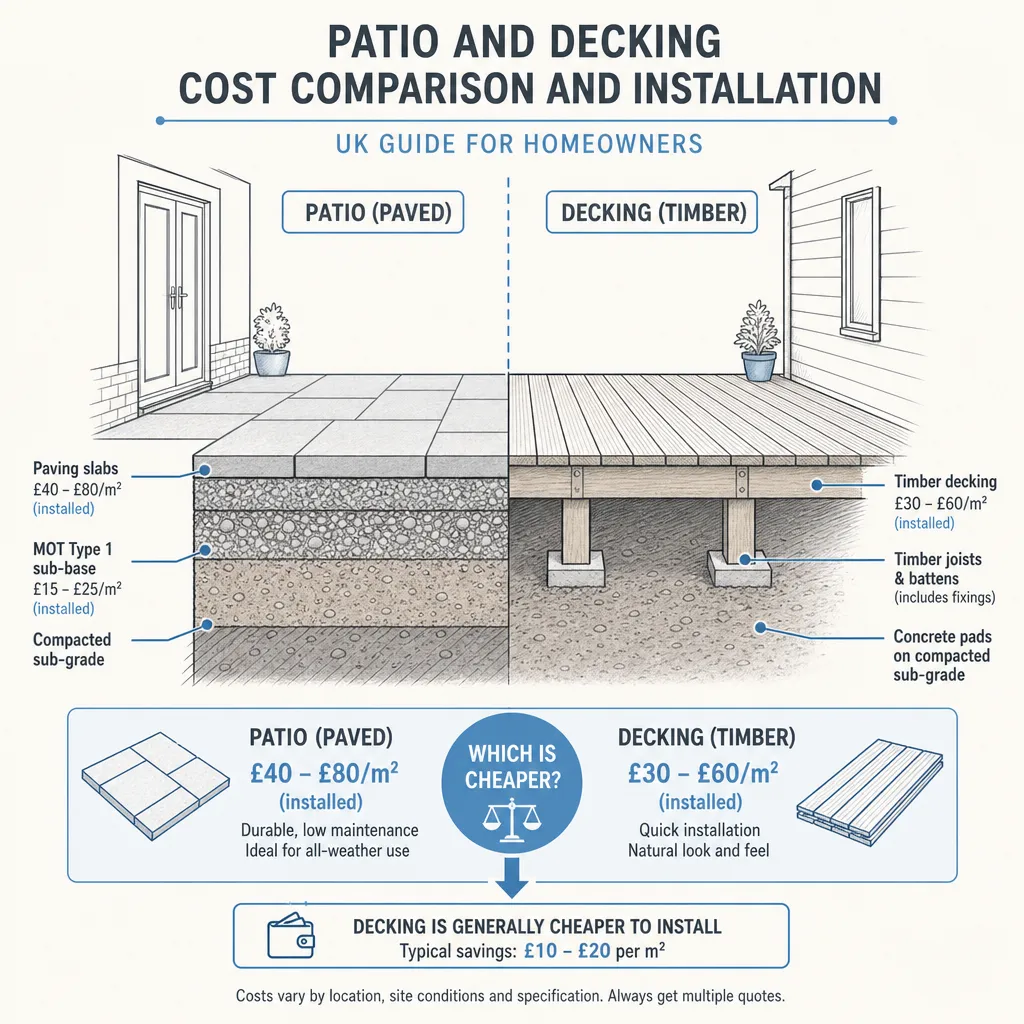
Patio and Decking Cost Comparison and Installation
A 20 m² porcelain or natural stone patio typically costs £2,000–£5,000 installed; block paving starts lower at £1,200–£3,000.
 Improvement & Build
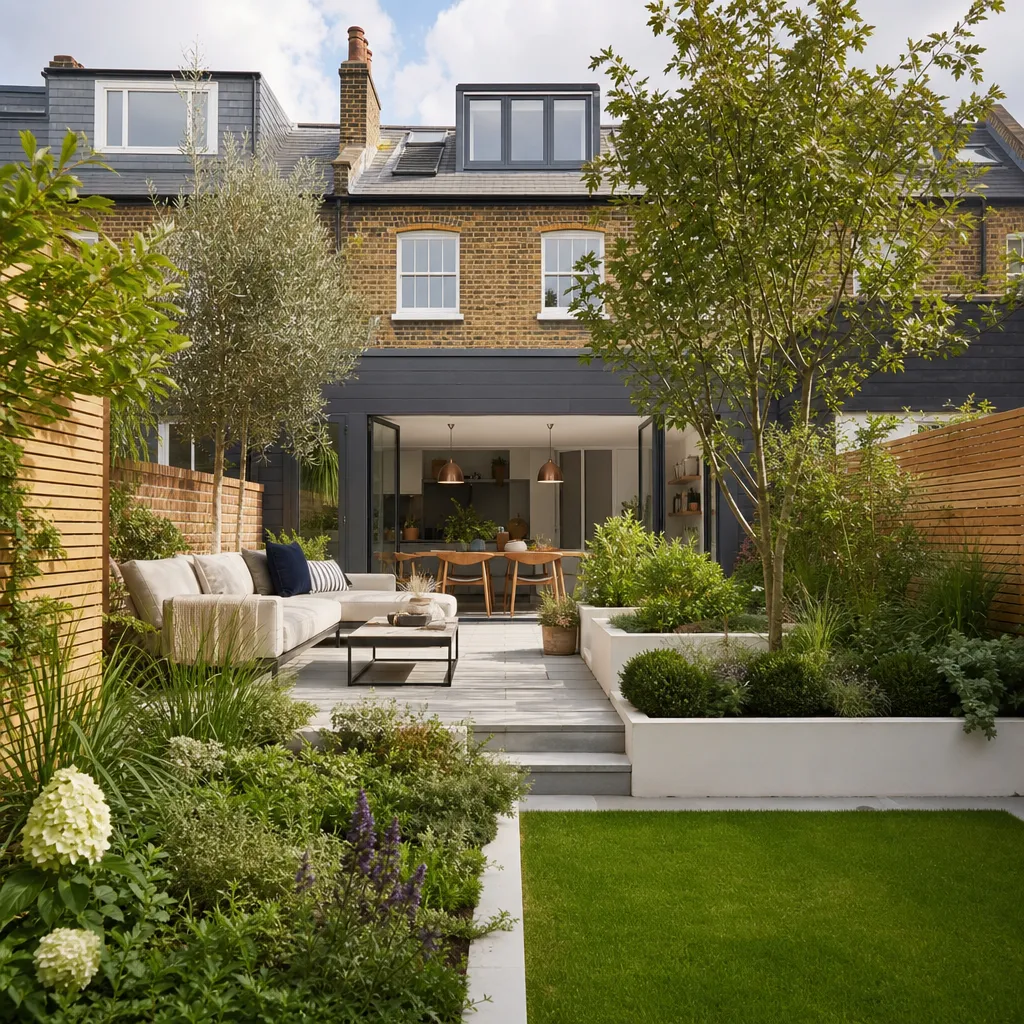
Seasonal Garden Transformations and Outdoor Design Ideas
A successful garden transformation in the UK works with the seasons rather than against them — establishing structure and hard landscaping in autumn or winter, planting in spring, and enjoying the results through summer.
 Improvement & Build
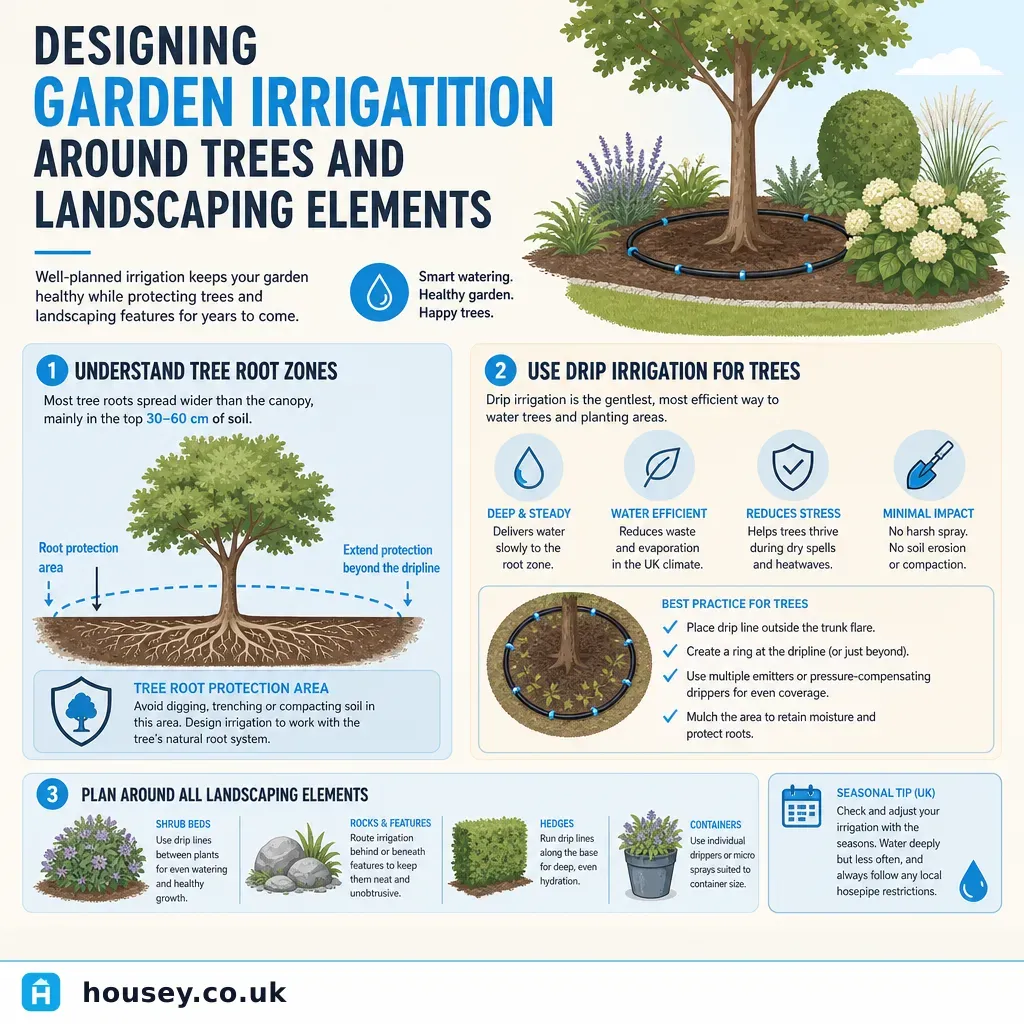
Designing Garden Irrigation Around Trees and Landscaping Elements
Design irrigation around trees by respecting the root protection area defined under BS 5837:2012, using drip or leaky pipe delivery rather than spray heads, and putting the tree zone on its own circuit.
 Improvement & Build
Garden Design Trends and Contemporary Landscaping Ideas
Contemporary UK garden design centres on low-maintenance naturalistic planting, multi-functional outdoor spaces, sustainable hard landscaping materials, and wildlife-friendly rewilded areas.
 Improvement & Build
Retaining Wall Design and Installation for Landscape Features
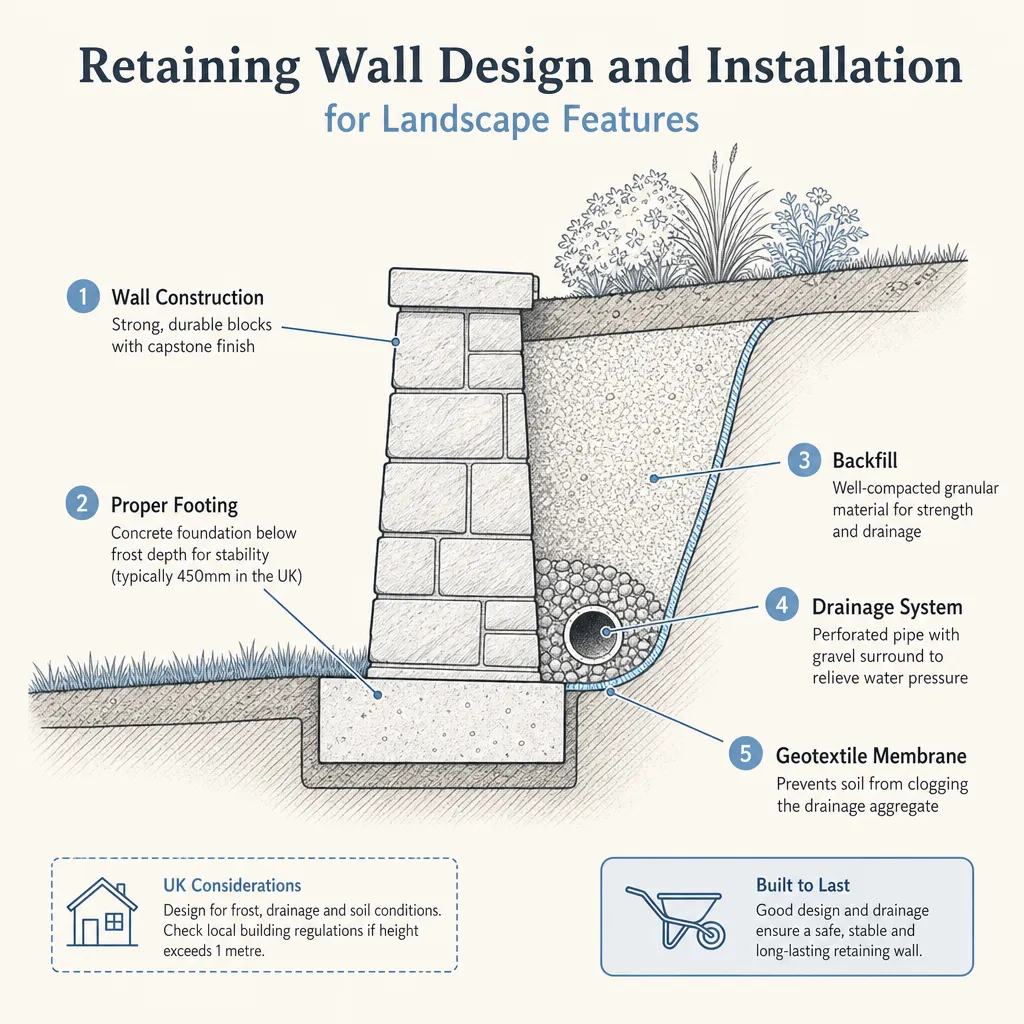
A garden retaining wall holds back soil on a sloped plot using concrete blocks, stone, or timber.