Period Properties and Heritage Conservation: Design Approaches
By Housey · Last reviewed 18th of May 2026
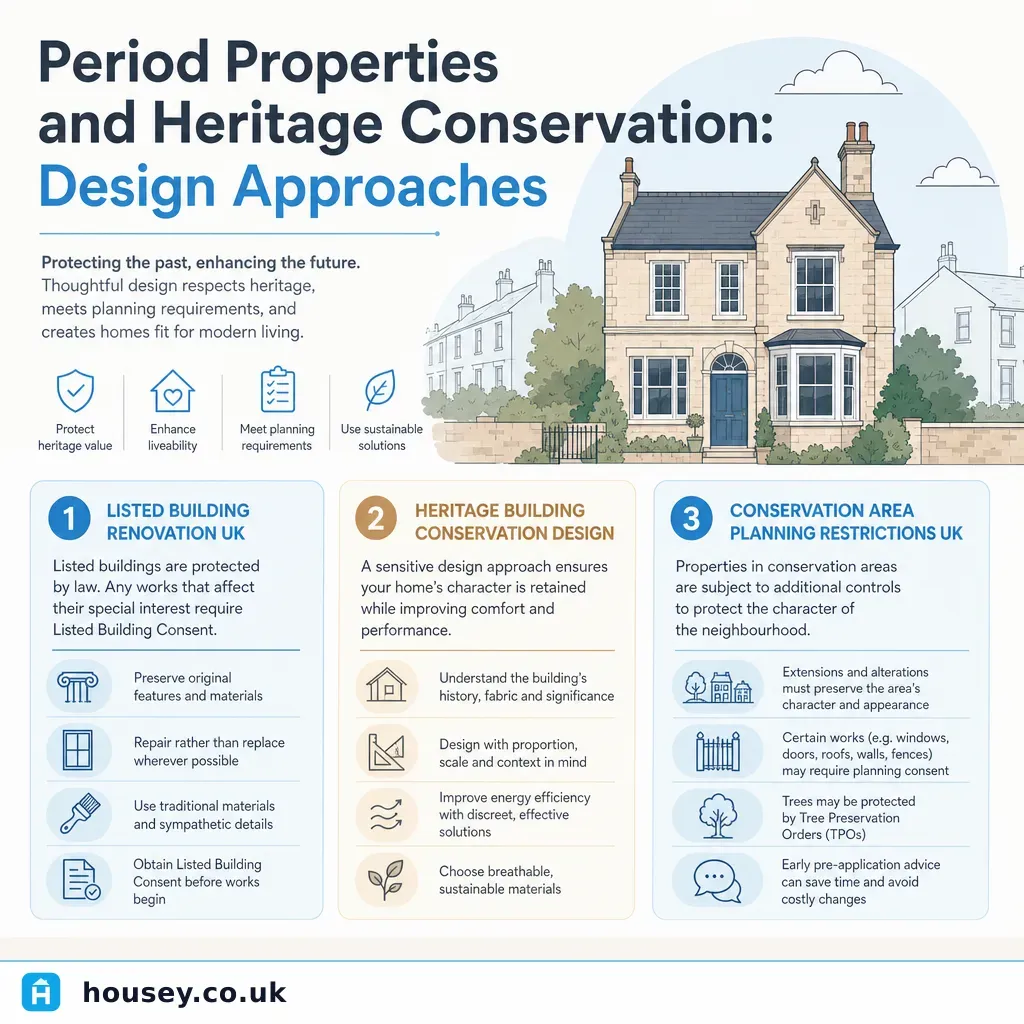
Period Properties and Heritage Conservation: Design Approaches
Victorian terraces, Georgian townhouses, Edwardian villas, and inter-war Arts and Crafts homes make up a large and much-valued part of the UK's housing stock. Questions about how to alter, extend, or restore a period property typically arise when buyers complete on a purchase and begin planning improvements, or when long-standing owners want to update the home without losing its character. Getting design decisions wrong on a listed building or in a conservation area can lead to enforcement action, costly reinstatement orders, and irreversible loss of heritage value that cannot easily be undone.
Key points
- There are approximately 400,000 listed buildings in England, designated Grade I, Grade II*, or Grade II; Historic Environment Scotland, Cadw (Wales), and the Historic Environment Division (Northern Ireland) maintain separate registers with different categories.
- Listed building consent (LBC) is required from the local planning authority for any works that would affect the character of a listed building — this includes internal alterations, not just changes to the exterior.
- Unauthorised works to a listed building are a criminal offence under the Planning (Listed Buildings and Conservation Areas) Act 1990; enforcement can require full reinstatement at the owner's cost.
- Conservation area designation restricts certain permitted development rights — side extensions, cladding of external walls, replacement windows, and demolition of unlisted structures may require a planning application even where they would otherwise be permitted development.
- Lime mortar should not be replaced with ordinary Portland cement mortar in pre-1919 solid-wall buildings; cement is harder and less permeable, trapping moisture and accelerating decay of brick and stone.
Which consent do you need?
Use this decision tree as a starting point — always confirm requirements with your local planning authority or conservation officer before starting any works.
- Is the property listed? Check the Historic England NHLE (England), Historic Environment Scotland, Cadw, or the Historic Environment Division. If listed → listed building consent is required for works affecting its character, in addition to any planning permission needed for external changes.
- Is the property in a conservation area? Check with your local planning authority. If yes → certain permitted development rights are curtailed; pre-application advice from the conservation officer is strongly recommended before drawing up any proposals.
- Does the work involve altering original fabric? Replacing windows, removing or covering cornices or fireplaces, altering staircases, or changing roof covering on a listed building almost always requires listed building consent.
- Is the property in an AONB, National Park, or World Heritage Site? Additional planning restrictions may apply; check with the relevant authority.
- Are you unsure? Most local authorities offer a pre-application query service — a written response can prevent costly mistakes and confirm the consent route before any professional fees are committed.
Listed buildings: what you need to know
A listing protects the building as a whole — its interest lies in the combination of elements, not only the features explicitly named in the list entry. Practical implications include:
- Internal alterations — removing partition walls, covering or stripping cornicing, replacing original fireplaces or flooring, altering staircases — require listed building consent even when no external changes are made.
- Windows and doors — like-for-like repair in the same material usually has a lower bar for consent, but substituting original timber sashes with uPVC or aluminium is typically refused. Matching the existing profile, glazing bar pattern, and material is the standard requirement.
- Extensions — possible but must be subservient in scale, massing, and height to the original building and use complementary materials. Both planning permission and listed building consent are usually required.
- Energy improvements — secondary glazing (not replacement), draught-proofing, and breathable insulation products are more commonly acceptable than external wall insulation, which is rarely consented on listed buildings.
Grade I listed buildings (around 2% of all listed buildings) are of exceptional interest; consent for significant alterations is granted only in exceptional circumstances. Grade II* (around 6%) are particularly important nationally. Grade II (around 92%) are still nationally important and all consent requirements apply in full.
Conservation areas: different rules apply
Conservation area designation protects the character and appearance of a place rather than individual buildings. Restrictions vary between local authorities but commonly include:
Feature | Standard house | House in conservation area |
|---|---|---|
Side extensions | Often permitted development | May require a full planning application |
Cladding external walls | Usually permitted development | Requires planning permission |
Replacement of windows | Usually permitted development | Often restricted; like-for-like preferred by most LPAs |
Demolition of outbuildings | Varies by size | Usually requires conservation area consent |
Rooflights on front slopes | Often permitted development | Frequently restricted or refused |
Satellite dishes visible from highway | Permitted development within limits | Usually requires planning permission |
Rules are set locally and vary. Always confirm specific restrictions with the local planning authority or conservation officer before starting any work.
Design approaches for period and heritage buildings
Sympathetic design for heritage properties follows consistent principles that conservation officers and Historic England reinforce across England.
Repair, not replacement: Original materials — lime mortar, handmade brick, clay plain tiles, Welsh or Westmorland slate, softwood sash windows — are often irreplaceable. Repairing using matching traditional materials preserves both character and long-term performance. Cement pointing on lime-built walls traps moisture, causing frost spalling and accelerating decay of the masonry.
Subservient extensions: New additions should be clearly subordinate to the original building in scale, height, and massing. Well-designed contemporary extensions that contrast subtly — using clean lines, recessed junctions, and complementary but distinct materials — are often approved where clumsy period pastiche is not, because they avoid misrepresenting the building's history.
Traditional craft skills: Lime plastering, lead roofwork, sash window joinery, and tuck pointing require specialist tradespeople. Allow time to identify appropriately skilled contractors before committing to a programme — demand often exceeds supply in conservation-heavy areas.
Worked UK property scenario: A Grade II listed Georgian townhouse in Bristol requires a rear kitchen extension. The conservation officer advises at pre-application stage that the extension must be single-storey, set back from the side return wall, use hand-made brick in a matching bond with lime mortar, and incorporate a flush conservation rooflight rather than a projecting dormer. Both listed building consent and planning permission are granted. A structural engineer specifies the steel beam and padstones for the rear wall opening. The building control application covers structural elements and the thermal performance of the new extension in compliance with Approved Document L, applied proportionately to the heritage context.
What to ask a qualified professional
Before appointing anyone for works to a period or heritage property, ask:
- Do you hold RIBA, RICS, or CIAT conservation accreditation, or equivalent specialist experience with listed buildings and conservation areas?
- Have you worked with this local authority's conservation team and can you handle pre-application discussions on my behalf?
- Will you review the Historic England list entry and the local conservation area appraisal before advising on consent requirements?
- How do you distinguish between works that require listed building consent and routine maintenance repairs?
- How will you specify materials — lime mortar, matching brick or stone, and appropriate roof coverings?
- Can you advise on energy improvements compatible with listed building consent requirements and PAS 2035?
- Is the building control application and structural design within your scope, or are those separate appointments?
Important limitations
This guide provides general information about the UK heritage planning regime and approaches to period property design. Rules, consent requirements, and the scope of listed building protection vary considerably between local planning authorities and between England, Scotland, Wales, and Northern Ireland. Nothing in this guide constitutes planning, legal, or professional advice. Carrying out works to a listed building without consent is a criminal offence under the Planning (Listed Buildings and Conservation Areas) Act 1990. A qualified heritage consultant, conservation-accredited architect or technologist, or local authority conservation officer must be consulted before any works to a listed or potentially listed building are planned or started.
When to get professional help
Seek professional advice before planning any works to a period property. The situation requires urgent action if:
- Works have already been carried out to a listed building without listed building consent — seek specialist planning advice immediately, as enforcement notices can require full reinstatement at the owner's cost.
- You have received an enforcement notice from the local planning authority — seek specialist advice without delay.
- You are planning to remove, replace, or alter original fabric — windows, fireplaces, plasterwork, structural walls, roof covering, or staircases — on a listed building.
- You have purchased a listed property and are uncertain whether previous owners carried out works without consent — a heritage condition survey can identify unauthorised alterations before you become responsible for them.
How Housey can help
Housey connects homeowners with professionals who understand the requirements of period and heritage properties. A heritage and conservation consultant can guide you through listed building consent applications and pre-application discussions with the local authority conservation officer. An architectural technologist with conservation experience can prepare drawings to the standard required for heritage applications. For broader design input and project oversight, an architect with a strong heritage portfolio can manage the project from consent through to completion.
Frequently asked questions
How do I find out whether my property is listed?
Check the Historic England National Heritage List for England (NHLE) at historicengland.org.uk. In Scotland, use Historic Environment Scotland's online buildings register; in Wales, Cadw's listed buildings records; in Northern Ireland, the Historic Environment Division database. Your local authority planning department can also confirm whether a property is listed or within a conservation area, and may offer pre-application advice on what consent is required before you start any works.
Can I replace windows in a listed building?
Replacing original windows in a listed building almost always requires listed building consent. Like-for-like repair — restoring a failed timber sash in the same material and profile — is the preferred approach and may not require formal consent in all cases, but always confirm with the local authority conservation officer first. Changing material (such as timber to uPVC or aluminium) or altering the glazing bar pattern is generally refused on listed buildings of any grade.
Can I insulate a listed building?
Insulation improvements are possible in listed buildings, but the approach must not harm the building's fabric or character. Breathable insulation materials — such as woodfibre or hemp — are often preferred for solid-wall construction. External wall insulation is rarely consented on listed buildings. Draught-proofing, secondary glazing, and carefully specified internal insulation are more typically acceptable. A retrofit assessor or heritage-experienced energy consultant should identify suitable measures before any work is specified.
Do I need listed building consent to paint the exterior of a listed building?
Painting an external surface that has not historically been painted may require listed building consent, as it can affect the building's character and breathability. Repainting a surface that is already painted, in a closely matching colour, may not require formal consent — but always confirm with the local authority conservation officer before proceeding. Interpretation varies between local authorities and depends on the grade of listing and the specific materials involved.
Sources and further reading
- National Heritage List for England — Historic England
- Planning (Listed Buildings and Conservation Areas) Act 1990 — legislation.gov.uk
- Conservation areas guidance — Historic England
- Energy efficiency in historic buildings — Historic England
- Permitted development rights for householders: technical guidance — GOV.UK
Useful next reads
 Planning & Pre-Build
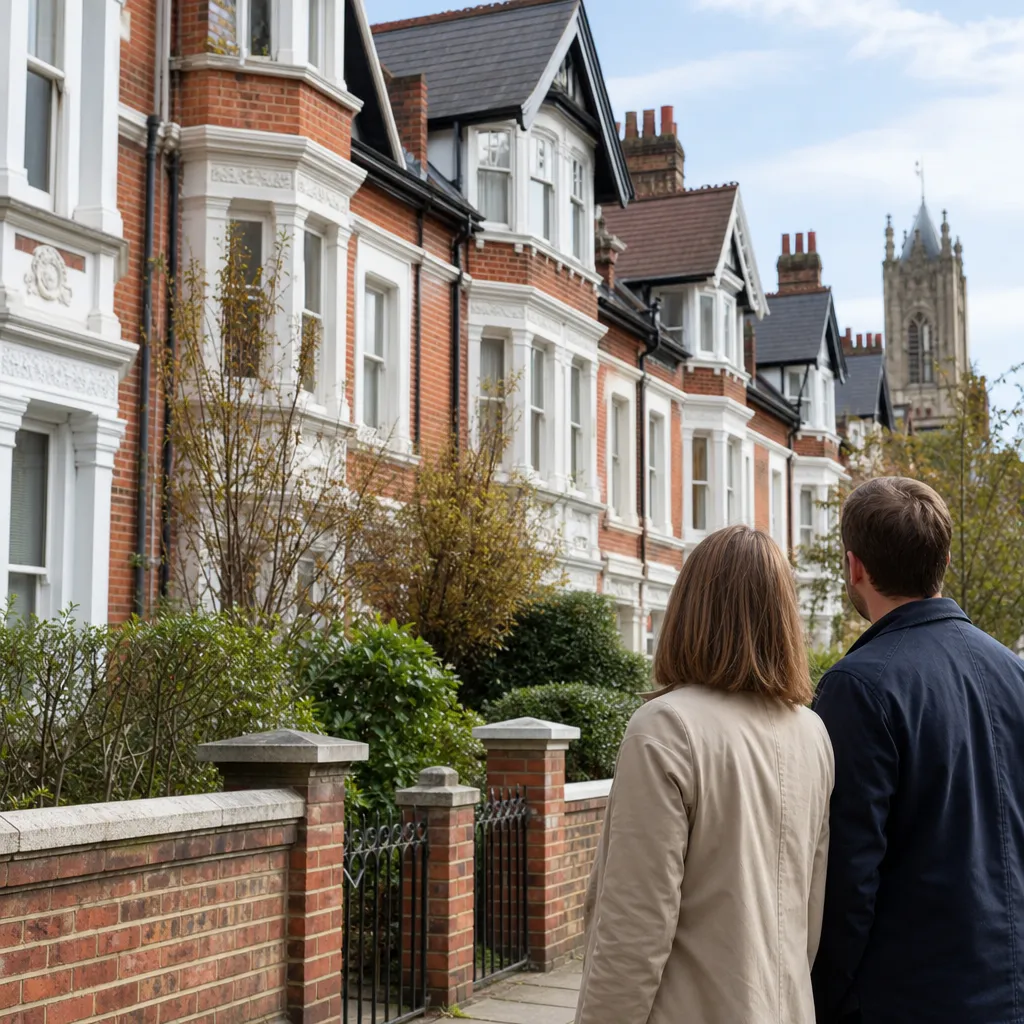
Viewing Properties Showcasing Distinguished Architectural Heritage
UK homes span centuries of architectural tradition, from Georgian symmetry to Victorian ornament, Edwardian craftsmanship, and post-war design.
 Planning & Pre-Build
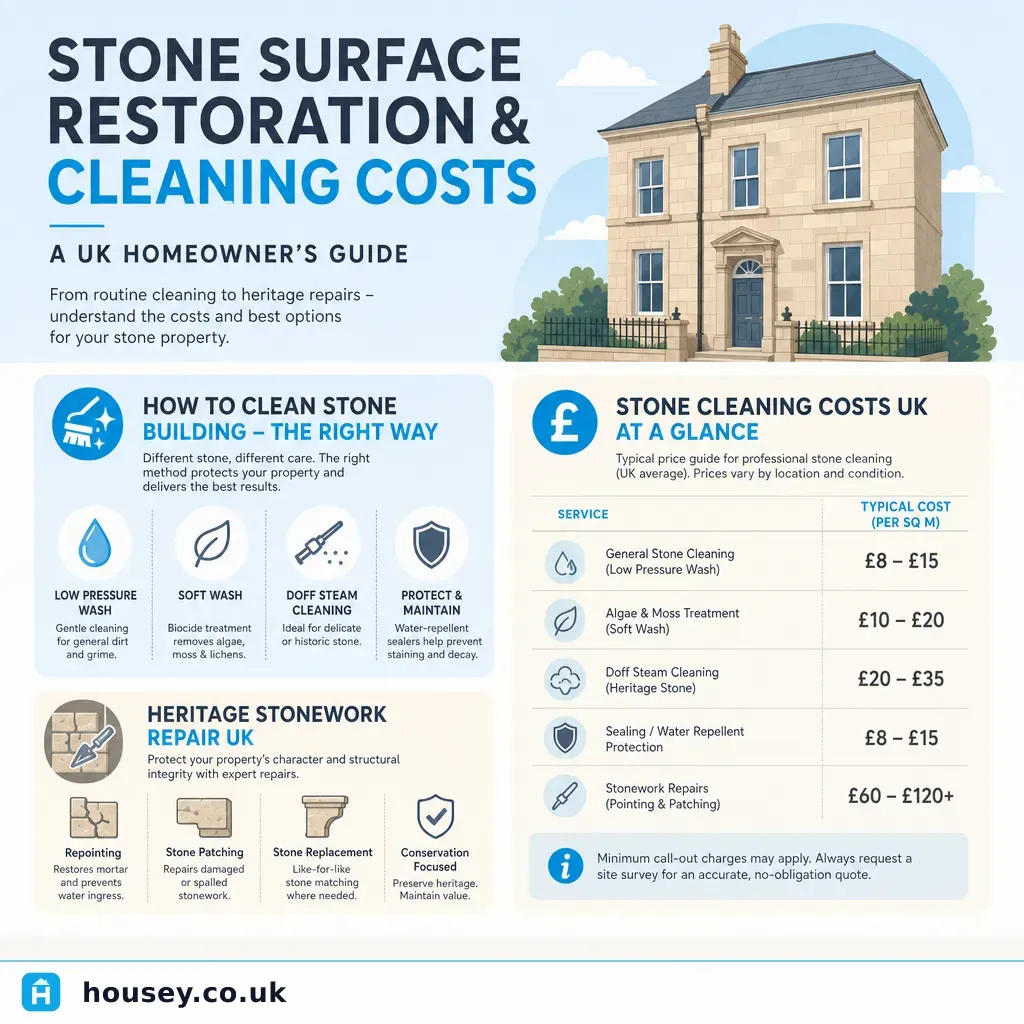
Stone Surface Restoration and Cleaning Costs
Stone cleaning in the UK typically costs £10–£50 per square metre; full restoration ranges from £150 to £500 or more per square metre.
 Planning & Pre-Build
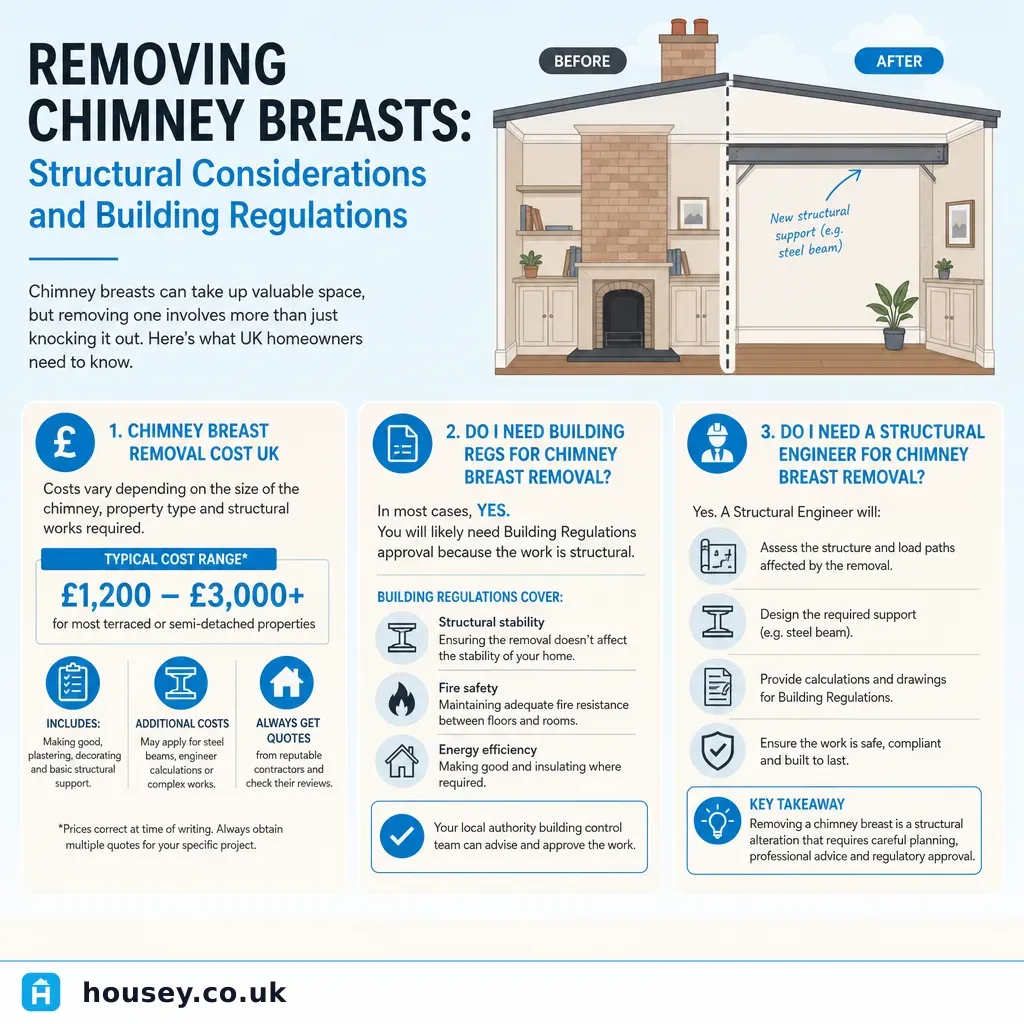
Removing Chimney Breasts: Structural Considerations and Building Regulations
Removing a chimney breast in England and Wales almost always requires building regulations approval because it is structural work.
 Planning & Pre-Build
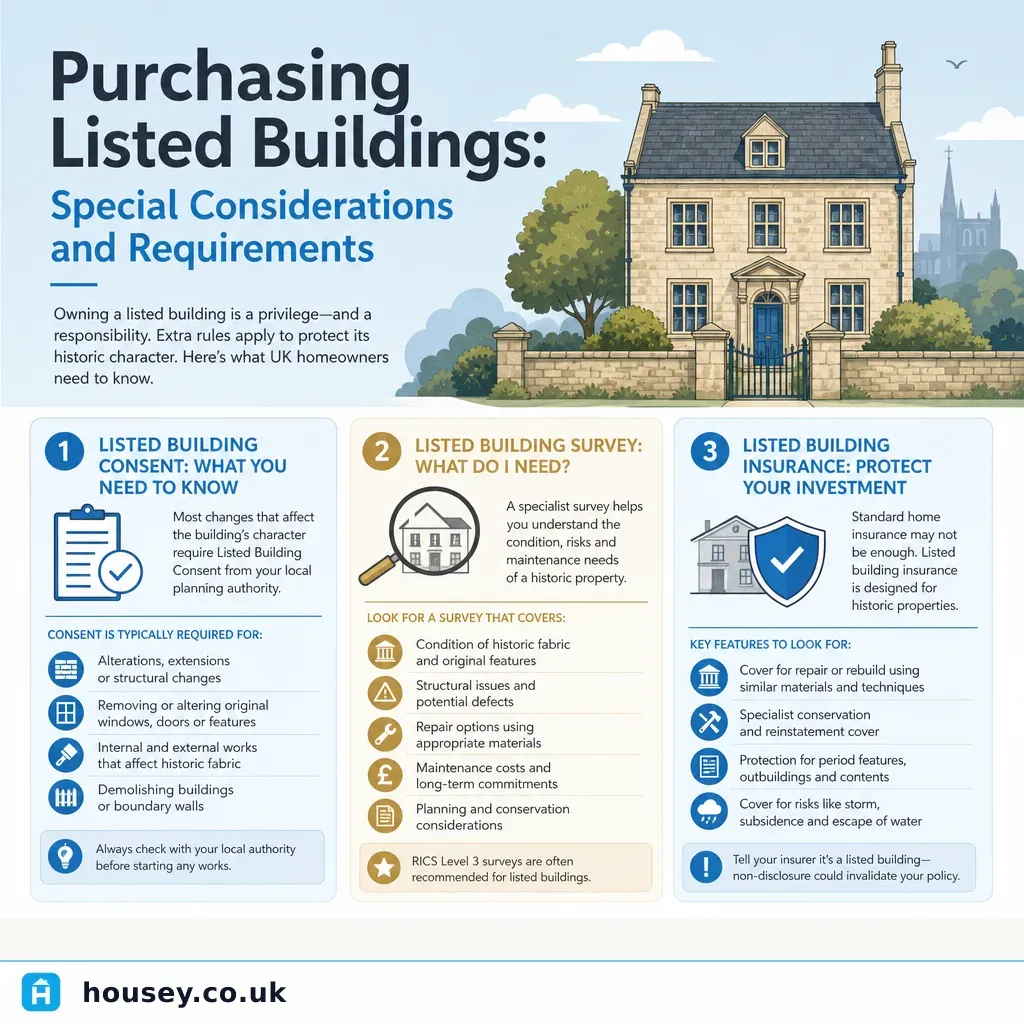
Purchasing Listed Buildings: Special Considerations and Requirements
Buying a listed building means any works affecting its character require Listed Building Consent — separate from planning permission.
 Planning & Pre-Build
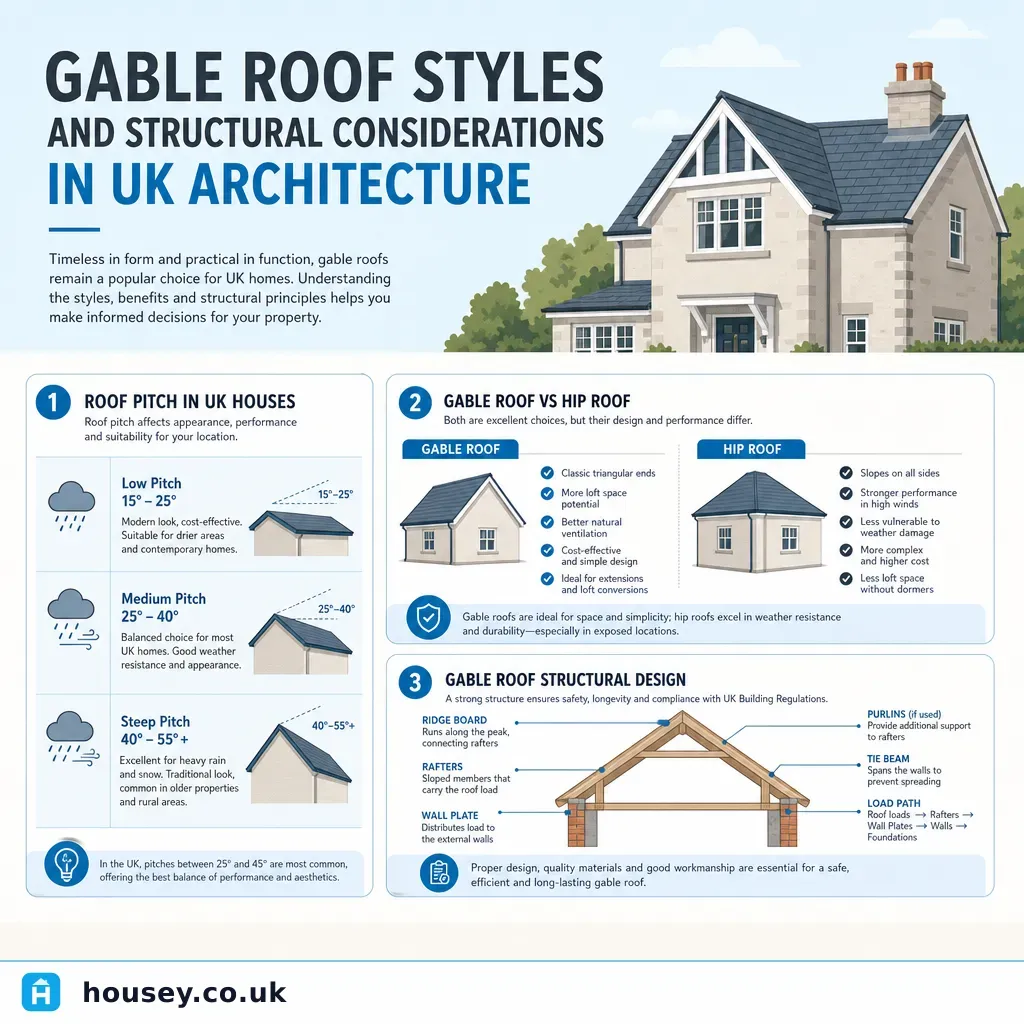
Gable Roof Styles and Structural Considerations in UK Architecture
Gable roofs — two sloping planes meeting at a central ridge with triangular end walls — are the most common roof form in UK residential architecture.