Stone Surface Restoration and Cleaning Costs
By Housey · Last reviewed 11th of May 2026
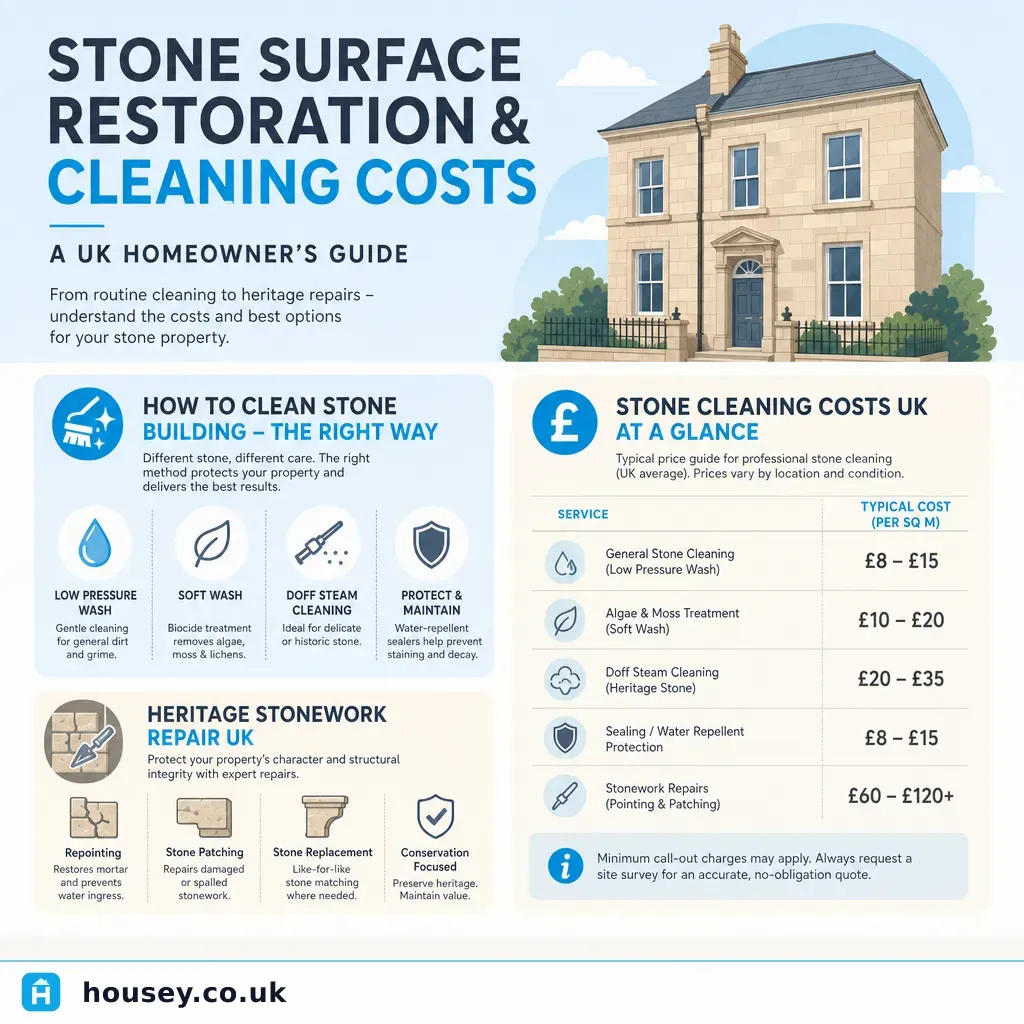
Stone Surface Restoration and Cleaning Costs
Stone facades, boundary walls, and decorative stonework on UK properties accumulate pollution, biological growth, and weathering damage over decades. Owners of Victorian terraces, Georgian townhouses, and listed buildings regularly face decisions about when to clean, repair, or fully restore stonework — and which methods are safe for the fabric of their building. The wrong approach can permanently damage irreplaceable historic stone, trigger enforcement action by the local planning authority, or void building insurance.
Key points
- Listed buildings and structures in conservation areas typically require listed building consent or prior discussion with the local planning authority (LPA) before any cleaning or chemical treatment is carried out.
- Historic England's guidance distinguishes between reversible cleaning methods (such as DOFF steam cleaning and the JOS system) and potentially damaging methods (such as sandblasting and acid washing, which can erode soft sandstones and limestones irreversibly).
- Indicative UK cleaning costs range from approximately £10–£50 per square metre for facade cleaning, rising to £150–£500+ per square metre for full restoration including repointing, crack repair, and surface consolidation (last reviewed 2026-05-11; quotes vary significantly by region and access).
- PAS 2038:2021 (the retrofit standard for non-domestic buildings) overlaps with heritage fabric guidance when stone properties undergo energy retrofit — specialist advice may be needed to avoid moisture-trapping treatments.
- Biological growth (algae, lichens, mosses) can be removed using biocide treatments approved for historic masonry, but some species are protected under the Wildlife and Countryside Act 1981 and should be identified before treatment begins.
Which stone types are most common in UK properties?
The dominant natural stones in UK residential properties vary significantly by region:
- Limestone and oolitic limestone (e.g. Portland stone, Bath stone): Common in southern England, prone to soiling and sulphation — the black crust formed when atmospheric pollution reacts with calcite in the stone surface.
- Sandstone (red, buff, yellow): Prevalent in northern England and Scotland. Highly susceptible to irreversible damage from abrasive cleaning and acid treatments.
- Granite: Mostly found in Cornwall, Aberdeen, and parts of Wales. Very hard and durable; less prone to erosion but still soils over time.
- Magnesian limestone: Found in Yorkshire and County Durham. Can be vulnerable to salt crystallisation damage in exposed locations.
- Rubble and coursed stone: Common in rural areas; often re-pointed with inappropriate modern cement that traps moisture and causes spalling in adjacent stone.
Identifying your stone type correctly before choosing a cleaning or restoration method is essential — what works safely on granite can permanently damage soft sandstone.
Stone cleaning methods compared
Method | Best for | Not ideal for | Approximate cost range | Main risk if wrong |
|---|---|---|---|---|
DOFF high-temperature steam | Most stone types; biological growth; delicate surfaces | Very friable or spalling stone | £15–£40/m² | Saturation damage if stone is already failing |
JOS system (fine abrasive + water) | Harder limestones; general soiling | Soft sandstone; carved detail | £20–£45/m² | Surface erosion, loss of fine detail |
TORC system (swirling abrasive + air) | Complex profiles; carved ornament | Very soft stone | £20–£50/m² | Over-cleaning and loss of carved detail |
Chemical cleaning (alkaline or acidic) | Heavy industrial soiling; iron staining | Sandstone; most limestones | £10–£30/m² | Irreversible salt damage, colour change |
Poulticing | Localised stains; iron deposits | Widespread soiling | Variable; specialist work | Incomplete removal; re-staining |
Sandblasting (dry) | Rarely appropriate for heritage | Any historic masonry | £10–£20/m² | Permanent erosion — not recommended |
Indicative UK costs, last reviewed 2026-05-11. Costs exclude access (scaffolding), VAT, and any associated repair work.
What does stone restoration involve beyond cleaning?
Cleaning is only one element of a full stone restoration programme. Depending on the condition of your property, restoration may also include:
- Repointing: Removing deteriorated mortar joints and replacing with an appropriate lime-based mortar. Hard cement pointing must be removed carefully as it can cause spalling in adjacent stone if removed insensitively.
- Consolidation: Applying consolidants (such as ethyl silicate) to stabilise friable or powdering stone surfaces before cleaning proceeds.
- Indenting and piecing-in: Cutting out and replacing individual damaged stones or sections with matching natural stone from a compatible source.
- Crack stitching: Inserting stainless steel bars across structural cracks to prevent further movement. If structural cracking is present, an engineer's report should precede any surface restoration work.
- Surface shelter coats: Thin lime washes or breathable sealants applied to protect cleaned surfaces on particularly vulnerable stone types in exposed locations.
For a typical Victorian terrace in a northern city, full facade restoration including cleaning, repointing, and minor piecing-in often costs £5,000–£20,000 depending on size and access requirements. For larger Georgian townhouses or listed buildings, costs can be substantially higher.
Do you need permission before cleaning or restoring stone?
This depends on the status of your property and the planned method.
Listed buildings (Grade I, Grade II* or Grade II): Any cleaning, repair, or alteration to the external fabric of a listed building requires listed building consent from your local planning authority. Even like-for-like repairs may need approval. Applying the wrong method without consent can result in enforcement proceedings and prosecution.
Conservation areas: Works that affect the character or appearance of structures in conservation areas may require Conservation Area Consent or need to comply with Article 4 Directions that remove permitted development rights. Always check with your LPA before starting any works.
Unlisted properties outside conservation areas: Cleaning and restoration is generally permitted development, but check whether a restrictive covenant, lease condition, or building insurance requirement applies before proceeding.
Grant funding: Historic England administers grant schemes including the Historic Environment Local Infrastructure Fund. Some local authorities and conservation area partnerships also offer grants for facade restoration on eligible buildings — check Historic England's online grants database and your LPA for current opportunities.
Finding a stone restoration specialist
Not all masonry contractors have the specialist knowledge needed for historic or heritage stonework. When seeking a specialist, look for:
- Membership of the Stone Federation Great Britain — the trade body for natural stone contractors.
- TrustMark accreditation for heritage repair work.
- Demonstrable experience with your specific stone type — ask for previous project references and photographs of comparable work.
- Familiarity with Historic England's Practical Building Conservation series and your local authority's conservation policies.
For listed buildings or significant conservation area properties, appointing a conservation architect or heritage and conservation consultant to specify and oversee the works is strongly advisable before any contractor is engaged.
What to ask before accepting a quote
- What cleaning method do you propose, and why is it suitable for this particular stone type?
- Have you carried out similar work on listed buildings or in conservation areas?
- Are you familiar with Historic England's Practical Building Conservation guidance?
- What mortar specification will you use for repointing — lime:sand ratio and aggregate type?
- Is scaffolding included in the quotation, and are there VAT and waste disposal costs to add?
- What happens if hidden defects — structural cracking, active salt damp — are found once work begins?
- Will you provide a photographic schedule of condition before and after the works?
- Are you TrustMark-accredited or a member of the Stone Federation Great Britain?
Important limitations
This article provides general information about stone cleaning and restoration in the UK. The suitability of any cleaning method, mortar mix, or consolidant depends on the specific stone type, condition, location, and regulatory status of the individual property. Rules about listed building consent and conservation area requirements vary by local planning authority and cannot be generalised across all properties. This article does not constitute planning or legal advice. A qualified conservation architect or heritage consultant should assess your specific property before any works are commissioned.
When this becomes urgent
Seek specialist advice without delay if:
- Active spalling, crumbling, or loss of stone from the facade is visible — falling masonry is a safety hazard and deterioration accelerates once protective surfaces fail.
- Repointing with hard cement mortar is causing surrounding stone to crack, bow, or delaminate.
- A structural crack has appeared in a load-bearing stone wall or arch.
- Water is penetrating through the stone face into interior spaces, causing damp or staining.
- An enforcement notice or pre-enforcement letter has been issued by the local planning authority in connection with any recent works to the property.
What to ask a qualified professional
Before engaging a conservation architect, heritage consultant, or specialist contractor for listed building or conservation area work:
- Does this work require listed building consent or any other LPA approval, and will you advise on the application process?
- What is the appropriate mortar specification and cleaning method for this stone in this specific location and exposure?
- Are there Historic England, Cadw, or local authority grant opportunities applicable to my property?
- Will you produce a condition survey and schedule of works before the restoration begins?
- How will you protect adjacent materials — windows, metalwork, plantings — during the cleaning process?
When to get professional help
Always instruct a specialist for stone cleaning or restoration if:
- The property is listed or in a designated conservation area — a conservation architect or heritage consultant should be involved before any contractor is engaged.
- Structural cracking or movement is visible in the stonework.
- The stone is soft or visibly friable — a general builder risks causing permanent and irreversible damage.
- Biological growth includes lichens or other potentially protected species that need identification before treatment.
- You are unsure of the stone type or the underlying cause of staining or surface loss.
Red flags from contractors:
- Recommending sandblasting or strong acid washing as a first-line treatment on historic stone.
- Unable to name the specific cleaning system proposed (DOFF, JOS, TORC, etc.) or explain why it suits this stone.
- No previous heritage project references or photographs of comparable work.
- No mention of listed building consent requirements when working on an obviously pre-1900 property.
How Housey can help
If your property involves heritage stonework or a listed building, a heritage and conservation consultant can help you specify the right approach, navigate listed building consent, identify qualified specialist contractors, and protect your property from costly mistakes. Housey connects you with accredited professionals who understand the specific requirements of historic stone in UK properties.
Frequently asked questions
Does cleaning stone always require planning permission?
Not always. For unlisted properties outside conservation areas, stone cleaning is generally permitted development. However, listed buildings and structures in conservation areas usually require listed building consent or conservation area consent before any cleaning or repair work begins. Always confirm with your local planning authority first — even like-for-like repairs on listed buildings may need formal approval.
How long does stone restoration last?
A well-executed restoration using appropriate methods and materials should last 20–40 years on most stone types before significant intervention is needed again. Ongoing maintenance — clearing gutters, checking pointing, treating biological growth early — will extend the life of the work considerably and reduce the cost of future restoration programmes.
Can I use a pressure washer to clean stone?
High-pressure water washing is generally not recommended for historic or soft stone. It can drive water into the fabric, cause surface erosion, and accelerate salt damage. Low-pressure cold water rinsing may sometimes be used alongside specialist systems such as DOFF or JOS. For harder stones in good condition, a conservation specialist can advise whether any form of water cleaning is appropriate for your property.
What is lime mortar and why does it matter for stone restoration?
Lime mortar is made from lime (calcium hydroxide) and sand, used in construction before Portland cement became standard in the early twentieth century. It is softer and more breathable than cement, allowing moisture to escape from the wall. Using hard cement mortar on historic stonework traps moisture, causing damage through freeze-thaw cycles and salt crystallisation. Repointing with the correct lime mortar specification is a key part of responsible stone restoration.
Sources and further reading
- Historic England: Practical Building Conservation — Stone — Historic England
- Planning Portal: Listed buildings and consent — Planning Portal
- Stone Federation Great Britain — Stone Federation Great Britain
- GOV.UK: Conservation areas guidance — GOV.UK
- Historic England: Grants for Heritage — Historic England
Useful next reads
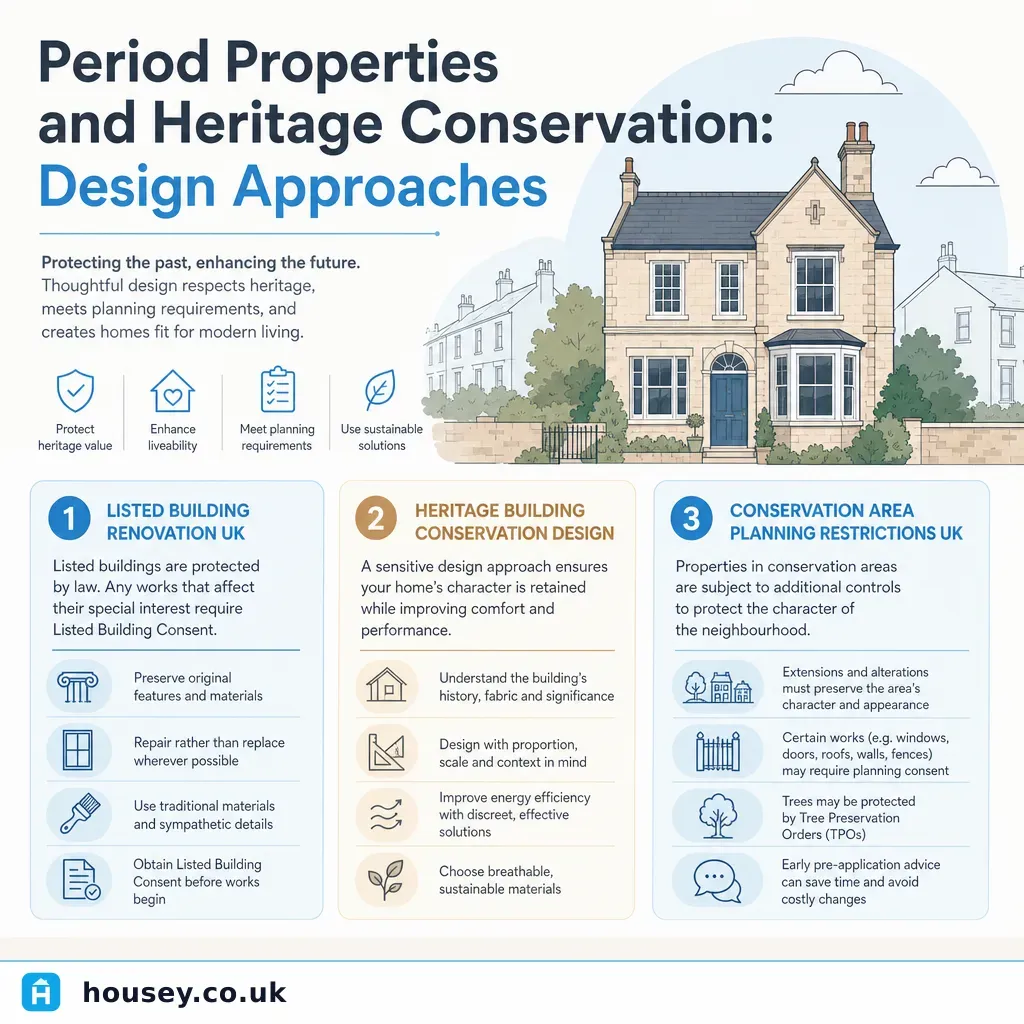 Planning & Pre-Build
Period Properties and Heritage Conservation: Design Approaches
Renovating a period or listed property in the UK requires listed building consent for most alterations — including internal works — and compliance with conservation area restrictions where applicable.
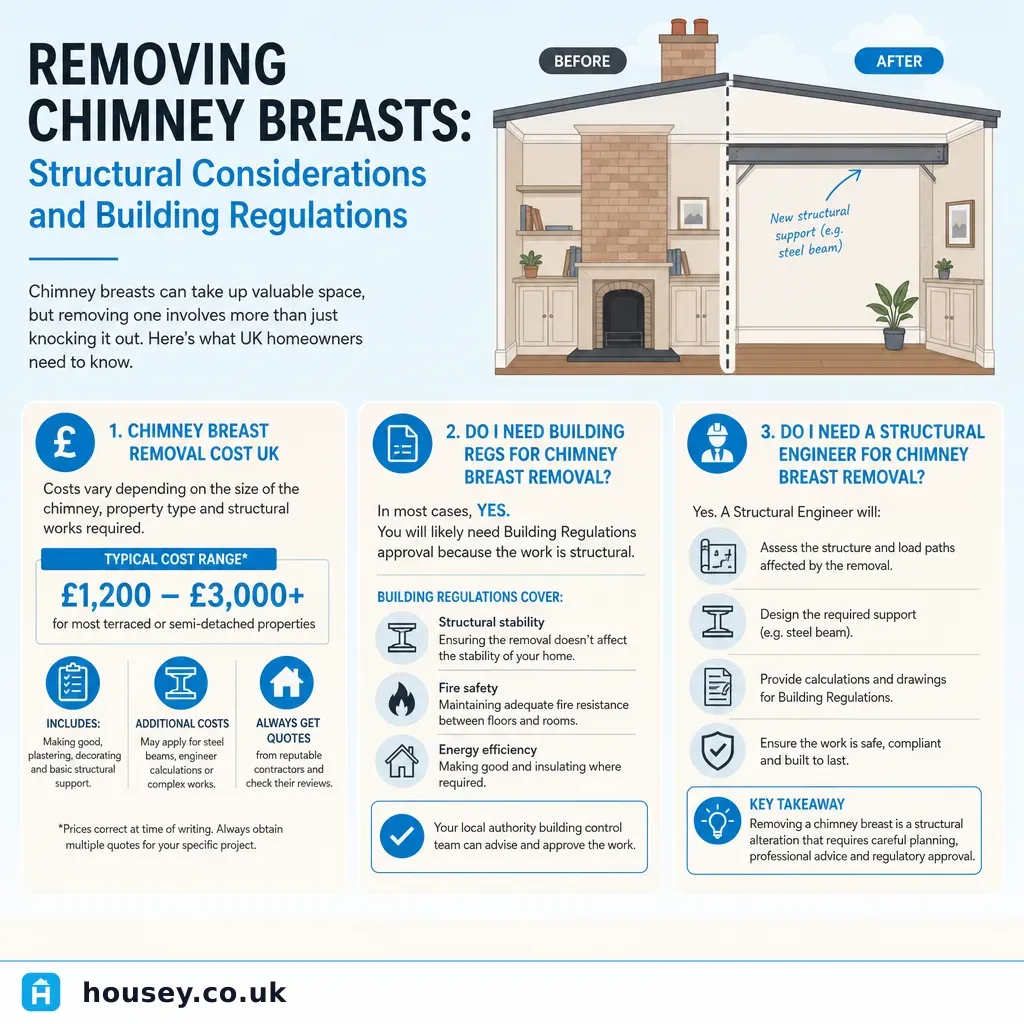 Planning & Pre-Build
Removing Chimney Breasts: Structural Considerations and Building Regulations
Removing a chimney breast in England and Wales almost always requires building regulations approval because it is structural work.
 Planning & Pre-Build
Viewing Properties Showcasing Distinguished Architectural Heritage
UK homes span centuries of architectural tradition, from Georgian symmetry to Victorian ornament, Edwardian craftsmanship, and post-war design.
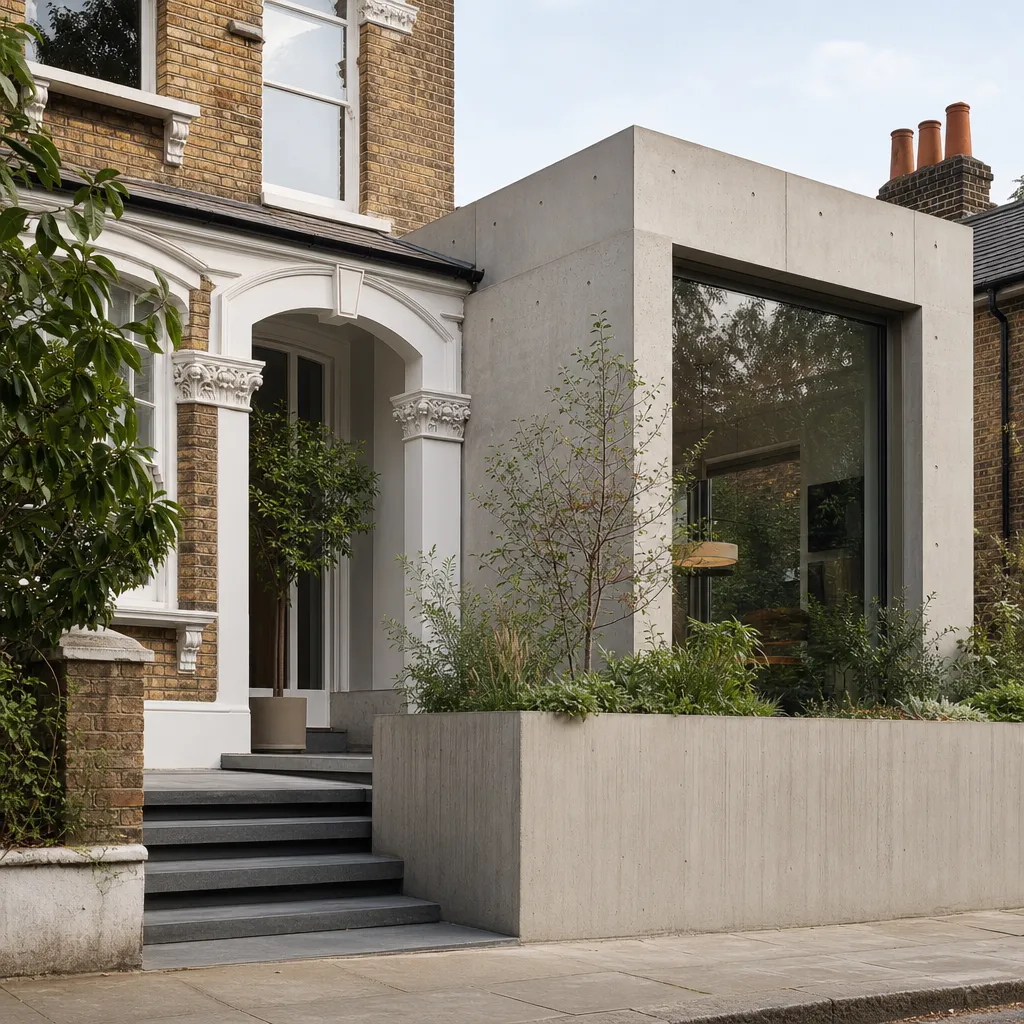 Planning & Pre-Build
Contemporary Architectural Concrete: Blending New with Historic Buildings
Contemporary concrete can work well alongside historic buildings, but any extension to a listed building requires Listed Building Consent in addition to planning permission.
 Planning & Pre-Build
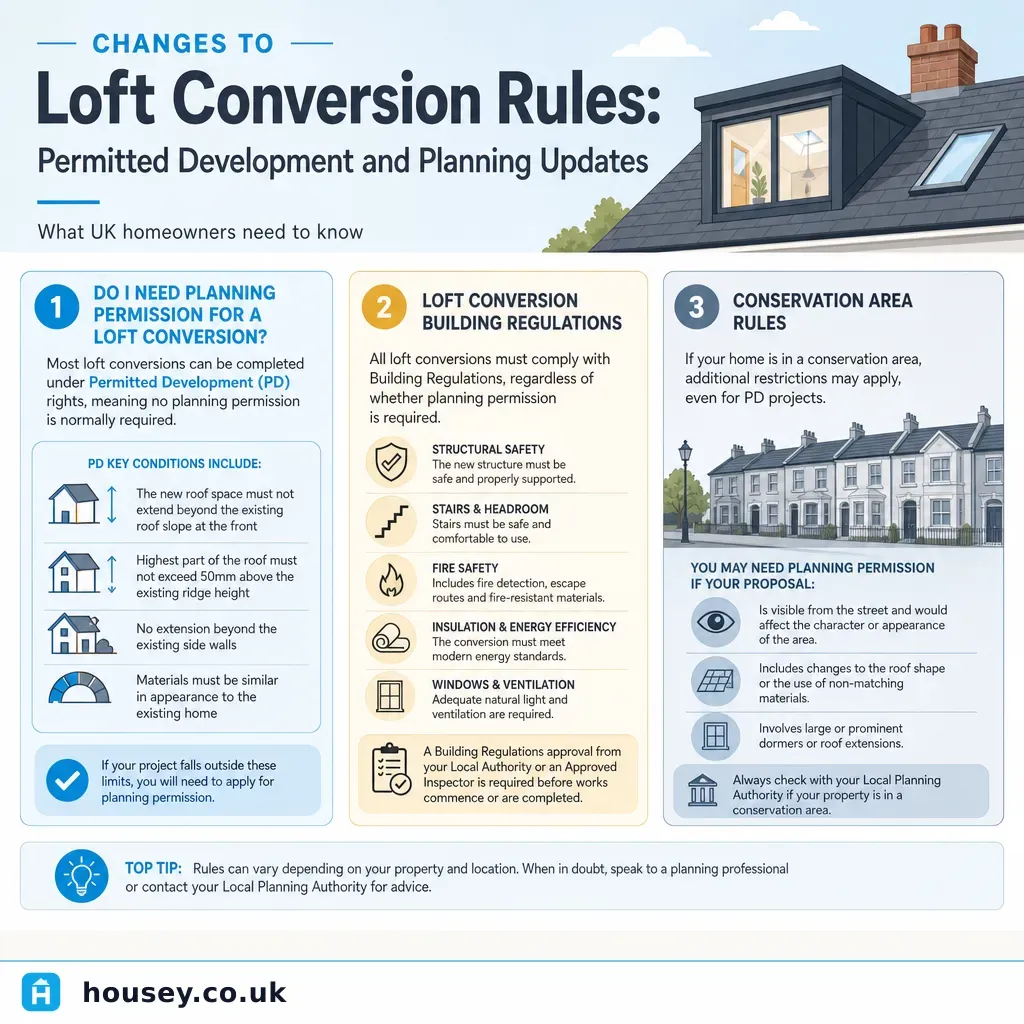
Changes to Loft Conversion Rules: Permitted Development and Planning Updates
In England, most loft conversions on standard houses qualify as Permitted Development under Class B of the GPDO 2015, allowing up to 40 cubic metres (terraced) or 50 cubic metres (detached or semi-detached) without a planning application — if conditions are met.