Viewing Properties Showcasing Distinguished Architectural Heritage
By Housey · Last reviewed 30th of May 2026

Viewing Properties Showcasing Distinguished Architectural Heritage
Britain's housing stock spans more than three centuries of design tradition, creating one of the most varied residential property landscapes in the world. If you are viewing an older home — whether a Georgian townhouse, a Victorian terrace, or an interwar semi-detached — understanding the architectural period shapes not only how you appreciate the property but how you may alter, extend, or repair it once you own it. Planning constraints, listing status, and building regulation requirements all interact with a property's heritage character in ways that become significant long before you raise your first builder's quote.
Key points
- England and Wales have over 400,000 listed buildings; alterations to any listed structure require Listed Building Consent from the local planning authority, separate from ordinary planning permission.
- Around 10,000 conservation areas exist in England alone; designation can restrict external alterations even on unlisted properties within the boundary.
- UK residential architectural periods broadly recognised include: Georgian (1714–1830), Victorian (1837–1901), Edwardian (1901–1910), Arts & Crafts (1880s–1920s), interwar (1918–1939), and post-war (1945–1980s).
- Lime mortar, solid single-leaf brickwork, and early timber sash windows require specialist repair methods; modern building products can cause irreversible damage to historic fabric.
- A measured building survey produces accurate as-built drawings essential for any design or planning application on a period or listed property.
Recognising UK architectural periods at a viewing
Being able to place a property in its approximate architectural period helps you anticipate what original features may survive, what alterations are likely to have occurred, and what planning or heritage constraints may apply.
Georgian (1714–1830)
Georgian architecture favours strict symmetry, sash windows with thin glazing bars, flat or low-pitched roofs behind a parapet, red or yellow brick, and classical proportions. Interiors often feature ornate plasterwork cornices, dado rails, and wide-plank timber floors. Many Georgian terraces and townhouses are listed at Grade I or Grade II-starred, so verify the National Heritage List for England before viewing.
Victorian (1837–1901)
Victorian housing is the most common period property type in England. Terraces predominate in industrial cities; detached and semi-detached villas were built for middle-class suburbs. Key features include decorative brickwork, bay windows, ornate encaustic tiling, cast-iron fireplaces, stained-glass fanlights, and gothic or Italianate details. Structural walls are typically solid brick, often 225 mm (9 in) thick.
Edwardian (1901–1910)
Edwardian homes are generally more spacious than their Victorian predecessors, with wider frontages, larger gardens, and an emphasis on natural light. Hallmarks include exposed timber in gabled ends, roughcast render, pebbledash, and decorative wooden porches. Arts & Crafts influence is visible in hand-crafted tilework, inglenook fireplaces, and leaded lights.
Interwar (1918–1939)
The interwar period produced Britain's first large-scale suburban housing wave, typified by the mock-Tudor semi-detached with decorative gable, stained-glass front door, and metal Crittall windows. Art Deco styling appears on some 1930s detached houses and flat-conversion buildings, recognisable by curved corner windows and geometric brickwork patterns.
Post-war and modernist (1945–1980s)
Post-war stock varies widely: prefabricated homes (some now listed), local-authority estates in reinforced concrete, and privately built estates using cavity-wall construction. Identifying non-traditional construction types at this stage matters because some building forms are considered unmortgageable by certain lenders without specialist reports.
UK architectural periods at a glance
Period | Approx. dates | Typical construction | Common original features | Key planning note |
|---|---|---|---|---|
Georgian | 1714–1830 | Solid brick, lime mortar | Sash windows, cornices, parapet roofs | Often listed Grade I or II-starred |
Victorian | 1837–1901 | Solid brick, slate roof | Bay windows, cast-iron fireplaces, decorative tiles | Many in conservation areas |
Edwardian | 1901–1910 | Solid brick, timber details | Wide hallways, pebbledash, leaded lights | Often unlisted but locally valued |
Arts & Crafts | 1880s–1920s | Handmade brick, oak timber | Inglenook fireplaces, hand-set tiles | May overlap with listed designation |
Interwar | 1918–1939 | Cavity brick, render | Metal windows, mock-Tudor gable, tile-hung bays | Permitted development usually applies |
Post-war | 1945–1980s | Cavity brick or non-traditional | Early cavity insulation, flat roofs on some types | Non-traditional construction may affect mortgage |
How heritage status affects planning and consent
Not every period property carries formal heritage designation, but three factors commonly restrict what you can alter:
Listed building status. A building on the National Heritage List for England (or equivalent registers in Wales, Scotland, and Northern Ireland) requires Listed Building Consent for any works affecting its character. This applies inside and outside the building, and to outbuildings and boundary walls in some cases.
Conservation area designation. Local planning authorities can designate areas of special architectural or historic interest as conservation areas. Within them, permitted development rights are curtailed and some demolition or external works require prior notification or consent from the council.
Article 4 directions. Local authorities can withdraw specific permitted development rights using an Article 4 direction — common in historic town centres — meaning full planning permission may be needed for alterations that would otherwise be permitted elsewhere.
Check the Historic England register, your local planning authority's interactive map, or a property solicitor's pre-purchase searches before assuming alterations are straightforward.
What to ask when viewing a property with heritage character
Asking the right questions at a viewing or of the selling agent helps you judge what investigation to commission before exchange.
- What is the listing grade, if applicable, and when was the property listed?
- Is the property within a conservation area or subject to an Article 4 direction?
- Have any alterations been made since the original construction, and were consents obtained?
- Are original features — fireplaces, shutters, cornicing, floorboards — still in place, and in what condition?
- Has any work been done with non-traditional materials, such as cement render over lime or uPVC replacing original timber windows?
- What heating system is installed, and has it been adapted for solid-wall construction?
- Are there any outstanding enforcement notices or unresolved planning conditions?
- Has the property been independently surveyed since the last sale, and are reports available to view?
When to get professional help
A heritage or period property carries specific risks that a basic valuation or standard legal searches rarely uncover. Consider commissioning specialist professional support in the following circumstances:
- You are buying a listed building of any grade — commission a RICS Level 3 Building Survey from a surveyor with heritage experience, or request a separate building conservation specialist's assessment.
- You intend to extend, alter, or carry out significant repairs — an architect experienced in conservation areas or listed buildings should advise before you budget for works.
- The property has visible defects such as damp patches, cracked render, bulging brickwork, or failed pointing — a structural assessment may be needed alongside a building survey.
- You cannot locate building regulations completion certificates for previous alterations or extensions.
- You need accurate drawings for a planning or Listed Building Consent application — a measured building survey will be required.
Red flags to address before exchange:
- Cement render applied over a solid-wall property (traps moisture and can cause serious masonry damage over time)
- Replacement uPVC windows in a listed building installed without Listed Building Consent
- Evidence of underpinning or previous structural movement without a structural engineer's sign-off
- Missing or inconsistent building regulation certificates for extensions or conversions
How Housey can help
Whether you are preparing a design scheme for a listed building, seeking accurate drawings for a planning application, or need expert guidance on what your period property can accommodate, Housey connects you with experienced architectural services for period properties and specialists offering measured building surveys — the accurate as-built record that underpins any heritage design project.
Frequently asked questions
Does listing status affect what I can do inside my property?
Yes. Listed Building Consent is required for any works that affect the character of a listed building — including internal alterations such as removing fireplaces, changing historic floorboards, or replacing windows. The exact scope depends on the listing grade and the local authority's interpretation. Always seek formal pre-application advice from the local planning authority before instructing contractors.
How do I find out if a property is in a conservation area?
Your local planning authority's website usually has an interactive planning map showing conservation area boundaries. You can also ask your solicitor to include a conservation area check in pre-purchase enquiries, or search the Historic England designation database online. Your estate agent should also be able to advise if they are familiar with the local area.
What is a measured building survey, and do I need one for a period property?
A measured building survey produces accurate scale drawings of a property as it currently stands — floor plans, sections, and elevations. For a listed or period building, local planning authorities usually require these before validating a planning or Listed Building Consent application. An architect will normally specify the survey accuracy level needed before commissioning one.
Can I replace original windows in a Victorian terrace that is not listed?
In most cases, replacing windows in an unlisted Victorian property requires no planning permission unless the house is in a conservation area or subject to an Article 4 direction. Building Regulations (Approved Document L on thermal performance and Approved Document F on ventilation) still apply to the replacement units. Always check conservation area status with your local planning authority before proceeding.
Sources and further reading
- National Heritage List for England — Historic England
- Listed buildings: making changes — GOV.UK
- Conservation areas guidance — Historic England
- Permitted development rights for householders: technical guidance — GOV.UK
- RICS Home Survey Standard — RICS
Useful next reads
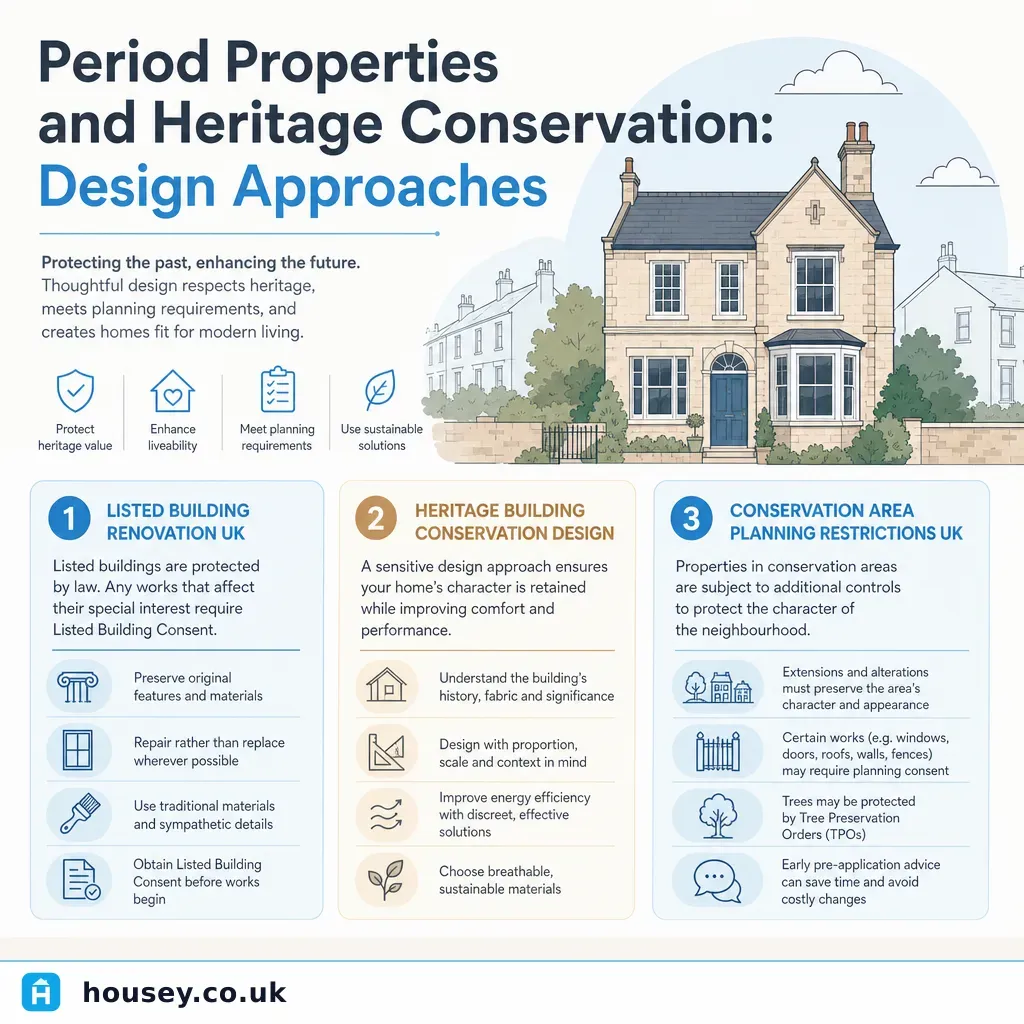 Planning & Pre-Build
Period Properties and Heritage Conservation: Design Approaches
Renovating a period or listed property in the UK requires listed building consent for most alterations — including internal works — and compliance with conservation area restrictions where applicable.
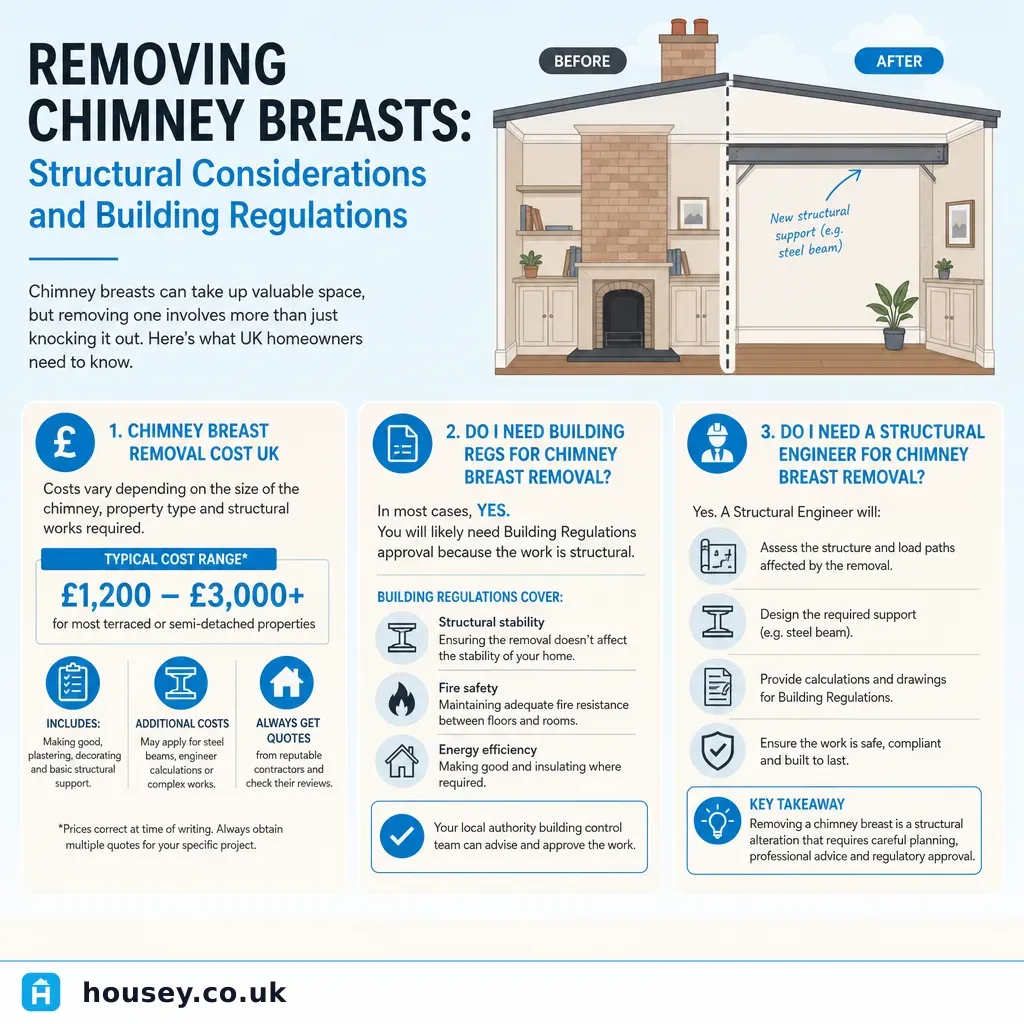 Planning & Pre-Build
Removing Chimney Breasts: Structural Considerations and Building Regulations
Removing a chimney breast in England and Wales almost always requires building regulations approval because it is structural work.
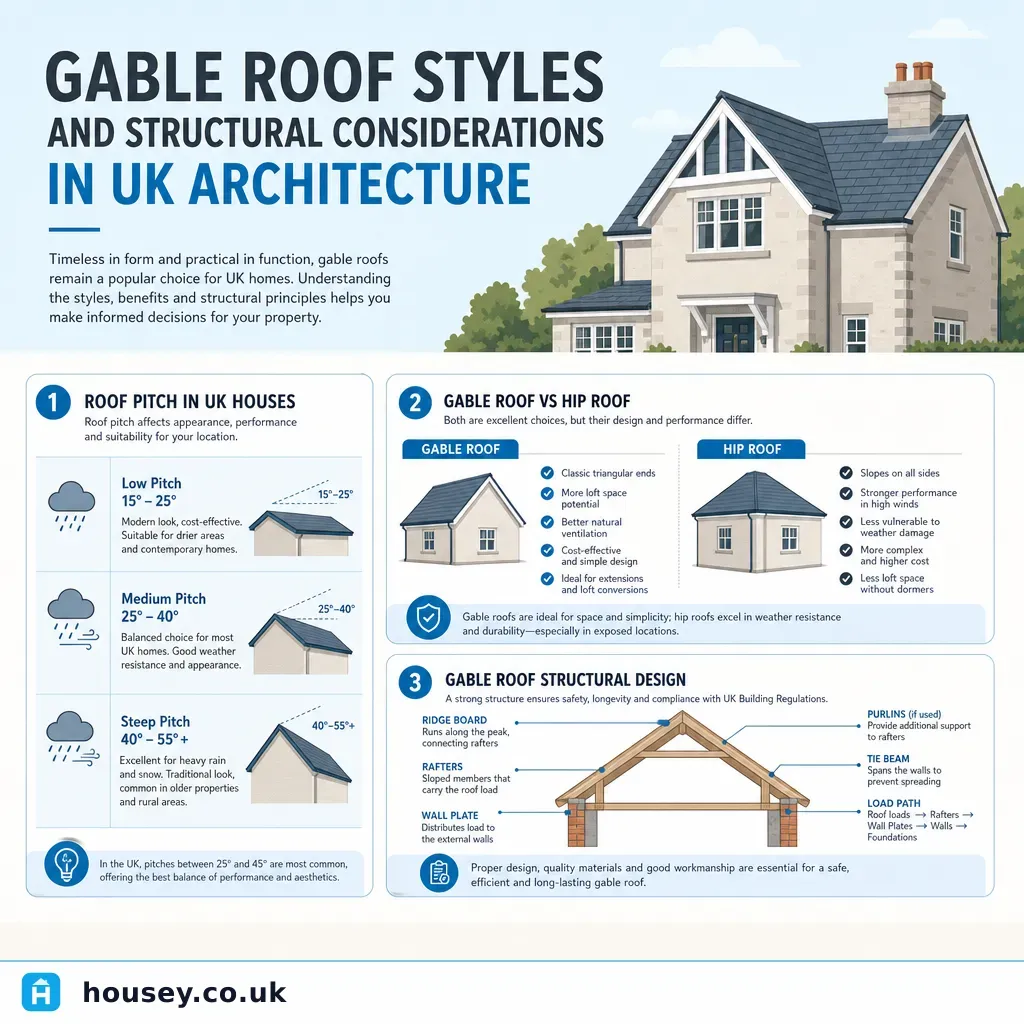 Planning & Pre-Build
Gable Roof Styles and Structural Considerations in UK Architecture
Gable roofs — two sloping planes meeting at a central ridge with triangular end walls — are the most common roof form in UK residential architecture.
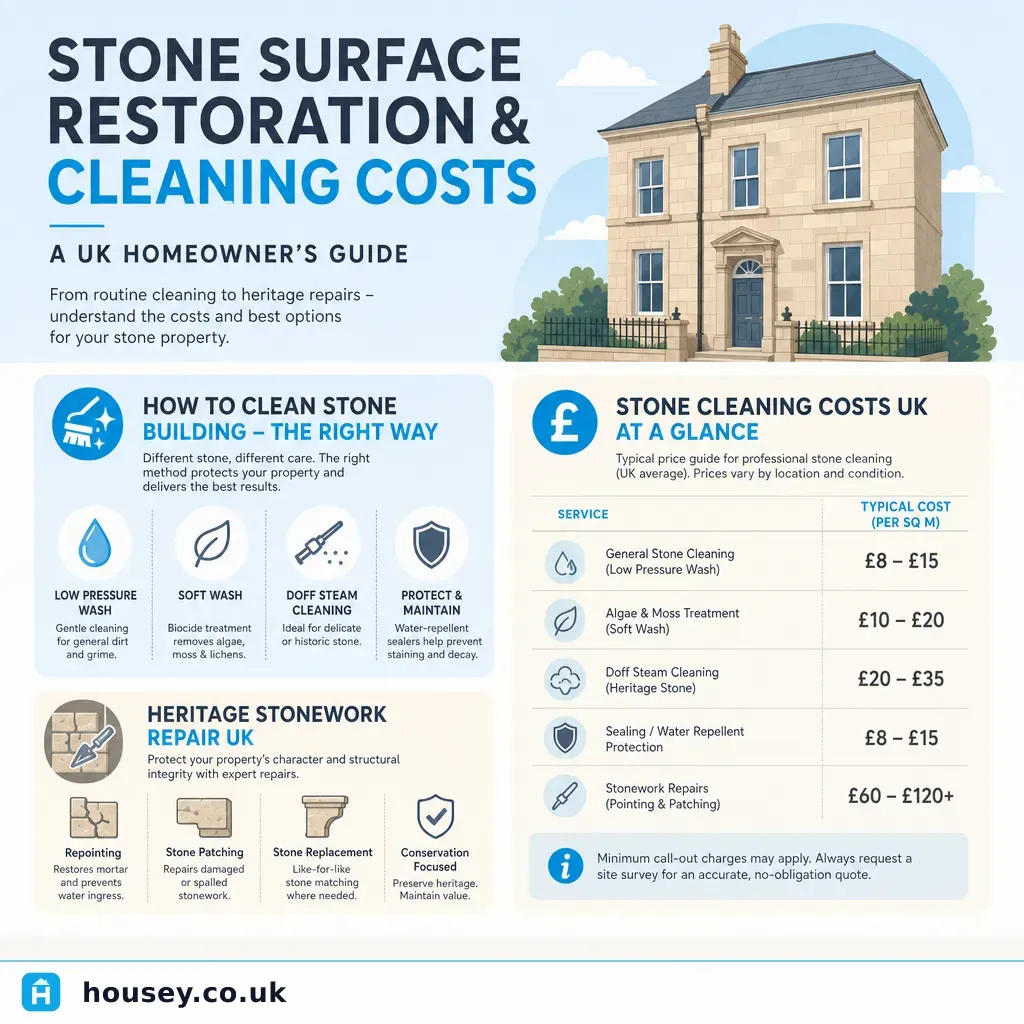 Planning & Pre-Build
Stone Surface Restoration and Cleaning Costs
Stone cleaning in the UK typically costs £10–£50 per square metre; full restoration ranges from £150 to £500 or more per square metre.
 Planning & Pre-Build
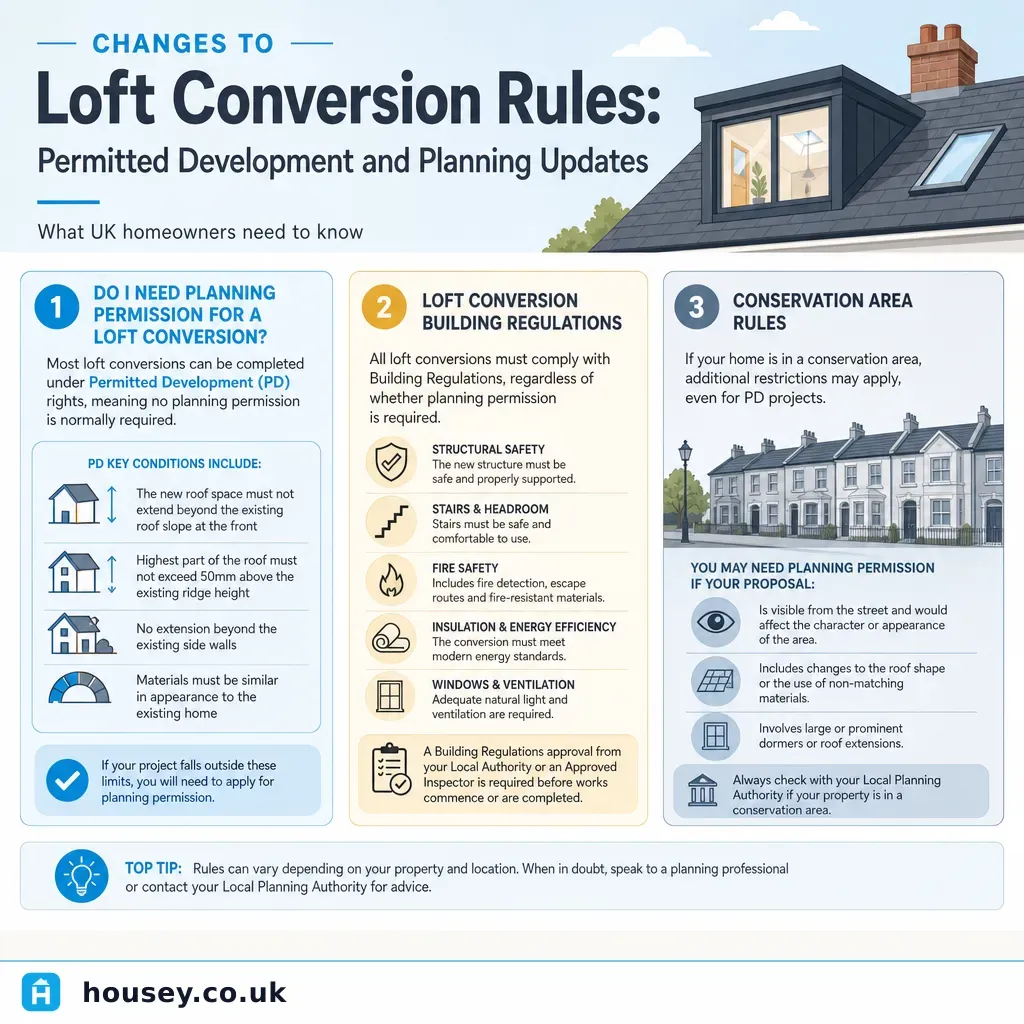
Changes to Loft Conversion Rules: Permitted Development and Planning Updates
In England, most loft conversions on standard houses qualify as Permitted Development under Class B of the GPDO 2015, allowing up to 40 cubic metres (terraced) or 50 cubic metres (detached or semi-detached) without a planning application — if conditions are met.