Permeable Bases for Driveways: Solving Drainage Problems
By Housey · Last reviewed 11th of May 2026
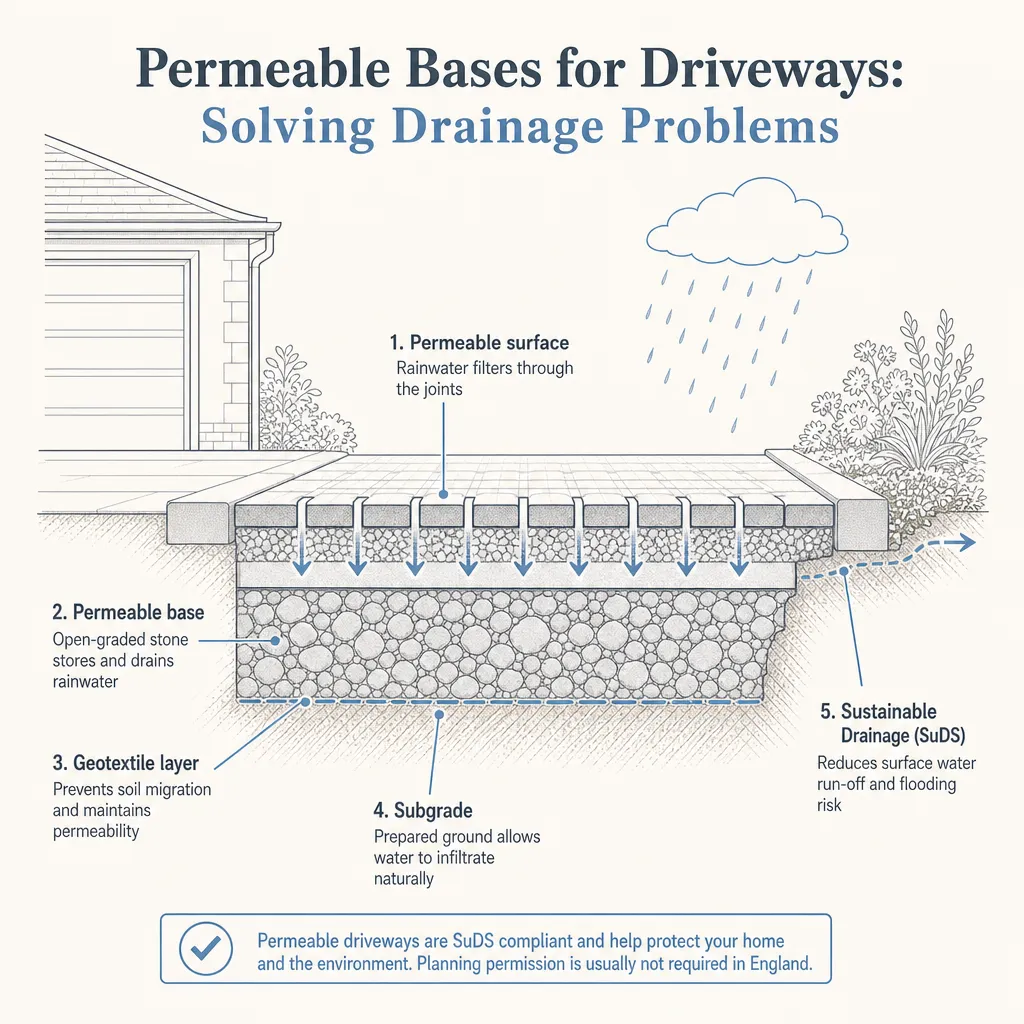
Permeable Bases for Driveways: Solving Drainage Problems
Waterlogged driveways are one of the most common complaints UK homeowners face after heavy rain, and the problem is typically rooted in the base layer rather than the surface finish. Whether you are replacing a crumbling tarmac apron on a 1960s semi or laying a brand-new driveway for a barn conversion, the sub-base specification determines whether water pools, floods the garage, or drains safely into the ground. Changes to permitted development rights in England since 2008 have also made drainage behaviour a planning consideration for most front driveways.
Key points
- Driveways larger than 5 m² require planning permission in England if they use a non-permeable surface and discharge water to the road or highway drain (Town and Country Planning (General Permitted Development) (England) Order 2015, Schedule 2, Part 2, Class F).
- A permeable surface — including permeable block paving, gravel, or bound porous materials — exempts most residential driveways from this planning requirement, provided water drains to a lawn, border, or soakaway rather than the highway.
- The sub-base material most commonly used beneath permeable driveways is MOT Type 3 (open-graded crushed stone), which retains large void spaces for water storage and infiltration; MOT Type 1 is dense-graded and unsuitable beneath permeable surfaces.
- Sub-base depth for a domestic driveway typically ranges from 100 mm to 250 mm depending on soil bearing capacity and expected vehicle loads — a heavier SUV or van loading zone may need the thicker end of this range.
- In Wales, Schedule 3 of the Flood and Water Management Act 2010 made SuDS (Sustainable Drainage Systems) approval mandatory for drainage discharging to surface water from October 2018; England introduced similar requirements for major developments from April 2024 under the Levelling-up and Regeneration Act 2023.
Why sub-base choice determines drainage performance
The base layers beneath a driveway surface do far more than provide structural support — they act as a temporary reservoir and infiltration zone. A conventional dense sub-base compacts tightly, offering little void space, so water travels laterally until it finds a drain or the surface edge. A permeable sub-base, by contrast, retains 25–40% void ratio, temporarily storing rainfall during peak events and releasing it slowly into the ground below or to a controlled outlet.
Standard driveway construction typically uses:
- Capping layer (if ground is weak or unstable): 150–300 mm of recycled or crushed material stabilising soft sub-grades.
- Sub-base: The structural layer. MOT Type 1 (dense) is conventional; MOT Type 3 (open-graded) is specified for permeable systems.
- Bedding course (for block or sett surfaces): 30–50 mm of sharp sand (dense systems) or fine crushed stone (permeable systems).
- Surface course: The visible finish — block paving, gravel, resin-bound aggregate, porous asphalt, or pervious concrete.
For water to pass through the full system, every layer must be specified as permeable. Using open-graded surface paving over a dense Type 1 sub-base simply routes water to the sub-base/sub-grade interface, where it may pond and weaken the structure over time.
Planning rules and permeable driveways in England
In England, GOV.UK planning guidance on householder permitted development makes the distinction clear: a new or replacement front garden driveway does not require planning permission if the surface is permeable or if surface water is directed to a lawn or border within your own property. A non-permeable surface discharging water to the highway or a highway drain triggers a requirement for prior approval or planning permission.
This means many homeowners who install block paving without permeable joints or a dense tarmac finish should technically have obtained permission — a rule that is widely unenforced for small areas but relevant if neighbours object or if the property is later sold.
Conservation areas and listed buildings may face additional constraints; always check with your local planning authority before starting work.
Comparing permeable base systems
System | Best for | Surface types supported | Drainage rate | Approx. indicative installed cost per m² |
|---|---|---|---|---|
MOT Type 3 open-graded sub-base | Standard permeable driveways | Permeable block paving, gravel, resin-bound | High | £40–£90 (surface cost additional) |
Geocomposite cells (grass/gravel grids) | Light-use areas, grass reinforcement | Grass or gravel infill | Very high | £15–£35 (cells only) |
Pervious concrete sub-base slab | Heavily loaded or sloped driveways | Permeable block, concrete overlay | Medium–high | £50–£110 |
Attenuation crate system | Poor-draining clay soils | Any permeable surface | Controlled release | £60–£140 (including crates) |
Indicative UK costs, last reviewed 2026-05-11. Prices vary by region, ground conditions, and access. Obtain at least three quotes.
How to assess your existing drainage problem
Before specifying a new sub-base, it helps to understand where water is coming from and where it needs to go.
Homeowner drainage checklist
When to get professional help
A drainage assessment is worth commissioning before major driveway works if:
- The ground is known to be clay or has poor drainage — a basic percolation test can reveal this before excavation starts.
- Water regularly enters the garage or approaches the house walls — this may indicate a defect beyond the driveway sub-base.
- The driveway slopes toward the house rather than away from it — regrading may require engineering input.
- The property is in a flood risk zone — check the Environment Agency flood map and consider a flood-risk assessment.
- You are in Wales and the drainage system connects to surface water — SuDS approval from the relevant Lead Local Flood Authority is mandatory.
- The driveway covers more than approximately 50 m² — larger areas generate meaningful run-off loads that benefit from a formal drainage design.
How Housey can help
Finding an installer who understands permeable sub-base specification — rather than simply laying the cheapest dense Type 1 available — makes a significant difference to long-term drainage performance. Housey connects homeowners with vetted driveway installers who can advise on sub-base selection, drainage outlet design, and whether your project requires planning approval.
Frequently asked questions
Does a permeable driveway definitely avoid planning permission in England?
In most cases, yes. Under the Town and Country Planning (General Permitted Development) (England) Order 2015, a front driveway using a permeable surface or directing run-off to a lawn or border is generally permitted development. However, properties in conservation areas, listed buildings, or those with Article 4 Directions may still need consent. Always check with your local planning authority if you are unsure.
What is the difference between MOT Type 1 and MOT Type 3 sub-base?
MOT Type 1 is a dense, well-graded crushed stone that compacts tightly, providing structural support but minimal void space for water. MOT Type 3 is open-graded, leaving large interconnected voids — typically 25–40% of the volume — allowing water to pass through. Type 3 is the correct specification beneath a permeable driveway surface.
How deep should a permeable sub-base be for a domestic driveway?
For a standard family car, 100–150 mm of compacted open-graded sub-base is usually adequate on reasonably bearing ground. Where soil is weak — clay, peat, or made ground — 200–250 mm may be needed, sometimes with a geotextile separation layer below. Heavier loading zones, such as areas used by vans or motorhomes, should be assessed by an experienced installer.
Can I retrofit permeable drainage to an existing driveway?
In many cases, yes. Existing block paving can often be lifted, the bedding and sub-base replaced with permeable materials, and the blocks re-laid with open joints filled with fine aggregate. Solid tarmac or concrete driveways typically require full removal. A drainage contractor can assess whether retrofit is cost-effective compared with full replacement.
Sources and further reading
- When is permission required? — GOV.UK
- Town and Country Planning (General Permitted Development) (England) Order 2015 — legislation.gov.uk
- The SuDS Manual C753 — CIRIA
- Driveways and dropped kerbs: planning permission — Planning Portal
- Flood and Water Management Act 2010 — legislation.gov.uk
Useful next reads
 Improvement & Build
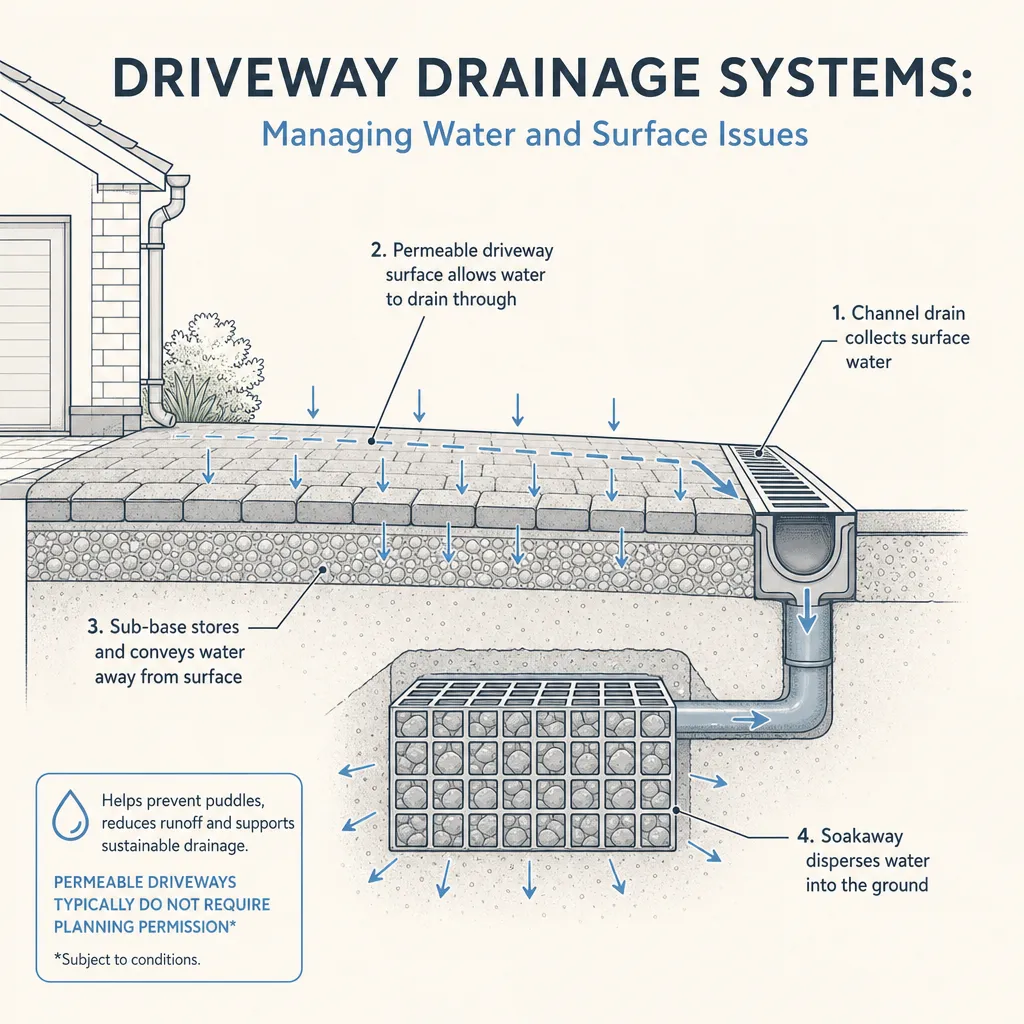
Driveway Drainage Systems: Managing Water and Surface Issues
The right driveway drainage system depends on your surface type, soil permeability, and local flood risk.
 Improvement & Build
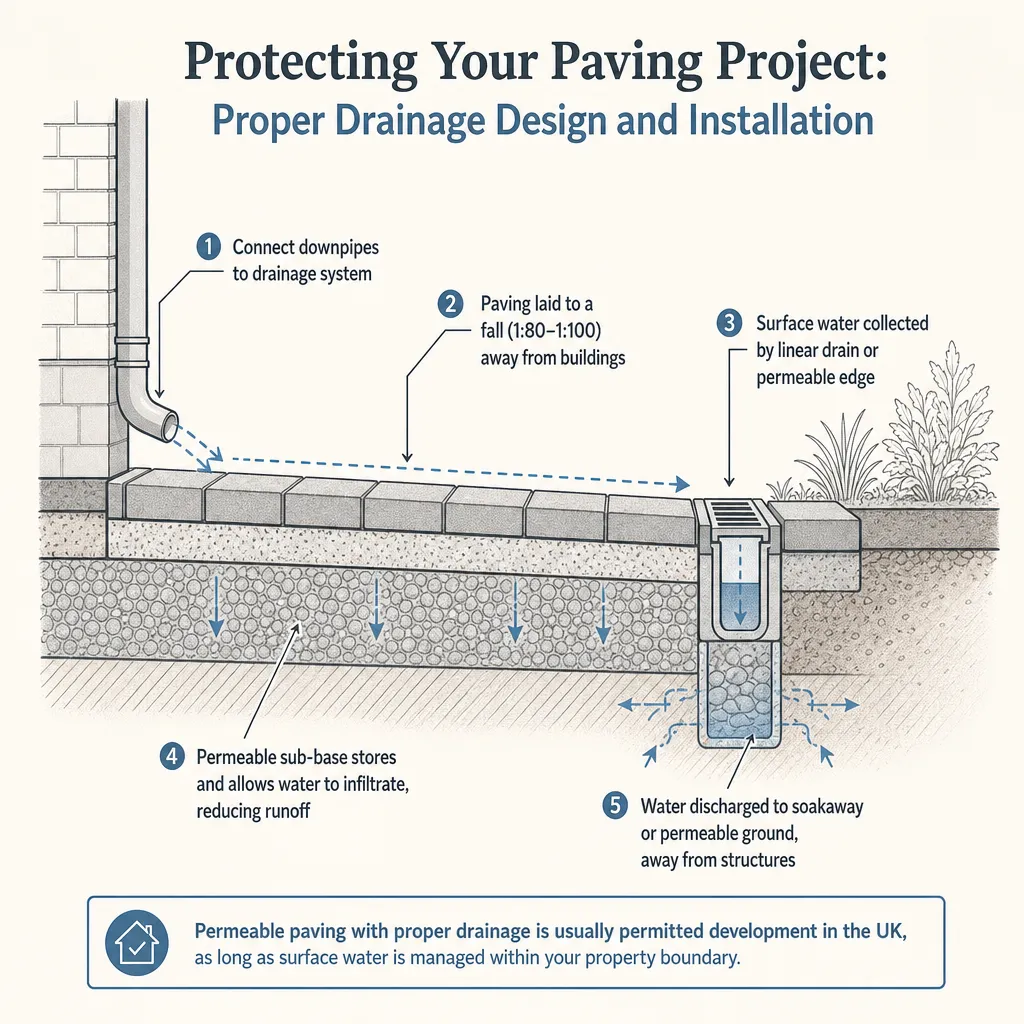
Protecting Your Paving Project: Proper Drainage Design and Installation
Good paving drainage starts with a minimum fall of 1:60 to 1:80 away from buildings, a correctly specified sub-base, and a clear outlet for surface water.
 Improvement & Build
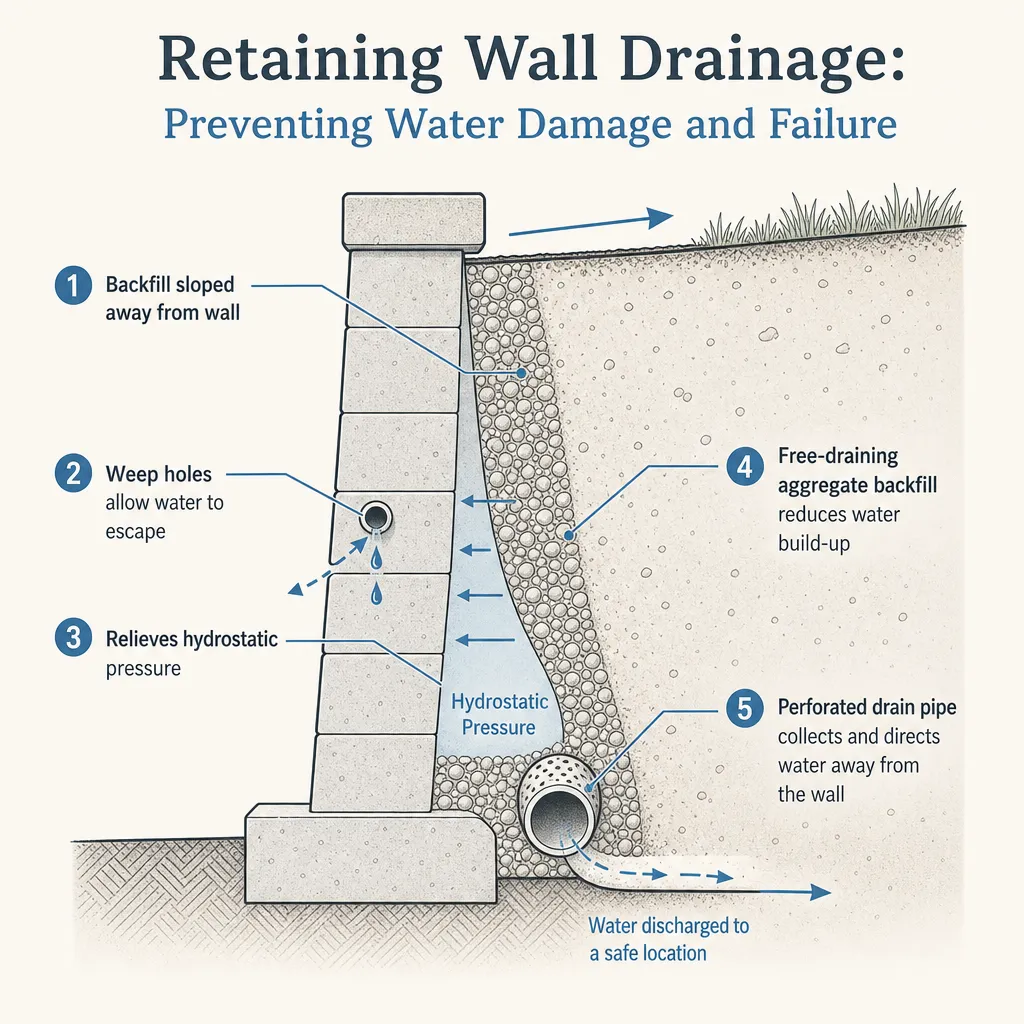
Retaining Wall Drainage: Preventing Water Damage and Failure
Retaining wall drainage fails when hydrostatic pressure builds behind the structure due to poor drainage layers, blocked weep holes, or impermeable backfill.
 Improvement & Build
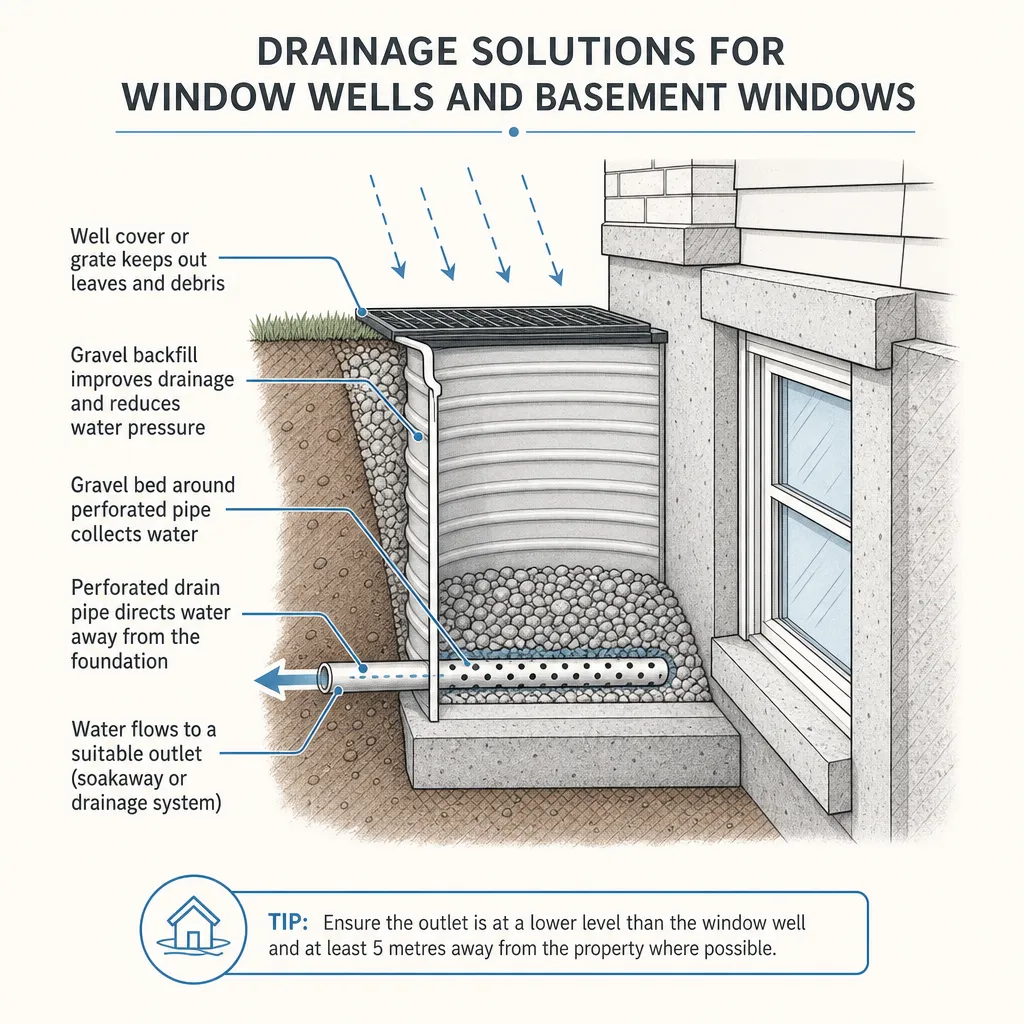
Drainage solutions for window wells and basement windows
Most UK window wells manage water through a gravel-filled sump at least 200 mm deep or a plastic liner fitted with a drain outlet connected to a soakaway or drainage system.
 Improvement & Build
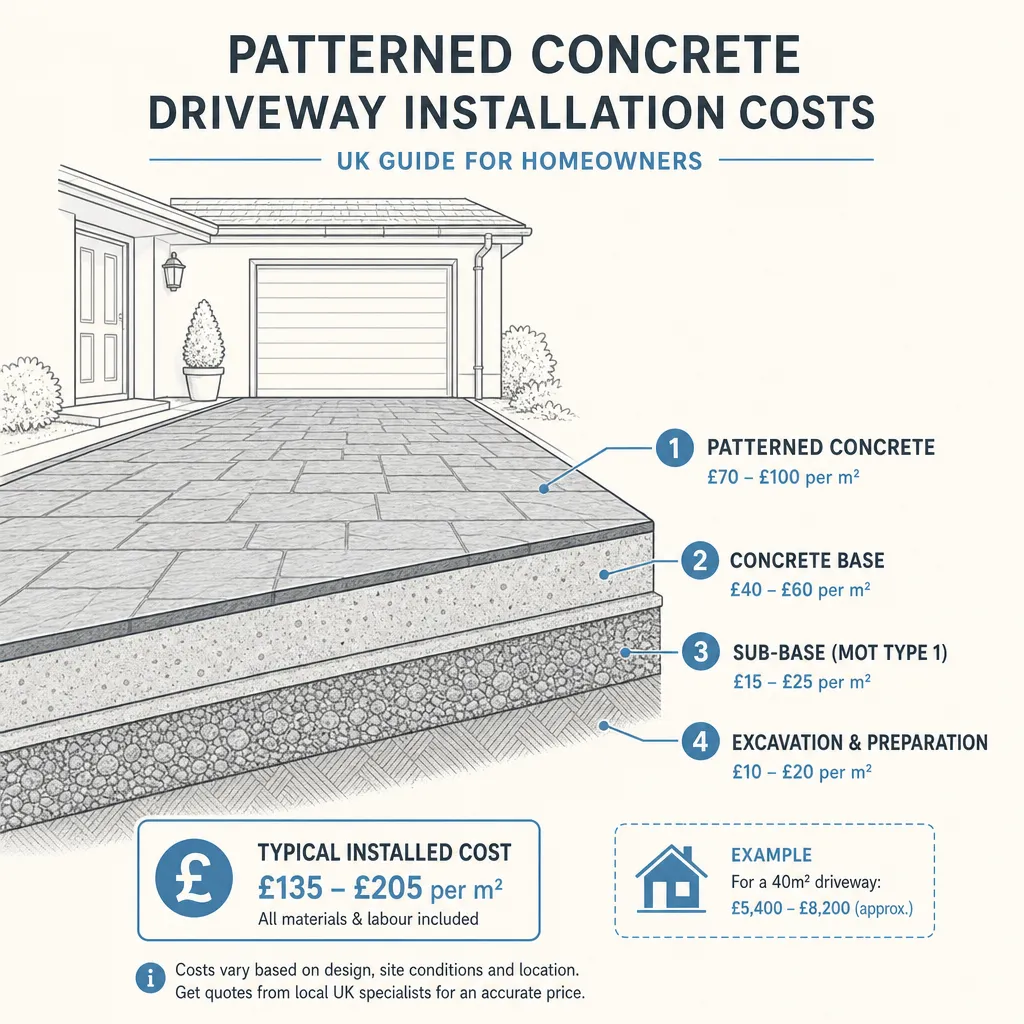
Patterned Concrete Driveway Installation Costs
A patterned concrete driveway in the UK typically costs £50–£120 per square metre installed, depending on pattern complexity, site preparation, and driveway size.