Planning a Full Property Refurbishment: Scope, Services, and Project Management
By Housey · Last reviewed 18th of May 2026
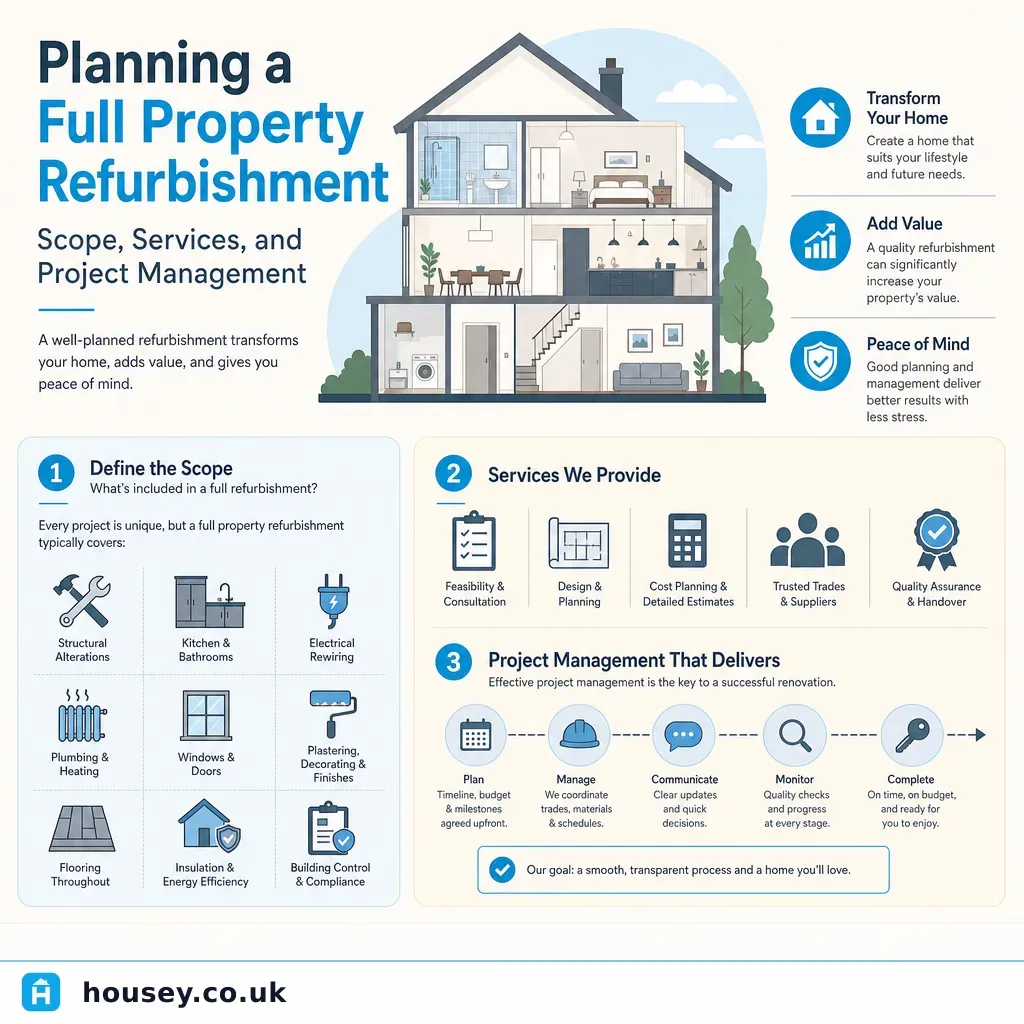
Planning a Full Property Refurbishment: Scope, Services, and Project Management
Full property refurbishments are among the most complex building projects a UK homeowner can undertake. Whether you have purchased an uninhabited Victorian terrace or are tackling a 1970s semi that needs everything updated, the scale of decisions — trades, timelines, budgets, and approvals — can quickly become overwhelming. Getting the scope defined and the project managed correctly from the outset is what separates a successful refurbishment from one that stalls on site or runs badly over budget.
Key points
- Building Regulations approval is required for structural alterations, extensions, roof work, electrical rewiring (Part P), plumbing changes, and significant energy-efficiency upgrades (Part L).
- The Party Wall etc. Act 1996 requires you to serve notice on adjoining owners at least two months before starting notifiable work to shared or boundary walls.
- Listed Building Consent must be obtained from your local planning authority before altering any element of a Grade I, II*, or II listed property — including internal work.
- VAT on residential renovation work is generally charged at 20%, but a reduced rate of 5% can apply for properties that have been empty for two years or more.
- RICS guidance suggests obtaining a Level 3 (Building Survey) before starting major structural refurbishment on an older or altered property, to avoid discovering hidden defects mid-project.
Defining the scope before anything else
The most common cause of cost and programme overruns on refurbishment projects is an incomplete or poorly understood scope of works. Before approaching any contractor or professional, a clear schedule of what you intend to do — and what you are explicitly leaving out — allows you to obtain meaningful, like-for-like quotes and gives a project manager or principal contractor a baseline to manage against.
A full refurbishment typically spans several distinct work packages. These are often interdependent: it makes little sense to redecorate before plastering is complete, or to lay new flooring before first-fix plumbing and electrics are finished. Thinking in phases helps.
Typical work packages in a full refurbishment:
- Demolition and strip-out — removing existing fixtures, finishes, partitions, and services that are being replaced.
- Structural works — steel beams, underpinning, roof structure, load-bearing wall alterations.
- Roof and envelope — re-roofing, repointing, external render, damp-proofing.
- First-fix services — new or upgraded electrical wiring, plumbing runs, heating pipework, ventilation ducts.
- Insulation — floor, wall, and loft insulation; often linked to Building Regulations Part L compliance.
- Plastering and internal finishes — dry-lining, wet plaster, screeds.
- Second-fix services — sockets, switches, sanitaryware, radiators, boiler or heat pump commissioning.
- Carpentry and joinery — stairs, doors, skirting, window boards, kitchen and fitted furniture.
- Tiling, flooring, and decoration — the finishing trades.
- External works — landscaping, drainage, paving, gates.
Which professionals do you need?
Depending on the scope, a full refurbishment may involve an architect, structural engineer, principal designer (for CDM purposes), project manager, and multiple specialist trades. Understanding which roles overlap — and which you genuinely need — helps control fees.
Role | When you need them | Typical scope |
|---|---|---|
Architect or designer | Design changes, extensions, planning applications, listed buildings | Drawings, specification, planning and building control submissions |
Structural engineer | Beam sizing, load-bearing wall removal, underpinning, roof alterations | Structural calculations and drawings |
Project manager | Multiple trades, complex programme, absentee client | Programme management, procurement, on-site supervision |
Principal designer (CDM) | Projects with more than one contractor | Health and safety coordination under CDM Regulations 2015 |
Main contractor or design-and-build firm | Clients wanting a single point of responsibility | Labour, subcontract management, materials procurement |
Quantity surveyor | Large or uncertain-scope projects | Cost planning, tender analysis, valuation of variations |
For a straightforward refurbishment within a single-occupancy house where no structural changes are involved and only one trade works at a time, a self-managed approach with carefully vetted contractors is feasible. For anything involving structural alterations, multiple concurrent trades, or a tight budget, appointing a project manager or design-and-build firm is usually more cost-effective in the long run.
Consents and approvals you may need
Failing to obtain required consents before starting work can result in enforcement action, difficulty selling the property, or the requirement to undo completed work.
Decision tree: do I need approval?
- Planning permission — needed if you are extending beyond permitted development limits, changing the use of the property, or the property is in a conservation area or is listed. Check with your local planning authority.
- Building Regulations — almost always required for structural work, new electrics, heating changes, extensions, and loft conversions. Apply through a building control body (local authority or approved inspector) before starting.
- Listed Building Consent — required for any alterations to a listed building, inside or outside. Apply to your local planning authority.
- Party Wall Act notice — required if work involves a shared wall, boundary wall, or excavation within 3 m of a neighbour's foundation. Serve notice at least two months before starting.
- CDM Regulations 2015 — apply when the domestic project uses more than one contractor. Additional duties apply depending on project duration and worker numbers.
Procurement: choosing your contracting approach
There are three main ways to procure a full refurbishment. Each has implications for cost certainty, control, and risk.
Approach | Best for | Risk profile |
|---|---|---|
Self-managed with separate trades | Experienced clients, phased work, tighter budget control | Higher client time and coordination risk |
Main contractor with subcontractors | Clients wanting one point of contact | Moderate; depends on main contractor quality |
Design-and-build firm | Clients wanting design and construction under one contract | Lower coordination risk; less design flexibility |
Getting at least three competitive quotes is standard practice. Before accepting any quote, ask for a detailed breakdown by work package, confirmation of insurance (public liability and employer's liability), references from comparable projects, and a clear payment schedule tied to defined milestones. Avoid front-loaded payment schedules that require large deposits before work begins.
Homeowner refurbishment checklist
When to get professional help
A full refurbishment rarely benefits from eliminating professional fees entirely. Engage a professional when:
- The project involves structural alterations (beam insertions, wall removals, underpinning).
- You are not on site regularly and cannot manage daily trade coordination.
- The budget is significant and any overrun would cause financial difficulty.
- Planning permission or listed building consent is required.
- The property has been empty and may have undisclosed defects.
- Disputes arise with contractors over quality, programme, or payment.
How Housey can help
Whether you need a project manager to run the whole programme, extension builders for the structural and shell works, or a design-and-build firm to handle everything from drawings to final clean, Housey connects you with vetted local professionals. Submit your project brief and receive quotes from up to four specialists matched to your property type and location.
Frequently asked questions
Do I need planning permission for a full internal refurbishment?
Internal works to a standard residential property generally do not need planning permission. However, if the property is listed, Listed Building Consent is required even for internal alterations. Conservation area restrictions primarily affect external appearance. Always check with your local planning authority if you are unsure.
How long does a full property refurbishment take in the UK?
Timescales vary significantly. A moderate refurbishment of a two-bedroom flat might take 8–14 weeks. A full gut-and-rebuild of a Victorian terraced house could take 6–12 months or more, depending on structural complexity, consent delays, and contractor availability. Build a programme before starting and review it monthly.
Should I move out during a full refurbishment?
For whole-house refurbishments involving major services work, structural alterations, or simultaneous multi-trade operations, staying in the property is rarely practical or safe. Dust, noise, and the absence of functioning kitchens and bathrooms make temporary alternative accommodation a necessary part of the overall project budget.
What insurance do I need during a major refurbishment?
Your standard home insurance policy is unlikely to cover an unoccupied property under active renovation. Specialist unoccupied property insurance or site insurance (often called contract works insurance) is usually required. Check with your insurer before work starts and confirm what your main contractor's policy covers.
Sources and further reading
- Building Regulations: approval — GOV.UK
- Party Wall etc. Act 1996 guidance — GOV.UK
- Listed buildings — Historic England
- CDM Regulations 2015 — Health and Safety Executive
- VAT: buildings and construction (Notice 708) — HM Revenue & Customs
Useful next reads
 Improvement & Build
Laundry Room Renovation and Fitting Costs
A basic UK laundry room fit-out typically costs £2,000–£6,000 where plumbing and electrics are already in place, rising to £8,000–£15,000 or more when structural work, new drainage connections, or new electrical circuits are needed.
 Improvement & Build
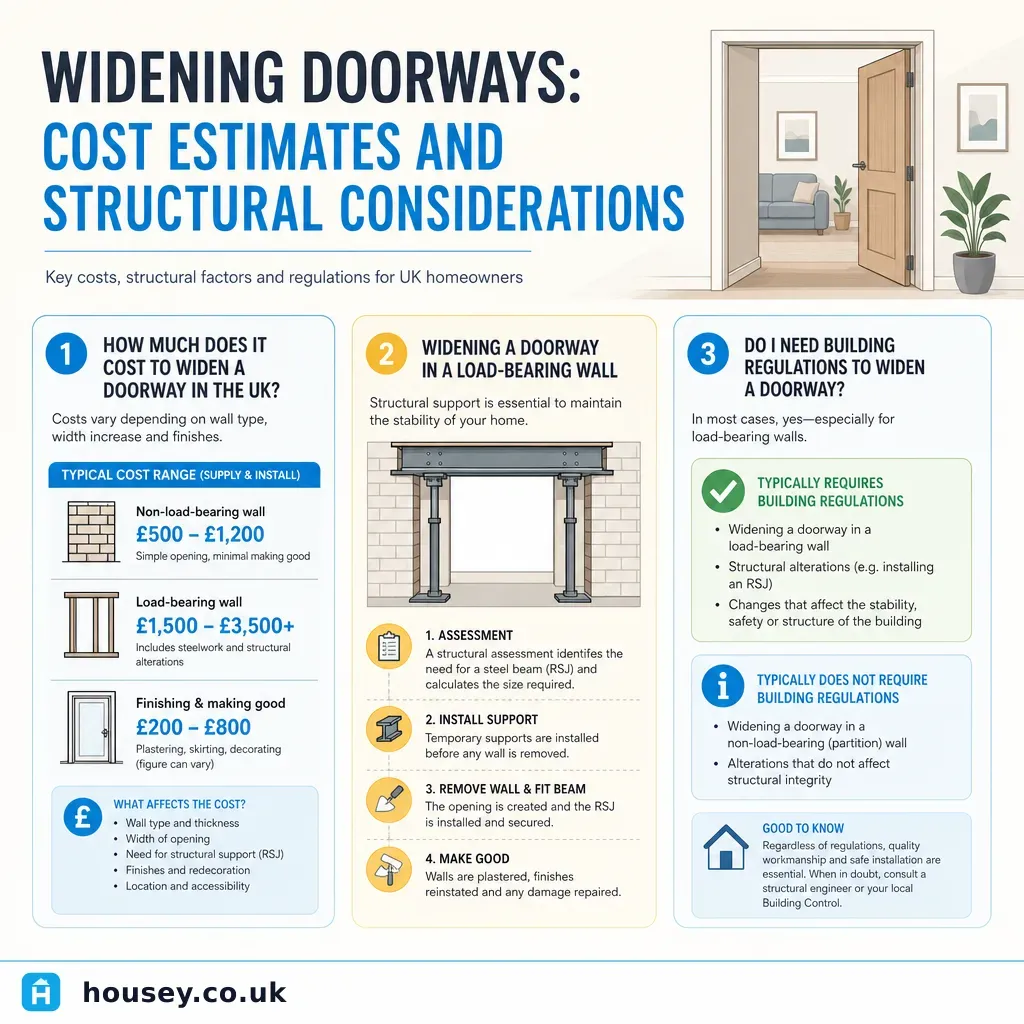
Widening Doorways: Cost Estimates and Structural Considerations
A doorway in a non-load-bearing partition can usually be widened for £500–£1,500.
 Improvement & Build
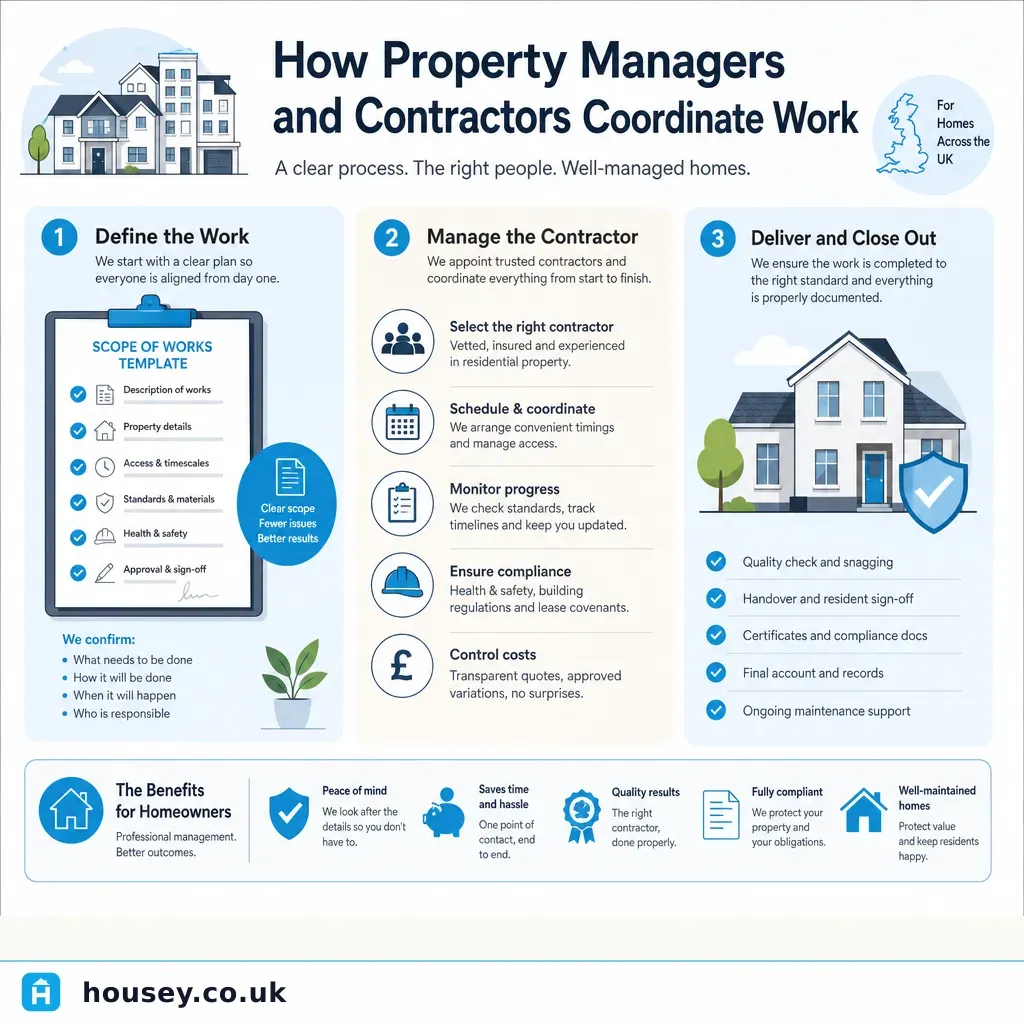
How Property Managers and Contractors Coordinate Work
Property managers coordinate contractors by scoping work clearly, selecting vetted and insured tradespeople, managing schedules and site access, checking progress against the brief, and handling sign-off and payment.
 Improvement & Build
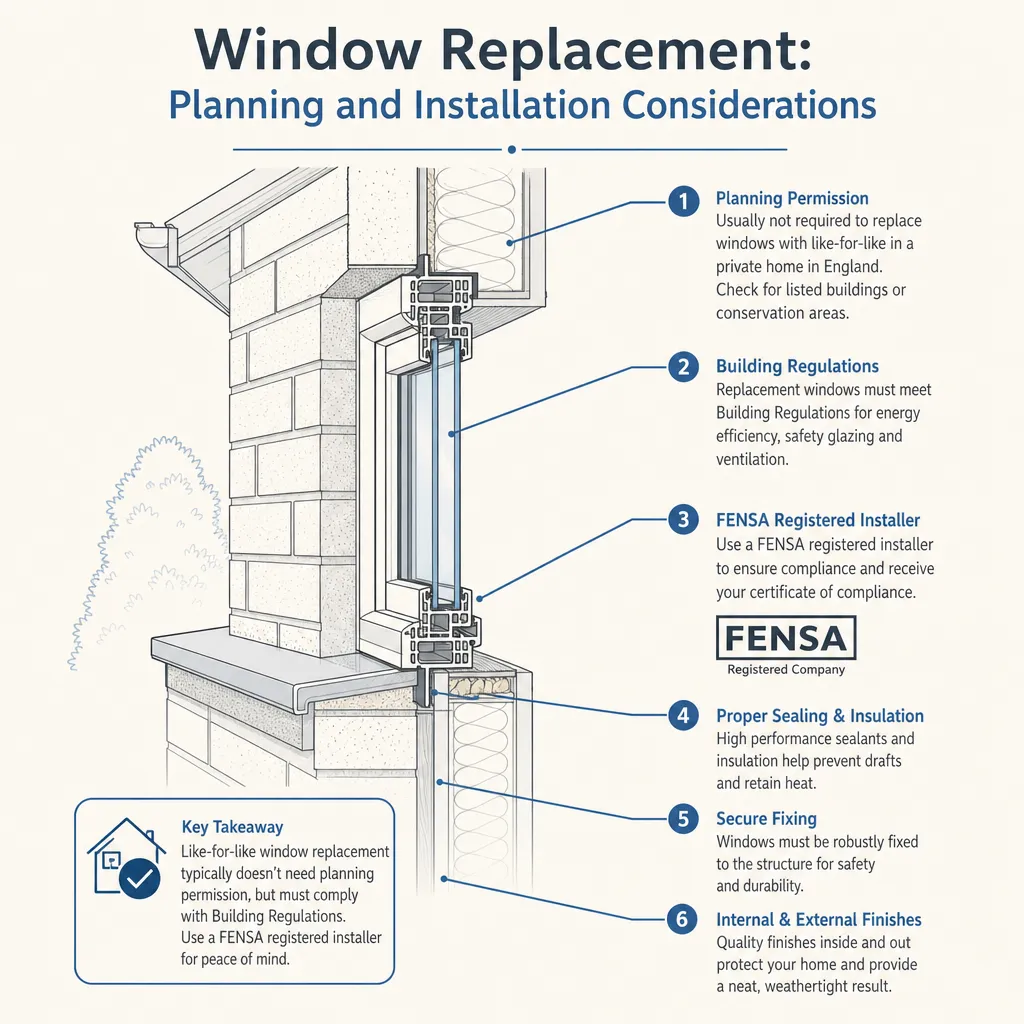
Window Replacement: Planning and Installation Considerations
Most window replacements in England fall under permitted development and do not need planning permission, though listed buildings, flats, and conservation areas are exceptions.
 Improvement & Build
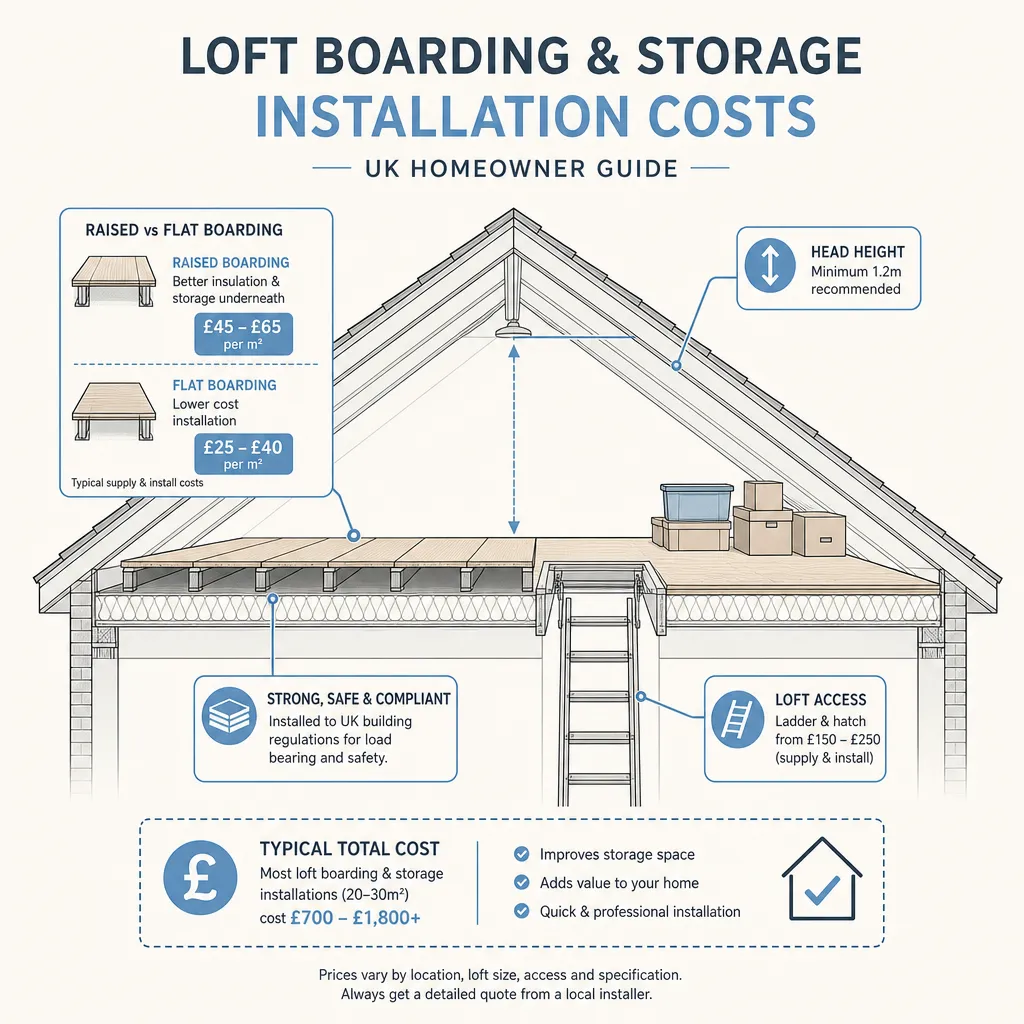
Loft Boarding and Storage Installation Costs
Basic loft boarding for an average semi-detached home costs £500–£1,500; a raised system that preserves insulation runs £800–£2,500.