Planning Appeal Process Costs and Professional Fees
By Housey · Last reviewed 7th of May 2026
Planning Appeal Process Costs and Professional Fees
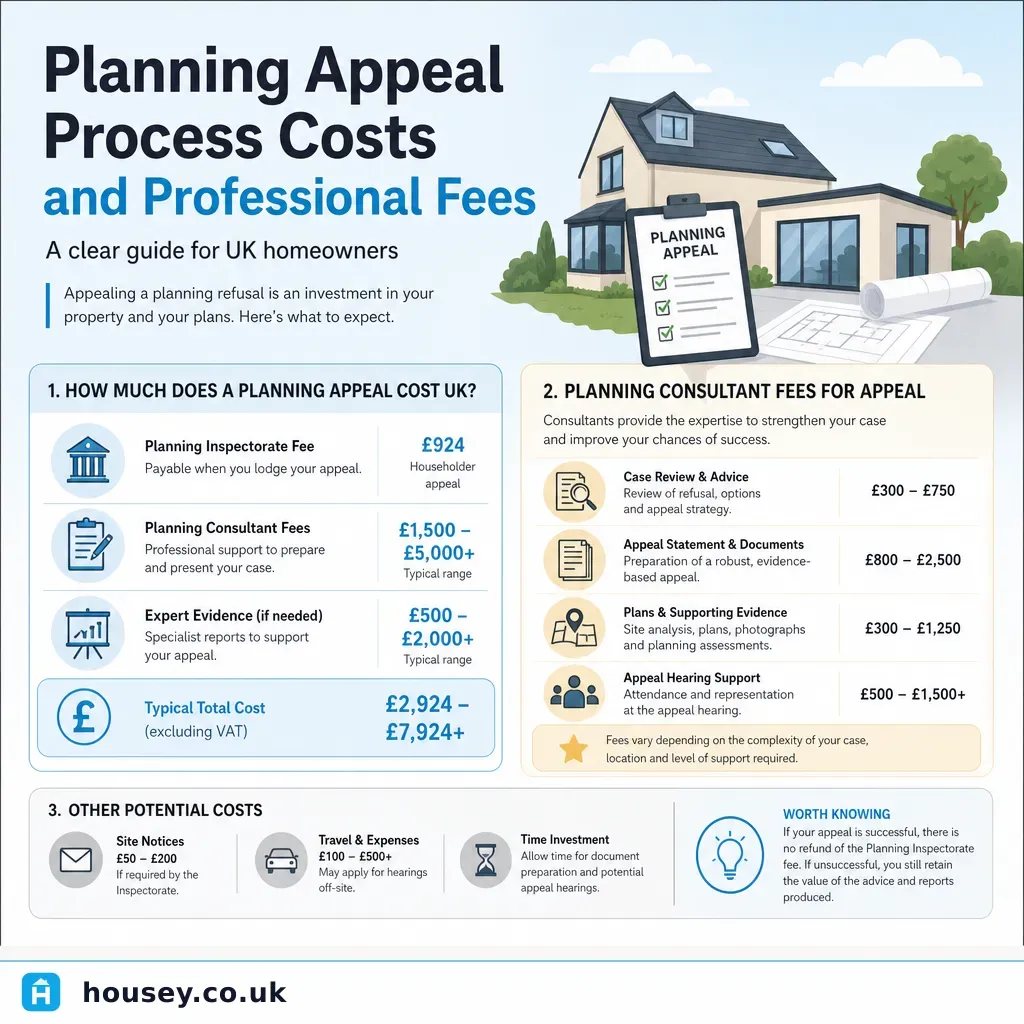
When a local planning authority (LPA) refuses a planning application — or grants it with conditions that cannot be accepted — appealing to the Planning Inspectorate is the formal route to seek independent review. The decision to appeal usually involves weighing the prospects of success against the time and professional costs involved, both of which vary considerably depending on the appeal route, case complexity, and the professional support engaged.
Key points
- There is no government fee to submit a planning appeal in England; the Planning Inspectorate does not charge appellants a submission fee
- Planning consultant fees for a written representations appeal typically range from £1,500–£5,000; hearing and public inquiry routes cost significantly more
- The three appeal routes in England are written representations, hearings, and public inquiries — assigned by the Inspectorate based on case complexity
- The Planning Inspectorate's target determination timescale for written representations is 26 weeks from the start of the procedure
- Each party normally bears its own costs, but the Inspectorate can award costs against a party that has behaved unreasonably under Planning Practice Guidance
The three appeal routes and their costs
The Planning Inspectorate assigns appeals to one of three procedural routes based on the nature and complexity of the case.
Appeal route | Best for | Typical professional cost (appellant) | Typical timescale |
|---|---|---|---|
Written representations | Householder and minor cases; clear policy disputes | £1,500–£5,000 (consultant) | 26 weeks (target) |
Hearing | More complex cases where discussion clarifies issues | £3,000–£8,000 (consultant) | 36+ weeks |
Public inquiry | Major or contentious cases; evidence cross-examined | £8,000–£25,000+ (consultant; barrister may be needed) | 52+ weeks |
Indicative UK professional costs, last reviewed 2026-05-07. Costs vary significantly by case complexity, witnesses required, and professionals engaged.
For most householder appeals — extensions, outbuildings, minor alterations — written representations is the assigned route and costs typically fall at the lower end of the range. Some homeowners manage written representations without professional support.
What the government fee covers (and what it does not)
Submitting a planning appeal in England is free of charge. This should not be confused with:
- The original planning application fee (already paid; non-refundable regardless of outcome)
- Professional consultant, architect, or legal fees (paid directly to your advisors)
- Any costs award made against you if the Inspectorate finds you behaved unreasonably
In Scotland, Wales, and Northern Ireland, appeals go to the DPEA, PEDW, and PAC respectively. The no-fee-to-appellant principle generally applies in each nation, but procedures, policy frameworks, and timescales differ significantly from England.
Which professional do you need?
Professional | When to engage | What they provide |
|---|---|---|
Planning consultant (MRTPI) | Most appeals | Policy analysis, statement of case, Inspectorate portal management |
Architect or architectural technologist | Design-led refusals — appearance, massing, heritage | Design justification, revised drawings if needed |
Solicitor or planning barrister | Public inquiries; enforcement appeals; legal grounds | Legal submissions, cross-examination of witnesses |
Self-represented | Simple householder cases with a clear policy basis | Saves cost; carries risk of weaker case presentation |
Day rates for experienced planning consultants typically range from £800–£1,800 per day. A hearing usually requires two to four days of preparation and attendance, so total costs can rise quickly. Always clarify whether a consultant is quoting a fixed fee or a time-and-materials arrangement before instructing.
Cost recovery: when can you claim costs?
In England, costs at appeal are not automatically awarded to a successful appellant. The Planning Inspectorate can award costs against either party — but only where that party has behaved unreasonably and caused unnecessary expense. Examples of LPA unreasonable behaviour might include:
- Refusing permission without a sound or clearly stated planning reason
- Failing to submit evidence on time or to engage with the process
- Withdrawing their case without adequate notice
A formal costs application must be submitted during the appeal and is separate from the appeal itself. Discuss this with your planning consultant before proceeding. Costs awards are the exception rather than the rule and should not be assumed when budgeting.
Homeowner checklist: before you commit to an appeal
Work through these steps before submitting:
Important limitations
This article provides general guidance on planning appeal costs and procedures in England. Planning law is complex and varies by:
- Nation: Scotland, Wales, and Northern Ireland operate separate appeal systems with different procedures, bodies, and timescales
- Application type: Householder, full planning, listed building consent, enforcement notice, and lawful development certificate appeals each have distinct rules
- Local authority behaviour: LPA engagement and policy interpretation varies considerably between authorities
- Case complexity: Heritage assets, ecology, flood risk, or highway matters typically make cases more expensive and time-consuming
Nothing in this article constitutes legal or professional planning advice. For advice on your specific case, consult a chartered planning consultant (MRTPI) or planning solicitor.
When to get professional help
Seek professional planning advice before submitting an appeal if:
- The refusal involves complex policy grounds, a heritage asset, ecological constraints, or highway safety
- You are appealing an enforcement notice — the procedure, timescales, and consequences differ from a standard application appeal
- You are considering a costs application against the LPA
- The LPA has raised grounds you are not confident addressing in writing
- The case has been assigned to a hearing or public inquiry route
What to ask a qualified professional
Before instructing a planning consultant for an appeal:
- What is your honest assessment of the prospects of success on these specific refusal grounds?
- Which appeal route do you expect to be assigned, and what are the cost and timescale implications?
- What is your fee structure — fixed fee, hourly, or day rate — and what is included?
- What would attract additional charges beyond the quoted fee?
- Have you dealt with this LPA and with appeals on similar policy grounds before?
- Would a revised application be a better option than appealing in this case?
- Do you hold MRTPI membership and professional indemnity insurance?
- What is the realistic timeline from submission to the Inspector's decision?
How Housey can help
If you have received a planning refusal and are weighing your options, planning consultancy support can help you assess whether to appeal, revise your application, or pursue an alternative route. Housey can connect you with qualified planning consultants across the UK.
Frequently asked questions
How long do I have to appeal a planning refusal in England?
For householder applications, you normally have 12 weeks from the date of the decision notice. For full planning applications, the deadline is typically six months. Missing the deadline forfeits the right to appeal that specific decision, so check the notice carefully as soon as it arrives.
Can I submit a planning appeal without a consultant?
Yes — the Planning Inspectorate accepts self-represented appeals. Written representations is the most manageable route without professional help. The risk is that a poorly structured statement of case may reduce your prospects of success, particularly where policy grounds are complex.
Does a planning appeal cost anything in government fees?
No. The Planning Inspectorate charges no submission fee for planning appeals in England. You pay for any professional advice you choose to take, and the Inspectorate can award costs against you if it finds you behaved unreasonably during the process.
What is the difference between written representations and a hearing?
Written representations are handled entirely on paper — the Inspector reviews submissions from both parties and visits the site independently. A hearing is an informal meeting where the Inspector questions both parties. Written representations are faster and cheaper; hearings are used where discussion clarifies the issues.
Can I recover my original planning application fee if I win?
No. Planning application fees are non-refundable regardless of the outcome of the application or any subsequent appeal. A costs award, if obtained, covers unreasonable behaviour costs — not the original application fee.
Sources and further reading
- Appeal a planning decision — GOV.UK
- Planning appeals — average timescales — Planning Inspectorate / GOV.UK
- Planning Practice Guidance: costs — GOV.UK / DLUHC
- National Planning Policy Framework (NPPF) — GOV.UK / DLUHC
- Find a planner — RTPI
Useful next reads
 Planning & Pre-Build
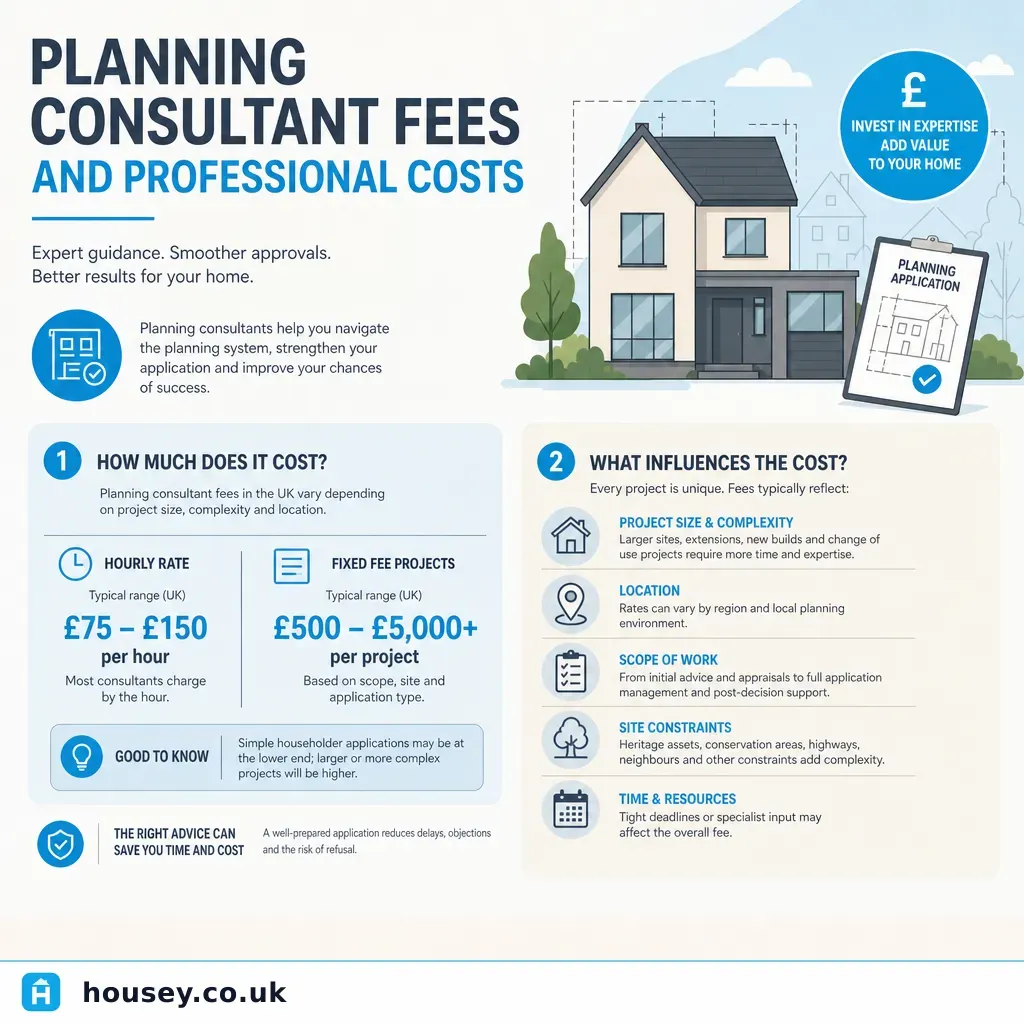
Planning Consultant Fees and Professional Costs
Planning consultant fees in the UK typically range from £75–£200 per hour, or around £500–£2,500 as a fixed fee for a householder application.
 Planning & Pre-Build
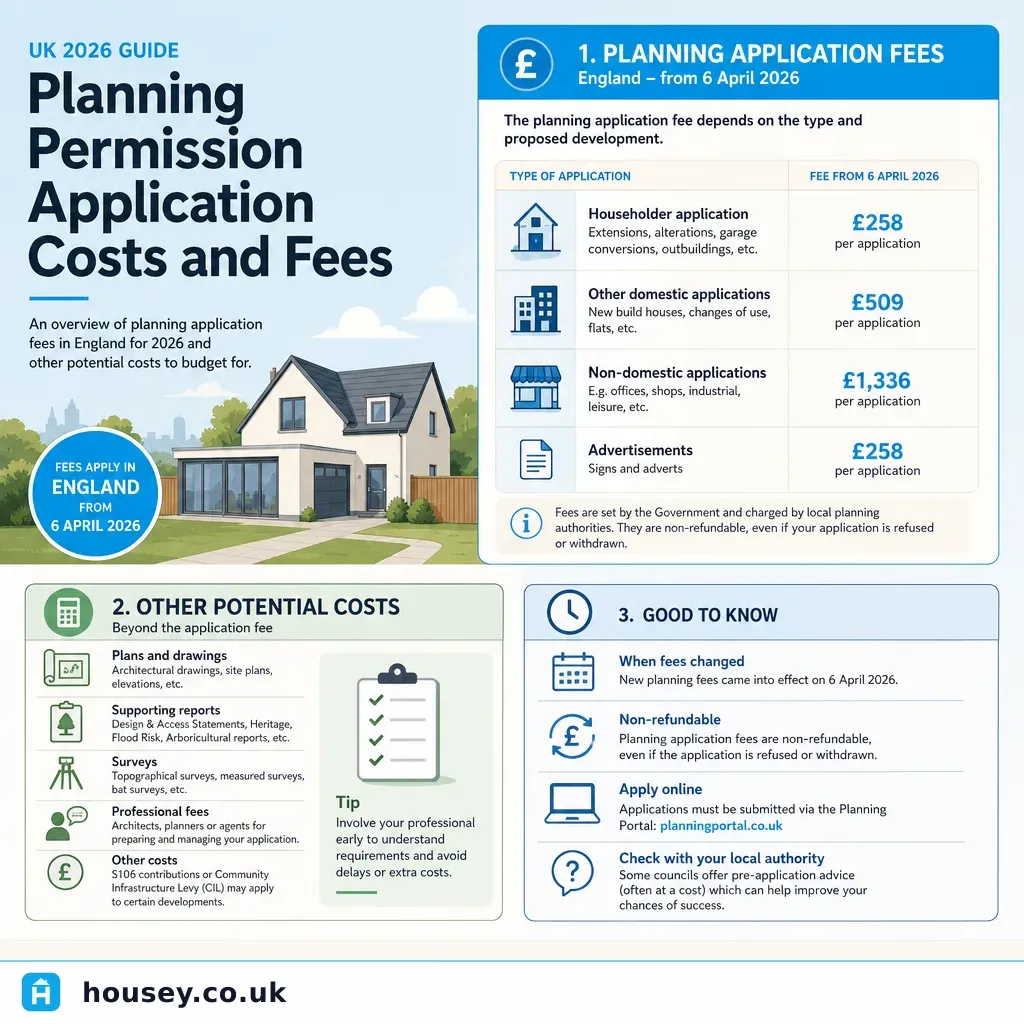
Planning Permission Application Costs and Fees
In England, the statutory fee for a householder planning application (extension, loft conversion) is £258.
 Planning & Pre-Build
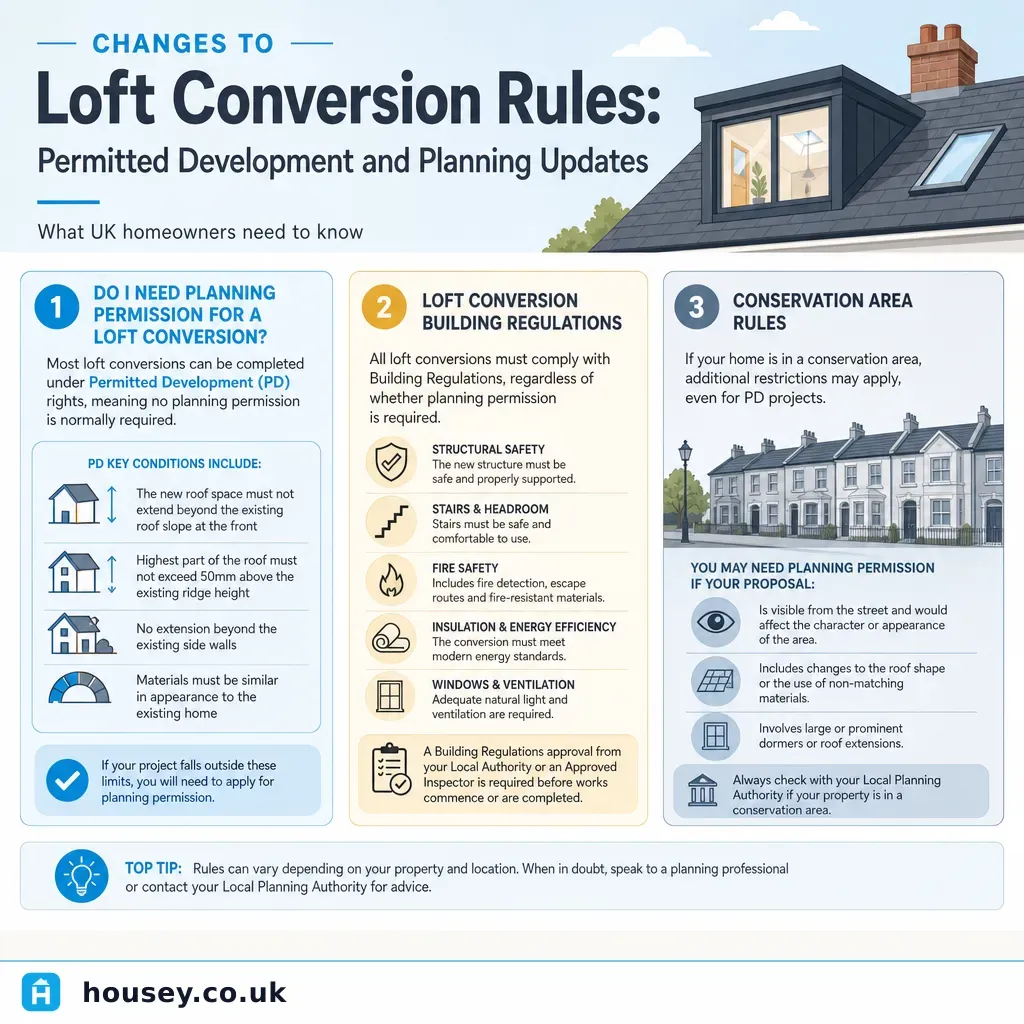
Changes to Loft Conversion Rules: Permitted Development and Planning Updates
In England, most loft conversions on standard houses qualify as Permitted Development under Class B of the GPDO 2015, allowing up to 40 cubic metres (terraced) or 50 cubic metres (detached or semi-detached) without a planning application — if conditions are met.
 Planning & Pre-Build
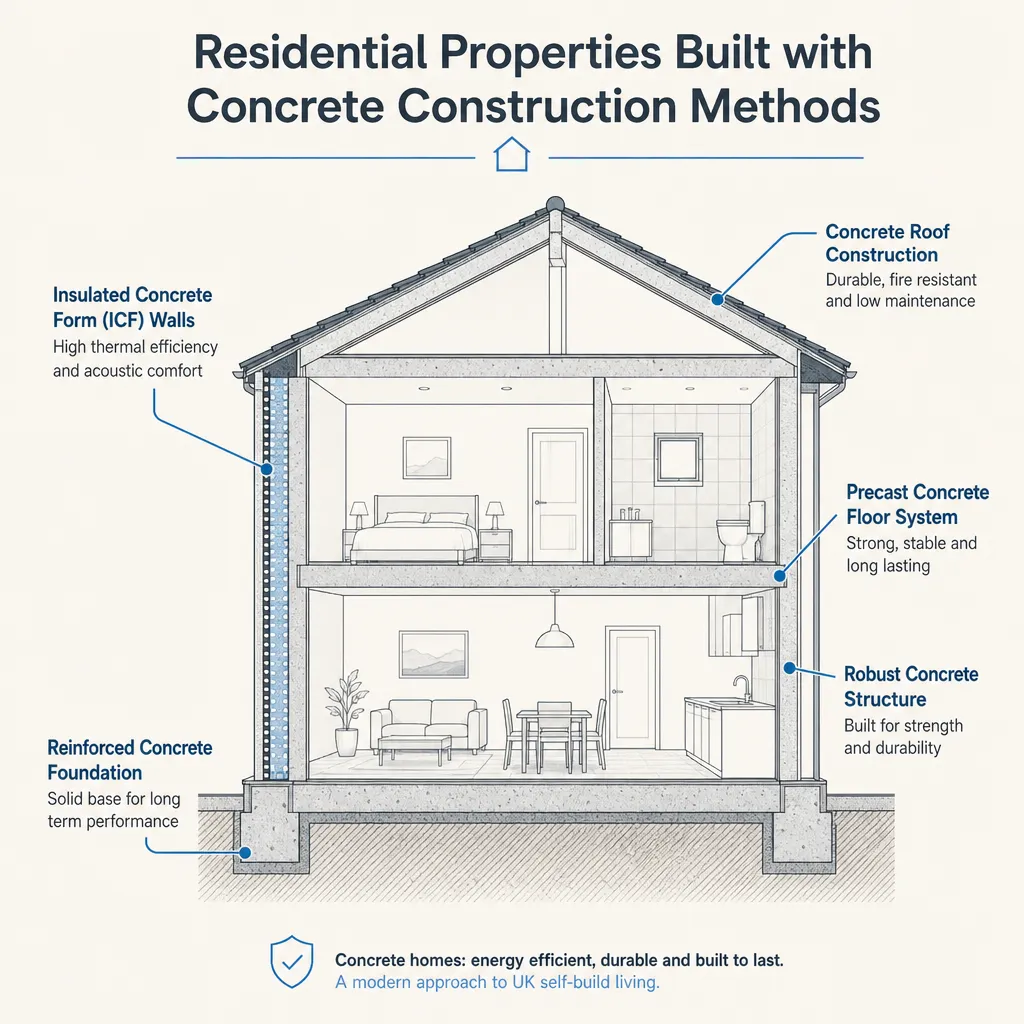
Residential Properties Built with Concrete Construction Methods
UK homes are built using several concrete methods: in-situ cast concrete, precast panel systems, insulating concrete formwork (ICF), and older non-traditional types such as Wimpey No-Fines and Laing Easiform.
 Planning & Pre-Build
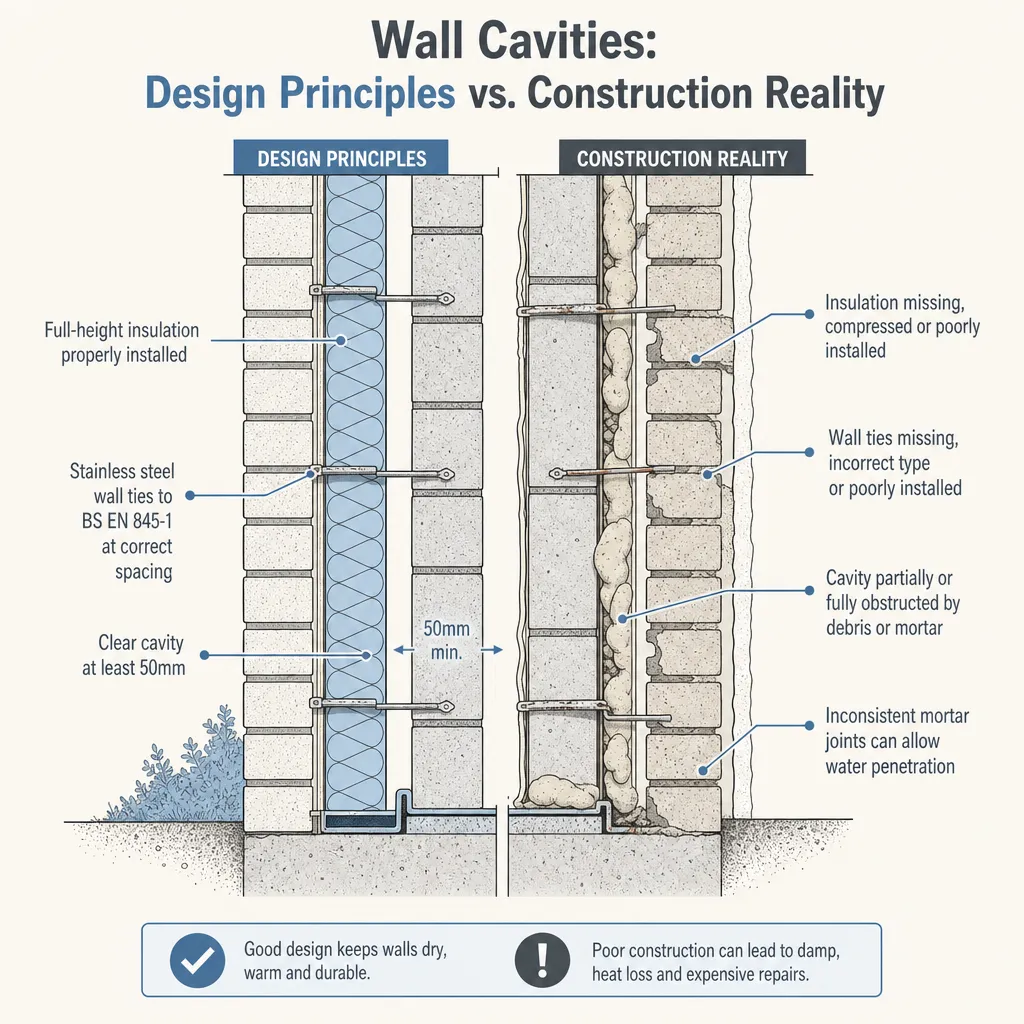
Wall Cavities: Design Principles vs. Construction Reality
A UK cavity wall is designed to resist weather, control heat loss, and structurally link two masonry leaves.