Planning Permission Application Costs and Fees
By Housey · Last reviewed 8th of May 2026
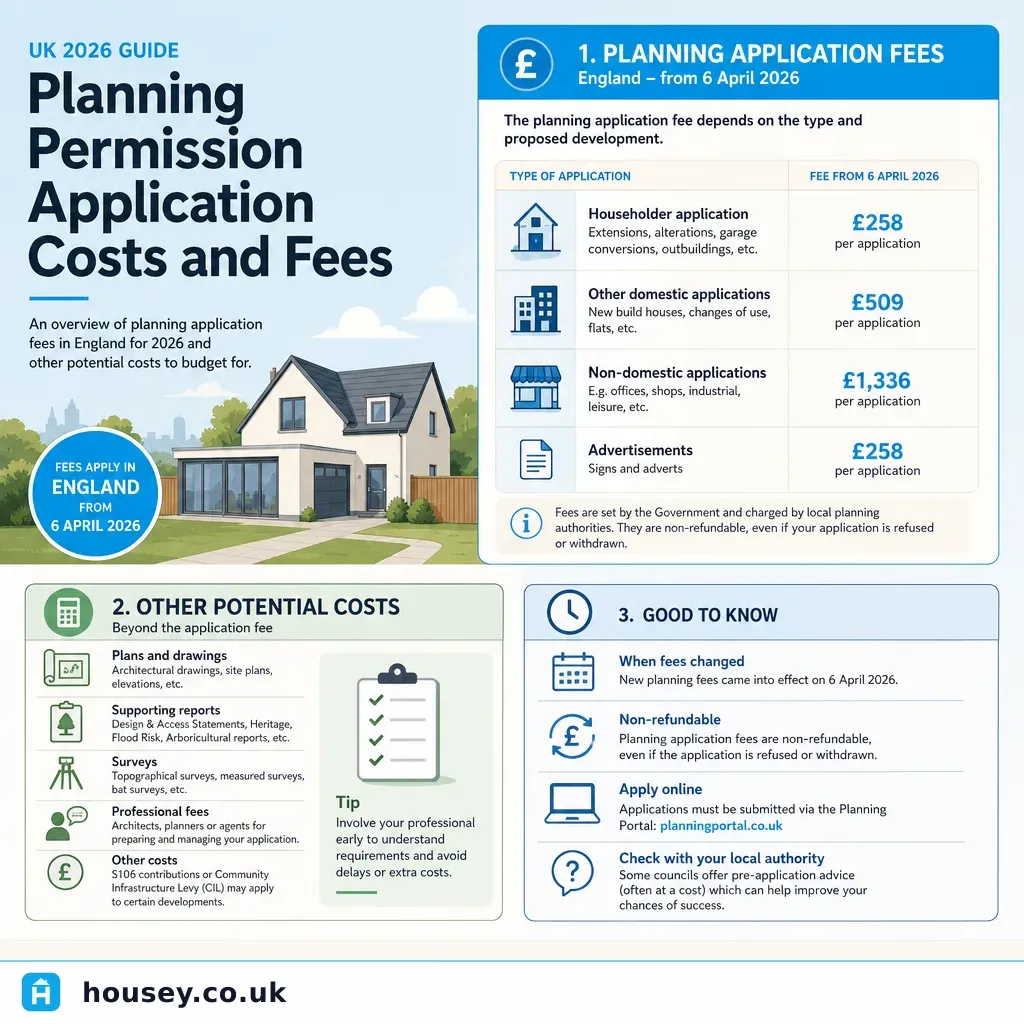
Planning Permission Application Costs and Fees
Most homeowners encounter planning application fees when considering an extension, conversion, or other development on their property. The fee payable to the local planning authority (LPA) is a statutory charge set by national government — entirely separate from any professional fees owed to an architect, planning consultant, or specialist report author. Getting a clear picture of the full cost before you start prevents budget surprises mid-process and helps you assess the value of professional support relative to the scale of your project.
Key points
- In England, the householder planning application fee is £258 following an increase in December 2023 — the first significant rise in over a decade, introduced through amended Town and Country Planning (Fees) Regulations.
- A full planning application for a single new dwelling in England costs £578 per dwelling.
- Statutory LPA fees are non-refundable whether the application is approved, refused, or withdrawn.
- Planning is a devolved matter: different fee structures apply in Wales, Scotland, and Northern Ireland under separate national regulations.
- Professional fees for drawings, planning statements, and supporting specialist reports are charged separately and frequently exceed the statutory LPA fee on a householder project.
What are planning application fees?
Planning application fees are statutory charges payable to the LPA when you submit a planning application in England. They are set by central government through the Town and Country Planning (Fees for Applications, Deemed Applications, Requests and Site Visits) (England) Regulations 2012, as amended. Fees are non-refundable on refusal, withdrawal, or appeal.
Certain application types carry no fee, including:
- Applications by or on behalf of a disabled person for works to improve access to their home.
- Listed building consent (the application itself is free; other associated professional costs apply).
- Applications for a Certificate of Lawfulness for an existing use where the relevant planning enforcement time limit has expired (in some circumstances — check with your LPA).
Current statutory planning fees in England
The figures below reflect fee levels in England following the December 2023 increases. Always verify the current fee using the Planning Portal fee calculator before submission.
Indicative statutory costs, last reviewed 2026-05-08.
Application type | Statutory fee (England) |
|---|---|
Householder application (extension, loft conversion, outbuilding) | £258 |
Full application — new dwelling (per dwelling, up to 50 units) | £578 per dwelling |
Change of use (new floor area created, first 75 m²) | £230 |
Prior approval — larger home extension (Class A GPDO) | £120 |
Prior approval — barn conversion (Class Q GPDO) | £120 |
Prior approval — commercial to residential conversion (Class MA) | £120 per dwelling created |
Listed building consent | No fee |
Advertisement consent | £605 |
Lawful Development Certificate (proposed works) | Half the equivalent full application fee |
Lawful Development Certificate (existing use or development) | £234 |
Discharge of planning conditions — householder | £34 per request |
Discharge of planning conditions — other applications | £116 per request |
Sources: GOV.UK planning fees guidance; Town and Country Planning (Fees) Regulations 2012 as amended December 2023.
Planning fees across the UK nations
Planning is devolved. Fee structures in Wales, Scotland, and Northern Ireland each operate under separate national regulations and differ from the English figures above. The table below provides a general comparison; verify current fees with the relevant national authority before submitting.
Nation | Householder application fee | Key reference |
|---|---|---|
England | £258 | GOV.UK planning fees guidance |
Wales | £230 | Welsh Government planning fees guidance |
Scotland | £300 (domestic) | Scottish Government planning fees |
Northern Ireland | £184 (minor application) | Department for Infrastructure (DfI) |
The full cost picture: beyond the statutory fee
For most homeowners, the statutory LPA fee is the smallest element of total planning costs. A realistic project budget should also cover:
Professional design and application fees
- Architect or architectural technologist drawings: typically £800 – £3,000+ for a householder application depending on size and complexity.
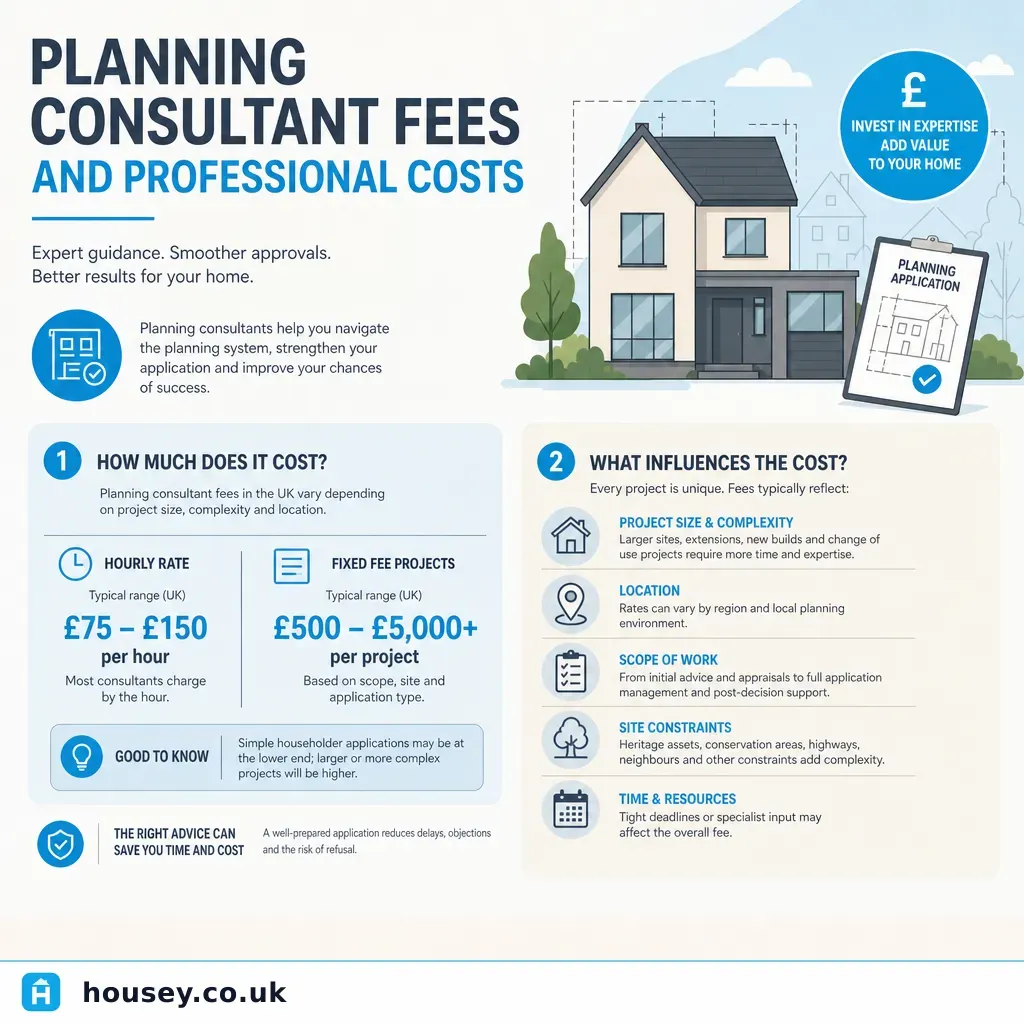
- Planning consultant: £500 – £2,500 for householder applications; significantly more for complex or major schemes.
- Planning statement: sometimes included within a planning consultant's fee; standalone statements from approximately £400 – £1,000.
Supporting specialist reports (if required)
Not all projects require specialist reports, but certain site characteristics or LPA policies trigger them:
- Heritage statement: £500 – £2,000+
- Ecological survey and report: £500 – £3,000+
- Arboricultural impact assessment: £500 – £1,500
- Flood risk assessment: £500 – £2,500
- Transport statement: £1,000 – £5,000+
A planning consultant or the LPA's pre-application advice service can confirm which reports apply to your site before you commission them.
Indicative UK professional costs, last reviewed 2026-05-08.
Decision tree: which planning route applies to my project?
Use this as a starting point only — always verify with your LPA or a qualified planning consultant before proceeding.
- No application needed if your project falls within permitted development rights under the Town and Country Planning (General Permitted Development) (England) Order 2015 (GPDO) and the property is not subject to an Article 4 direction.
- Householder application (£258) if you are extending or altering an existing single dwelling house and the works do not qualify as permitted development.
- Full planning application (£578 per dwelling) if you are building a new dwelling, changing the use of a building, or undertaking works that exceed householder application scope.
- Prior approval application (£120) if your project falls under specific GPDO classes — larger home extensions (Class A), barn conversions (Class Q), or commercial-to-residential conversions (Class MA).
- Check with your LPA first if the property is in a conservation area, subject to an Article 4 direction, or is a listed building — permitted development rights are often restricted or removed in these circumstances.
- Ask a planning consultant if the site has a complex planning history, you have previously been refused permission, or you are uncertain which application route applies to your proposal.
Homeowner checklist: before you submit
What happens after you pay the fee?
The LPA must validate the application — checking that it is complete, accompanied by the correct supporting documents, and accompanied by the correct fee — before the statutory determination period begins. An incomplete application will be returned or held pending further information.
Statutory determination periods in England:
- 8 weeks: most householder and minor applications.
- 13 weeks: major applications (10 or more dwellings or large commercial floor area).
- 16 weeks: applications requiring an environmental impact assessment (EIA).
If the LPA fails to determine within the statutory period without an agreed extension, you may appeal to the Planning Inspectorate on grounds of non-determination. No additional fee is payable by the appellant for lodging a planning appeal in England.
Important limitations
Planning fees and regulations change. The figures in this article reflect the position in England following the December 2023 fee increase and are reviewed to May 2026. Welsh, Scottish, and Northern Irish fee structures differ and are subject to separate devolved regulations. Your specific application type, site area, and number of units may produce a different fee from those listed. The Planning Portal's fee calculator and your LPA's published guidance should always be the final reference before submission.
This article provides general information only and is not a substitute for professional planning advice tailored to your property and proposed development.
What to ask a qualified professional
Before submitting a planning application:
- Ask your architect or planning consultant to verify the correct application fee using the Planning Portal calculator before submission — errors lead to invalid applications.
- Ask whether your proposal could qualify for permitted development, which would avoid a statutory fee entirely.
- Ask the LPA's pre-application advice team whether any supporting specialist reports will be required before you commission drawings.
- Ask your planning consultant whether a Lawful Development Certificate might be more appropriate than a full application if your proposal sits at or near permitted development thresholds.
- Clarify who is responsible for responding to the LPA's post-validation queries — you, your architect, or your planning consultant — and ensure that is confirmed in writing.
When to get professional help
Consider instructing a planning consultant or architect before submitting if any of the following apply:
- You have previously been refused planning permission on the same site or for a similar proposal.
- The property is in a conservation area, is listed, is in the green belt, or is near protected trees or a watercourse.
- The application involves a change of use, a new dwelling, or any commercial element.
- The LPA's pre-application response has raised policy concerns about the scheme.
- You are uncertain about which application type or fee category applies to your proposal.
- The supporting documentation requirements appear complex, site-specific, or unfamiliar.
How Housey can help
Housey connects homeowners with RTPI-accredited planning consultants who can confirm the correct application route, verify the applicable fee, prepare planning statements, and manage the submission process. Find and compare planning consultancy services on Housey before you commit to an application.
Frequently asked questions
Are planning application fees refundable if the application is refused?
No. Statutory planning fees are non-refundable regardless of the outcome. If you withdraw an application before determination, the fee is also retained by the LPA in most circumstances. This makes thorough preparation — including pre-application advice where appropriate — particularly worthwhile before committing to submission.
Do I pay a fee for permitted development?
No. Work that falls within permitted development rights does not require a planning application and no fee is payable. If you want written confirmation that your proposal is lawful, you can apply for a Lawful Development Certificate, which carries a fee of approximately half the equivalent full application fee — around £129 for proposed householder works in England.
Can I appeal a planning refusal without paying an additional fee?
Yes. Planning appeals to the Planning Inspectorate in England are free to the appellant — no statutory fee is charged for lodging the appeal. You may however incur professional fees if you instruct a planning consultant or barrister to prepare and present your appeal case, particularly for hearings or public inquiries.
How long does the LPA have to decide a planning application?
The statutory determination period is 8 weeks for most householder and minor applications, and 13 weeks for major applications (10 or more dwellings or large commercial floor area). These periods run from the date of validation — not submission — and can be extended by mutual agreement between the applicant and the local planning authority.
What is the difference between a householder application and a full planning application?
A householder application covers works to an existing single dwelling house — extensions, loft conversions, outbuildings. A full planning application is required for new buildings, change of use, and works beyond householder scope. The statutory fees differ (£258 versus £578 per dwelling in England), as do the validation requirements and determination periods.
Sources and further reading
- GOV.UK — Fees for planning applications — GOV.UK
- Planning Portal — Fee calculator — Planning Portal
- Town and Country Planning (Fees) Regulations 2012 as amended — legislation.gov.uk
- National Planning Policy Framework (December 2024) — Ministry of Housing, Communities & Local Government
- Welsh Government — Planning fees — Welsh Government
Useful next reads
 Planning & Pre-Build
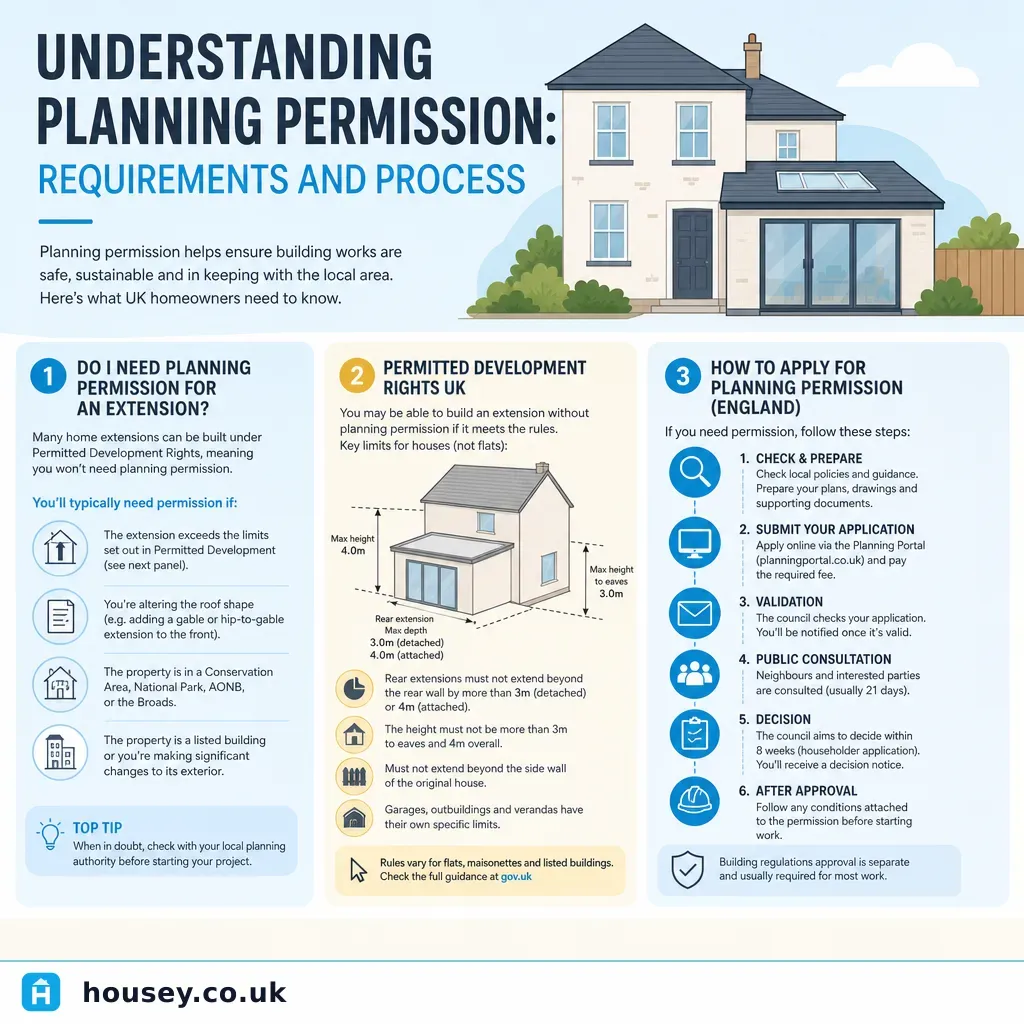
Understanding Planning Permission: Requirements and Process
Planning permission is required for most new buildings, significant extensions, and material changes of use in England and Wales.
 Planning & Pre-Build
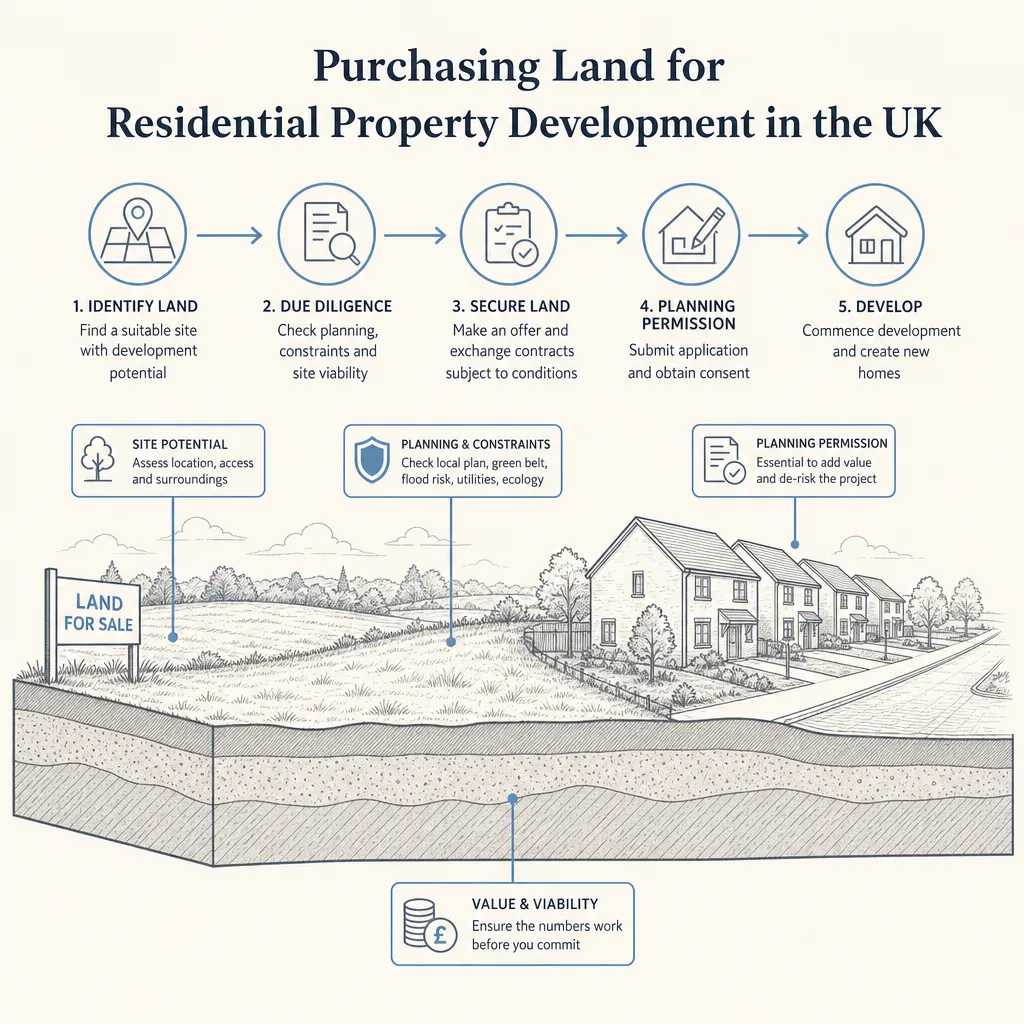
Purchasing Land for Residential Property Development in the UK
Buying development land in the UK involves due diligence on planning status, ground conditions, legal title, and utilities access before exchange.
 Planning & Pre-Build
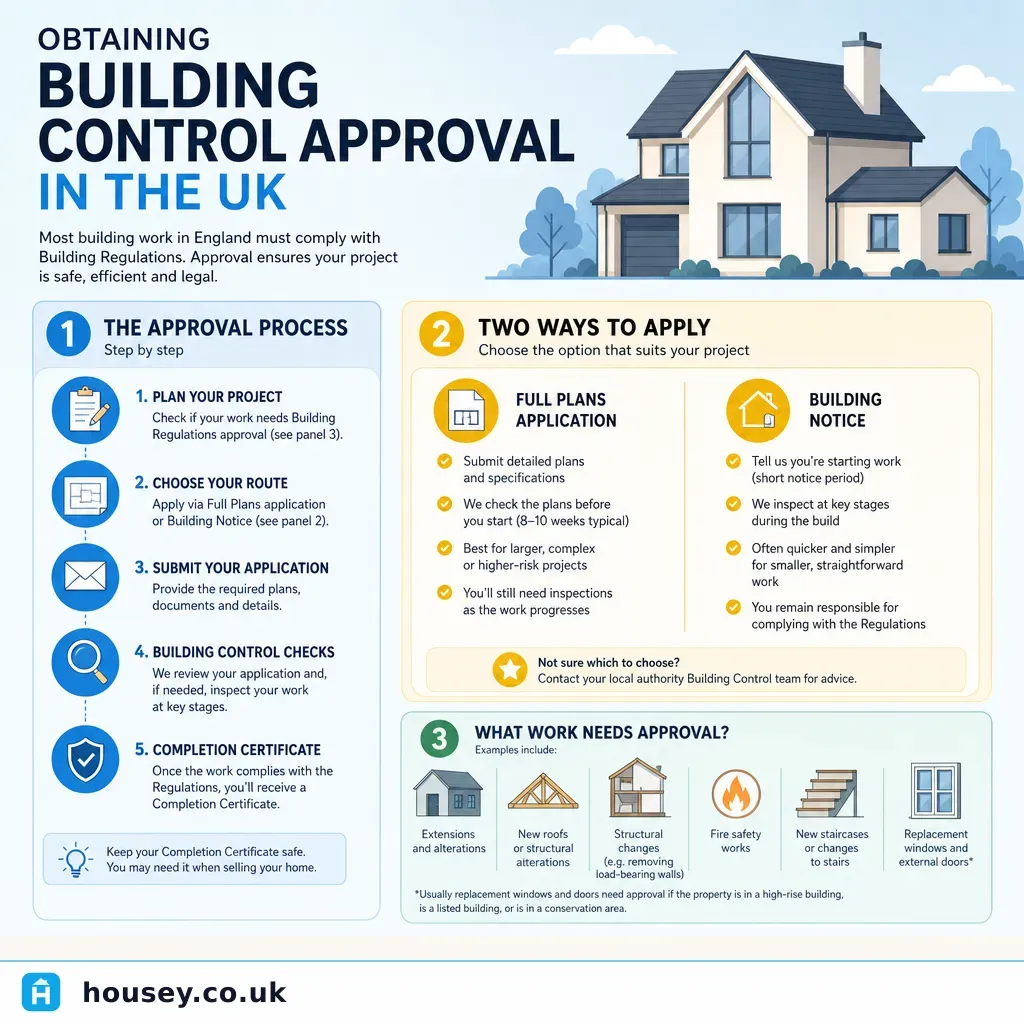
Obtaining Building Control Approval in the UK
Building control approval in the UK is required for most structural changes, extensions, loft conversions, and new builds.
 Planning & Pre-Build
Planning Consultant Fees and Professional Costs
Planning consultant fees in the UK typically range from £75–£200 per hour, or around £500–£2,500 as a fixed fee for a householder application.
 Planning & Pre-Build
Guide to Planning Permission Requirements for Property Development
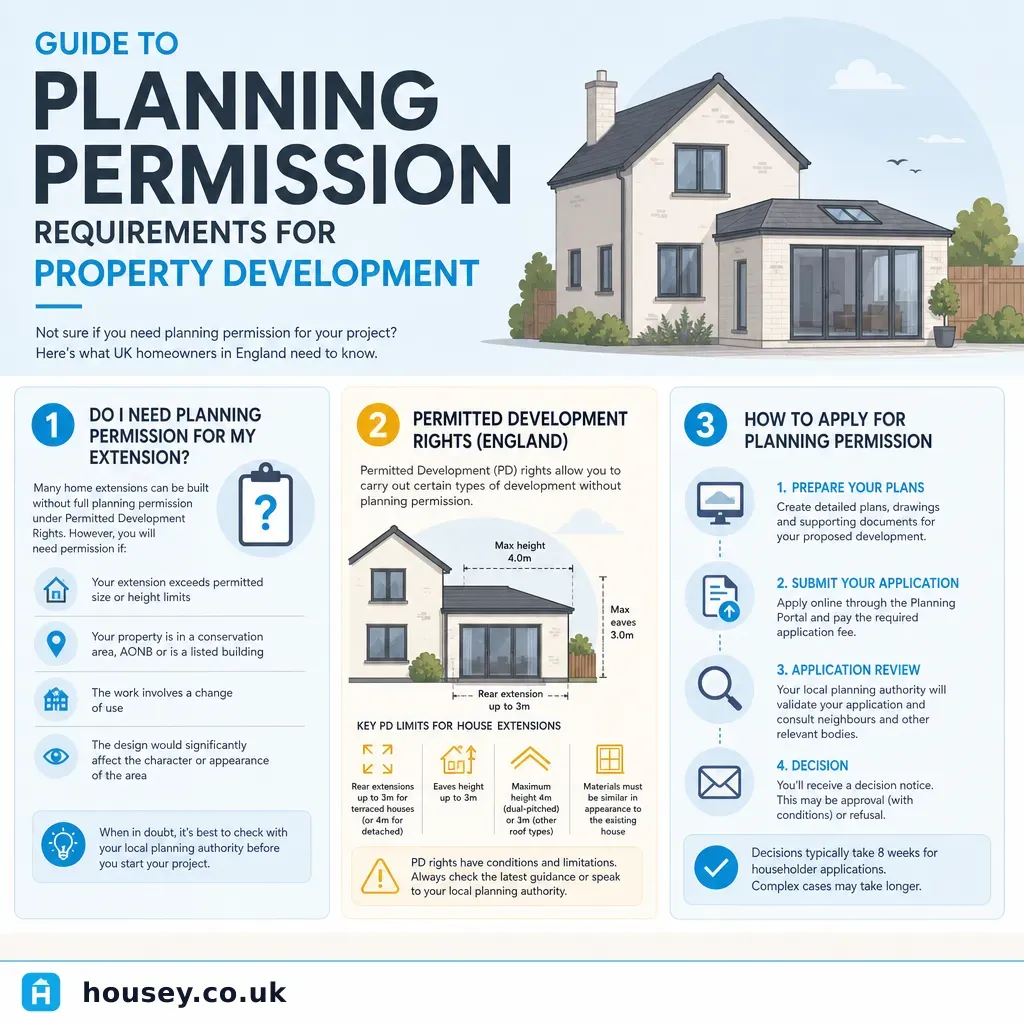
Most home improvements in England fall within permitted development rights and do not need a planning application.