Planning Consultant Fees and Professional Costs
By Housey · Last reviewed 8th of May 2026
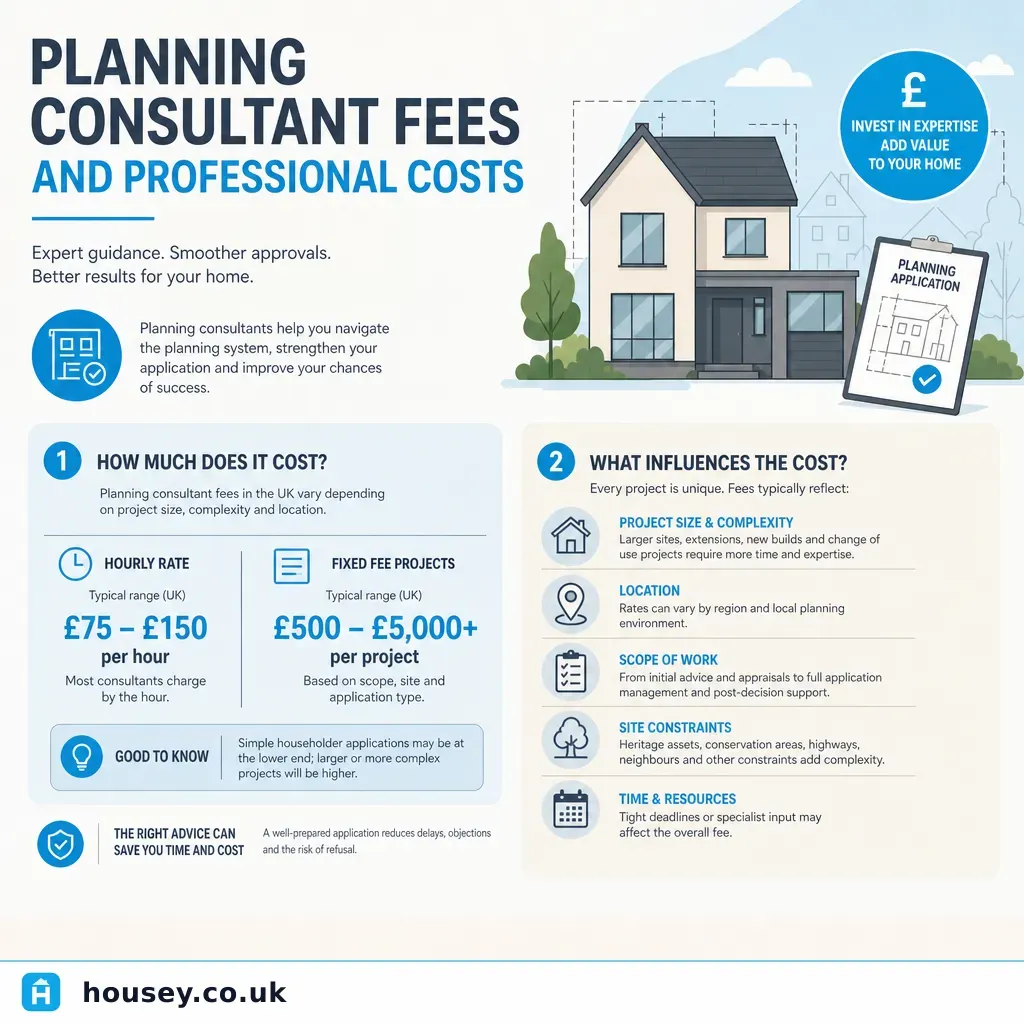
Planning Consultant Fees and Professional Costs
Planning consultants are typically brought in when an application is complex, contentious, or involves a sensitive site or development use. Homeowners extending a Victorian terrace in a conservation area, developers seeking permission for a small housing scheme, and owners of listed properties all face a planning system that rewards specialist knowledge — and can penalise poorly prepared applications. Understanding what a planning consultant charges, and what drives those costs, helps you budget accurately and choose the right level of support for your project.
Key points
- Planning consultant fees in the UK typically range from £75 to £200 per hour; senior chartered consultants at specialist London or regional firms may charge more.
- Fixed-fee packages for householder applications (extensions, loft conversions, outbuildings) commonly range from £500 to £2,500 depending on complexity and site sensitivity.
- Major planning applications — new dwellings, commercial change of use, and larger residential schemes — can attract consultant fees of £3,000 to £15,000 or more.
- Membership of the Royal Town Planning Institute (RTPI) is the recognised professional benchmark in the UK; look for MRTPI or FRTPI designations when selecting a consultant.
- Planning appeals are substantially more expensive than original applications: fees of £2,000 to £10,000+ are typical for written representations appeals, rising significantly for hearings or public inquiries.
What does a planning consultant do?
A planning consultant assesses whether a proposal is likely to receive consent, prepares and submits planning applications, negotiates with the local planning authority (LPA), writes planning statements, and in some cases represents clients at planning appeals or public inquiries.
The scope of work varies considerably by project type:
Service | What is involved | Typical client |
|---|---|---|
Pre-application advice | Site review, policy assessment, written opinion | Any applicant before committing to drawings |
Householder application support | Policy review, planning statement, submission management | Extensions, loft conversions, outbuildings |
Full planning application | Pre-app engagement, application assembly, LPA liaison | New dwellings, change of use, larger schemes |
Planning appeal | Appeal statement, evidence preparation, hearing attendance | Refused applications |
Permitted development advice | Written PD opinion, prior approval application | Barn conversions, Class MA commercial-to-residential |
Discharge of planning conditions | Condition strategy, document preparation, submission | Post-consent compliance |
How much do planning consultants charge?
Planning consultants set their own fees; there is no national tariff. Costs depend on the consultant's seniority and location, the complexity and planning policy context of the scheme, and whether the project is in a sensitive designation such as a conservation area, National Landscape (formerly AONB), green belt, or flood zone.
Indicative UK costs, last reviewed 2026-05-08.
Project type | Typical consultant fee range | Notes |
|---|---|---|
Pre-application written advice | £300 – £1,200 | Many consultants offer a fixed-price initial opinion |
Householder application (simple) | £500 – £1,500 | Rises if conservation area or listed building setting |
Householder application (complex or sensitive site) | £1,200 – £2,500 | Planning statement and LPA engagement included |
Single new dwelling (full application) | £2,500 – £6,000 | May rise if Section 106 or viability work is required |
Small residential scheme (2–10 dwellings) | £4,000 – £15,000+ | Often charged as a retainer or phased fee |
Written representations appeal | £2,000 – £6,000 | Preparation and lodging of appeal statement |
Hearing or inquiry appeal | £5,000 – £20,000+ | Multi-day hearings with specialist advocacy may exceed this |
Permitted development or prior approval | £500 – £2,000 | Policy research and statement preparation |
These ranges reflect the breadth of the market. A sole practitioner in a rural area will often charge less than a chartered consultant at a London planning practice. Always request an itemised written quote before instructing.
Worked UK property scenario
Scenario: A homeowner in Bristol wants to add a 6-metre rear extension to a 1930s semi-detached house. The property backs onto a conservation area boundary but is not within it. The proposed extension exceeds the standard permitted development depth of 4 metres for a semi-detached dwelling under the Town and Country Planning (General Permitted Development) (England) Order 2015 and therefore requires a householder planning application.
- Architect's drawings: approximately £1,200 – £2,000 (separate professional fee)
- Planning consultant fee (planning statement, submission management): approximately £800 – £1,500
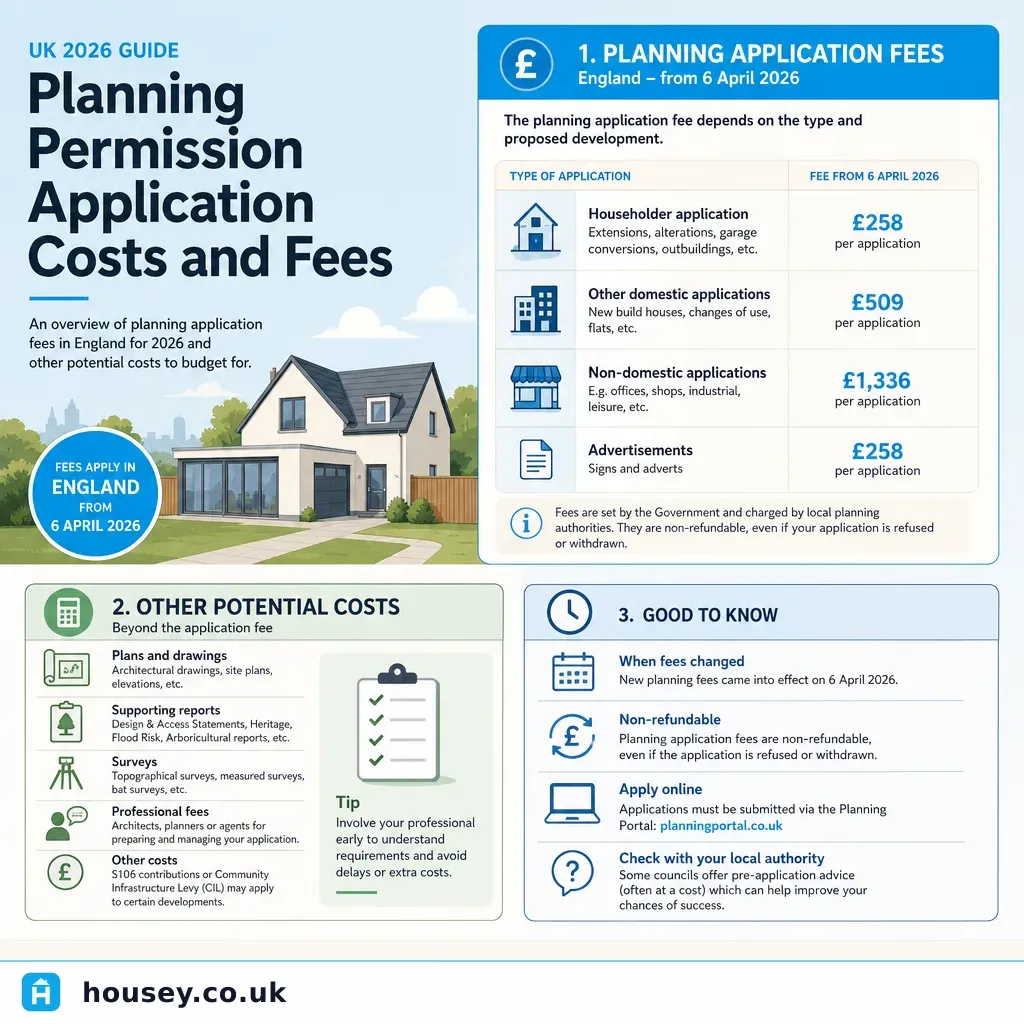
- LPA householder application fee (England, 2026): £258
- Estimated total professional and statutory costs: approximately £2,300 – £3,800
A pre-application meeting with the LPA — some charge for this at householder level, some offer it free — could reduce the risk of refusal. The proximity to the conservation area boundary may prompt the LPA to request a brief heritage comment, which an experienced planning consultant can address within the planning statement without triggering a separate heritage assessment.
What pushes planning consultant costs higher?
Several factors can move fees beyond the typical ranges above:
- Sensitive designations: Conservation areas, National Landscapes, green belt, flood risk zones, and listed building settings require detailed policy analysis and often supporting specialist reports.
- Section 106 obligations: Larger schemes may require negotiated planning obligations, adding legal and consultancy time.
- Environmental impact assessment (EIA): Applications that trigger EIA carry significant additional costs in consultant and specialist time.
- Contested applications: Where objectors or the LPA are actively opposed, more preparation, negotiation, and post-submission engagement is needed.
- Complex planning history: Sites with prior refusals, enforcement notices, or overlapping consents require careful policy navigation that takes additional time to research and address.
What to ask before hiring a planning consultant
- Are you RTPI-accredited (MRTPI or FRTPI), and do you have direct experience with this type of application and this specific LPA?
- Is your fee a fixed price or an hourly rate — and if hourly, what is your estimate of total hours for this scope?
- What is included: pre-application liaison, report writing, drawing review, submission management, post-submission follow-up?
- What happens if the LPA requests amendments — is revision work within your fee or charged separately?
- Will you attend any pre-application meeting with the LPA, or will you advise me to go alone?
- What is your honest assessment of the likelihood of consent before we commit to fees?
- Will you personally work on my application, or will it be handled by a junior colleague?
- Which supporting specialist reports — ecology, heritage, flood risk, trees — are likely to be required, and can you advise before I commission drawings?
Important limitations
Planning policy varies significantly between local planning authorities, and national policy is updated periodically through the National Planning Policy Framework (NPPF), most recently revised in December 2024. The fee ranges and guidance in this article are general information only and do not constitute professional planning advice. Your specific proposal, site history, and local development plan policies will all affect both the cost of advice and the likelihood of consent. Always verify current LPA policies directly with your local council or through a qualified planning consultant before submitting an application.
What to ask a qualified professional
Before instructing a planning consultant:
- Confirm they hold current RTPI membership and have worked on similar proposals within your specific LPA area.
- Ask for a written scope of services and fee agreement — verbal quotes are not sufficient protection for either party.
- Establish whether formal pre-application advice from the LPA is recommended for your scheme, and who will lead that engagement.
- Clarify which supporting specialist reports are likely to be required before you commit to consultant fees, so you can budget for the full scope from the outset.
When to get professional help
A planning consultant adds most value in the following situations:
- The application involves a site in a conservation area, listed building setting, National Landscape, green belt, or flood zone.
- A previous application on the same site or a similar proposal has been refused.
- The proposal involves a change of use, new dwelling, or any commercial element.
- The LPA has informally indicated concerns about the scheme through pre-application correspondence.
- You are facing a planning enforcement notice and need advice on compliance or appeal options.
For a straightforward householder extension clearly within permitted development rights, a consultant may not be essential — but a written permitted development opinion from a qualified consultant provides useful protection if your PD status is later queried by a solicitor or mortgage lender.
How Housey can help
If you need a qualified planning consultant for your project, Housey can help you request quotes from RTPI-accredited practitioners across the UK. Compare costs and experience for your specific proposal and local planning authority through planning consultancy on Housey.
Frequently asked questions
Do I always need a planning consultant for a planning application?
Not always. Many straightforward householder applications — a modest rear extension, a loft conversion within permitted development limits — can be submitted without a consultant, particularly if an architect is preparing drawings. A consultant adds most value for complex sites, sensitive designations, or when a previous application has been refused.
Is there a fixed fee structure for planning consultants in the UK?
No. Unlike statutory LPA application fees, consultant fees are set entirely by the individual or firm. You may receive a fixed-price quote for a defined scope, an hourly rate, or a staged fee aligned to project milestones. Always obtain a written fee agreement and confirm exactly what is and is not included before instructing.
What is the difference between a planning consultant and an architect?
An architect designs the scheme and prepares drawings; a planning consultant advises on planning policy, prepares planning statements, and manages the application process. On complex or sensitive projects both are often engaged. Some architects and architectural technologists hold RTPI membership and can perform both roles on smaller schemes.
Can a planning consultant guarantee that my application will be approved?
No. No professional can guarantee consent from an LPA or the Planning Inspectorate on appeal. A good consultant will give a candid assessment of likelihood before you commit to fees and will identify the policy issues and supporting evidence that may improve prospects of approval. Be cautious of any consultant who offers outcome assurances.
How long does it take a planning consultant to prepare a householder application?
For a householder application, preparation time is typically two to four weeks once drawings are finalised, depending on workload and whether a planning statement is required. Applications involving multiple specialist reports — ecology, heritage, flood risk — can take several months to assemble fully before submission.
Sources and further reading
- Royal Town Planning Institute — Find a Planner — RTPI
- GOV.UK — Apply for planning permission — GOV.UK
- National Planning Policy Framework (December 2024) — Ministry of Housing, Communities & Local Government
- Planning Portal — Guide to planning applications — Planning Portal
- GOV.UK — Fees for planning applications — GOV.UK
Useful next reads
 Planning & Pre-Build
Planning Permission Application Costs and Fees
In England, the statutory fee for a householder planning application (extension, loft conversion) is £258.
 Planning & Pre-Build
Guide to Planning Permission Requirements for Property Development
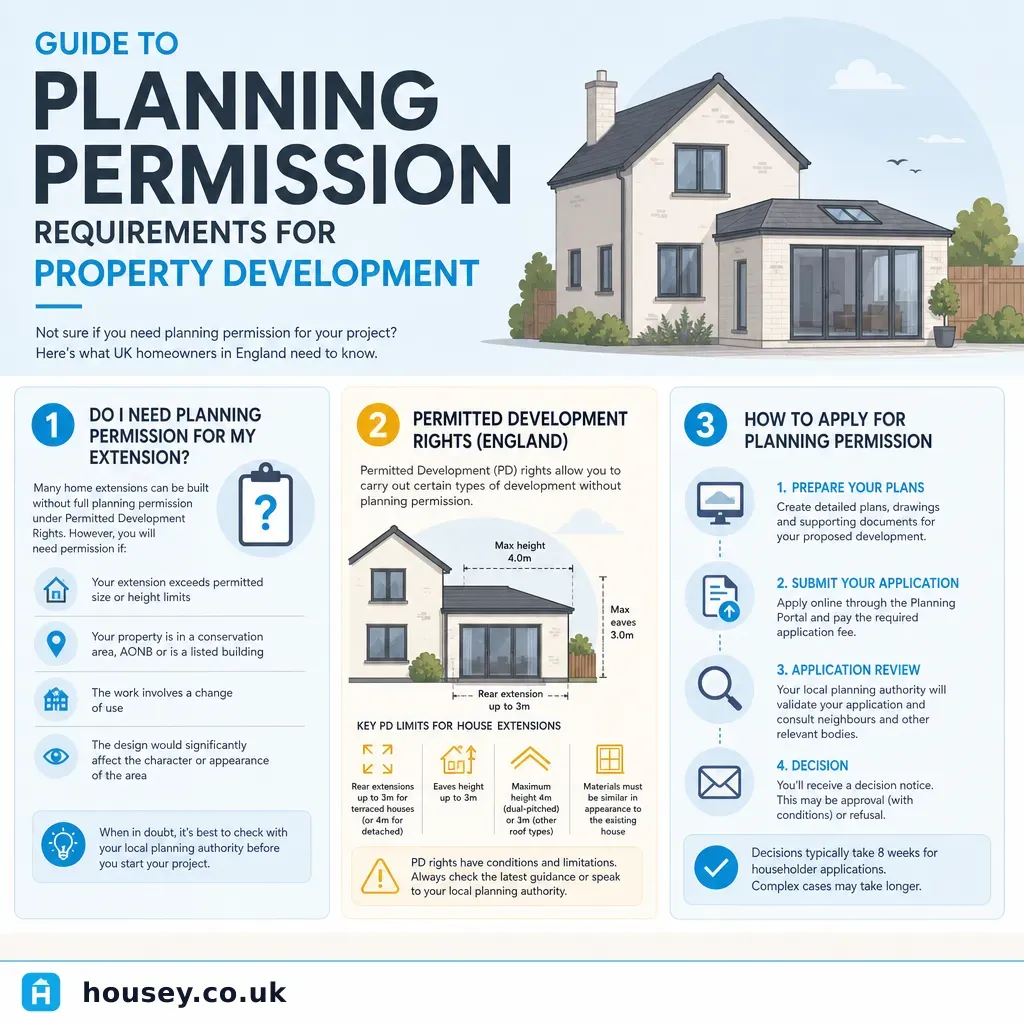
Most home improvements in England fall within permitted development rights and do not need a planning application.
 Planning & Pre-Build
Planning Appeal Process Costs and Professional Fees
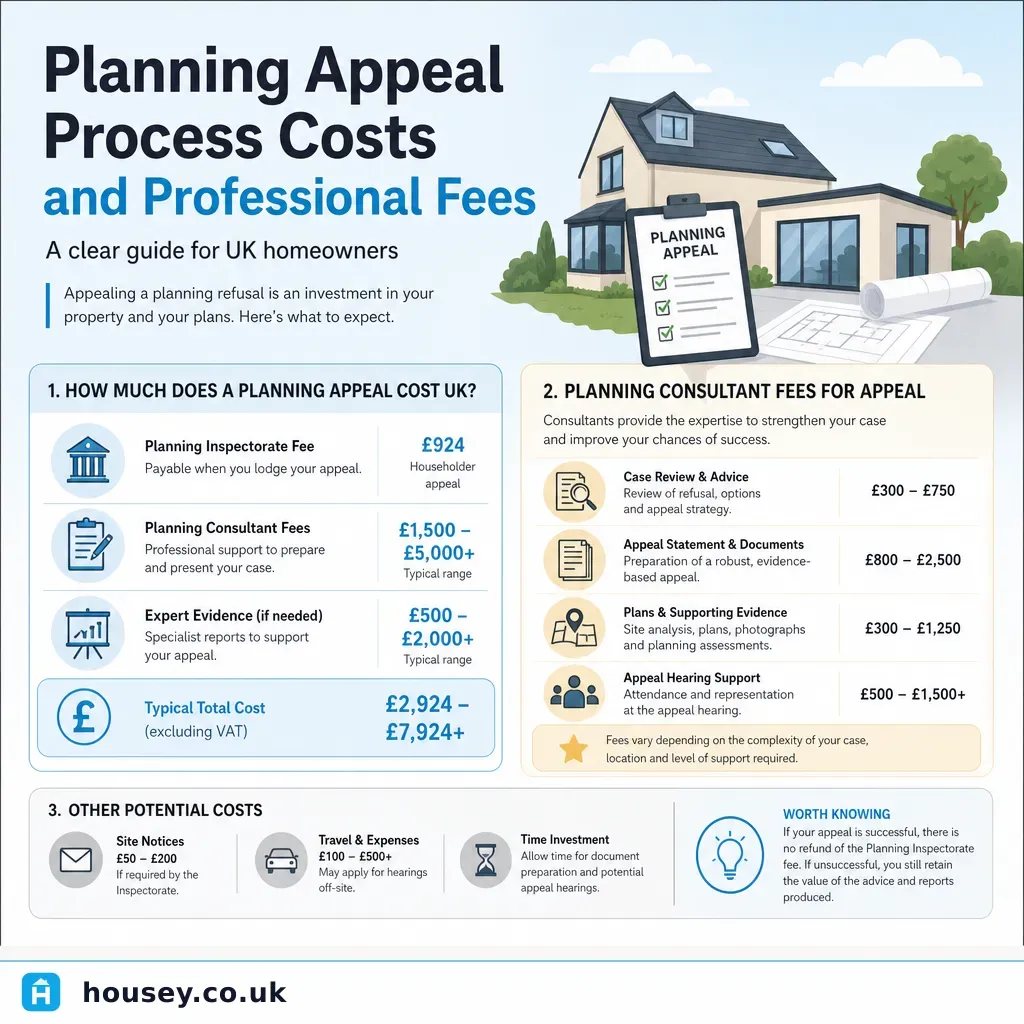
Appealing a refused planning application in England costs nothing in government fees — the Planning Inspectorate charges no submission fee.
 Planning & Pre-Build
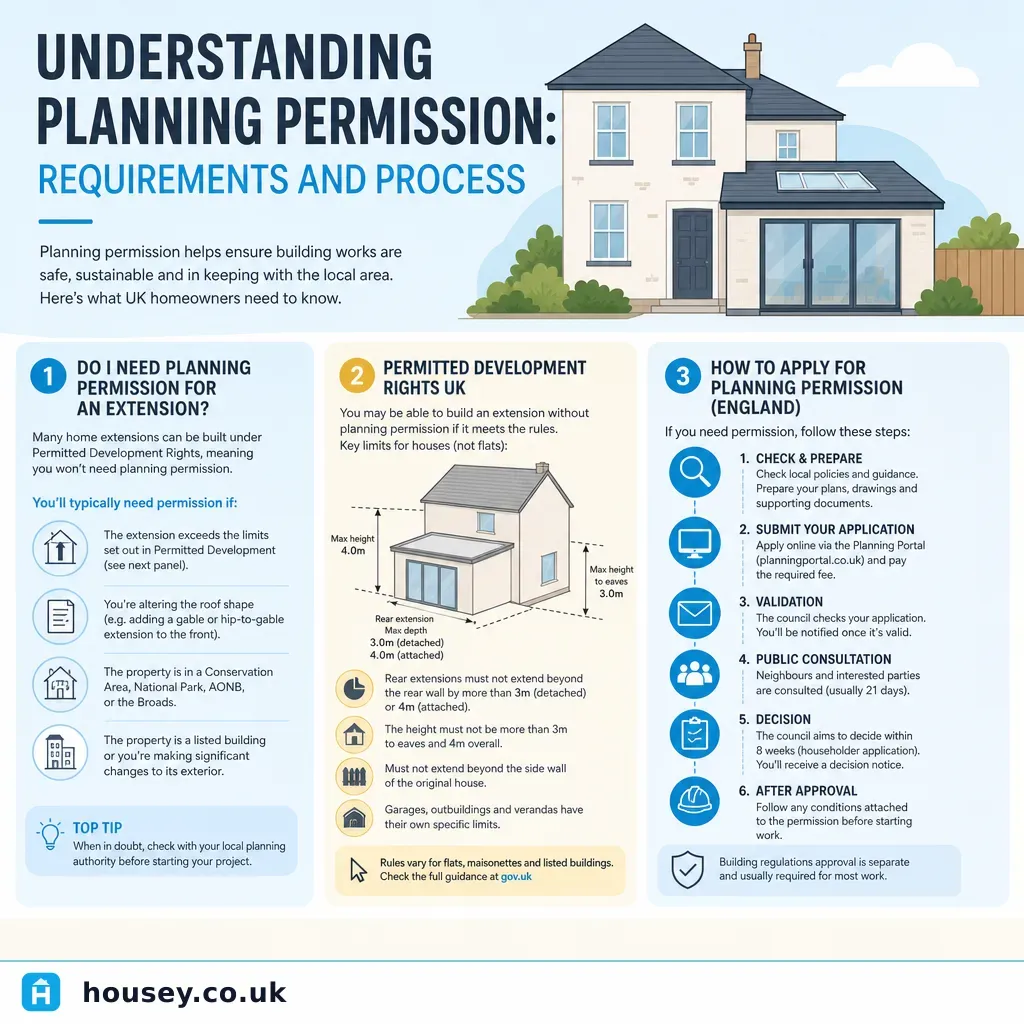
Understanding Planning Permission: Requirements and Process
Planning permission is required for most new buildings, significant extensions, and material changes of use in England and Wales.
 Planning & Pre-Build
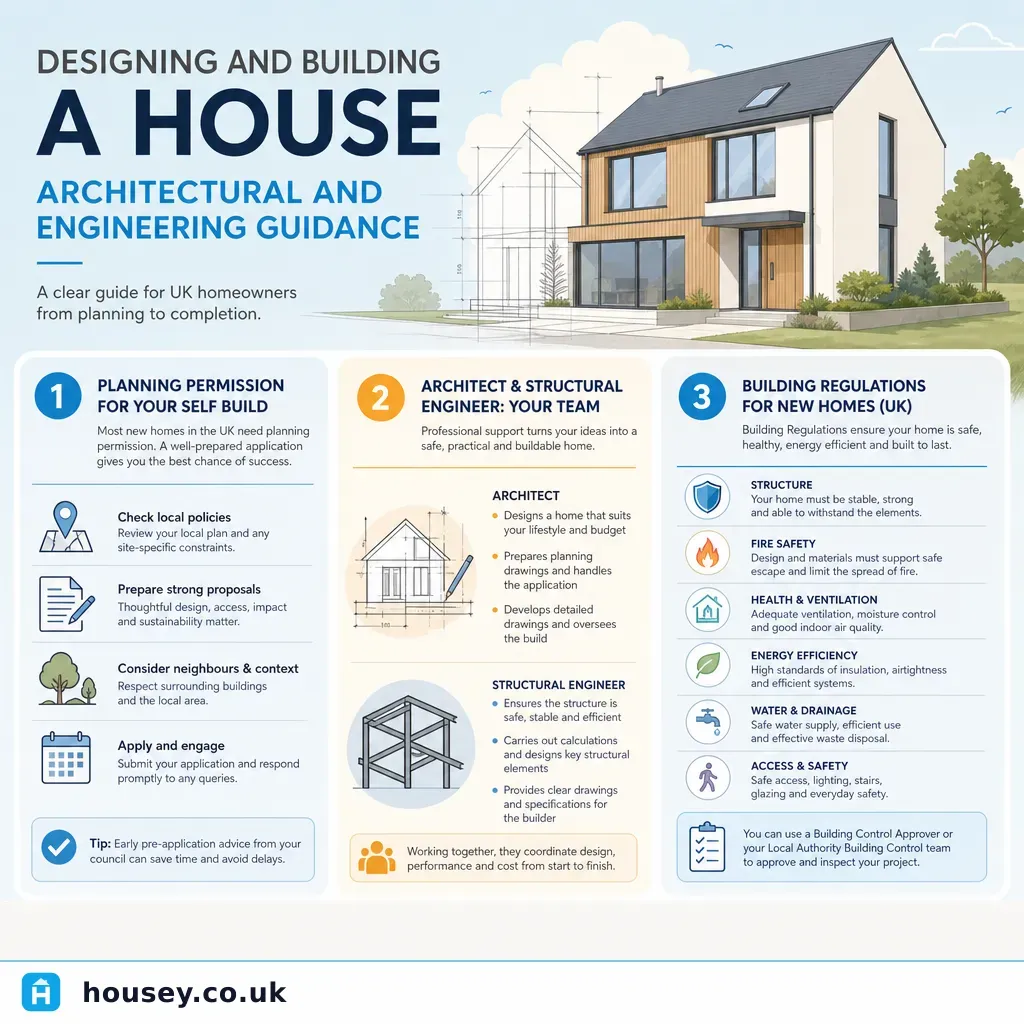
Designing and Building a House: Architectural and Engineering Guidance
Building a new house in the UK requires separate planning permission and Building Regulations approval, a professional team typically including an ARB-registered architect, a structural engineer, and often a civil or geotechnical engineer.