Planning and building regulations for converted school buildings
By Housey · Last reviewed 31st of May 2026
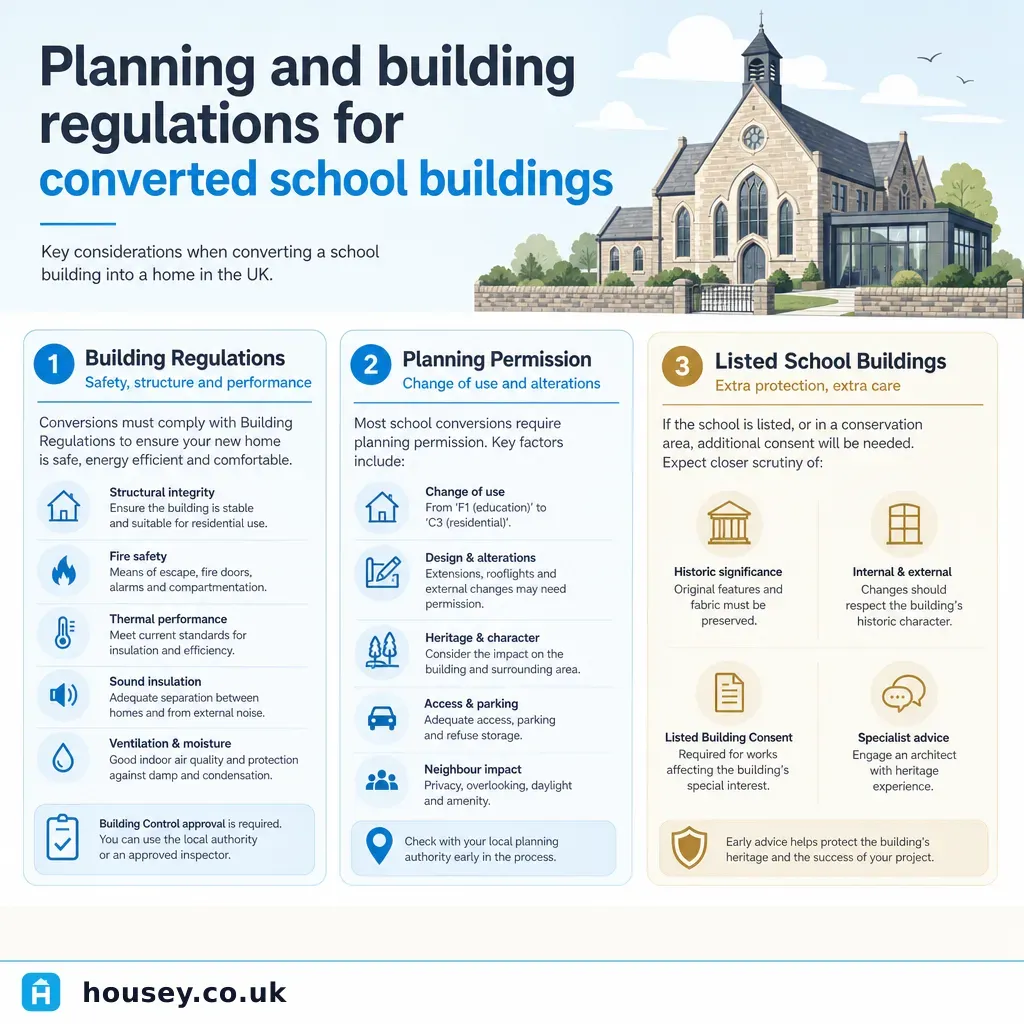
Planning and building regulations for converted school buildings
Converting a former school into residential accommodation or mixed-use space has become more common across England and Wales as surplus educational estate is released for development. Former primary schools, Victorian grammar buildings, and village schoolhouses all present a combination of genuine architectural interest and regulatory complexity that sets them apart from straightforward residential conversions. The framework spans planning law, heritage legislation, building regulations, and frequently protected species requirements — understanding the landscape before committing to a purchase or instructing a design team is essential to avoiding costly delays and enforcement risk.
Key points
- School buildings in England (Use Class F.1(a)) have no permitted development route to residential use — a full planning application for change of use is required in virtually all cases.
- Many former school buildings are listed (Grade I, II* or II) or sit within conservation areas, triggering listed building consent requirements under the Planning (Listed Buildings and Conservation Areas) Act 1990 in addition to planning permission.
- Building Regulations Parts A (structure), B (fire safety), F (ventilation), L (energy efficiency), and M (accessibility) all apply to a change of use to residential and must be addressed in a full plans submission to building control.
- The National Planning Policy Framework (NPPF) 2023, paragraph 100, requires local planning authorities to assess the loss of community facilities — including former schools — meaning applicants commonly need to demonstrate active marketing for continued community use before residential conversion is approved.
- Pre-application advice from the local planning authority typically costs £200–£800 for small residential schemes (indicative UK costs, last reviewed 2026-05-31; fees are set individually by each LPA).
Does converting a school require planning permission?
Yes, in almost all cases. School buildings in England are classified as Use Class F.1(a) — learning and non-residential institutions — under the Town and Country Planning (Use Classes) Order 1987 (as amended 2020). Converting to residential (Use Class C3) is a material change of use and requires a full planning application to the local planning authority (LPA).
Unlike commercial properties in Use Class E (offices, retail, light industrial), F.1(a) uses have no Class MA permitted development right for conversion to residential. There is no prior approval route. A planning application must be submitted and determined on its merits against the local development plan, the NPPF, and any site-specific constraints.
Decision tree: planning and consent requirements for a school conversion
- Converting any school building to residential use → Full planning application required in virtually all cases.
- Building is listed → Check the Historic England National Heritage List for England to confirm grade → Listed building consent also required before any works affecting the building's character.
- Building is in a conservation area → Permitted development rights are reduced; external alterations and demolition of unlisted structures may need LPA notification or consent.
- Building has an Article 4 Direction → Additional permitted development rights removed; check the LPA's planning constraints register.
- Site has mature trees or disused roof voids → A protected species or tree survey may be required before the planning application is submitted — raise this at pre-application stage.
- Building has any active or recently vacated educational use → Prior consultation with the local education authority may be relevant depending on academy or maintained status.
Change of use: what the LPA will assess
The planning assessment for F.1(a) to C3 residential is not simply a design review. Community facility policies frequently apply, and most LPAs have adopted local policies requiring applicants to demonstrate that a building is genuinely surplus to community needs before a residential conversion will be approved.
Key material considerations typically assessed:
- Loss of community facility — evidence of active marketing for continued educational or community use, usually for 12–24 months, is commonly required.
- Heritage impact — if listed or in a conservation area, proposals must preserve or enhance the significance of the heritage asset under NPPF paragraphs 199 onwards.
- Design and character — the LPA will assess whether the scheme respects the original building's character, limiting the extent of internal subdivision, new openings, and extensions.
- Highways and parking — many former schools have limited on-site parking in areas of existing pressure; the LPA will assess against local transport policy.
- Flood risk — Victorian schools in town centres are sometimes in Flood Zone 2 or 3; a site-specific flood risk assessment may be required under NPPF paragraph 167.
Building regulations that apply to school conversions
A change of use from F.1(a) to C3 residential triggers a full building regulations application under the Building Regulations 2010 (as amended). The relevant approved documents include:
Approved Document | What it covers | Typical implication for school conversions |
|---|---|---|
Part A (Structure) | Structural stability | Large open-plan halls or gymnasia may need new structural elements to support floor subdivision |
Part B (Fire safety) | Compartmentation, means of escape, detection | Conversion to multiple dwellings requires fire compartmentation between each unit; buildings over 11m may require automatic fire suppression |
Part F (Ventilation) | Adequate ventilation in habitable rooms | Former classrooms with limited openable windows may require mechanical ventilation systems |
Part L (Energy efficiency) | Fabric thermal performance | Solid-wall Victorian buildings require upgrading; this frequently conflicts with listed building requirements |
Part M (Access) | Accessible and adaptable design | New dwellings must meet Part M Category 1 (visitable) as a minimum |
For listed school buildings, a practical tension frequently arises between Part L energy efficiency requirements and the need to preserve original fabric — single-glazed sash windows, solid masonry walls, and original roof coverings. Historic England's guidance Energy Efficiency and Historic Buildings (2023) sets out how conservation principles can be reconciled with energy performance. A heritage consultant or conservation architect is usually needed to navigate this balance before the building regulations submission is prepared.
Listed buildings and conservation areas: additional requirements
If the school building is listed, listed building consent must be obtained from the LPA before any works that affect the building's character as a listed structure. This applies to internal alterations as well as external changes — removing original partitions, installing a new staircase, introducing a mezzanine, or opening up new window positions all require consent.
Works without listed building consent are a criminal offence under Section 7 of the Planning (Listed Buildings and Conservation Areas) Act 1990, carrying an unlimited fine and up to two years' imprisonment on conviction. Unauthorised works can also result in an enforcement notice requiring reinstatement of removed historic fabric.
In conservation areas, demolition of structures above certain sizes still requires planning permission under Conservation Area Demolition provisions, and local authorities may have issued Article 4 Directions that further restrict changes to buildings' external appearance.
Red flags for listed school conversions
- Original architectural features — herringbone brickwork, terracotta detailing, stone dressings, timber king-post trusses — that the conversion could damage or remove: each element must be assessed and protected in the design.
- Asbestos-containing materials (ACMs) in flat-roofed extensions, floor tiles, ceiling tiles, or pipe lagging: a pre-purchase Type 2 management survey is essential before any works commence.
- Bat roosts or nesting birds in disused roof voids — a protected species survey under the Wildlife and Countryside Act 1981 (as amended) may be needed, and Natural England may need to issue a mitigation licence before roof works can proceed.
- Evidence of historic settlement or foundation movement in large Victorian structures: a structural survey before purchase is strongly advisable.
- Lead paint on original joinery, which requires careful management under the Control of Lead at Work Regulations 2002.
Structural and fire safety considerations
Large-volume school buildings — assembly halls with exposed timber trusses, gymnasia, and science wings — present specific challenges when subdivided into dwellings. A structural engineer should assess:
- Whether existing floor slabs and structural frames can carry residential live loads in the proposed new configuration.
- Whether new partition walls or apartment cores require new foundations or transfer structures.
- Whether the existing roof structure can remain, be adapted, or needs replacing for proposed upper-level accommodation.
Fire safety under Approved Document B (2019 edition, as amended 2022) requires strict compartmentation between each dwelling unit, protected escape routes of appropriate width and fire rating, and — in buildings where any floor is above 11m — an automatic fire suppression system. Complex historic layouts with non-standard geometries may benefit from a fire engineering assessment rather than a prescriptive Part B solution.
Important limitations
This article provides general information about the planning and building regulations framework for school conversions in England. Rules vary significantly between local planning authorities, individual site designations, building condition, construction type, and the scale of conversion proposed. Nothing in this article constitutes planning advice, legal advice, or a professional assessment of any specific property. Planning and building regulations also differ in Scotland, Wales, and Northern Ireland — consult the relevant national planning authority for guidance applicable to those jurisdictions.
When this becomes urgent
Seek professional advice immediately if:
- Works have already started and you discover that planning permission or listed building consent was not obtained — enforcement action can require full reinstatement at the owner's cost.
- An enforcement notice or stop notice has been served by the LPA.
- Structural movement, roof failure, or evidence of active subsidence is present in a building you are purchasing or occupying — do not proceed to exchange without a structural engineer's report.
- Bats or nesting birds are found during initial inspections — works must stop and a licensed ecologist must be instructed before they can resume.
- Asbestos-containing materials are found in a damaged or disturbed condition — treat the area as a suspected ACM and do not proceed until a licensed asbestos surveyor has assessed it.
What to ask a qualified professional
Before instructing a planning consultant, heritage architect, or structural engineer for a school conversion:
- Are you familiar with F.1(a) to C3 change-of-use applications in this LPA, and can you provide references for similar schemes?
- What pre-application advice process do you recommend, and what is the LPA's typical turnaround for pre-app responses on heritage conversion projects?
- How will you evidence the community facility marketing requirement, and what period of marketing is typically sufficient for this LPA?
- How will you handle the potential conflict between Part L energy compliance and listed building requirements for this building's fabric?
- Which specialist surveys — ecology, structural, asbestos, flood risk assessment — do you advise commissioning before the planning application is submitted?
- Are there any Article 4 Directions, local heritage designations, or neighbourhood plan policies relevant to this site that could affect the application?
When to get professional help
School conversions are among the most technically and procedurally complex residential conversion projects in the UK market. Professional input is essential from the outset:
- A planning consultant should assess consent risk, community facility policy implications, and likely planning conditions before purchase.
- A heritage and conservation consultant is needed if the building is listed or in a conservation area — ideally before an offer is made.
- A structural engineer should inspect the building before exchange to identify any structural interventions the conversion requires.
- Architectural technologists or conservation architects can prepare planning drawings and building regulation submissions coordinated with heritage requirements.
- A building control consultant can advise on fire safety, energy performance, and accessibility compliance from the early design stage, reducing the risk of abortive work.
How Housey can help
Housey connects homeowners and developers with experienced professionals for complex conversion projects. You can find vetted planning consultants, heritage and conservation consultants, and building control consultants through the platform, with profiles showing relevant experience in change-of-use and listed building projects.
Frequently asked questions
Can a listed school building be converted to residential without listed building consent?
No. Any works that affect the character of a listed building — including internal alterations — require listed building consent from the LPA under Section 7 of the Planning (Listed Buildings and Conservation Areas) Act 1990. Works carried out without consent are a criminal offence carrying an unlimited fine, regardless of whether the building is in active use or stands vacant.
How long does planning permission for a school conversion take in England?
A standard householder or small residential change-of-use application is determined within 8 weeks of validation; major applications (10 or more dwellings) within 13 weeks. In practice, listed school buildings and heritage conversions often require pre-application discussions, ecology or heritage surveys, and further negotiation with officers, so the overall process from first engagement to decision can take considerably longer. A planning consultant can give a realistic timeline for the specific LPA and scheme.
Does the whole building need to be converted, or can part be retained as community use?
A mixed-use scheme retaining some community, educational, or cultural space alongside residential accommodation is often more acceptable to an LPA than full residential conversion, particularly where community facility loss policies apply. Demonstrating that a meaningful proportion of community use is retained can reduce or remove the marketing evidence requirement. A planning consultant can advise on whether a mixed-use approach is viable for your specific site and LPA.
Are there grants available for restoring or converting listed school buildings?
Historic England administers grant programmes including the Historic Environment Fund. Some local authorities operate conservation area grant schemes, and the UK Shared Prosperity Fund has been used in some areas for heritage-led regeneration. Eligibility varies by location, building grade, and proposed use. Contact Historic England's regional offices and your LPA's conservation officer for current funding opportunities.
Sources and further reading
- National Planning Policy Framework 2023 — GOV.UK
- Town and Country Planning (Use Classes) Order 1987 (as amended 2020) — legislation.gov.uk
- Planning (Listed Buildings and Conservation Areas) Act 1990 — legislation.gov.uk
- Historic England: Energy Efficiency and Historic Buildings — Historic England
- Building Regulations 2010 — Approved Documents — GOV.UK
- Historic England: National Heritage List for England — Historic England
Useful next reads
 Planning & Pre-Build
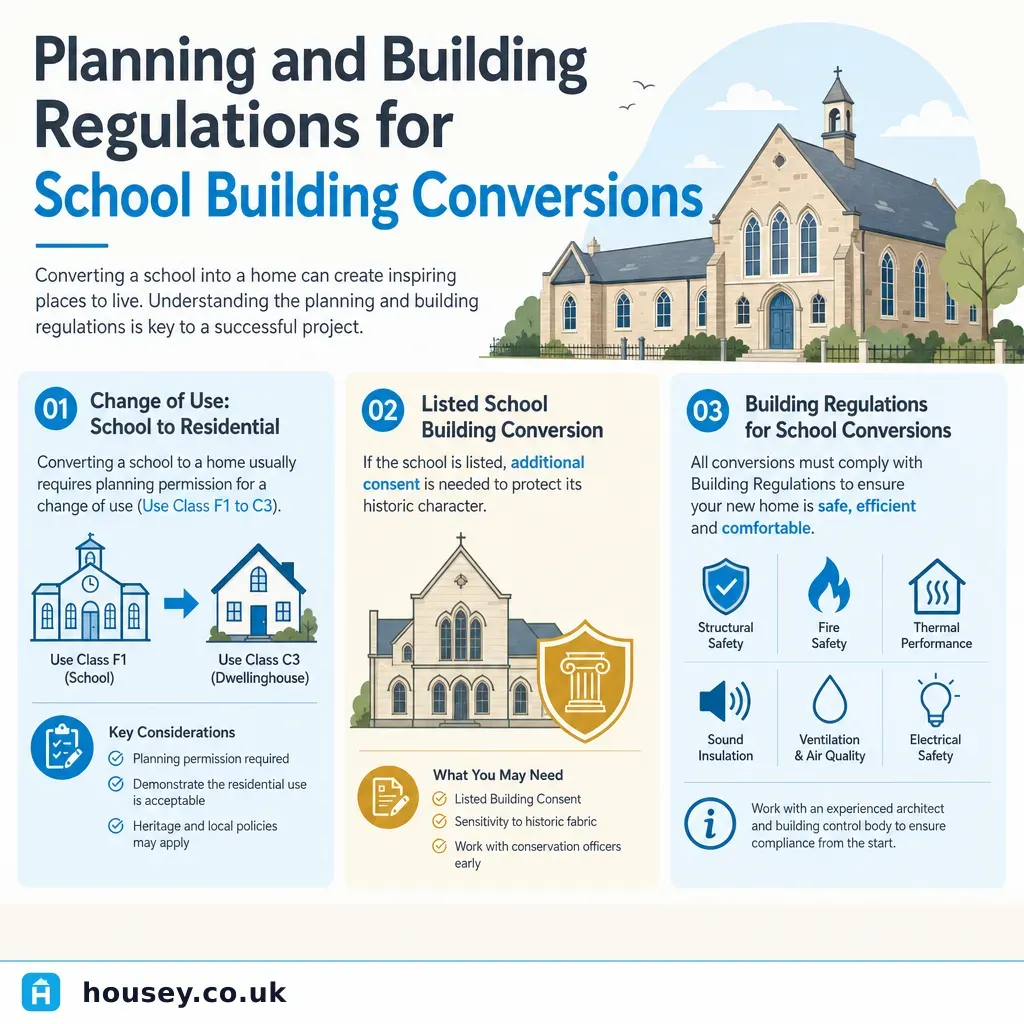
Planning and Building Regulations for School Building Conversions
Converting a school to residential use in England requires full planning permission — there is no permitted development right for this change of use.
 Planning & Pre-Build
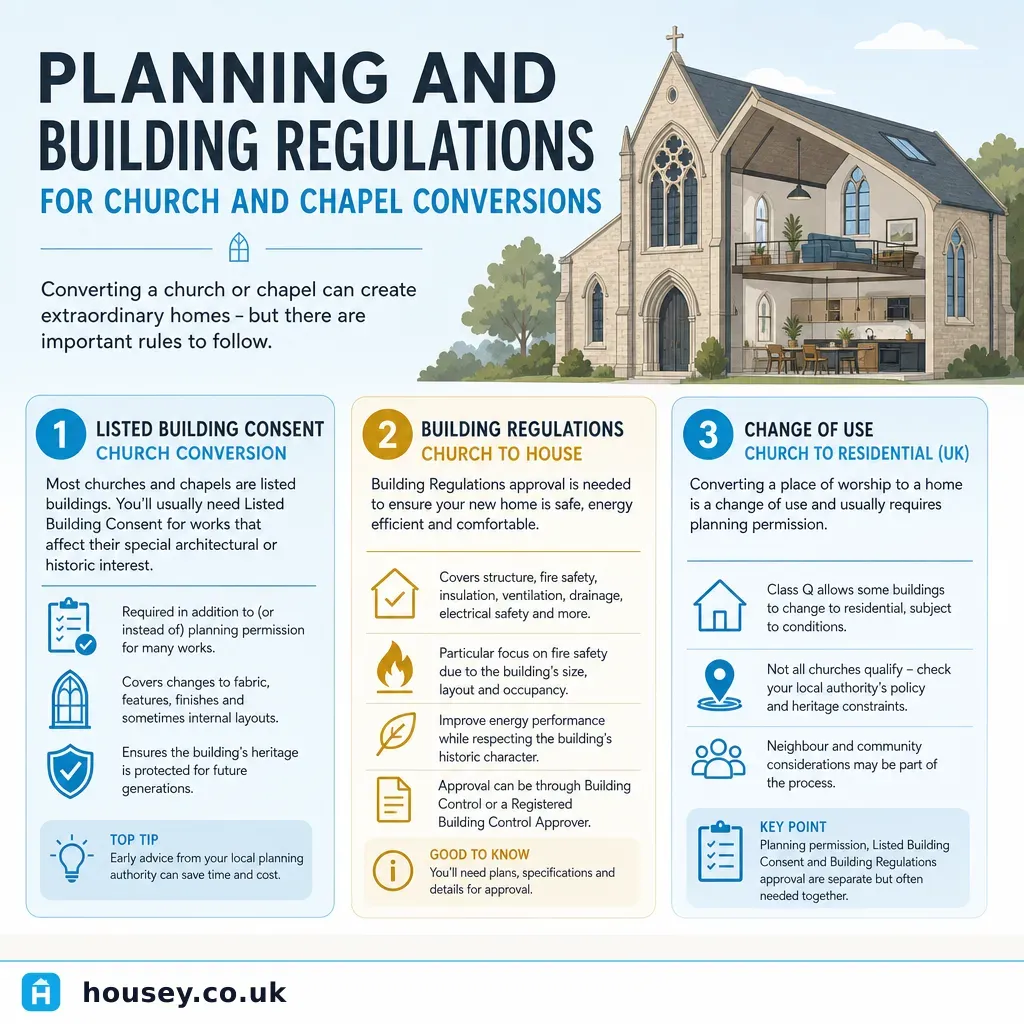
Planning and Building Regulations for Church and Chapel Conversions
Converting a church or chapel to residential use requires planning permission for change of use from Class F1 to Class C3, and listed building consent if the building is listed.
 Planning & Pre-Build
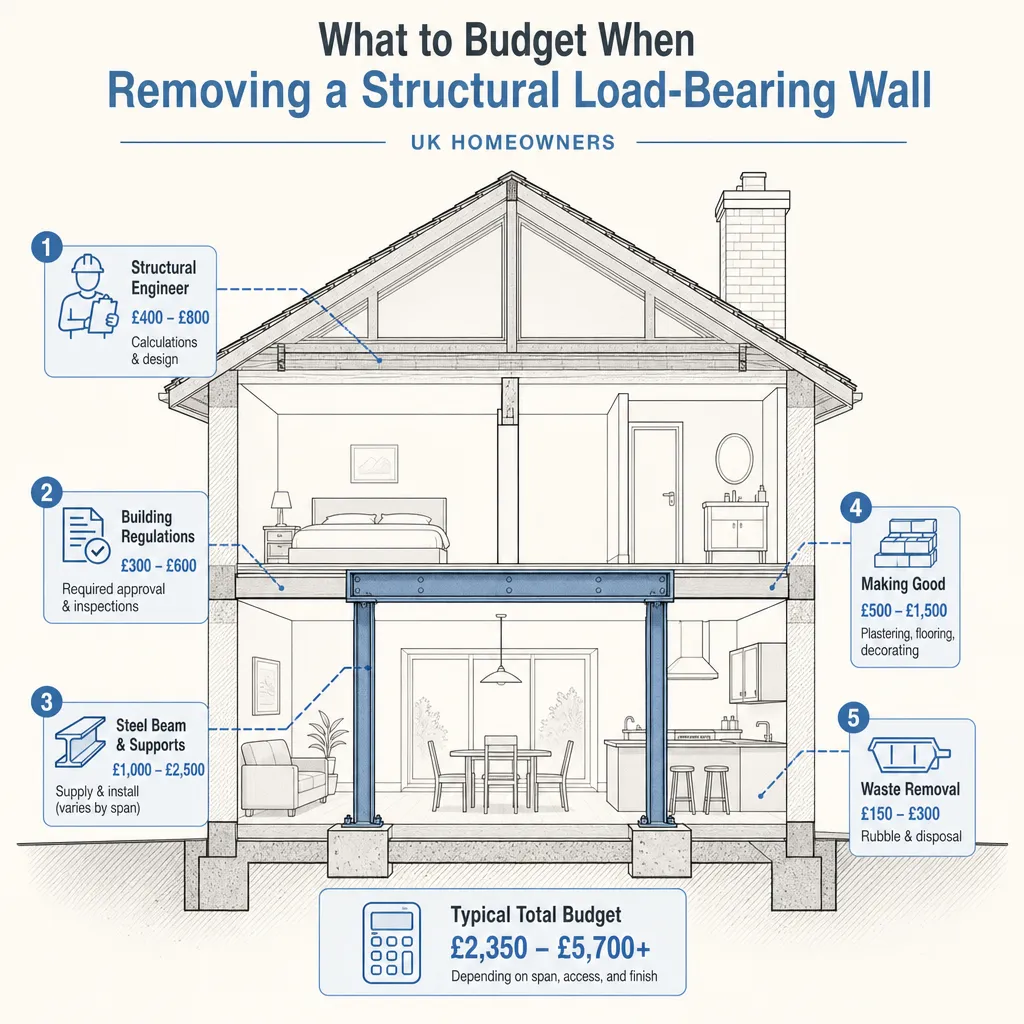
What to Budget When Removing a Structural Load-Bearing Wall
Removing a load-bearing wall in a typical UK home costs £2,500–£8,000 or more in total, covering a structural engineer's calculations, Building Regulations approval, the steel beam, builder's labour, and replastering.
 Planning & Pre-Build
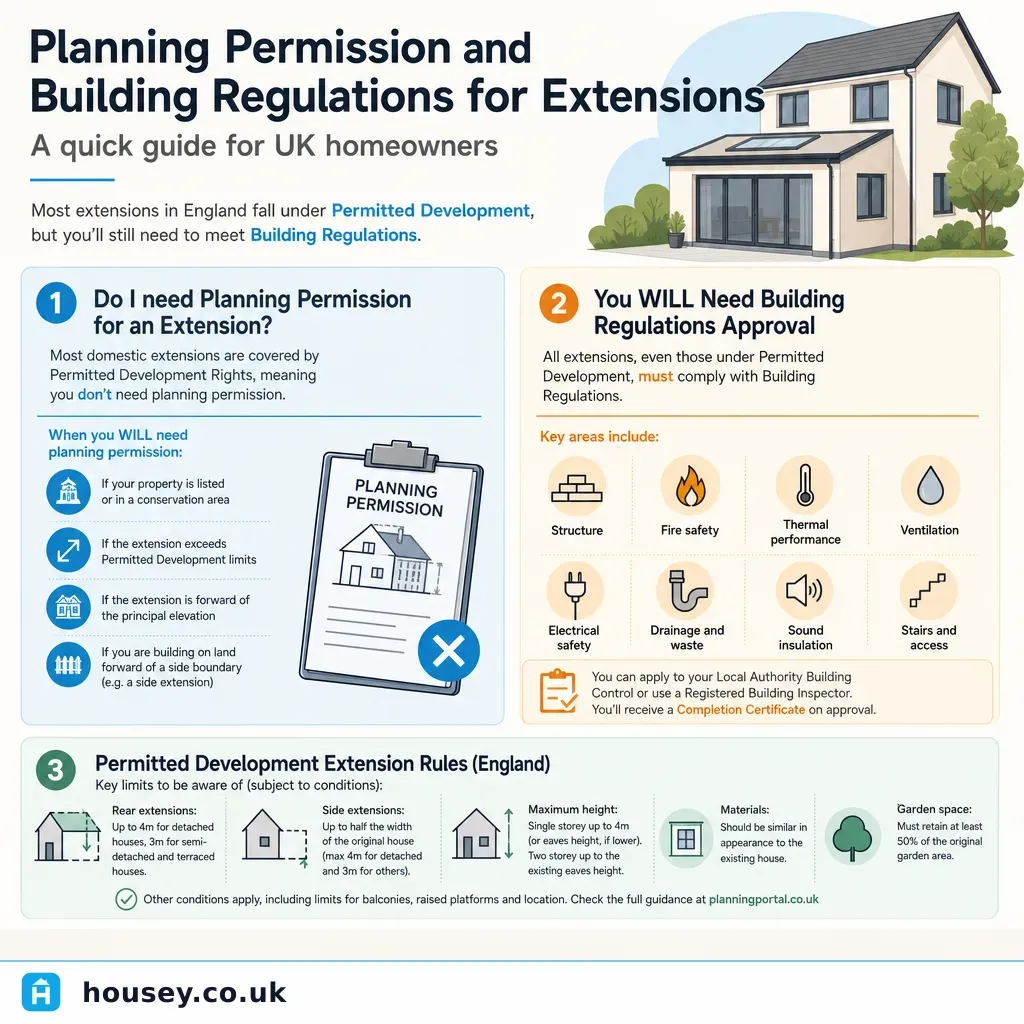
Planning Permission and Building Regulations for Extensions
UK home extensions usually require both planning permission and Building Regulations approval, though most smaller rear extensions qualify as Permitted Development under the GPDO 2015 and need no planning application.
 Planning & Pre-Build
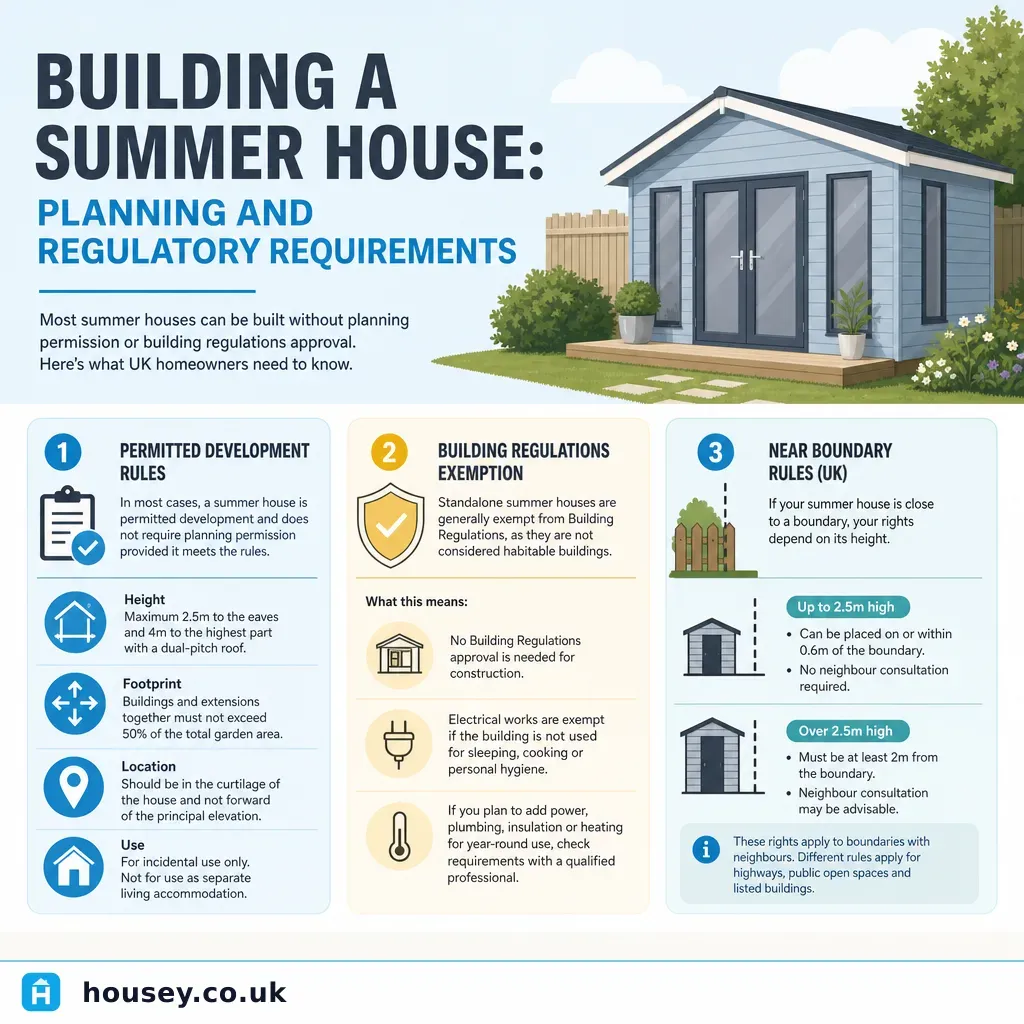
Building a Summer House: Planning and Regulatory Requirements
Most garden summer houses in England fall under Class E permitted development and need no planning permission, provided they are single-storey, within height limits, and not used for sleeping.