Understanding Planning Permission: Requirements and Process
By Housey · Last reviewed 30th of May 2026
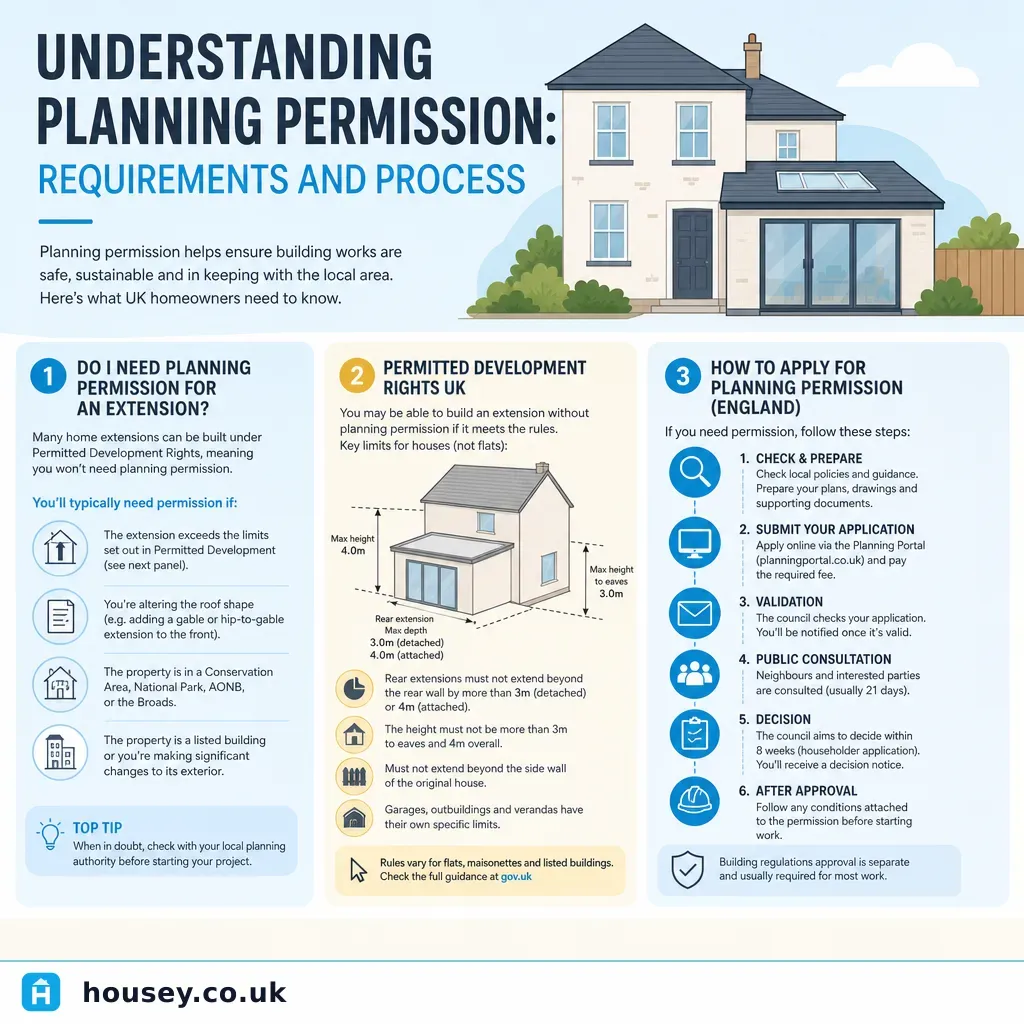
Understanding Planning Permission: Requirements and Process
Planning permission sits at the heart of any significant change to a property or land in England and Wales. Whether you are considering a rear extension, a loft conversion, a change of use, or a brand-new dwelling, understanding when permission is required — and how to apply for it — can mean the difference between a smooth project and an enforcement notice. The rules draw on national planning policy, each council's adopted Local Plan, and property-specific designations such as conservation area status or listed building designation that can significantly affect what is and is not allowed.
Key points
- Planning permission is required for "development" as defined by the Town and Country Planning Act 1990; many household projects instead fall under Permitted Development (PD) rights set out in the Town and Country Planning (General Permitted Development) (England) Order 2015, subject to conditions and size limits.
- PD rights can be removed by an Article 4 Direction — commonly applied in conservation areas — meaning a formal application is then required for works that would otherwise be permitted.
- Householder planning applications in England currently cost £258; a Certificate of Lawful Development (proposed) for a householder project costs £129 — both are set by national regulations.
- Minor householder applications have a statutory eight-week determination target in England; major applications have thirteen weeks, though complex cases routinely exceed these targets.
- Unauthorised operational development can be subject to enforcement action for up to four years after completion; an unauthorised change of use can be enforced for up to ten years.
What is planning permission and when do you need it?
Planning permission is formal consent from a local planning authority (LPA) to carry out development. The Town and Country Planning Act 1990 defines development as building, engineering, mining, or other operations in, on, over, or under land, or a material change of use of buildings or land.
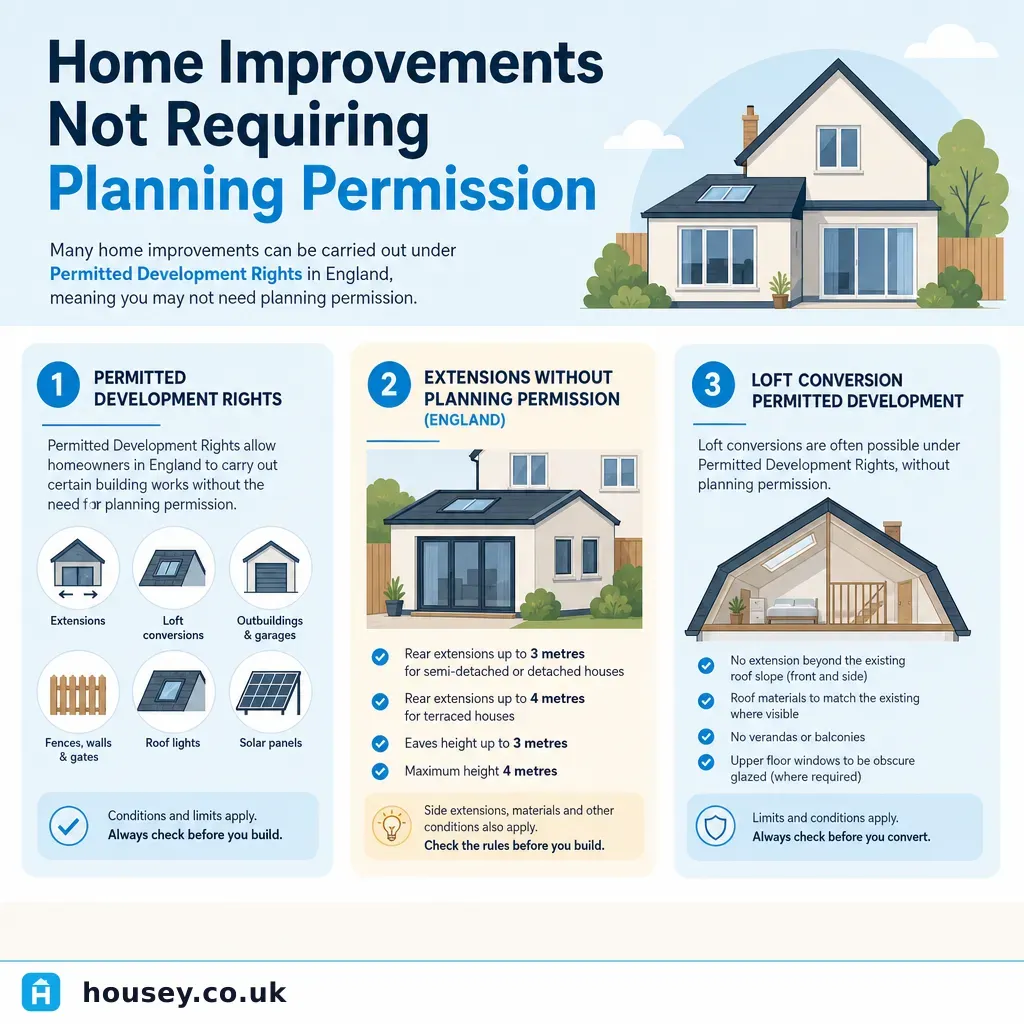
Not every project requires a full application. Many common household projects fall within Permitted Development rights — pre-approved permissions allowing specific types of work without a formal application, subject to the conditions and limitations in the 2015 GPDO.
Works that typically require planning permission
- New buildings or dwellings on any land
- Extensions that exceed Permitted Development size, height, or position limits
- Material changes of use (e.g., a house converted to multiple flats, or residential to commercial)
- Any works affecting the character of a listed building (listed building consent also separately required)
- Development in National Parks, Areas of Outstanding Natural Beauty, or areas subject to an Article 4 Direction
- Demolition of certain structures, including buildings in conservation areas
Works that often fall under Permitted Development
- Single-storey rear extensions within the specified volume and eaves-height limits
- Loft conversions with roof extensions within the permitted cubic-metre thresholds
- Outbuildings (garden offices, sheds, garages) within permitted footprint and height limits, set back from the highway
- Solar panels on dwellings, subject to conditions on appearance and output
- Most internal alterations (with significant exceptions for listed buildings)
Always confirm with your LPA before starting work, as PD rights depend on the property's history, tenure, and location.
Decision tree: do I need planning permission?
- Is the property a listed building? → Any works affecting its character require listed building consent. Check with the LPA whether planning permission is also needed.
- Is the property in a conservation area, National Park, AONB, or World Heritage Site? → Permitted Development rights may be heavily restricted; check whether an Article 4 Direction applies to your road or area.
- Have PD rights been removed by a condition on an existing or previous planning permission? → Even work that would otherwise be PD will need a full application — check your property's planning history on your LPA's public portal.
- Does the project involve a material change of use? → Planning permission is almost certainly required; for nuanced changes (e.g., house to small HMO) the rules are complex, so take specialist advice.
- Is the proposed work within current PD size, height, and position limits? → If yes, and no local restrictions apply, a formal application may not be needed. Apply for a Certificate of Lawful Development (proposed) to get written confirmation from the LPA.
- Still unsure? → Use the Planning Portal interactive house guide or pay for pre-application advice from your LPA before incurring drawing costs.
How to apply for planning permission
Most applications are submitted through the Planning Portal and routed to the relevant local planning authority. The main stages are:
- Pre-application advice — optional but often worthwhile for anything beyond a straightforward householder extension. Many LPAs charge for this; it can surface objections early and reduce the risk of refusal.
- Prepare drawings and supporting documents — you typically need a site location plan (1:1250 or 1:2500 scale), a block plan (1:500), and existing and proposed floor plans plus elevations. An architect or architectural technologist usually prepares these.
- Submit the application and pay the fee — via the Planning Portal or directly to your LPA.
- Consultation period — the LPA notifies neighbours and statutory consultees (highways authority, heritage bodies, Environment Agency, etc.). The standard consultation window is 21 days.
- Planning officer assessment — the officer prepares a report weighing the proposal against the development plan and national planning policy. Householder applications should be decided within eight weeks of validation.
- Decision notice — you receive planning permission (with or without conditions) or a refusal with stated reasons.
- Appeals — householder appeals against refusal must be submitted to the Planning Inspectorate within twelve weeks of the decision notice date.
Application fees in England (indicative, last reviewed 2026-05-30)
Application type | Fee |
|---|---|
Householder application (extensions, outbuildings) | £258 |
New single dwelling | £578 |
Change of use of existing building | £578 |
Certificate of Lawful Development (proposed, householder) | £129 |
Prior Approval notification (e.g., larger home extension) | Varies; typically £120 |
Fees are set by the Town and Country Planning (Fees for Applications, Deemed Applications, Requests and Site Visits) Regulations 2012 as amended. Check your LPA or GOV.UK for current rates before submitting.
What affects the outcome of a planning application?
Decisions are made against the development plan — the authority's adopted Local Plan — and material considerations including the National Planning Policy Framework (NPPF). Common grounds for refusal include:
- Impact on the character and appearance of the area, streetscene, or existing building
- Overlooking or loss of privacy for neighbouring properties
- Loss of daylight or sunlight to adjacent habitable rooms
- Insufficient parking or adverse effect on highways
- Impact on a listed building or conservation area character
- Flood risk, contamination, or biodiversity harm
- Departure from adopted Local Plan policies on design, density, or affordable housing
Engaging a planning consultant for pre-application discussions with the LPA can substantially reduce refusal risk by identifying and addressing issues before formal submission.
Important limitations
This article provides general information about the planning permission process in England. Planning rules are complex and depend on the specific property, its planning history, location, local plan policies, and the nature of the proposed works. Rules differ materially between England, Scotland, Wales, and Northern Ireland. Nothing in this article constitutes planning, legal, or professional advice. Always consult your local planning authority or a qualified planning consultant before committing to a project or incurring significant design costs.
When this becomes urgent
Seek professional advice immediately if:
- You have already started works that may require planning permission without having obtained it
- You have received an enforcement notice or stop notice, or been contacted by the LPA about potentially unauthorised development
- You are buying a property where extensions or alterations appear to have been built without planning permission or building regulations approval
- Works relate to a listed building and you are uncertain whether listed building consent was ever obtained
- A time-limited planning permission is approaching its three-year expiry and work has not yet started
Unauthorised development can result in enforcement notices requiring demolition and reinstatement. Addressing potential breaches early — ideally before purchase or before works progress further — substantially limits liability.
What to ask a qualified planning consultant
- Does this project need planning permission, or is it likely to fall within Permitted Development rights?
- Has the property had any conditions attached to previous permissions that may restrict PD rights?
- What are the main development plan policies and design guidance that will apply to this application?
- Is pre-application advice from the LPA worthwhile for this specific proposal, given its complexity?
- What drawings and supporting documents will the application require?
- What is a realistic timeline and probability of success, given the local planning context?
- If permission is refused, what are my realistic appeal options?
When to get professional help
An architect, architectural technologist, or planning consultant can prepare and manage your application, assess compliance with local plan policies, and handle negotiations with the planning officer. For straightforward householder extensions, many designers offer a package service covering planning drawings and application submission.
Red flags that mean you should instruct a professional without delay:
- The property is listed or in a conservation area
- You are proposing a change of use or development of more than one dwelling
- You have received any enforcement-related communication from the LPA
- The project falls in a designated area (National Park, AONB, Green Belt, or flood zone)
How Housey can help
Whether you are exploring a simple householder extension or a more complex development proposal, our planning consultancy service connects you with experienced planning professionals who can assess your project, prepare your application, and manage the process from pre-application discussions through to the decision notice.
Frequently asked questions
How long does planning permission last in England?
Planning permission in England is typically valid for three years from the date of the decision notice. You must begin the development within this period — a material operation such as breaking ground usually counts as commencement. If work does not start within three years, the permission lapses and a new application is generally required.
Can my neighbours object to my planning application?
Yes. Neighbours are notified during the consultation period and may submit written representations. However, objections do not automatically lead to refusal. The planning officer weighs all material planning considerations — only matters relevant to land use planning carry weight; personal disputes, commercial competition, and loss of view generally do not.
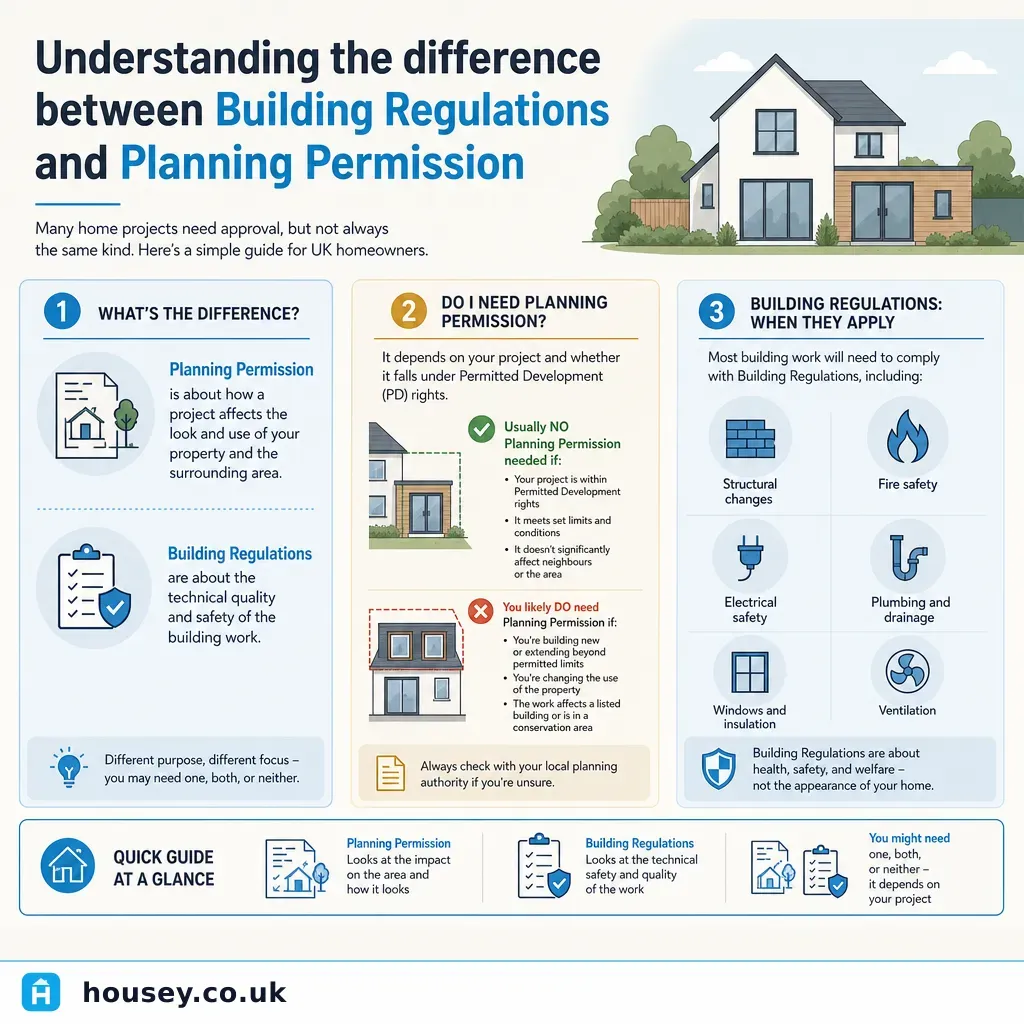
What is the difference between planning permission and building regulations approval?
Planning permission addresses whether a development is acceptable in land-use terms — its impact on the environment, neighbours, and the character of the area. Building regulations approval ensures the work meets technical standards for safety, structure, fire, energy efficiency, and accessibility. Most projects requiring planning permission will also need building regulations approval; these are entirely separate processes with separate fees.
Do I need planning permission for a garage conversion?
Often not, if the conversion is internal and does not materially alter the external appearance. However, adding a window, changing the door opening, or altering the external form may engage Permitted Development limits or require a full application. A Certificate of Lawful Development can confirm your position in writing from the local planning authority.
Sources and further reading
- Planning permission: when you need it — GOV.UK
- The Planning Portal — Planning Portal
- National Planning Policy Framework (NPPF) — Department for Levelling Up, Housing and Communities
- Town and Country Planning Act 1990 — legislation.gov.uk
- Planning enforcement in England — GOV.UK
Useful next reads
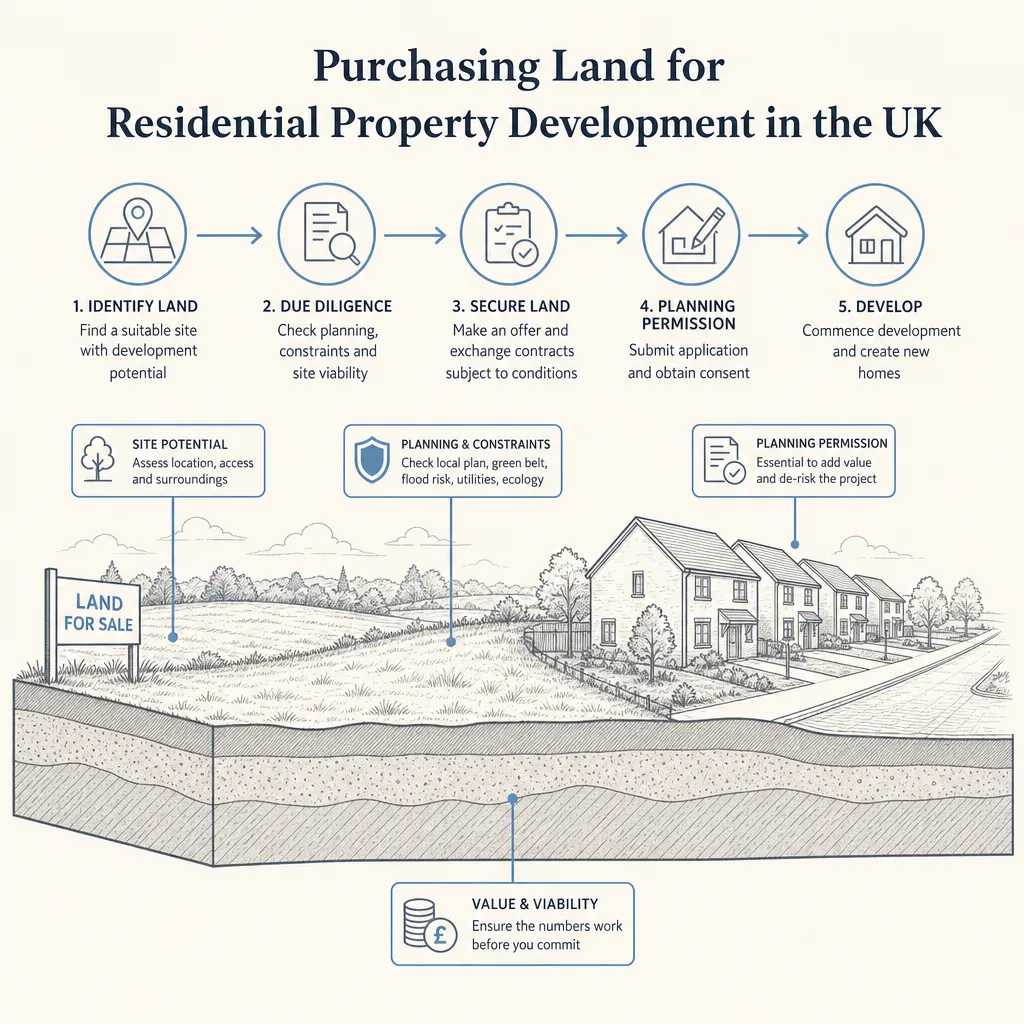 Planning & Pre-Build
Purchasing Land for Residential Property Development in the UK
Buying development land in the UK involves due diligence on planning status, ground conditions, legal title, and utilities access before exchange.
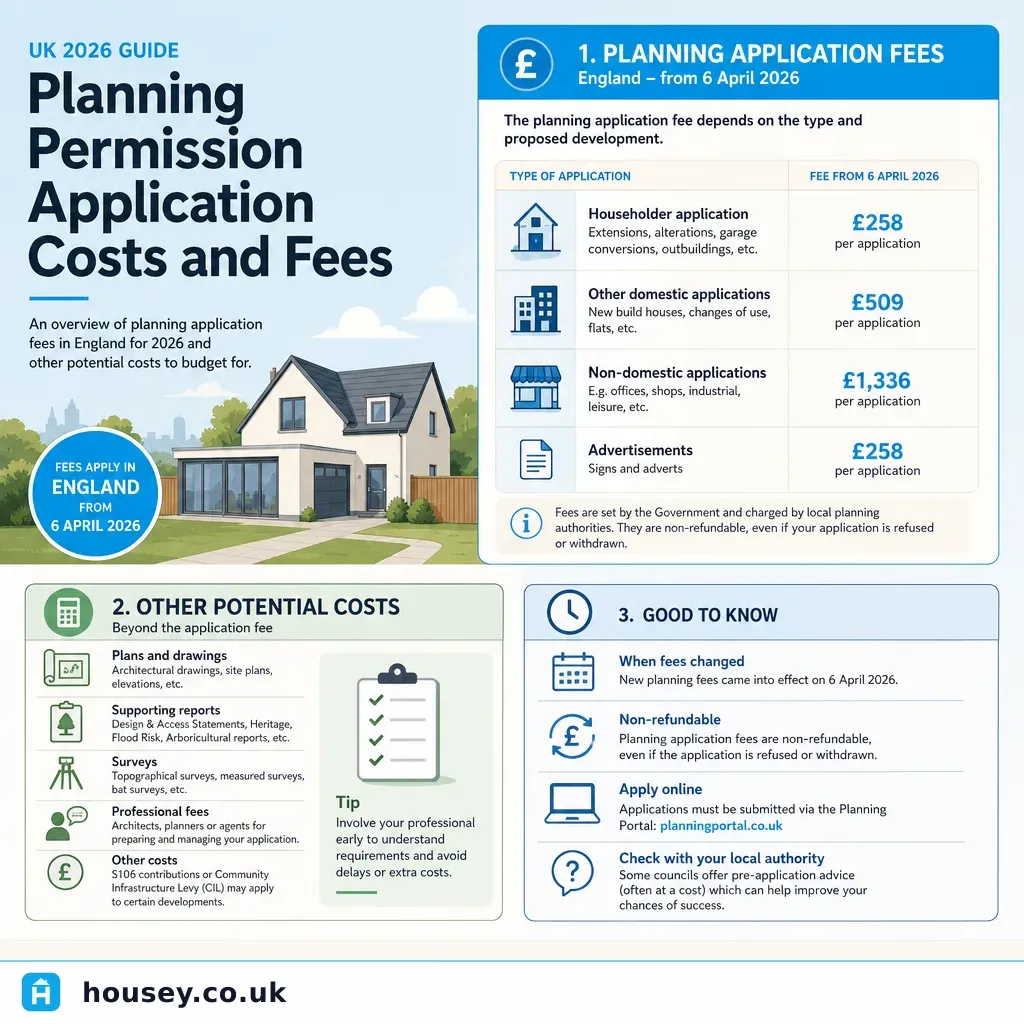 Planning & Pre-Build
Planning Permission Application Costs and Fees
In England, the statutory fee for a householder planning application (extension, loft conversion) is £258.
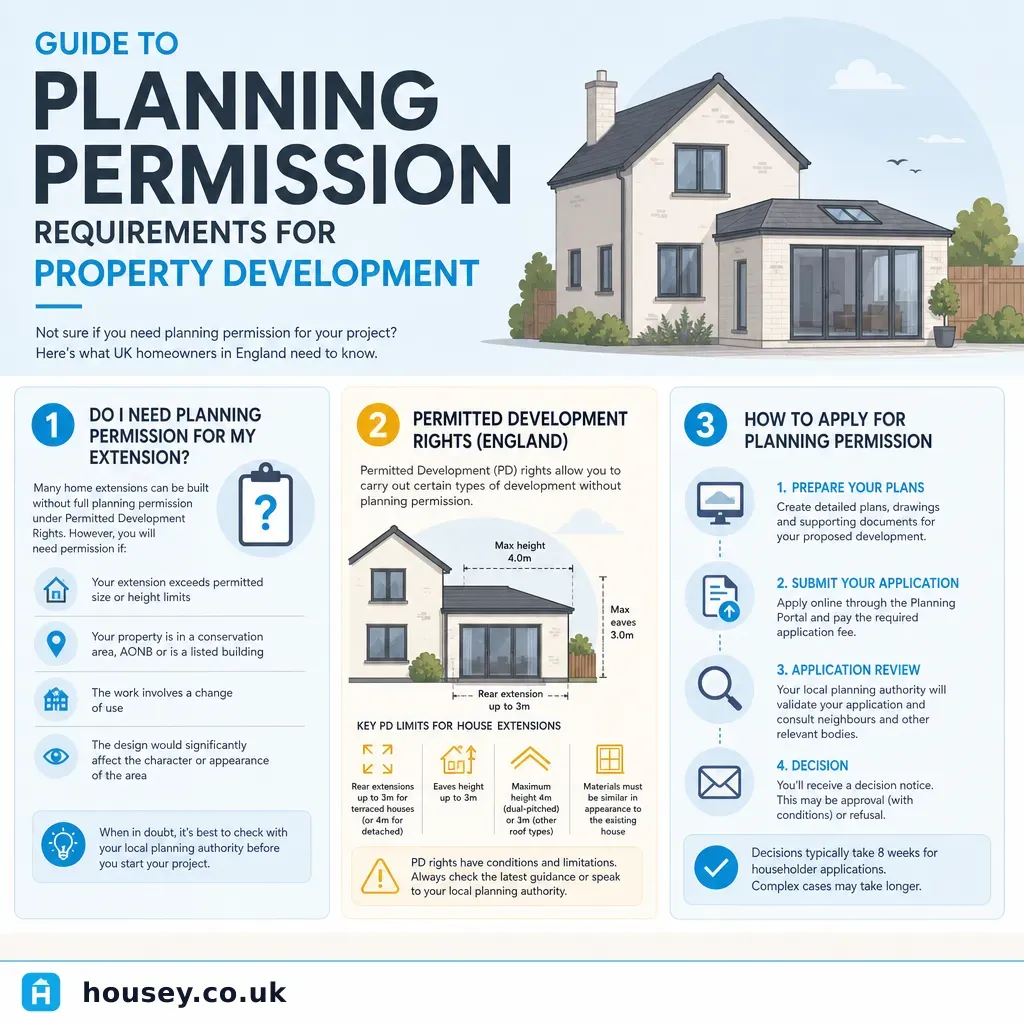 Planning & Pre-Build
Guide to Planning Permission Requirements for Property Development
Most home improvements in England fall within permitted development rights and do not need a planning application.
 Planning & Pre-Build
Understanding the difference between building regulations and planning permission
Planning permission is granted by your Local Planning Authority and controls whether a development is acceptable in principle — its appearance, use, and impact on the area.
 Planning & Pre-Build
Home Improvements Not Requiring Planning Permission
Many common home improvements in England fall under Permitted Development Rights and do not require a planning application.