Planning a Mudroom or Entrance Vestibule Extension
By Housey · Last reviewed 1st of June 2026
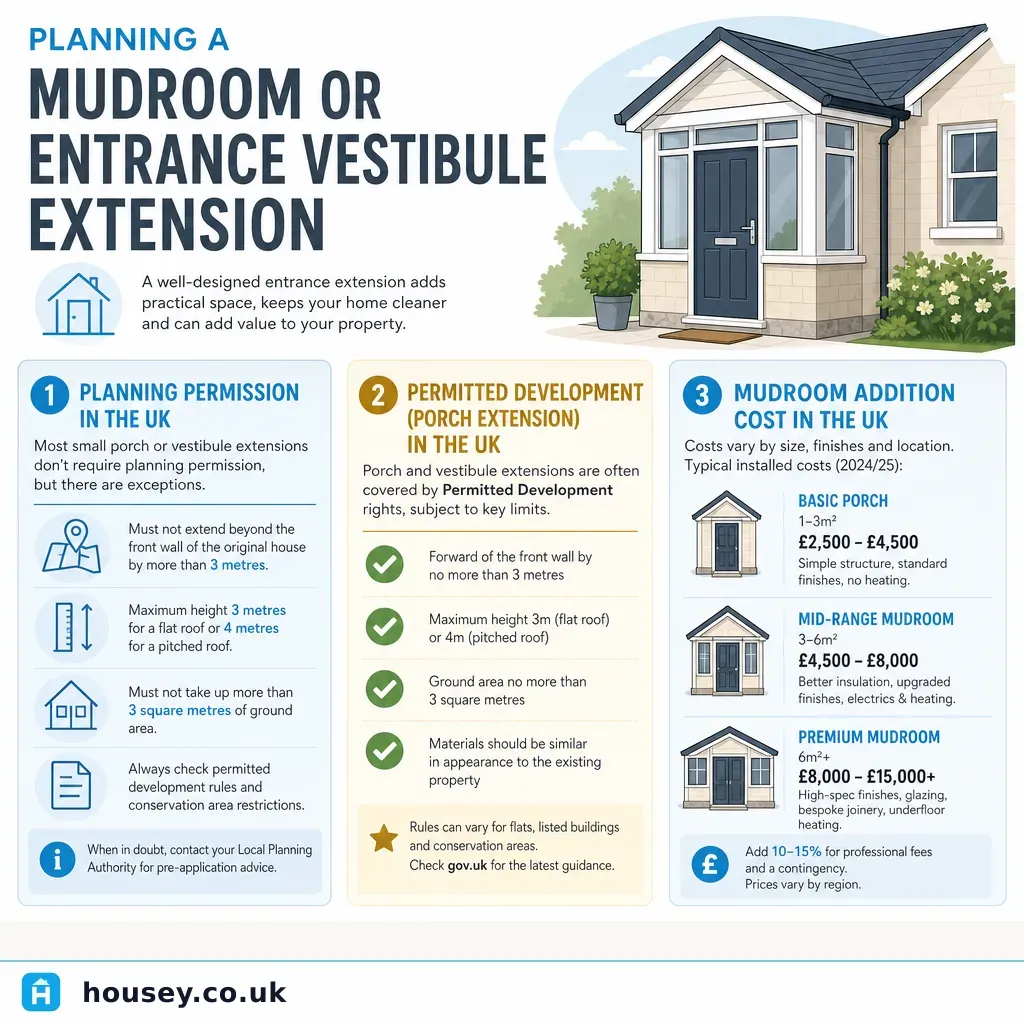
Planning a Mudroom or Entrance Vestibule Extension
A dedicated entrance space — whether called a mudroom, boot room, or entrance vestibule — solves one of the most practical problems in a UK home: managing wet coats, muddy boots, bikes, and bags without creating disruption in the rest of the house. For most homeowners, the question is not whether to add one but how to do it correctly within the planning and building regulations framework — and at what cost.
Key points
- A porch or vestibule extension up to 3 m² ground floor area, no taller than 3 m, and set more than 2 m from a road or footpath boundary is generally permitted development in England under Class E of Schedule 2, Part 1 of the Town and Country Planning (General Permitted Development) (England) Order 2015.
- Permitted development Class E rights do not apply to flats, listed buildings, or properties subject to an Article 4 Direction; in these cases a householder planning application is required.
- Building regulations apply to all new entrance extensions regardless of whether planning permission is needed — covering structure (Part A), moisture (Part C), ventilation (Part F), thermal performance (Part L), and safety glazing (Part N).
- Extensions that exceed 3 m², exceed 3 m in height, or adjoin a road or public footpath within 2 m require a householder planning application, currently costing £258 in England (as of 2026).
- Building Regulations Part L requires new extension walls to achieve a maximum U-value of 0.28 W/m²K and roofs 0.16 W/m²K; doors and windows must achieve 1.4 W/m²K or better.
Do you need planning permission?
Decision tree: mudroom or vestibule extension
- Is your property a house (not a flat, maisonette, or converted building)? If not → a full planning application is required regardless of size.
- Is it listed, or subject to a planning condition removing permitted development rights? If yes → apply for planning permission and, for listed buildings, listed building consent before starting any design work.
- Is it in a conservation area? Some Class E rights may still apply, but check with your local planning authority before committing to a design. Additional scrutiny of materials and proportions is common.
- Is it in an Article 4 Direction area? If yes → full householder planning application required.
- Will the structure be 3 m² or less, no more than 3 m high, and entirely more than 2 m from a highway boundary? If yes to all → likely permitted development; still seek confirmation from your local planning authority or apply for a lawful development certificate as written evidence.
- Does it exceed any of those thresholds, or adjoin a road? → Householder planning application required. Application fee: £258 in England as of 2026.
- Unsure about your property's planning history or local restrictions? → Contact the duty planning officer at your local planning authority, or instruct a planning consultant to advise before committing to a design.
Always verify using the Planning Portal's interactive house guide and confirm with your local planning authority. Conditions attached to previous planning permissions, local Article 4 Directions, or flood-zone designations can restrict permitted development in ways that are not apparent from the property address alone.
Building regulations: what always applies
Planning permission and building regulations are separate requirements. Even if your mudroom qualifies as permitted development, you must notify your local building control body or a registered building control approver before work begins.
Regulation | What it governs | Practical requirement for a mudroom extension |
|---|---|---|
Part A — Structure | Stability of walls, roof, and foundations | Foundations sized to ground conditions; walls and roof to carry design loads |
Part B — Fire Safety | Means of escape and fire spread | Existing escape routes must not be obstructed or impaired |
Part C — Moisture | Damp proofing and weather resistance | DPC continuous with the existing house; weatherproof roof and external walls |
Part F — Ventilation | Indoor air quality | Trickle ventilators in any new windows |
Part L — Energy | Thermal performance | Walls ≤0.28 W/m²K; roof ≤0.16 W/m²K; doors and windows ≤1.4 W/m²K |
Part N — Glazing | Safety glazing in critical locations | Toughened or laminated glass in doors and low-level panels |
A building control surveyor will inspect at foundation, structural frame, and completion stages. The completion certificate you receive is a legal document — retain it, as it will be required during any future conveyancing.
Design considerations for a UK mudroom
Thermal performance: A well-detailed vestibule acts as a thermal airlock, reducing heat loss each time the front door opens. The greatest thermal risk is a cold bridge at the junction between the new extension wall and the existing house wall. Specify a continuous insulation layer at this detail and confirm it in the building control submission.
Moisture management: Mudrooms accumulate wet gear and footwear. Specify a tiled or tanked floor with a drainage channel or mat well at the threshold, and robust weatherproofing at the door sill. Where a new paved area adjoins the structure, ensure new levels do not bridge the existing damp-proof course.
Natural light: A small roof lantern or high-level fixed glazing can bring daylight into a narrow vestibule without compromising wall insulation or street character. All glazed elements must meet Part L U-value requirements.
Kerb appeal and street character: Extensions on the front elevation are visible from the street. Many local planning authorities publish design guidance on materials and proportions. Check this before finalising your specification, particularly in conservation areas or areas with a strong prevailing character.
Door specification: External doors must meet Part L thermal standards. Certified composite doors or thermally broken aluminium frames typically achieve the required U-values; older softwood or standard aluminium frames may not.
Indicative UK costs
Indicative UK costs, last reviewed 2026-06-01. Costs vary significantly by region, ground conditions, specification, and contractor. Obtain at least three itemised quotes.
Scope | Indicative cost range |
|---|---|
Basic masonry vestibule up to 3 m² | £8,000–£15,000 |
Timber-frame or structural-glass porch | £12,000–£25,000 |
Architect or designer fees (where instructed) | £1,500–£5,000 |
Building control fees | £300–£700 |
Householder planning application fee (England) | £258 |
Costs in London and the South East are typically 20–30% higher than the national ranges above. VAT at 20% applies to most new-build and extension work; confirm with your contractor whether quoted prices are inclusive or exclusive of VAT.
What to ask before accepting a builder's quote
- Is VAT included in the quoted price?
- Who is responsible for the building control application and fee — the contractor or the homeowner?
- What happens if ground conditions require deeper or wider foundations than assumed in the quote?
- What U-values will be achieved for walls, roof, and doors, and how will compliance be demonstrated at inspection?
- Does the quote include making good to the existing house wall where the extension abuts it?
- What structural engineer input, if any, is included in the quoted fee?
- What workmanship warranty does the contractor offer, and for how long?
Important limitations
This article provides general information about planning and building regulations in England. Rules for Wales, Scotland, and Northern Ireland differ — consult the relevant planning authority or Building Standards body in those nations. Permitted development rights can be removed or restricted by Article 4 Directions, conditions attached to previous planning permissions, or the specific planning history of a property. Nothing in this article constitutes planning or legal advice. Always verify requirements with your local planning authority before committing to a design or contractor, and seek professional planning advice for any property where there is doubt about what is permitted.
What to ask a qualified professional
Before instructing an architect, extension builder, or planning consultant:
- Does this work require a householder planning application, or is it genuinely permitted development given my property's specific location, tenure, and planning history?
- Are there any restrictive covenants, planning conditions, or tree preservation orders affecting what I can build externally?
- Which building control route do you recommend — local authority or a registered building control approver?
- What U-values will the walls, roof, and doors achieve, and how will compliance be demonstrated to the building control surveyor at each inspection stage?
- Will you manage the building control application, or is that my responsibility as the homeowner?
- What completion certificate will I receive, and when should I expect it?
When to get professional help
Seek professional advice before committing to any design if:
- Your property is listed, in a conservation area, or in an Article 4 Direction area.
- The proposed extension exceeds the 3 m² permitted development threshold.
- You are uncertain whether previous extensions have already used up permitted development allowances on the property.
- The property has a restrictive covenant that may limit external alterations.
- Ground conditions are poor — made-up ground, proximity to mature trees, or suspected drainage issues beneath the proposed footprint.
- You want a lawful development certificate as written confirmation before starting work.
Even for straightforward permitted development projects, an experienced extension builder will help ensure the construction meets Part L, Part C, and structural requirements correctly from the outset.
How Housey can help
Housey connects homeowners with vetted extension builders and project managers experienced in small single-storey additions. Describe your mudroom or vestibule project, receive quotes from local specialists, and compare them all in one place.
Frequently asked questions
Can I build a mudroom under permitted development rights?
A porch or small entrance vestibule up to 3 m² ground floor area, no taller than 3 m, and set more than 2 m from a highway boundary is generally permitted development in England for a house. Verify this with your local planning authority, as Article 4 Directions, conditions on prior approvals, or listed building status can remove this right for your specific property.
Do I need building regulations approval for a small entrance extension?
Yes — building regulations apply to most new structures, including small entrance extensions. You must notify your local building control body or a registered building control approver before work starts. The completion certificate issued on satisfactory inspection is a legal document required for future conveyancing, so retain it carefully.
How long does a householder planning application take in England?
A householder planning application in England typically receives a decision within 8 weeks of validation. Pre-application advice from your local planning authority can reduce the risk of refusal and clarify design requirements. Applications affecting listed buildings or in conservation areas may take longer.
Can I add a mudroom or vestibule to a listed building?
Listed building consent is required for any works affecting the character of a listed building, including external extensions. This is separate from planning permission and both may be needed. The bar for approval is higher than for unlisted properties, and a heritage consultant or conservation officer should be consulted before any design is prepared.
Sources and further reading
- Permitted Development for Porches — Planning Portal
- Town and Country Planning (General Permitted Development) (England) Order 2015, Schedule 2, Part 1, Class E — legislation.gov.uk
- Building Regulations: An Overview — GOV.UK
- Apply for Planning Permission in England or Wales — GOV.UK
- Find an Architect — RIBA
Useful next reads
 Improvement & Build
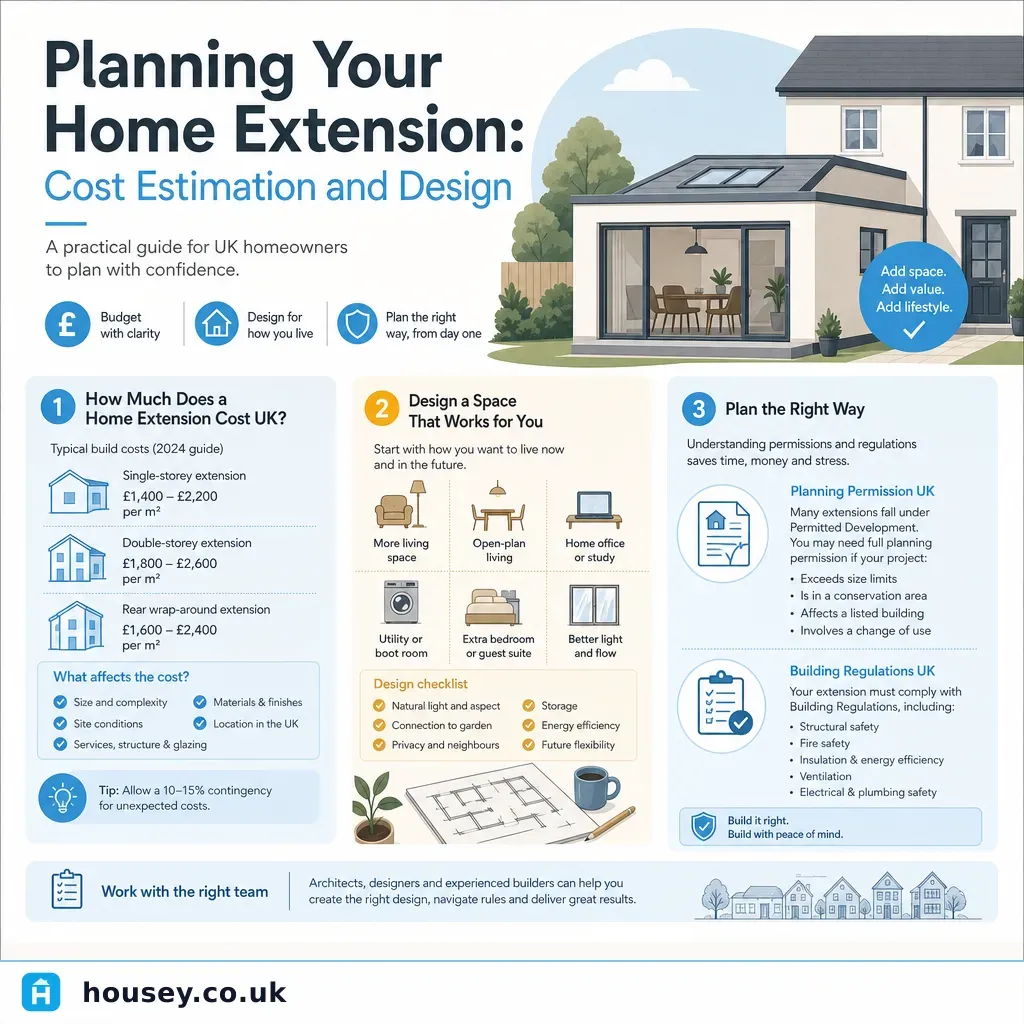
Planning Your Home Extension: Cost Estimation and Design
Planning a home extension involves checking permitted development rights, obtaining Building Regulations approval, and budgeting carefully — typically £1,500 to £2,500 per square metre for basic shell construction.
 Improvement & Build
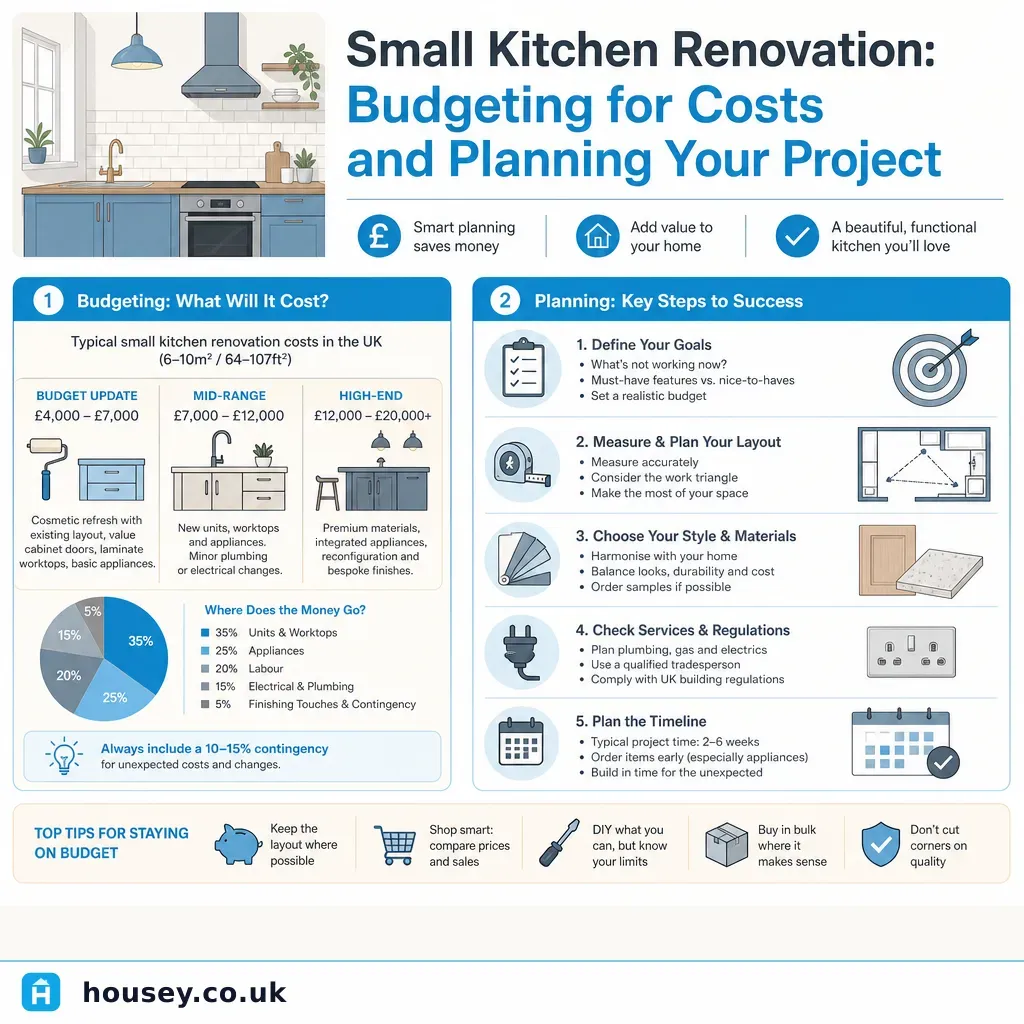
Small kitchen renovation: budgeting for costs and planning your project
A small kitchen renovation in the UK typically costs £5,000–£15,000 for a full refresh including new units, worktops, tiling, and appliances, though costs vary widely by specification, region, and whether structural changes or rewiring are involved.
 Improvement & Build
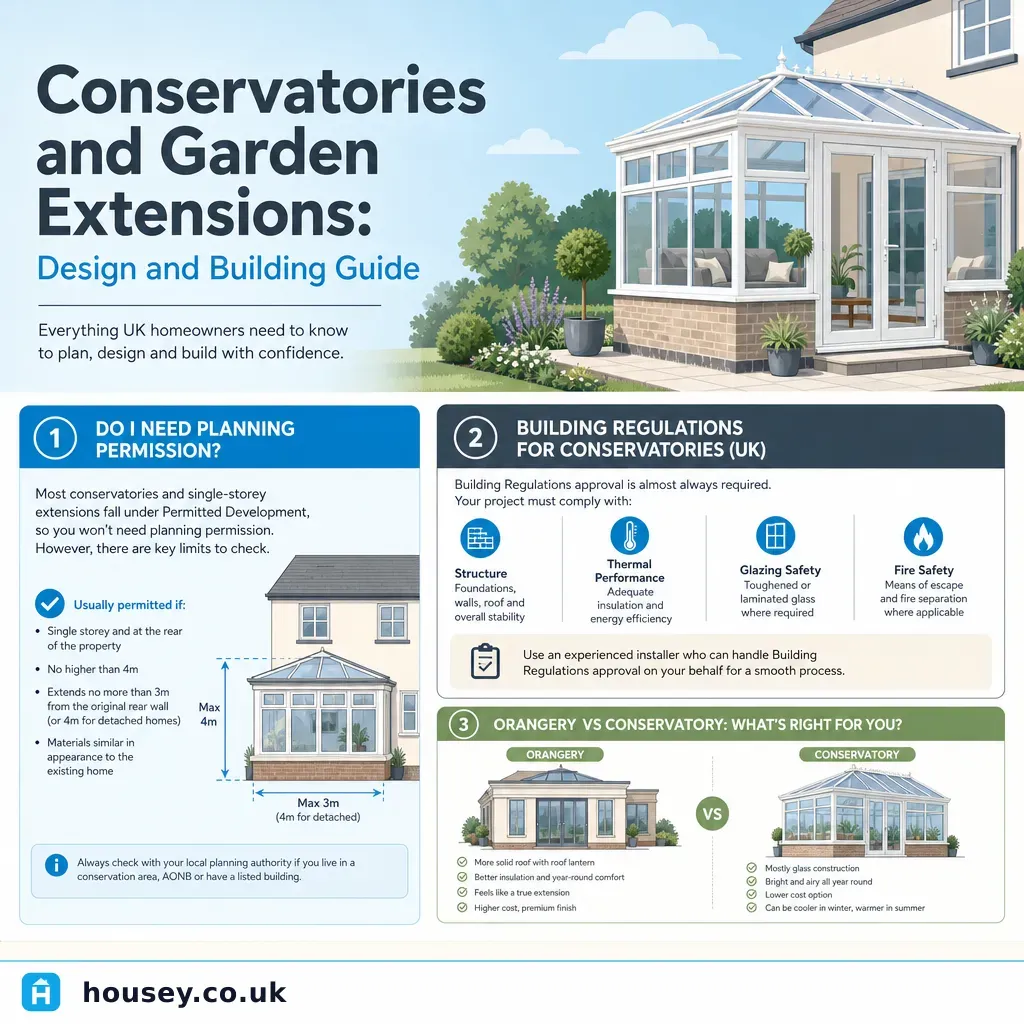
Conservatories and Garden Extensions: Design and Building Guide
Most conservatories qualify as permitted development in England if they are single-storey, within 50% of original curtilage, and meet dimensional limits.
 Improvement & Build
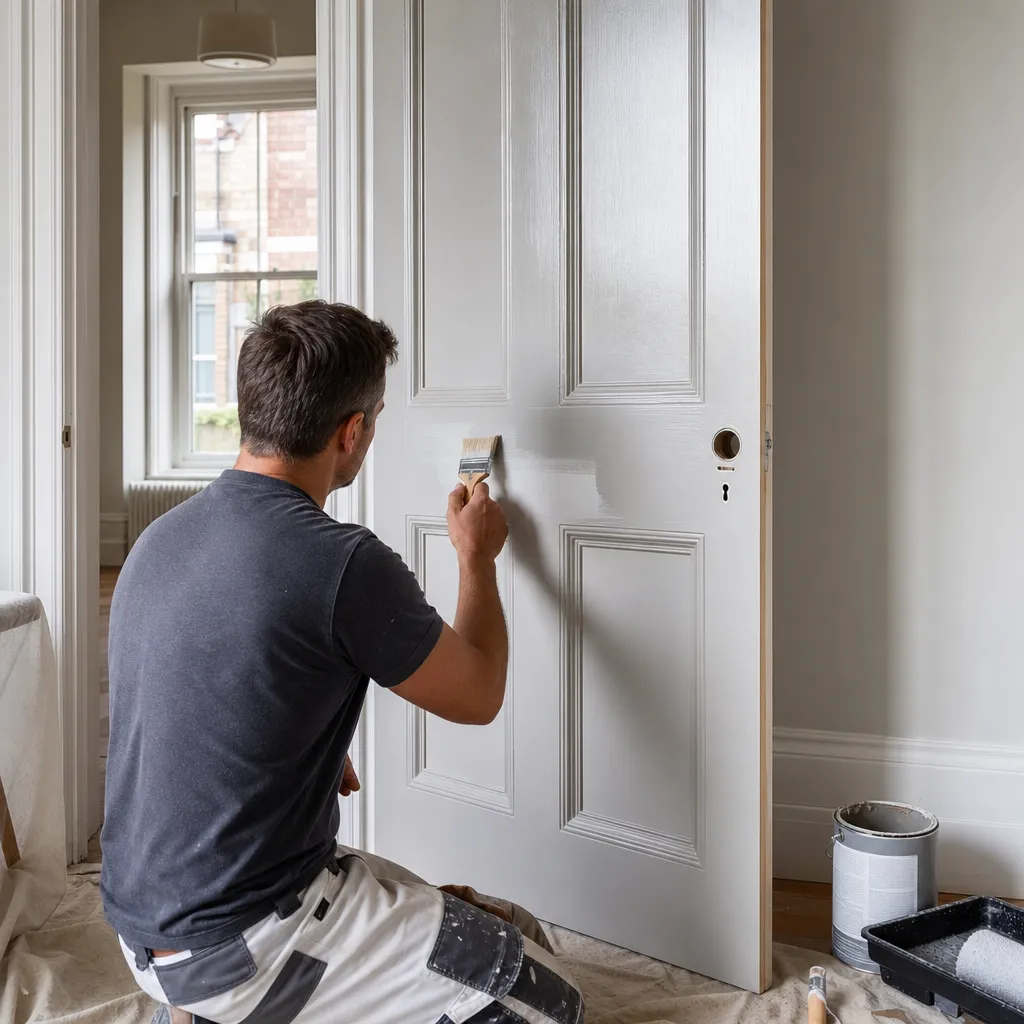
Painting Interior Doors: Preparation and Technique
Painting interior doors well depends on preparation rather than paint choice.
 Improvement & Build
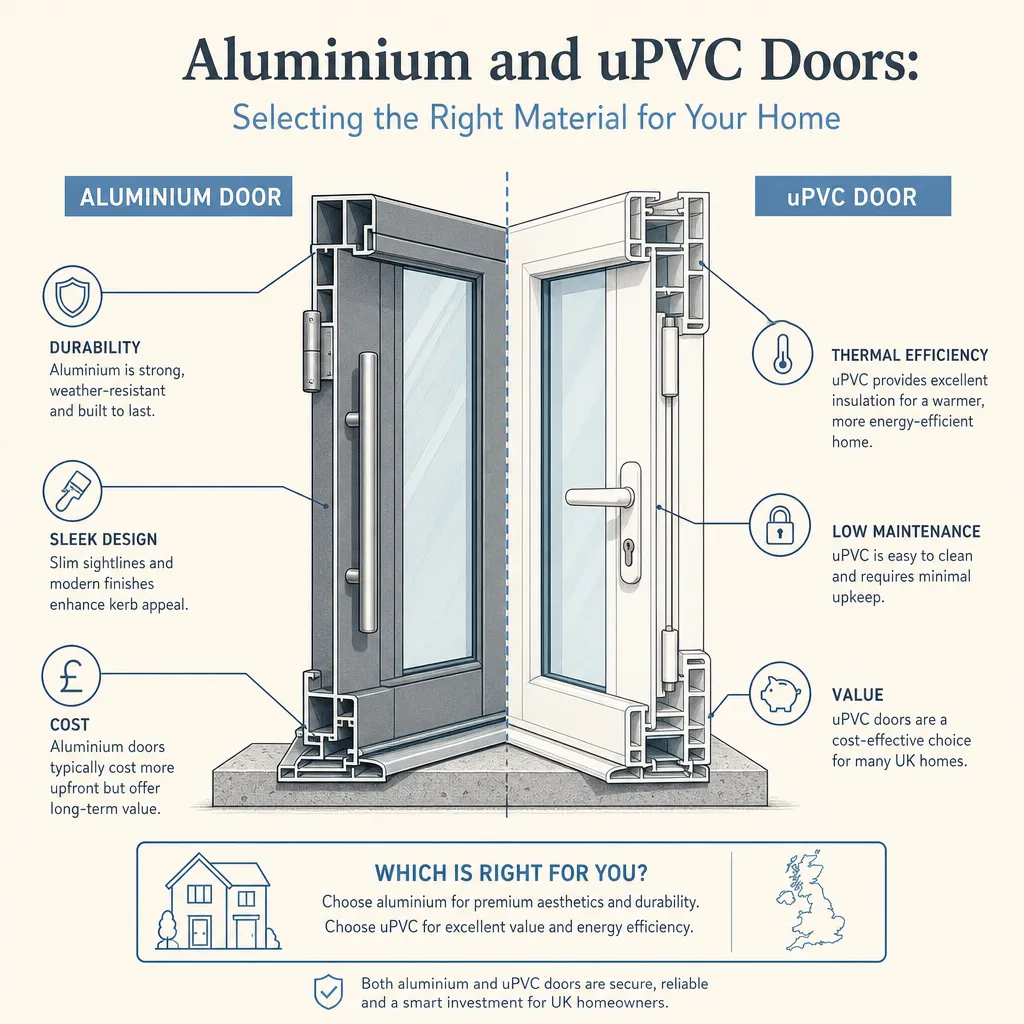
Aluminium and uPVC Doors: Selecting the Right Material for Your Home
uPVC doors are lower-cost and low-maintenance, making them a practical choice for most UK homes.