Planning Your Fencing Project: Initial Considerations and Timeline
By Housey · Last reviewed 7th of May 2026
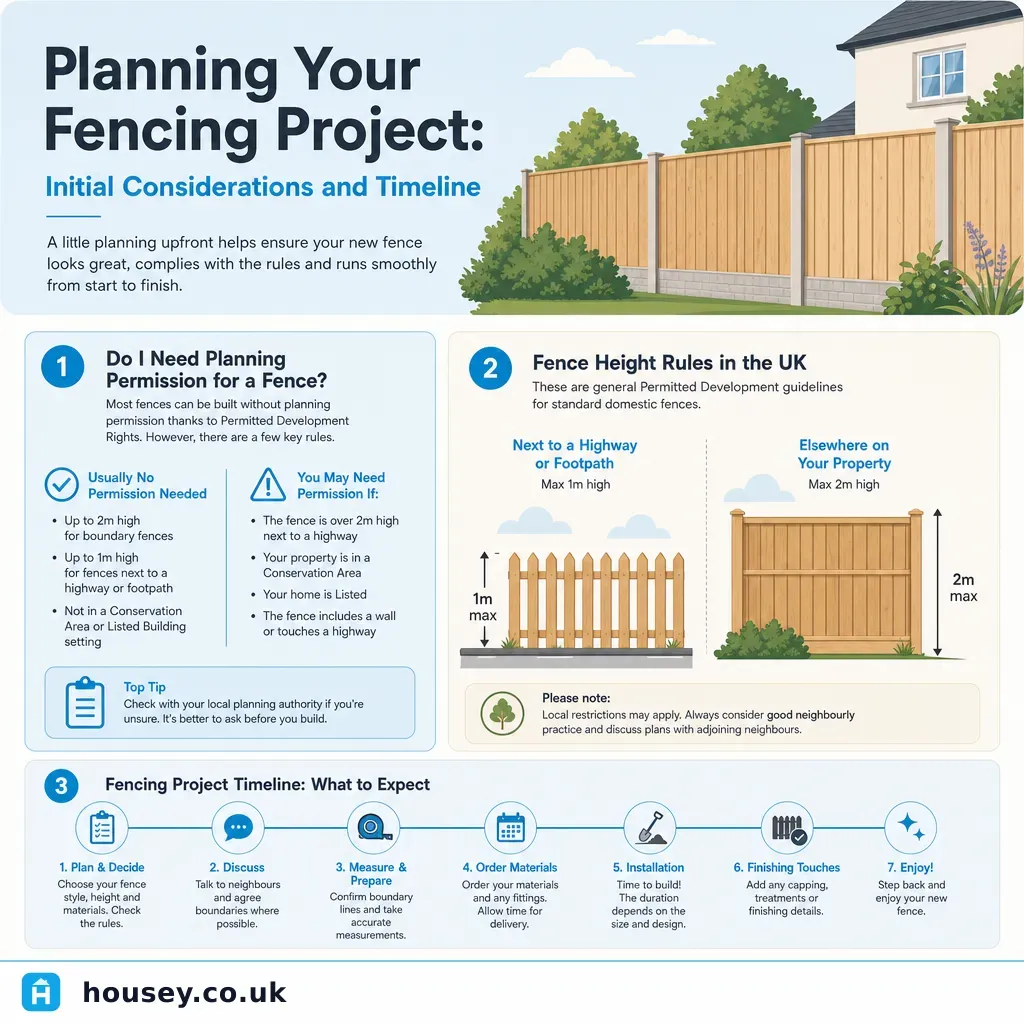
Planning Your Fencing Project: Initial Considerations and Timeline
Most homeowners reach this point after moving in, losing a fence in a storm, or beginning a garden redesign. What looks like a straightforward job — posts, panels, done — often involves planning rules, boundary questions, and material choices that catch people off guard. Getting the groundwork right before a single post goes in saves money, avoids neighbour friction, and keeps you on the right side of planning and property law.
Key points
- Fences over 2 metres in height — or over 1 metre if they adjoin a highway or public footpath — typically require planning permission under the Town and Country Planning (General Permitted Development) (England) Order 2015.
- In a conservation area or adjacent to a listed building, permitted development rights for fencing are often restricted or removed entirely; check with your local planning authority before ordering materials.
- The boundary itself determines ownership and maintenance responsibility; your title deeds or Land Registry title plan should clarify this before any work starts.
- Pressure-treated softwood fence panels typically last 10–20 years; composite or metal alternatives often carry manufacturer warranties of 20–25 years.
- Most straightforward residential fencing projects run 1–4 weeks from obtaining quotes to completion, though complex sites, hard ground, or special-order materials extend this considerably.
Do you need planning permission?
Planning permission is not required for most standard garden fences, but the rules contain important thresholds.
Under the Town and Country Planning (General Permitted Development) Order 2015 (as amended for England), fences, walls, and gates are classed as permitted development provided:
- The fence or wall does not exceed 2 metres in height.
- Where it is adjacent to a highway used for vehicle traffic — including a private drive that joins a public road — the height limit drops to 1 metre.
- The property is not in a conservation area, is not a listed building, and permitted development rights have not been withdrawn by a condition attached to a planning permission.
Wales, Scotland, and Northern Ireland operate under their own separate planning frameworks. Always check with your local planning authority (LPA) if you are in any doubt — planning enforcement notices can require removal at your cost.
Decision tree: do I need planning permission for my fence?
- Is the fence less than 2m tall AND not next to a highway? → Probably permitted development. Check your deeds for any conditions that withdraw PD rights.
- Is the fence 1m or less AND next to a highway? → Usually permitted development.
- Is the fence taller than either threshold? → You will likely need planning permission. Contact your LPA before starting work.
- Are you in a conservation area or adjacent to a listed building? → Contact your LPA before any work starts. Restrictions are common and can cover relatively modest fences.
- Has the property had planning conditions that restrict PD rights? → Check your original planning consent or ask your LPA for confirmation.
Understanding your boundary
Before any posts go in, establish who owns the boundary and whether it is shared.
Your Land Registry title plan shows the general position of registered boundaries, but it does not definitively establish exact legal ownership or the precise line on the ground. Boundary disputes are one of the most common causes of neighbour conflict in UK residential property.
Check your title deeds for T marks — a T on your side of a boundary line generally indicates you own and are responsible for that boundary. An H mark (a T on both sides) suggests a party boundary shared with your neighbour.
If ownership is unclear, have a conversation with your neighbour before work starts. For shared or party fence walls, both parties are normally involved in decisions about repair or replacement, and costs may be shared.
The Party Wall etc. Act 1996 applies primarily to party structures between properties, but work near a boundary involving excavation within 3 metres of a neighbour's building can also trigger notice obligations. If in doubt, speak to a party wall surveyor.
An official copy of your title plan costs £3 from HM Land Registry and is a sensible first step before any boundary work begins.
Choosing the right fencing material
The material you choose affects lifespan, maintenance requirements, cost, and appearance. Here is a practical comparison of common UK residential fencing options.
Material | Typical lifespan | Indicative installed cost per linear metre | Maintenance | Best for |
|---|---|---|---|---|
Pressure-treated softwood (panels) | 10–20 years | £80–£150 | Annual treatment recommended | Standard boundaries, cost-effective |
Hardwood (oak, iroko) | 20–30 years | £120–£250 | Low if properly installed | Decorative boundaries, longer-term investment |
Composite (wood/plastic blend) | 20–25 years | £150–£300+ | Very low | Low-maintenance gardens, modern aesthetics |
Metal (steel or aluminium) | 30+ years | £150–£400+ | Low to medium | Security fencing, contemporary design |
Concrete posts and gravel boards | 25–40 years | £100–£180 (posts and boards) | Very low | Supporting timber panels, preventing rot at the base |
Indicative UK costs, last reviewed 2026-05-07. Costs vary significantly by region, ground conditions, site access, and contractor. Obtain at least three written quotes before committing.
Planning your project timeline
A realistic timeline helps you avoid being left without a fence at the wrong time — high winds, frost, and the bird nesting season can all create complications.
- Week 1 – Preparation: Review title deeds, speak to neighbours, and check planning rules with your LPA if needed.
- Weeks 1–2 – Quotes: Obtain at least three written quotes. Specify panel size, material, post type (timber, metal, or concrete), and whether gravel boards are included.
- Week 2–3 – Booking: Confirm your contractor, agree a start date, and clarify who supplies materials if you are not using the contractor's supply.
- Week 3–4 – Installation: Most standard residential fencing installs in 1–3 days. Concrete post-setting requires a 24–48 hour cure before panels are fitted.
- Post-completion: Confirm removal and disposal of old fence materials — check this is included in your quote, as some contractors charge separately.
Note on nesting birds: Between approximately February and August, nesting birds may be present in existing hedges or overgrown fence lines. Disturbing an active nest is an offence under the Wildlife and Countryside Act 1981. If vegetation is involved, check for nests before clearing.
Homeowner checklist before work starts
Work through this before instructing a contractor:
Common pitfalls to avoid
Assuming the fence on the ground marks the legal boundary. Fences shift over time. Get a proper boundary check before installing a permanent structure.
Skipping neighbour communication. Even when you legally own the boundary, telling your neighbour in advance avoids complaints and preserves the relationship — particularly important on terraced or semi-detached properties.
Choosing the cheapest post option. Thin timber posts rot faster, especially if set directly into soil without concrete or a post spike. Concrete or metal posts, set properly, last considerably longer and are usually worth the modest extra cost.
Ignoring ground conditions. Rocky, clay-heavy, or waterlogged ground requires different installation methods. Your contractor should assess ground conditions at survey stage, not after starting work.
When to get professional help
Most residential fencing is a standard job for a competent fencing contractor. However, consider seeking specialist advice if:
- The boundary position is genuinely unclear or in active dispute with a neighbour.
- You are planning a fence over 2 metres, or on a highway boundary where planning rules are uncertain.
- The fence is adjacent to a listed building or in a conservation area.
- Ground conditions are unusual — steep slopes, clay soil, filled ground, or significant tree roots nearby.
- Excavation near a neighbouring structure raises questions about party wall obligations under the Party Wall etc. Act 1996.
For boundary disputes that cannot be resolved through conversation, a boundary surveyor or solicitor specialising in property law should be consulted before work starts.
How Housey can help
Housey connects you with vetted local contractors for improvement and build projects across the UK. If your fencing project is ready to go — boundary confirmed, neighbours consulted, planning rules checked — you can request quotes through the Housey platform to compare pricing and contractor details side by side.
Frequently asked questions
Do I need to tell my neighbour before I replace a fence?
There is no general legal requirement to notify a neighbour before replacing a fence you own, but it is strongly advisable. If the boundary is shared or the fence is a party structure, both owners are normally involved. Good communication avoids disputes and means your neighbour can prepare for any temporary access you may need during the work.
Can I put a fence on my boundary line?
Generally yes, if you own the boundary. However, the exact legal boundary line is often uncertain from title plans alone. In practice, many fences are built a small distance inside the legal boundary to avoid encroachment disputes. If there is any doubt, have the boundary properly checked before work starts.
What are concrete gravel boards and do I need them?
Gravel boards are horizontal boards fixed at the base of a fence panel, lifting it clear of the ground and preventing the timber from sitting in soil or water. They significantly extend the life of timber panels and are strongly recommended for any timber fence installed in a British climate.
How long does a concrete fence post take to set?
Standard rapid-setting concrete such as postcrete typically achieves adequate strength for panel-fitting within 24–48 hours in normal temperature conditions. Cold or wet weather significantly slows curing and can reduce final strength. A reputable contractor will allow adequate curing time and will not rush this stage.
Who is responsible for maintaining a boundary fence?
Responsibility usually follows ownership, which is shown in your title deeds by a T mark on your side of the boundary. However, many deeds are ambiguous and boundary ownership in the UK is often unclear. If there is a genuine dispute, seek advice from a solicitor experienced in property and boundary law.
Sources and further reading
- Permitted development rights for householders: technical guidance — GOV.UK
- Town and Country Planning (General Permitted Development) (England) Order 2015 — legislation.gov.uk
- Party Wall etc. Act 1996 — legislation.gov.uk
- Search for land and property information — HM Land Registry via GOV.UK
- Wildlife and Countryside Act 1981 — legislation.gov.uk
Useful next reads
 Improvement & Build
Seasonal Home Improvement: Planning and Executing Projects Throughout the Year
UK home improvement projects deliver best results when timed to suit the season.
 Improvement & Build
Small kitchen renovation: budgeting for costs and planning your project
A small kitchen renovation in the UK typically costs £5,000–£15,000 for a full refresh including new units, worktops, tiling, and appliances, though costs vary widely by specification, region, and whether structural changes or rewiring are involved.
 Improvement & Build
Conservatories and Garden Extensions: Design and Building Guide
Most conservatories qualify as permitted development in England if they are single-storey, within 50% of original curtilage, and meet dimensional limits.
 Improvement & Build
How to Find and Hire an Extension Builder
To hire a reliable extension builder, get at least three detailed written quotes from contractors with documented experience of similar projects.
 Improvement & Build
Painting Interior Doors: Preparation and Technique
Painting interior doors well depends on preparation rather than paint choice.