Plasterboard vs Drywall: Choosing Interior Wall Finishes for UK Properties
By Housey · Last reviewed 18th of May 2026
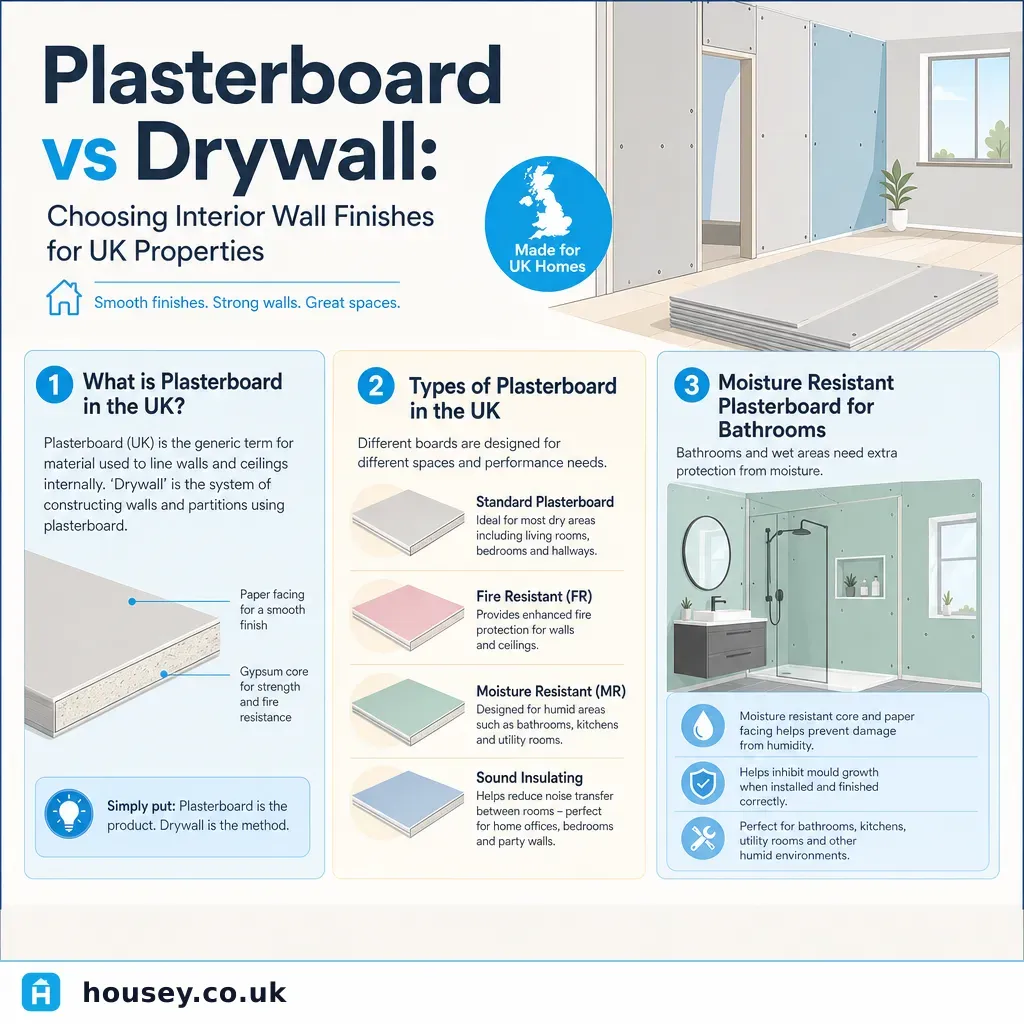
Plasterboard vs Drywall: Choosing Interior Wall Finishes for UK Properties
The term "drywall" appears frequently in American renovation guides, YouTube tutorials, and international building supplier catalogues — and if you are a UK homeowner planning a stud partition, a loft conversion, or a bathroom renovation, you may find yourself wondering whether it is the same product your local builder calls plasterboard, and whether North American installation advice applies here. Getting the specification wrong — choosing the wrong board type for the room's use or the regulatory requirement — can mean acoustic test failures, moisture problems, or a surface that does not respond as your plasterer expects.
Key points
- In the UK, "plasterboard" and "drywall" both refer to gypsum-core panels bonded between paper facings; UK practice finishes them with a 2–3 mm skim coat of finishing plaster, while American drywall practice uses jointing compound and tape without a skim coat.
- Standard UK plasterboard is 12.5 mm thick; 15 mm or doubled boards are used where acoustic mass or fire resistance is required under Building Regulations.
- British Standard BS EN 520:2004+A1:2009 defines gypsum board types including Type H (humidity-resistant), Type F (fire-resistant), and Type D (high-density acoustic).
- Building Regulations Approved Document E sets minimum airborne sound insulation standards (DnT,w + Ctr ≥ 45 dB for walls between dwellings) for separating walls and floors in new builds and material changes of use.
- Moisture-resistant (Type H) plasterboard is not waterproof — it must be paired with a tanking membrane or proprietary system in shower enclosures and persistently wet areas.
Are plasterboard and drywall the same thing?
Structurally, yes. Both consist of a gypsum plaster core bonded between two sheets of paper-faced lining. The differences are in terminology, finishing convention, and edge profile.
In the UK, the standard product is sold as plasterboard or simply "board" by manufacturers such as British Gypsum (Gyproc), Knauf, and Siniat. These boards are designed to receive a wet plaster skim coat as the final finish — usually a 2–3 mm coat of finishing plaster such as British Gypsum Thistle Finish. This skim produces a smooth, hard surface that bonds well to emulsion and eggshell paints.
American drywall finishing works differently: joints between boards are filled with compound (commonly called "mud"), reinforced with paper or fibreglass tape, feathered, and sanded smooth. No wet skim coat is applied. This eliminates wet trades and drying time but produces a subtly different surface texture and is unfamiliar to many UK plasterers.
Both methods are valid under UK Building Regulations. The choice is largely practical: who is doing the work, and what finish quality is required.
Which board type should you choose?
The more important decision is matching the board specification to the room's use and any regulatory performance requirements.
Board type | Best for | Not suitable for | Typical thickness | Relevant standard |
|---|---|---|---|---|
Standard plasterboard | General internal walls, ceilings, dry areas | Wet rooms, fire-critical or acoustic-critical separating walls | 12.5 mm | BS EN 520 Type A |
Moisture-resistant (Type H) | Bathrooms, kitchens, utility rooms — behind tiles or cladding | Direct prolonged water contact, below damp-proof course level | 12.5 mm | BS EN 520 Type H |
Fire-resistant (Type F) | Attached garages, loft conversion stairwells, party walls | Where acoustic performance alone is the driver | 12.5–15 mm | BS EN 520 Type F |
High-density acoustic (Type D) | Separating walls and floors, home studios, rented property partitions | — | 15 mm or doubled 12.5 mm | BS EN 520 Type D / Approved Document E |
Thermal-backed insulated board | Dry-lining solid external walls (dot-and-dab method) | Exposed or high-humidity situations | 37.5–52.5 mm (board + insulation laminate) | Approved Document L |
Skim coat versus jointing compound: which finishing method suits your project?
Skim coat (standard UK approach)
A 2–3 mm coat of finishing plaster applied to the primed board face is the default expectation of UK plasterers. It adds half a day to a full day of working time plus drying time before painting — typically 24–48 hours in warm conditions, longer in winter. The result is a hard surface that bonds well to most decorative coatings.
Jointing compound (American drywall approach)
Joint compound is applied, taped, feathered, and sanded over joints and fixings only; the board face is primed and painted directly. This eliminates wet trades but achieving a flawless result takes practice — any unevenness in feathering tends to show up in raking light once painted.
Decision guide
- Choose skim coat if you are hiring a UK plasterer, you want a durable hard finish, or your boards have tapered edges designed for skim.
- Choose jointing compound if you are finishing a garden room or utility space yourself, you want to avoid wet trades, and you have sourced tapered-edge boards specifically for jointing.
- Ask an architectural technologist if your project involves a separating wall requiring acoustic compliance testing, a Listed Building, or an unusual performance specification — the finish method may interact with pre-completion testing requirements.
Acoustic and fire performance: what the regulations require
Fire performance (Approved Document B)
Where plasterboard forms part of a fire-resisting construction — for example, the ceiling below a habitable loft room, or a wall between an attached garage and the house — Approved Document B specifies minimum fire-resistance periods (commonly 30 or 60 minutes). British Gypsum, Knauf, and Siniat publish tested system specifications confirming which board thicknesses and fixing patterns achieve rated performance. Do not substitute board types within a tested system without checking the manufacturer's data sheets.
Acoustic performance (Approved Document E)
For separating walls and floors in new dwellings and conversions, Approved Document E requires pre-completion acoustic testing. The performance standard depends on the entire system specification — board mass, resilient bars, quilt type — not the board alone. Check with a building control officer or acoustic consultant if in doubt about the system design.
When to get professional help
For straightforward internal stud partitions in dry rooms, a competent builder or experienced DIYer can handle plasterboard installation. Seek qualified help when:
- The wall is a party wall or separating wall requiring acoustic or fire performance testing before sign-off.
- You are dry-lining an external solid wall and need to comply with Part L thermal standards.
- The project is in a Listed Building — consult a conservation specialist before covering historic fabric with board.
- You are unsure whether an existing wall is load-bearing before cutting openings or fixing heavy boards to it.
- Working height requires staging above 2 m — appropriate equipment and risk assessment are needed.
How Housey can help
Whether you are planning a loft conversion, a new extension, or a straightforward room partition, Housey connects you with vetted extension builders and architectural technologists who can specify and install the right board system for your project and ensure compliance with Building Regulations from the outset.
Frequently asked questions
Is drywall the same as plasterboard in the UK?
Yes — both terms describe gypsum-core panels bonded between paper facings. In the UK, "plasterboard" is the standard term. The practical difference lies in finishing convention: UK practice applies a wet skim coat of finishing plaster, while North American drywall uses jointing compound and tape. Both methods are acceptable under UK Building Regulations.
Do I need moisture-resistant plasterboard in a bathroom?
Moisture-resistant (Type H) plasterboard is advisable behind tiles in bathrooms but is not waterproof. In shower enclosures and wet areas it must be combined with a tanking membrane or proprietary waterproofing system. Standard plasterboard should not be used where it will be regularly exposed to moisture or steam.
What thickness of plasterboard is standard in UK homes?
12.5 mm is the most common thickness for walls and ceilings. 15 mm is used where improved rigidity, acoustic mass, or fire resistance is needed — for example on ceilings spanning wide joists, or as part of a tested fire-resisting system specified under Approved Document B.
Can I skim over drywall jointing compound?
Skimming over cured jointing compound is possible, but the compound must be fully dry and any suction difference between the compound and board face managed carefully — usually with a PVA bonding agent applied first. Most UK plasterers prefer boards that have not been pre-jointed. Check with your plasterer before starting.
Sources and further reading
- Approved Document B: Fire Safety — GOV.UK
- Approved Document E: Resistance to the passage of sound — GOV.UK
- Approved Document C: Site preparation and resistance to contaminants and moisture — GOV.UK
- British Gypsum White Book — technical specifications — British Gypsum
- BS EN 520 — Gypsum plasterboards: definitions, requirements and test methods — BSI Group
Useful next reads
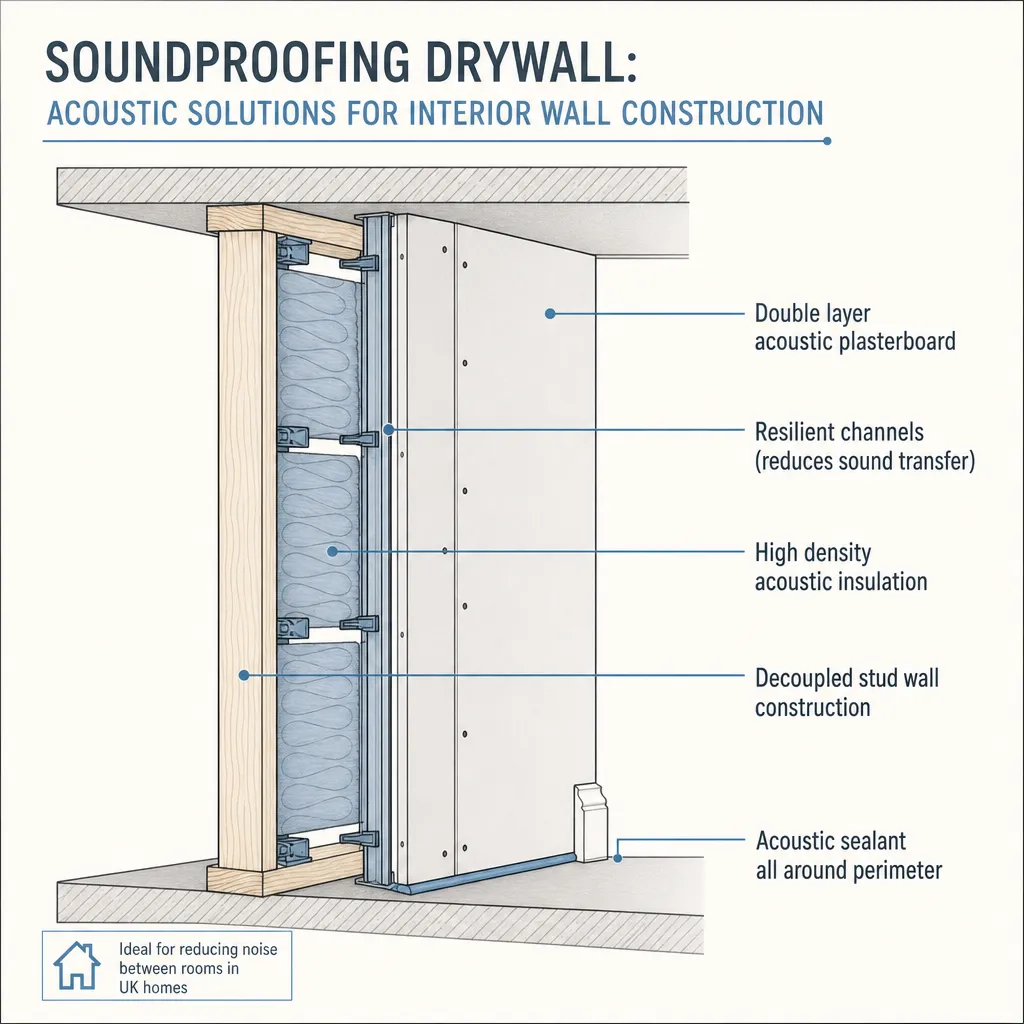 Improvement & Build
Soundproofing drywall: acoustic solutions for interior wall construction
Soundproofing drywall in UK homes typically combines acoustic plasterboard, resilient bar fixings, and mineral wool cavity fill to reduce airborne and structure-borne noise.
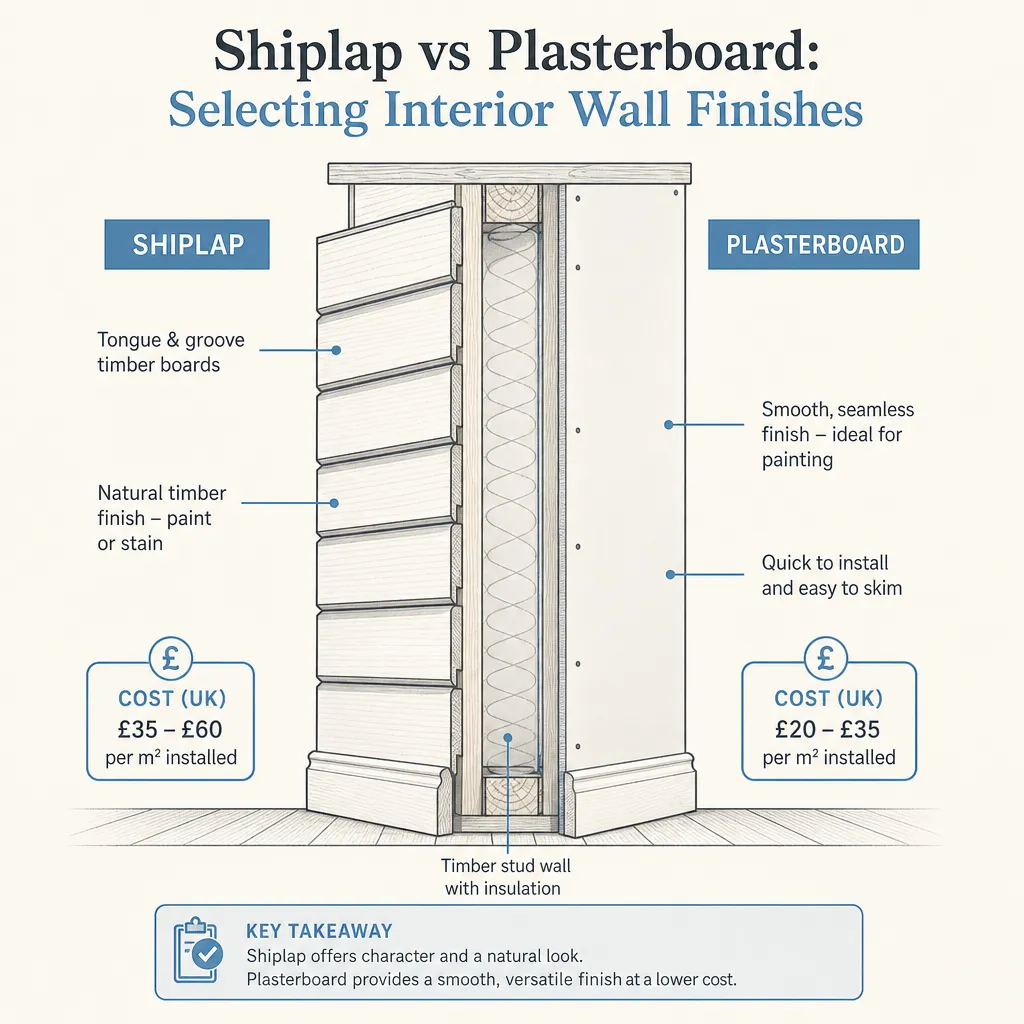 Improvement & Build
Shiplap vs Plasterboard: Selecting Interior Wall Finishes
Plasterboard is the standard interior wall finish for most UK homes and extensions, offering a smooth, paintable surface at lower cost.
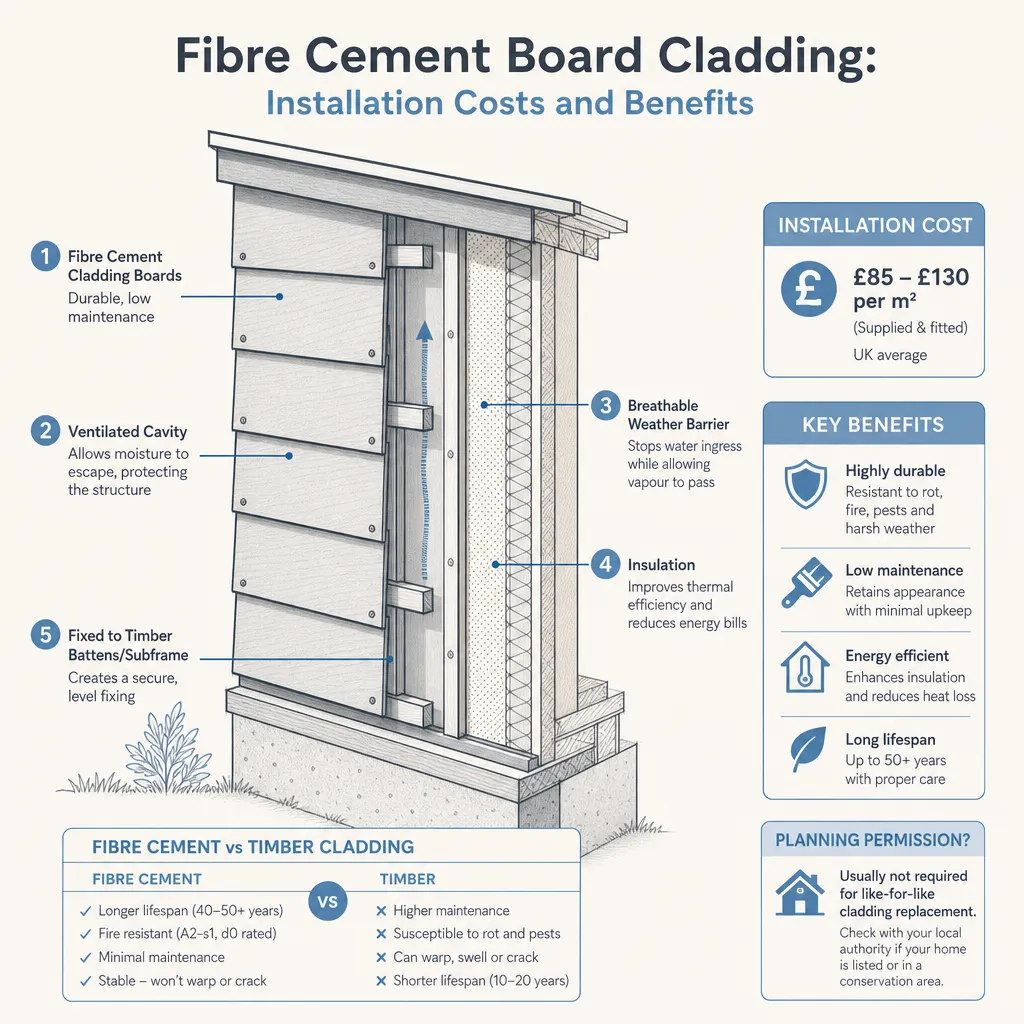 Improvement & Build
Fibre Cement Board Cladding: Installation Costs and Benefits
Fibre cement board cladding typically costs £80–£180 per m² installed in the UK, including boards, battens, breather membrane, and labour.
 Improvement & Build
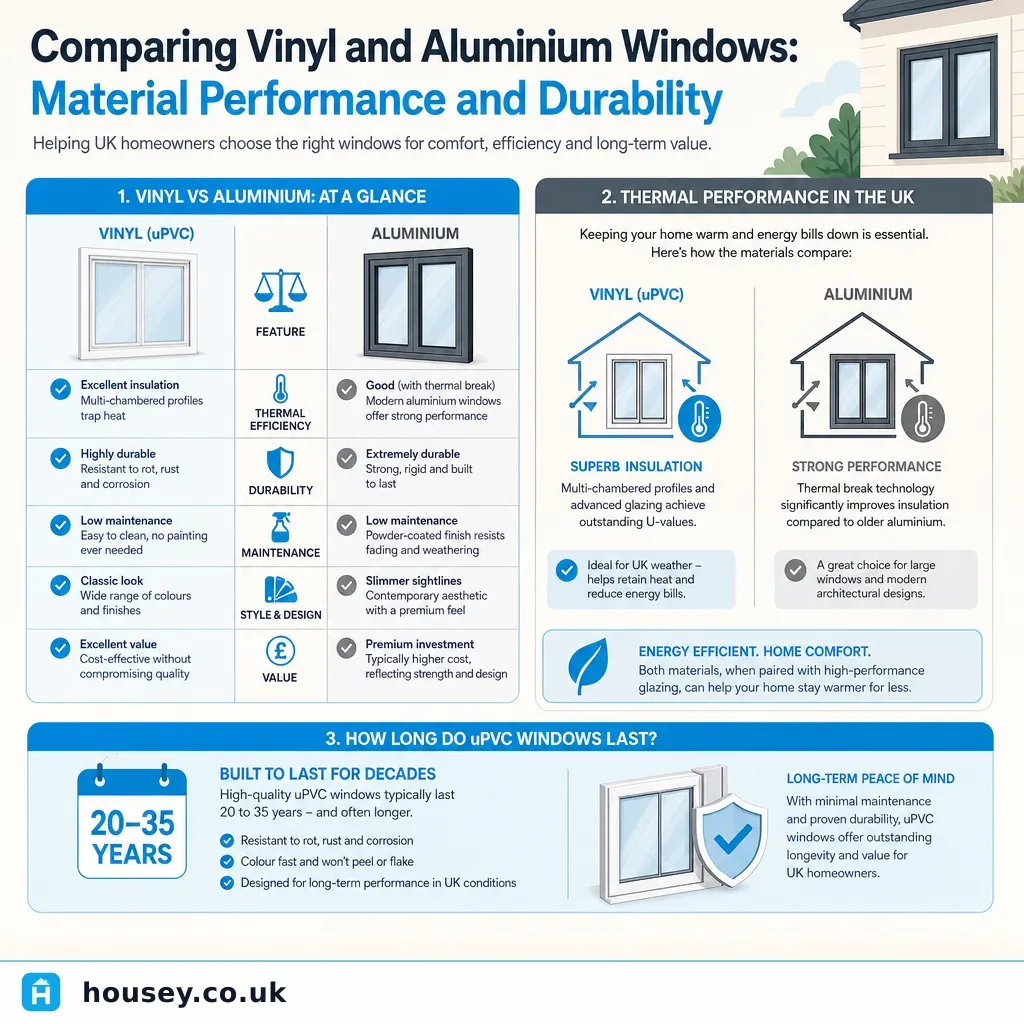
Comparing Vinyl and Aluminium Windows: Material Performance and Durability
uPVC (vinyl) and aluminium windows both meet UK Building Regulations Part L when properly specified.
 Improvement & Build
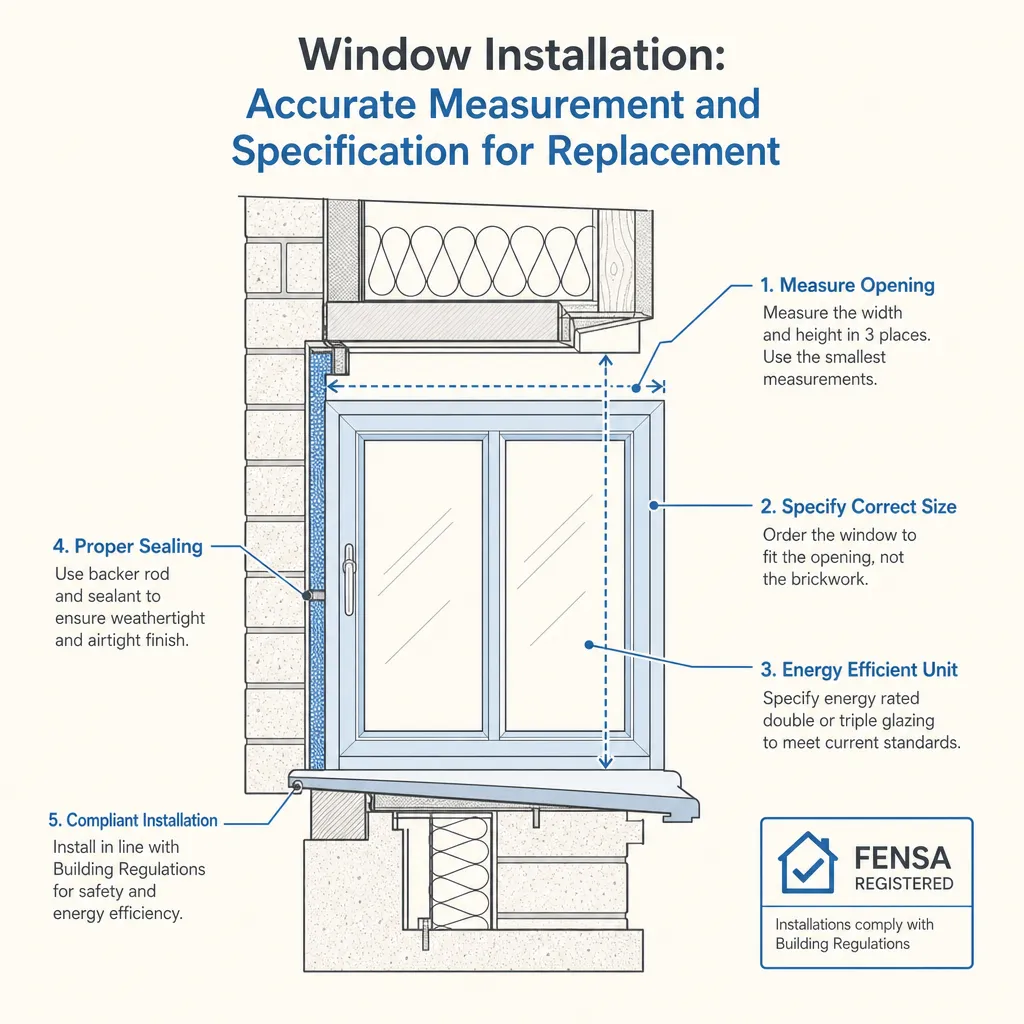
Window Installation: Accurate Measurement and Specification for Replacement
Accurate window measurement for replacement means recording the width and height of the existing frame opening in at least three places, noting the smallest dimension, and providing a full specification to your installer — including frame material, glazing type, opening style, and trickle ventilators.