Shiplap vs Plasterboard: Selecting Interior Wall Finishes
By Housey · Last reviewed 18th of May 2026
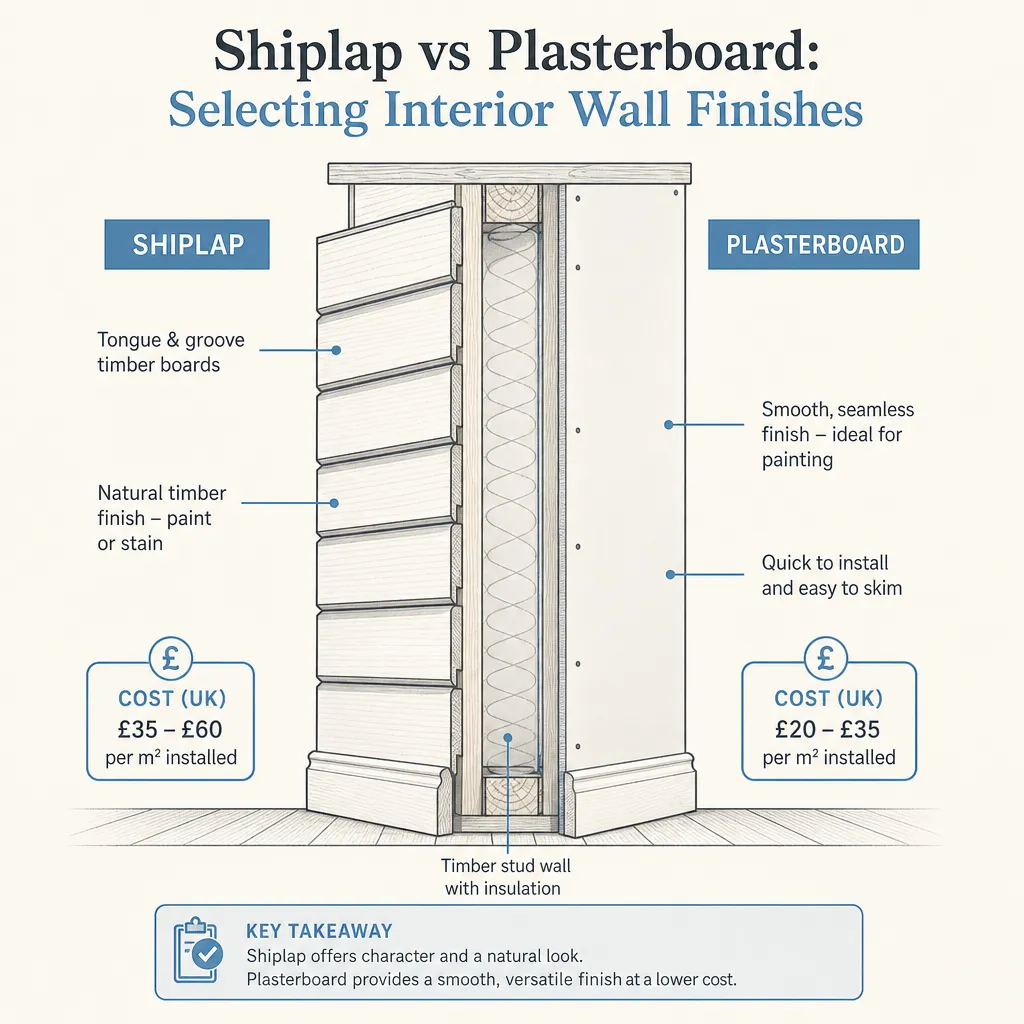
Shiplap vs Plasterboard: Selecting Interior Wall Finishes
Whether you are lining a new extension, renovating an older room, or planning a feature wall, choosing between shiplap cladding and plasterboard affects your budget, timeline, maintenance requirements, and the final character of the space. UK homeowners face this decision most often during extension builds, loft conversions, and full room refurbishments — contexts where the wall finish has long-term consequences for thermal performance, acoustic separation, and compliance with Building Regulations.
Key points
- Plasterboard (gypsum board or drywall) is the standard UK interior wall lining, typically 12.5 mm for general use, or 15 mm for fire-rated (Type F) and acoustic (Type A) applications per BS EN 520.
- Shiplap is a timber or composite cladding system with rebated or overlapping boards; interior grades include pine, MDF, and moisture-resistant PVC-cored composites suited to humid environments.
- Building Regulations Part B (fire) and Part E (sound insulation) set performance requirements for wall build-ups in regulated spaces — plasterboard systems have certified tested assemblies; shiplap used as the sole lining often does not.
- Indicative material costs: standard plasterboard £4–£10 per m²; pine shiplap boarding £8–£20 per m² (Indicative UK costs, last reviewed 2026-05-18 — prices vary by supplier and region).
- A skim-plaster finish over plasterboard adds approximately £10–£18 per m² in labour; painted shiplap requires no skim but needs priming, filling, and at least two topcoats.
When plasterboard is the standard choice
Plasterboard is specified in the vast majority of UK domestic construction projects for good reason. It creates a flat, fire-resistant, paintable surface that integrates with standard finishing trades. Most builders, plasterers, and decorators work with it daily, which keeps labour costs competitive and makes compliance documentation straightforward.
For extensions subject to Building Regulations, plasterboard systems with certified fire ratings and acoustic values are relatively simple to specify and inspect. Products such as British Gypsum Gyproc Fireline and Knauf Fire Panel come with documented system performance data, making sign-off by a building control body easier.
Plasterboard is usually the practical choice when:
- The wall is part of an extension, loft conversion, or conversion under building control.
- You want a smooth, seamless finish for contemporary or neutral décor and intend to skim-plaster.
- The room requires fire compartmentation — for example, an integral garage wall or a flat separating wall.
- Acoustic performance between rooms matters; a Type A board with a resilient bar system is a common tested assembly under Part E.
When shiplap makes sense
Interior shiplap creates a textured, tactile surface popular for feature walls, utility rooms, garden rooms, snugs, and coastal or Scandi-style interiors. It can be the right choice when:
- You want a strong decorative character that paint alone will not achieve.
- The room is a low-humidity habitable space, or you specify moisture-resistant boards for wet areas.
- Speed of installation matters — shiplap boards can be fitted directly over existing walls without a skim coat.
- You are fitting out a log cabin, garden office, or outbuilding where a more rustic aesthetic suits the structure.
Shiplap is less suited as the primary structural lining of a habitable extension or conversion. It generally lacks the tested fire and acoustic performance required by Building Regulations unless paired with a compliant board underneath. Check with your building control surveyor before specifying shiplap as the sole lining in any regulated space.
Shiplap vs plasterboard: side-by-side comparison
Factor | Plasterboard | Interior shiplap (timber or composite) |
|---|---|---|
Typical use | Extensions, conversions, all rooms | Feature walls, utility rooms, garden rooms |
Fire performance | Certified Type F boards available | Timber is combustible — typically needs FR board behind in regulated spaces |
Acoustic performance | Tested assemblies (Type A boards + resilient bar) | Limited unless backed with mineral wool and plasterboard |
Moisture resistance | MR grades widely available | MR composite boards available; solid pine needs sealing |
Indicative material cost | £4–£10 per m² | £8–£20 per m² |
Finishing labour | Skim plaster then paint | Prime, fill, and paint — no skim needed |
DIY suitability | Moderate (boarding manageable; skimming is a trade skill) | Moderate to good (cutting and fixing manageable for a confident DIYer) |
Building Regulations compliance | Widely tested and certified | Confirm with building control if used as sole lining |
Repairability | Patching is straightforward | Matching aged or painted timber boards is harder |
Indicative UK costs, last reviewed 2026-05-18.
Which should you choose?
Use this decision tree to identify the right approach for your project.
- Choose plasterboard if the wall is part of an extension, loft conversion, or new-build under building control — standard systems have certified fire and acoustic performance.
- Choose plasterboard if you want a smooth, seamless finish for contemporary décor and intend to skim-plaster.
- Choose shiplap if the wall is a purely decorative feature wall in an existing habitable room — hallway, bedroom, or living room — where Building Regulations do not govern the lining choice.
- Choose moisture-resistant composite shiplap if you want a textured look in a bathroom or kitchen, provided the boards carry a humidity rating for that environment.
- Combine both if you need to meet Part B or Part E requirements but also want a shiplap aesthetic — a compliant plasterboard inner lining with shiplap boards fixed over it satisfies both objectives.
- Ask a builder or building control officer if the wall is a party wall, a separating wall between dwellings, or adjacent to a garage or boiler room — these locations have specific fire requirements needing professional assessment.
Indicative costs for a 15 m² bedroom wall
Stage | Plasterboard route | Shiplap route |
|---|---|---|
Materials | ~£75–£150 | ~£120–£300 |
Boarding or fixing labour | ~£150–£250 | ~£100–£200 |
Skim plaster (plasterboard only) | ~£150–£270 | — |
Priming and painting | ~£100–£200 | ~£100–£200 |
Indicative total | ~£475–£870 | ~£320–£700 |
Indicative UK costs, last reviewed 2026-05-18. Prices vary significantly by region, access, and contractor. Always obtain at least three itemised quotes.
When to get professional help
Most plasterboard work in an extension or conversion should be carried out or supervised by a qualified builder, particularly where fire or acoustic compliance is required. Consider seeking professional advice if:
- The project is subject to a building control application — your building control surveyor or approved inspector can confirm which wall assemblies are acceptable.
- The wall is a party wall, separating wall, or immediately adjacent to a garage.
- You are unsure whether existing fixings or the wall substrate can support the weight of shiplap boarding.
- You want to combine tiling, underfloor heating, or a wet-room finish alongside a shiplap aesthetic — moisture management planning is important in these situations.
How Housey can help
If you are planning an extension or renovation where wall finishes form part of a larger build, connecting with a vetted extension builder through Housey can help you get accurate, itemised quotes and professional guidance on material specifications before work begins.
Frequently asked questions
Can I fix shiplap directly to an existing plasterboard wall?
Yes, in most cases. Use ring-shank nails or screws into the timber studs behind the plasterboard rather than relying on adhesive alone. Check that the existing plasterboard is sound and that the additional weight will not cause fixings to pull through. For a decorative feature wall in a habitable room, this is usually a straightforward approach.
Does shiplap meet Building Regulations for an extension?
Shiplap alone typically does not satisfy the fire and acoustic requirements for the inner lining of a habitable extension. You would normally need a compliant plasterboard lining — at minimum 12.5 mm standard board, or a Type F fire-rated board in relevant locations — with shiplap fixed over it decoratively. Always confirm the specific wall assembly with your building control body before proceeding.
Is plasterboard or shiplap better for a damp or humid room?
Both are available in moisture-resistant grades. For bathrooms or wet rooms, specify moisture-resistant (MR) plasterboard — sometimes called aquaboard — or a PVC-cored composite shiplap rated for wet environments. Standard pine shiplap will swell and deteriorate in persistent damp unless thoroughly sealed and maintained.
How long does it take to board and finish a room?
Boarding a standard bedroom with plasterboard typically takes a skilled team one to two days, plus a further one to two days for the skim coat and drying time. Shiplap can reach a decorative finish slightly faster as there is no skim coat, though cutting and fitting individual boards carefully still takes time. Always allow full paint drying time before moving furniture back.
Sources and further reading
- Approved Document B: Fire Safety — GOV.UK
- Approved Document E: Resistance to the Passage of Sound — GOV.UK
- British Gypsum White Book: System Performance Data — Saint-Gobain / British Gypsum
- Building Regulations: Approved Documents collection — GOV.UK
Useful next reads
 Improvement & Build
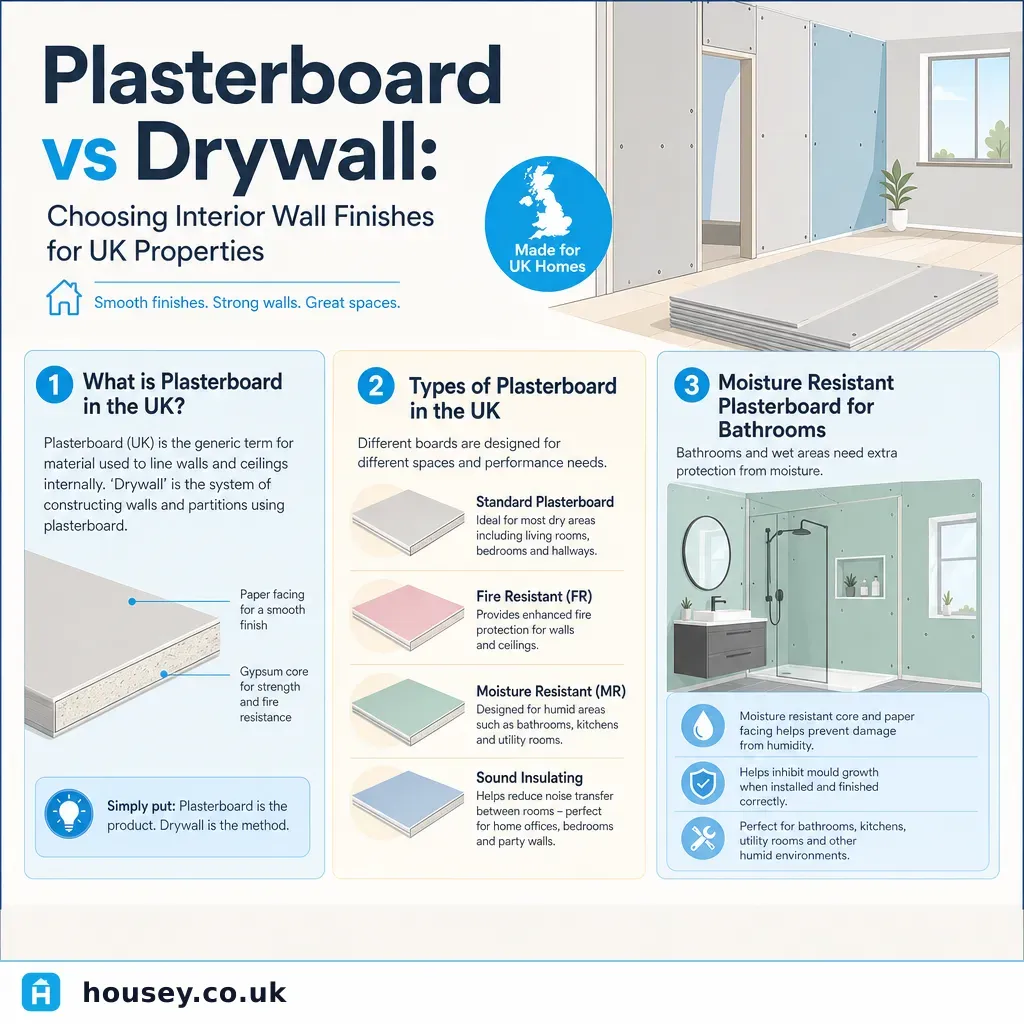
Plasterboard vs Drywall: Choosing Interior Wall Finishes for UK Properties
In the UK, plasterboard and drywall describe the same gypsum-core panel material.
 Improvement & Build
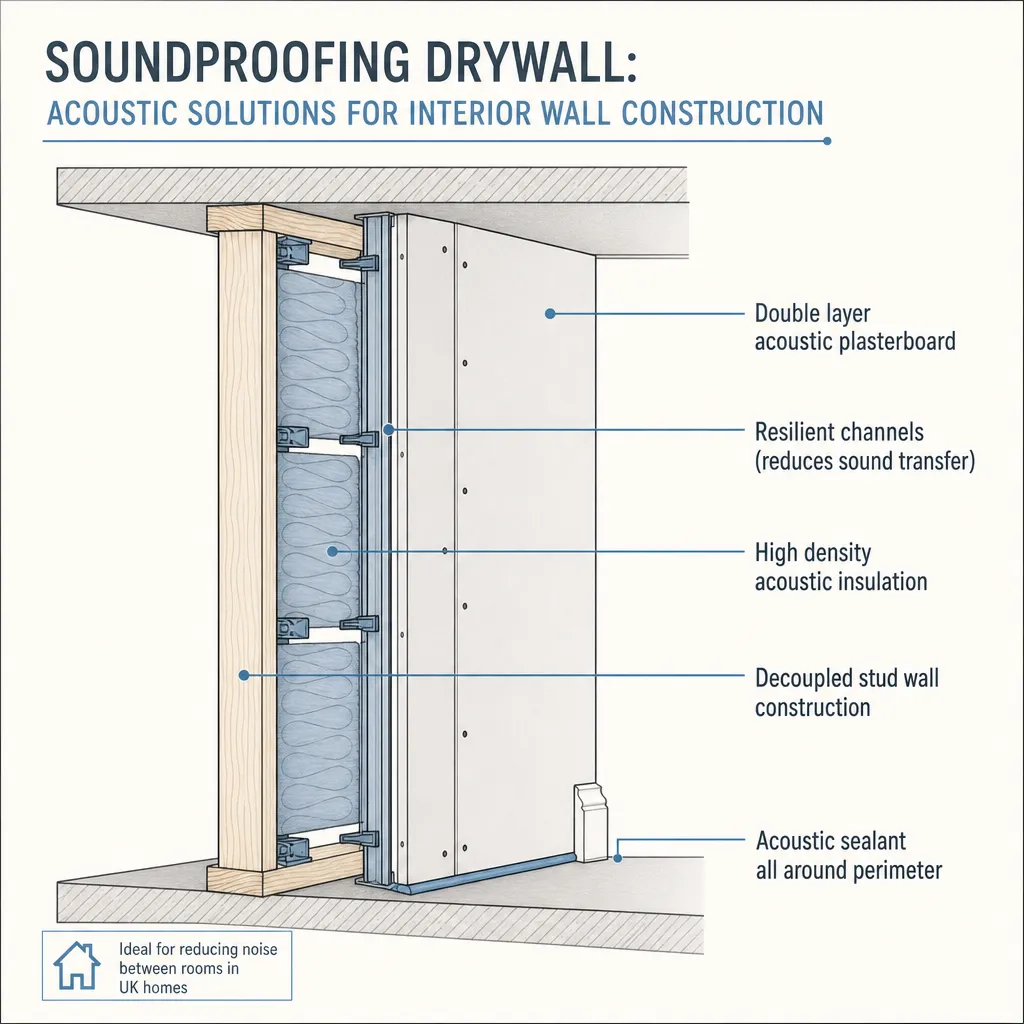
Soundproofing drywall: acoustic solutions for interior wall construction
Soundproofing drywall in UK homes typically combines acoustic plasterboard, resilient bar fixings, and mineral wool cavity fill to reduce airborne and structure-borne noise.
 Improvement & Build
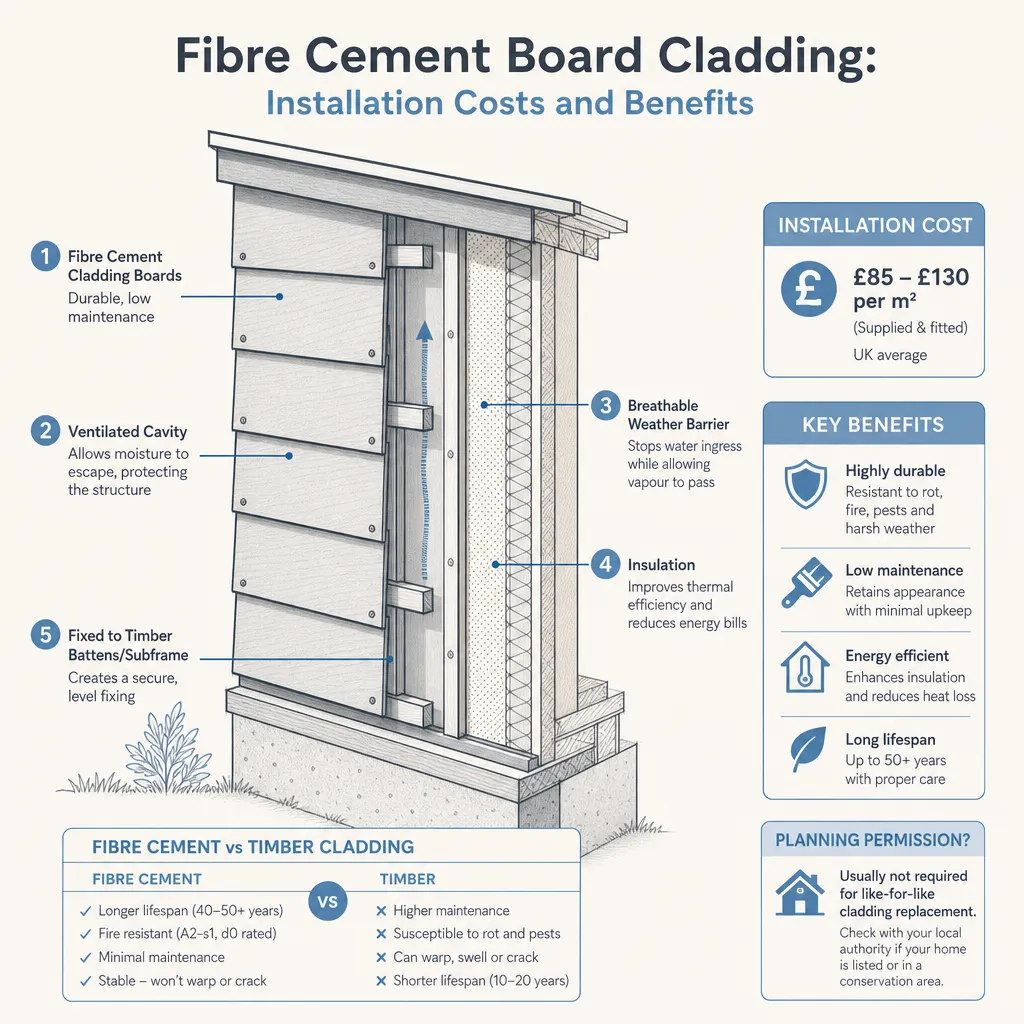
Fibre Cement Board Cladding: Installation Costs and Benefits
Fibre cement board cladding typically costs £80–£180 per m² installed in the UK, including boards, battens, breather membrane, and labour.
 Improvement & Build
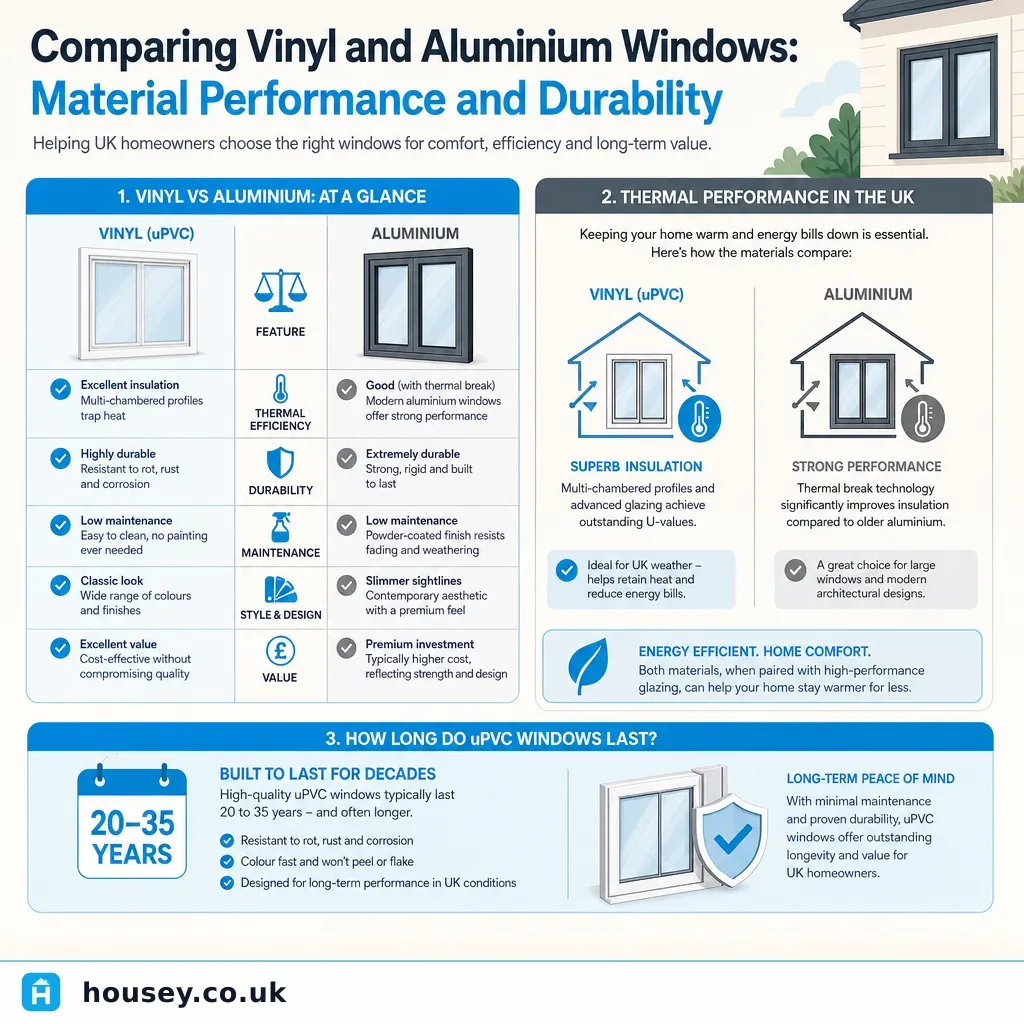
Comparing Vinyl and Aluminium Windows: Material Performance and Durability
uPVC (vinyl) and aluminium windows both meet UK Building Regulations Part L when properly specified.
 Improvement & Build
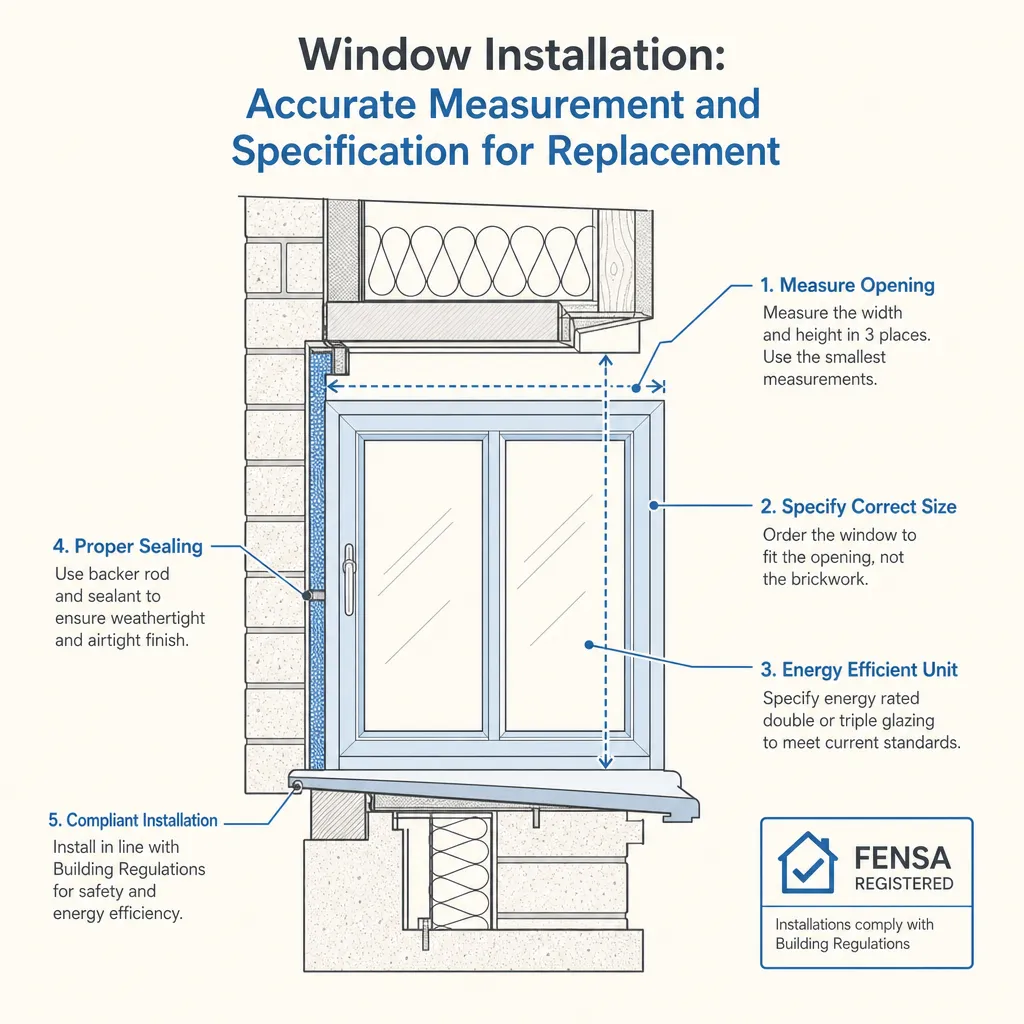
Window Installation: Accurate Measurement and Specification for Replacement
Accurate window measurement for replacement means recording the width and height of the existing frame opening in at least three places, noting the smallest dimension, and providing a full specification to your installer — including frame material, glazing type, opening style, and trickle ventilators.