Plastering Over Artex: Preparation, Process, and Asbestos Considerations
By Housey · Last reviewed 5th of May 2026
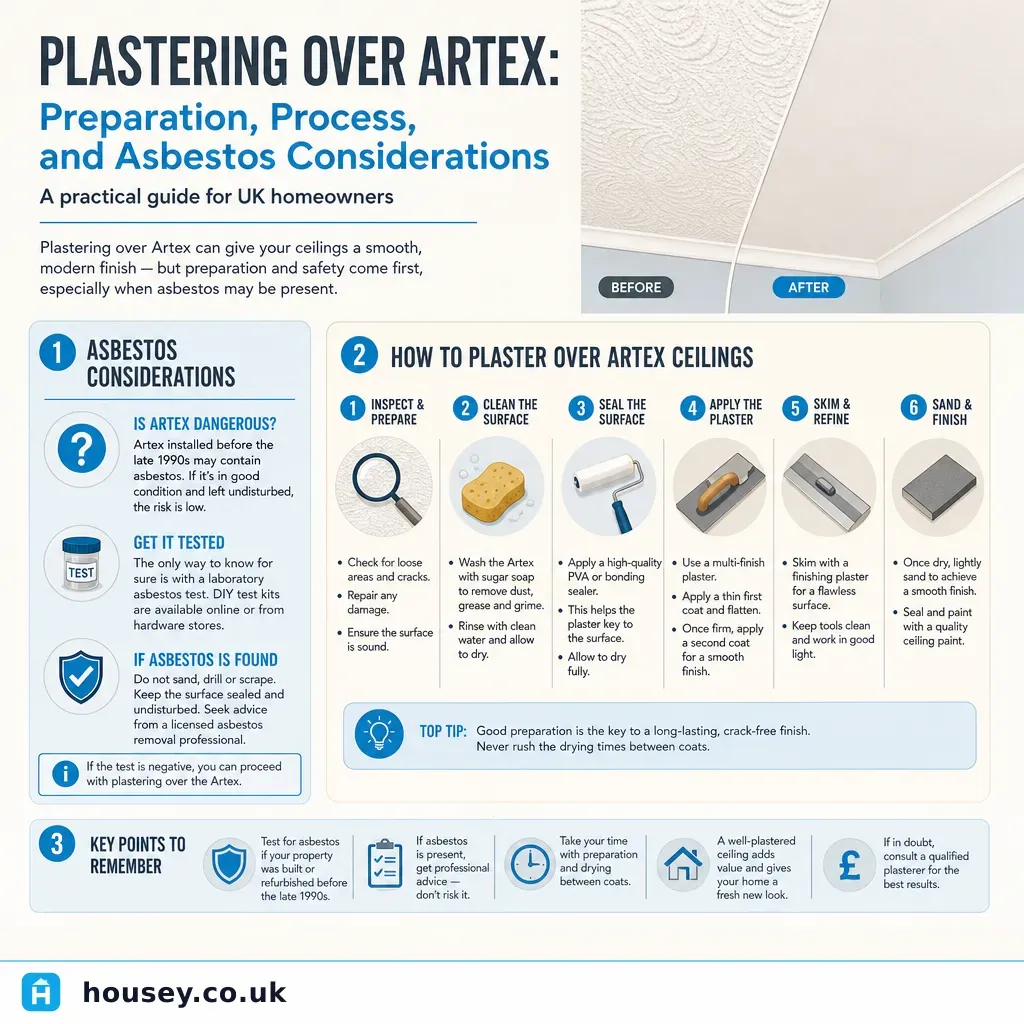
Plastering Over Artex: Preparation, Process, and Asbestos Considerations
Artex and other textured decorative coatings were installed in millions of UK homes from the 1950s to the 1990s. When homeowners plan replastering work, the critical question is whether the coating contains asbestos — a reinforcing agent added to many textured coatings until it was banned in the UK in 1999.
Key points
- Artex installed before 2000 should be assumed to contain chrysotile (white) asbestos until proven otherwise by a bulk sample test at a UKAS-accredited laboratory.
- Plastering over intact artex — known as encapsulation — is generally permissible under HSE guidance provided the coating is undamaged and is not sanded, drilled, or abraded.
- The Control of Asbestos Regulations 2012 requires a risk assessment before any work that may disturb asbestos-containing materials.
- A PVA bonding coat — typically 1 part PVA to 4 parts water — is required before skimming over artex to achieve adequate adhesion.
- Artex installed before 1985 is considered highly likely to contain asbestos at concentrations of up to 3–5% by weight.
Does Artex in My Home Contain Asbestos?
Products installed before 1985 are highly likely to contain chrysotile asbestos. Those installed between 1985 and 1999 may contain asbestos at lower concentrations. Only products installed from 2000 onwards are asbestos-free. The sole reliable test is bulk sample analysis by a UKAS-accredited laboratory; a qualified asbestos surveyor or specialist contractor should take the sample safely.
What the test result means for your project
- No asbestos detected: You can proceed with surface preparation and plastering using standard precautions.
- Asbestos confirmed, coating in good condition: Encapsulation by plastering over is generally the recommended and permissible approach under HSE guidance.
- Asbestos confirmed, coating damaged, flaking, or friable: Specialist stabilisation or removal is required before plastering begins. Do not proceed until a qualified contractor has assessed and treated the material.
Should You Test, Encapsulate, or Remove? A Decision Tree
- Test first if your home predates 2000 and you have no written asbestos survey confirming the artex is clear.
- Choose encapsulation if asbestos is confirmed and the coating is firmly adhered and undamaged — this is often the safest, most cost-effective approach.
- Choose removal if the coating is damaged, flaking, or building works will otherwise disturb it; removal of asbestos-containing artex must be carried out by an HSE-licensed or appropriately trained contractor under the Control of Asbestos Regulations 2012.
- Ask a UKAS-accredited asbestos surveyor if you are unsure of the coating’s condition, if there is visible damage, or if other building works may affect the ceiling.
- Check HSE EH37 guidance before instructing any contractor to work on suspected asbestos-containing artex.
Surface Preparation and Methods: A Comparison
Option | Best for | Not ideal for | Main risk |
|---|---|---|---|
PVA and two-coat skim | Light-to-medium texture in good condition | Deep or uneven texture; damaged artex | Cracking if surface not properly sealed |
Bonding coat then skim | Deep or heavily textured artex; previously painted artex | Fresh artex in excellent condition | Adds weight; requires skilled application |
Plasterboard overlay (dot-and-dab or batten-fixed) | Any artex including asbestos-containing material | Rooms where ceiling height loss matters | Adds 12–15 mm to ceiling; fire stopping required at edges |
Wet-scrape removal | Confirmed asbestos-free artex only | Any confirmed asbestos-containing artex | Can damage the ceiling substrate |
For PVA application: apply a first coat at 1:4 (PVA to water) and allow to dry to a tacky finish. Apply a second coat at 1:3 immediately before plastering. Fibreglass scrim tape should bridge any cracks before the second coat.
Red Flags: When to Stop and Seek Advice
- Artex is flaking, soft, or sounds hollow when tapped — adhesion has failed and the material must be stabilised before any plastering can proceed.
- Brown water stains are visible — an active or past leak must be identified and resolved before plastering begins.
- Stepped or hairline cracks run across the ceiling — this may indicate substrate movement rather than surface deterioration alone.
- The property predates 2000 and no written asbestos test result exists — do not proceed with plastering until a test has been carried out.
Important Limitations
This article is general information only and is not a substitute for a professional assessment of your specific property. Asbestos regulations, safe-work methods, and testing requirements depend on the condition of the material and the nature of planned works under the Control of Asbestos Regulations 2012. Rules can vary by property type and tenure. Always seek advice from a qualified asbestos surveyor or licensed contractor before proceeding with any work on suspected asbestos-containing materials.
What to Ask a Qualified Professional
Before instructing a contractor or surveyor, ask:
- Are you UKAS-accredited, or do you use a UKAS-accredited laboratory for bulk sample analysis?
- What is your experience of working with asbestos-containing textured coatings in domestic properties?
- Will you provide a written risk assessment and method statement before starting work?
- If asbestos is confirmed, what respiratory protective equipment (RPE) and PPE will be used, and will the area be sealed off during any disturbance?
- Will you provide a waste transfer note if asbestos-containing material is removed?
- What surface preparation will you carry out to ensure the skim coat adheres correctly, and what warranty do you offer on the finished work?
When to Get Professional Help
Seek professional help if: the property predates 2000 and no asbestos test has been carried out; any artex is damaged, flaking, or appears friable; planned work involves cutting, drilling, or sanding the ceiling; or a water leak has affected the ceiling and the artex condition is uncertain. Landlords should note their specific management duties under the Control of Asbestos Regulations 2012.
Do not sand, drill, or use power tools on artex that may contain asbestos. If in doubt, stop work and arrange a test.
How Housey Can Help
If you need to find a qualified plasterer or arrange a professional asbestos assessment before work begins, Housey can connect you with specialist contractors in your area. Use Housey’s quote request service to describe your project and compare responses from local professionals.
Frequently Asked Questions
Is it safe to plaster over artex that contains asbestos?
Plastering over intact, well-adhered artex containing asbestos is generally a low-risk encapsulation method under HSE guidance, as fibres are not released when the material is undisturbed. The coating must not be sanded, drilled, or scraped. A written risk assessment by a qualified professional should be carried out before work begins.
How much does it cost to plaster over an artex ceiling?
Indicative UK costs, last reviewed 2026-05-05. A skim coat over a standard bedroom ceiling (approximately 12 m²) typically ranges from £200 to £450 including labour; ceilings needing a bonding coat first will cost more. Costs vary by region, texture depth, and condition. Obtain at least three written quotes and confirm what preparation work is included in each.
Do I need to inform anyone if my artex contains asbestos?
For homeowners encapsulating asbestos-containing artex without disturbance, there is no general legal notification requirement. Work that disturbs the material — including removal — may require HSE notification under the Control of Asbestos Regulations 2012. Landlords have additional management duties. Seek specialist advice before proceeding with any disturbance.
What if I want to remove artex rather than plaster over it?
Confirmed asbestos-free artex may be wet-scraped by a plasterer, though this risks damaging the substrate. Where asbestos is present, removal must be carried out by a trained or licensed contractor following HSE guidance. The material is classified as hazardous waste and must be disposed of via a licensed waste carrier, with a waste transfer note provided on completion.
Sources and Further Reading
- Artex and asbestos: HSE guidance — Health and Safety Executive
- Control of Asbestos Regulations 2012 — legislation.gov.uk
- Managing and working with asbestos: Approved Code of Practice (L143) — Health and Safety Executive
- Asbestos: the survey guide (HSG264) — Health and Safety Executive
- Find a UKAS-accredited testing laboratory — United Kingdom Accreditation Service
Useful next reads
 Improvement & Build
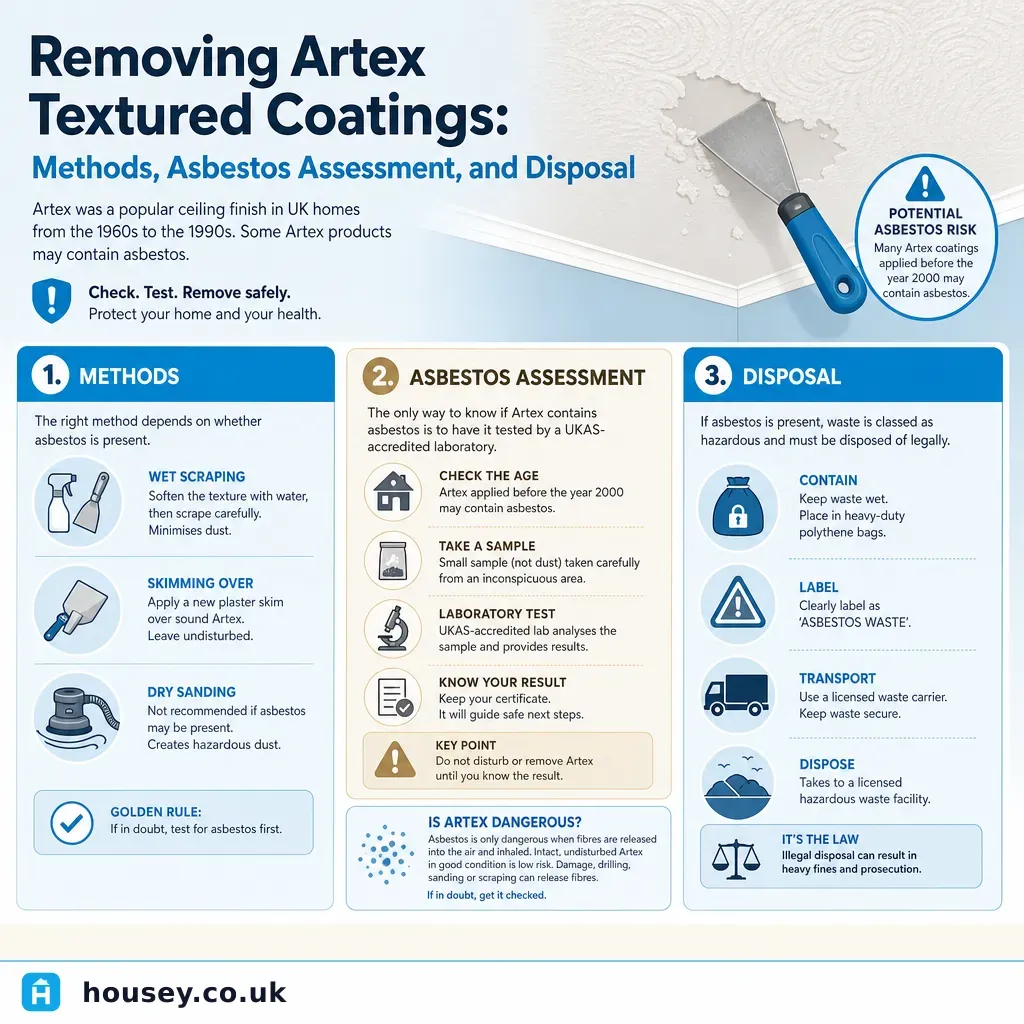
Removing Artex Textured Coatings: Methods, Asbestos Assessment, and Disposal
Before disturbing any textured ceiling coating in a pre-2000 UK home, have it tested for asbestos by a UKAS-accredited analyst.
 Improvement & Build
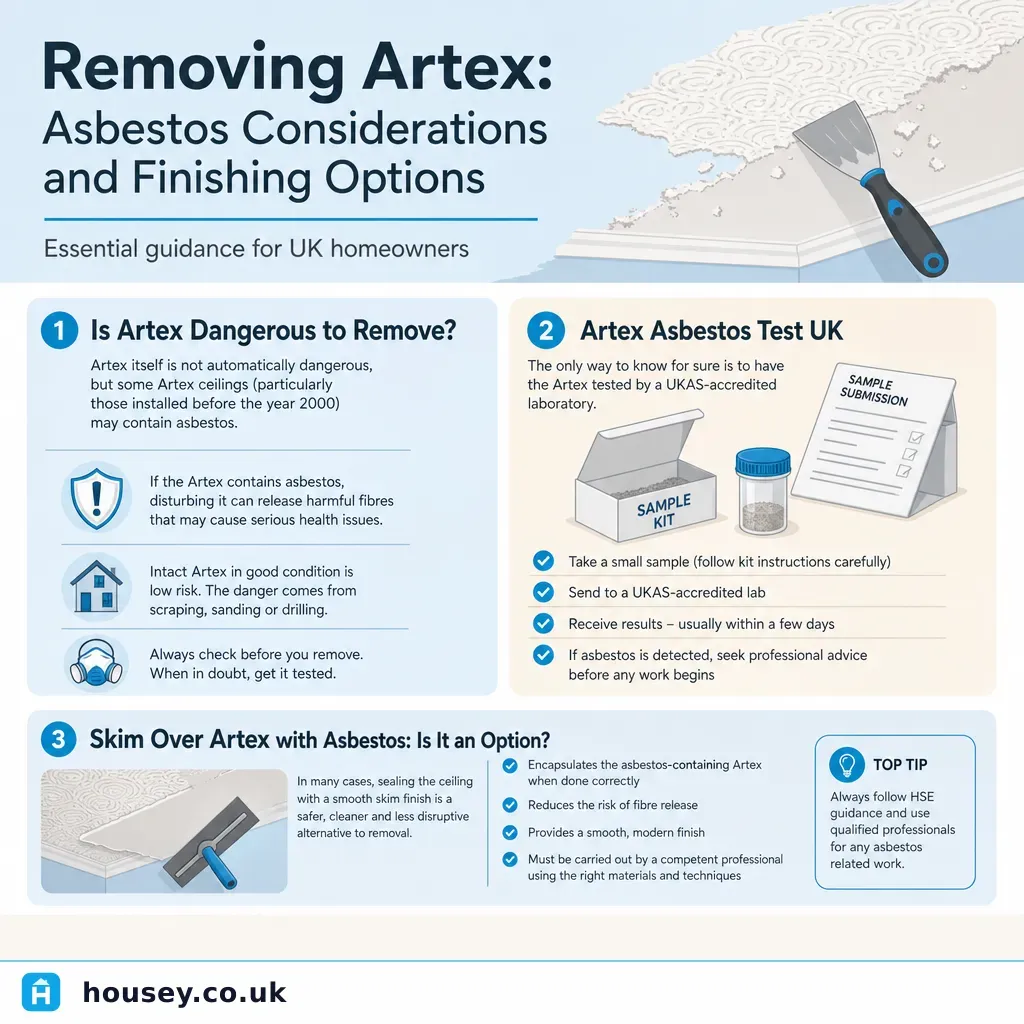
Removing Artex: Asbestos Considerations and Finishing Options
Artex applied before 2000 may contain chrysotile (white) asbestos, which poses a health risk if disturbed.
 Improvement & Build
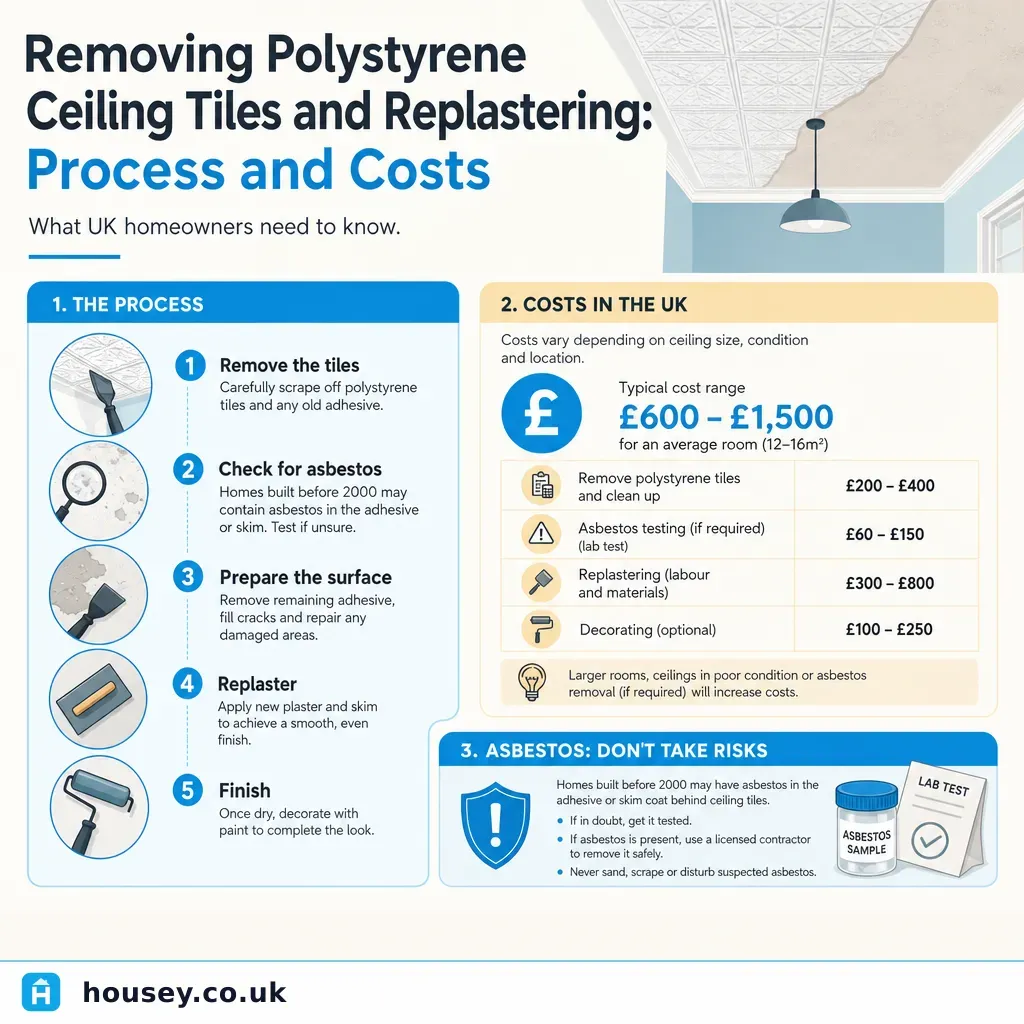
Removing Polystyrene Ceiling Tiles and Replastering: Process and Costs
Polystyrene ceiling tiles are usually glued directly to plaster or artex and must be removed before replastering.
 Improvement & Build
Removing Marley Floor Tiles: Techniques and Asbestos Precautions
Marley floor tiles manufactured before approximately 1990 may contain chrysotile (white) asbestos — and the black bitumen adhesive beneath them often does too.
 Improvement & Build
Skimming Over Wallpaper Lining: Surface Preparation and Results
You can skim plaster over wallpaper lining paper, provided the paper is fully adhered, the correct weight (usually 1,200g) is used, and the surface is primed with diluted PVA before applying a 2–3mm skim coat.