Removing Artex Textured Coatings: Methods, Asbestos Assessment, and Disposal
By Housey · Last reviewed 4th of May 2026
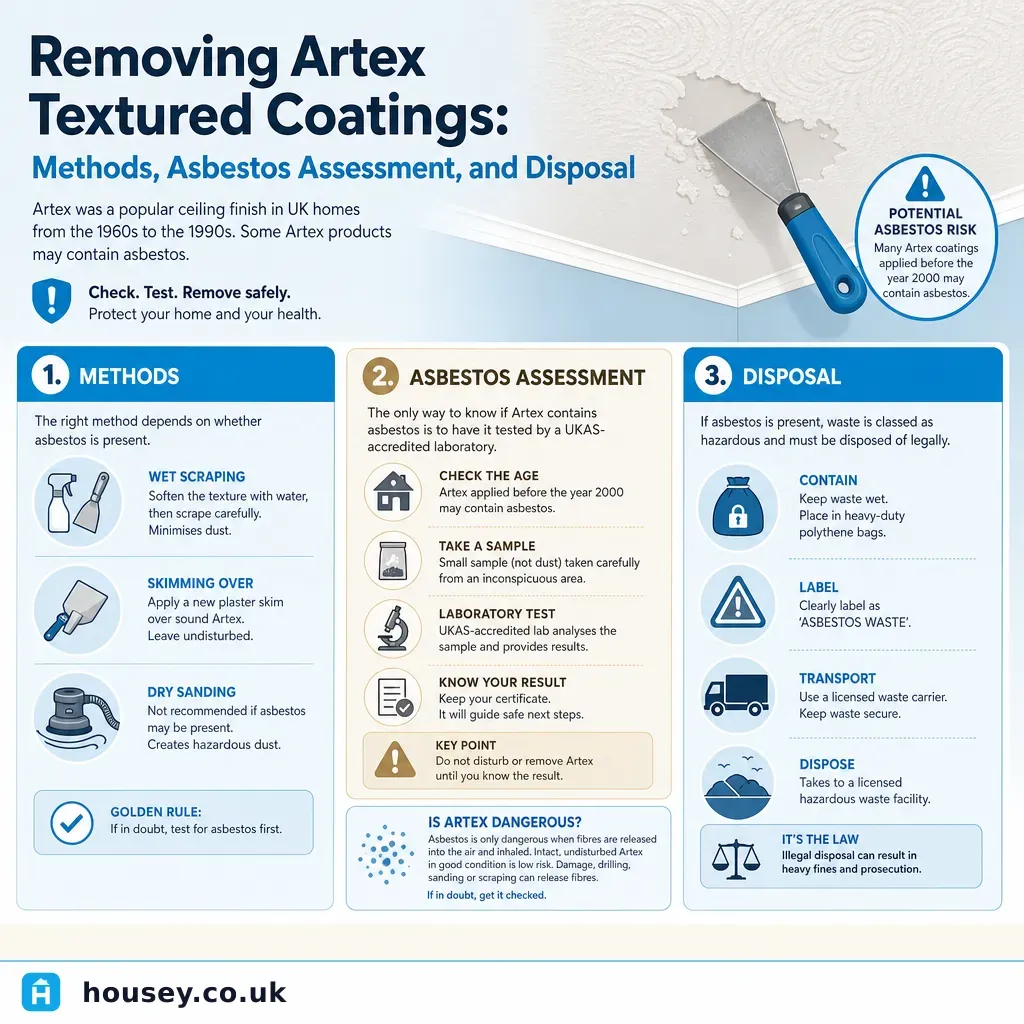
Removing Artex Textured Coatings: Methods, Asbestos Assessment, and Disposal
Artex and similar textured coatings were applied to ceilings and walls across UK homes from the 1950s through the 1990s, making them a near-universal feature in properties of that era. For homeowners planning redecoration, renovation, or preparing a property for sale, the central question is whether the material contains asbestos — a health and legal issue that must be resolved before any work begins. Getting this wrong carries serious consequences for both health and regulatory compliance.
Key points
- Artex applied before 2000 may contain chrysotile (white) asbestos, typically at concentrations of 1–5%, and must be tested before any disturbance.
- Sampling for regulatory purposes must be carried out by a UKAS-accredited analyst; DIY test kits are not accepted as evidence of compliance.
- The Control of Asbestos Regulations 2012 govern any disturbance of asbestos-containing materials (ACMs), including textured coatings, regardless of asbestos concentration.
- Covering Artex with skim plaster or plasterboard (encapsulation) avoids disturbing the material entirely and is often safer and cheaper than removal.
- Asbestos-containing waste is classified as hazardous waste and must be transported by a licensed waste carrier to an authorised disposal facility.
Does Artex contain asbestos?
Artex was manufactured with chrysotile asbestos as a strengthening agent from the early 1960s until around 1984, when the manufacturer phased it out. Other brands of textured coating continued to incorporate asbestos until 1999. Any textured ceiling or wall coating applied before 2000 should be treated as potentially containing asbestos until a UKAS-accredited sample analysis confirms otherwise.
Asbestos in Artex is typically present in a bonded (non-friable) form, meaning fibres are not freely released under normal conditions. The risk arises when the material is sanded, scraped dry, or otherwise mechanically disturbed, which can generate respirable fibres. The HSE classifies disturbance of low-concentration bonded asbestos — such as textured coatings — as notifiable non-licensed work (NNLW) in most domestic situations, meaning a licensed contractor is not always required, but the local enforcing authority must be notified and strict control procedures must be followed under the Control of Asbestos Regulations 2012.
If the asbestos concentration is higher, or if the scope of work is more extensive, a licensed contractor under the HSE's asbestos licensing scheme may be required. A UKAS-accredited analyst or asbestos consultant can advise on the correct regulatory classification after testing.
How to arrange an asbestos test
Before any removal or significant disturbance of a pre-2000 textured coating, the correct process is:
- Commission a UKAS-accredited analyst to take bulk samples of the textured coating. Do not attempt to collect samples yourself for regulatory purposes — sampling must be carried out safely with the chain of custody maintained.
- Laboratory analysis uses polarised light microscopy (PLM) or similar techniques to identify asbestos type and concentration.
- Receive a written report confirming whether asbestos is present, the fibre type, and the concentration found.
- Determine regulatory classification: your analyst or an asbestos consultant can confirm whether planned works constitute non-licensed, notifiable non-licensed, or licensed work under the 2012 Regulations.
Typical cost for a single-room bulk sample analysis ranges from approximately £100 to £250 including sampling and laboratory fees (indicative UK costs, last reviewed 2026-05-04; quotes vary depending on location and number of samples).
Artex removal methods compared
The appropriate approach depends on whether asbestos is present, the condition of the existing surface, the desired finish, and structural constraints such as ceiling height.
Method | Best for | Not suitable when | Asbestos implication | Typical outcome |
|---|---|---|---|---|
Skim plaster over Artex | Shallow texture, good substrate adhesion | Deep texture, crumbling or damp surface | No disturbance — safest if ACM confirmed | Smooth plastered finish |
Plasterboard overlay (dry lining) | Deep texture, damaged ceiling, speed | Where headroom is critical | No disturbance — encapsulates ACM | Lowered ceiling, smooth finish |
Wet chemical softener removal | No asbestos confirmed; moderate texture | Asbestos present without compliant setup | Reduces dust generation; controls still required if ACM | Coating removed, substrate exposed |
Steam removal | No asbestos confirmed | Any suspected or confirmed asbestos | Steam can mobilise fibres from ACMs | Coating removed |
Dry scraping or sanding | Not recommended in any circumstance | Always — generates fine airborne dust | Extremely hazardous if asbestos is present | Not recommended |
If asbestos is confirmed, the HSE strongly recommends encapsulation over removal wherever practicable. Covering the ceiling with skim or plasterboard eliminates the need to disturb the ACM and avoids the cost and complexity of compliance with removal procedures.
Disposal of asbestos-containing waste
Artex waste confirmed as containing asbestos is classified as hazardous waste under the Hazardous Waste (England and Wales) Regulations 2005. The following requirements apply:
- Waste must be double-bagged in UN-approved asbestos waste sacks, clearly labelled with asbestos warning markings.
- It must not be mixed with general building waste or placed in a standard skip.
- A licensed waste carrier registered with the Environment Agency must transport it.
- It must be taken to an authorised hazardous waste disposal facility.
- A waste transfer note and, for larger quantities, a consignment note must be completed and retained for at least two years.
Some local authority household waste recycling centres accept small quantities of bonded asbestos from householders — check with your local authority before assuming this option applies in your area.
What to ask a qualified professional
Before instructing anyone to test, treat, or remove textured coatings:
- Are you UKAS-accredited, or do you use a UKAS-accredited laboratory for sample analysis?
- Will you provide a written report identifying asbestos type, concentration, and regulatory classification?
- Is the proposed removal method compliant with the Control of Asbestos Regulations 2012?
- Will you handle hazardous waste disposal and provide waste transfer documentation?
- Do you carry appropriate employers' liability and public liability insurance for asbestos work?
- What notification will you make to the relevant enforcing authority?
- Are you recommending removal or encapsulation, and on what basis?
Red flags — stop and take professional advice
- You or a previous occupier have already dry-scraped or sanded a textured ceiling in a pre-2000 property — ventilate the space and contact an occupational hygienist.
- The coating is visibly damaged, crumbling, or water-stained — damaged ACMs can release fibres without active disturbance.
- A contractor offers to remove Artex without testing first — do not proceed.
- A contractor cannot produce a method statement and risk assessment for the proposed work.
- Fibrous material is visible in broken sections of the coating — treat as asbestos until confirmed otherwise by analysis.
- The property is a pre-2000 rental and there is no asbestos register or record of previous testing.
Important limitations
This article provides general information for UK homeowners and is not a substitute for a site-specific asbestos survey, professional risk assessment, or legal compliance advice. The Control of Asbestos Regulations 2012 and current HSE guidance are the definitive regulatory references. Requirements vary depending on the extent of disturbance, asbestos type and concentration, and property tenure. Landlords have additional duties under Regulation 4 of the 2012 Regulations regarding the management of asbestos in properties they own.
When to get professional help
Always engage a UKAS-accredited professional for asbestos testing before any work begins on a pre-2000 textured ceiling. If asbestos is confirmed and removal is preferred over encapsulation, instruct a contractor able to demonstrate compliance with the Control of Asbestos Regulations 2012 and who will manage waste disposal correctly.
Seek immediate professional advice if:
- You have already disturbed a textured ceiling in a pre-2000 property without prior testing.
- The coating is damaged and the room is regularly occupied.
- You are a landlord with ongoing duty-to-manage obligations.
- You are preparing a property for sale and need to understand disclosure obligations regarding known or suspected ACMs.
How Housey can help
Housey helps UK homeowners connect with qualified professionals for improvement and build projects, including specialists in asbestos assessment and ceiling works. If you are planning work on a textured ceiling and need help identifying the right type of professional, visit Housey.co.uk to explore relevant services in your area.
Frequently asked questions
Is all Artex dangerous?
Not automatically. Artex applied after 2000 is unlikely to contain asbestos. Artex applied before 2000 may contain chrysotile asbestos, but in its bonded form it poses a low risk when left undisturbed. The hazard arises when the material is sanded, dry-scraped, or otherwise disturbed, which can release respirable fibres. Testing before any work is the only reliable way to confirm whether asbestos is present.
Can I skim over Artex without testing for asbestos?
Applying a skim coat of finishing plaster does not usually disturb Artex significantly, as wet plaster is applied rather than the surface being abraded. However, any preparatory work — such as knocking back high texture points — could release fibres if asbestos is present. The HSE recommends treating pre-2000 textured coatings as potentially containing asbestos and seeking professional advice before any preparation or application work begins.
Who is legally responsible for asbestos in a rented property?
Landlords have a duty under Regulation 4 of the Control of Asbestos Regulations 2012 to manage asbestos in non-domestic premises. For residential rental properties, broader health and safety obligations apply. Landlords should maintain a record of known or suspected asbestos-containing materials and ensure contractors are informed before undertaking any work that could disturb them.
How long does Artex removal take for a single room?
For a single room with no asbestos confirmed, wet chemical removal or skim plastering typically takes one to two days. Where asbestos is confirmed and removal is chosen over encapsulation, additional time is needed for containment, decontamination, and clearance air testing — often two to four days for a single room. Encapsulation by boarding or skimming is usually quicker than removal in all cases.
Can I put asbestos waste in a skip?
No. Asbestos-containing waste is classified as hazardous waste under the Hazardous Waste (England and Wales) Regulations 2005 and must be transported by a licensed waste carrier to an authorised disposal facility. Placing asbestos waste in a general skip is illegal. Some local household waste recycling centres accept small quantities of bonded asbestos from householders — check with your local authority before assuming this option is available.
Sources and further reading
- Control of Asbestos Regulations 2012 — legislation.gov.uk
- HSE: Asbestos in textured coatings — Health and Safety Executive
- HSE: Non-licensed work with asbestos — Health and Safety Executive
- GOV.UK: Dispose of hazardous waste — GOV.UK / Environment Agency
- UKAS: Find an accredited organisation — United Kingdom Accreditation Service
Useful next reads
 Improvement & Build
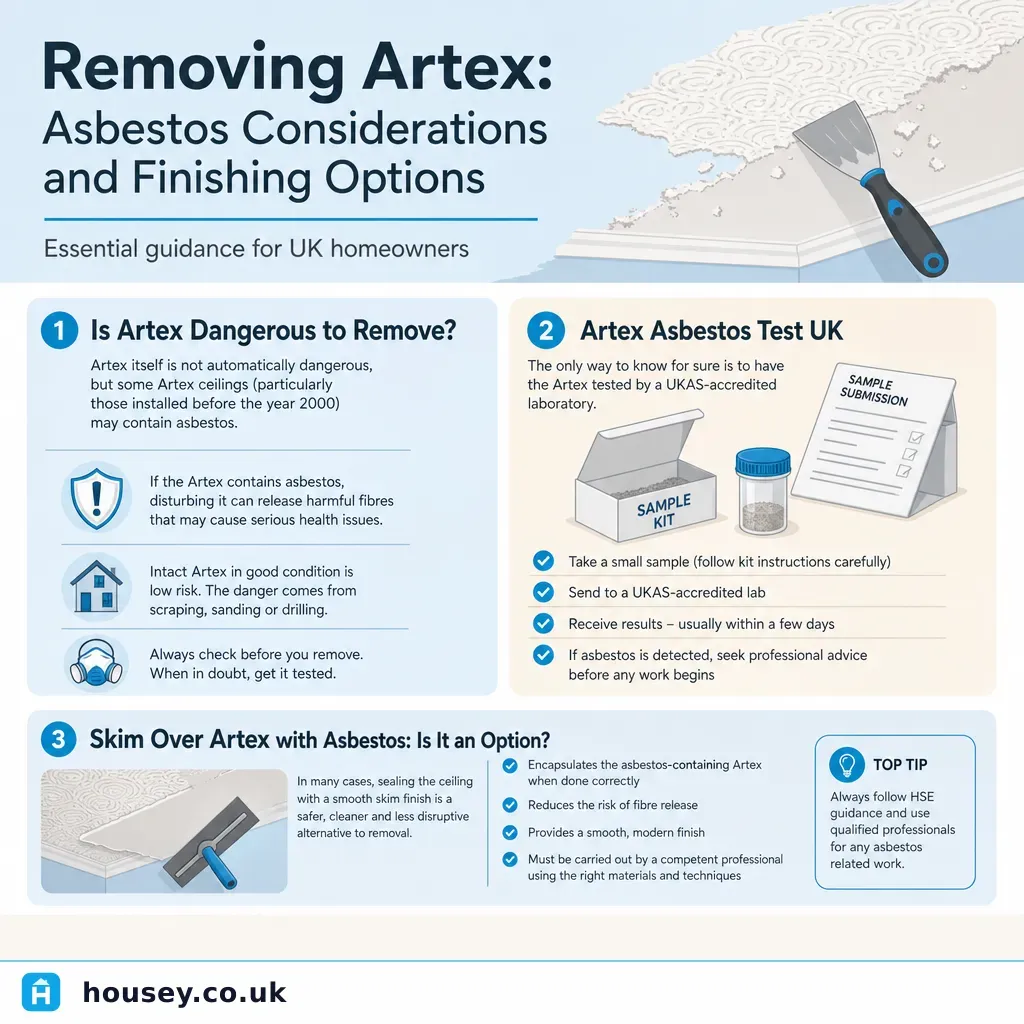
Removing Artex: Asbestos Considerations and Finishing Options
Artex applied before 2000 may contain chrysotile (white) asbestos, which poses a health risk if disturbed.
 Improvement & Build
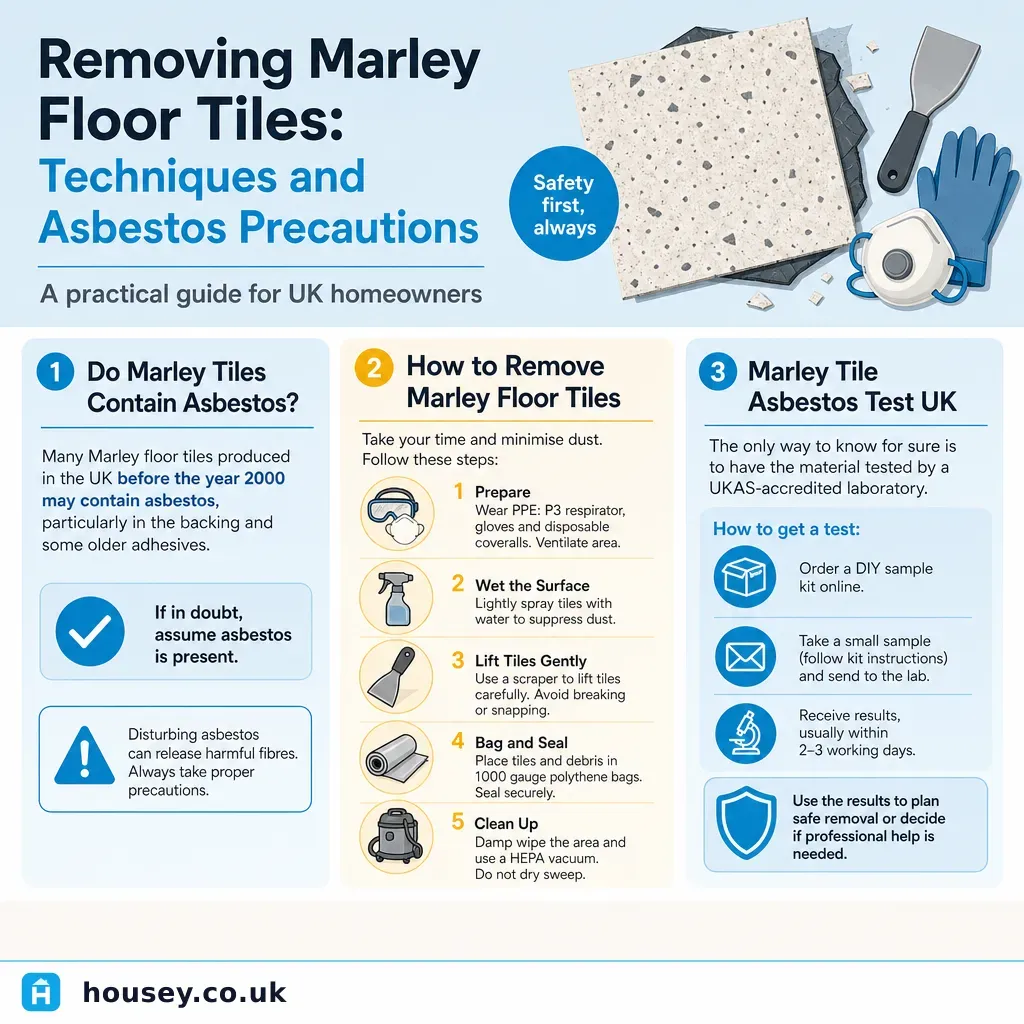
Removing Marley Floor Tiles: Techniques and Asbestos Precautions
Marley floor tiles manufactured before approximately 1990 may contain chrysotile (white) asbestos — and the black bitumen adhesive beneath them often does too.
 Improvement & Build
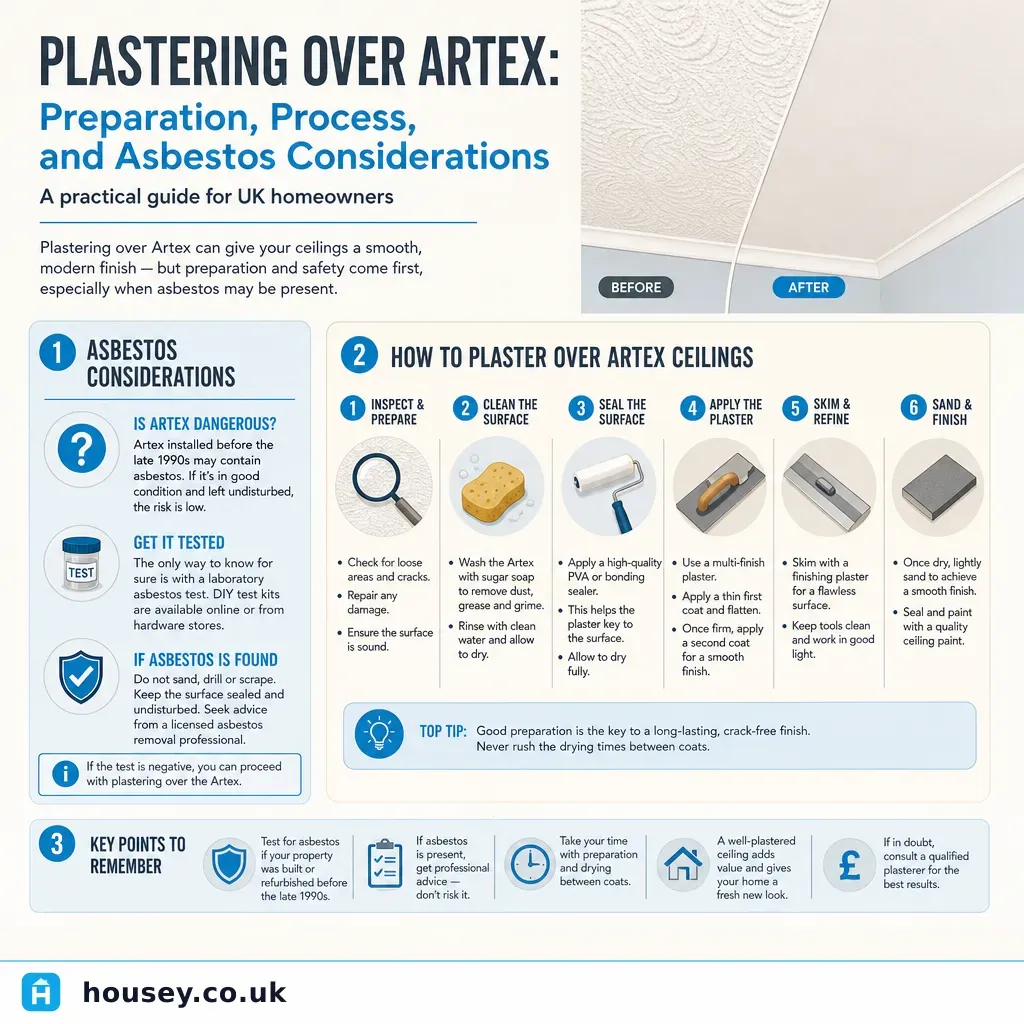
Plastering Over Artex: Preparation, Process, and Asbestos Considerations
Artex textured coatings in homes built before 2000 may contain chrysotile asbestos.
 Improvement & Build
How to plan a tree removal project
Planning a tree removal project starts with checking whether the tree is protected by a Tree Preservation Order or sits in a conservation area, as both require council consent before any work begins.
 Improvement & Build
Removing Stains from Indian Sandstone Paving: Cleaning Methods and Products
Most stains on Indian sandstone respond to a pH-neutral or mildly alkaline cleaner formulated for natural stone.