Removing Artex: Asbestos Considerations and Finishing Options
By Housey · Last reviewed 19th of May 2026
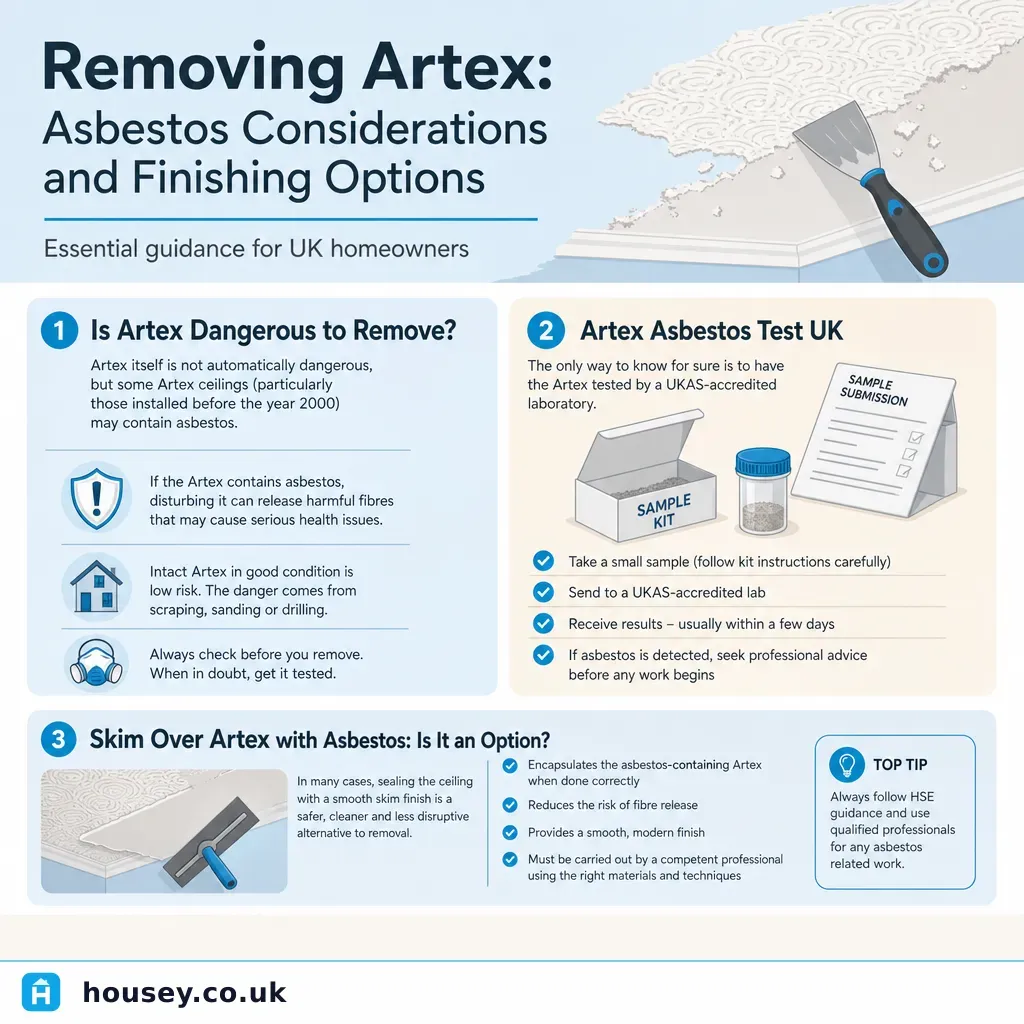
Removing Artex: Asbestos Considerations and Finishing Options
Artex — the textured coating applied to millions of UK ceilings and some walls from the 1950s through to the late 1990s — is a familiar feature of older British homes. It becomes a serious concern when homeowners or decorators plan to remove, sand, drill into, or otherwise disturb it, because Artex manufactured before 2000 may contain chrysotile (white) asbestos. This is not a matter for guesswork: the only safe starting point is a laboratory-confirmed test result before any work proceeds.
Key points
- Artex and similar textured coatings applied before 2000 may contain chrysotile asbestos; materials applied after 1999 are unlikely to contain asbestos fibres, but any coating of uncertain date should be tested before disturbance.
- Under the Control of Asbestos Regulations 2012 (CAR 2012), it is illegal to disturb asbestos-containing material without proper controls; domestic removal work must be assessed to determine whether it requires notifiable non-licensed work (NNLW) status or an HSE licence.
- Sampling and analysis must be carried out by a UKAS-accredited laboratory; improvised sampling can release fibres and should never be attempted by an untrained person.
- If asbestos-containing Artex is in good condition, encapsulation or skimming over it is often the safest and most practical approach — removal is not always necessary.
- The HSE advises that all textured coatings applied before 2000 should be treated as containing asbestos unless a laboratory test proves otherwise.
Why Artex may contain asbestos
Chrysotile (white asbestos) was commonly added to Artex and similar textured coatings as a reinforcing agent from the 1950s until approximately 1984, when its use in this application began to decline. Chrysotile remained a possible ingredient in some products until the full UK ban on asbestos-containing materials in 1999. Any Artex applied before 2000 should therefore be treated as potentially containing asbestos until confirmed otherwise by UKAS-accredited laboratory analysis.
The HSE's own guidance is clear on this point: the safest assumption for any pre-2000 textured coating is that it contains asbestos unless tested. The risk from intact, undisturbed Artex in a lived-in home is generally low — fibres are only released when the material is disturbed, cut, sanded, or drilled.
How to test Artex for asbestos
The only reliable way to confirm whether Artex contains asbestos is laboratory analysis. The process works as follows:
- A UKAS-accredited asbestos surveyor visits the property and takes a small sample using correct containment and personal protective procedures.
- The sample is submitted to a UKAS-accredited laboratory for polarised light microscopy (PLM) or scanning electron microscopy (SEM/EDXA) analysis.
- A written report confirms the presence or absence of asbestos fibres, the type identified, and approximate concentration.
Do not collect samples yourself using a domestic knife or scraper. Even a small sample from asbestos-containing material can release fibres into the air; correct sampling procedure protects both the occupants and anyone carrying out subsequent work.
A laboratory analysis of a single sample typically costs £20–£60; combined with an asbestos surveyor's visit, total costs are often in the range of £150–£400. Indicative UK costs, last reviewed 2026-05-19.
What the test results mean
Result | What it means | Recommended action |
|---|---|---|
No asbestos detected | Safe to proceed with standard methods | Use a competent decorator; follow manufacturer guidance |
Chrysotile (white asbestos) confirmed | Asbestos-containing material present | Seek professional advice; consider encapsulation or NNLW/licensed removal |
Amosite or crocidolite detected | Higher-risk asbestos types (rare in textured coatings) | Licensed contractor and HSE notification mandatory |
Inconclusive or insufficient sample | Test could not provide a definitive result | Retest with a fresh sample, or treat the material as containing asbestos |
Options if asbestos is found
If your Artex tests positive for asbestos, you have three main courses of action.
Leave it undisturbed
If the ceiling or wall is in good condition — no cracks, no water damage, no crumbling or friable areas — leaving the Artex in place and managing it through regular inspection is often the safest short-term approach. Asbestos only poses a risk when fibres are released into the air. Record the location and condition of the material and note it for any future contractors working in the property.
Encapsulate or skim over
A qualified plasterer can apply a thin skim coat of finishing plaster over the Artex, sealing the asbestos-containing layer and providing a smooth, contemporary finish without disturbing the material beneath. This is the approach favoured by many professionals where the Artex is sound. The plasterer must be informed of the asbestos test result before starting work and should avoid scraping or abrading the Artex during any preparatory stages.
Professional removal
Where removal is genuinely necessary — for example, if the Artex is water-damaged, extensively cracked, or coming away from the substrate — a competent contractor must first assess whether the work falls into one of two categories under CAR 2012:
- Notifiable Non-Licensed Work (NNLW): Required for lower-risk removal of chrysotile-containing Artex. The contractor must notify the enforcing authority (HSE or local authority) at least 14 days before work starts, keep health records of workers, and follow CAR 2012 procedures throughout.
- Licensed work: Required for higher-risk removal activities, higher asbestos concentrations, or the removal of amosite or crocidolite. Must be carried out by an HSE-licensed asbestos contractor.
The HSE provides a decision tool to help determine whether a specific job is NNLW or requires a full licence.
Finishing options once the Artex has been addressed
Once the Artex has been professionally removed, encapsulated, or confirmed asbestos-free, you have several finishing options for the ceiling or wall:
- Skim plaster: A smooth 2–3 mm finish coat applied over a bonding coat or directly to plasterboard is the most common choice — it gives a clean, modern surface ready for paint.
- Plasterboard overlay: Fixing 9.5 mm or 12.5 mm plasterboard over the existing ceiling before skimming avoids disturbing the surface beneath and speeds up the plastering process; check that the ceiling structure can carry the additional load.
- Decorative ceiling tiles: An option where plastering is not practical, though less common in modern interiors.
- Exposed boarding or timber: Suitable for certain renovation aesthetics, particularly in older properties, where the ceiling structure is designed for visual exposure.
Artex removal decision guide
- Test before touching: If your home was built or last decorated before 2000, do not drill, sand, scrape, or otherwise disturb any Artex without a UKAS-accredited laboratory test result in hand.
- If the Artex is undamaged and you want a smooth ceiling: Commission a skim coat over the existing surface — low disruption, low fibre-release risk, and a good finish.
- If the Artex is water-damaged, crumbling, or you want full removal: Engage a NNLW-compliant or licensed contractor depending on the test result and the scale of the works.
- If asbestos is confirmed and the area is large: Do not proceed without a professional assessment confirming whether HSE notification and licensed removal is required.
- If the test result is inconclusive or no test has been done: Treat the material as containing asbestos and act accordingly.
- If the ceiling has been affected by damp or a water leak: Address the source of moisture first; a damp and timber survey can identify the underlying cause before any ceiling works begin.
Important limitations
This article provides general information about Artex, asbestos risks, and finishing options for UK homeowners. It does not constitute health and safety advice and should not be used as the basis for disturbing or removing potentially asbestos-containing materials without professional assessment. The Control of Asbestos Regulations 2012 imposes legal duties that vary depending on the nature of the work, the asbestos type and condition, and who is carrying out the works. A qualified asbestos professional should assess your specific situation before any decision is made to disturb, remove, or encapsulate the material.
When this becomes urgent
Stop work immediately and seek professional advice if:
- You have already drilled, sanded, or scraped Artex in a property built or decorated before 2000 without first obtaining a laboratory test result.
- The Artex is visibly crumbling, friable, or has been affected by a water leak or prolonged damp.
- Renovation works have disturbed a large area of textured coating and you are unsure of the material's composition or whether dust has been properly contained.
- Any dust generated from ceiling work in a pre-2000 property has not been contained and disposed of correctly.
In these situations: ventilate the area if it is safe to do so, restrict access, and contact a UKAS-accredited asbestos surveyor or the HSE's asbestos helpline for advice on next steps.
What to ask a qualified professional
Before instructing a contractor to deal with Artex:
- Are you UKAS-accredited for asbestos sampling, or will you use a UKAS-accredited laboratory for analysis?
- Is the proposed removal work classified as notifiable non-licensed work (NNLW) or does it require an HSE licence — and have you checked the HSE decision tool for this specific job?
- What containment and decontamination procedures will you put in place during the works?
- How will the asbestos waste be packaged, transported, and disposed of — and will you provide a hazardous waste transfer note?
- Can you provide a written risk assessment and method statement before work begins?
- If I choose to skim over the Artex, what precautions will the plasterer take to ensure the surface is not abraded or disturbed during preparation?
When to get professional help
Do not attempt to remove, sand, or extensively scrape Artex without a confirmed laboratory test result. Always engage a professional if:
- The test result confirms any asbestos type — removal must be carried out by a NNLW-compliant or HSE-licensed contractor.
- You are unsure whether the scope of work qualifies as NNLW or requires a full HSE licence.
- The ceiling area affected is large or the material is in poor, friable condition.
- The property is a house in multiple occupation (HMO) or a rented property — additional duties apply to landlords under CAR 2012 and the Housing Act 2004.
Housey connects homeowners with vetted asbestos surveyors who can test your Artex, provide a written report, and advise on the safest course of action. Starting with a professional survey is the most important step before any decisions are made about the ceiling.
How Housey can help
Housey connects homeowners with vetted asbestos surveyors who can test Artex, provide a UKAS-backed written report, and advise on the appropriate next steps — whether that is encapsulation, NNLW removal, or simply leaving the material undisturbed. If water damage to the ceiling has contributed to the Artex deteriorating, a damp and timber survey can identify the underlying cause before any ceiling works begin.
Frequently asked questions
Is all Artex dangerous?
Not all Artex contains asbestos. Materials applied after 1999 are highly unlikely to contain asbestos fibres. However, Artex applied before 2000 should be treated as potentially containing asbestos until a UKAS-accredited laboratory test confirms otherwise. Undisturbed, well-bonded Artex poses negligible risk day-to-day — the hazard arises when fibres are released into the air through disturbance.
Can I skim over Artex without removing it?
Yes, skimming over undisturbed Artex is a common and practical alternative to removal. If asbestos is present and the Artex is in sound condition, skimming avoids releasing fibres and provides a smooth modern finish. The plasterer must be informed of any asbestos test result before starting work and should avoid scraping or abrading the Artex during surface preparation.
What is notifiable non-licensed work (NNLW) for asbestos?
NNLW refers to lower-risk asbestos work that does not require an HSE licence but must be notified to the enforcing authority at least 14 days before it starts. The contractor must keep health records of workers, supervise the work, and follow Control of Asbestos Regulations 2012 procedures throughout. The HSE provides a decision tool to help determine whether work is NNLW or requires a full licence.
Can a homeowner remove asbestos-containing Artex themselves?
The HSE strongly advises against DIY removal of asbestos-containing materials due to the serious and long-term health risks involved. While the Control of Asbestos Regulations 2012 focus primarily on workplaces, the risks to a homeowner and their household from releasing chrysotile fibres are real. For anything beyond minimal, well-controlled disturbance of a very small area, engaging a NNLW or licensed contractor is strongly recommended.
Sources and further reading
Useful next reads
 Improvement & Build
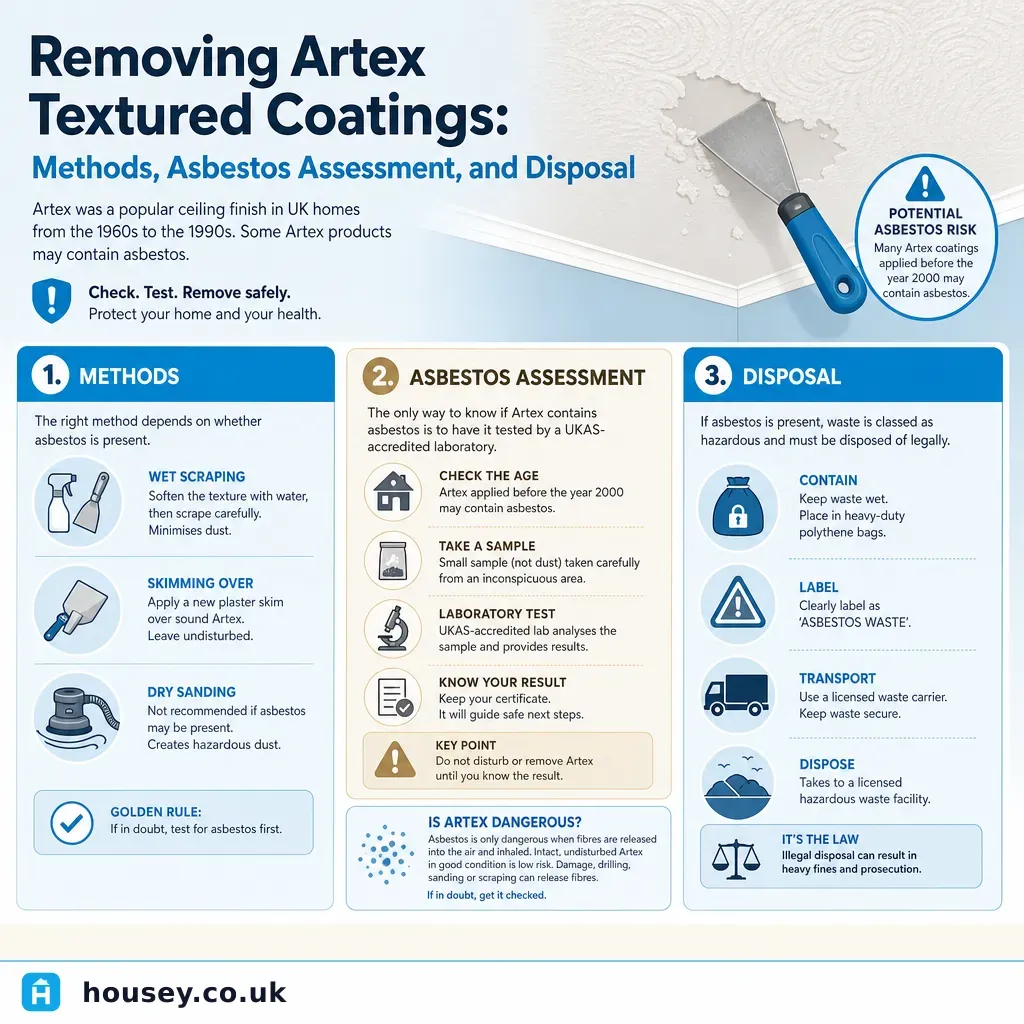
Removing Artex Textured Coatings: Methods, Asbestos Assessment, and Disposal
Before disturbing any textured ceiling coating in a pre-2000 UK home, have it tested for asbestos by a UKAS-accredited analyst.
 Improvement & Build
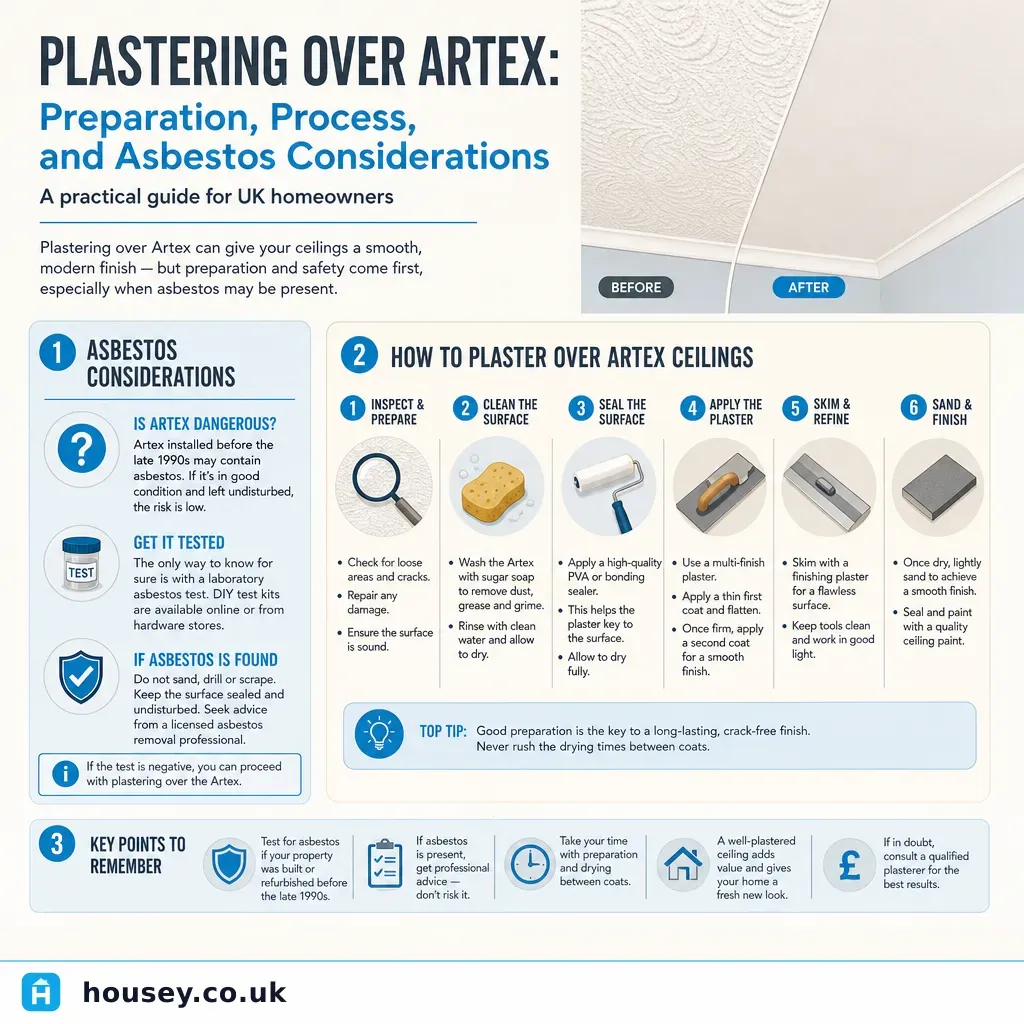
Plastering Over Artex: Preparation, Process, and Asbestos Considerations
Artex textured coatings in homes built before 2000 may contain chrysotile asbestos.
 Improvement & Build
Wall Panelling and Feature Wall Installation Costs
Wall panelling installation in the UK typically costs £40–£120 per m² fully fitted, depending on panel style, material, and wall condition.
 Improvement & Build
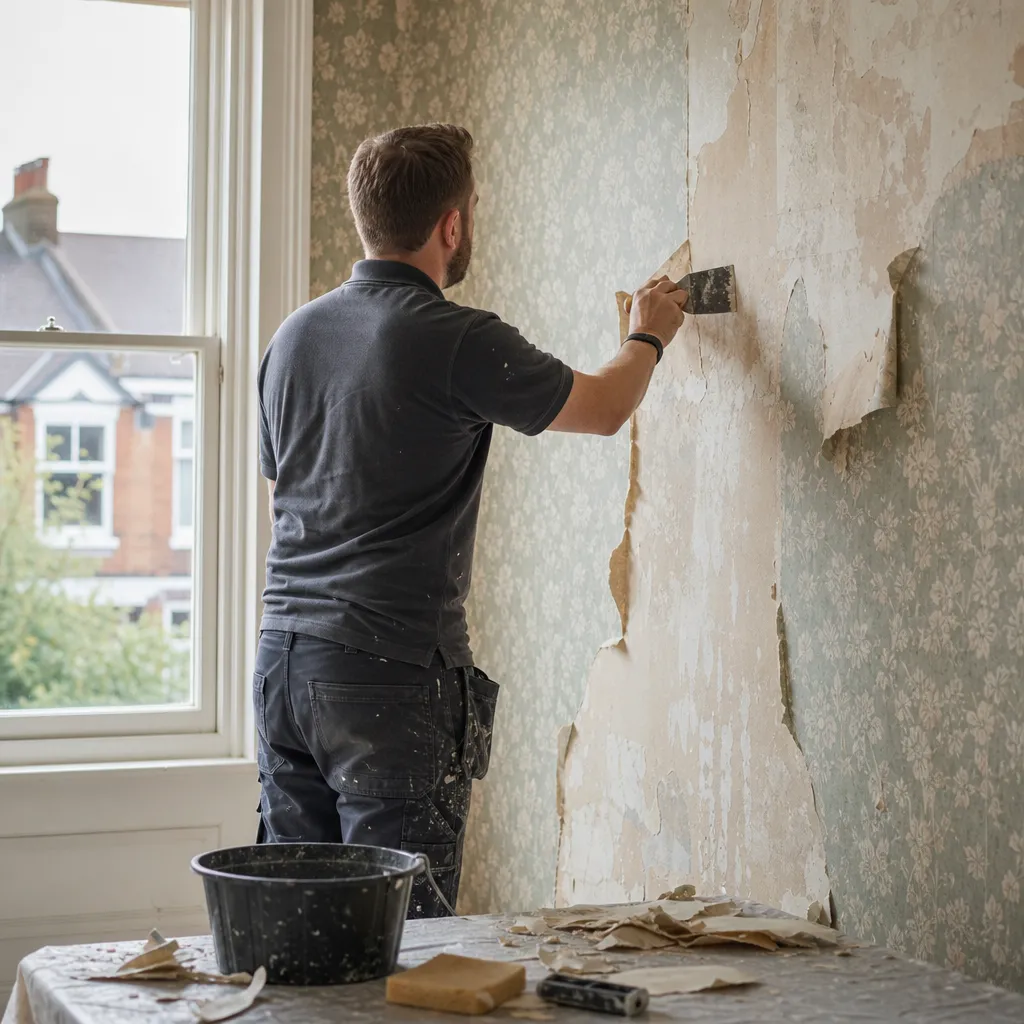
Stripping Wallpaper: Techniques for Interior Wall Preparation
Strip wallpaper by scoring the surface, soaking with warm water or a chemical stripper solution, then lifting with a broad scraper.
 Improvement & Build
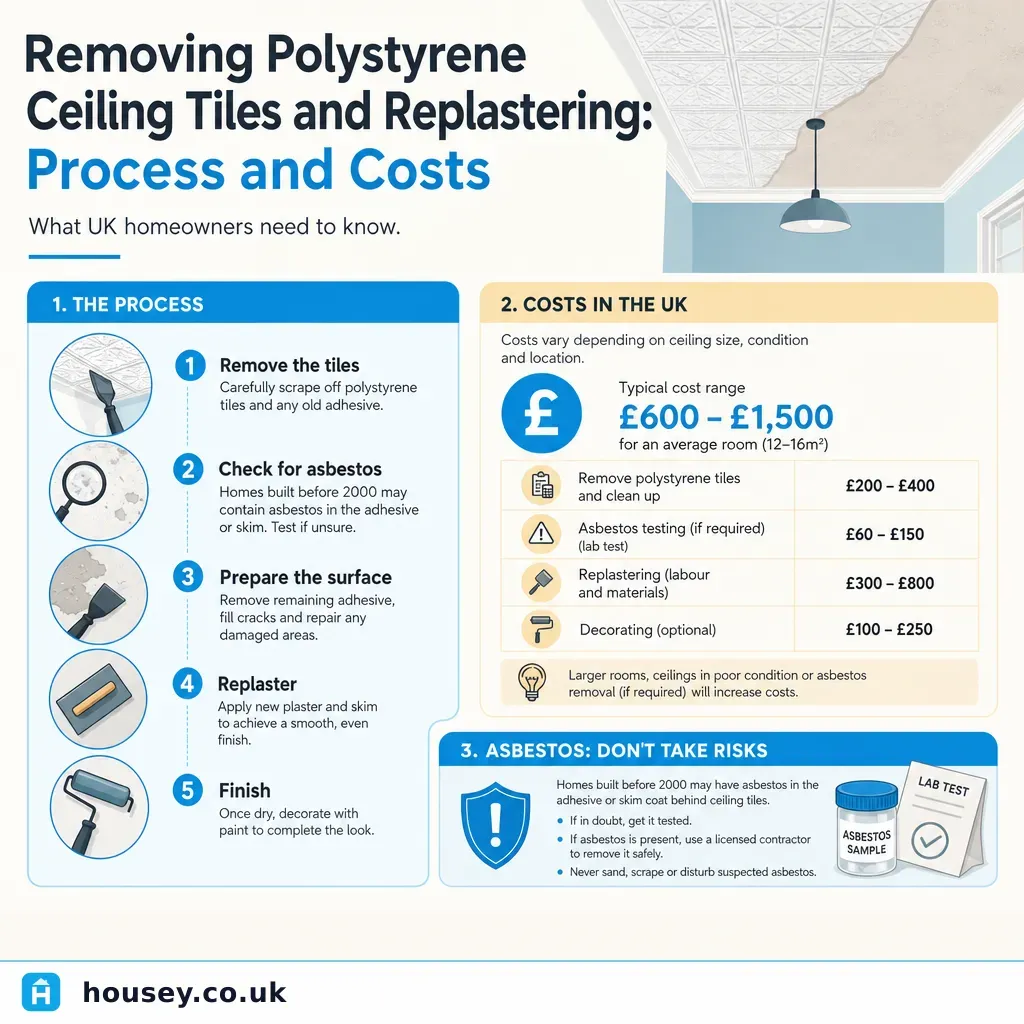
Removing Polystyrene Ceiling Tiles and Replastering: Process and Costs
Polystyrene ceiling tiles are usually glued directly to plaster or artex and must be removed before replastering.