Removing Marley Floor Tiles: Techniques and Asbestos Precautions
By Housey · Last reviewed 3rd of May 2026
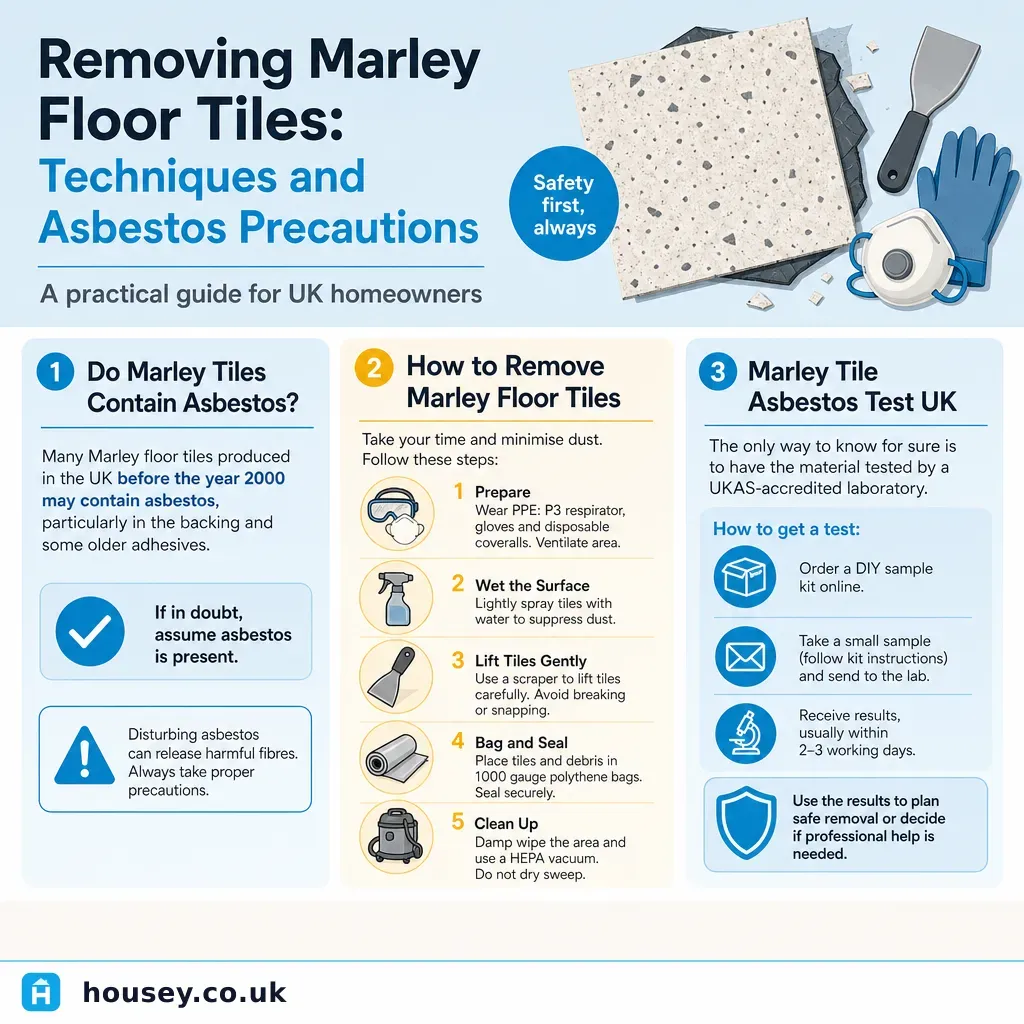
Removing Marley Floor Tiles: Techniques and Asbestos Precautions
Marley tiles are hard vinyl or asphalt-composition floor tiles installed widely in UK homes, schools, and commercial buildings from the 1950s through the late 1980s. They surface most often during kitchen, hallway, or utility room renovations in post-war semis and terraced properties. The critical concern is that tiles manufactured before approximately 1990 have a significant probability of containing chrysotile (white) asbestos — and the black bitumen adhesive used to fix them frequently does too. Physical disturbance of these materials without proper precautions can release fibres that cause mesothelioma, asbestosis, and lung cancer — serious, irreversible conditions with long latency periods.
Key points
- Marley tiles manufactured before approximately 1990 may contain up to 25% chrysotile (white) asbestos by composition.
- The black bitumen adhesive used to bond asbestos floor tiles commonly also contains asbestos and must be treated as a hazardous material throughout any removal project.
- The Control of Asbestos Regulations 2012 (CAR 2012) governs all work with asbestos-containing materials in the UK; breach is a criminal offence.
- Non-licensed asbestos work — such as the careful removal of intact, non-friable floor tiles — still requires a written risk assessment, appropriate Respiratory Protective Equipment (FFP3 minimum), and disposal as hazardous waste under CAR 2012.
- Intact, well-adhered Marley tiles that have tested positive for asbestos can often be safely encapsulated by overlaying with new flooring, avoiding disturbance entirely.
How to identify whether your Marley tiles may contain asbestos
Marley tiles cannot be identified as asbestos-free by sight or touch. Age and physical characteristics provide clues only — laboratory analysis is the only reliable confirmation.
Indicator | What it suggests |
|---|---|
Tiles installed before 1990 | Higher probability of chrysotile content — laboratory testing strongly recommended |
Dark brown or black adhesive beneath tiles | Black bitumen mastic of this era commonly contained asbestos |
Tiles are 9-inch × 9-inch (229mm) squares | Classic dimensions for UK asbestos-containing vinyl composition tiles |
Tiles are brittle, crumbly, or cracked | Elevated fibre-release risk — do not disturb without professional assessment |
Property built 1950–1985 | Peak period for asbestos floor tile installation in UK residential buildings |
Tiles are flexible, intact, and well bonded | Lower immediate release risk, but still require testing before any removal |
A UKAS-accredited laboratory can confirm or rule out asbestos content from a small bulk sample. Sampling by an accredited asbestos surveyor typically costs £100–£300 for a site visit plus £30–£80 per sample for laboratory analysis (indicative UK costs, last reviewed 2026-05-03).
What the Control of Asbestos Regulations 2012 requires
CAR 2012 sets the legal framework for all work involving asbestos-containing materials in the UK.
- Non-licensed work: Removing intact, well-bonded vinyl floor tiles where fibres are unlikely to become airborne may fall into the non-licensed category. This still requires a written risk assessment, FFP3 respiratory protective equipment, Type 5/6 disposable coveralls, and disposal of waste as hazardous material.
- Licensed work: Where tiles are damaged, friable, or the work involves significant disturbance — grinding, sanding, power-scraping — the work is likely licensable. Licensed work must be carried out by an HSE-licensed asbestos contractor and may require notification to the HSE.
- Waste disposal: Asbestos-containing materials, including tiles and adhesive, must be disposed of at a licensed hazardous waste facility with a waste transfer note. They cannot go into household waste, a general skip, or a council tip.
Full guidance is available from the HSE at hse.gov.uk/asbestos.
Removal versus encapsulation: a comparison
Option | Best for | Not suitable for | Fibre-release risk | Indicative cost |
|---|---|---|---|---|
Encapsulation (overlay new flooring) | Intact, flat, fully adhered tiles with no damage | Tiles that are lifting, crumbling, or severely damaged | Very low — no disturbance | Cost of new flooring only |
Non-licensed careful removal (by hand) | Intact tiles, low-risk conditions, competent person with correct PPE | Damaged or friable tiles; uncertain asbestos content | Moderate — requires strict controls | £300–£800 (small room, indicative) |
Licensed contractor removal | Damaged, friable, or high-disturbance scenarios | — | Controlled — highest standard of protection | £1,000–£3,500+ depending on area and condition |
Leave in place (no works) | Tiles in good condition, no flooring change planned | Active renovation requiring floor access | Lowest — no disturbance | Nil |
Indicative UK costs, last reviewed 2026-05-03. Costs vary by region, contractor, and tile condition.
Safe removal techniques — non-licensed, non-friable tiles only
These steps apply only where laboratory testing has confirmed asbestos content and tiles are intact — not crumbling, cracked, or lifting. If in any doubt, engage a licensed contractor.
- Do not use power tools — angle grinders, floor buffers, and power scrapers generate fine dust and must never be used on asbestos-containing tiles or adhesive.
- Work by hand — use a wide, stiff floor scraper or cold chisel at a shallow angle to lever tiles up intact, minimising breakage.
- Lightly dampen the work area — a fine water mist suppresses dust; avoid flooding.
- Wear correct PPE — FFP3 half-mask respirator (not a dust mask), Type 5/6 disposable coveralls, nitrile gloves, and overshoe covers.
- Double-bag waste immediately — seal tiles and adhesive fragments in two heavy-duty polythene sacks, label clearly as asbestos-containing waste.
- Clean with damp wipes — do not dry-sweep or use a standard vacuum; use an H-class (HEPA) vacuum if available.
- Dispose at a licensed facility — contact your local council waste authority or a registered hazardous waste carrier.
Red flags: when to stop and call a professional
- Tiles are cracked, crumbling, powdering, or lifting at the edges.
- You have already broken tiles and visible dust has been generated — stop immediately, vacate the room, and contact an accredited contractor.
- The floor area exceeds approximately 10m² — larger areas carry greater cumulative exposure risk.
- Underfloor heating pipework runs beneath the tiles and must be disturbed — this increases fibre-release risk significantly.
- You have any pre-existing respiratory condition or health vulnerability.
- You are unsure of the tile's age, composition, or whether the adhesive has been tested separately.
Important limitations
This article provides general information about Marley tile removal and asbestos precautions in UK homes. It is not a substitute for professional asbestos advice, a site-specific risk assessment, or the guidance of a qualified asbestos consultant. Rules regarding what constitutes licensable versus non-licensable work depend on specific site conditions, tile condition, and work methods — a professional assessment is always preferable.
This information reflects the Control of Asbestos Regulations 2012 and HSE guidance current as of 2026-05-03. Regulations may be updated; always check the current position at hse.gov.uk/asbestos.
What to ask a qualified professional
Before instructing an asbestos surveyor or removal contractor, ask:
- Are you UKAS-accredited, or are you using a UKAS-accredited laboratory for sampling and analysis?
- Is your company licensed by the HSE for asbestos removal? (Required for licensable work.)
- Will you provide a written risk assessment and method statement before any work begins?
- What RPE and PPE will your operatives use on site?
- How will asbestos waste be disposed of, and will you provide a waste transfer note?
- Will you provide a clearance certificate or four-stage clearance and air test on completion?
- Does your quote cover the black bitumen adhesive beneath the tiles, or only the tiles themselves?
- Are you registered with TrustMark or a recognised trade body for this type of work?
When to get professional help
Always engage a qualified asbestos professional before starting work if:
- Laboratory testing has confirmed asbestos in tiles or adhesive.
- Tiles are damaged, lifting, crumbling, or show any signs of deterioration.
- You are unsure of the property's construction date or the tile's composition.
- The floor area is large or the space is poorly ventilated.
- Heating services, underfloor heating, or other services pass through the floor build-up.
- You have any respiratory health concern.
How Housey can help
Housey connects UK homeowners with vetted local professionals for property assessments and renovation work. For asbestos-related projects, always confirm that any specialist holds the relevant HSE licence and uses a UKAS-accredited laboratory before instructing them. Visit housey.co.uk to find and compare local service providers.
Frequently asked questions
Are all Marley floor tiles dangerous?
Not all Marley tiles contain asbestos. Tiles manufactured from approximately 1990 onwards are unlikely to contain asbestos-containing materials. However, tiles installed before 1990 must be treated as suspect until tested by a UKAS-accredited laboratory. Tiles in good condition that are left in place or overlaid pose little risk — the danger arises primarily from physical disturbance that releases fibres.
Can I overlay new flooring directly over old Marley tiles?
In many cases, yes. If tiles are flat, fully adhered, and not cracked or damaged, overlaying with new vinyl, laminate, or engineered flooring is often the safest approach, as it avoids any disturbance of the tiles or adhesive. Have tiles tested first so you know what you are working with. Check that the height gain will not cause issues with door clearances or transitions to adjacent floors.
How much does asbestos floor tile removal cost in the UK?
Costs vary considerably depending on whether work is non-licensed or licensable, the tile area, and the contractor. Non-licensed removal of a small room with intact tiles by a competent tradesperson using correct PPE might cost £300–£800. Licensed contractor removal of a standard kitchen floor (10–15m²) with damaged tiles can cost £1,000–£3,500 or more. Always obtain multiple written quotes. Indicative UK costs, last reviewed 2026-05-03.
What should I do if I have already broken some asbestos-containing tiles?
Stop work immediately and do not sweep the area. Vacate the room and close the door. Open windows if possible. Contact an accredited asbestos removal contractor — they can carry out an air test, advise on safe cleaning, and arrange disposal. If you are concerned about personal exposure, seek guidance from your GP and inform them of the potential asbestos contact.
How do I find a UKAS-accredited asbestos laboratory?
The United Kingdom Accreditation Service (UKAS) maintains a searchable directory of accredited organisations at ukas.com. The HSE also publishes a register of licensed asbestos removal contractors at hse.gov.uk/asbestos. Always confirm accreditation before commissioning sampling or removal work — verbal assurances are not sufficient.
Sources and further reading
- Asbestos: the basics — Health and Safety Executive
- Control of Asbestos Regulations 2012 — legislation.gov.uk
- Asbestos essentials task manual (EM1 series) — Health and Safety Executive
- Directory of UKAS-accredited organisations — United Kingdom Accreditation Service
- Licensed asbestos contractors register — Health and Safety Executive
Useful next reads
 Improvement & Build
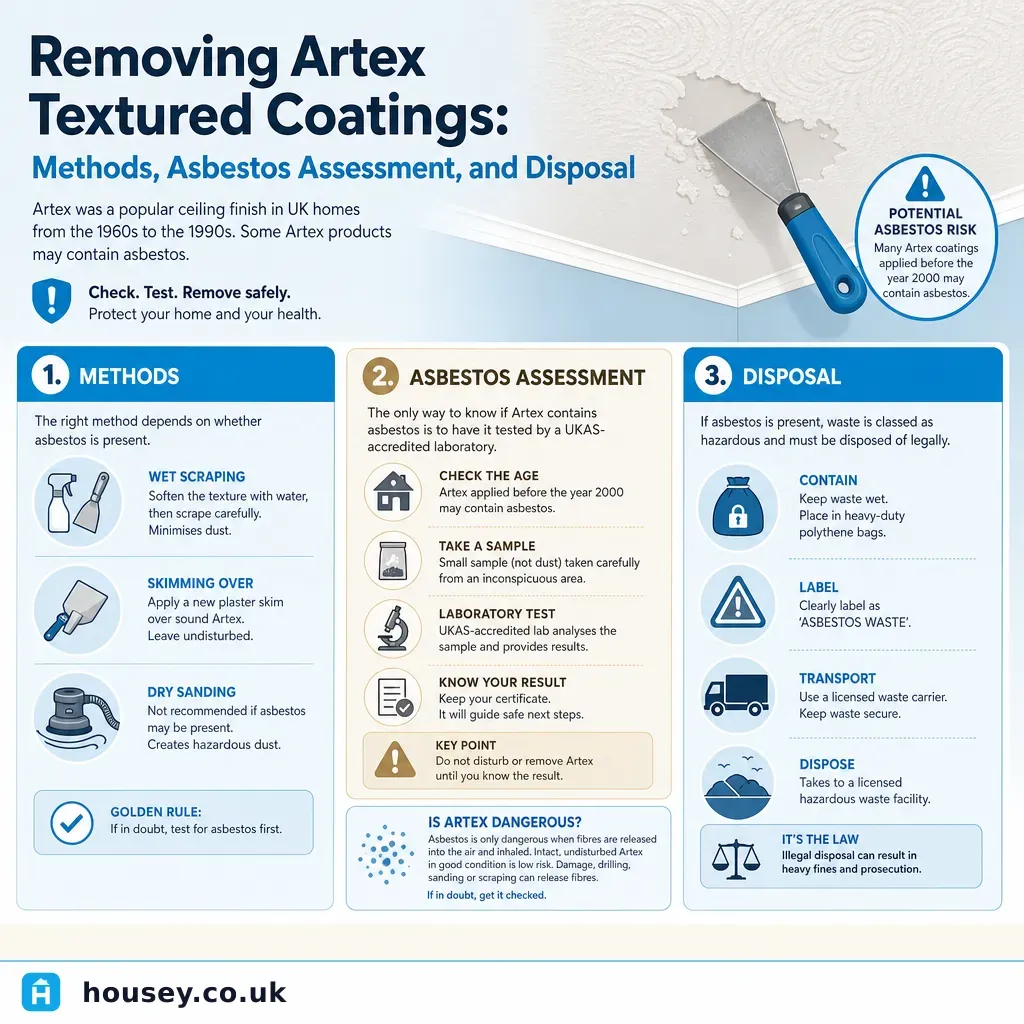
Removing Artex Textured Coatings: Methods, Asbestos Assessment, and Disposal
Before disturbing any textured ceiling coating in a pre-2000 UK home, have it tested for asbestos by a UKAS-accredited analyst.
 Improvement & Build
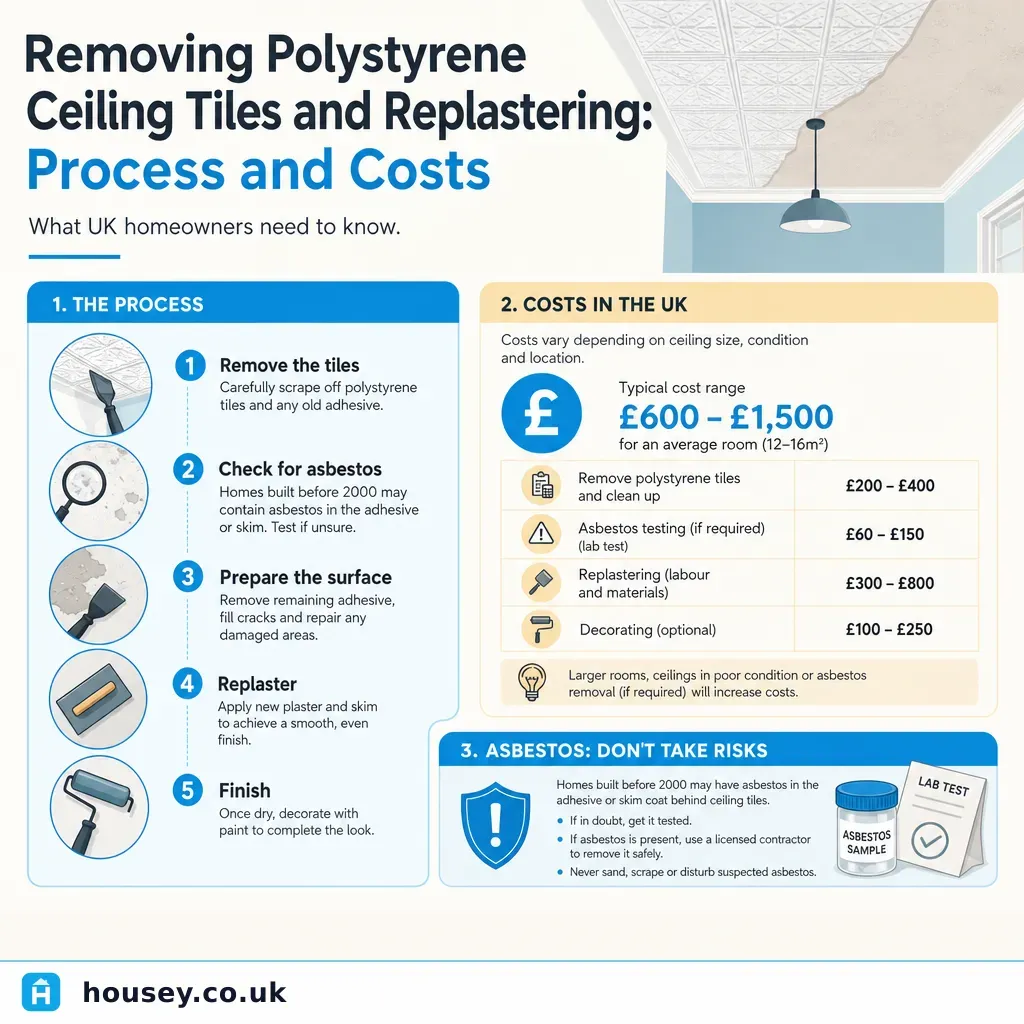
Removing Polystyrene Ceiling Tiles and Replastering: Process and Costs
Polystyrene ceiling tiles are usually glued directly to plaster or artex and must be removed before replastering.
 Improvement & Build
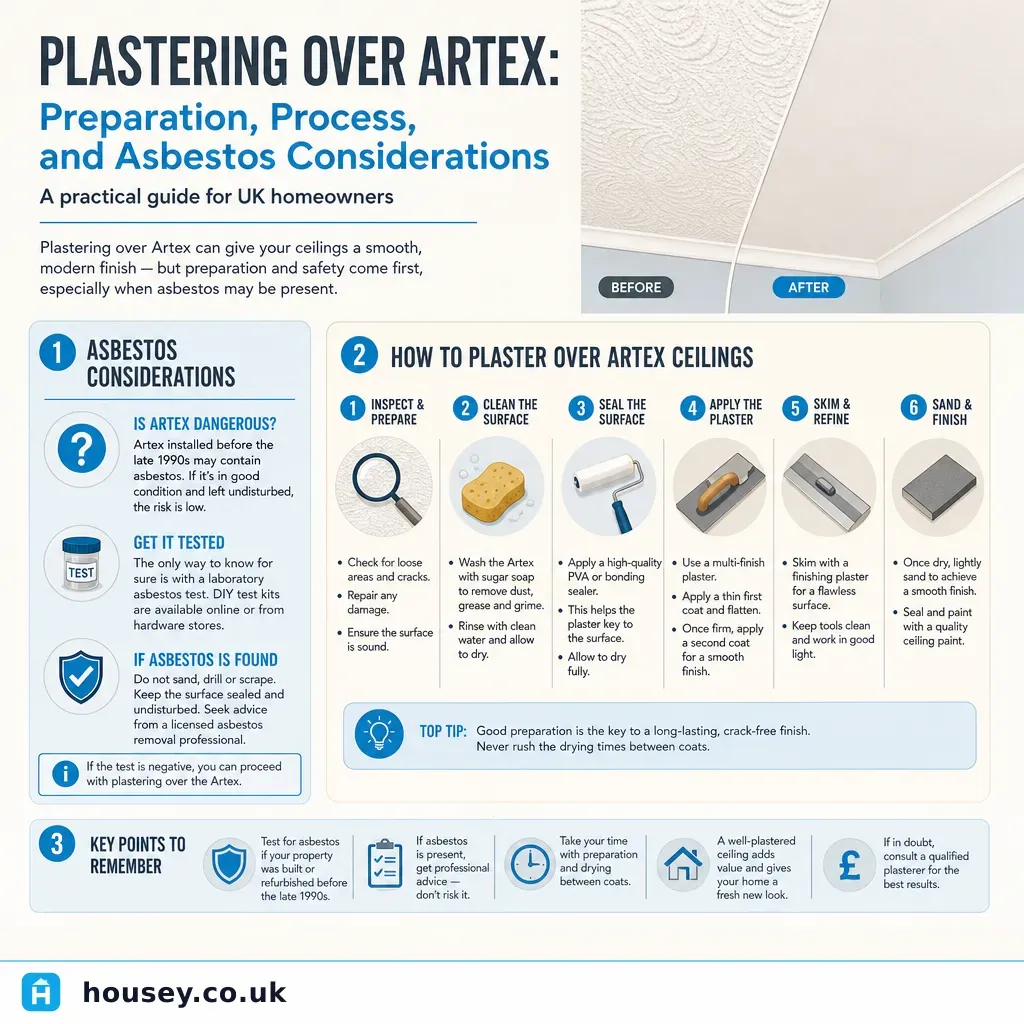
Plastering Over Artex: Preparation, Process, and Asbestos Considerations
Artex textured coatings in homes built before 2000 may contain chrysotile asbestos.
 Improvement & Build
Paint Removal with White Spirit: Effectiveness and Application
White spirit dissolves uncured, freshly applied oil-based paints and is useful for cleaning brushes and removing fresh drips, but has very limited effect on fully dried or cured paint films.
 Improvement & Build
Plastering Over Existing Paint and Wallpaper: Surface Prep and Technique
Whether you can plaster over existing paint or wallpaper depends on surface condition and adhesion.