Removing Polystyrene Ceiling Tiles and Replastering: Process and Costs
By Housey · Last reviewed 3rd of May 2026
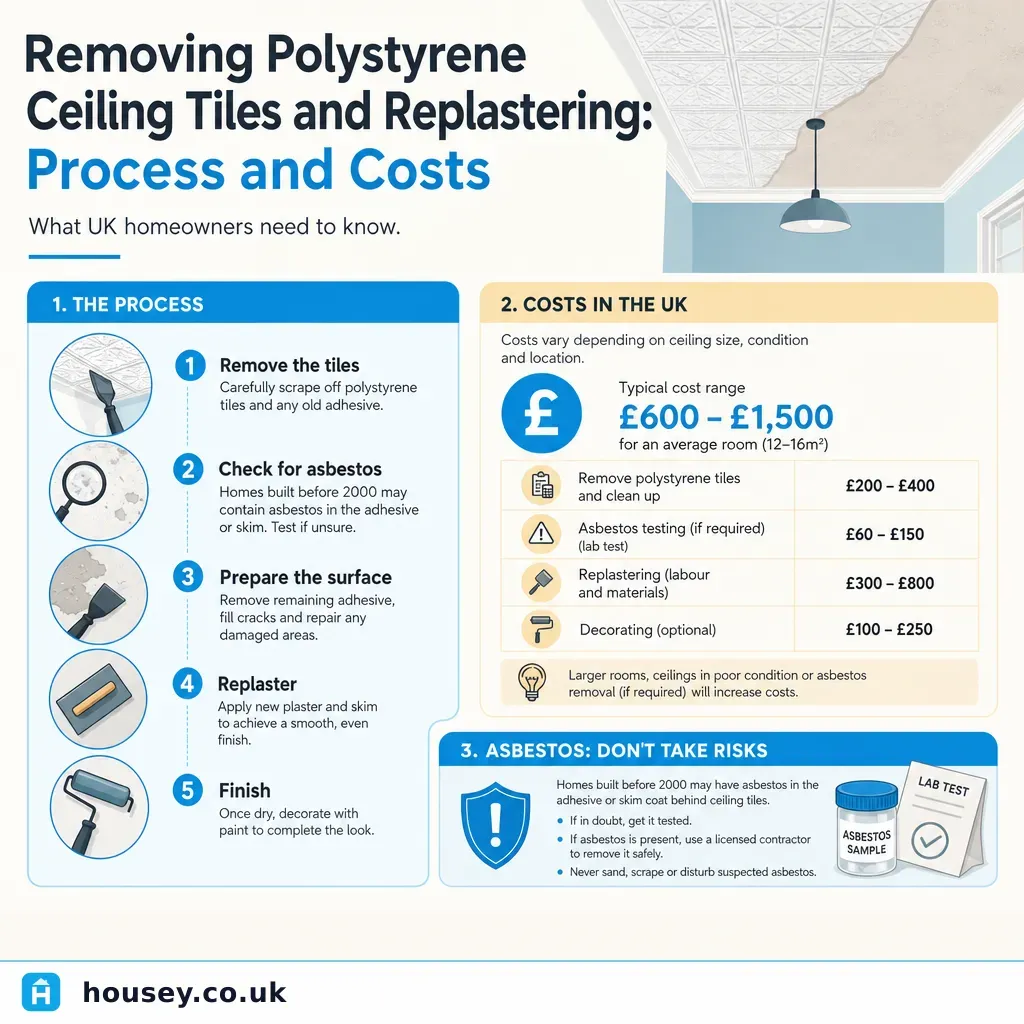
Removing Polystyrene Ceiling Tiles and Replastering: Process and Costs
Polystyrene ceiling tiles were a popular finish in UK homes refurbished between the 1960s and 1990s, and many properties still have them. Homeowners typically encounter this task when redecorating or preparing a property for sale — and what looks like a simple job can become more complex once adhesive residue, damaged plaster, or legacy artex is revealed beneath.
Key points
- Artex and some tile adhesives used before 2000 may contain chrysotile (white) asbestos; arrange a test from a UKAS-accredited laboratory before disturbing any ceiling material in a pre-2000 property.
- Polystyrene ceiling tiles are combustible and present a fire hazard under Building Regulations Approved Document B; painting over them is not a compliant long-term solution in habitable rooms.
- Adhesive residue left after tile removal must be fully stripped or mechanically keyed before a new plaster skim will bond reliably.
- A full re-board and re-skim may be more cost-effective than patching if the substrate beneath is badly damaged or artex-covered.
- Indicative UK costs for professional tile removal and ceiling re-skim in a standard room (12–16 m²): £400–£1,200. Indicative UK costs, last reviewed 2026-05-03.
Why asbestos is the first consideration
Asbestos was used in UK construction materials until its final ban in 1999. In ceiling contexts, the risk comes from two main sources:
- Artex: Many polystyrene tiles were stuck directly over an artex finish. Artex applied before 2000 may contain chrysotile (white) asbestos, typically at 3–5% by weight.
- Tile adhesive: Some bitumen-based and solvent-based adhesives used between approximately 1965 and 1985 contained asbestos fibres.
If your property was built or significantly refurbished before 2000, do not scrape, sand, or mechanically disturb the ceiling surface until a sample has been tested by a UKAS-accredited laboratory (typically £30–£80 per sample). The HSE publishes guidance on asbestos in textured coatings. If asbestos is confirmed, a licensed contractor must carry out or oversee removal under the Control of Asbestos Regulations 2012.
The removal process, step by step
Where asbestos has been ruled out (or the building post-dates 1999), removal typically follows this sequence:
- Protect the room. Cover floors and furniture; seal doorways with polythene dust sheets.
- Remove the tiles. Most were fixed with spot or full-bed adhesive. Warm the surface gently with a heat gun on a low setting, or work a broad scraper under tile edges. Avoid excessive force.
- Remove adhesive residue. Options include chemical adhesive remover, mechanical scraping, or sanding depending on adhesive type and substrate condition.
- Assess the substrate. Common findings: intact plaster (skimmable); damaged plaster with hollow areas (needs repair or re-boarding); artex surface (overboard or skim directly if tested clear of asbestos).
- Prepare for plastering. Apply a bonding agent — PVA diluted 1:4 or an SBR-based product — to the substrate. Repair significant holes with bonding coat plaster.
- Apply finish skim. A two-coat skim (approximately 3 mm total) gives a smooth finish. Allow 3–5 days drying time before decorating.
Substrate options: repair, overboard, or re-skim?
Substrate condition after tile removal | Recommended approach | Typical cost indication |
|---|---|---|
Intact original plaster, adhesive removed cleanly | Bonding agent and skim | Base cost |
Artex surface, tested clear of asbestos | Overboard with 6 mm plasterboard + skim, or skim directly if profile is low | +£100–£250 |
Artex surface, asbestos confirmed | Licensed removal required, then replaster or overboard | +£400–£1,500+ |
Plaster badly damaged (hollow, cracked, loose) | Strip back to substrate and re-board | +£200–£600 |
Timber lath and plaster (pre-1945 properties) | Overboard entirely | +£250–£500 |
Indicative UK costs, last reviewed 2026-05-03. Costs vary by location and condition.
Worked UK property scenario
A homeowner in a 1970s semi-detached house in the Midlands wants to redecorate their living room. The ceiling has polystyrene tiles over artex.
- Asbestos sample taken from artex beneath a loose tile; sent to UKAS-accredited laboratory. Result: chrysotile at 4%.
- Licensed contractor removed the artex under controlled conditions. Cost: approximately £600 for a 14 m² ceiling.
- Plasterer applied bonding coat and two-coat finish skim. Cost: approximately £350.
- Total: approximately £950 plus redecoration, over approximately three weeks.
Had the artex tested clear, the project would have cost approximately £350–£500 — illustrating why testing first is both a safety and financial necessity.
Red flags: when to stop and seek advice
- Ceiling material in a pre-2000 property not yet tested for asbestos. Do not disturb further.
- A grey, brown, or powdery layer beneath tiles that crumbles when scratched. May be asbestos-containing adhesive or artex residue.
- Widespread hollow plaster — a drumming sound when tapped indicates detachment; may be unsafe to work on.
- Sagging or cracked lath and plaster in pre-1945 properties. Requires structural assessment first.
- Tiles encapsulating an unidentified previous repair or insulation layer. Investigate before continuing.
Homeowner checklist before starting work
Important limitations
This article provides general guidance on a common UK home improvement task. Conditions vary considerably by property age, construction type, and previous repairs. The asbestos risk in pre-2000 properties is genuine; this article cannot substitute for a physical asbestos survey or professional assessment. Always use licensed, qualified professionals for any confirmed or suspected asbestos work.
What to ask a qualified professional
- Are you UKAS-accredited for asbestos bulk sample analysis, or can you refer me to an accredited laboratory?
- For asbestos removal: are you licensed under the Control of Asbestos Regulations 2012, and will you provide a waste consignment note?
- What substrate preparation is included in your plastering quote — does it cover adhesive removal as well as the skim?
- Will you make good any additional damage found, and how would extra costs be agreed?
- Is VAT included in the quote?
When to get professional help
Removing polystyrene tiles can be manageable for a confident DIYer in a post-2000 property with no artex present. Professional involvement is strongly advisable where asbestos cannot be ruled out, the substrate is in poor condition, or the ceiling is large. The plaster skim should always be carried out by an experienced plasterer — ceiling work is significantly more demanding than walls.
How Housey can help
If your ceiling project requires a professional plasterer or an asbestos testing referral, Housey can connect you with qualified UK tradespeople for ceiling work and home improvement projects. Getting at least two or three quotes before committing to any approach is always worthwhile given how much the substrate condition can vary.
Frequently asked questions
Can I skim plaster directly over the polystyrene tiles rather than removing them?
This is not recommended. Polystyrene does not provide a stable substrate for plaster — tiles may flex under the weight of wet plaster and the bond will fail. Some contractors fix 6 mm plasterboard through the tiles into ceiling joists as an alternative, but this requires confirming joist positions and load capacity first.
How long does a newly plastered ceiling take to dry before painting?
New plaster skim typically takes 3–5 days to dry to a uniform pale colour in normal UK conditions (15–20°C, reasonable ventilation). Painting over wet plaster traps moisture and causes peeling. Most decorators recommend a mist coat of diluted emulsion before applying full-coverage paint.
What should I do with waste polystyrene ceiling tiles?
Polystyrene tiles are not accepted in most kerbside recycling collections. Check with your local authority for household waste recycling centre (HWRC) guidance on expanded polystyrene. Do not burn polystyrene — it produces toxic fumes including styrene.
Is it safe to paint over polystyrene ceiling tiles as a short-term measure?
Polystyrene tiles are combustible and spread flame rapidly. Under Building Regulations Approved Document B (Fire Safety), they present a meaningful fire risk in habitable rooms. Specialist intumescent coatings can reduce but do not eliminate flame spread. Removal is the safest and most durable solution.
Sources and further reading
- Asbestos: the licensed contractor guide — Health and Safety Executive (HSE)
- Control of Asbestos Regulations 2012 — legislation.gov.uk
- Asbestos in textured coatings — Health and Safety Executive (HSE)
- Approved Document B: Fire Safety — GOV.UK
Useful next reads
 Improvement & Build
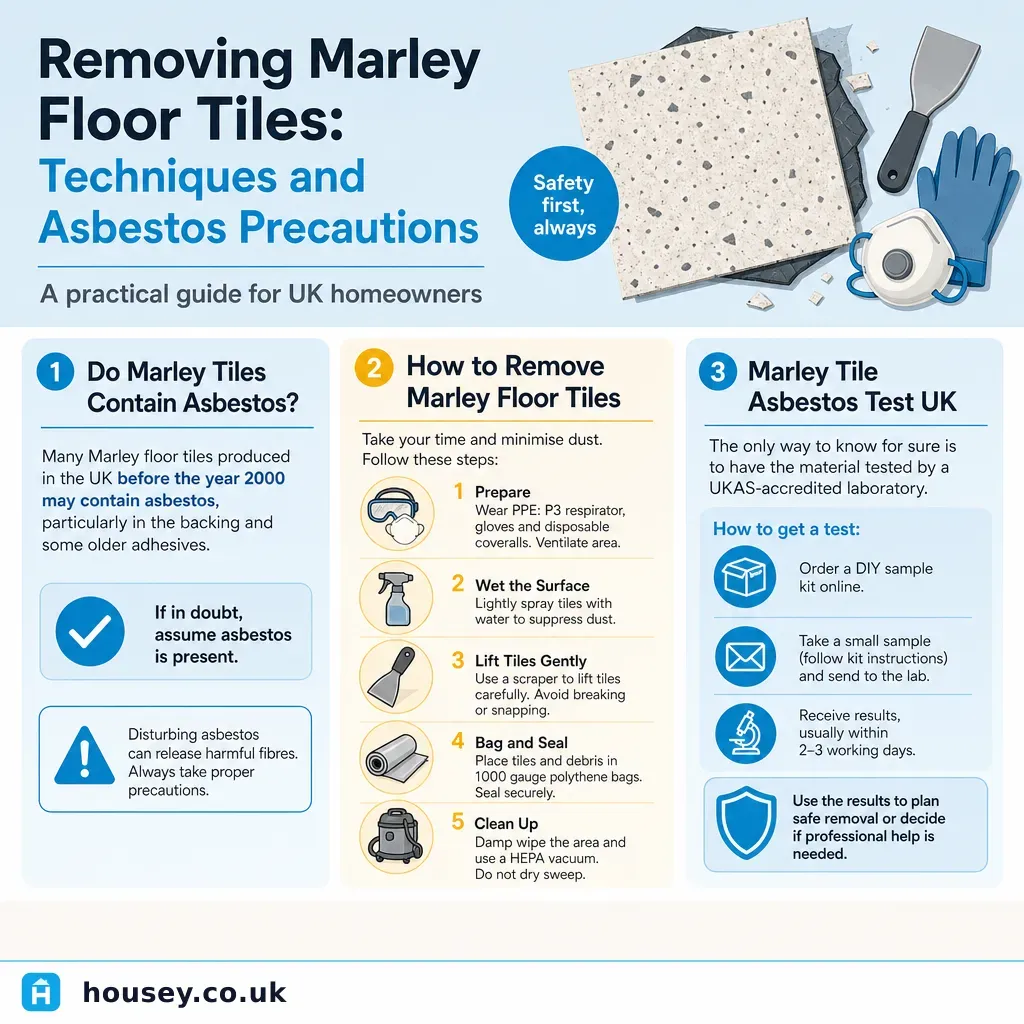
Removing Marley Floor Tiles: Techniques and Asbestos Precautions
Marley floor tiles manufactured before approximately 1990 may contain chrysotile (white) asbestos — and the black bitumen adhesive beneath them often does too.
 Improvement & Build
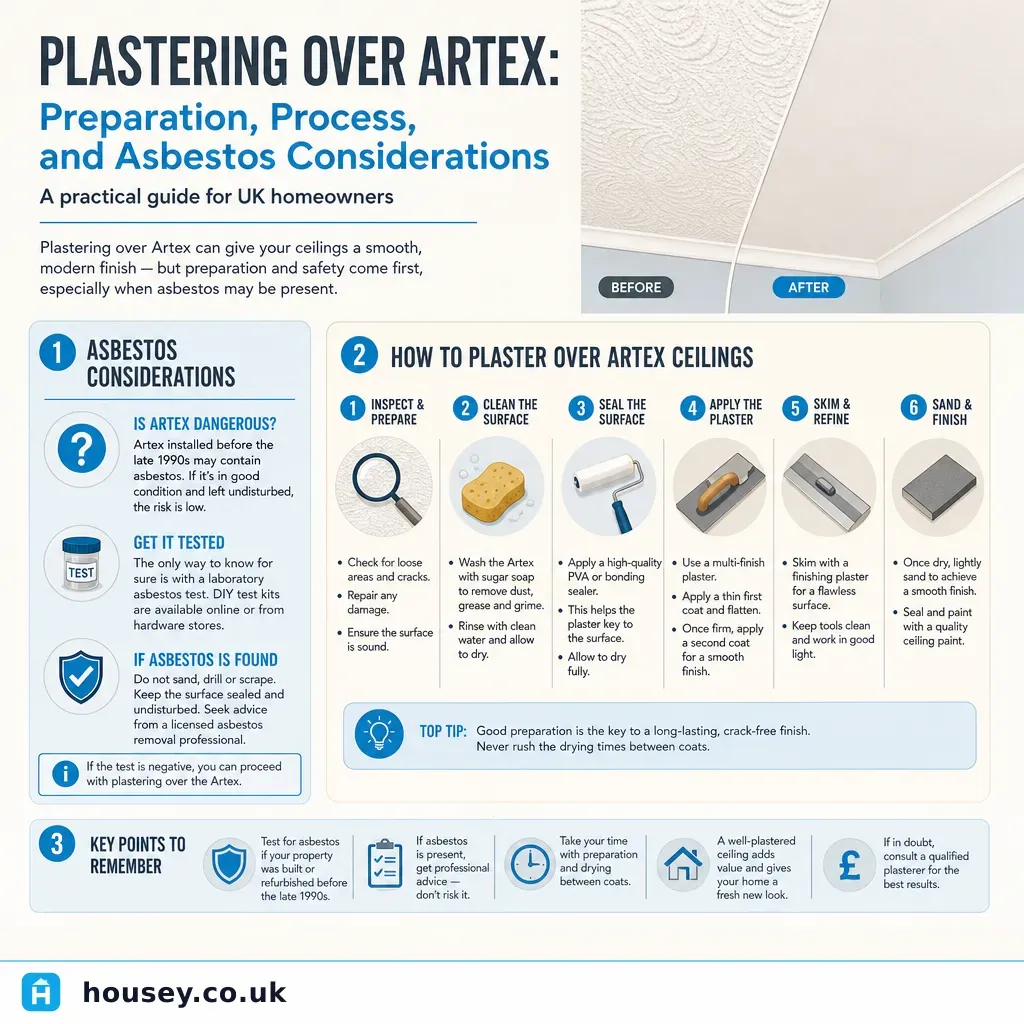
Plastering Over Artex: Preparation, Process, and Asbestos Considerations
Artex textured coatings in homes built before 2000 may contain chrysotile asbestos.
 Improvement & Build
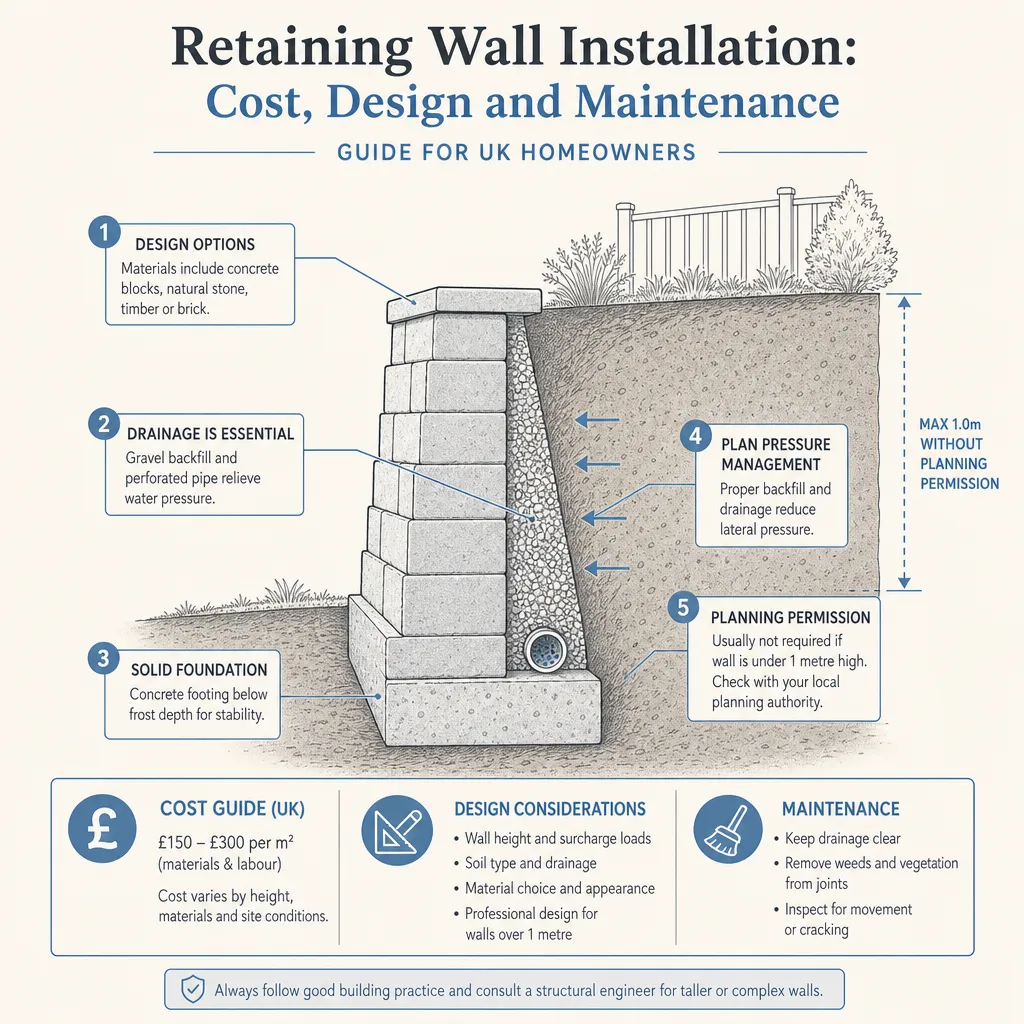
Retaining Wall Installation: Cost, Design and Maintenance
A retaining wall holds back soil on a sloped or banked site.
 Improvement & Build
Paint Removal with White Spirit: Effectiveness and Application
White spirit dissolves uncured, freshly applied oil-based paints and is useful for cleaning brushes and removing fresh drips, but has very limited effect on fully dried or cured paint films.
 Improvement & Build
Plastering Over Existing Paint and Wallpaper: Surface Prep and Technique
Whether you can plaster over existing paint or wallpaper depends on surface condition and adhesion.