Pocket Doors: Alternatives and Design Solutions for Space Planning
By Housey · Last reviewed 26th of May 2026
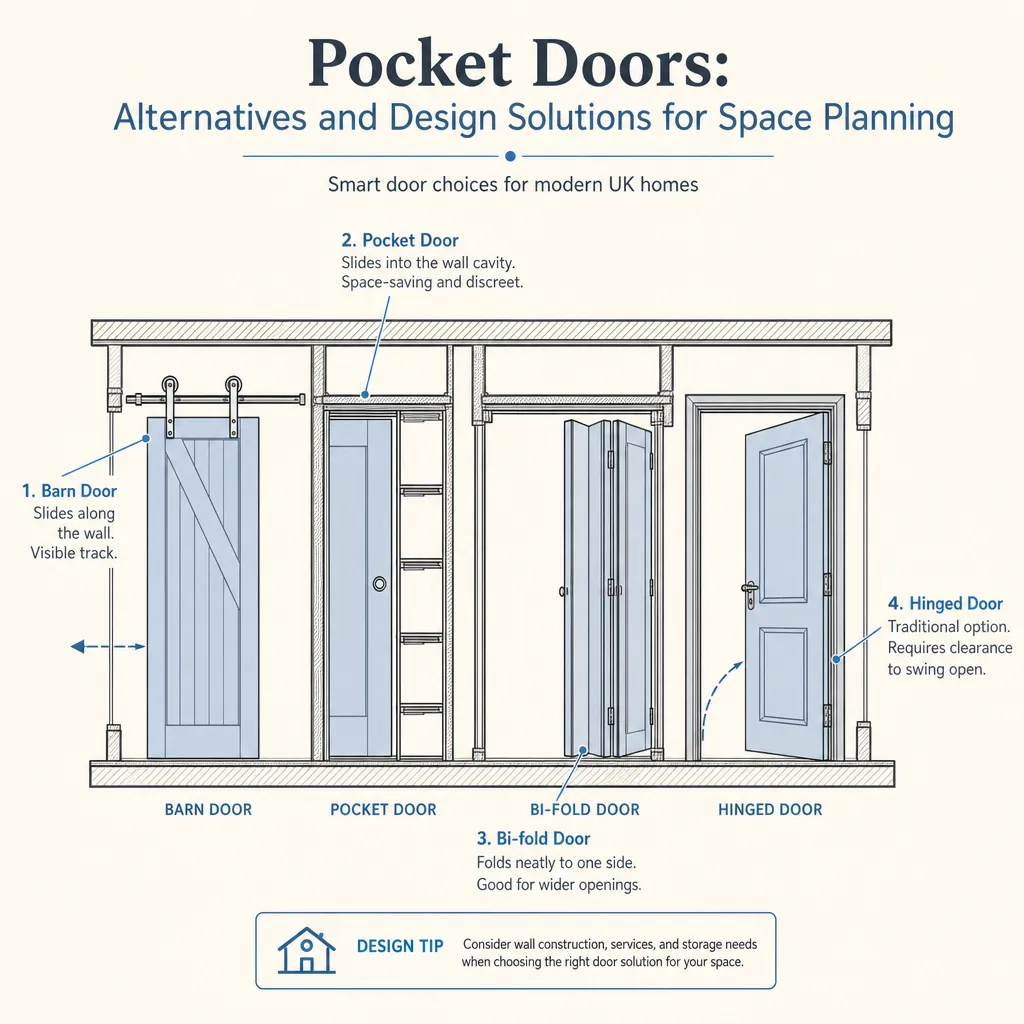
Pocket Doors: Alternatives and Design Solutions for Space Planning
Space planning in UK homes — particularly in Victorian terraces, compact new-builds, and open-plan kitchen-dining conversions — often raises the question of what to do when a standard hinged door compromises circulation or simply will not fit without conflicting with furniture or sanitaryware. Pocket doors are a popular solution but they are not always practical, and several well-established alternatives exist that suit different wall constructions, budgets, and design aesthetics. Understanding the trade-offs before committing to any sliding system saves time, money, and the disruption of unpicking finished wall surfaces.
Key points
- A pocket door requires a clear, unobstructed wall cavity equal to at least the door-leaf width — typically 800–950mm of free wall — making it unsuitable for partitions containing buried pipes, electrical cables, or structural posts.
- Pocket door frame kits are manufactured in stud widths of 75mm, 100mm, and 125mm; thinner configurations reduce the acoustic and thermal performance of the partition compared with standard uninterrupted studwork.
- Barn-style surface-mounted sliding doors require no wall cavity and can be retrofitted to masonry, timber-frame, or stud partitions, but the overhead track occupies 50–100mm of clear wall height above the door opening.
- Bi-fold doors require approximately 50% of the opening width as clear side space when folded; bypass (double-sliding) doors need no side clearance but limit the maximum clear opening to half the total door width.
- Structural alterations to load-bearing walls — which may be needed to form a wider opening for any sliding door system — require compliance with Building Regulations Approved Document A and a building control notification.
What is a pocket door and how does it work?
A pocket door slides horizontally into a concealed cavity built within the wall thickness. The door leaf travels on a top-hung aluminium track — or sometimes a combined top-and-floor track — housed within a proprietary steel cassette or purpose-built timber frame. Because the door disappears entirely when open, pocket doors are especially useful where floor space is constrained or where the full clear opening width is needed for access or light.
Common UK applications include:
- En-suite bathrooms where a hinged door would conflict with a shower enclosure or WC position
- Kitchen openings onto a dining or garden room in a rear extension or open-plan conversion
- Narrow hallways in Victorian and Edwardian terraced houses where a hinged door reduces usable width
- Utility and downstairs WC doors in compact terraced or semi-detached layouts
Limitations of pocket doors in UK homes
- Wall cavity requirements: the pocket needs a clear wall run equal to the full door width, free of structural posts, pipes, and cables. In older UK properties with buried services and uncharted wiring, achieving this without re-routing services is often impractical and costly.
- Reduced acoustic performance: the pocket cassette breaks the continuity of the partition, reducing sound insulation compared with a standard solid door frame. This matters between bedrooms, between a WC and a living area, or in flats where Approved Document E requirements apply.
- Maintenance access: if the track or hardware fails, accessing the cavity usually means opening up the wall finish — a significant repair cost in a tiled bathroom.
- Hardware constraints: conventional lever handles cannot be used; flush pulls or edge pulls are required, which some users find less intuitive and less accessible for occupants with limited dexterity.
- Load-bearing walls: retrofitting a pocket door into a load-bearing wall requires a structural engineer's assessment and building control approval. This is not a general builder task.
Alternatives to pocket doors
Door type | Space saving | Wall modification needed | Acoustic performance | Indicative supply-only cost | Best for |
|---|---|---|---|---|---|
Pocket door | Maximum — door fully hidden | Yes — cavity in partition | Reduced vs standard | £200–£600 (frame kit + leaf) | En-suites, open-plan kitchens, narrow halls |
Barn/surface sliding door | High — no swing | Track above opening only | Similar to hinged if edge-sealed | £150–£500 | Retrofits, farmhouse or industrial aesthetic |
Bi-fold door | High — folds to one side | Minimal | Moderate | £200–£800 (internal bi-fold set) | Larger openings 900mm+, room dividers |
Bypass (double-sliding) | Moderate | Track above only | Moderate | £200–£600 | Wardrobe openings, laundry and utility rooms |
Pivot door | Low to moderate | Floor and ceiling fixings | Good if well-sealed | £400–£2,000+ | Statement entrances, oversized door leaves |
Standard hinged door | Lowest | None | Best | £80–£400 | Most standard residential uses |
Indicative UK supply-only costs, last reviewed 2026-05-26. Professional installation typically adds £100–£300 per door depending on complexity.
Which door solution suits your situation?
Decision guide
- Choose a pocket door if you have or can create a clear cavity wall free from services, if maximum clear opening width is the priority, and if the work forms part of a full refurbishment where walls are being opened anyway.
- Choose a barn-style sliding door if you are retrofitting without wall modification, want a visible design feature, or are working over masonry where no cavity exists and forming one is impractical.
- Choose bi-fold if you have a wider opening — 900mm or more — and want the flexibility of a large clear span when the doors are folded back, with leaves neatly stacked to one side.
- Choose bypass (double-sliding) if you are fitting wardrobe or utility room doors where the full opening does not need to be fully cleared at once and side clearance is unavailable.
- Stay with a standard hinged door if acoustic separation between rooms is the priority, the budget is limited, or the wall construction makes cavity formation impractical without significant disruption.
- Consult a structural engineer before proceeding if any wall modification involves or is immediately adjacent to a load-bearing element.
Installation considerations
Pocket door installation
Pocket door frame kits from suppliers such as Eclisse, Portman, or Nickel are ideally installed during first-fix carpentry, or during a refurbishment where the wall finish is being fully stripped back. Key steps:
- Use a pipe and cable detector to confirm the full wall run is clear of buried services before cutting or removing any board or masonry.
- Confirm the wall is non-load-bearing, or obtain structural engineer sign-off and building control notification if it is not.
- Select the correct stud depth (75mm, 100mm, or 125mm) to match the existing partition thickness and thermal or acoustic specification.
- Allow a 3–5mm clearance between the door leaf and the frame jambs for smooth, consistent travel.
- In bathrooms and WCs, use moisture-resistant boards; ensure any penetration through the partition maintains required fire separation where applicable under Approved Document B.
Barn-style sliding door installation
Barn doors are surface-mounted and generally simpler to retrofit. The critical requirement is a solid fixing point for the overhead track — into masonry, into adequate timber noggins within a stud partition, or onto an exposed structural lintel. The track must be set perfectly level; even a minor deviation causes the door to drift when released and places uneven load on the fixings.
Building regulations
Internal door changes are not normally notifiable to building control as a standalone project. Notification is required if:
- The wall being modified is load-bearing and structural alterations are necessary
- The door affects fire compartmentation in a converted flat, licensed HMO, or commercial premises under Approved Document B
- The change is part of a wider notifiable project such as a loft conversion, change of use, or rear extension
When to get professional help
Internal door installation is within the range of competent DIY and general carpentry for standard non-load-bearing partitions. Always engage a qualified professional if:
- You suspect the wall is load-bearing — a structural engineer should assess before any cavity is formed or opening width is increased
- The door forms part of a fire compartmentation line in a converted flat, HMO, or commercial space
- The installation requires re-routing buried pipes or cables to create the pocket cavity
- The opening spans more than 1,200mm and may require a structural lintel to carry the load above
How Housey can help
Housey connects you with experienced window and door installers who work across pocket door systems, barn-style sliders, bi-fold installations, and bespoke joinery throughout the UK. Request up to four quotes from vetted local specialists to compare options for your project.
Frequently asked questions
Can a pocket door be fitted in a solid brick wall?
Yes, but it is considerably more complex than fitting one in a stud partition. A structural engineer will likely need to assess the lintel requirements and confirm load-bearing status. Forming a pocket cavity in solid masonry is disruptive and typically expensive. In most UK Victorian or Edwardian terraces with 215mm or 102mm brick walls, a barn-style surface-mounted slider is usually a more practical and cost-effective alternative.
Are pocket doors suitable for use as fire doors?
Pocket doors can be specified as fire-rated assemblies, but this requires a certified cassette and door-leaf combination rated to 30 or 60 minutes' fire resistance. Standard domestic pocket door kits are not fire-rated. For any fire compartmentation requirement — under Approved Document B, in HMOs, or in flat conversions — always use a complete certified fire-door assembly from a single manufacturer.
How much does pocket door installation cost in the UK?
Supply-only pocket door frame kits typically cost £200–£600; a door leaf adds £80–£400 depending on material and finish; and professional installation by a carpenter costs £150–£400 per door. Total installed costs of £450–£1,400 are typical for a standard internal pocket door in a non-load-bearing partition. Costs rise significantly if services need re-routing or structural work is required.
Do barn-style sliding doors reduce noise between rooms?
Less effectively than hinged doors. Because barn doors have a perimeter gap at the top, sides, and bottom, they do not provide the same acoustic seal as a hinged door fitted with a threshold strip and draught seals. For rooms where noise separation matters — bedrooms, home offices, bathrooms — a hinged door or a sealed pocket door in an acoustic cassette is the better choice.
Sources and further reading
- Approved Document A: Structure — GOV.UK / DLUHC
- Approved Document B: Fire Safety — GOV.UK / DLUHC
- Approved Document E: Resistance to the Passage of Sound — GOV.UK / DLUHC
- Do I need planning permission? Internal works — Planning Portal
- TRADA: timber in construction — Timber Research and Development Association
Useful next reads
 Improvement & Build
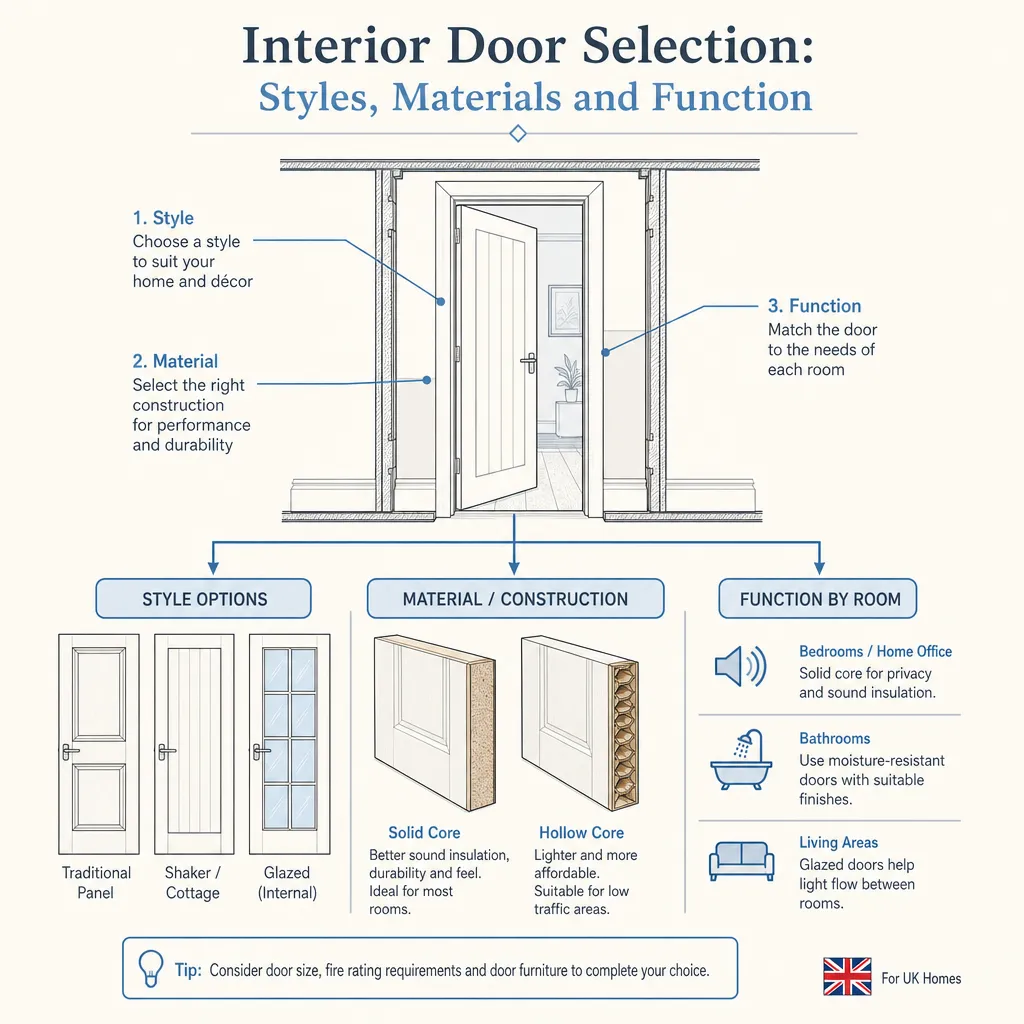
Interior Door Selection: Styles, Materials and Function
Interior doors in UK homes come in solid core, hollow core, and glazed varieties, with styles from flush and panelled to bifold and pocket.
 Improvement & Build
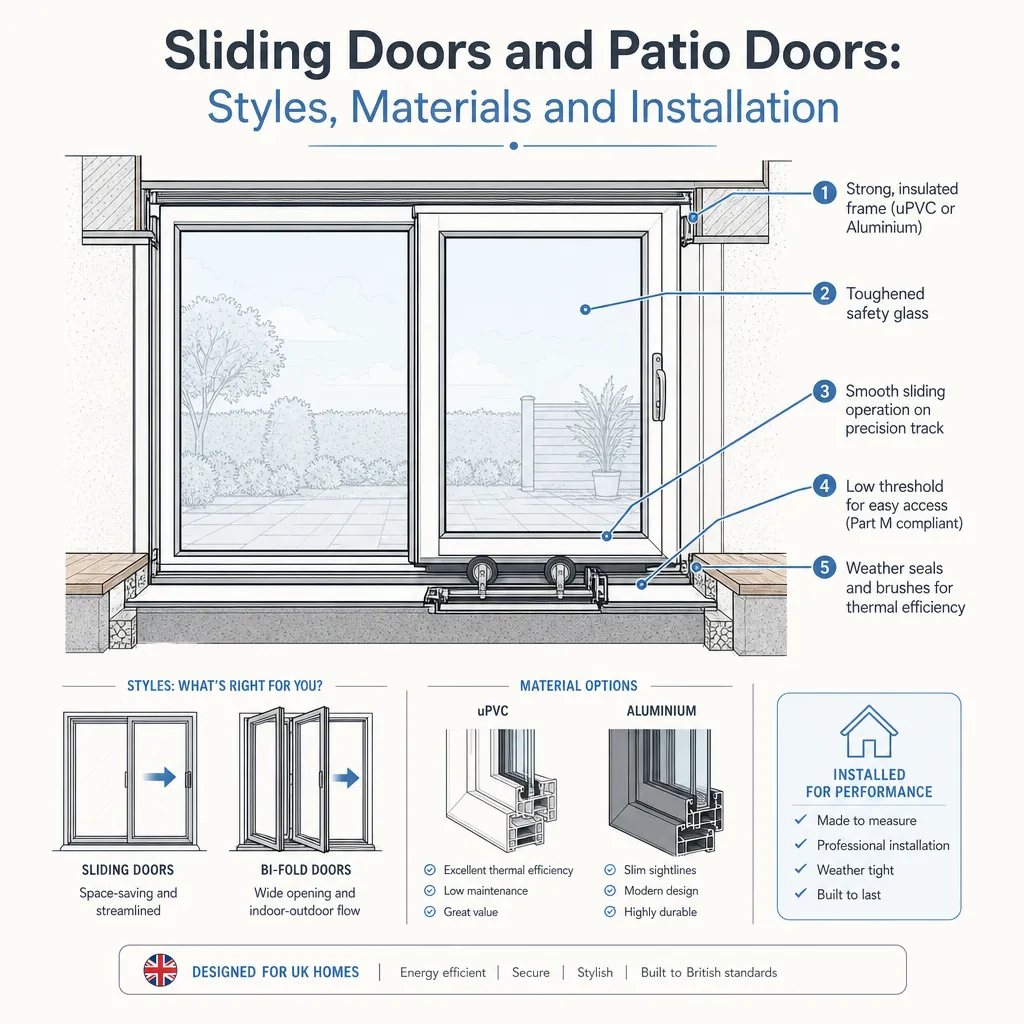
Sliding Doors and Patio Doors: Styles, Materials and Installation
Sliding patio doors move horizontally on a track, keeping outside space clear compared to a swinging door.
 Improvement & Build
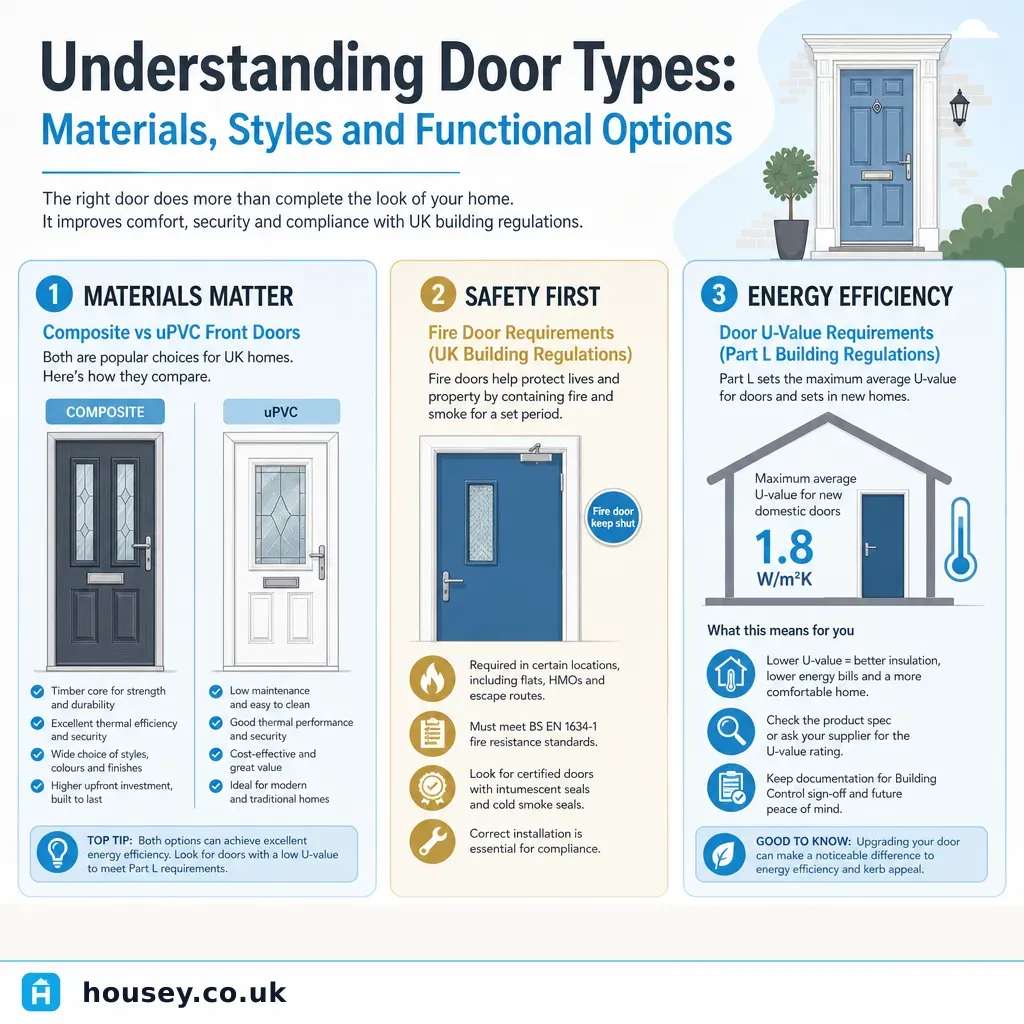
Understanding Door Types: Materials, Styles and Functional Options
Doors are available in timber, uPVC, aluminium, steel, and composite materials, each suited to different budgets, locations, and performance requirements.
 Improvement & Build
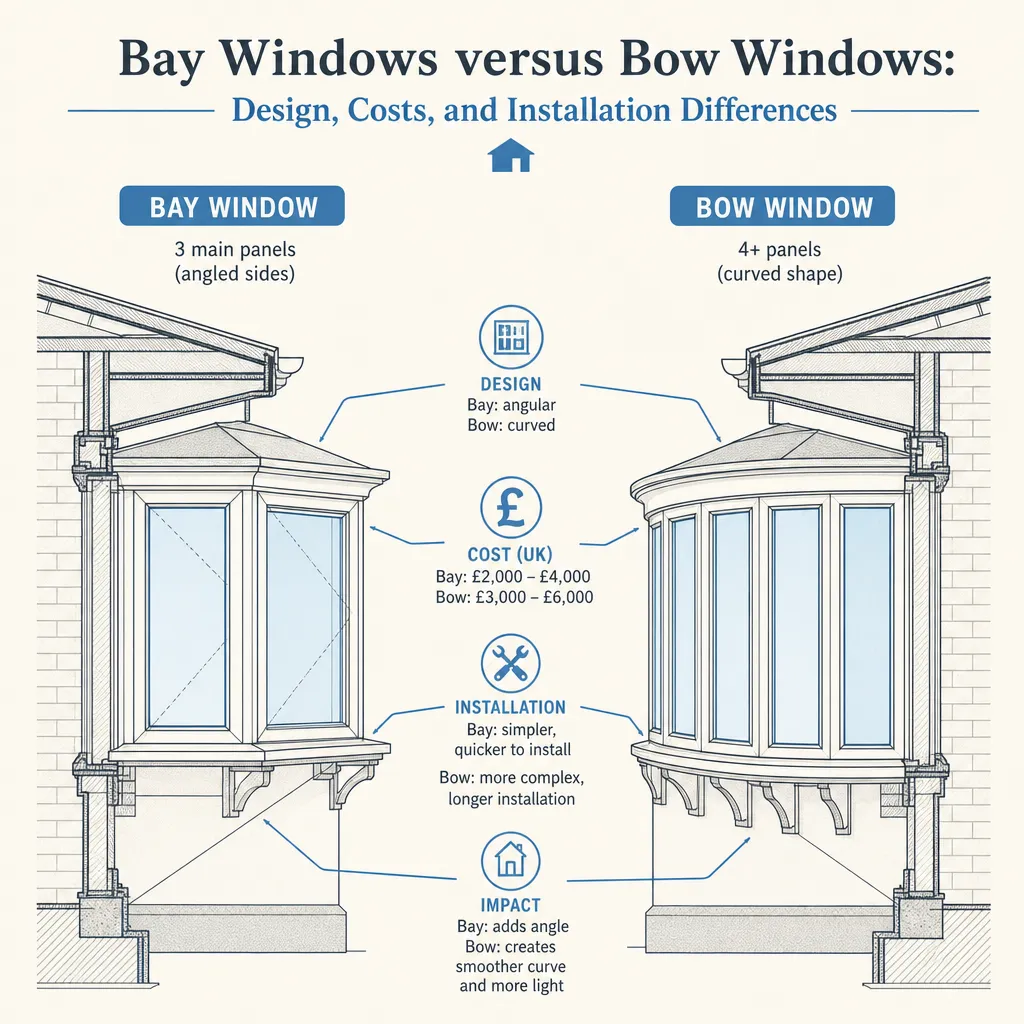
Bay Windows versus Bow Windows: Design, Costs, and Installation Differences
Bay windows project outward at angles — usually three panels at 90° or 135° — creating more floor space inside.
 Improvement & Build
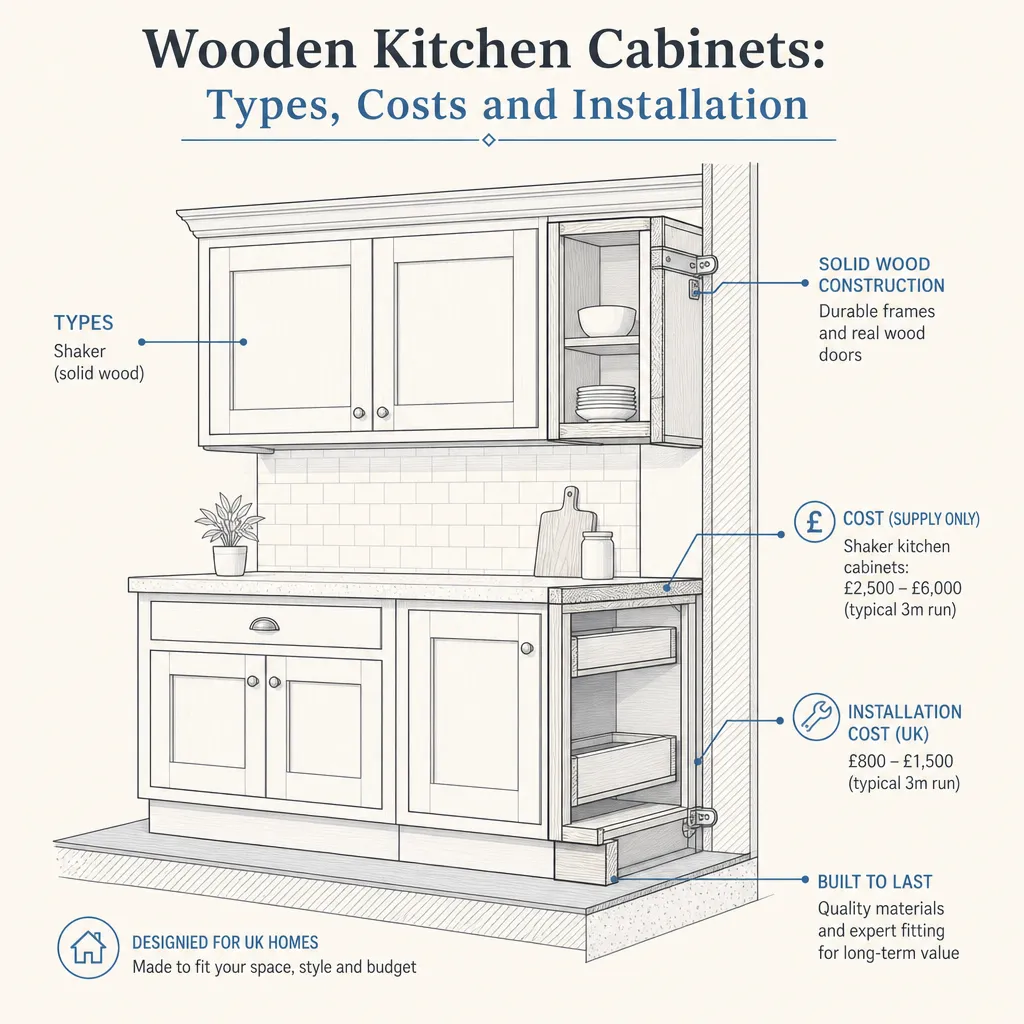
Wooden kitchen cabinets: types, costs and installation
Wooden kitchen cabinets in the UK range from around £4,000–£12,000 installed for mid-range painted shaker units to £10,000–£25,000 or more for solid hardwood kitchens.