Sliding Doors and Patio Doors: Styles, Materials and Installation
By Housey · Last reviewed 26th of May 2026
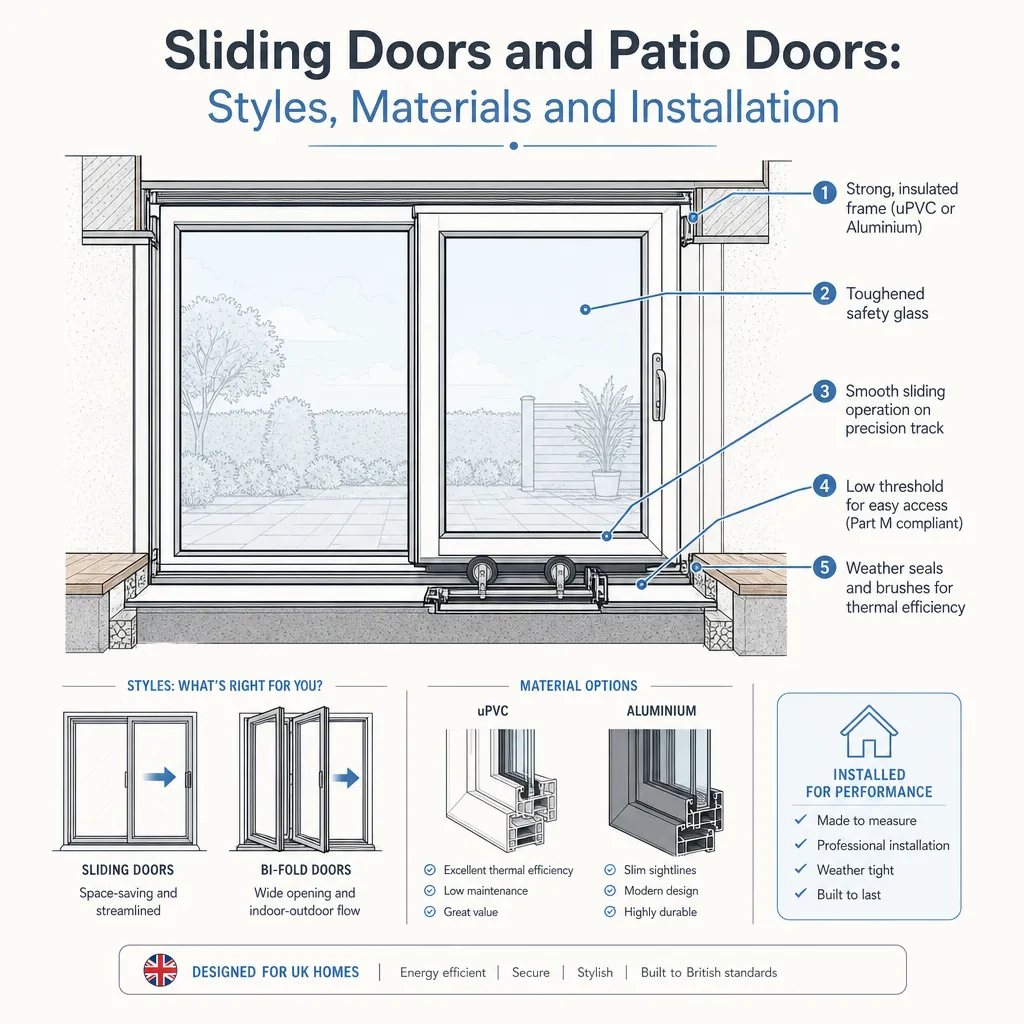
Sliding Doors and Patio Doors: Styles, Materials and Installation
Sliding patio doors are among the most popular home improvement projects in UK properties — whether you are opening up a kitchen-diner to the garden, replacing a dated 1980s aluminium frame, or fitting glazed doors in a new extension. The decision involves more than aesthetics: frame material, glazing specification, security performance, and installer credentials all affect the long-term result. Planning constraints, thermal performance requirements, and certification rules vary depending on whether you are replacing an existing door or creating a new opening in an external wall.
Key points
- Replacement sliding patio doors must meet a minimum whole-window U-value of 1.4 W/m²K under Building Regulations Approved Document L (2021 edition, effective June 2022 for England).
- Part Q of the Building Regulations requires doors in new dwellings and extensions to resist a standard security test; products tested to PAS 24:2022 are commonly used to demonstrate compliance.
- FENSA or CERTASS registration allows an installer to self-certify compliance with Building Regulations; without this, the homeowner must apply separately for a local authority building control certificate.
- uPVC sliding doors are the most widely installed type in the UK due to low maintenance cost and strong thermal performance; thermally broken aluminium is increasingly used for larger or more architectural openings.
- Creating a new opening in an external wall — as opposed to replacing a door in an existing opening — requires a structural lintel design and Building Regulations approval regardless of whether planning permission is needed.
Sliding door styles compared
Style | How it works | Best for | Typical opening width | Key limitation |
|---|---|---|---|---|
Two-pane inline sliding | One panel slides behind the other | Moderate openings, 1.8–2.4 m; limited external space | Up to 2.4 m | Only 50% of the opening is unobstructed at any time |
Three-pane sliding | Two panels slide, one fixed | Wider openings, 2.4–3.6 m | 2.4–3.6 m | Maximum two-thirds clear aperture |
Lift-and-slide | Panel lifts off sill seal then slides | Large or heavy panels; high-specification extensions | 3 m and above | Higher cost; specialist installation required |
Slide-and-fold | Panels concertina then slide to one end | Wide openings requiring a large clear aperture | 2.4–5 m | More seals and maintenance points than inline sliding |
Aluminium bifold (folding-sliding) | Panels fold and stack to one or both sides | Widest openings; contemporary architectural extensions | 2.4–6 m | Higher cost; seal performance varies between products |
Choosing a frame material
uPVC is the most common frame material for sliding patio doors in standard UK residential properties. Modern uPVC profiles achieve whole-window U-values comfortably below the Part L threshold, require virtually no maintenance, and are competitively priced. Very wide single panels — above approximately 1.5 m per leaf — can flex more than aluminium equivalents, so uPVC is less common in very large or architectural openings.
Aluminium offers slimmer sight lines, greater rigidity for large panels, and a more contemporary appearance. Thermally broken aluminium — where a plastic insulating bridge separates the inner and outer aluminium sections — is required to meet Part L. Aluminium frames typically cost 30–60% more than comparable uPVC products but suit wide openings and high-specification finishes well. Indicative UK costs, last reviewed 2026-05-26.
Timber is less common for sliding patio doors but used in heritage properties and bespoke high-specification projects. Timber requires regular painting or staining and is more susceptible to swelling and warping than uPVC or aluminium if moisture management is inadequate.
Composite frames combine a timber interior with an aluminium or GRP exterior, offering better weather resistance than solid timber with a warmer internal appearance than full aluminium. Cost is typically higher than aluminium.
Which style and material is right for your property?
- Choose uPVC two-pane inline sliding if you are replacing an existing patio door on a 1970s–1990s property where cost and thermal performance are the key priorities.
- Choose aluminium lift-and-slide if you have a large opening (over 3 metres wide) or a high-specification extension where slim frames and smooth operation justify the additional cost.
- Choose aluminium bifold if you want the maximum clear opening and a fully open indoor-outdoor connection in summer months, and can accept slightly higher maintenance requirements.
- Choose timber or composite if your property is listed, in a conservation area, or if the existing joinery is timber and aesthetic consistency is important.
- Ask your installer for the whole-window U-value calculation or BFRC energy rating certificate before selecting a product — this is the figure building control uses to assess compliance with Part L.
- Check with your local planning authority before installing any external door on a listed building or in a conservation area, as like-for-like replacement in the original material may be required.
Security: what to look for
Part Q of the Building Regulations applies to doors in new dwellings and extensions; it does not technically extend to replacement doors in existing openings, but security best practice is still worth applying across all installations:
- Multi-point locking systems that engage at several points along the door frame are significantly more resistant to forced entry than single-point locks.
- Anti-lift devices or integral anti-lift features in the track prevent panels from being lifted off the sill from outside.
- Laminated inner glass (rather than toughened glass alone) holds together if broken, making forced entry substantially harder and reducing injury risk.
- Shootbolts at the top and bottom of the sliding panel add resistance to levering and lifting attacks.
- PAS 24:2022 is the security performance standard referenced by Approved Document Q; look for this certification on any door fitted in a new or extended opening.
Thermal performance and energy efficiency
All replacement glazing in England must achieve a minimum whole-window U-value of 1.4 W/m²K. In practice, most modern double-glazed units achieve 1.0–1.4 W/m²K; triple-glazed units can reach 0.6–0.8 W/m²K and are worth considering for north-facing doors or where you are targeting a high EPC rating.
The British Fenestration Rating Council (BFRC) energy rating scheme awards grades from A++ to G, based on a combination of thermal transmittance, solar heat gain, and air leakage. As a minimum baseline, look for a B rating; an A or A+ rating on a south-facing door can contribute to passive solar gain during winter months.
What to ask before accepting a quote
- What is the whole-window U-value and BFRC energy rating for the specific product being quoted — not the glass unit alone?
- Is the installer FENSA or CERTASS registered, and will they provide the registration certificate and building control notification on completion?
- Does the quote include removal and disposal of the existing frame, making good of surrounding plasterwork, and any external rendering or brickwork repairs to the reveal?
- Is VAT included in the quoted price?
- What glass specification is included — double or triple glazed, low-e coating, laminated inner pane, argon or krypton fill?
- Has the product been independently tested to PAS 24:2022, and is there documentation available to confirm this?
- What are the separate warranty periods for frames, glass units, and hardware?
When to get professional help
Most patio door installations are straightforward for a FENSA-registered installer. However, seek additional professional input if:
- The existing opening needs to be widened or a new opening is being created — a structural lintel calculation and Building Regulations approval are required regardless of whether planning permission applies.
- Your property is listed or in a conservation area and the proposed door differs from the existing in material, frame depth, or glazing bar style.
- The surrounding structure shows signs of settlement — cracked reveals, sticking frames, or uneven lintels — which should be assessed before new doors are installed.
- You are installing very large panels (above 5 metres total width) where deflection, bearing, and fixing point calculations become more involved.
How Housey can help
Housey connects you with vetted FENSA-registered window and door installers who can advise on the right sliding or patio door system for your property, provide thermal performance certificates, and handle the compliance notification so you have the paperwork ready for your conveyancer when you come to sell.
Frequently asked questions
Do I need planning permission for sliding patio doors in the UK?
In most cases, replacing an existing patio door or installing a sliding door in an existing rear-elevation opening does not require planning permission under permitted development rights. Creating a new opening in an external wall, or any change to a listed building or property in a conservation area, may need prior consent. Check with your local planning authority if in doubt.
What is the difference between sliding patio doors and bifold doors?
Sliding doors have panels that move horizontally on a track — one panel slides behind another, so only part of the opening is ever fully clear. Bifold doors fold concertina-style and stack to one or both sides, providing a larger clear aperture. Bifold doors are generally more expensive and have more seal and hinge maintenance points than inline sliding systems.
How long do uPVC patio doors last?
A well-manufactured and correctly installed uPVC patio door should last 20–30 years before the frame requires replacement. Double-glazed unit seals typically last 15–25 years before fogging or failure. Hardware — handles, locks, and rollers — may need servicing or replacement before the frame itself reaches the end of its useful life.
Can I install a patio door myself?
Installing a patio door in an existing opening may appear manageable but requires accurate measurement, correct structural support if the lintel span is changing, and compliance certification. If the installer is not FENSA or CERTASS registered, a building control application is needed. DIY installation that bypasses compliance can create legal and mortgage problems when selling the property.
Sources and further reading
- Approved Document L — Conservation of Fuel and Power (2021 edition) — GOV.UK
- Approved Document Q — Security — GOV.UK
- FENSA — homeowners guidance on replacement glazing — FENSA
- British Fenestration Rating Council — window energy ratings — BFRC
- Planning Portal — permitted development for windows and doors — Planning Portal
Useful next reads
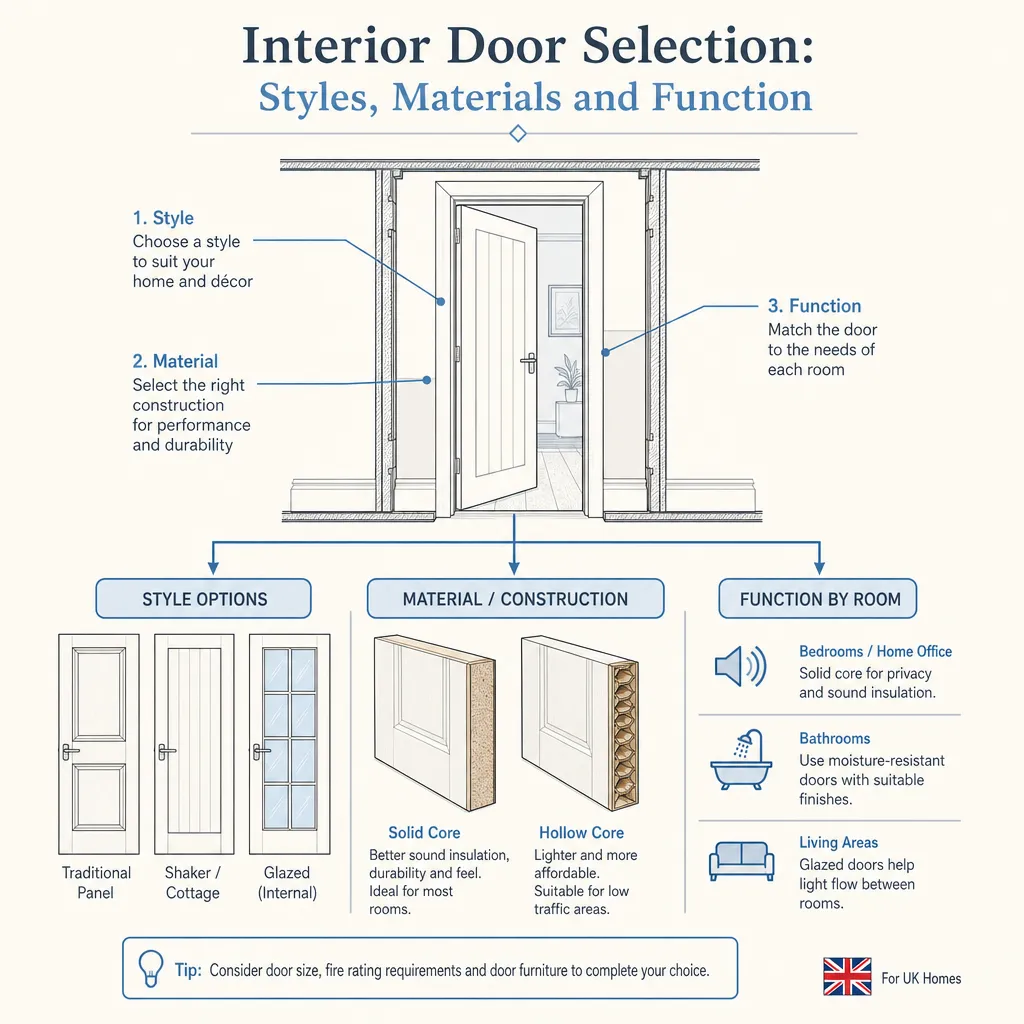 Improvement & Build
Interior Door Selection: Styles, Materials and Function
Interior doors in UK homes come in solid core, hollow core, and glazed varieties, with styles from flush and panelled to bifold and pocket.
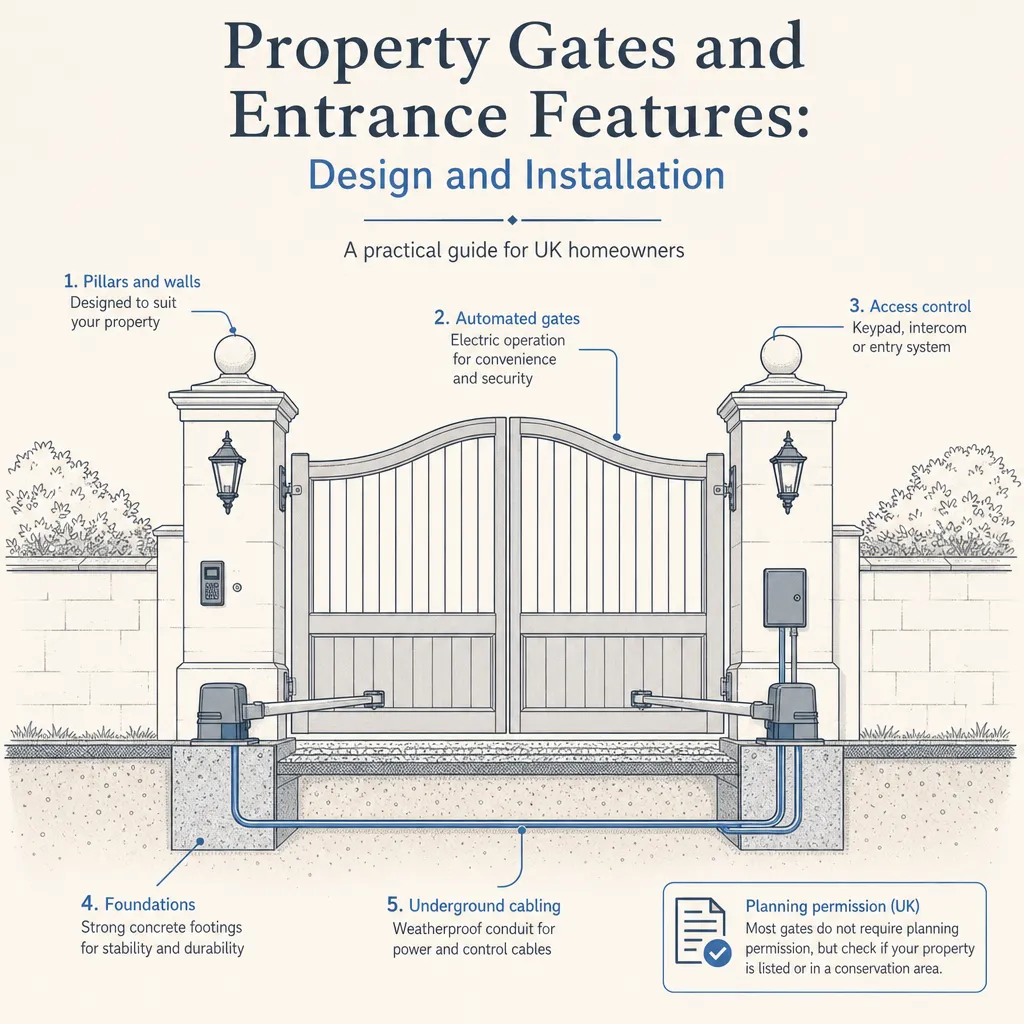 Improvement & Build
Property Gates and Entrance Features: Design and Installation
Gates on a boundary adjacent to a highway are limited to 1 m in height without planning permission; gates elsewhere on the boundary may be up to 2 m.
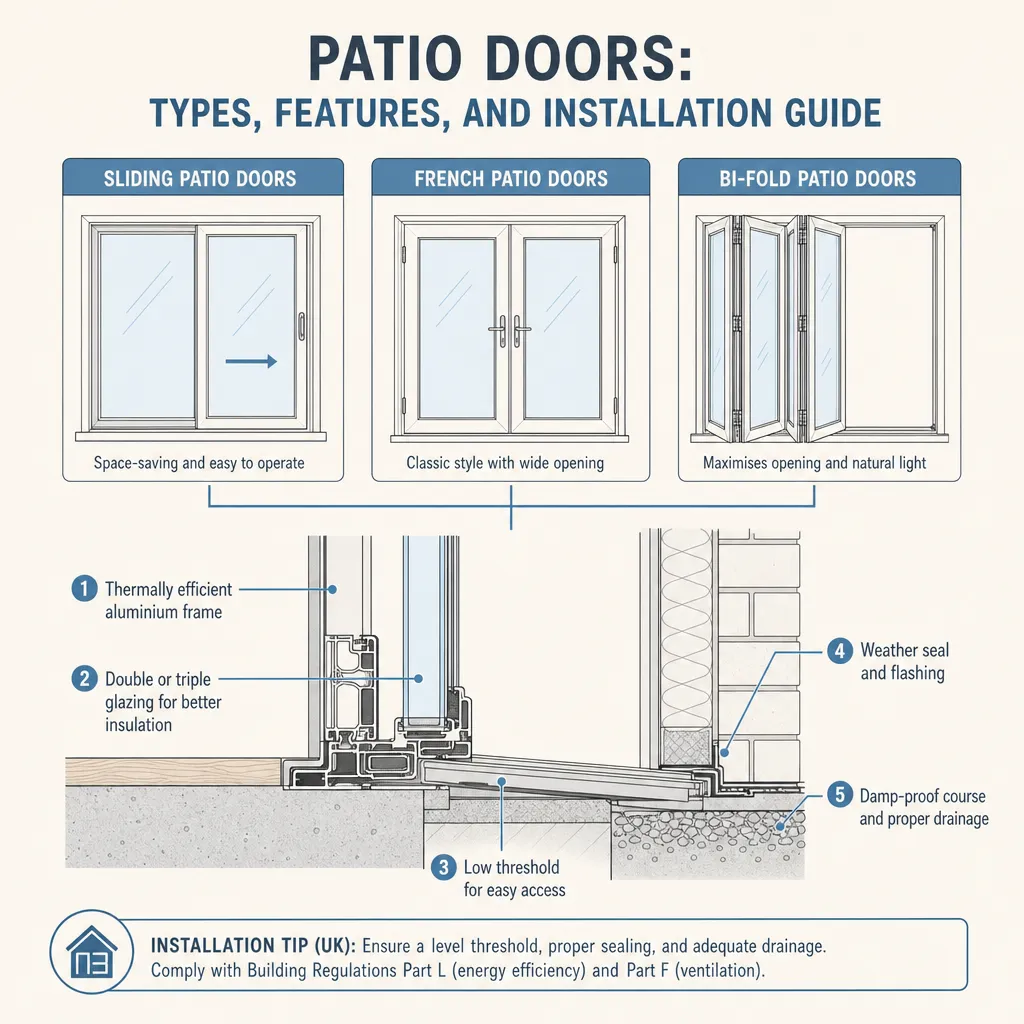 Improvement & Build
Patio Doors: Types, Features, and Installation Guide
UK patio doors come as sliding, French, or bifold systems.
 Improvement & Build
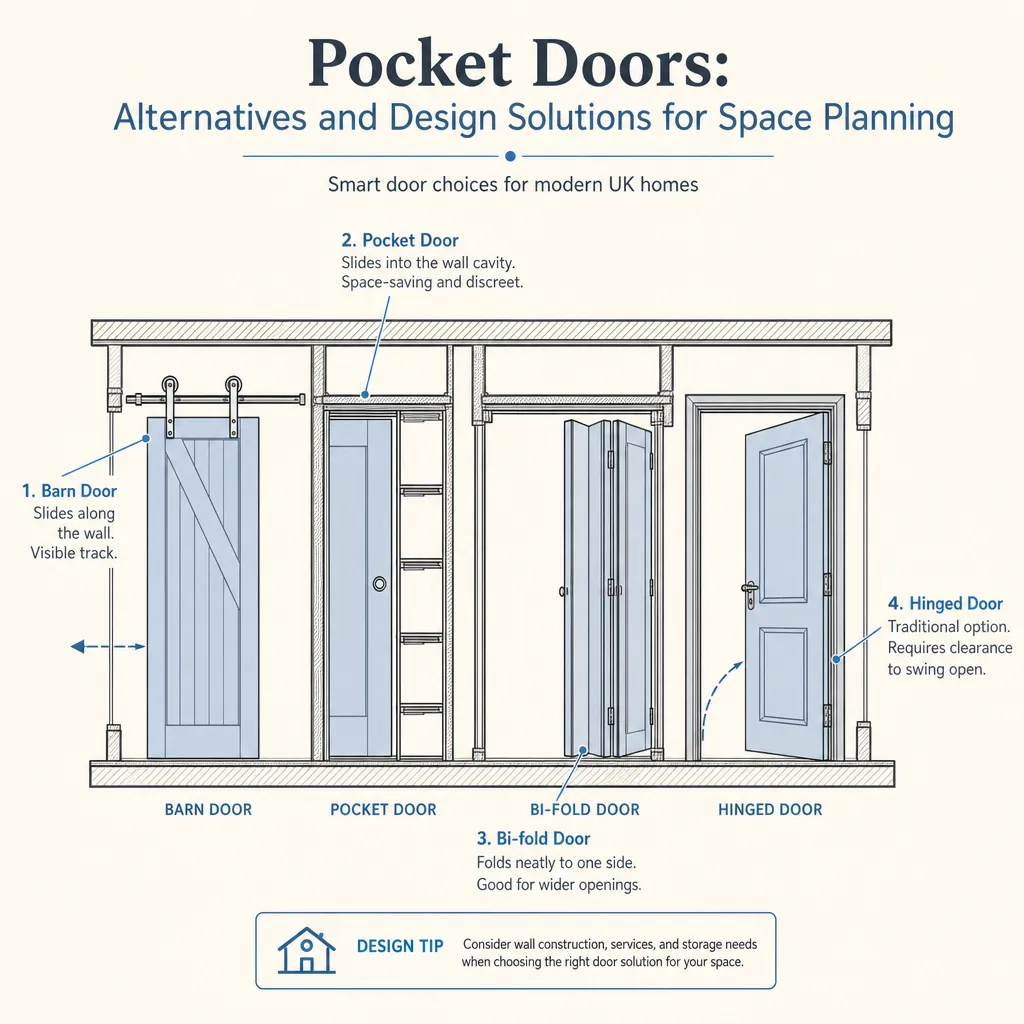
Pocket Doors: Alternatives and Design Solutions for Space Planning
Pocket doors slide into a wall cavity and free floor space where a hinged door would swing, but require a clear, service-free wall section to work.
 Improvement & Build
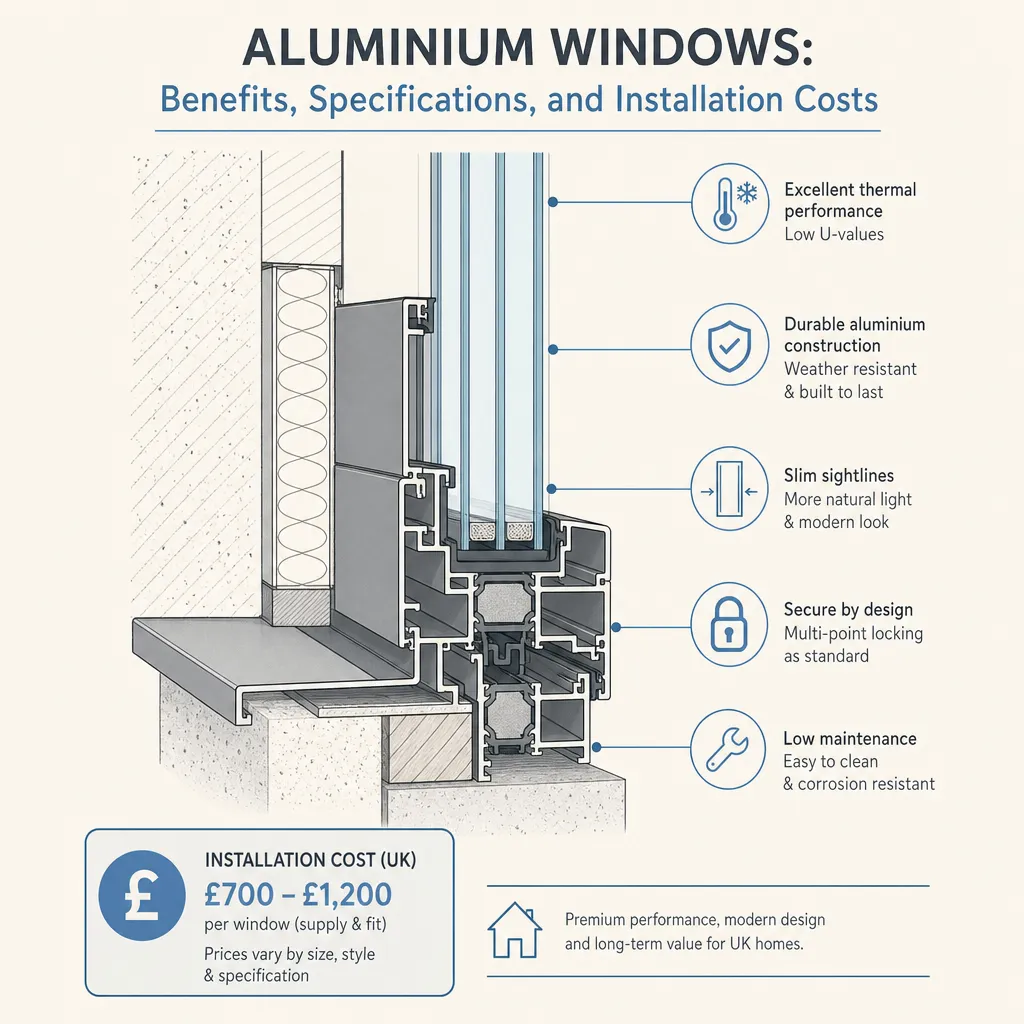
Aluminium Windows: Benefits, Specifications, and Installation Costs
Aluminium windows typically cost £600–£1,800 per window installed in the UK, depending on size and specification.