Pocket Doors Versus Barn Doors: Features and Selection Guidance
By Housey · Last reviewed 26th of May 2026
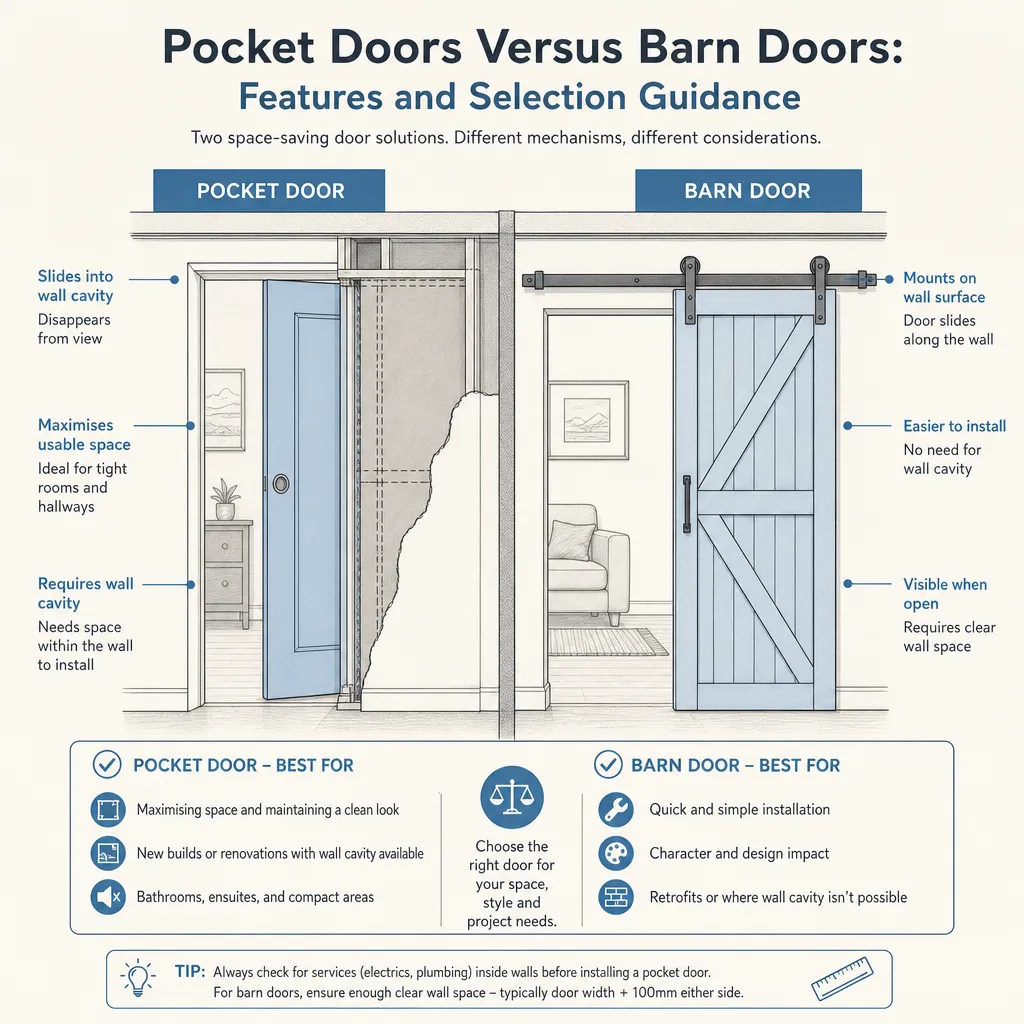
Pocket Doors Versus Barn Doors: Features and Selection Guidance
When homeowners in the UK decide to replace a standard hinged door with a sliding alternative — whether to reclaim floor space, open up a kitchen-diner, or improve flow in a Victorian terrace — the choice usually comes down to two options: a pocket door that disappears into the wall, or a barn door that slides along the wall face. Both solve the swing-clearance problem, but they suit different rooms, walls, and design schemes.
Key points
- Pocket doors require a wall cavity of at least the full door leaf width — typically 750–900mm — making them unsuitable for walls containing structural elements or services that cannot be re-routed.
- Barn doors mount on a surface-fixed track above the opening and need clear wall space equal to at least the door leaf width beside the frame.
- Barn doors do not seal fully into a rebated frame, which means they offer less acoustic privacy and are not suitable as certified fire doors in standard configurations.
- Pocket doors can be specified with intumescent fire seals and compliant ironmongery to meet FD30 fire door requirements under Building Regulations Part B.
- Barn door hardware kits in the UK typically start at £80–£300 for the track and fittings; pocket door frame kits typically start at £150–£400, with door leaf costs additional in both cases (Indicative UK costs, last reviewed 2026-05-26).
What is a pocket door?
A pocket door slides horizontally into a cavity — the pocket — built into or cut into the wall beside the opening. When fully open, the door is invisible. The mechanism relies on an overhead track recessed into the frame kit and a bottom floor guide.
Advantages: No floor clearance or ceiling swing needed; door is fully concealed when open; can achieve a flush, minimal finish with no visible hardware; compatible with certified fire door assemblies; good acoustic seal when correctly specified with seals and a rebated frame.
Disadvantages: Wall must be built around a frame kit or substantially modified to retrofit; pipework, cables, and structural elements cannot pass through the pocket; access to the mechanism for maintenance requires removing part of the wall lining; higher installation cost and complexity than a barn door.
What is a barn door?
A barn door (sometimes called a sliding wall door) hangs from a visible overhead track fixed to the wall or ceiling above the opening. It slides along the face of the wall, covering the doorway rather than concealing itself within it.
Advantages: Much easier to retrofit — only a fixing rail and door leaf are needed; visible hardware can be a design feature; door is accessible for maintenance at any time; no wall modifications required; lower installation cost.
Disadvantages: Requires clear wall space beside the opening equal to or greater than the door leaf width; does not seal into a rebated frame, so acoustic and draught performance is reduced; not suitable as a certified fire door in standard configurations; gap around the door when closed allows some sound and air transfer.
Pocket doors vs barn doors: at a glance
Feature | Pocket door | Barn door |
|---|---|---|
Wall modification required | Yes — cavity or frame kit | No — surface track only |
Space needed beside opening | None | Equal to or greater than door width |
Door visible when open | No — inside wall | Yes — beside opening on wall face |
Acoustic privacy | Good (if sealed correctly) | Reduced (gap around door) |
Fire door compatible | Yes (FD30 / FD30S assembly) | Generally not in standard configurations |
Draught sealing | Good (rebated frame) | Limited (surface-slide gap) |
Retrofit difficulty | High | Low |
Maintenance access | Moderate (panel removal needed) | Easy |
Indicative hardware cost | £150–£400+ | £80–£300+ |
Aesthetic style | Minimal, flush | Industrial, rustic, or statement |
Suitable for bathrooms | Yes | With care — gap allows steam and sound |
Indicative UK costs, last reviewed 2026-05-26. Door leaf costs are additional. Quotes vary by specification and supplier.
Which should you choose?
- Choose a pocket door if the adjacent wall is a non-structural timber partition with no services you cannot re-route, you need good acoustic privacy (bathroom, bedroom, home office), or you want a completely flush finish with no visible hardware.
- Choose a barn door if you are retrofitting and cannot modify the wall, you have clear wall space beside the opening, you want the track and fittings to be a visible design feature, or budget constraints favour a simpler installation.
- Specify a pocket door if Building Regulations Part B requires a fire door at this location — barn doors cannot usually satisfy certified fire separation requirements.
- Consult a structural engineer or builder if you are unsure whether the wall beside the proposed opening is load-bearing, as this affects which option is structurally feasible.
- Ask your local planning authority if the property is listed or in a conservation area — listed building consent may be required for alterations to internal fabric regardless of which door type you choose.
A worked UK property scenario
A homeowner in a 1930s semi-detached house wants to improve the connection between the kitchen and dining room. The wall between them is a 100mm timber stud partition with a 762mm doorway.
- Barn door: A fitter can fix a track to the wall above the frame and hang a reclaimed-oak leaf for a modest outlay. However, a radiator pipe runs inside the wall on the pocket side — this is not a problem for a barn door, which requires no wall cavity.
- Pocket door: The pocket zone would need the radiator pipe re-routed before the frame kit is installed, adding plumbing cost. The result is a cleaner finish and better acoustic separation when the dining room is in use for entertaining.
- Decision: If the plumbing re-route is within budget, the pocket door delivers a more refined result. If not, the barn door provides a practical and visually distinctive alternative without disrupting the wall structure.
When to get professional help
Either door type can be installed by an experienced carpenter, but seek professional input when:
- The wall beside the opening may be load-bearing.
- Pipework or electrical cables need re-routing — engage a Gas Safe or NICEIC/NAPIT-registered tradesperson as appropriate.
- The property is listed or in a conservation area — alterations to internal wall openings may require listed building consent.
- A fire door is required at this location and you need a fully compliant pocket door assembly.
How Housey can help
Whether you have settled on a pocket door or a barn door, Housey's network of vetted window and door installers can assess your wall, recommend the right system, and carry out installation to a high standard. Compare quotes from local fitters before committing to a supplier or door type.
Frequently asked questions
Which type of door is better for a bathroom?
A pocket door is usually preferable for a bathroom because it provides a proper rebated seal, reducing sound and steam transfer when closed. A barn door leaves small gaps around all four edges, which can allow moisture and noise to escape. If a barn door is the only practical option, a close-tolerance track with brush seals can reduce — though not eliminate — the gap.
Are barn doors more affordable to install than pocket doors?
In most cases, yes. A barn door installation involves fixing a track and hanging a leaf — a job an experienced carpenter can often complete in a day. Pocket door installation requires frame kit assembly, possible wall modification, plastering, and sometimes services re-routing. Hardware costs are broadly similar, but pocket door labour is typically higher overall.
Can either door type be used as a fire door?
Pocket doors can be used as fire doors when the full assembly — leaf, frame kit, ironmongery, and seals — is specified to meet FD30 or FD30S requirements under Building Regulations Part B. Barn doors cannot generally be certified as fire doors because they do not close into a rebated, sealed frame. Check with a building control officer if fire separation is required at your chosen location.
Do I need planning permission to install a sliding door inside my home?
For most UK homes, replacing or modifying an internal door does not require planning permission. However, if the works involve structural alterations — such as widening a doorway in a load-bearing wall — those changes may be notifiable to building control. In listed buildings, listed building consent is usually required for alterations to internal fabric. Check with your local planning authority if in doubt.
Sources and further reading
- Building Regulations Approved Document B: Fire safety — GOV.UK / MHCLG
- Planning Portal: do you need permission? — Planning Portal
- Listed buildings: what is designation? — Historic England
- Building regulations approval — GOV.UK
Useful next reads
 Improvement & Build
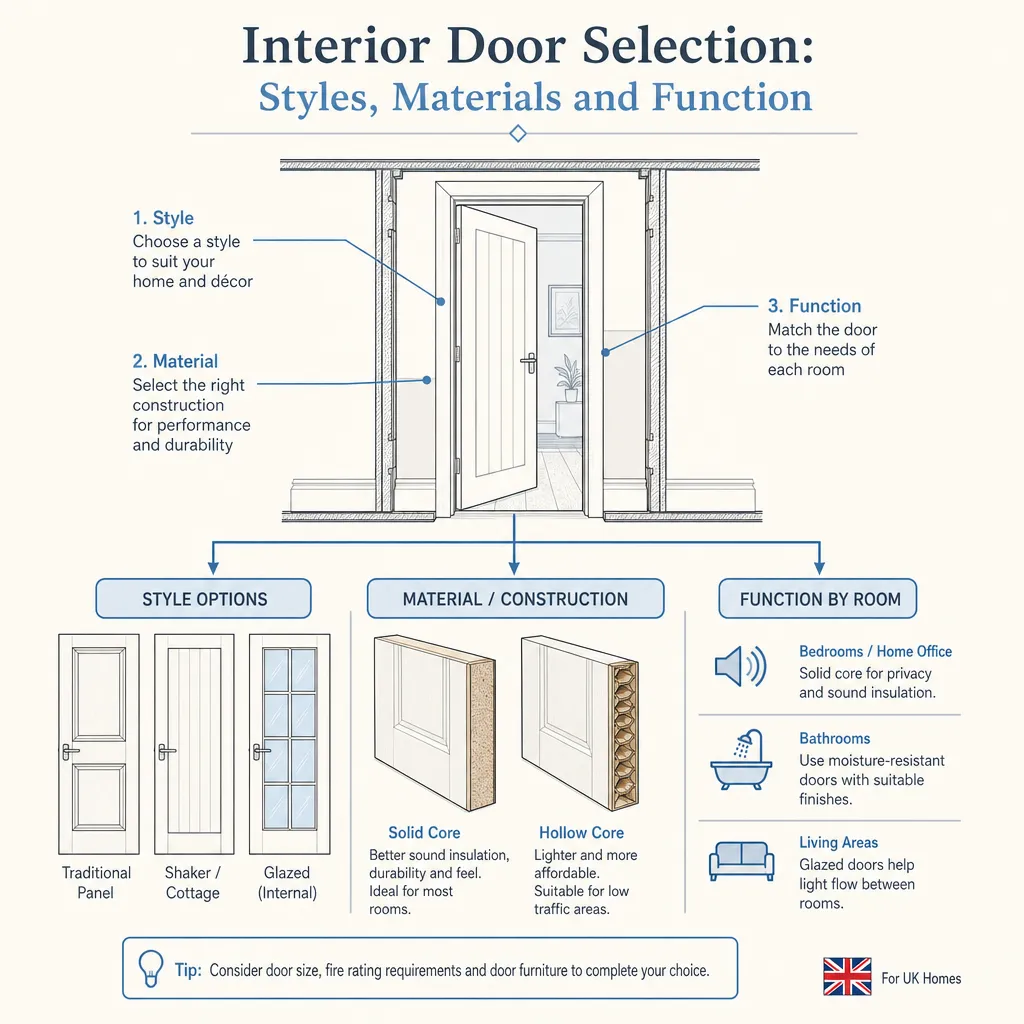
Interior Door Selection: Styles, Materials and Function
Interior doors in UK homes come in solid core, hollow core, and glazed varieties, with styles from flush and panelled to bifold and pocket.
 Improvement & Build
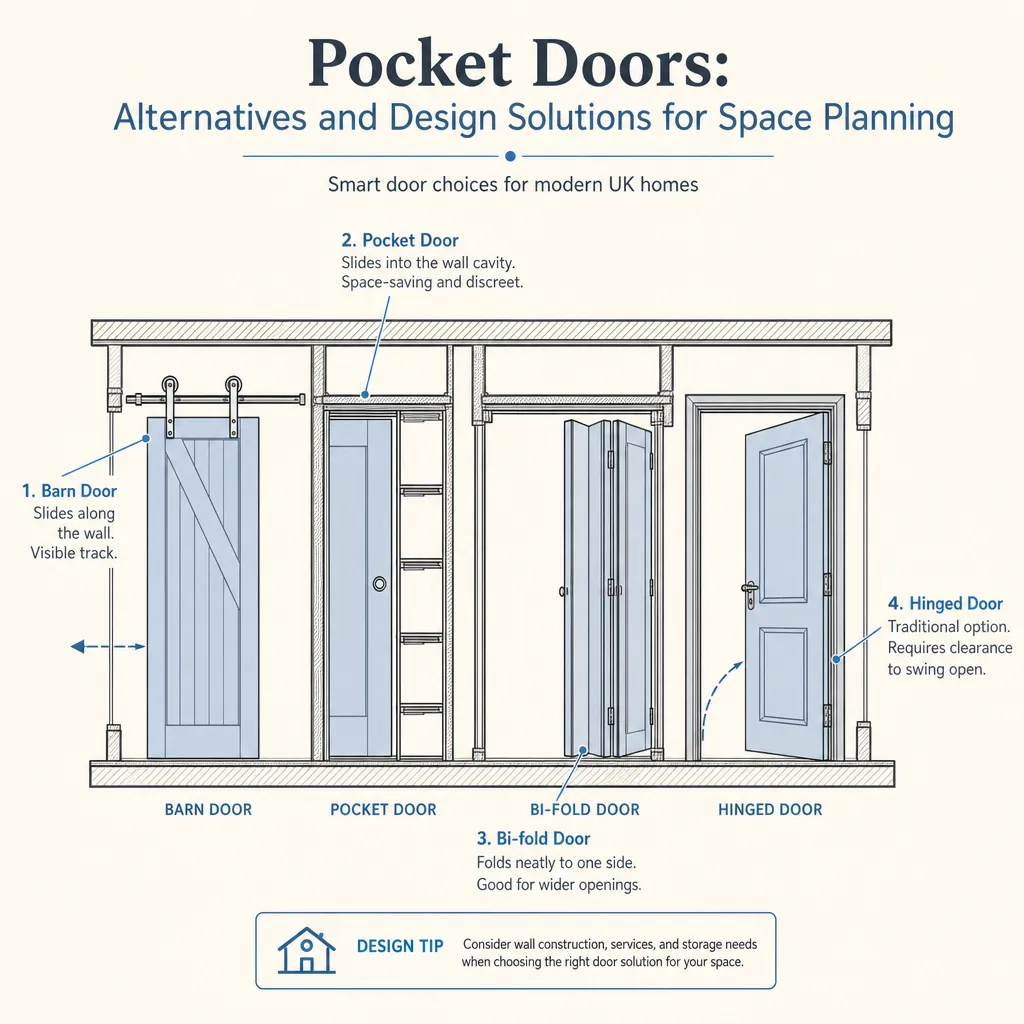
Pocket Doors: Alternatives and Design Solutions for Space Planning
Pocket doors slide into a wall cavity and free floor space where a hinged door would swing, but require a clear, service-free wall section to work.
 Improvement & Build
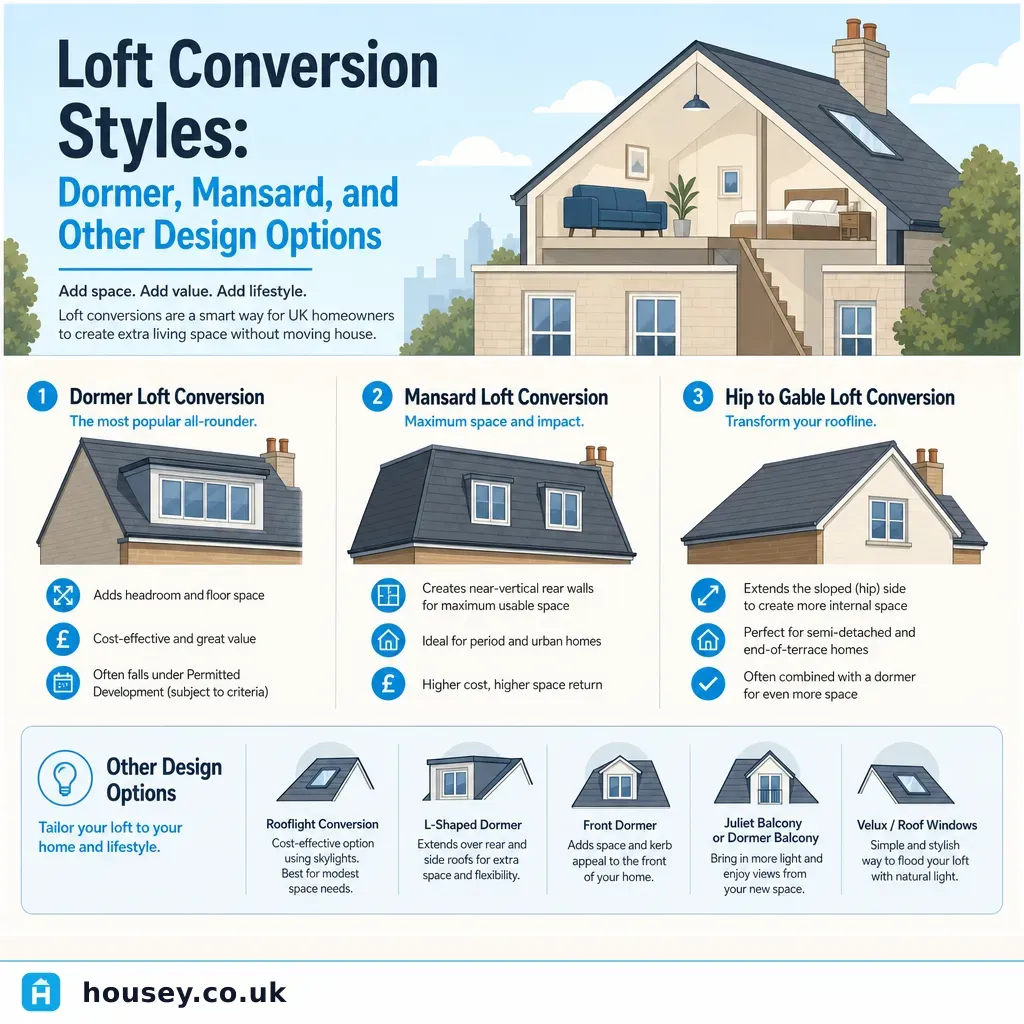
Loft Conversion Styles: Dormer, Mansard, and Other Design Options
The main loft conversion types in the UK are rooflight, dormer, hip-to-gable, and mansard.
 Improvement & Build
Window Types for Homes: A Comprehensive Overview
UK homes use several main window styles: casement (outward-swinging), sash (vertically sliding), tilt-and-turn, fixed light, and bay or bow.
 Improvement & Build
Home Extensions and Additions: Planning Your Project
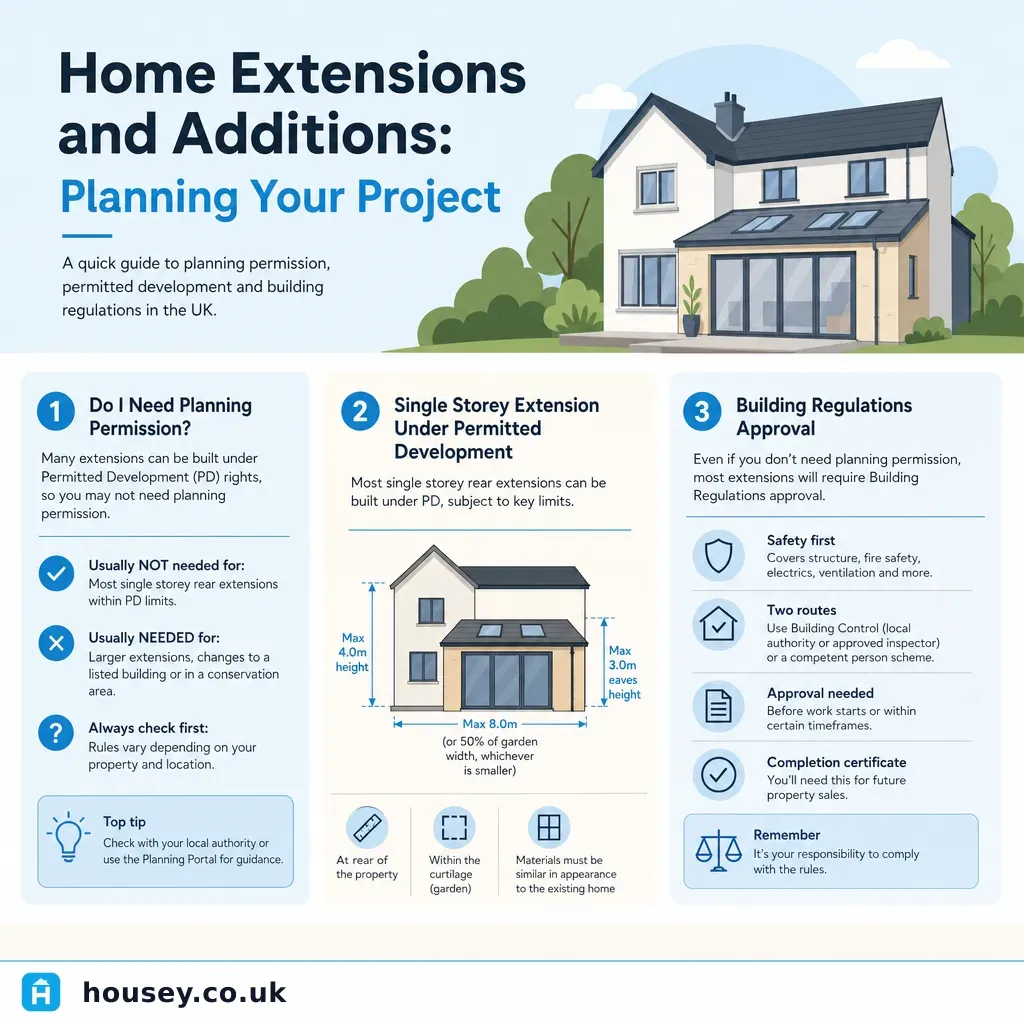
Most single-storey rear extensions can be built under permitted development without a full planning application, provided they stay within depth limits of 4 m for detached or 3 m for semi-detached and terraced properties.