Pond Maintenance and Management: Seasonal Care and Upkeep
By Housey · Last reviewed 26th of May 2026
Pond Maintenance and Management: Seasonal Care and Upkeep
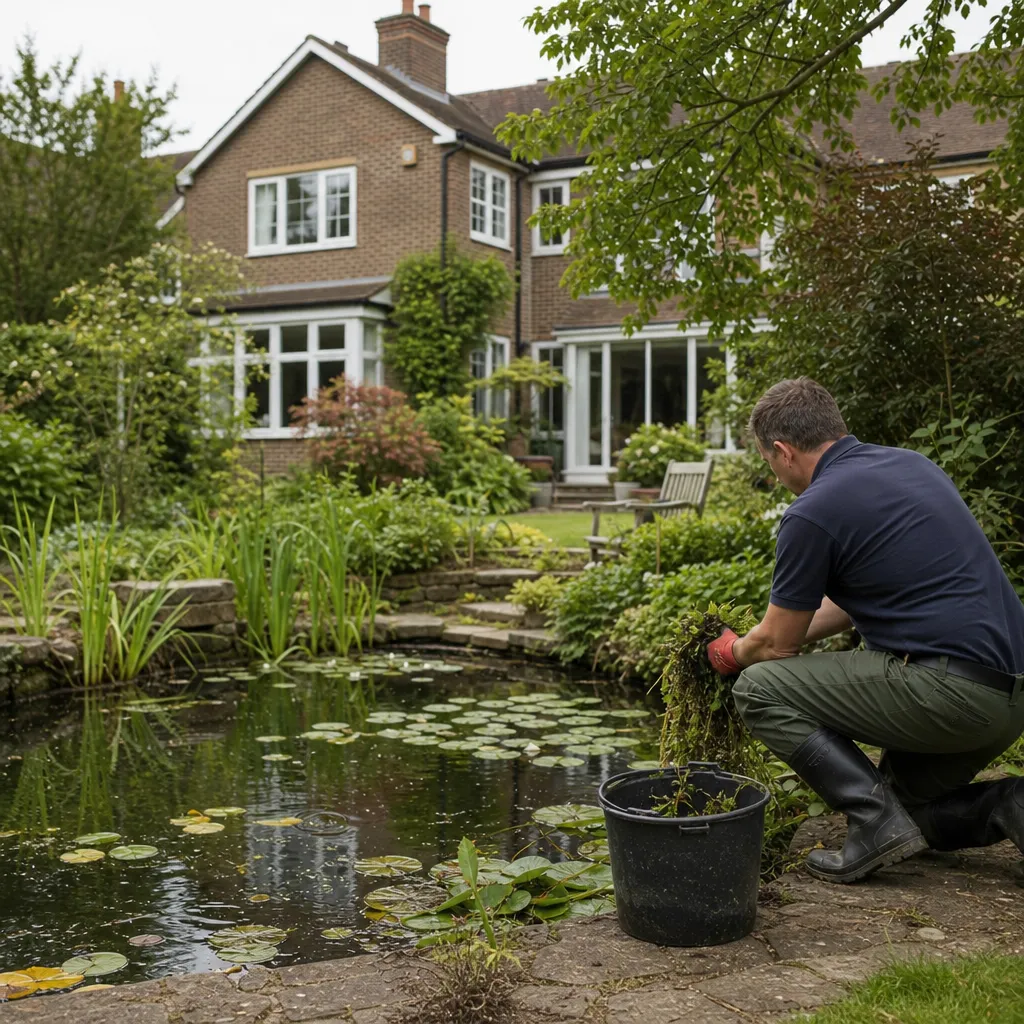
A garden pond requires year-round attention, but the volume and type of work changes significantly with each season. Spring demands equipment checks and vegetation management; summer calls for water quality monitoring; autumn is the time for leaf control and structural assessment; winter requires minimal intervention but a watchful eye on ice formation. Neglecting seasonal routines accelerates deterioration, reduces wildlife value, and ultimately leads to the costly interventions — full dredges or liner replacements — that attentive management can delay for many years.
Key points
- A healthy garden pond should maintain a pH between 7.0 and 8.5; values outside this range stress fish and disrupt plant growth.
- Oxygenating submerged plants — such as hornwort (Ceratophyllum demersum) or water crowfoot (Ranunculus aquatilis) — should cover roughly one-third of the pond floor to maintain dissolved oxygen levels.
- Pump filters in ornamental ponds should be cleaned at least monthly between April and October; always rinse filter media in pond water, never tap water, to preserve the beneficial bacteria that process waste.
- Great crested newts (Triturus cristatus) and water voles are legally protected under the Wildlife and Countryside Act 1981; significant works near an active habitat may require a Natural England European Protected Species licence.
- Blanket weed can double in surface coverage within days during warm, sunny weather; weekly removal during peak summer is normal for productive garden ponds.
Seasonal maintenance tasks
Spring (February–April): restart and inspect
Spring is the most labour-intensive season. As water temperatures rise above 10°C, biological activity restarts — beneficial bacteria in filters become active again, plant growth accelerates, and amphibians return to breed.
Spring checklist
Summer (May–August): water quality and growth control
Summer is peak biological activity. Warm water holds less dissolved oxygen, and higher light levels accelerate plant and algal growth. Water quality management is most active during this period.
Summer checklist
Autumn (September–November): protection and assessment
Autumn is the critical preparation window. Falling leaves, dying aquatic vegetation, and cooling water create conditions for oxygen depletion if not actively managed.
Autumn checklist
Winter (December–February): minimal intervention
A pond in good condition needs very little attention in winter. The priority is maintaining gas exchange at the surface.
Winter checklist
Wildlife pond vs ornamental pond: management comparison
Aspect | Wildlife pond | Ornamental pond (no fish) | Ornamental pond (with fish) |
|---|---|---|---|
Intervention frequency | Low — minimal disturbance preferred | Moderate — seasonal thinning and quality checks | High — regular feeding, filtration, water quality monitoring |
Algae management | Allow some; supports invertebrates and food chains | Remove excess blanket weed and duckweed | Control actively; fish waste fuels algal growth |
Leaf matter | Some decomposition is acceptable | Remove most to limit silt build-up | Remove all; decomposition degrades water quality for fish |
Pump and filtration | Optional; aeration only if pond is large | Beneficial for clarity | Essential; size to turn pond volume 2–3× per hour |
Vegetation balance | Encourage native species; allow self-seeding | Choose by aesthetics; manage spread | Choose non-invasive species; avoid plants with heavy leaf drop |
Full clean-out interval | 10–20 years | 5–15 years | 3–10 years — fish waste accelerates silt accumulation |
Water quality: common problems and causes
Problem | Likely cause | Management approach |
|---|---|---|
Green water — phytoplankton bloom | High nutrients; direct sunlight | Add oxygenating plants; install UV clarifier; reduce fish load |
Blanket or string weed | High phosphates; shallow, sunny water | Remove physically; use barley straw extract; add phosphate remover |
Brown or tannin-stained water | Decomposing leaves or bog plant roots | Remove leaf matter; partial water change of up to 10% |
Sulphurous smell when disturbed | Anaerobic sediment at base | Indicates dredging is needed; a partial water change is a temporary measure only |
pH below 7.0 | Organic acids; low buffering capacity | Add crushed limestone chips near the filter; review plant balance |
What to ask before hiring a pond maintenance professional
- What tasks are included in each maintenance visit, and what is excluded?
- Do you identify and record any wildlife species present on site?
- What qualifications or practical experience do you hold in water feature management?
- Will dredged material or removed plants be taken away, or left for me to dispose of?
- Can you assess whether the liner or pond structure needs attention during the visit?
- Do you have experience working with ponds that may support protected species such as great crested newts or water voles?
When to get professional help
Routine seasonal maintenance is achievable for most homeowners. Consider engaging a professional when:
- The pond is larger than 15 m² or has a complex planting and filtration system
- Water quality problems persist despite consistent seasonal management
- The pond supports or may support protected species
- You are planning structural changes including altering depth, shape, or repairing the liner
- An adjacent watercourse raises questions about Environment Agency consents or permissions
A landscaper experienced in pond care can carry out seasonal maintenance visits, manage dredging, and advise on replanting schedules. A garden designer can help redesign a neglected or overgrown water feature into a low-maintenance, ecologically valuable garden asset.
How Housey can help
Housey connects you with landscapers experienced in pond care offering seasonal maintenance and dredging services, as well as garden designers who can advise on replanting and long-term water feature management. Describe your pond and its current condition to receive quotes from local specialists.
Frequently asked questions
How often should I clean out a garden pond?
A full clean-out is typically needed every 3–5 years for ornamental fish ponds and every 5–15 years for wildlife and planted ponds with limited nutrient input. Routine seasonal tasks — leaf removal, blanket weed management, and filter cleaning — should be carried out throughout the year to maintain water quality and extend the interval between major clean-outs.
Is it normal for a new pond to go green?
Yes. New ponds almost always turn green within the first few weeks as algae colonise before plant competitors and predators are established. This usually resolves within 4–8 weeks as oxygenating plants establish and water fleas graze on phytoplankton. Avoid adding large volumes of tap water during this period, as chlorine kills the beneficial microorganisms that stabilise the water.
Do I need to change the water in my pond?
Complete water changes are rarely necessary and can disrupt the biological balance. Small partial changes of 10–15% are useful when pH is very low, ammonia is elevated in a fish pond, or water is heavily tannin-stained. Use dechlorinated or rainwater where possible. Wildlife ponds almost never require water changes once they are established.
Can I have a pond without a pump?
Wildlife ponds do not need pumps and often thrive without them. Planted ornamental ponds without fish can function well with adequate oxygenating plant coverage of around one-third of the pond floor. Fish ponds generally require filtration to manage waste load and dissolved oxygen; the pump should be sized to turn the total pond volume over 2–3 times per hour.
Sources and further reading
- RHS: pond care and management — Royal Horticultural Society
- How to manage your pond — The Wildlife Trusts
- Great crested newt guidance — Natural England / GOV.UK
- Check if you need a flood risk activity permit — Environment Agency / GOV.UK
- Freshwater Habitats Trust — pond ecology and management resources
Useful next reads
 Improvement & Build
Pond Dredging and Maintenance: Garden Water Feature Care
Pond dredging involves removing accumulated silt, sediment, and decaying vegetation to restore water depth and quality.
 Improvement & Build
When to Hire Professional Contractors vs. DIY Home Projects
Some home improvement work — including gas fitting, consumer-unit electrical work, structural alterations, and asbestos removal — is legally restricted to qualified professionals in the UK.
 Improvement & Build
Garden Landscaping: Professional Transformation of Outdoor Spaces
Garden landscaping covers all physical works to reshape and improve an outdoor space, from earthworks and hard landscaping such as patios, paths, and walls, to planting, drainage, and lawn installation.
 Improvement & Build
Garden Design Services: What Designers Charge
UK garden designers typically charge £50–200+ per hour, or fixed fees from around £200 for an initial consultation to £3,000–5,000+ for a full design package on a medium garden.
 Improvement & Build
How to Find and Vet Professional Roofing Contractors
Professional roofing contractors should carry public liability insurance of at least £2m, provide a written workmanship guarantee, and hold accreditation from a recognised body such as the NFRC or the Competent Roofer scheme.