Pondless Waterfalls: Water Feature Installation and Design
By Housey · Last reviewed 26th of May 2026
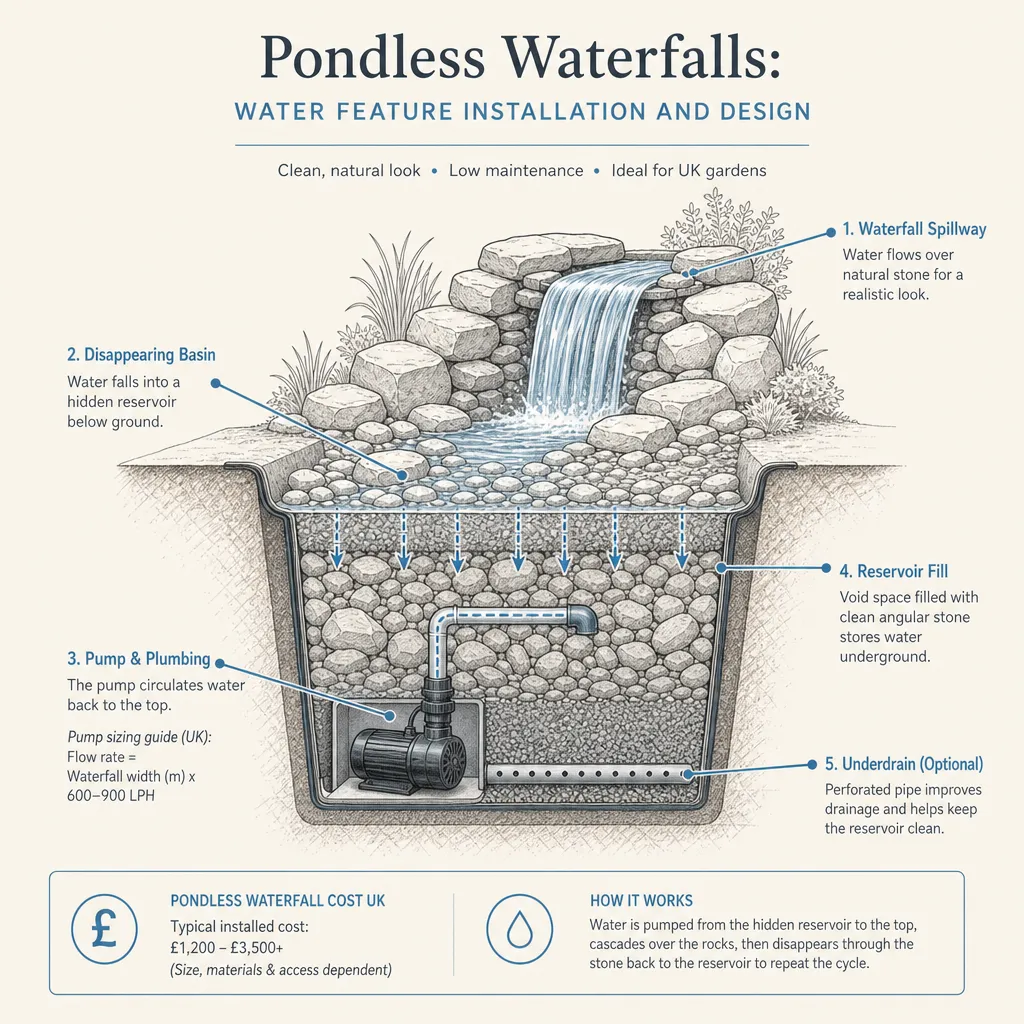
Pondless Waterfalls: Water Feature Installation and Design
A pondless waterfall offers the sights and sounds of flowing water without the safety concerns, maintenance burden, or planning complications of a traditional garden pond. They are increasingly popular among UK homeowners with young children, smaller gardens, or a preference for low-maintenance outdoor living — and can be installed in almost any garden, from a compact urban courtyard to a more generous suburban plot. Whether you are renovating an established garden or planning a new one from scratch, the decision involves choosing the right pump, checking permitted development rules, and finding a professional with genuine water feature experience.
Key points
- A pondless waterfall recirculates water through a sealed underground reservoir (basin), so there is no exposed standing water once the pump is switched off.
- Submersible pumps for UK residential pondless systems are typically rated between 1,500 and 6,000 litres per hour; correct sizing depends on the cascade height, width, and total pipe run.
- Professional installation typically costs £1,500–£5,000 for a modest feature, rising to £8,000–£15,000+ for large bouldered cascades — indicative UK costs, last reviewed 2026-05-26.
- Most pondless waterfalls do not require planning permission under permitted development, but features in conservation areas or on listed building curtilages may need consent from your local planning authority.
- Monthly pump pre-filter checks and an annual basin clean-out are the minimum maintenance tasks to keep a pondless system running reliably.
What is a pondless waterfall and how does it work?
A pondless waterfall is a recirculating water feature in which water cascades over rocks, slate, or other materials into a buried gravel-filled reservoir rather than into an open pond. A submersible pump sits inside the reservoir, drawing water up through a buried pipe to the top of the feature, from where it flows back down. When the pump stops, the water level in the cascade drops back into the reservoir, leaving no exposed water surface at ground level.
This design addresses two common objections to garden ponds: child safety and evaporation losses. The reservoir's water level remains hidden below a layer of cobbles or gravel, and the overall water volume is smaller than most ponds of equivalent visual impact. The sound and movement of water are preserved without the associated open-water hazard.
Pondless waterfall vs. traditional garden pond
Feature | Pondless waterfall | Traditional garden pond |
|---|---|---|
Open water hazard | None — water hidden in basin when pump is off | Yes — safety measures recommended near children |
Maintenance level | Low — monthly filter check, annual clean | Higher — algae control, liner, fish health if stocked |
Planning considerations | Rarely needed for standard domestic sizes | Rarely needed, but ecological rules can apply |
Wildlife value | Limited — no standing water habitat | High — attracts frogs, newts, dragonflies |
Running costs | Pump electricity: £30–£80/yr (indicative) | Pump plus potential fish and plant costs |
Installation cost | Lower to moderate — smaller excavation needed | Moderate to high — larger excavation, pond liner |
Visual footprint | Can be compact | Usually requires more garden space |
Indicative UK running costs, last reviewed 2026-05-26.
Choose a pondless waterfall if you have young children, a compact garden, or want low ongoing maintenance. Choose a traditional pond if encouraging UK amphibians and invertebrates is a priority and you are prepared for more regular management.
Choosing the right pump and reservoir
The pump is the most critical component of a pondless system. Under-sizing causes a trickle where you expected a cascade; over-sizing wastes energy and creates unwanted turbulence in the basin.
A useful rule of thumb: for every 30 cm of waterfall width, plan for roughly 1,000 litres per hour of pump flow at the required head height (the vertical distance from reservoir to the top of the falls). Add 10–15% for pipe friction losses on longer runs.
Reservoir sizing depends on the volume of water held in the cascade at any one time — your installer will calculate this to ensure the basin never runs dry during operation. An undersized reservoir is a common cause of pump failure in poorly specified installations.
Key pump considerations:
- Energy efficiency: EC (electronically commutated) motor pumps are the most efficient option for continuous operation, typically costing £30–£80 per year to run.
- Pre-filter access: the pump inlet filter needs monthly checking; choose a reservoir design that allows access without major excavation of the cobble or gravel surface layer.
- Frost protection: most UK residential pumps should be removed and stored indoors if temperatures are expected to fall below −5 °C, or the system drained for the winter months.
Planning permission and electrical requirements
In England, most garden water features fall within permitted development for residential properties and do not require planning permission. However, check with your local planning authority before starting work if:
- Your property is in a conservation area or subject to an Article 4 Direction.
- The building is listed or within the curtilage of a listed building.
- The feature involves significant groundworks near a boundary that could alter local land drainage.
Running electrical power to an outdoor pump must be carried out by a qualified electrician working to Part P of the Building Regulations. A residual current device (RCD) and weatherproof fittings are mandatory for any outdoor electrical installation — this is not a DIY task.
Always check for underground services before any excavation using LSBUD (lsbud.co.uk), the free service for locating buried pipes and cables.
Installation: what the process looks like
A professional landscaper or water feature installer will typically work through these stages:
- Site survey and design — assess slope, sightlines, existing drainage, and the route for power supply.
- Excavation — dig the basin pit (usually 1–1.5 m deep for a residential feature) and any pipe runs.
- Liner and reservoir — lay EPDM liner, place the reservoir vault or build a gravel-filled basin with a dedicated pump chamber.
- Pump, pipework, and header pool — install the pump, run the supply pipe to the feature top, create the header pool from which water falls.
- Stone and rock placement — the most skill-intensive stage; stone positioning determines the visual quality and the character of the sound.
- Electrical connection — carried out by a Part P-qualified electrician.
- Commissioning and testing — fill, test flow rate, adjust stones, check for leaks.
- Planting — optional marginal and surrounding planting to integrate the feature into the garden scheme.
A straightforward installation on accessible, reasonably level ground usually takes two to three days.
Homeowner preparation checklist
Before your landscaper or installer arrives:
Maintenance: keeping the system running
Task | Frequency | Notes |
|---|---|---|
Check and clean pump pre-filter | Monthly | A clogged pre-filter is the most common cause of pump failure |
Top up water level | As needed — weekly in summer | Evaporation increases significantly in hot or windy weather |
Annual basin clean-out | Once per year, autumn recommended | Remove debris, check liner for punctures, inspect pump |
Winterise the pump | Before sustained frost | Remove pump and store indoors, or drain if below −5 °C forecast |
Check outdoor electrical fittings | Annually | Look for cracked weatherproof covers or any exposed cable |
When to get professional help
Pondless waterfalls are generally straightforward for experienced landscapers, but involve a qualified professional if:
- You are uncertain whether underground services cross the excavation area — always use LSBUD before any digging.
- The pump is not maintaining adequate flow or is repeatedly tripping the RCD — may indicate an electrical fault or an undersized supply cable.
- Persistent wet patches appear around the feature outside the cascade zone — a possible liner leak that could affect nearby foundations or structures.
- Pump noise or vibration changes suddenly — the pump may be drawing air, indicating it is close to failure.
- You want to add or upgrade any outdoor electrical supply — this must always be carried out by a Part P-registered electrician.
How Housey can help
If you are ready to plan and install a pondless waterfall, Housey can connect you with experienced garden designers who can advise on placement, stone selection, and planting integration, as well as qualified landscapers who can handle the groundworks, reservoir installation, pump commissioning, and coordination with your electrician.
Frequently asked questions
How much does a pondless waterfall cost in the UK?
A modest pondless waterfall — around 1–1.5 m tall with natural stone — typically costs £1,500–£4,000 installed by a professional landscaper. Larger features with premium boulders and planting can reach £8,000–£15,000 or more. Always obtain at least two or three itemised quotes. Indicative UK costs, last reviewed 2026-05-26.
Do I need planning permission for a pondless waterfall?
Most residential pondless waterfalls in England fall within permitted development and do not require planning permission. Exceptions apply in conservation areas, on listed building curtilages, or where groundworks would significantly alter land drainage. Check with your local planning authority before starting work.
How much electricity does a pondless waterfall pump use?
A typical residential pump running continuously costs roughly £30–£80 per year based on UK average electricity rates. EC motor pumps are the most efficient option. Many homeowners run the feature on a timer during daylight hours only, significantly reducing annual running costs. Indicative figure, last reviewed 2026-05-26.
Can I install a pondless waterfall on a sloping garden?
Yes — a sloping garden is often ideal, as the natural gradient reduces excavation depth and creates a more authentic cascade effect. Your landscaper will assess whether the slope needs terracing or whether the natural contour can support the feature structure directly without additional groundworks.
Is a pondless waterfall safer than a garden pond around young children?
This is one of the main reasons UK homeowners choose pondless systems. Water returns to a covered underground reservoir when the pump is off, so there is no accessible body of water. The surface is typically cobbles or gravel, presenting significantly lower drowning risk than a traditional open pond.
Sources and further reading
- Planning Portal — permitted development for householders — Planning Portal / GOV.UK
- LSBUD — check for underground services before excavating — LSBUD
- Approved Document P — electrical safety in dwellings — GOV.UK
- Energy Saving Trust — home energy guidance — Energy Saving Trust
Useful next reads
 Improvement & Build
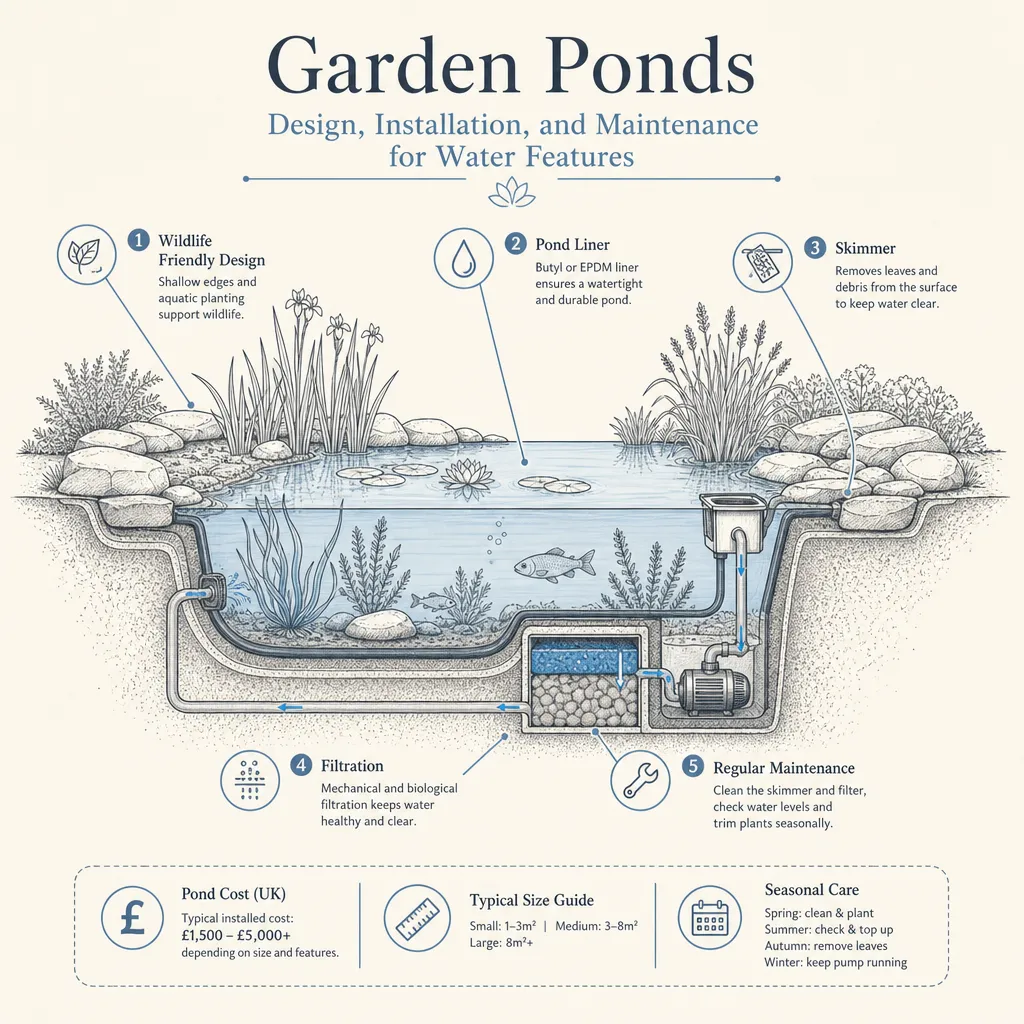
Garden Ponds: Design, Installation, and Maintenance for Water Features
Garden ponds can be installed by a specialist landscaper or pond contractor.
 Improvement & Build
Window Screens and Insect Mesh: Options and Installation
UK window screens fall into four main types: fixed frame, roller retractable, pleated folding, and magnetic snap-fit.
 Improvement & Build
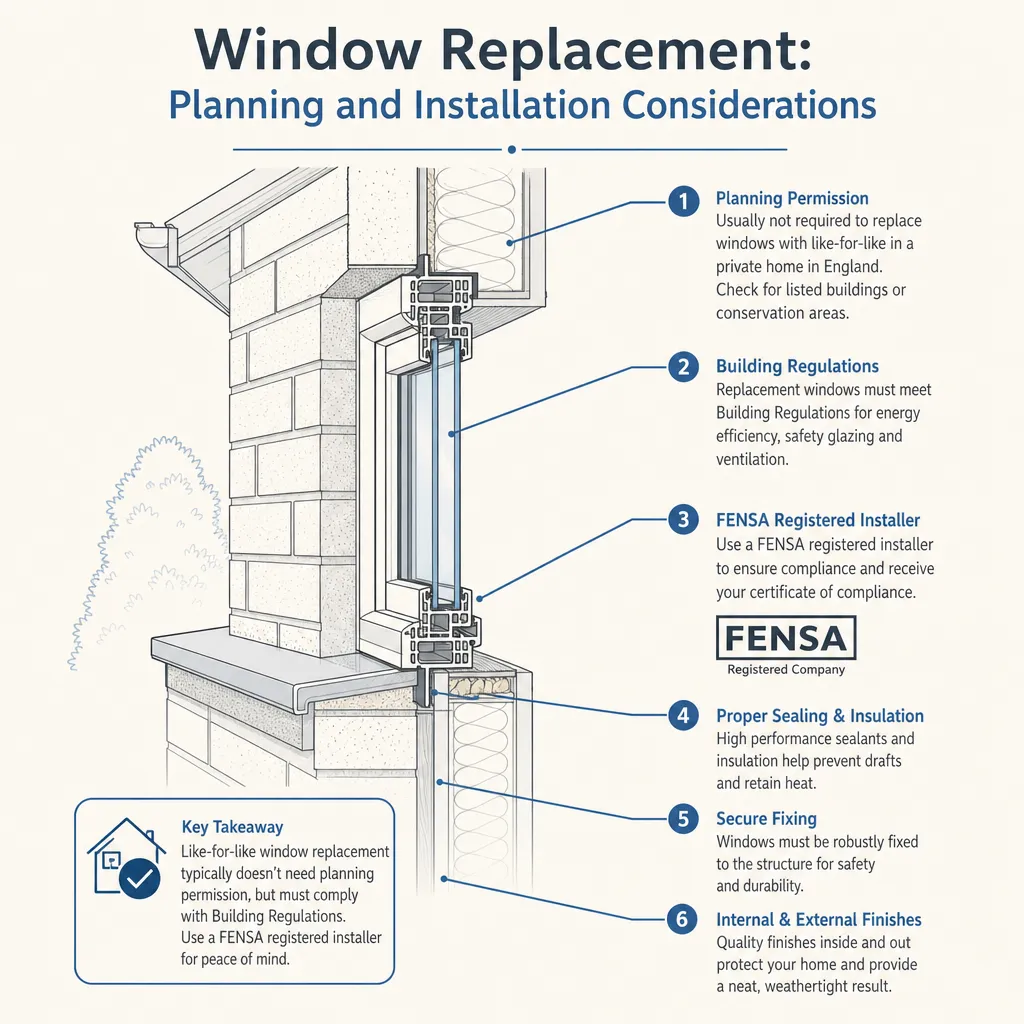
Window Replacement: Planning and Installation Considerations
Most window replacements in England fall under permitted development and do not need planning permission, though listed buildings, flats, and conservation areas are exceptions.
 Improvement & Build
Enhancing Your Home's Exterior with Professional Outdoor Lighting Design
Professional outdoor lighting design improves kerb appeal, extends garden use after dark, and deters intruders.
 Improvement & Build
How Much Does a Wellness Garden Cost in the UK?
A wellness garden in the UK typically costs £8,000–£40,000 for a mid-sized design-and-build project.