Popcorn Ceiling Removal: Methods and Asbestos Considerations
By Housey · Last reviewed 30th of May 2026
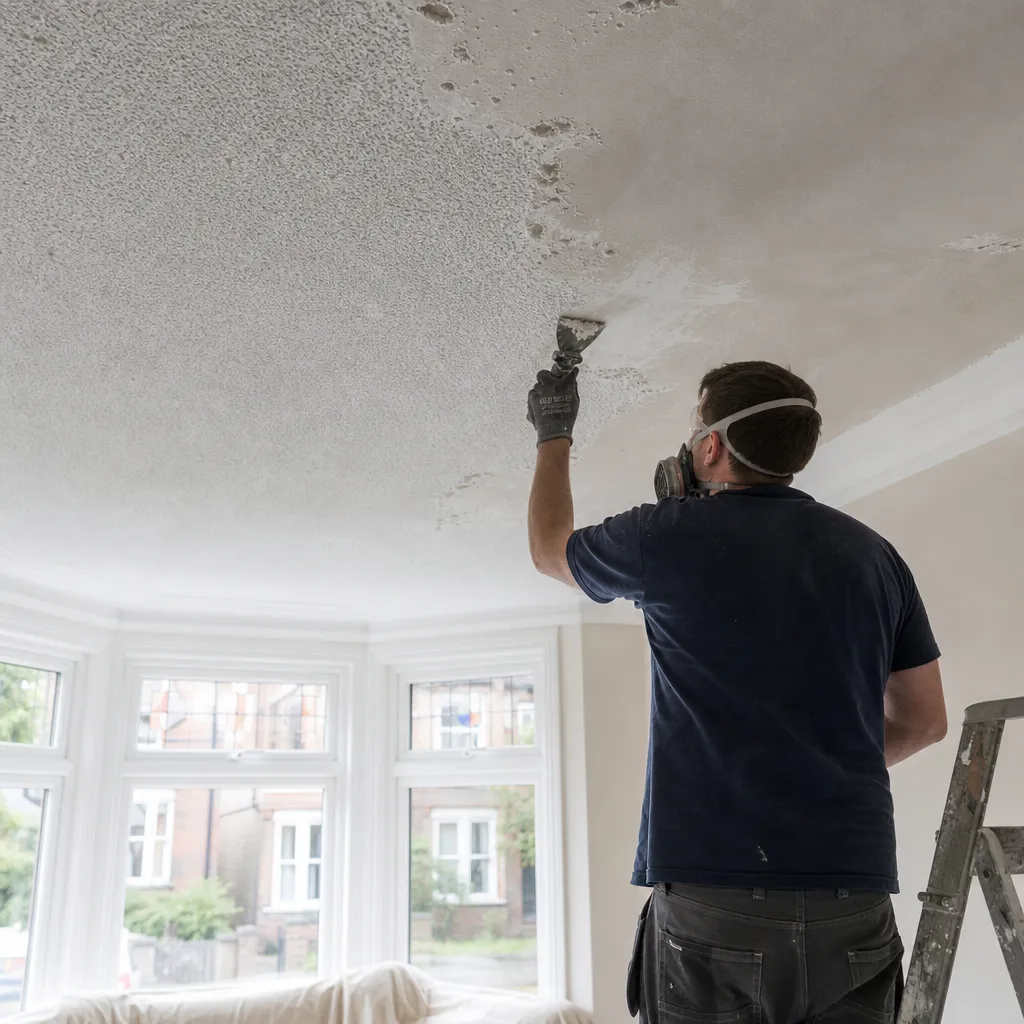
Popcorn Ceiling Removal: Methods and Asbestos Considerations
In UK homes, what is internationally known as a popcorn or stipple ceiling is most commonly called Artex — a brand name that became generic for any textured ceiling or wall coating. Applied widely from the 1950s through to the 1990s, Artex was used in millions of properties across the country. When homeowners decide to modernise, the question of removal quickly becomes a health and safety matter: Artex applied before 2000 may contain chrysotile (white asbestos), meaning removal is not simply a decorating decision but a regulated task requiring proper assessment before any tools come out.
Key points
- Artex and similar textured coatings applied before 2000 may contain chrysotile asbestos — do not disturb the material without testing first.
- The Control of Asbestos Regulations 2012 prohibits unlicensed disturbance of asbestos-containing materials (ACMs); homeowners and contractors both carry legal obligations.
- A UKAS-accredited refurbishment/demolition survey, as defined in HSE guidance document HSG264, should be carried out before any ceiling removal work begins.
- If asbestos is confirmed, removal must generally be carried out by a licensed asbestos contractor; encapsulation with specialist paint is sometimes a lower-risk alternative.
- If no asbestos is found, Artex can be removed by wet scraping, steam, chemical stripper, or the ceiling can be overboarded with new plasterboard.
Should you test your textured ceiling before removing it?
The risk of asbestos in a textured ceiling depends primarily on when the coating was applied. Use this guide to assess your situation before any work begins.
- Applied after 2000: Asbestos is very unlikely; standard removal methods apply. If the application date is uncertain, treat the material as potentially containing asbestos.
- Applied between 1984 and 1999: Chrysotile was still legal and in use; testing is strongly recommended before any disturbance.
- Applied before 1984: Higher likelihood of asbestos content; treat the material as an ACM until a laboratory test proves otherwise. A refurbishment survey is essential.
- Date of application unknown: Treat the material as potentially containing asbestos and arrange UKAS-accredited testing before proceeding.
- You are a landlord: The duty to manage asbestos under the Control of Asbestos Regulations 2012 applies regardless of planned works; a management survey is a legal baseline requirement.
Methods for removing textured ceilings
Once asbestos has been ruled out by laboratory testing — or professionally managed by a licensed contractor — there are several approaches to removal or covering.
Method | How it works | Best for | Indicative cost (2026) | Main risk |
|---|---|---|---|---|
Wet scraping | Dampen Artex with water or softening solution, scrape with a wide-blade tool | Thin Artex layers on solid plaster | Low material cost; labour-intensive | Ceiling damage if plasterboard beneath is over-soaked |
Steam removal | Steam gun softens texture before scraping | Thicker or older Artex | Moderate | Ceiling may need re-skimming; soaking risk |
Chemical stripper | Solvent-based product dissolves the texture | Modern formulations | Low–moderate | Fumes; may not suit all Artex products |
Overboarding | New plasterboard screwed over existing ceiling | Any ceiling, especially where the substrate is in poor condition | £15–£25 per m² labour and materials | Adds ceiling weight; affects light fittings, coving, and door frames |
Encapsulation | Specialist paint seals confirmed asbestos fibres in place | Confirmed asbestos in non-friable condition | £500–£1,500 per room | Ongoing management required; not a permanent removal solution |
Indicative UK costs, last reviewed 2026-05-30. Costs vary by region, room size, and contractor. Obtain at least three quotes.
What does an asbestos survey involve?
For domestic ceiling removal, the relevant survey types under HSE guidance document HSG264 are:
Management survey: A visual inspection and sampling of suspected ACMs to determine whether asbestos is present. Suitable as an ongoing management tool for landlords and property owners.
Refurbishment/demolition (R&D) survey: Required before any work that will disturb the fabric of the building. This is the appropriate survey type before ceiling removal. The surveyor takes a small sample — typically a few centimetres square — of the coating and sends it to a UKAS-accredited laboratory for analysis by polarised light microscopy. Results typically take 3–5 working days.
For most domestic ceiling removal projects, a refurbishment survey carried out before any work begins is the correct approach. Cost for a single-room domestic asbestos survey: approximately £100–£300 (indicative, 2026).
Red flags: stop work and seek specialist help immediately if any of these apply
- You have started scraping and the material has a fibrous or woolly texture beneath the surface coating.
- The property predates 1985 and you were unaware of asbestos risk when work began.
- Fine white or grey dust accumulates during scraping and does not dissolve or brush away cleanly.
- A previous survey report mentions asbestos anywhere in the building — even if described as low risk or in good condition.
- A contractor recommends proceeding with removal without testing the material first.
If you suspect you have already disturbed asbestos-containing material, leave the room immediately, seal the door to contain dust, and contact the HSE or a licensed asbestos removal contractor before re-entering.
Important limitations
This article provides general information about textured ceiling removal and asbestos risk in UK domestic properties. It does not constitute professional, legal, or health-and-safety advice. The Control of Asbestos Regulations 2012 places specific duties on employers, the self-employed, and — where work could affect others — homeowners. Whether asbestos is present and what action is required can only be determined by laboratory testing through a UKAS-accredited facility. Do not attempt to manage or remove suspected ACMs without professional guidance.
What to ask a qualified professional
Before instructing an asbestos surveyor or removal contractor, ask:
- Are you, or the laboratory you use, UKAS-accredited for asbestos analysis?
- Is a management survey or a refurbishment/demolition survey appropriate for my situation?
- Will you provide a written report including the laboratory analysis certificate?
- If asbestos is confirmed, are you licensed under the Control of Asbestos Regulations 2012 to carry out removal?
- If encapsulation is recommended, what ongoing management obligations will I have as the property owner?
- What waste carrier licence do you hold for asbestos disposal?
- Will notification requirements — notifiable non-licensed work or licensed work notification — be met and handled by you?
When to get professional help
Professional involvement is not optional if:
- You have any reason to believe the ceiling may contain asbestos — do not touch it without testing.
- Asbestos is confirmed — licensed removal or a managed encapsulation decision must be handled by a licensed contractor.
- You are a landlord — the duty to manage asbestos is a legal obligation, not a discretionary choice.
- You have already disturbed the material before testing — vacate the room and contact a specialist before re-entering.
How Housey can help
Before any textured ceiling removal in a pre-2000 UK home, arranging a professional asbestos survey is the essential first step. Housey connects homeowners with UKAS-accredited asbestos surveyors who can test ceiling coatings and provide a written report — so you know exactly what you are dealing with before any tools come out.
Frequently asked questions
How can I tell if my Artex ceiling contains asbestos just by looking at it?
You cannot reliably identify asbestos visually. Chrysotile fibres are microscopic; the texture pattern — swirls, stipple, bark, skip trowel — gives no indication of whether asbestos is present. Only laboratory analysis of a sample from the material can confirm its composition. If your home was built or refurbished before 2000, treat the ceiling as potentially containing asbestos until a test proves otherwise.
Is it illegal to remove Artex containing asbestos yourself?
The Control of Asbestos Regulations 2012 prohibits unlicensed work with most asbestos-containing materials. There is a narrow category of notifiable non-licensed work, but bulk removal of ceiling coatings is very likely to require a licensed contractor. Carrying out removal yourself or engaging an unlicensed contractor puts your household at risk and may create legal liability.
What if the asbestos test comes back negative?
If a UKAS-accredited laboratory confirms no asbestos is present, the ceiling can be removed using standard decorating methods: wet scraping, steam, chemical stripper, or overboarding. A plasterer or decorator can advise on the best approach for your specific ceiling condition. Always confirm that the substrate — plasterboard or solid plaster — is sound before choosing your method.
How much does professional Artex removal cost?
For non-asbestos Artex, a professional plasterer typically charges £15–£30 per m² to remove and re-skim. For a standard double bedroom of approximately 12m², expect £180–£360. Where licensed asbestos removal is required, costs rise significantly — often £500–£2,000 or more for a single room depending on fibre levels, access, and waste disposal requirements. Indicative UK costs, last reviewed 2026-05-30.
Sources and further reading
- Control of Asbestos Regulations 2012 (legislation.gov.uk) — Legal framework for asbestos management and removal in the UK
- HSE — Asbestos: The survey guide HSG264 — HSE guidance on survey types and asbestos management
- HSE — Artex and asbestos — Specific HSE guidance on Artex and asbestos risk
- UKAS — Find an accredited testing body — Directory of UKAS-accredited asbestos testing laboratories
Useful next reads
 Surveys & Inspections
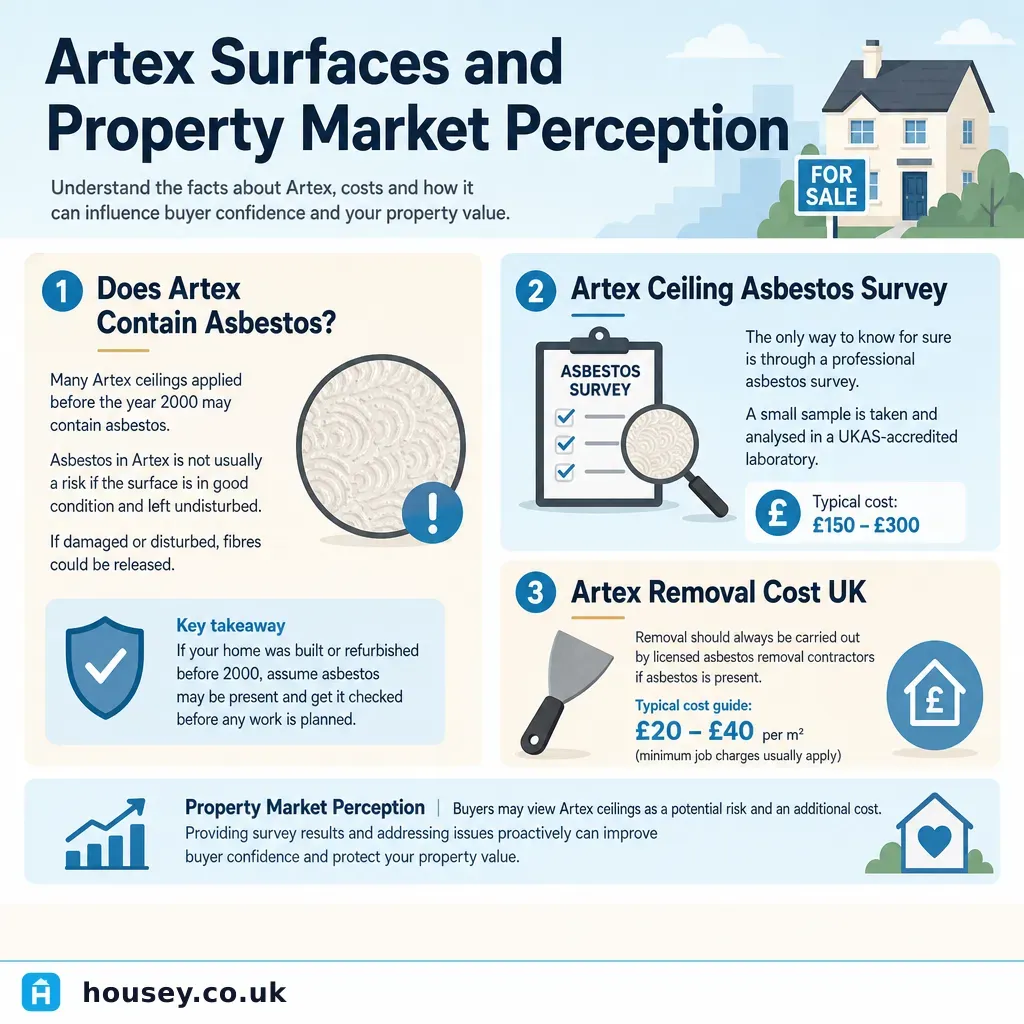
Artex Surfaces and Property Market Perception
Artex applied before 2000 may contain chrysotile asbestos, which is safe when undisturbed but hazardous if sanded or scraped without professional assessment.
 Surveys & Inspections
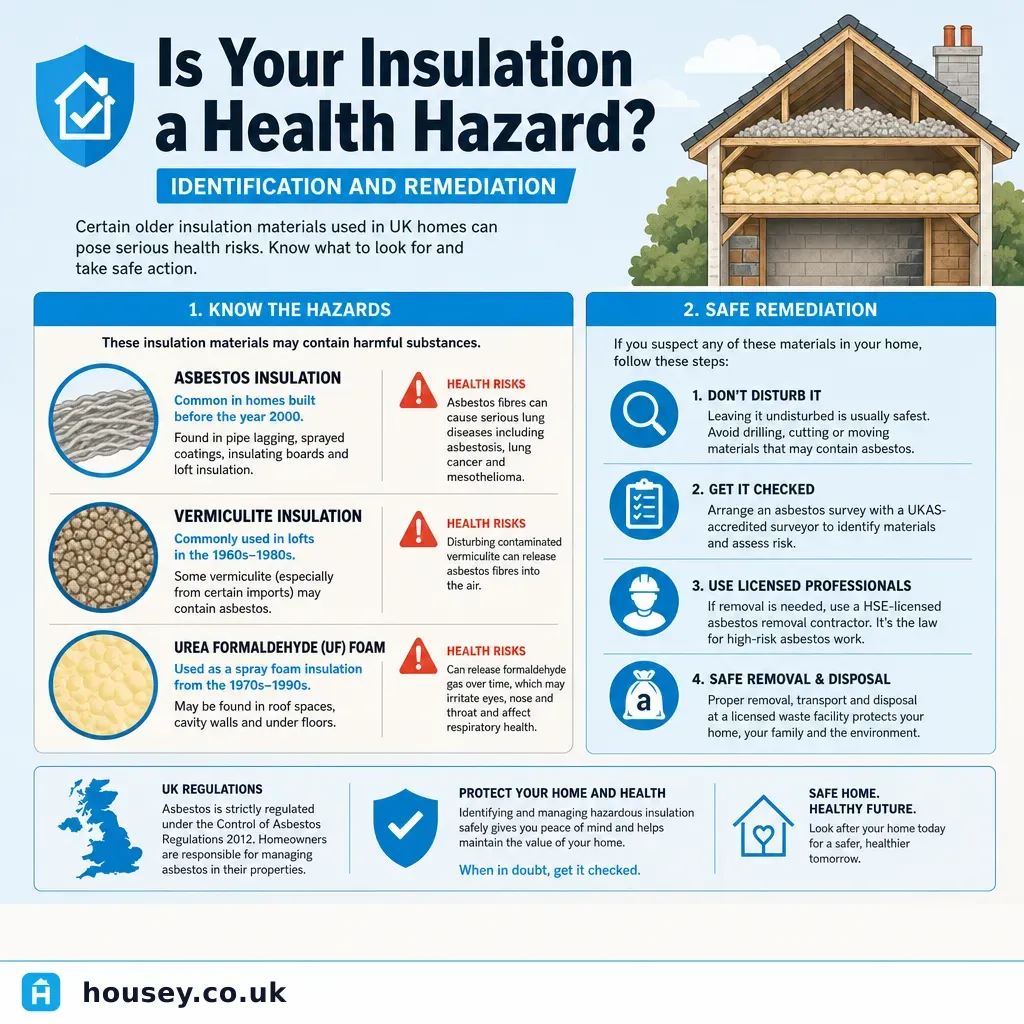
Is Your Insulation a Health Hazard? Identification and Remediation
Some insulation materials in pre-2000 UK homes may pose genuine health risks.
 Surveys & Inspections
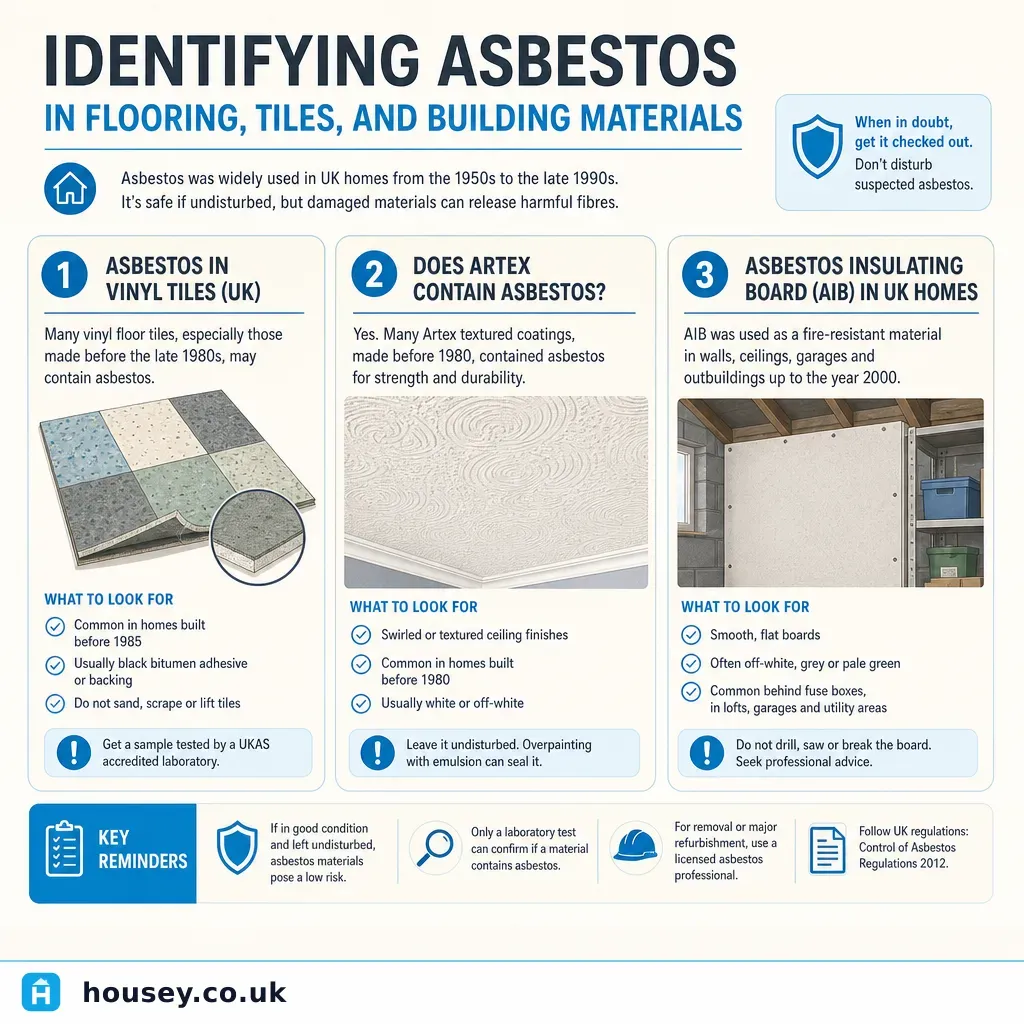
Identifying asbestos in flooring, tiles, and building materials
Asbestos-containing materials are common in UK properties built or refurbished before 2000.
 Surveys & Inspections
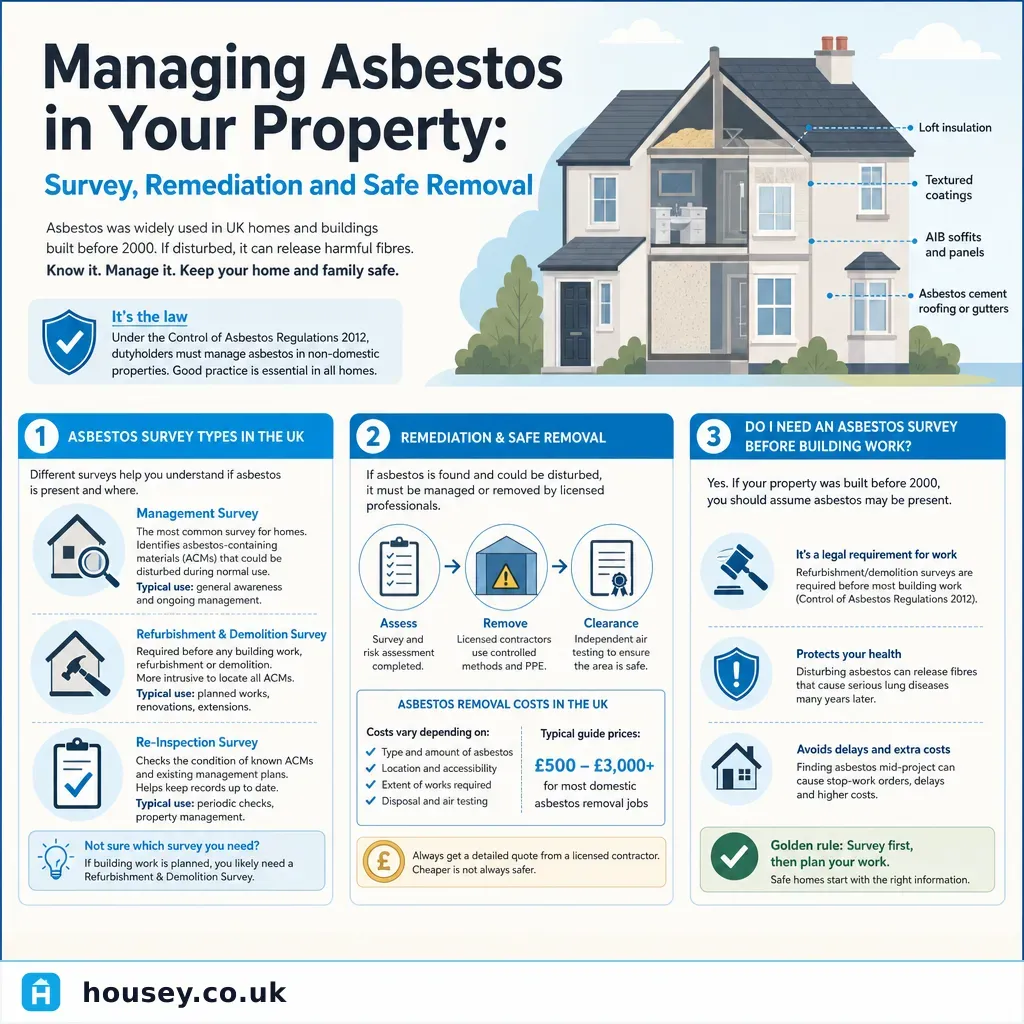
Managing Asbestos in Your Property: Survey, Remediation and Safe Removal
Asbestos was commonly used in UK buildings until its full ban in 1999.
 Surveys & Inspections
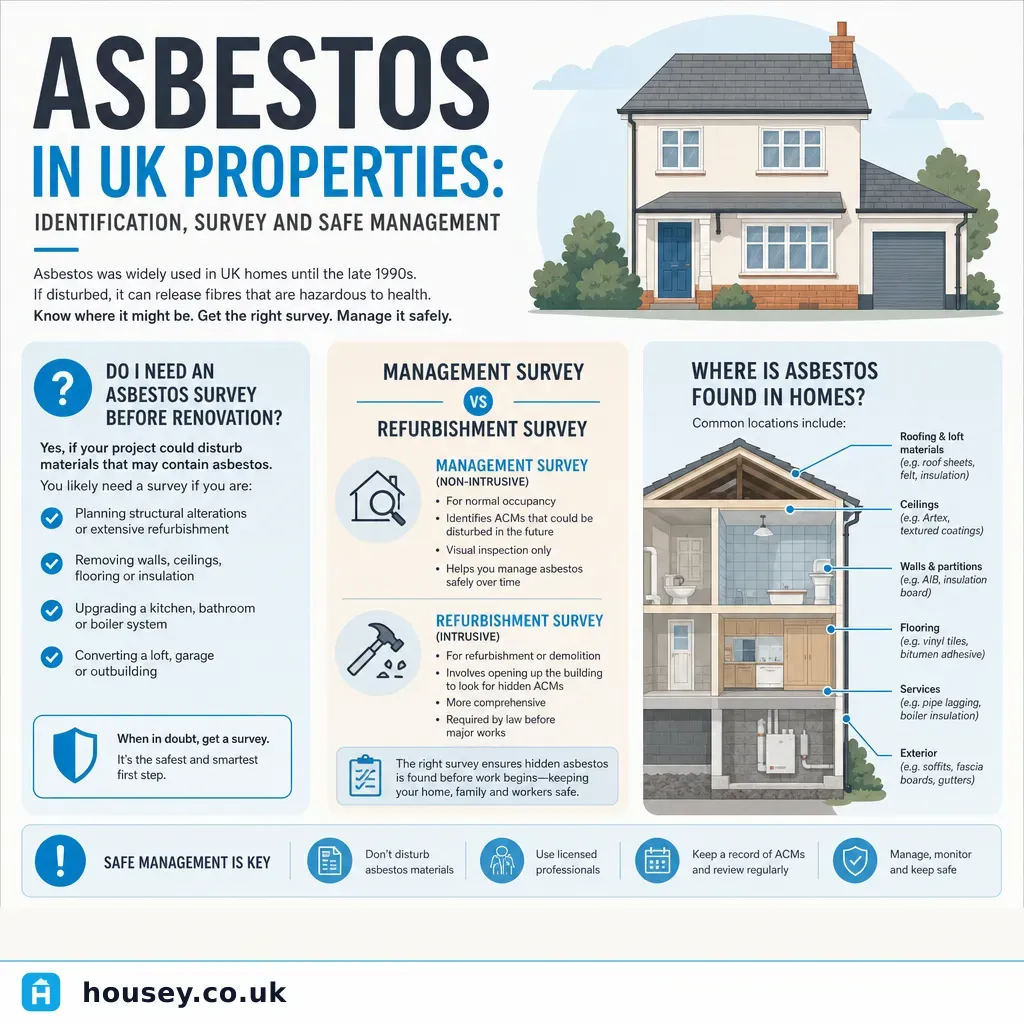
Asbestos in UK Properties: Identification, Survey and Safe Management
Asbestos may be present in any UK property built or refurbished before 2000.