Post-Disaster Property Recovery: Supporting Homeowners After Major Damage
By Housey · Last reviewed 31st of May 2026
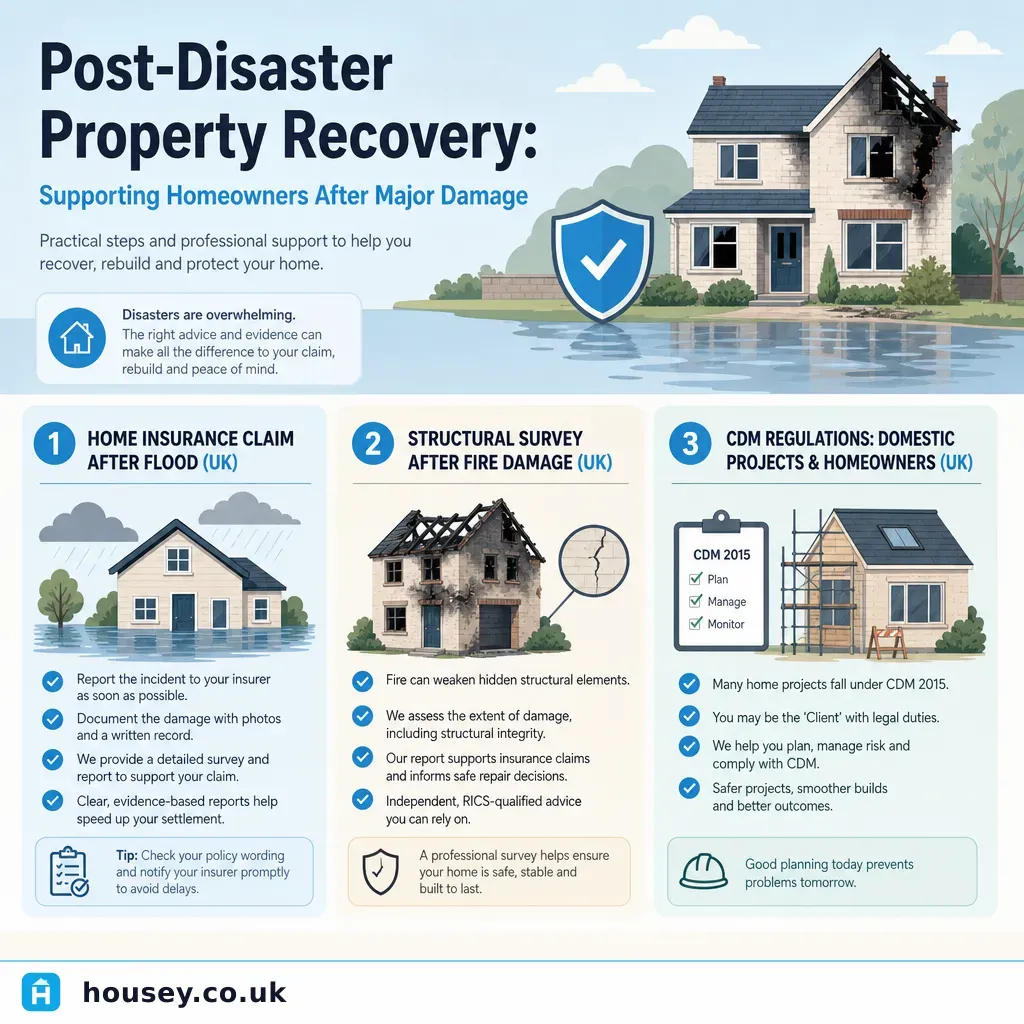
Post-Disaster Property Recovery: Supporting Homeowners After Major Damage
When a flood, fire, subsidence event, or severe storm causes significant damage to a UK home, the weeks and months that follow can be among the most stressful any homeowner will face. Navigating insurance claims, structural assessments, contractor procurement, and regulatory approvals simultaneously — often while living elsewhere — requires a clear process and the right professional support at each stage. Understanding your rights, your insurer's obligations, and the regulatory framework governing reinstatement work gives you a stronger foundation for the recovery ahead.
Key points
- Before reinstatement work begins on a structurally damaged property, a qualified chartered surveyor or structural engineer should assess the building — disturbing a damaged structure without professional guidance can be dangerous and may invalidate your insurance claim.
- Most UK home insurance policies require prior written consent before appointing a contractor for reinstatement; proceeding without insurer approval can lead to claim repudiation.
- The CDM Regulations 2015 apply to most disaster-recovery projects — where more than one contractor is involved, a Principal Designer and Principal Contractor must be appointed in writing before work starts.
- Properties affected by flooding may benefit from cover supported by the Flood Re reinsurance scheme, which helps insurers offer affordable flood cover for eligible residential properties built before 1 January 2009.
- Reinstatement work must comply with current Building Regulations — not simply return the building to its pre-damage state — which can require thermal, fire safety, or electrical improvements beyond like-for-like replacement.
The first 72 hours: stabilise, document, notify
Immediate actions after a serious property incident determine the quality of the recovery that follows. In the first 72 hours, the priority is safety, documentation, and notification — not repair.
Homeowner checklist: first 72 hours
- Do not re-enter a structurally compromised building until the fire service, local authority emergency team, or a structural engineer has confirmed it is safe to do so.
- Notify your insurer immediately — most policies require prompt notification; delay can affect the validity of your claim.
- Document all visible damage before any clearance or repair starts: timestamped photographs and video of every affected area and item of contents are essential evidence.
- Secure the property against further damage and unauthorised entry — boarding windows and doors is usually covered as emergency mitigation under most policies.
- Notify your mortgage lender — lenders often require notification of major damage as a condition of the mortgage.
- Contact your local authority if the building poses a risk to neighbours or the public: fallen masonry, unstable walls, or a fire-damaged roof structure.
- Keep all receipts for emergency accommodation, storage, and security — these are generally claimable under loss of use or additional living costs provisions.
Understanding the UK insurance claim process
For significant damage, most UK home insurance claims follow a structured sequence:
- Loss adjuster appointment — the insurer appoints a loss adjuster to assess damage and quantify the claim. You may also appoint your own independent loss assessor to represent your interests in the negotiation.
- Specialist surveys — the insurer may commission a structural survey, damp and contamination report, or fire investigation before agreeing the scope of reinstatement.
- Schedule of works agreement — the loss adjuster prepares a reinstatement schedule; review this carefully with your own professional adviser before signing.
- Contractor appointment — many insurers operate approved contractor panels. You may have the right to appoint your own contractor, but confirm this in writing with your insurer first.
- Stage payments — for large claims, interim payments are typically released at defined programme milestones.
- Final settlement — the insurer settles on either a reinstatement basis (like-for-like rebuild cost) or an indemnity basis (market value less wear and tear), depending on your policy terms.
Which professional do I need?
Situation | Professional to appoint | Why |
|---|---|---|
Structural damage after fire, flood, or impact | Chartered building surveyor (RICS) or structural engineer | Assess structural integrity before re-entry or any works |
Significant insurance claim | Independent loss assessor | Represents your interests in claim negotiation |
Major reinstatement project | Project manager or principal contractor | Coordinates trades, CDM compliance, and building control |
Damp, mould, or contamination after flooding | Specialist damp or environmental surveyor | Defines remediation scope; prevents long-term hidden damage |
Listed building or conservation area | Conservation architect or heritage consultant | Reinstatement must comply with listed building consent |
Dispute with insurer | Independent loss assessor or RICS-accredited building surveyor | Evidence-based challenge to the insurer's assessment |
Regulatory requirements for reinstatement work
Reinstatement is not simply about returning the property to its previous condition. Works are subject to current Building Regulations, which may require improvements beyond like-for-like:
- Energy efficiency (Part L): if more than 25% of a thermal element (wall, floor, or roof) is being replaced, the whole element may need to be upgraded to current U-value standards.
- Fire safety (Part B): reinstated structures must meet current compartmentation and fire-resistance requirements.
- Electrical safety (Part P): all electrical installation work must comply with BS 7671; only a competent person registered with NICEIC, NAPIT, or an equivalent scheme — or a building control notification — should carry out notifiable work.
- Asbestos (Control of Asbestos Regulations 2012): before demolition or stripping of any materials in a pre-2000 building, a refurbishment asbestos survey by an accredited surveyor is a legal requirement.
Building control approval should be obtained before structural or significant works begin. Completion certificates provide compliance documentation important for future sale or remortgage.
Red flags: when to pause and seek independent advice
- The insurer's loss adjuster is also recommending a specific contractor — you have the right to obtain an independent quote and, in most cases, to appoint your own contractor subject to insurer consent.
- A contractor proposes to begin structural demolition or repair without a prior structural engineer's assessment.
- Building control has not been notified of structural reinstatement works.
- The proposed scope of works does not include an asbestos survey before stripping pre-2000 materials — a legal requirement under the Control of Asbestos Regulations 2012.
- The loss adjuster's schedule excludes damage you have documented — do not sign until discrepancies are resolved in writing.
- Visible mould growth or persistent odour is present but the schedule does not include specialist damp and contamination remediation.
Important limitations
This article provides general guidance on post-disaster property recovery in England. Insurance policy terms vary considerably; read your policy carefully and take independent legal or financial advice if you are in dispute with your insurer. Structural assessments, asbestos surveys, and fire investigations must be carried out by qualified professionals — this article is not a substitute for professional advice. Rules in Scotland, Wales, and Northern Ireland may differ from those described here. Always verify current Building Regulations requirements with your local building control body.
When this becomes urgent
If a damaged structure shows signs of ongoing movement — widening or stepped cracks, roof instability, or sagging floors — suspend re-entry immediately and contact your local authority emergency team or the fire service. Do not attempt DIY stabilisation of structural elements. If asbestos-containing materials may have been disturbed during the incident, do not clean or clear the area — commission a professional survey first. If your insurer is unreasonably delaying action on a safety risk, the Financial Ombudsman Service handles insurance disputes free of charge.
What to ask a qualified professional
- Is the property structurally safe for re-entry, and if not, what remediation is needed before access can be permitted?
- Does the insurer's proposed schedule of works cover all the damage I have documented?
- Are there Building Regulations requirements — energy efficiency, fire safety, or electrical — that apply to the reinstatement work beyond like-for-like replacement?
- Given the property's age, could asbestos-containing materials be present, and has a refurbishment asbestos survey been commissioned before any stripping work?
- Who will be the Principal Contractor and Principal Designer under CDM Regulations 2015, and how will the health and safety file be maintained?
When to get professional help
Engage a qualified professional — not solely your insurer's appointed representative — if:
- There are signs of structural movement, spreading cracks, or instability following the incident.
- The property was built before 2000 and demolition or material stripping is planned (asbestos risk).
- Your insurer's settlement offer appears significantly below your documented losses.
- The property is listed or in a conservation area, where listed building consent is required for reinstatement works.
- The project involves multiple trades or a programme exceeding six weeks, at which point CDM Regulations 2015 duties apply in full.
How Housey can help
Recovering from major property damage is a complex, high-stakes project requiring coordination across trades, regulatory compliance, and insurer processes. Housey can connect you with experienced project managers who can take on contractor coordination, CDM compliance, building control liaison, and insurer communication — giving you a single professional point of contact throughout the recovery.
Frequently asked questions
Can I appoint my own contractor rather than use the insurer's panel?
In most cases, yes. Many UK home insurance policies give you the right to appoint your own contractor, but you usually need the insurer's prior written consent and the contractor must provide a written guarantee. Check your policy wording carefully — some policies require comparative quotes from at least two sources before a non-panel contractor is approved.
Does reinstatement work need building control approval?
Yes, in most cases. Structural repairs, significant electrical works, and works affecting the thermal envelope or fire compartmentation require building regulations approval. Current regulations may require improvements beyond like-for-like replacement. A completion certificate provides compliance documentation that is important for future sale or remortgage.
What is the Flood Re scheme and does my property qualify?
Flood Re is a reinsurance scheme backed by the UK government and insurance industry that helps insurers offer affordable flood cover for eligible homes. It covers residential properties built before 1 January 2009; properties built after that date and those used partly for business are not eligible. Visit floodre.co.uk for current eligibility details.
How long does post-disaster reinstatement typically take?
This varies widely depending on damage extent, insurer processes, contractor availability, and whether listed building consent or building control approval is needed. Minor repairs may take weeks; major structural reinstatement can take one to three years. Appointing a project manager early to produce a realistic programme helps manage expectations on all sides.
Sources and further reading
- CDM Regulations 2015 — client guidance — HSE
- Flood Re: how it works for homeowners — Flood Re
- Control of Asbestos Regulations 2012 — HSE
- Building Regulations: approved documents — GOV.UK
- Financial Ombudsman Service: insurance complaints — Financial Ombudsman Service
- RICS: find a surveyor — RICS
Useful next reads
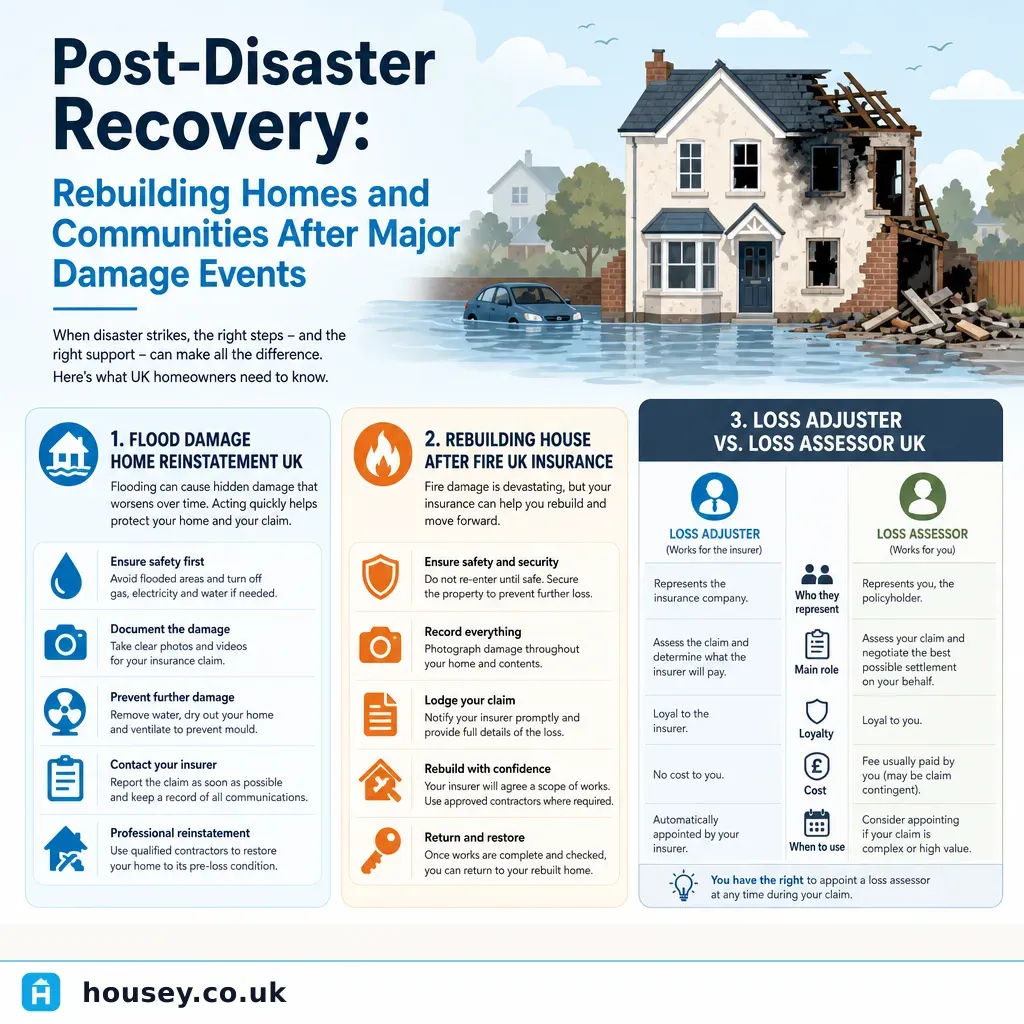 Improvement & Build
Post-Disaster Recovery: Rebuilding Homes and Communities After Major Damage Events
After major property damage in the UK — from flooding, fire, or structural failure — notify your insurer promptly, document all damage before any clean-up, and do not re-enter until a structural professional confirms it is safe.
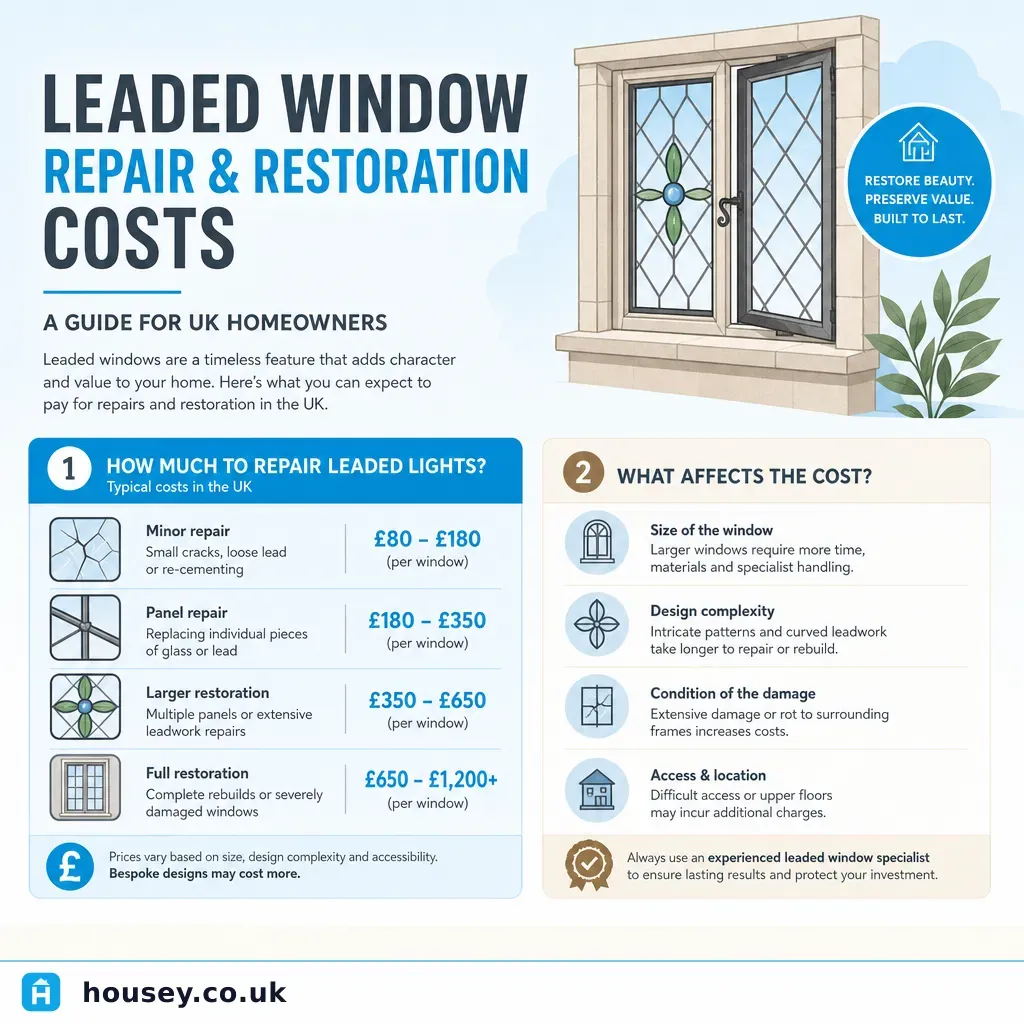 Improvement & Build
Leaded Window Repair and Restoration Costs
Leaded window repair in the UK typically costs £150–£600 for minor re-soldering or resealing, rising to £800–£2,500+ for full panel removal and restoration.
 Improvement & Build
Guide to Replacing Timber Sash Windows with Authentic Restoration
Restoring a timber sash window typically costs £150–£400 per window; full replacement costs £800–£2,500.
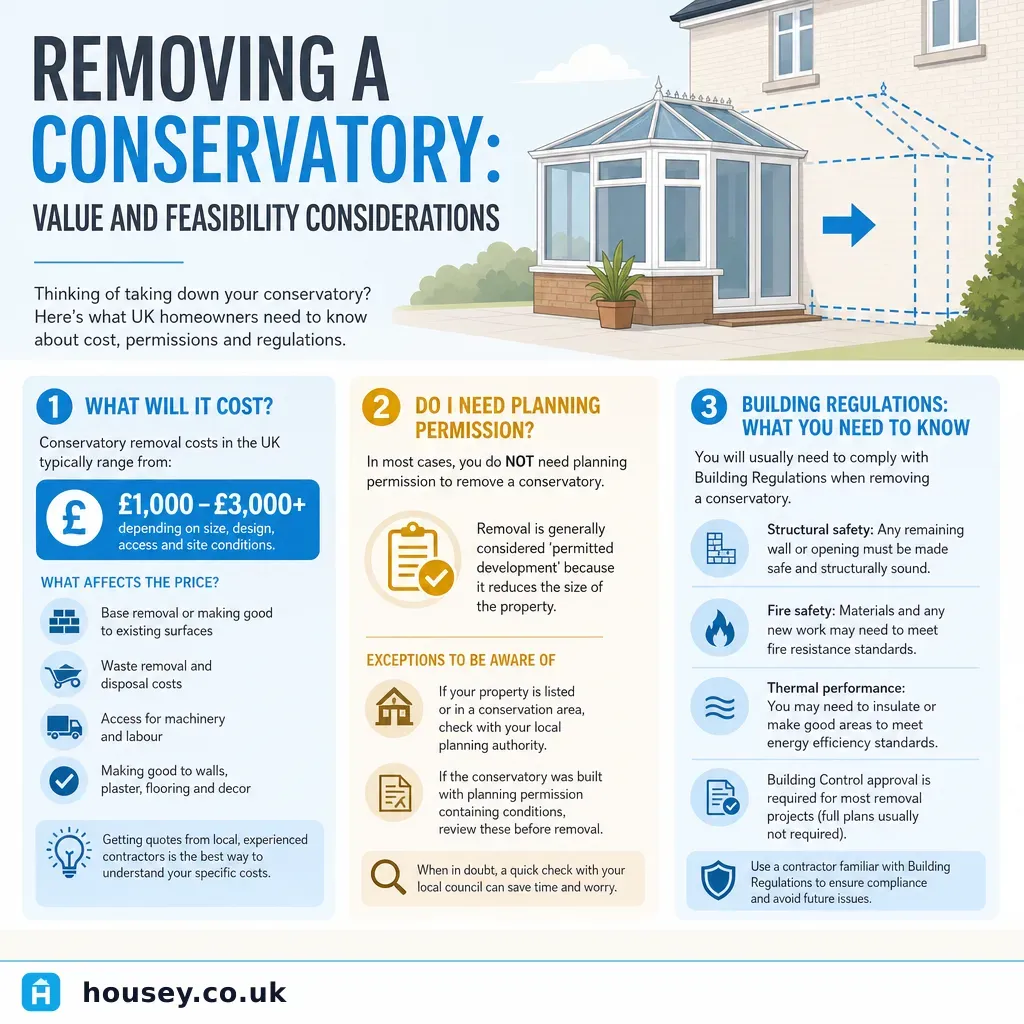 Improvement & Build
Removing a Conservatory: Value and Feasibility Considerations
Removing a conservatory in England usually does not need planning permission if the original structure was permitted development, but reinstating the original wall almost always requires a building regulations application covering structural, thermal, and moisture elements.
 Improvement & Build
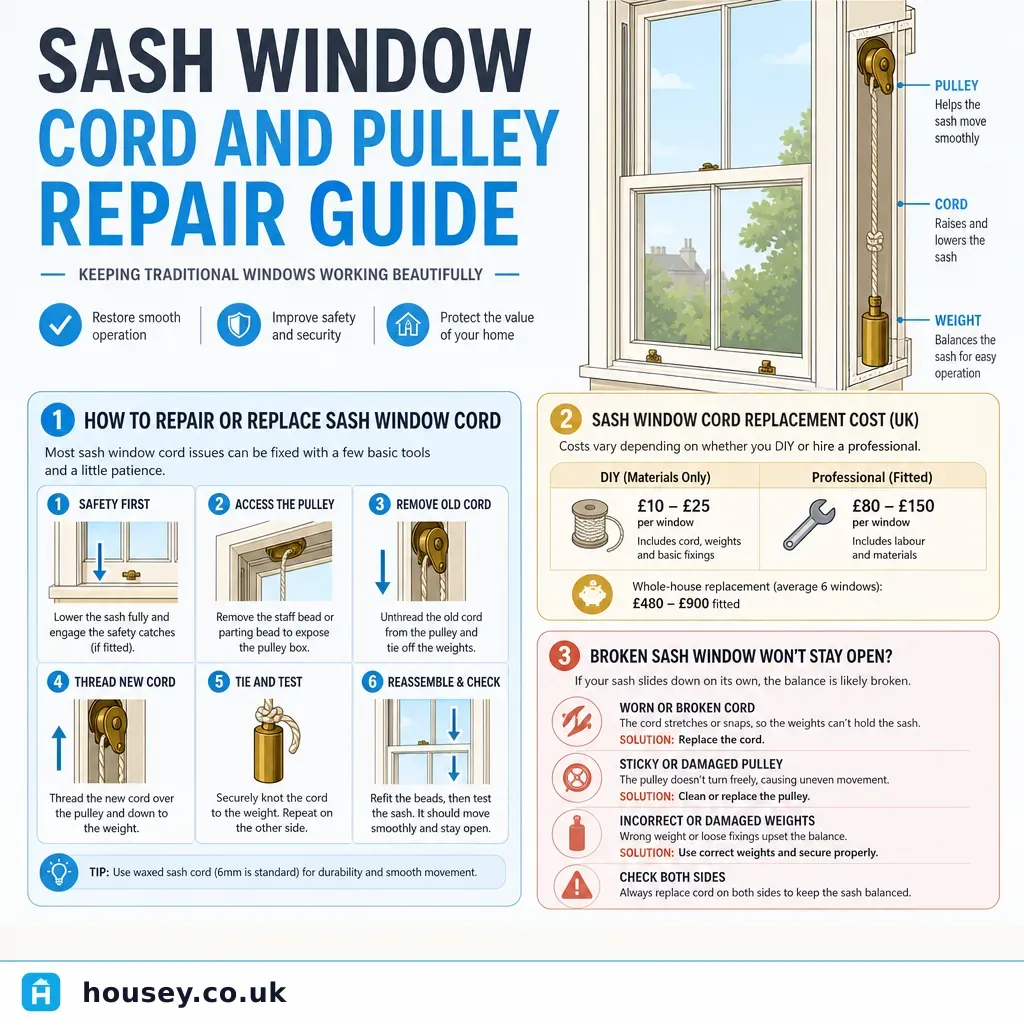
Sash Window Cord and Pulley Repair Guide
Repairing a broken sash window cord involves removing the staff bead, lifting out the lower sash, threading new wax-coated cord through the pulley, and tying it securely to the sash weight.