Post-Disaster Recovery: Rebuilding Homes and Communities After Major Damage Events
By Housey · Last reviewed 31st of May 2026
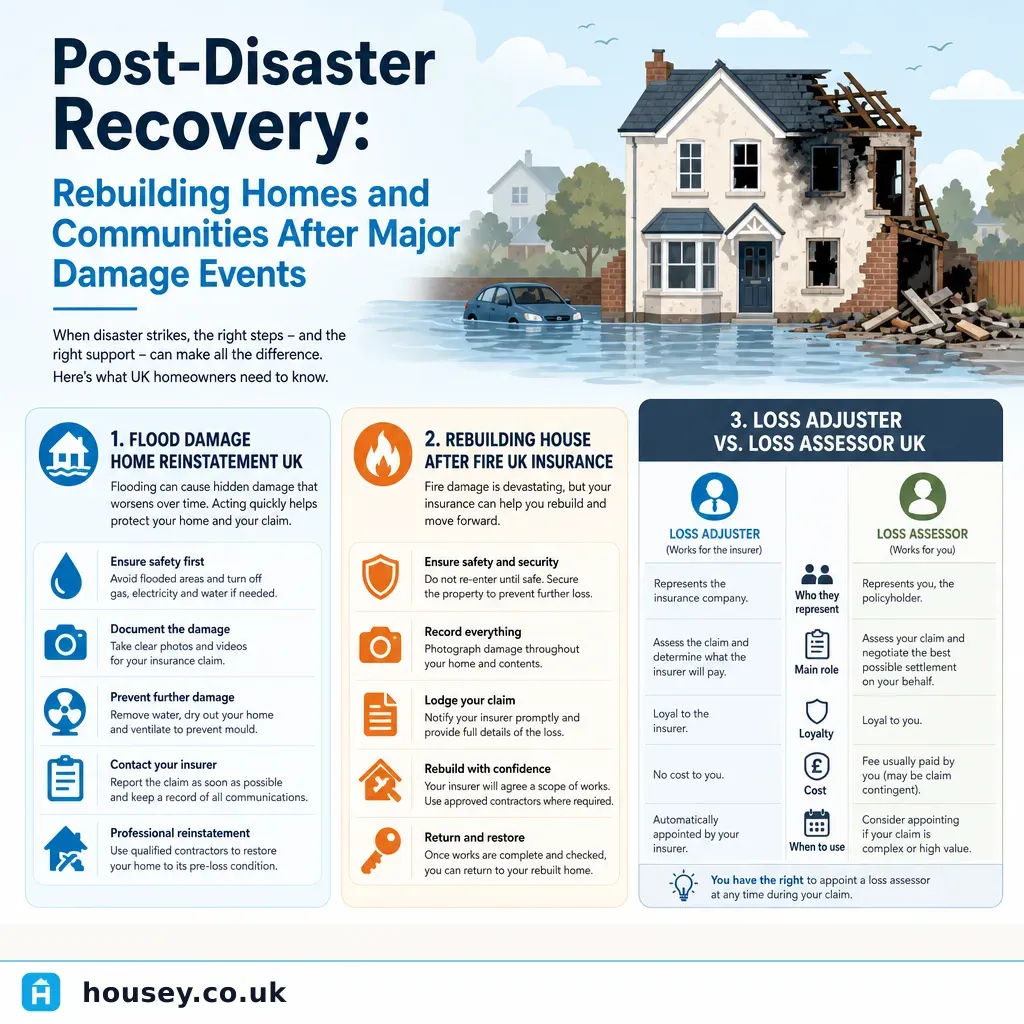
Post-Disaster Recovery: Rebuilding Homes and Communities After Major Damage Events
For UK homeowners, the most common major damage events are flooding, severe storm damage, fire, and — less frequently — subsidence or structural failure. When significant damage occurs, the recovery process unfolds across insurance, regulatory, and practical building phases simultaneously. Each phase carries its own timeline, professional requirements, and potential complications, and the decisions made in the early days can significantly affect the final outcome.
Key points
- Around 5.2 million homes in England are at risk of flooding, according to the Environment Agency, making flood damage the most common form of major domestic damage event in the UK.
- Most home insurance policies cover reinstatement to pre-damage condition, but like-for-like reinstatement may miss the opportunity to build in resilience through measures such as raised electrics or flood-resilient wall construction.
- Any reinstatement involving structural works, changes of use, or installation of new services is notifiable under the Building Regulations 2010 and must comply with the relevant Approved Documents.
- Properties built after 1 January 2009 are excluded from Flood Re, the government-backed reinsurance scheme that can make home insurance more affordable in flood-risk areas.
- The Bellwin Scheme provides emergency central government funding to local authorities for exceptional disaster response costs but does not directly fund individual homeowner reinstatement or repair.
First steps after major damage
The actions taken immediately after a damage event protect your safety, safeguard your insurance claim, and create an evidence trail that is difficult to reconstruct later.
- Ensure safety first. Do not re-enter a structurally damaged property without a structural engineer or building control officer confirming it is safe. Isolate gas, electricity, and water supplies at the mains if instructed by emergency services.
- Notify your insurer promptly. Most policies require notification within a specific timeframe. Delay can jeopardise your claim.
- Document all damage thoroughly. Photograph and video every area of damage before anything is moved, cleaned, or disposed of. Insurers, loss adjusters, and building control will need this evidence.
- Do not dispose of damaged contents without insurer agreement. Items may need to be assessed for replacement value.
- Request a loss adjuster visit. For significant claims, the insurer will appoint a loss adjuster to assess damage and agree the scope of reinstatement.
- Notify your local council if the damage poses a public risk — for example, a partially collapsed boundary wall or structural damage visible from the street.
Understanding the insurance and reinstatement process
Stage | Who is involved | Typical timeframe | Key documents |
|---|---|---|---|
Emergency response | Insurer helpline, utility companies, emergency services | Hours to days | Damage photographs, policy schedule |
Loss adjuster assessment | Loss adjuster appointed by insurer | Days to two weeks | Scope of works report, inventory of loss |
Contractor appointment | Insurer-approved or independent contractor | Two to four weeks | Builder's specification, reinstatement quote |
Building control notification | Local building control or Approved Inspector | Before notifiable works start | Building Regulations application or Building Notice |
Reinstatement works | Contractor and specialist trades | Weeks to months | Progress photographs, interim certificates |
Completion sign-off | Building control, structural engineer if applicable | End of works | Completion certificate, structural sign-off |
Insurance settlement | Insurer | Ongoing | Receipts, final accounts, settlement letter |
Reinstating for resilience, not just restoration
A direct like-for-like reinstatement restores your home to its pre-damage condition but does not reduce the risk of the same damage recurring. The government and the Environment Agency have published guidance on flood-resilient reinstatement, sometimes called build back better or repair and protect.
Resilience measures worth discussing with your insurer and contractor after flood damage:
- Replacing timber ground floors with concrete or tiled surfaces
- Installing flood-resilient wall construction using lime plaster and solid blockwork below damp-proof course level
- Relocating electrics, boilers, and white goods to a higher level
- Installing a sump and pump system beneath suspended floors
- Fitting airbrick covers or automatic flood barriers at doorways
Some insurers will fund resilience improvements as part of reinstatement — ask explicitly whether build-back-better funding is available, and obtain any agreement in writing before works start.
Fire damage reinstatement
After a fire, structural assessment is essential before any reinstatement work begins. Fire can weaken structural elements that appear intact. Approved Document B (fire safety) applies to any reinstatement that changes the fire resistance or compartmentation of the structure. For significant fires, a RICS Level 3 survey or structural engineer's assessment is strongly advisable before agreeing a scope of works with your insurer.
Homeowner checklist: post-disaster recovery
What to ask before appointing a contractor
- Are you registered with a recognised trade body such as the FMB or NHBC, and do you hold professional indemnity and public liability insurance?
- Have you carried out post-flood or post-fire reinstatement work previously, and can you provide references from similar projects?
- How will you work alongside the loss adjuster and the insurer's appointed team?
- Who holds the Building Regulations application — you or the homeowner?
- Is your quotation based on the loss adjuster's agreed scope of works, or your own independent assessment?
- What is the programme, and what are the key dependencies such as drying time, structural sign-off, or material lead times?
- How will you handle unexpected additional damage discovered during works, and what is the process for agreeing variation costs?
- Is VAT included in your quotation?
Community-level recovery
Where multiple properties are affected — as frequently occurs in flood events or where a single incident damages a row of terraces — coordinating recovery at neighbourhood level can bring real benefits:
- Shared contractor procurement may achieve better pricing and more consistent quality
- Local authorities may appoint flood recovery support officers to assist affected residents
- Community Flood Action Groups can lobby for improved flood defences and drainage infrastructure upgrades
- The National Flood Forum provides guidance, peer support, and advocacy for affected communities
Important limitations
This article provides general information on post-disaster recovery processes in the UK. Insurance policy terms, Building Regulations requirements, and available funding schemes vary significantly. This is not legal, structural, or insurance advice. For structural assessments, appoint a chartered structural engineer or RICS Level 3 surveyor. For insurance disputes, consider an independent loss assessor (paid by you, not the insurer) or seek advice from Citizens Advice. Structural repair and gas or electrical reinstatement must only be carried out by appropriately qualified professionals.
What to ask a qualified professional
Before appointing a structural engineer, project manager, or specialist contractor for disaster reinstatement:
- What is the extent of structural damage, and is the property safe to occupy during works?
- Is a full structural survey needed before a scope of works can be agreed with the insurer?
- Which Approved Documents are triggered by the reinstatement scope, and who will submit the Building Regulations application?
- What resilience improvements would you recommend given the nature of this damage event and the risk of recurrence?
- What professional indemnity and public liability insurance do you hold for this type of project?
When to get professional help
Seek professional advice immediately if any of the following apply:
- The property has suffered structural damage including cracking, movement, partial collapse, or significant roof damage
- Gas or electrical systems have been flood-damaged or fire-damaged
- Asbestos-containing materials may have been disturbed by fire, flood, or structural collapse
- The insurer's loss adjuster has produced a scope of works you do not understand or believe undervalues the damage
- Reinstatement works involve removing or rebuilding walls, altering the structure, or changing the floor plan
- The property is listed or in a conservation area, where consent may be required for reinstatement works
- You are considering resilience improvements that change ground-floor construction or drainage arrangements
How Housey can help
Coordinating multiple contractors across a complex reinstatement project is one of the most demanding aspects of disaster recovery. Housey can connect you with experienced project managers who specialise in overseeing building reinstatement, liaising with insurers and loss adjusters, and ensuring Building Regulations compliance throughout. Use the Housey quote tool to find a local specialist.
Frequently asked questions
Does my insurer have to fund resilience improvements rather than just like-for-like reinstatement?
Standard home insurance policies typically fund reinstatement to pre-loss condition, not improvements beyond that standard. However, some insurers working within the Flood Re scheme have committed to fund build-back-better upgrades as part of flood reinstatement claims. The government has also operated supplementary grant schemes. Always ask your insurer explicitly and obtain any agreement in writing before works begin.
What is a loss assessor, and how does it differ from a loss adjuster?
A loss adjuster is appointed and paid by the insurer to assess the claim on the insurer's behalf. A loss assessor is appointed and paid by you, the policyholder, to represent your interests. For large or complex claims involving significant structural damage, or where the initial scope appears to undervalue the loss, a loss assessor can help achieve a fair settlement.
Can I use my own contractor rather than the insurer's approved contractor?
Most policies give you the right to use your own contractor, though an insurer-approved contractor typically carries a guarantee backed by the insurer. If you use your own contractor, the insurer will generally pay up to the agreed scope at their assessed cost. Ensure your contractor's quotation aligns with the loss adjuster's scope, or negotiate with the insurer before works begin.
How long does post-flood reinstatement typically take?
Timescales vary widely depending on the extent of damage, the drying period required — often six to twelve weeks for flood-damaged properties — material availability, and contractor capacity. For a significantly flood-damaged home, a realistic timeline from loss adjuster assessment to completion is often six to eighteen months. Request a detailed programme from your contractor before works start.
Sources and further reading
- Flooding: protect your home and property — GOV.UK
- Flood Re: making flood insurance more affordable — Flood Re
- Flood resilient construction guidance — GOV.UK
- National Flood Forum — National Flood Forum
- Home insurance and flooding — Association of British Insurers
- Building Regulations: Approved Documents — GOV.UK
Useful next reads
 Improvement & Build
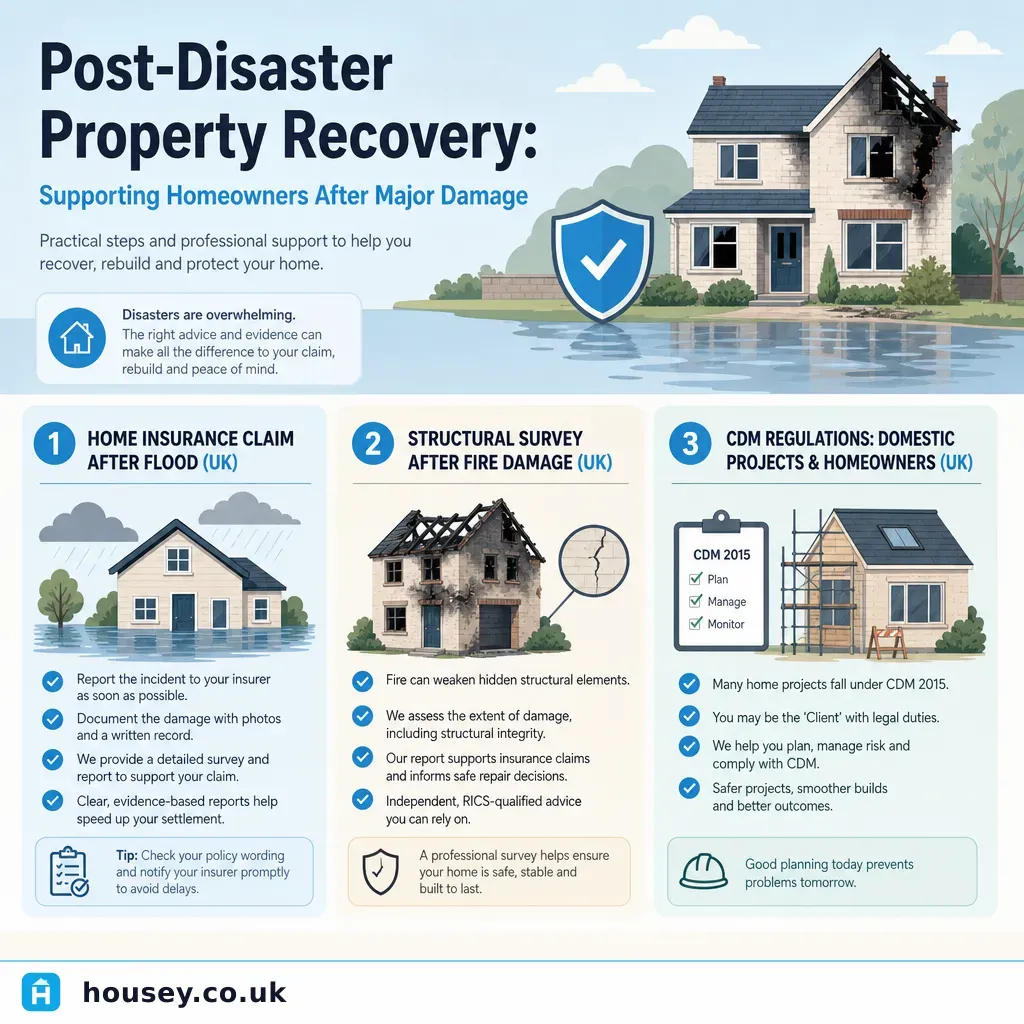
Post-Disaster Property Recovery: Supporting Homeowners After Major Damage
After major property damage, the immediate priorities are safety assessment, insurer notification, and careful documentation before any work begins.
 Improvement & Build
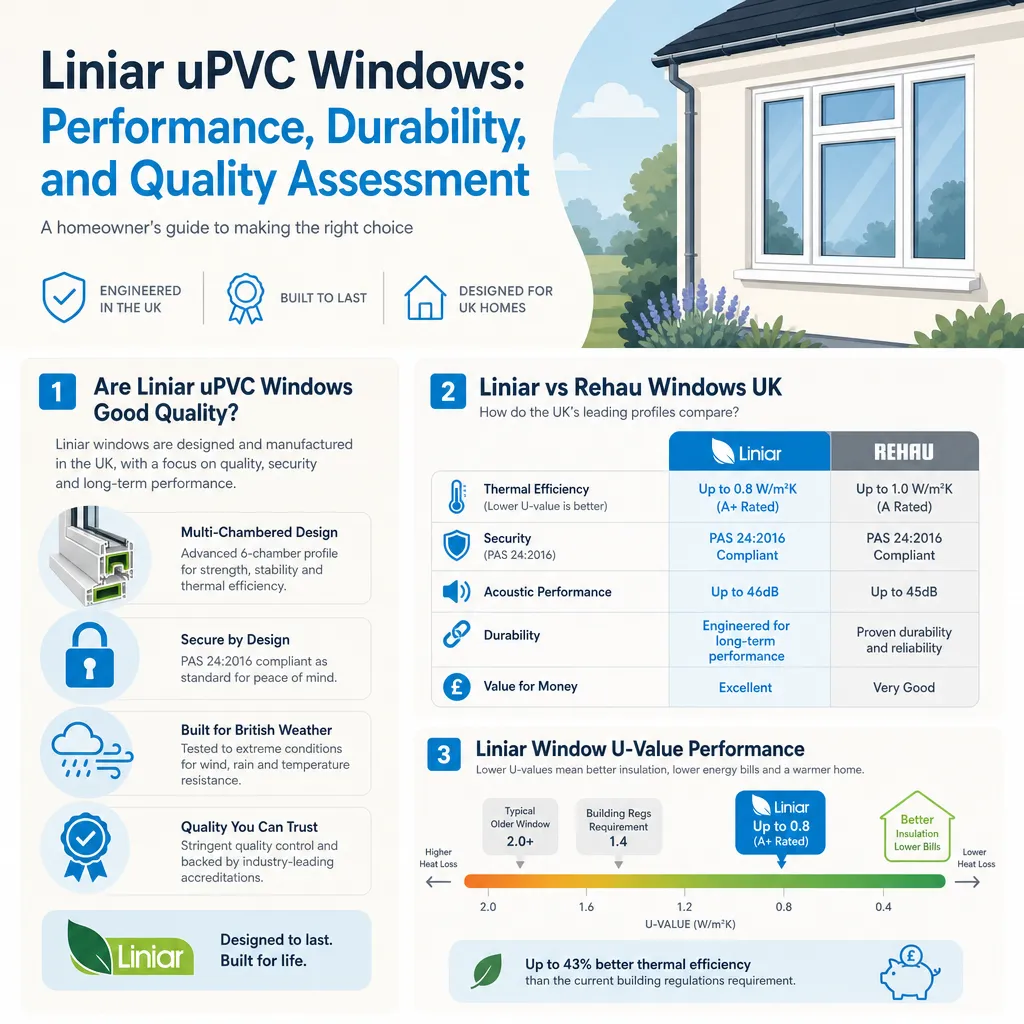
Liniar uPVC Windows: Performance, Durability, and Quality Assessment
Liniar uPVC window profiles are manufactured in the UK using multi-chambered, foamed frames.
 Improvement & Build
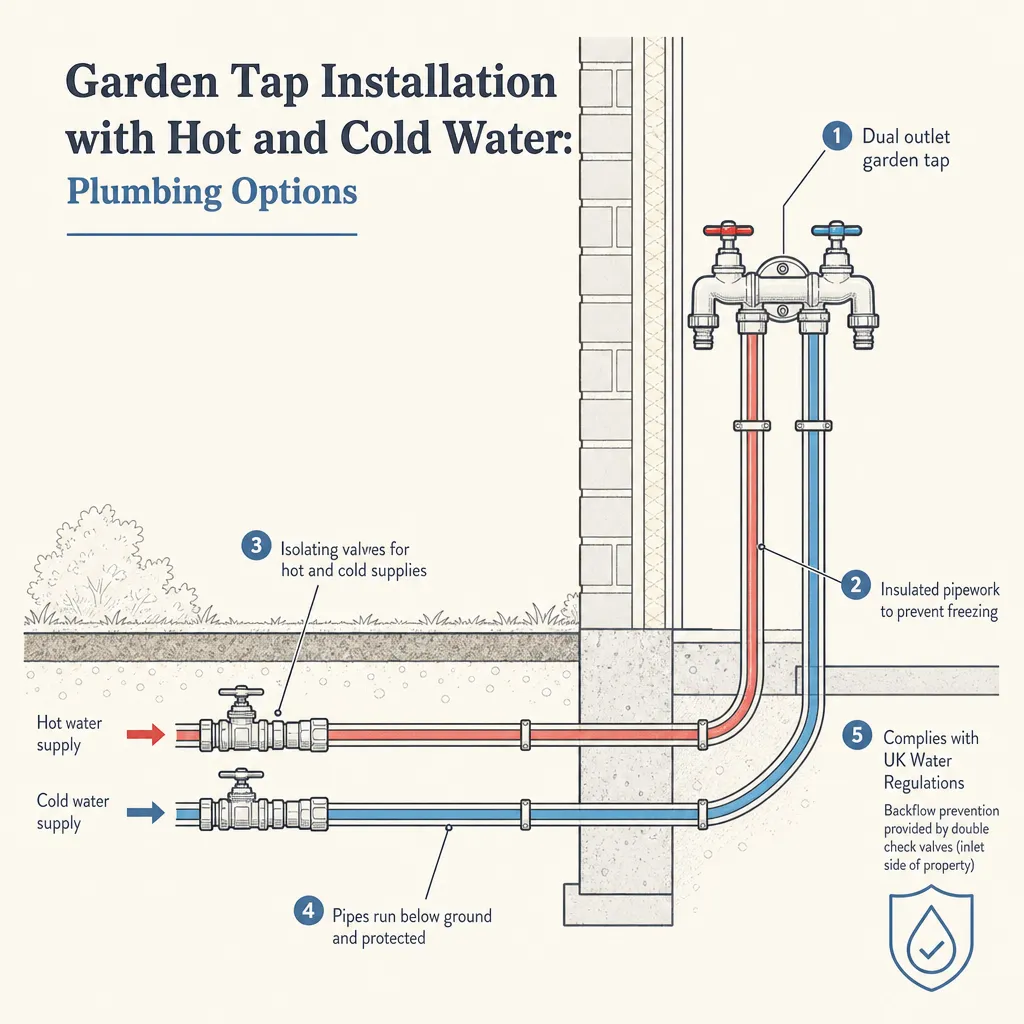
Garden Tap Installation with Hot and Cold Water: Plumbing Options
Adding a cold garden tap is a common DIY project, but routing hot water outdoors requires a plumber to connect to your domestic hot water system and comply with the Water Supply (Water Fittings) Regulations 1999.
 Improvement & Build
Sealing and Maintaining Historic Leaded Glass Windows: Preservation and Performance
Leaded glass windows are maintained using traditional linseed oil cement — not silicone or modern sealants, which prevent natural movement in the lead came.
 Improvement & Build
Greenhouse Construction: Glass Versus Polycarbonate Materials
Glass transmits around 90% of available light and lasts indefinitely if unbroken, but insulates poorly and shatters into sharp fragments.