Post-Survey Repairs and Negotiations
By Housey · Last reviewed 31st of May 2026
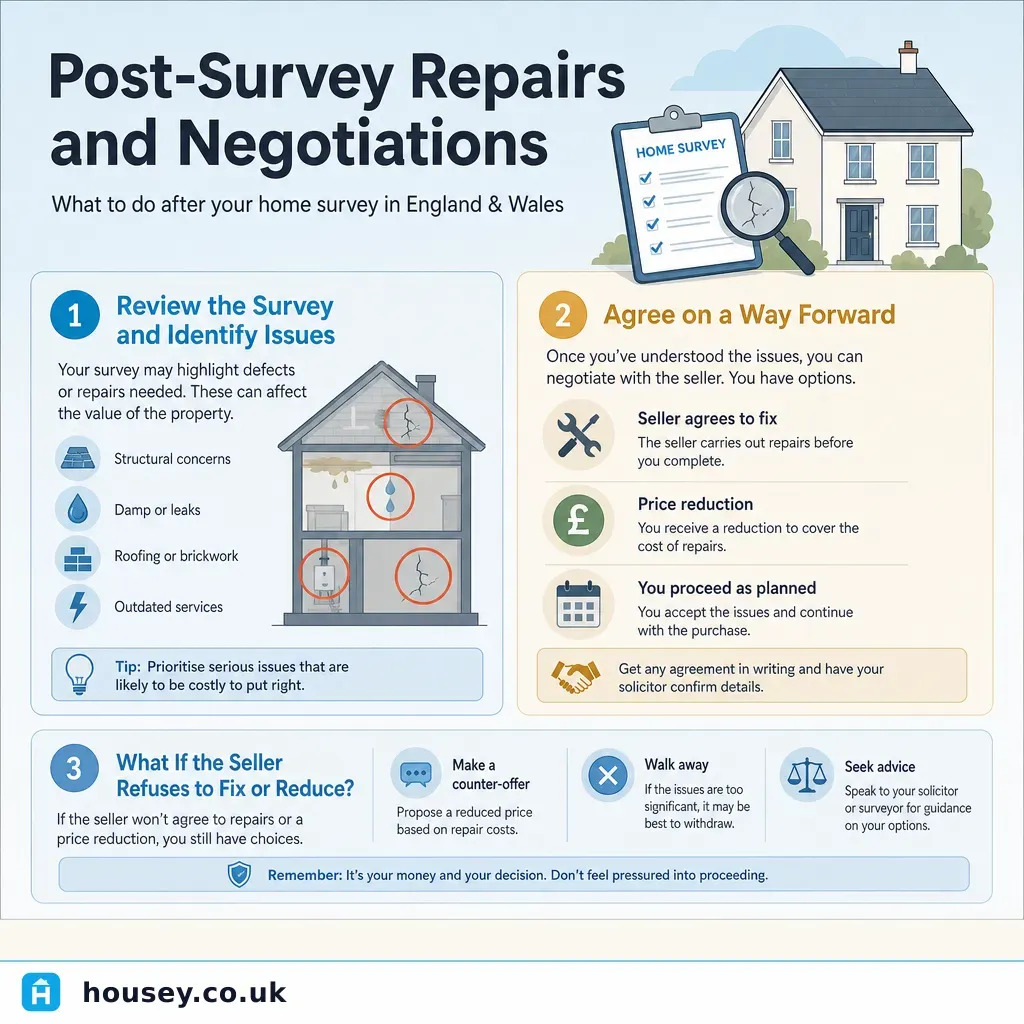
Post-Survey Repairs and Negotiations
For most buyers in England and Wales, a survey is the first moment a property's true condition becomes clear — and what the report reveals can significantly change the dynamics of a transaction. Whether the findings are minor maintenance items or material structural defects, understanding how to respond and what practical options are available is one of the most consequential decisions in the buying process.
Key points
- Sellers in England and Wales have no legal obligation to carry out repairs or reduce the asking price after a survey — any concession is voluntary.
- The RICS Home Survey Standard uses a Condition Rating system: CR3 signals urgent repair or replacement needed; CR2 indicates a defect requiring attention but not immediately; CR1 means no action currently required.
- Renegotiations should be supported by written contractor cost estimates — a surveyor's narrative commentary without a price is far easier for a seller to dismiss.
- Buyers in England and Wales retain the right to withdraw from a purchase until contracts are exchanged — this right is sometimes the most powerful tool available, but should not be used lightly or repeatedly.
- If a seller knew about a material defect and did not disclose it on the TA6 property information form, your solicitor may be able to advise on misrepresentation — this is separate from ordinary post-survey negotiation.
What a survey does — and does not — give you
A RICS Home Survey (Level 2 or Level 3) is addressed to the buyer and provides a professional assessment of the property's condition at the time of inspection. It is not a schedule of works, a repair guarantee, or a legal document binding on the seller.
You can use a survey report to:
- Request a price reduction reflecting the cost of making good significant defects.
- Ask the seller to carry out specific repairs before exchange, to an agreed standard.
- Commission specialist reports (structural engineer, damp and timber survey, drainage CCTV) to scope and price works in more detail before deciding how to proceed.
- Decide to withdraw from the purchase if defects are materially worse than anticipated.
You cannot use it to:
- Force the seller to repair anything or reduce the price.
- Use the survey as the sole basis for a misrepresentation claim — you would need to show the seller knew about the defect and failed to disclose it on the TA6.
Decision tree: how to respond to a survey report
- CR3 items only (structural movement, roof failure, drainage, serious damp): obtain contractor quotes before raising with the seller. Request a price reduction equal to the documented cost of works, or ask the seller to complete repairs to a specified standard before exchange.
- Multiple CR2 items with significant total cost: assess the cumulative figure. If the combined cost is material — typically over £2,000–£5,000 depending on purchase price — raise the most significant items with the seller through solicitors.
- CR1 items only: informational; no renegotiation is normally warranted.
- Surveyor recommends a specialist report (structural engineer, asbestos survey, drainage CCTV): instruct the specialist before proceeding further. Do not exchange until you understand the full scope and cost of the issue.
- Defects suggest the seller knew and did not disclose: raise this with your solicitor before contacting the seller directly. Do not approach the seller yourself.
- Remediation cost approaches or exceeds your contingency budget: seriously consider withdrawing before exchange. The right to walk away is your strongest protection.
How to negotiate effectively after a survey
Step 1: quantify before you negotiate
A survey report notes a flat roof is at the end of its serviceable life. Before raising this with the seller, obtain at least one — ideally two — quotes from qualified roofing contractors. A surveyor's commentary without a price is easy to dismiss. A written contractor quote is concrete and harder to argue with.
Step 2: pick your battles
Most surveys on older UK properties — Victorian terraces, 1930s semis, interwar stock — list several CR2 items. Raising every item risks antagonising the seller and unsettling the transaction. Focus on:
- The highest-cost items.
- Anything affecting safety: gas, electrical, structural.
- Anything the surveyor flagged as requiring an immediate specialist report.
- Items the seller demonstrably knew about, as shown by the TA6 form or disclosures during viewings.
Step 3: choose your approach
Option | What it means | Best suited to |
|---|---|---|
Price reduction | You complete at a lower price and carry out works yourself after completion | Buyers with cash reserves; sellers motivated to proceed quickly without further delay |
Seller carries out repairs | Seller completes specified works before exchange, to an agreed standard | High-risk safety defects; buyers with limited post-completion funds |
Retention | Solicitors hold back a sum from completion funds until specified works are done post-completion | Works that cannot be completed before exchange but have a clear, documented cost |
Price reductions are usually quicker and simpler than requiring the seller to carry out works, which introduces delays and potential quality disputes. Retentions are less common in residential transactions but can work where both parties agree and the scope is clear.
Step 4: keep everything in writing
All renegotiation should go through solicitors. Any agreed reduction or undertaking must be reflected in the contract or a written addendum — verbal agreements before exchange carry no legal weight.
Red flags: when to consider walking away
Some survey findings should prompt serious reconsideration, not just renegotiation:
- Active structural movement — stepped cracking in brickwork, bulging walls, cracked lintels — where a structural engineer cannot rule out ongoing movement and cannot give a stable prognosis.
- Japanese knotweed on or adjacent to the property, not previously disclosed on the TA6, without a management and guarantee plan in place.
- Evidence of undisclosed flooding history or the property sitting in a high-risk flood zone where buildings insurance is difficult or prohibitively expensive to obtain.
- Missing building regulations certificates for extensions, loft conversions, or electrical works, where the seller will not provide indemnity insurance or agree a retention.
- Asbestos-containing materials in poor condition (friable ACMs) requiring urgent encapsulation or removal, not disclosed prior to survey.
- Subsidence with a live insurance claim, ongoing monitoring regime, or history the seller has not disclosed on the TA6.
These are not automatic deal-breakers, but each changes the risk profile significantly. A modest price reduction may not adequately compensate for long-term liability, difficulty insuring, or mortgage lender objections.
What to ask before accepting a repair or price concession
- Have you obtained at least one written quote from a qualified contractor that covers all elements of the repair — materials, labour, scaffolding if required, and making good?
- Has your solicitor confirmed that the agreed reduction or repair condition is formally reflected in the contract?
- If the seller is carrying out repairs, who will inspect the completed works before exchange, and against what specification?
- Does the defect require a specialist report before you can properly scope the cost — structural engineer, gas engineer, damp specialist?
- Is the agreed price reduction or retention sufficient to cover a reasonable contingency for unforeseen works once materials are opened up?
- Does the repair affect any warranties, guarantees, or insurance policies currently in place on the property?
When to get professional help
Your solicitor should be involved in any post-survey renegotiation. Additionally, seek specialist input if:
- The surveyor has recommended a structural engineer, damp specialist, or other professional — instruct that specialist before deciding whether to proceed.
- The seller is offering to carry out significant works before exchange — your surveyor or a building control consultant should specify and inspect those works independently.
- Defects relate to gas safety, electrical safety, or structural integrity — do not rely solely on the survey narrative to scope and price these.
- You suspect the seller has misrepresented the property's condition on the TA6 property information form.
How Housey can help
If your survey has raised concerns about a property's condition, Housey can connect you with experienced professionals who can carry out a RICS Home Survey at Level 2 or Level 3, recommend appropriate specialist reports, and help you understand the full picture before you commit to exchange.
Frequently asked questions
Can I renegotiate the price after exchange of contracts?
No. Once contracts are exchanged in England and Wales, both parties are legally bound at the agreed price. Renegotiation is only possible before exchange. This is why it is important to obtain survey results and any recommended specialist reports well in advance of the exchange deadline — do not allow yourself to be rushed into exchanging before defects are fully understood.
Should I show the seller my full survey report?
You are not obliged to share your survey report with the seller. Many buyers share relevant extracts — typically the summary of significant defects — to support a renegotiation request, but sharing the full report is not required and may not be in your interests. Take advice from your solicitor on what information to share and how to frame any request.
What if the seller refuses to negotiate at all?
If the seller refuses any reduction or repair, you must decide whether to proceed at the agreed price — accepting the future cost of works yourself — or withdraw before exchange. There is no legal mechanism to compel concessions. If defects were known to the seller but not disclosed on the TA6 property information form, your solicitor may be able to advise on potential misrepresentation.
How much can I realistically negotiate off after a survey?
This depends on the property market, the seller's motivation, and the documented cost of defects. In a buyer's market, reductions of 1–3% of the purchase price for significant Condition Rating 3 defects are not unusual. In a competitive market, sellers may decline. Base any request on written contractor quotes rather than estimates — a documented figure is far harder for a seller to dismiss.
Sources and further reading
- RICS Home Survey Standard — RICS
- Buying or selling your home — GOV.UK
- Buying a home: taking steps to buy — Citizens Advice
- Conveyancing protocol and property information forms — The Law Society
Useful next reads
 Surveys & Inspections
Identifying Unpleasant Odours in Your Home
Unpleasant smells in a UK home often point to damp, mould, a drainage fault, or — in the most urgent cases — a gas leak.
 Surveys & Inspections
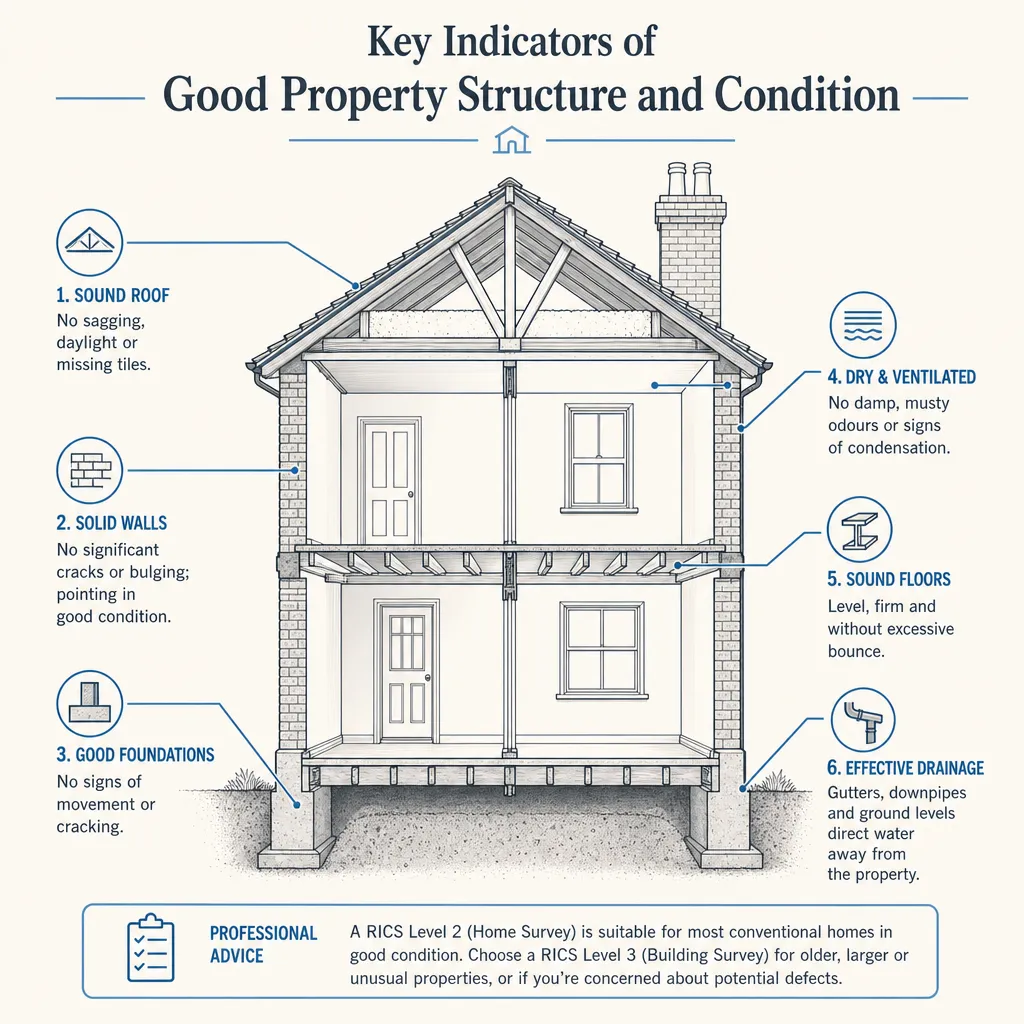
Key Indicators of Good Property Structure and Condition
Good property structure is indicated by plumb walls, level floors, crack-free masonry at corners and above openings, an intact roof covering, and dry internal surfaces.
 Surveys & Inspections
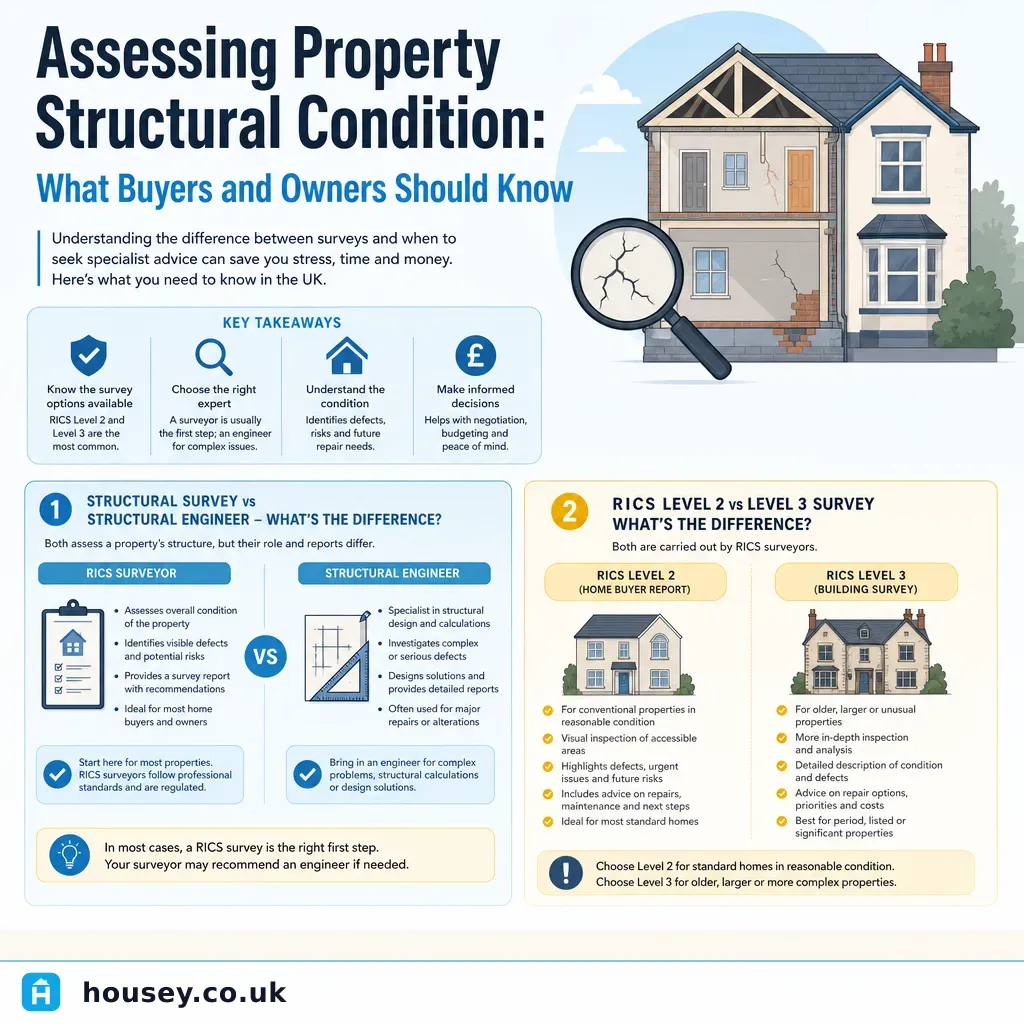
Assessing Property Structural Condition: What Buyers and Owners Should Know
A RICS Level 2 Home Survey suits conventional post-war properties in reasonable condition.
 Surveys & Inspections
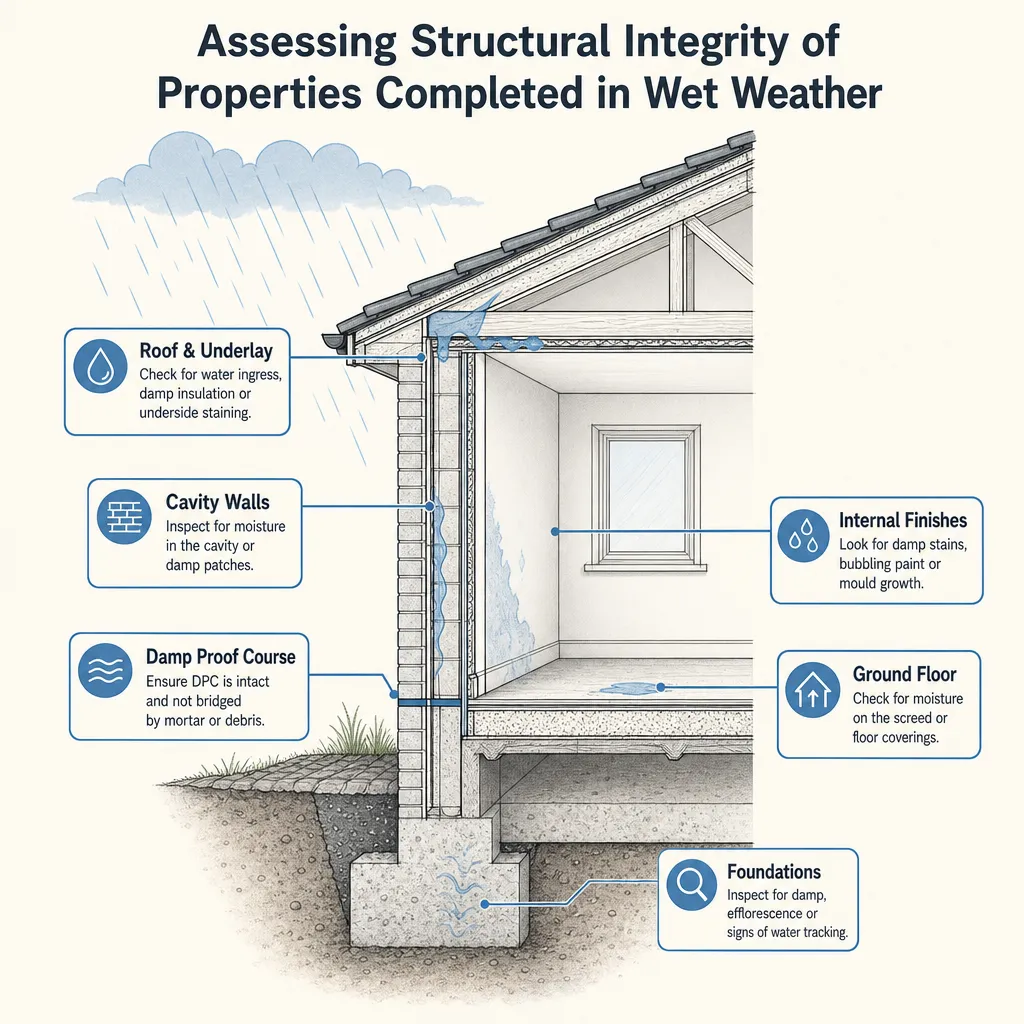
Assessing Structural Integrity of Properties Completed in Wet Weather
Construction carried out during prolonged wet weather can introduce defects including shrinkage cracking in mortar, compromised concrete strength, damp ingress through inadequately protected cavities, and movement in timber frames.
 Surveys & Inspections
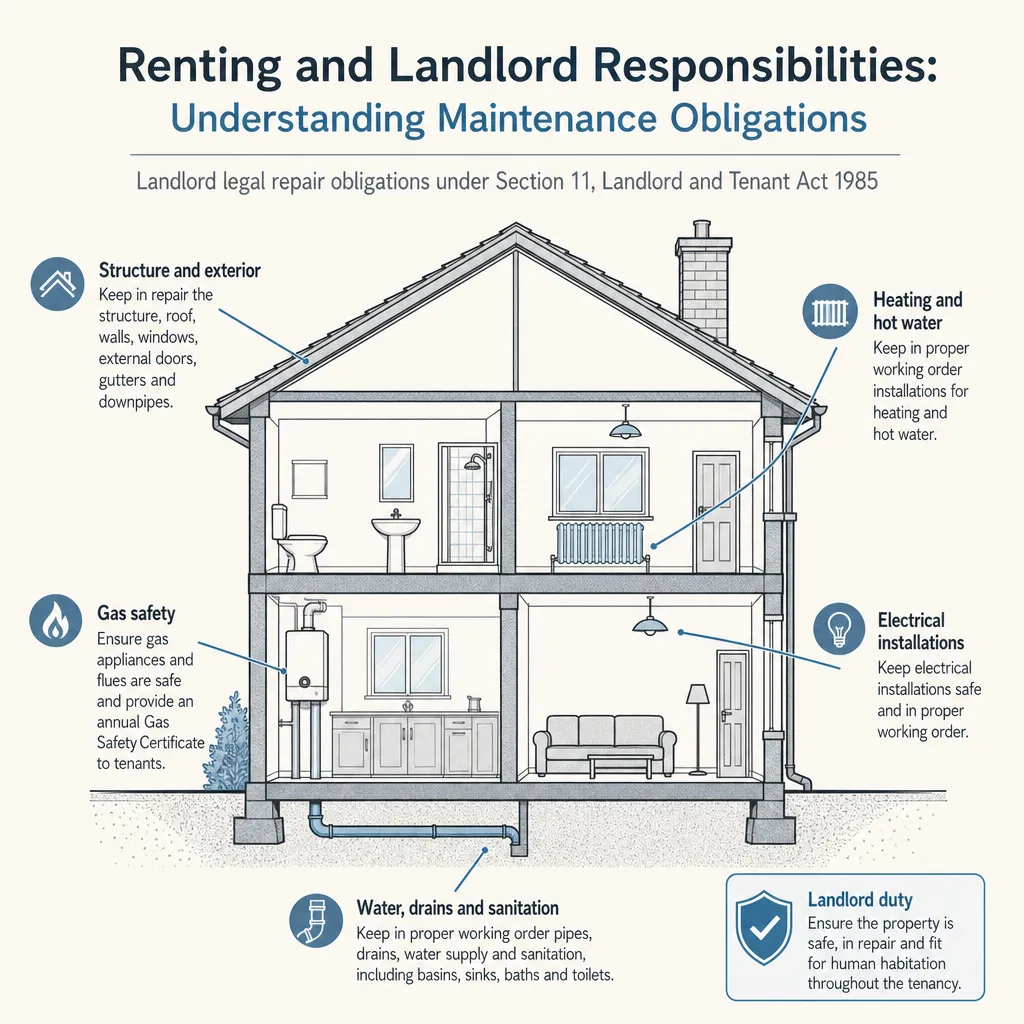
Renting and Landlord Responsibilities: Understanding Maintenance Obligations
UK landlords must keep the structure, exterior, and core services of a rented property in good repair under Section 11 of the Landlord and Tenant Act 1985.