Professional Home Energy Assessment: Understanding Your Property's Efficiency
By Housey · Last reviewed 31st of May 2026
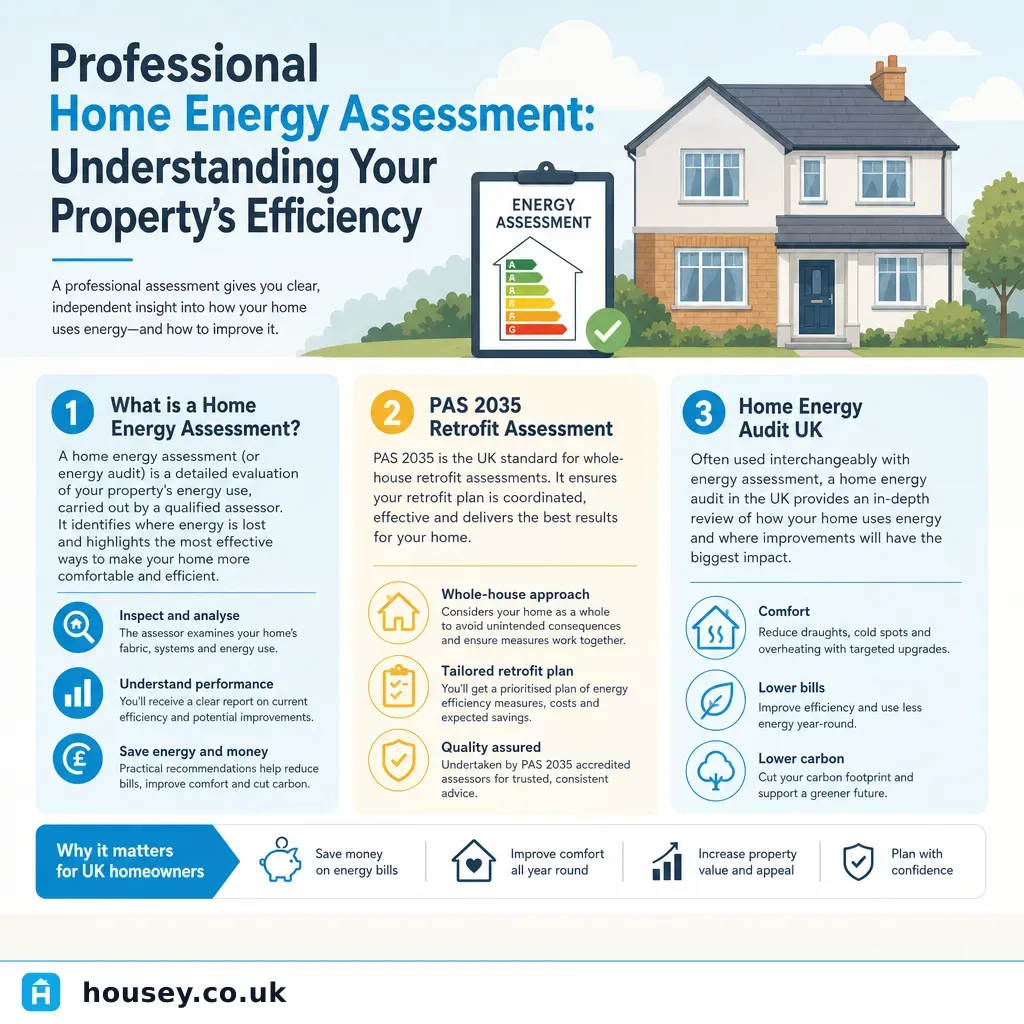
Professional Home Energy Assessment: Understanding Your Property's Efficiency
A growing number of UK homeowners are looking beyond their Energy Performance Certificate (EPC) towards a more detailed understanding of how their property actually performs. The gap between the two often becomes apparent when a planned retrofit — insulation, heat pump, mechanical ventilation — produces unexpected results or, worse, causes moisture or condensation problems because the building was not assessed as a whole system first.
Key points
- A standard EPC (produced by a Domestic Energy Assessor using SAP calculations) rates a property's theoretical efficiency on a scale of A–G; it does not diagnose how or where heat is actually lost in practice.
- A PAS 2035 Retrofit Assessment is a whole-house approach, mandated for projects receiving government-backed funding (ECO4 and the Great British Insulation Scheme), and includes a Medium-Term Improvement Plan (MTIP) and a Retrofit Plan.
- TrustMark and MCS are the main government-endorsed quality frameworks; ECO4 and the Great British Insulation Scheme (GBIS) both require TrustMark-registered retrofit coordinators for qualifying works.
- Retrofit moisture risk is a recognised hazard: adding insulation to a solid-wall or poorly ventilated property without a condensation risk assessment can cause structural damage and hidden mould growth within wall structures over time.
- A thermographic survey (thermal imaging) uses infrared cameras to identify heat loss patterns, cold bridges, and air leakage points that are not visible to the naked eye.
What does a professional home energy assessment involve?
A professional energy assessment goes beyond the checklist approach of a standard EPC. Depending on who conducts it and its intended purpose, it may include some or all of the following:
Building fabric review
The assessor examines wall construction type (cavity, solid, or timber-frame), estimated U-values, roof insulation depth, floor construction, and glazing specification. For older properties, this often involves reviewing building control certificates, planning records, or visual inspection of exposed construction elements.
Air permeability and draught assessment
A blower-door test or walk-through draught assessment identifies where uncontrolled air infiltration is occurring. This informs both the ventilation strategy and draught-proofing priorities for the property.
Heating and hot water system assessment
The assessor checks boiler age, flue type, controls, and system configuration. For heat pump readiness, they assess whether existing heat emitters (radiators, underfloor heating) are compatible with lower-flow-temperature operation and whether the heat loss calculation supports a heat pump specification.
Ventilation review
Adequate ventilation must be confirmed or improved before any airtightness or insulation work proceeds. Building Regulations Approved Document F governs ventilation requirements for dwellings in England and Wales.
Renewables potential
Some assessors include a roof and orientation review for solar PV or solar thermal suitability, and may note whether a heat pump is feasible given the property's calculated heat loss and available outdoor space.
Types of energy assessment: a comparison
Assessment type | Who conducts it | Output | When you need it |
|---|---|---|---|
Standard EPC | Domestic Energy Assessor (DEA) | A–G rating and basic improvement recommendations | Selling, renting, or applying for some grants |
PAS 2035 Retrofit Assessment | PAS 2035-qualified Retrofit Assessor | Retrofit Assessment document, MTIP, and Retrofit Plan | Whole-house retrofit; ECO4 or GBIS-funded works |
CIBSE Low Carbon Consultant assessment | CIBSE Low Carbon Energy Assessor (LCEA) | Detailed technical report with dynamic energy modelling | Complex or high-value retrofits, listed buildings |
Thermographic survey | Level 1–2 thermographer (ITC or BINDT qualified) | Thermal images identifying heat loss, cold bridges, and air leakage | Validating insulation, diagnosing condensation or cold-bridge issues |
Air permeability test | ATTMA-registered tester | Air changes per hour (ACH) figure and leakage map | Pre- and post-retrofit verification; new build |
Which professional do I need?
Your situation | Recommended professional |
|---|---|
Selling or renting the property | Domestic Energy Assessor (DEA) for a standard EPC |
Applying for ECO4 or GBIS funding | TrustMark-registered Retrofit Coordinator who commissions a PAS 2035 assessment |
Planning significant works (insulation, heat pump, ventilation) | PAS 2035 Retrofit Assessor — recommended even without grant funding |
Diagnosing moisture, cold bridges, or post-insulation performance issues | Thermographer (ITC/BINDT Level 1–2) and a moisture risk specialist if needed |
Complex or listed property | CIBSE Low Carbon Consultant or heritage retrofit specialist |
What does a professional energy assessment cost?
Indicative UK costs, last reviewed 2026-05-31.
Costs vary significantly by assessment type, property size, and assessor:
- Standard EPC: £60–£120 for a typical house.
- PAS 2035 Retrofit Assessment: £300–£600 for a standard house; larger or more complex properties may cost more.
- Thermographic survey: £200–£500 depending on property size and report depth.
- CIBSE-level detailed assessment: typically £600–£2,000 or more for residential properties.
For grant-funded works under ECO4 or GBIS, the cost of the retrofit assessment is usually covered within the grant allocation, but confirm this with the scheme coordinator before committing.
Moisture risk: the critical retrofit consideration
Adding insulation to a UK property — particularly solid-wall external or internal insulation — without a proper moisture risk assessment is one of the most common causes of retrofit failure. The specific risks include:
- Interstitial condensation: moisture vapour migrating through a wall structure and condensing within the insulation layer or at the cold side of the wall. This can degrade insulation performance and cause mould growth hidden inside the wall.
- Thermal bridging: insulating some areas while leaving cold bridges at structural junctions can concentrate moisture and surface condensation at those points.
- Reduced drying potential: some insulation systems significantly reduce a wall's ability to dry out after rain or internal moisture events, increasing long-term moisture accumulation.
A PAS 2035 Retrofit Assessment includes a condensation risk analysis, carried out to BS EN ISO 13788 or via dynamic hygrothermal modelling for complex cases. If an assessor proposes solid-wall insulation without discussing moisture risk, this is a significant red flag.
Important limitations
This article provides general information about home energy assessments in the UK. The appropriate type of assessment, the right professional to engage, and the specific recommendations that follow will depend on your property's construction, condition, tenure, location, and the funding route you are pursuing. Rules and eligibility for grant schemes change; always check current GOV.UK guidance before proceeding. No retrofit measure should be specified or commenced without a qualified professional inspecting your individual property.
When this becomes urgent
You should seek a professional assessment — and not proceed with planned works — if:
- You are planning to add insulation to solid walls, a cold roof, or a ground floor and have not had a moisture risk assessment.
- Your property shows signs of existing damp, condensation, or mould before any retrofit work has started.
- You are applying for ECO4 or GBIS funding and have been told a PAS 2035 Retrofit Assessment is required.
- You intend to install a heat pump and your current heating system has not been assessed for compatibility with lower flow temperatures and heat loss modelling.
- Your property is listed or in a conservation area — appropriate insulation and ventilation strategy can differ significantly from standard practice for these buildings.
What to ask a qualified professional
Before instructing an energy assessor or retrofit assessor, ask:
- What qualifications and accreditations do you hold? (Look for: PAS 2035 Retrofit Assessor, CIBSE LCEA, TrustMark registration.)
- Is your work eligible to support ECO4, GBIS, or other grant-funded measures?
- Does the assessment include a condensation and moisture risk analysis for the measures you are recommending?
- Will the assessment cover ventilation strategy and the recommended sequence of retrofit measures?
- What report will I receive, and how is it structured?
- If you find evidence of existing defects — damp, rot, structural movement — how will those be handled in the report and recommendations?
- Is VAT included in your fee?
When to get professional help
An energy assessment is itself the starting point for professional help with retrofit. If you are unsure what level of assessment you need, contact the Energy Saving Trust for free, impartial advice on energy efficiency options for UK homeowners.
Red flags that mean you should not proceed with retrofit works until a professional has assessed your property:
- A contractor quotes for wall insulation without mentioning ventilation or moisture risk.
- You are told a standard EPC is sufficient specification for a whole-house retrofit programme.
- Solid-wall insulation is proposed with no mention of interstitial condensation risk analysis.
- The assessor cannot confirm TrustMark registration or a PAS 2035 qualification when asked.
How Housey can help
Housey connects homeowners with qualified professionals across the full range of energy assessment services — including retrofit assessments, thermographic surveys, insulation assessments, and heat pump surveys. Describe your property and improvement goals, and Housey will match you with local, accredited assessors so you can compare approaches and quotes before committing to any works.
Frequently asked questions
Is a standard EPC enough for a whole-house retrofit?
Not usually. An EPC rates theoretical performance and provides basic recommendations, but does not assess moisture risk, ventilation strategy, or the sequence and interaction of measures. For any significant retrofit — particularly insulation, heat pumps, or mechanical ventilation — a PAS 2035 Retrofit Assessment gives a more reliable basis for decision-making and is mandatory for ECO4 and GBIS-funded works.
Do I need a PAS 2035 assessment if I am not using a grant?
Not legally, unless you are receiving ECO4 or GBIS funding. However, a PAS 2035 Retrofit Assessment is strongly recommended for any whole-house project. The framework was developed specifically to prevent the moisture and performance problems that affected earlier retrofit programmes, and its discipline of assessing measures in the correct sequence applies regardless of funding route.
How long does a professional energy assessment take?
A standard EPC inspection for a mid-terrace house typically takes 30–60 minutes. A PAS 2035 Retrofit Assessment involves a property visit of around 1.5–2 hours plus several hours of desk work and report writing. A thermographic survey requires a significant indoor-outdoor temperature differential and the imaging survey itself may take 1–2 hours for an average home.
Can I have a thermographic survey done separately from an energy assessment?
Yes. Thermographic surveys are sometimes commissioned as a standalone service — for example, to validate newly installed insulation or diagnose cold bridges causing surface condensation. Results are most useful when interpreted alongside a broader energy assessment or moisture risk report, particularly for solid-wall properties where condensation risk analysis is important.
Sources and further reading
- PAS 2035: Retrofitting dwellings for improved energy efficiency — BSI — BSI Group
- ECO4 scheme guidance — GOV.UK — Department for Energy Security and Net Zero
- TrustMark: find a registered business — TrustMark
- Energy Performance Certificates — GOV.UK — GOV.UK
- Great British Insulation Scheme — GOV.UK — GOV.UK
- Approved Document F: Ventilation — GOV.UK — Ministry of Housing, Communities and Local Government
Useful next reads
 Energy & Retrofit
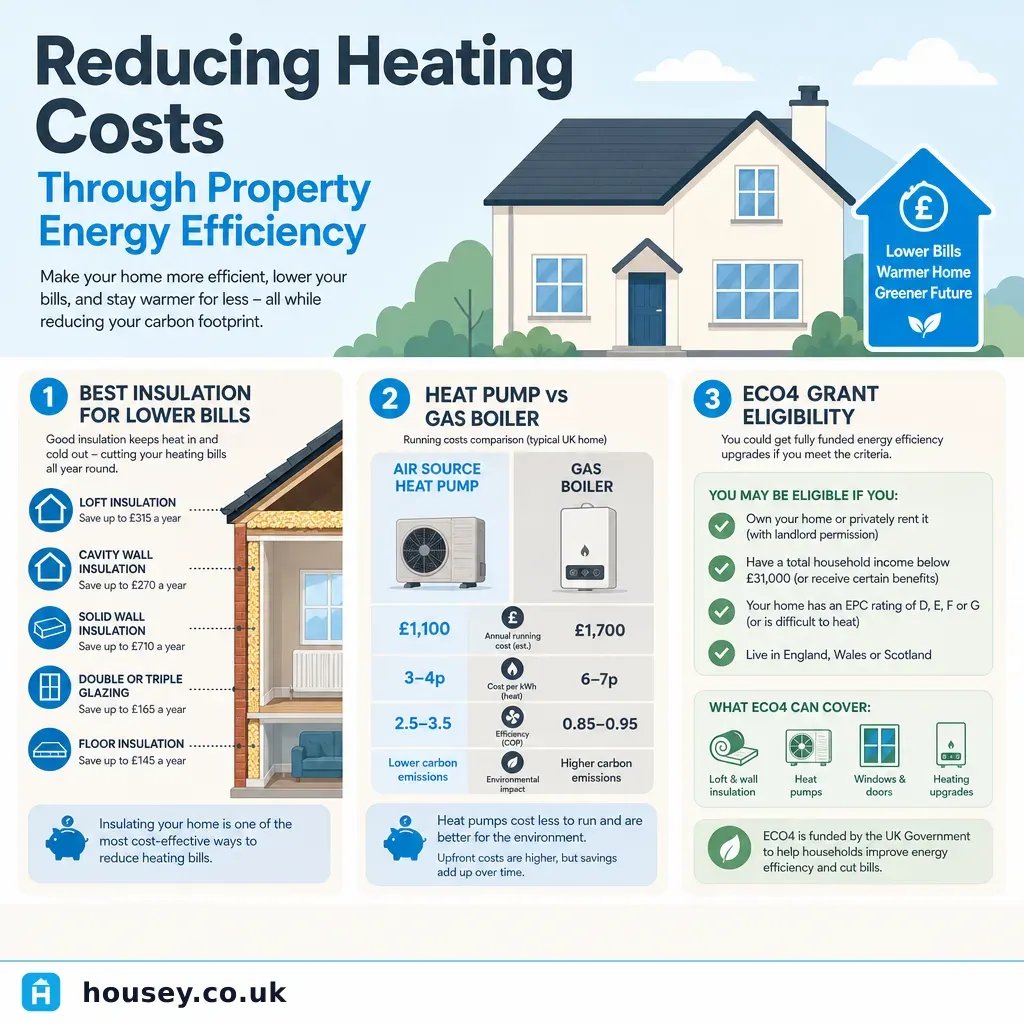
Reducing Heating Costs Through Property Energy Efficiency
Reducing heating costs starts with identifying where heat is lost — typically walls (30–35%), roof (20–25%), and windows.
 Energy & Retrofit
Practical Energy Saving Tips for Homeowners
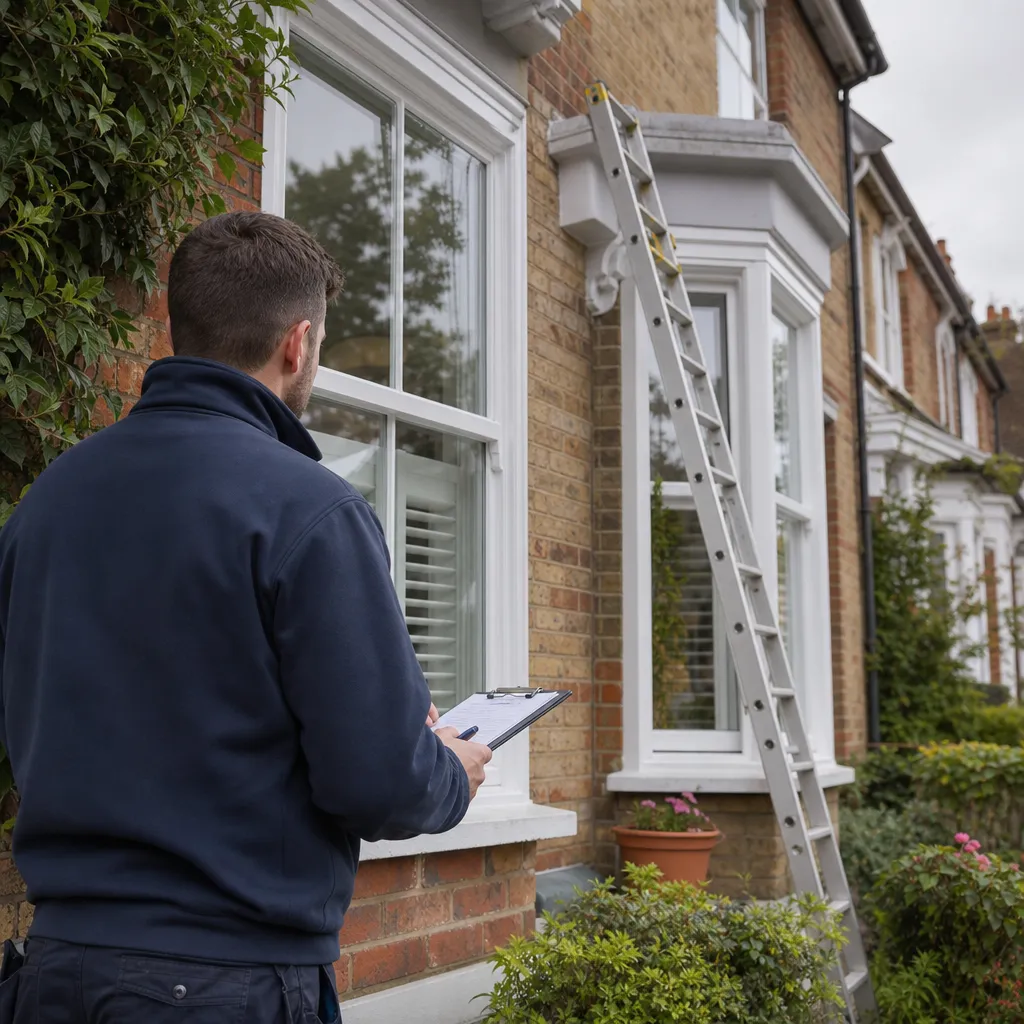
Most UK households can meaningfully reduce their energy bills by making targeted changes: lowering the thermostat by 1°C, switching to LED lighting, and draught-proofing doors and windows.
 Energy & Retrofit
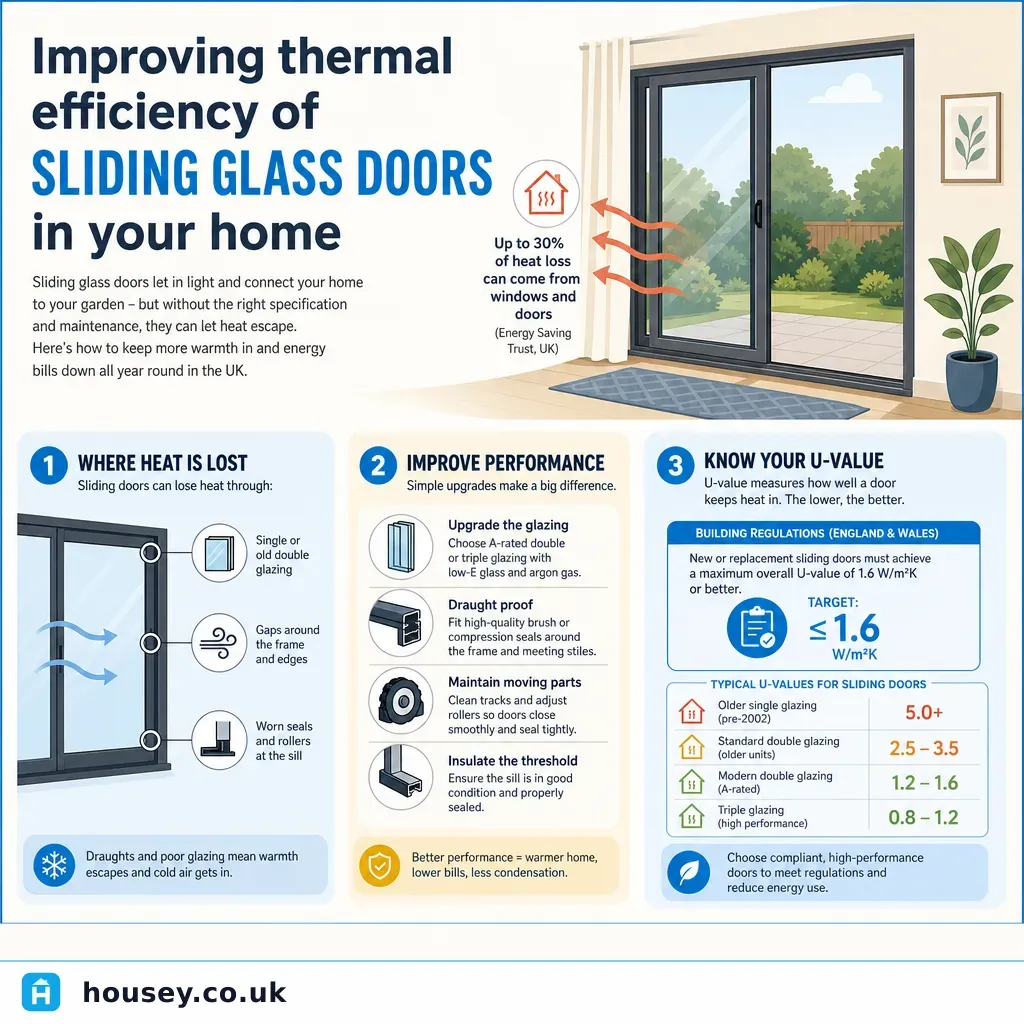
Improving thermal efficiency of sliding glass doors in your home
Sliding glass doors lose heat through the glazing unit, the frame, and air gaps in worn seals.
 Energy & Retrofit
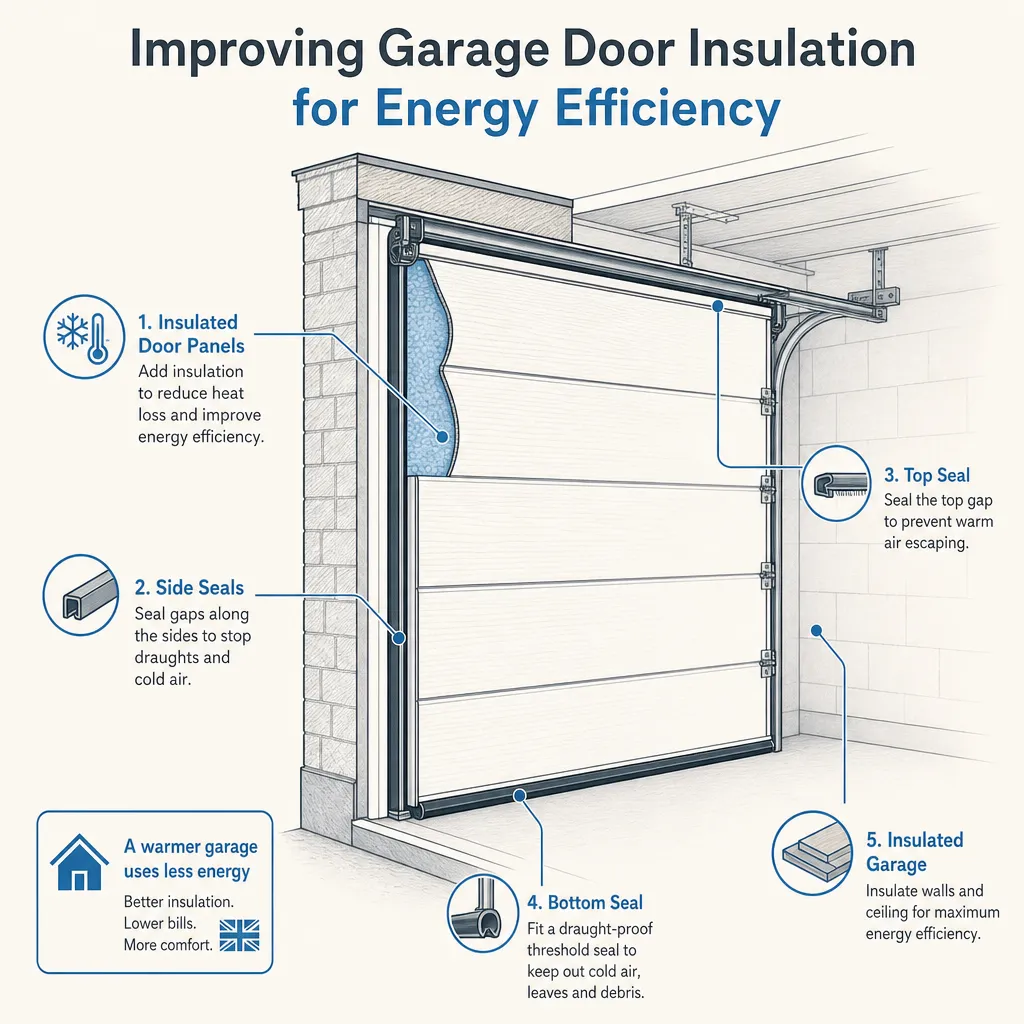
Improving Garage Door Insulation for Energy Efficiency
Improving garage door insulation typically involves fitting a retro-fit panel kit to an existing door, replacing a single-skin door with an insulated sectional model, or adding draught seals around the frame.
 Energy & Retrofit
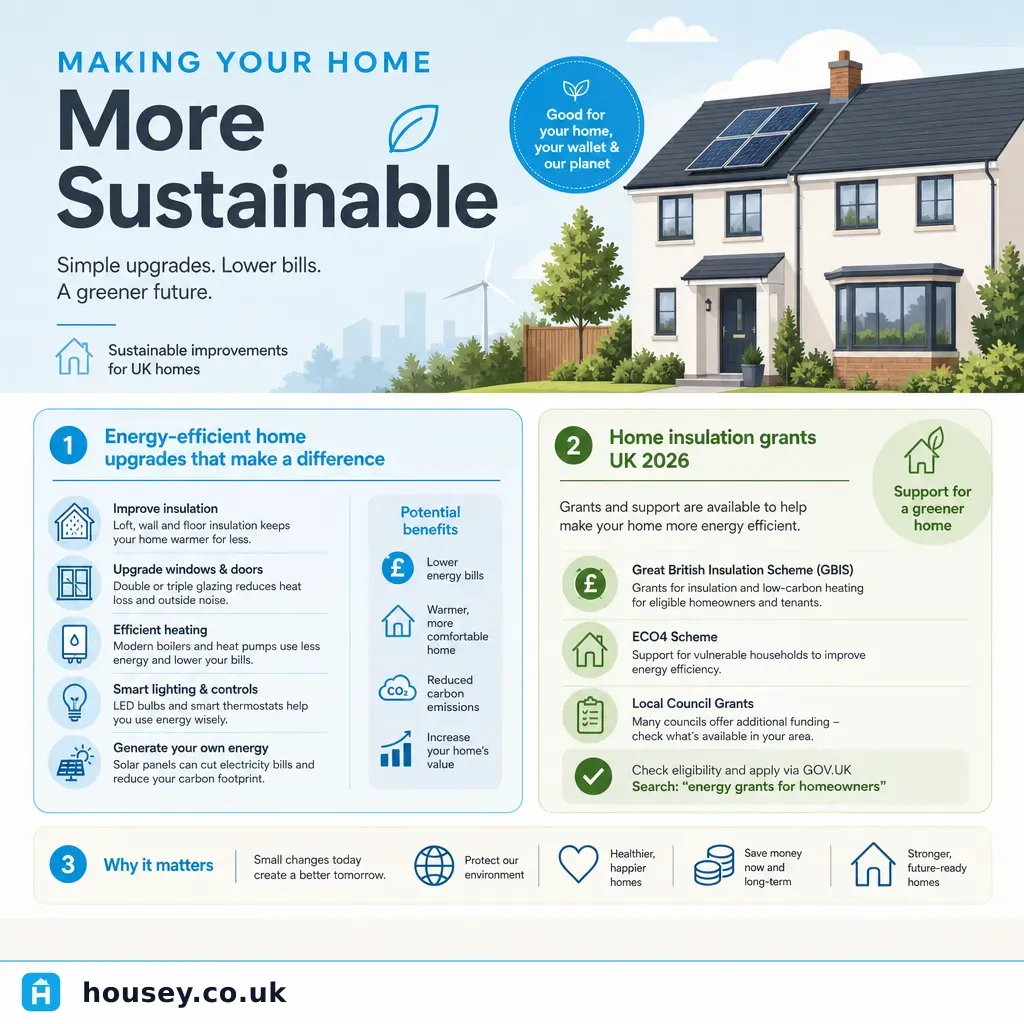
Making your home more sustainable
Making a UK home more sustainable usually starts with fabric-first improvements such as insulation, draught-proofing, and efficient glazing before adding renewable energy systems like solar panels or a heat pump.