Understanding prefab homes and modular construction methods
By Housey · Last reviewed 31st of May 2026
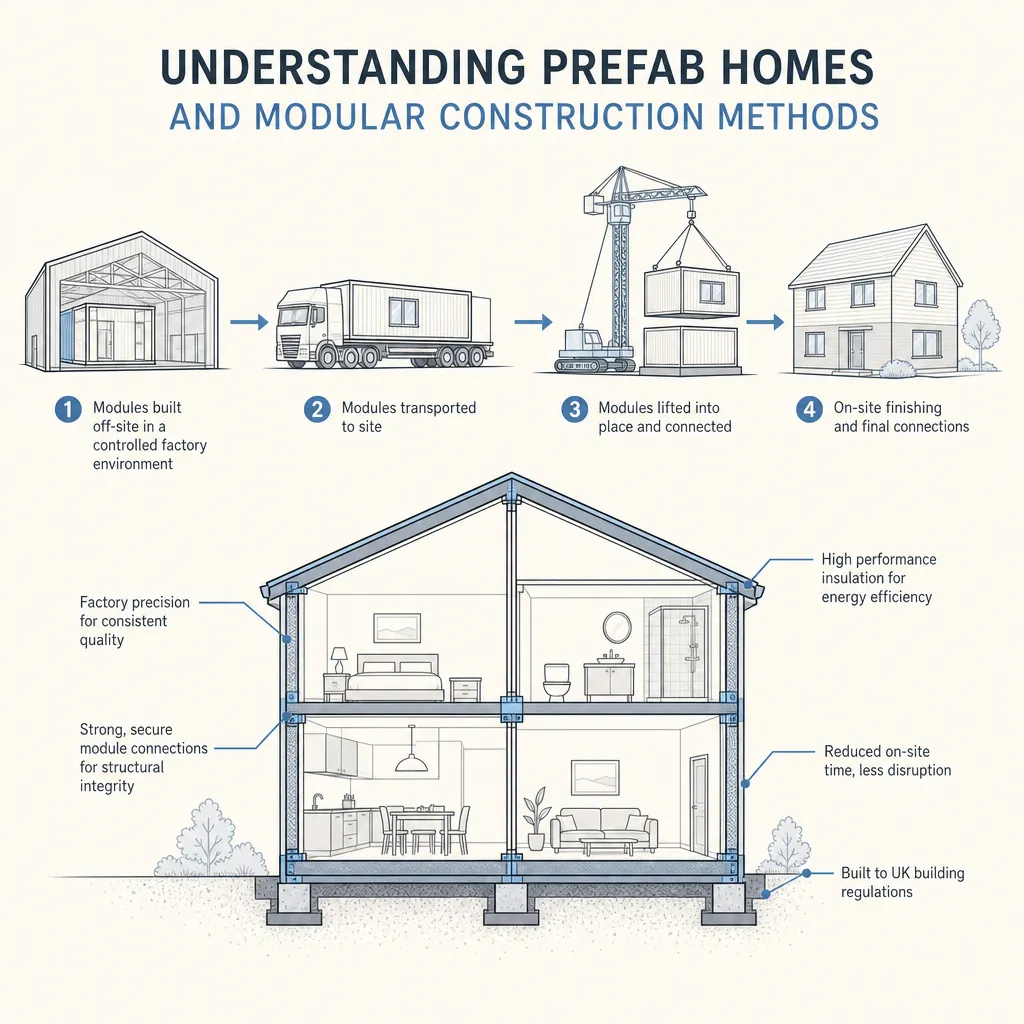
Understanding prefab homes and modular construction methods
Interest in prefab and modular homes has grown considerably in the UK over the past decade, driven by housing shortages, rising on-site labour costs, and improvements in factory manufacturing quality. For a self-builder, developer, or homeowner planning a garden annex or replacement dwelling, the terminology can be confusing: 'prefab', 'modular', 'panellised', and 'off-site construction' are often used interchangeably, yet they describe distinct procurement routes with different implications for planning, mortgage availability, and build programme.
Key points
- Off-site construction can reduce on-site build time by 30–50% compared with traditional masonry construction, according to research from the Construction Industry Training Board (CITB).
- Volumetric modular homes are built as completed room modules in a factory — with wiring, plumbing, and finishes installed — then craned onto a prepared foundation; panellised systems such as timber frame and structural insulated panels (SIPs) are assembled on site from flat factory-made components.
- All new prefab and modular homes require planning permission and Building Regulations approval in England, Wales, and Scotland — the construction method does not affect the planning position.
- BOPAS (Build Offsite Property Assurance Scheme) accreditation, developed by RICS and the Building Societies Association, assesses off-site systems to a minimum 60-year durability standard and is increasingly required by mortgage lenders before advancing funds.
- Building Regulations Part L 2021 requires new dwellings to achieve a 31% reduction in regulated carbon emissions compared with the 2013 standard — off-site-constructed homes must comply just as traditional builds do.
What 'prefab' and 'modular' actually mean
The terms are often used interchangeably, but in UK construction practice they describe different approaches:
Prefabricated (prefab): any building that uses factory-made components assembled on site. This includes timber frame panel systems, structural insulated panels (SIPs), and light steel frame systems. Most modern UK house builders use some form of prefabrication even when the resulting home looks identical to a traditional brick-and-block house.
Volumetric modular: entire rooms or apartment units are manufactured in a factory as completed three-dimensional boxes — with wiring, plumbing, and finishes installed — then craned onto a prepared foundation and connected. On-site build times are typically much shorter, but logistics and crane access requirements make volumetric systems less suitable for tight urban plots.
Hybrid systems: a combination of volumetric modules (typically bathroom or plant room pods) assembled with a panellised or traditional superstructure on site.
Comparison: construction methods at a glance
Method | Typical on-site programme | Best for | Mortgage availability | Planning and Building Regs needed? |
|---|---|---|---|---|
Traditional masonry (brick and block) | 12–24 months | Any plot; conventional financing | Standard | Yes |
Timber frame panel | 8–16 months | Self-builds; rural plots | Standard | Yes |
Structural insulated panels (SIPs) | 6–14 months | Tight programmes; Passivhaus targets | Usually standard | Yes |
Volumetric modular | 4–10 months on site | Multi-unit; repetitive floor plans; crane access available | Improving; confirm with lender | Yes |
Hybrid off-site / on-site | 6–16 months | Bespoke self-builds needing wet room pods | Varies by lender | Yes |
Indicative UK timelines, last reviewed 2026-05-31. Actual programmes depend on plot complexity, design approval, and supply chain lead times.
Planning permission and building regulations
A new prefab or modular home is, in planning terms, a new dwelling. It will almost always require full planning permission. Planning officers assess proposed use, massing, design, and local policy context — the construction method itself is largely irrelevant to the planning decision.
Building Regulations approval is required for any new dwelling. Off-site manufacturers typically design to Part A (Structure), Part B (Fire safety), Part C (Resistance to contaminants and moisture), Part F (Ventilation), and Part L (Conservation of fuel and power). Some manufacturers hold type-approval certification, which can simplify the building control process, but the building control body — either the local authority building control team or a Registered Building Control Approver — must still sign off the completed installation.
Where a modular home replaces an existing dwelling (for example, a demolished bungalow), the planning history of the site is relevant. Permitted development rights do not generally permit new residential units, though prior approval routes exist for certain agricultural building conversions under the Town and Country Planning (General Permitted Development) (England) Order 2015.
Finance and mortgages
Securing a mortgage on a modular or prefab home has historically been more complex than on a conventional masonry home. Lenders' concerns have included:
- Durability and re-saleability: lenders may apply a loan-to-value restriction if they are uncertain about future marketability.
- Non-standard construction: many standard mortgage products exclude homes built with specific panel systems, steel frames, or non-masonry external wall types.
- Warranty requirements: most lenders require a 10-year structural warranty (NHBC Buildmark, LABC Warranty, Premier Guarantee, or similar) before releasing funds on a new build.
BOPAS accreditation provides a durability assessment for off-site systems that an increasing number of lenders now accept. Checking BOPAS status early — ideally before selecting a manufacturer — can significantly widen mortgage options.
Which approach should you choose?
- Choose traditional masonry if you need conventional financing, maximum design flexibility, or are building in a conservation area or near a listed building.
- Choose timber frame panels if you want a faster programme than masonry, are comfortable with standard mortgage products, and need good insulation performance.
- Choose SIPs if you have a tight programme, want excellent airtightness, or are targeting a low-energy or Passivhaus standard.
- Choose volumetric modular if your project involves repetitive units, you have confirmed crane access and a prepared foundation, and your lender accepts the system.
- Consult an architect or project manager if you are unsure which system suits your plot, budget, and planning context — particularly for self-builds where procurement decisions are made early and are difficult to reverse.
Worked UK scenario: garden annex in a Surrey semi
A homeowner in a 1960s semi-detached in Surrey wants a single-storey garden annex for an elderly parent. They are comparing SIPs versus volumetric modular. Key constraints: a 900mm side gate, a 6m x 4m footprint covered under Class E permitted development (ancillary use, not a separate dwelling), and a budget of £75,000–£90,000 including groundworks.
A volumetric module would require crane access over or alongside the house — likely impossible on this plot and prohibitively expensive even if access could be arranged. A SIPs panel system, delivered flat and hand-assembled on a pre-poured concrete slab, is far more practical. The manufacturer holds LABC Registered System approval, simplifying the building control process. Estimated on-site build time: approximately six weeks. Because the owners are funding the project directly, BOPAS accreditation is not a requirement here.
Important limitations
This article provides a general overview of prefab and modular construction methods in the UK. Planning permission requirements, permitted development conditions, Building Regulations obligations, and mortgage lending criteria vary by property, site, local planning authority, and construction system. Nothing in this article constitutes planning advice, structural advice, or financial advice. Always consult a qualified architect, planning consultant, or structural engineer before selecting a construction method, and speak to a specialist mortgage broker if lending will be required.
When to get professional help
Seek qualified advice before committing to an off-site construction method if:
- You are unsure whether the plot has adequate access for delivery vehicles or crane operations.
- You need a mortgage and have not confirmed that the manufacturer's system is acceptable to your lender.
- The site is in a conservation area, within the curtilage of a listed building, or has complex planning history.
- The project involves drainage connections, proximity to protected trees subject to Tree Preservation Orders, or structural alterations to an existing building.
- You are unsure whether your proposed structure qualifies for permitted development rights or requires full planning permission.
What to ask a qualified professional
Before selecting a manufacturer or construction system, ask:
- What planning history does this site have, and does the proposed construction method raise any policy constraints?
- Is this system BOPAS-accredited, and which lenders have already approved mortgage applications on it?
- What 10-year structural warranty is available, and which scheme administers it?
- What building regulations type-approval or registered system documentation does the manufacturer supply?
- How is surface water drainage handled, and does the system comply with Part H and Part C requirements?
- What site access is required for delivery and crane installation, and has the delivery route been surveyed?
How Housey can help
Housey can connect you with experienced project managers experienced in off-site construction who can help coordinate manufacturer procurement, manage delivery logistics, and oversee on-site assembly through to building control sign-off.
Frequently asked questions
Do modular homes last as long as traditionally built ones?
Modern modular homes built under BOPAS-accredited systems are assessed to a minimum 60-year durability standard. Traditional masonry homes can last considerably longer if well maintained, but the durability gap between modern off-site systems and conventional construction has narrowed significantly since the post-war prefab era.
Can I get a mortgage on a modular or prefab home?
Some lenders offer mortgages on off-site-constructed homes where the system holds BOPAS accreditation and a 10-year structural warranty is in place. Lending criteria vary considerably — speak to a broker with experience of new-build and non-standard construction before selecting a manufacturer or system.
Does a prefab or modular home need planning permission?
Yes, in almost all cases. The construction method does not change the planning position. A new permanent dwelling requires full planning permission unless a very specific permitted development right applies — which rarely covers primary residential units. Always check with your local planning authority before proceeding.
How much does a modular home cost in the UK?
Indicative UK costs, last reviewed 2026-05-31. Off-site modular homes in the UK typically range from £1,500 to £3,000 or more per square metre, depending on specification, manufacturer, access, and groundworks. Always obtain detailed quotes that clearly separate the factory build cost, delivery, groundworks, and on-site connection costs.
Sources and further reading
- Build Offsite Property Assurance Scheme (BOPAS) — RICS / Lloyd's Register / Building Societies Association
- Building Regulations Approved Documents — GOV.UK
- NHBC Standards for new build homes — NHBC
- Construction industry research and statistics — CITB
- Planning permission: England and Wales — GOV.UK
Useful next reads
 Planning & Pre-Build
What Is a Patio Home? Understanding This Property Type in the UK
A patio home is a compact, low-maintenance property designed around a private patio or courtyard rather than a traditional lawn garden.
 Planning & Pre-Build
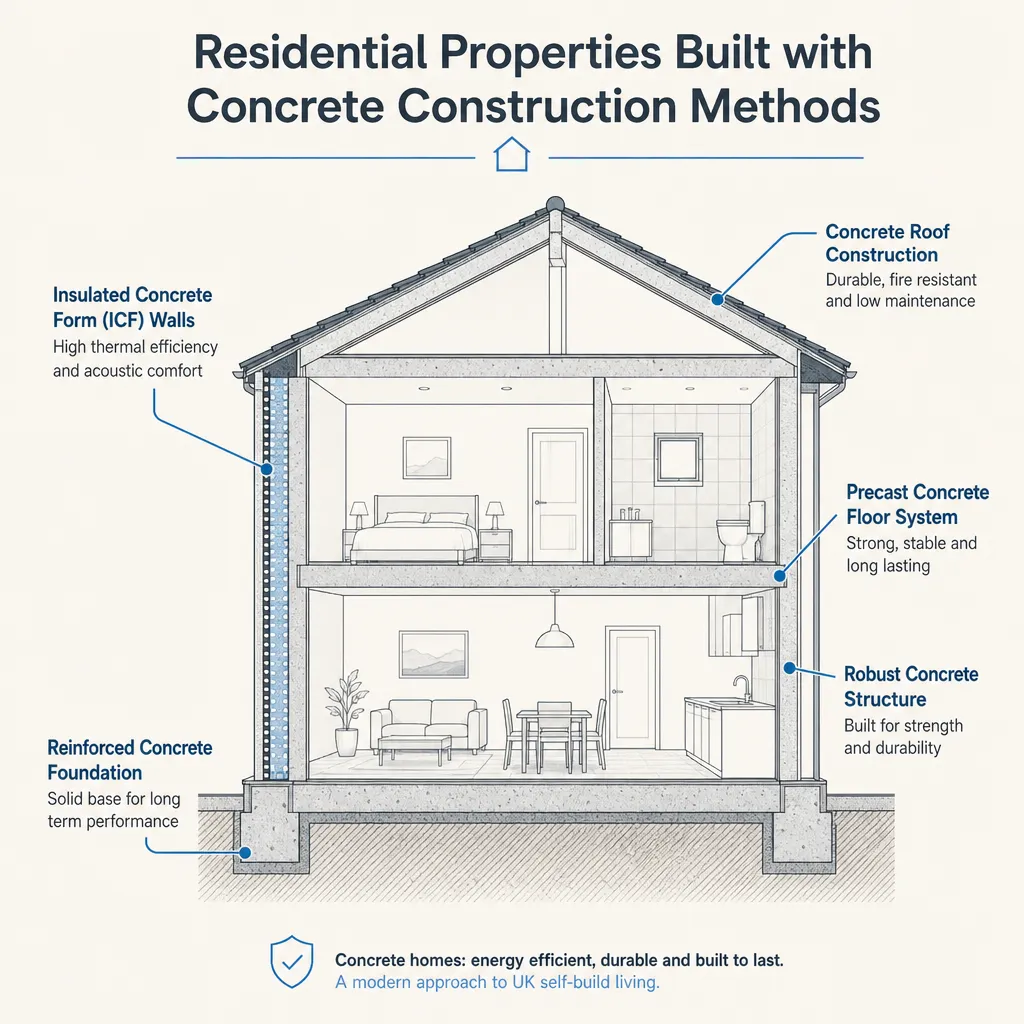
Residential Properties Built with Concrete Construction Methods
UK homes are built using several concrete methods: in-situ cast concrete, precast panel systems, insulating concrete formwork (ICF), and older non-traditional types such as Wimpey No-Fines and Laing Easiform.
 Planning & Pre-Build
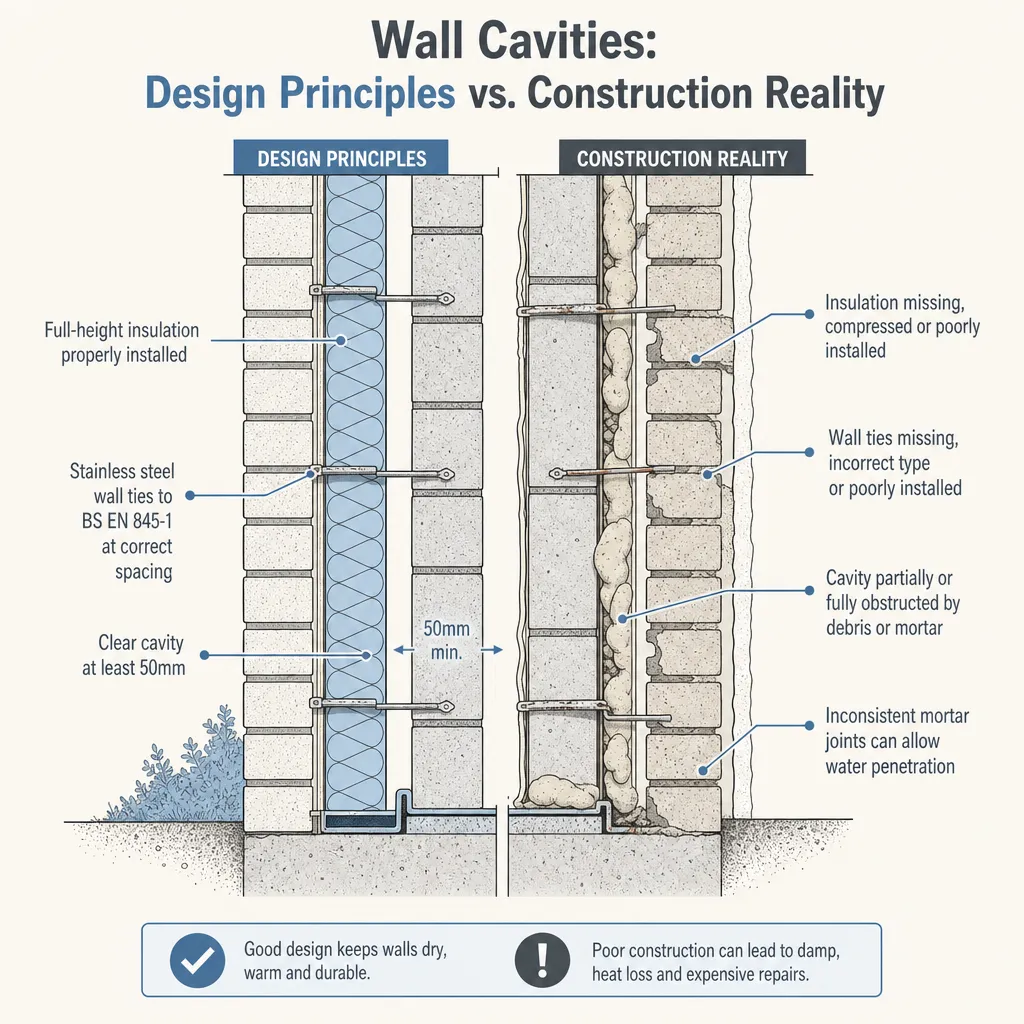
Wall Cavities: Design Principles vs. Construction Reality
A UK cavity wall is designed to resist weather, control heat loss, and structurally link two masonry leaves.
 Planning & Pre-Build
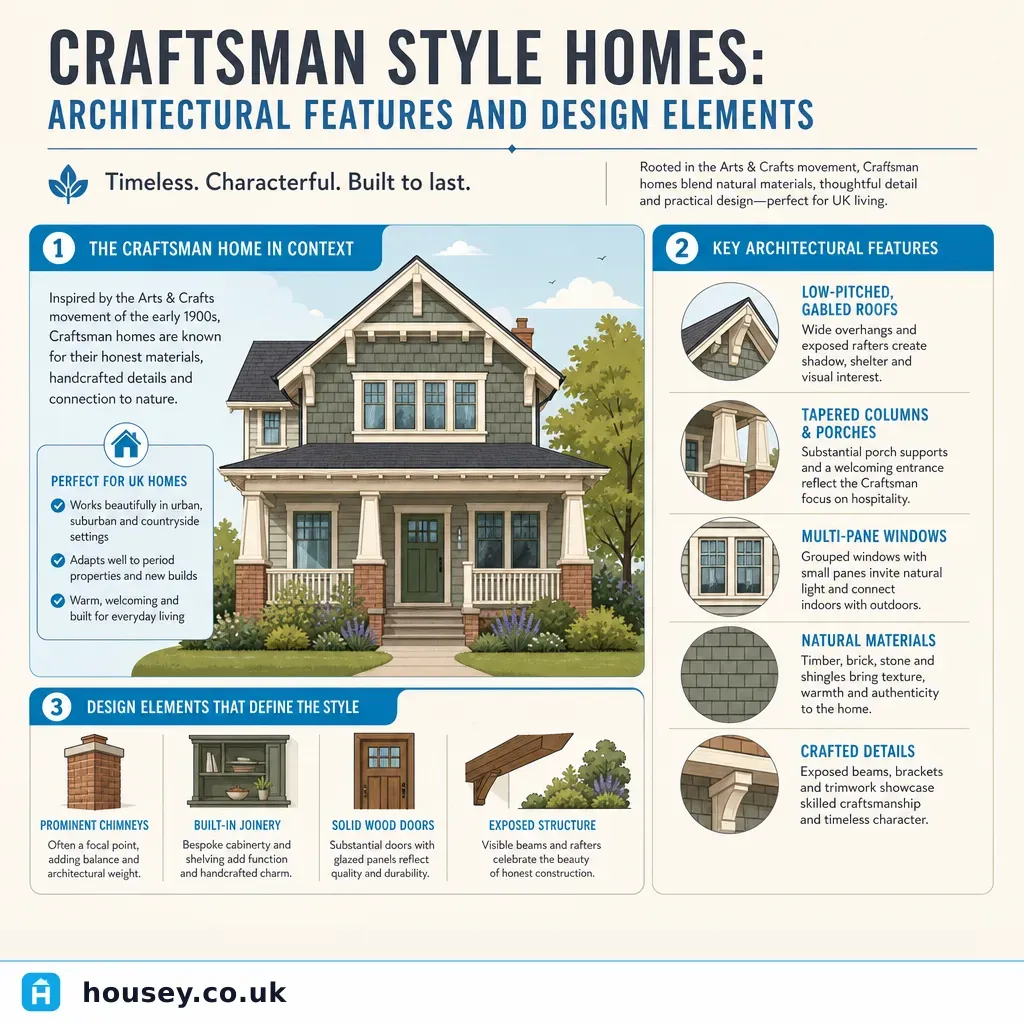
Craftsman Style Homes: Architectural Features and Design Elements
Craftsman style homes are defined by natural materials, low-pitched gabled roofs with wide eaves, covered porches, exposed timber details, and grouped casement windows.
 Planning & Pre-Build
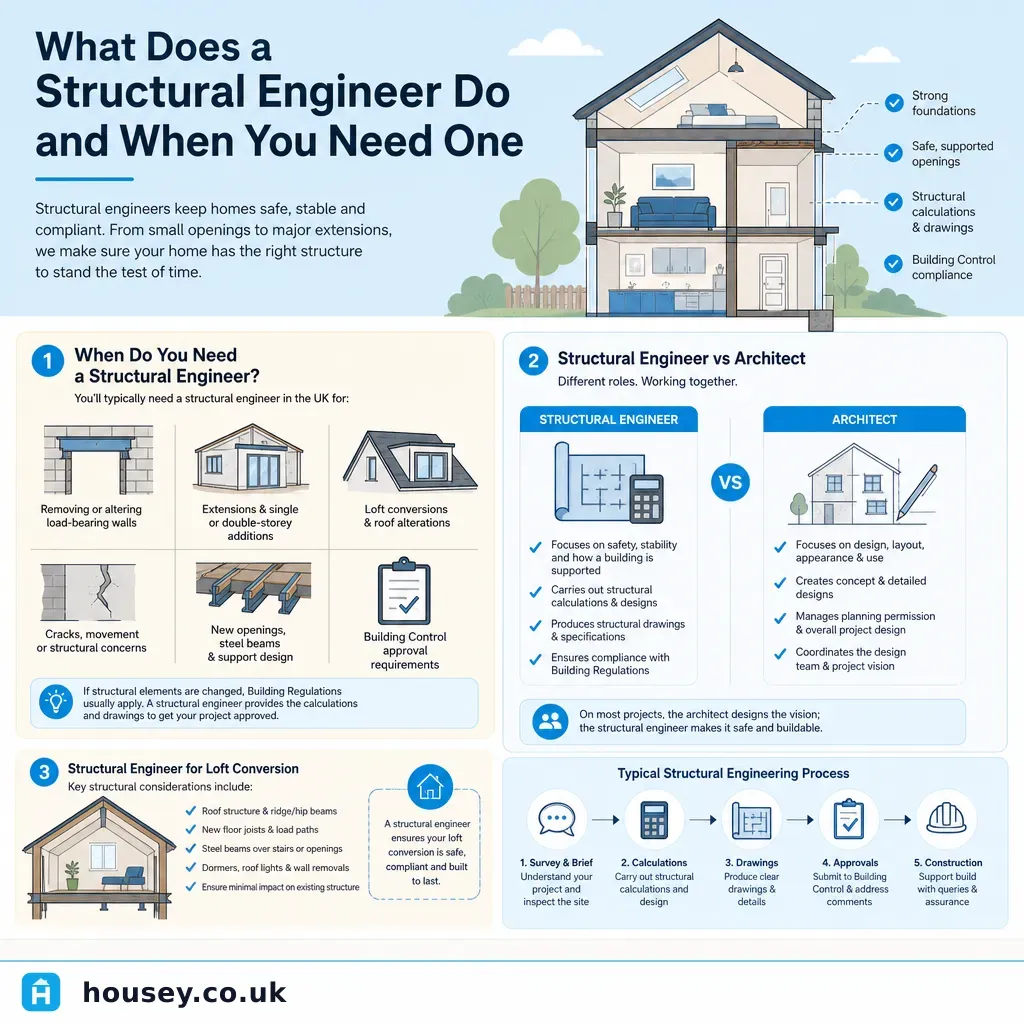
What Does a Structural Engineer Do and When You Need One
A structural engineer analyses and designs the load-bearing elements of a building — foundations, beams, columns, walls, and floors.