Prefabricated vs. Modular Home Construction: Methods Explained
By Housey · Last reviewed 1st of June 2026
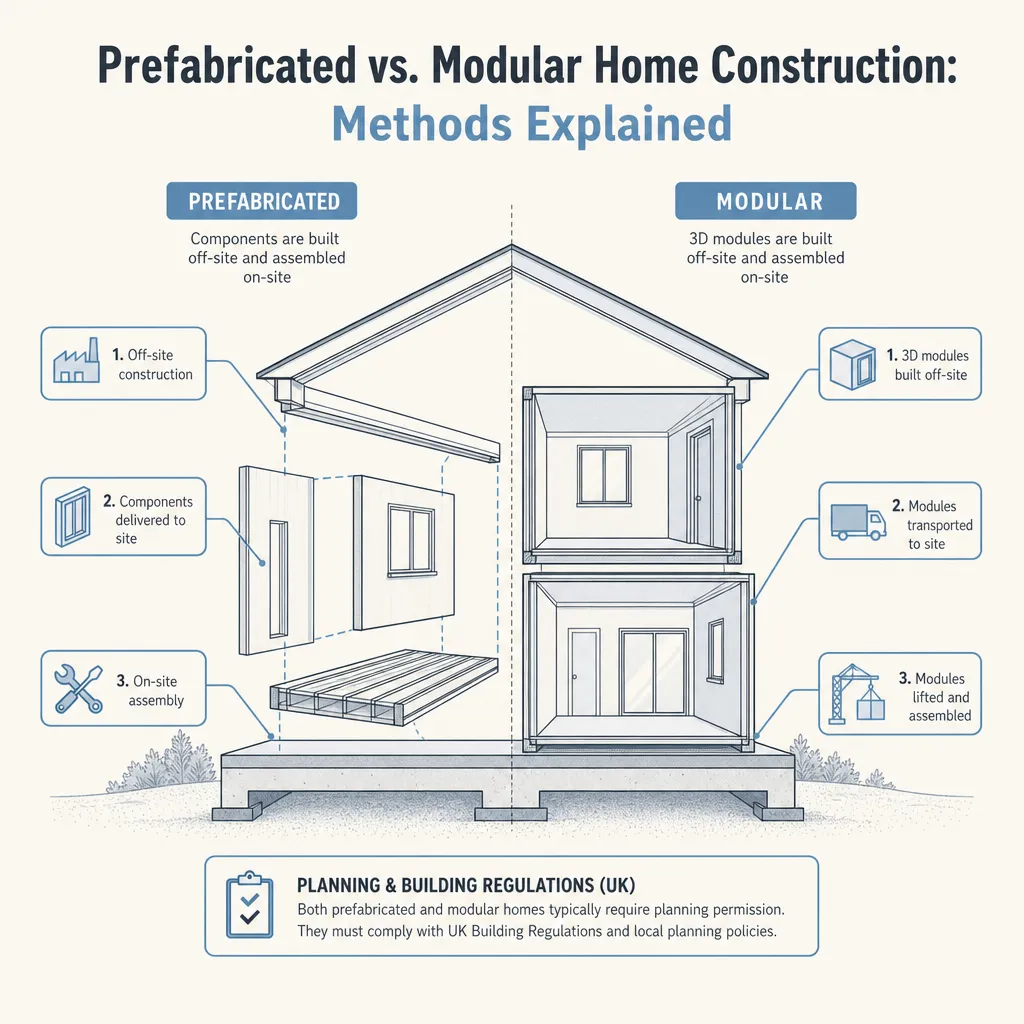
Prefabricated vs. Modular Home Construction: Methods Explained
Homeowners exploring self-build plots, replacement dwellings, or custom-build schemes increasingly encounter unfamiliar terminology around off-site construction — and the distinction between prefab and modular is one of the most commonly misunderstood in modern UK housebuilding. It matters practically: lenders, insurers, warranty providers, and local authorities treat different construction systems differently, and choosing an approach that does not suit your site or mortgage situation can create costly problems later.
Key points
- Modern Methods of Construction (MMC) is the UK government's umbrella term for off-site and innovative build techniques, defined across seven categories by MHCLG.
- Volumetric modular construction (MMC Category 1) delivers fully fitted three-dimensional room-modules; panelised systems (MMC Category 2) deliver flat structural panels assembled on site.
- Most major lenders now finance modular and prefab homes, but some impose conditions on structural system type and warranty provider — confirm before choosing a manufacturer.
- Building Regulations approval is mandatory for all prefab and modular homes; established manufacturers should hold current third-party type approval from BOPAS, NHBC Accepts, or the BBA.
- Planning permission rules are identical for MMC and traditional construction — your Local Planning Authority assesses design, massing, and materials, not how the home was built.
What do prefabricated and modular actually mean?
Prefabricated (or prefab) is the broad term for any building element manufactured off-site before delivery and assembly. It covers pre-cut timber frames, structural insulated panels (SIPs), concrete panels, and fully fitted room-sized modules. Modular construction is a specific sub-category: it uses three-dimensional volumetric units — typically complete rooms with walls, ceiling, floor, electrics, plumbing, and finishes installed in the factory — that are craned onto prepared foundations and connected on site.
Term | What it covers | How it arrives on site |
|---|---|---|
Prefabricated (broad) | Any off-site manufactured element: panels, frames, pods, or 3D modules | Flat panels, trusses, or 3D units depending on type |
Panelised (MMC Category 2) | Structural wall and floor panels assembled on site | Flat, stacked on a lorry |
Volumetric modular (MMC Category 1) | Fully fitted 3D room-modules | Large modules on low-loader lorries, craned into place |
Hybrid | Volumetric core plus panelised or traditional extensions | Mix of delivery methods |
The MHCLG MMC definition framework (2019) provides the authoritative seven-category breakdown used by government, lenders, and warranty providers.
Panelised vs. volumetric: how the construction process differs
Panelised construction uses factory-produced structural panels — cross-laminated timber (CLT), structural insulated panels (SIPs), or light-gauge steel frames — delivered flat and erected by a site crew. Services, insulation, and finishes are largely installed on site after the structural shell is up. Build time is faster than traditional brick-and-block but slower than full volumetric modular.
Volumetric modular construction manufactures entire rooms — including internal linings, kitchen and bathroom fit-out, and mechanical and electrical services — in a controlled factory environment. On site, foundations are prepared and a crane lifts modules into position, typically over one to three days. Finishing connections between modules and external works take further weeks, but the overall programme is substantially shorter.
Factor | Panelised | Volumetric modular |
|---|---|---|
Design flexibility | High — bespoke drawings per project | Moderate — constrained by module grid geometry |
Site programme | Several weeks faster than traditional | Typically 30–50% shorter overall programme |
Transport logistics | Flat panels suit most road access | Requires wide-load routes and crane hire |
Cost certainty | Good — factory prices for structural panels | Very high — most costs fixed at manufacture |
Tight urban site suitability | Good | Moderate — crane access and staging area required |
Common warranty providers | NHBC, LABC, Checkmate | BOPAS, NHBC Accepts, Build-Zone |
Which construction method should you choose?
- Choose panelised or SIPs if you want high design flexibility, have a conventional self-build plot, and want a faster erection programme than traditional methods without committing to a modular grid.
- Choose volumetric modular if speed on site is the priority, your design works within modular geometry, and you have confirmed road access and crane staging space.
- Choose a hybrid approach if you want factory-built bathroom pods or wet rooms within a panelised or traditional structural frame — a common solution in larger custom-build projects.
- Ask an architectural technologist or structural engineer if your site has access constraints, unusual foundation conditions, or a design that does not fit neatly within one system's capabilities.
- Check with your mortgage lender before committing — confirm they accept the specific construction system and warranty scheme before engaging a manufacturer.
Planning permission and building regulations
Planning permission for a prefab or modular home is assessed on identical criteria to any other new dwelling: design quality, massing, materials, and impact on neighbours and the street scene. Your Local Planning Authority (LPA) does not operate a separate track for MMC. Permitted development rights may apply in specific circumstances — certain rural exception sites or replacement dwelling scenarios — but these are site-specific. Always check with your LPA before assuming any permitted development applies.
Building Regulations approval is mandatory and covers structure, fire safety, thermal performance (Part L), ventilation (Part F), and drainage regardless of build method. Look for current BOPAS accreditation, jointly operated by the BBA and Buildoffsite, or NHBC Accepts approval — many lenders require one of these as a mortgage condition.
Costs and timelines
Indicative UK costs, last reviewed 2026-06-01. Costs vary significantly by design, specification, region, and ground conditions — treat these figures as a comparison framework and obtain detailed contractor quotes.
Build route | Typical shell cost per m² | Typical site programme to watertight |
|---|---|---|
Traditional brick-and-block | £1,200–£1,800/m² | 8–18 months |
Panelised timber frame or SIPs | £1,100–£1,700/m² | 5–12 months |
Volumetric modular | £1,500–£2,500/m² | 3–7 months |
Factory costs for volumetric modular are often higher per square metre, but programme savings reduce finance costs, site preliminaries, and interim rental — making total project cost more competitive than the headline figure suggests. Always compare like-for-like specifications and programme costs together.
Mortgages and insurance for MMC homes
Not all lenders offer mortgages on non-traditional construction without conditions. A government-backed MMC lender working group has worked to standardise mortgage appetite, and many major lenders now actively finance BOPAS-accredited or NHBC-warranted modular homes. A specialist mortgage broker can identify appropriate lenders early in the process. Buildings insurance for MMC homes is available from specialist providers — confirm cover before committing to a construction system.
When to get professional help
Prefab and modular projects involve complex procurement, warranty, and planning decisions that are difficult to navigate without professional input. Seek specialist advice if:
- You are unsure which MMC category suits your site or design intent.
- Your site has access restrictions, unusual ground conditions, or shared boundaries affecting crane positioning.
- A lender or insurer has raised concerns about a specific construction system.
- Your proposed design sits in a conservation area, near a listed building, or within the Green Belt.
- You are reviewing a design-and-build contract and are uncertain about warranty coverage, defects liability, or performance specifications.
How Housey can help
Housey connects you with experienced architectural technologists who can advise on which construction system suits your plot and design brief, and design-and-build firms experienced in delivering MMC projects through planning and building regulations approval. Where your site involves unusual ground conditions or infrastructure connections, a civil engineer can advise on foundations and service routes.
Frequently asked questions
Do prefab and modular homes last as long as traditional builds?
Modern prefab and modular homes built to current Building Regulations are designed with a minimum 60-year intended design life, and many manufacturers target 100-plus years. Structural performance is assessed as part of BOPAS or NHBC Accepts accreditation. Durability depends on the specific system, maintenance, and construction quality — as it does for any traditional build.
Can I get a self-build mortgage for a modular home in the UK?
Yes. Many lenders offer self-build or custom-build mortgages for modular and panelised homes, provided the construction system holds a recognised warranty such as BOPAS, NHBC Accepts, or equivalent. Confirm lender appetite and the specific accreditation required before selecting your manufacturer, as conditions vary between lenders.
Is planning permission easier for modular homes?
No. Planning permission is assessed on the same grounds as any new dwelling regardless of construction method. Local Planning Authorities assess design, massing, materials, and neighbourhood impact. There is no streamlined modular planning track in the UK.
What warranties should a modular home come with?
Look for a structural warranty of at least 10 years from a recognised provider such as NHBC, LABC, Checkmate, or Build-Zone. The manufacturer should also warrant the external envelope, mechanical and electrical systems, and fitted elements. Confirm warranty transferability before signing contracts if you plan to sell.
Sources and further reading
- Modern Methods of Construction: definition framework — GOV.UK / MHCLG
- BOPAS accreditation scheme — Buildoffsite Property Assurance Scheme
- NHBC Accepts for innovative construction — NHBC
- Custom and self-build homes guidance — GOV.UK
- Building Regulations Approved Documents — GOV.UK
Useful next reads
 Planning & Pre-Build
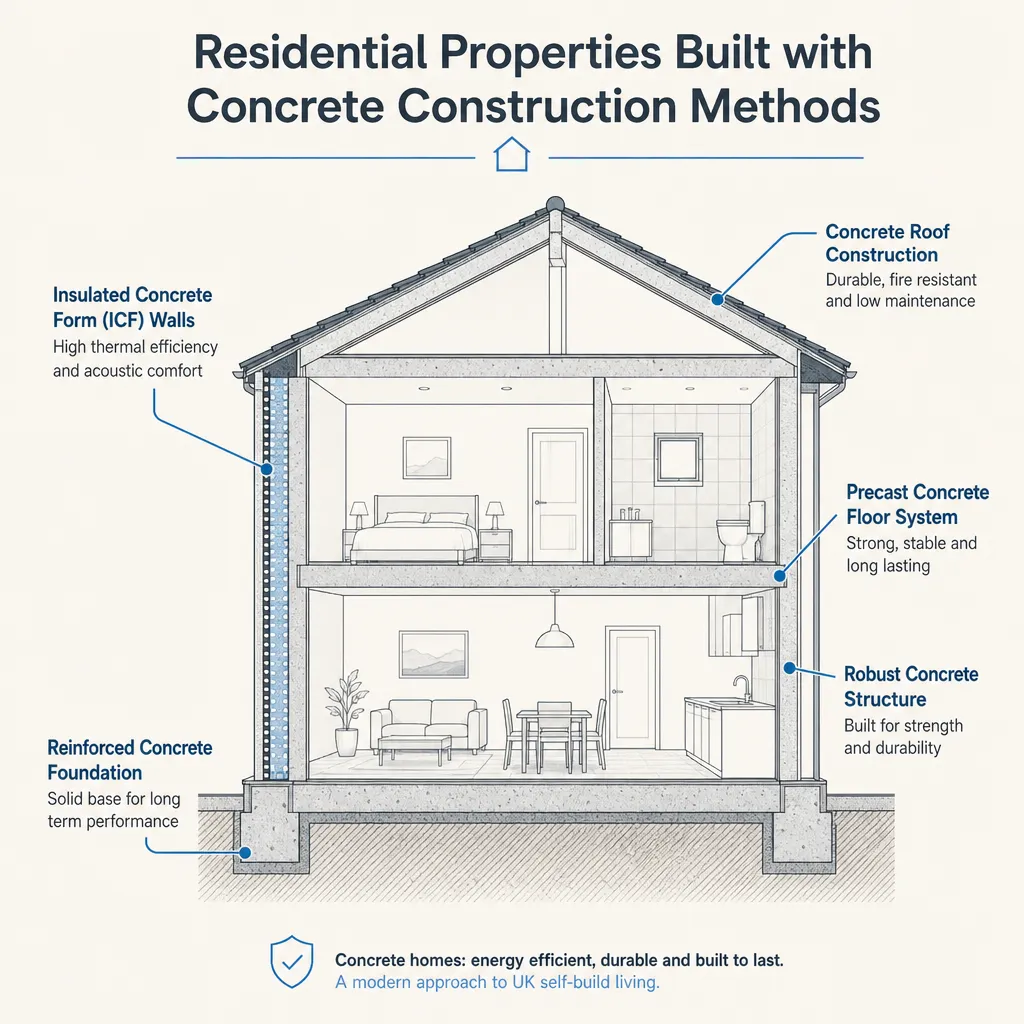
Residential Properties Built with Concrete Construction Methods
UK homes are built using several concrete methods: in-situ cast concrete, precast panel systems, insulating concrete formwork (ICF), and older non-traditional types such as Wimpey No-Fines and Laing Easiform.
 Planning & Pre-Build
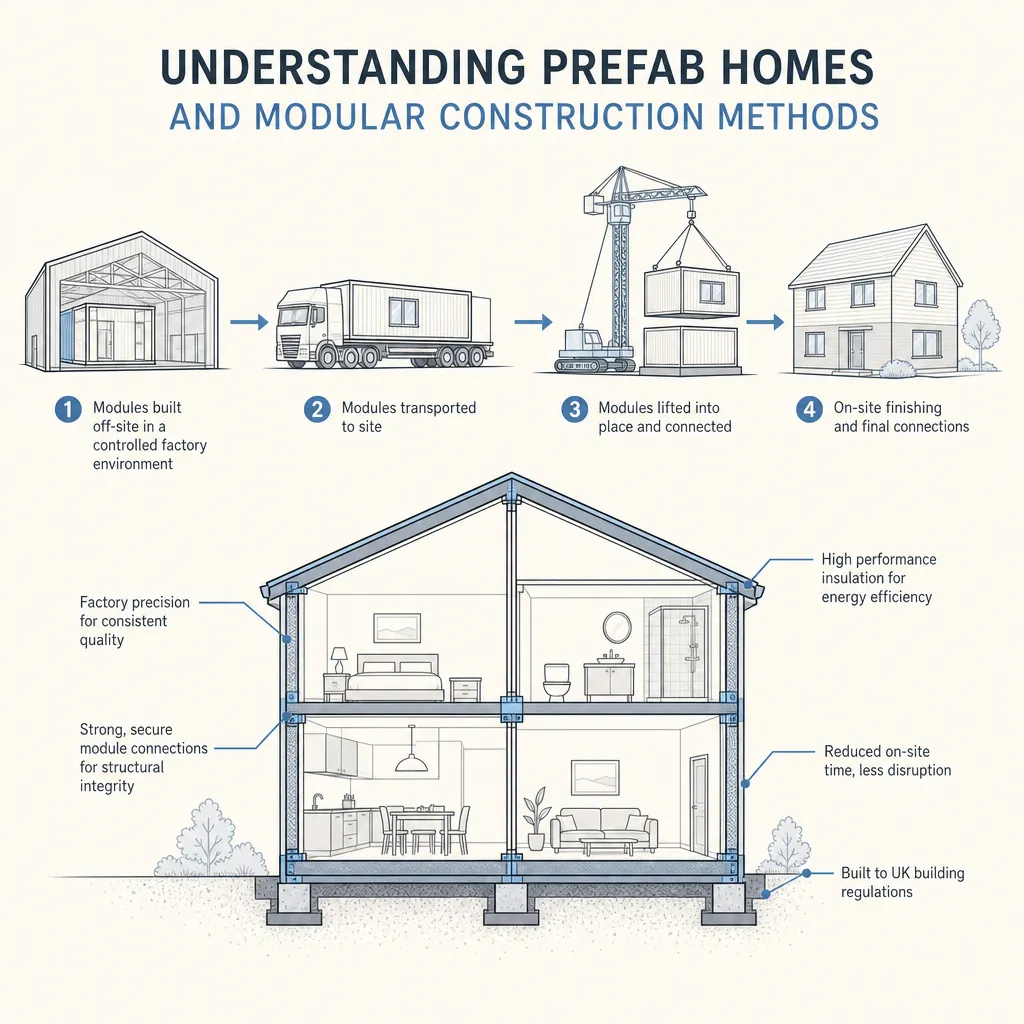
Understanding prefab homes and modular construction methods
Prefab and modular construction covers a range of off-site manufacturing methods, from timber frame panels to fully volumetric room modules craned into position.
 Planning & Pre-Build
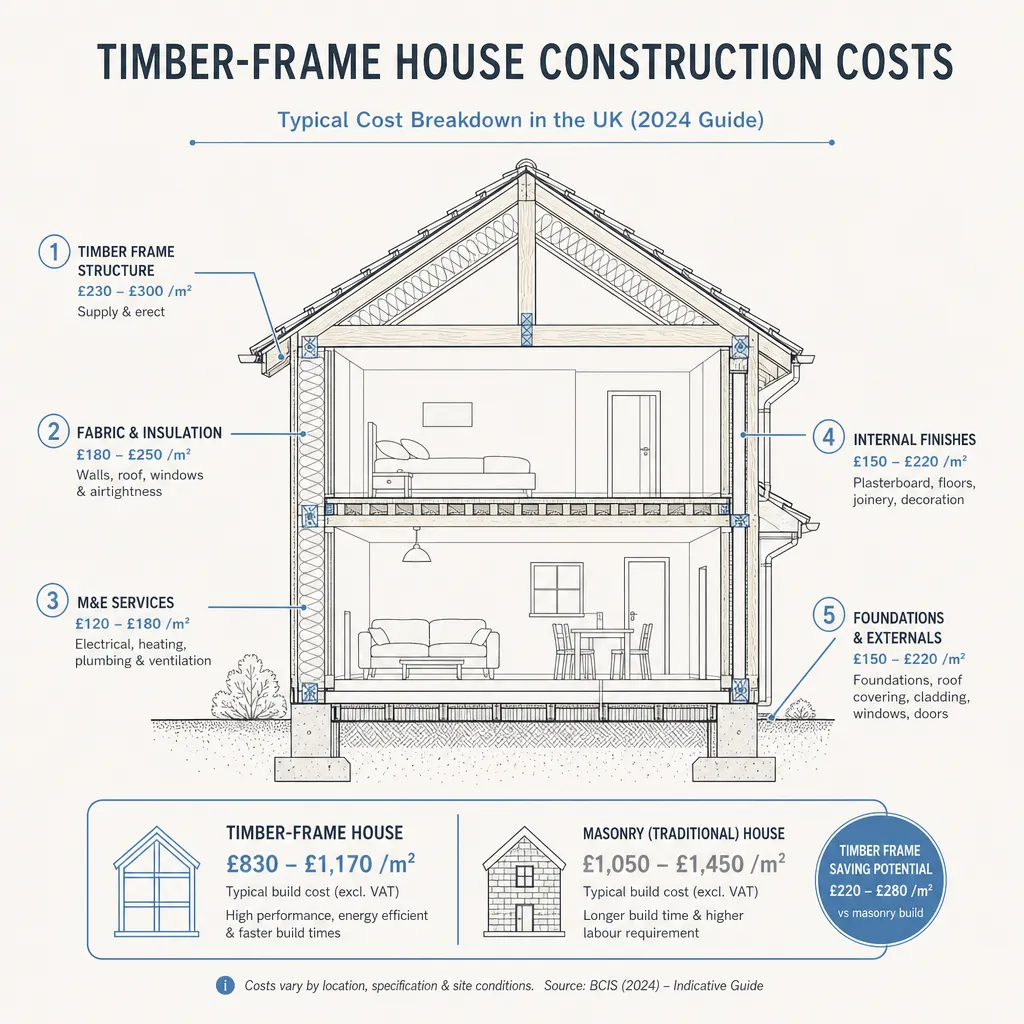
Timber-Frame House Construction Costs
Building a timber-frame house in the UK typically costs £2,000–£3,500 per m² of floor area, depending on system type, specification, and location.
 Planning & Pre-Build
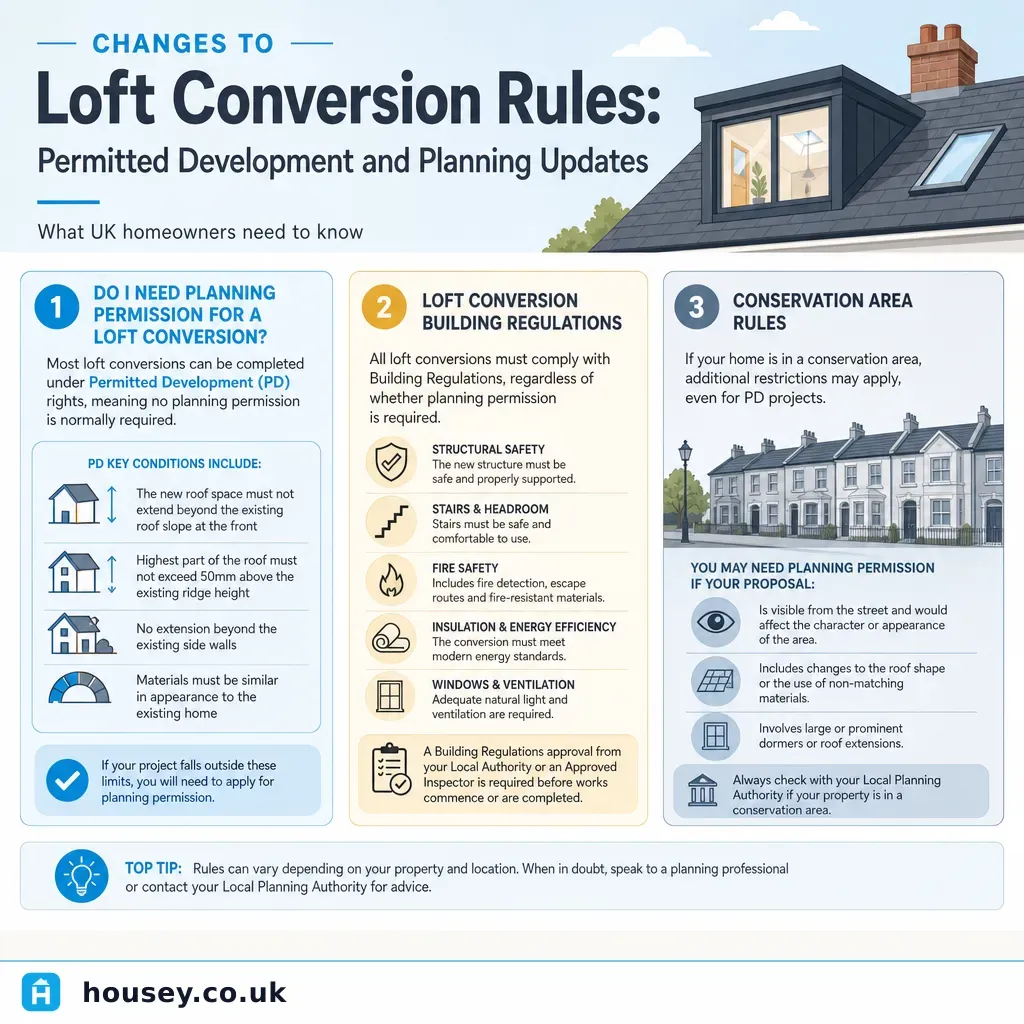
Changes to Loft Conversion Rules: Permitted Development and Planning Updates
In England, most loft conversions on standard houses qualify as Permitted Development under Class B of the GPDO 2015, allowing up to 40 cubic metres (terraced) or 50 cubic metres (detached or semi-detached) without a planning application — if conditions are met.
 Planning & Pre-Build
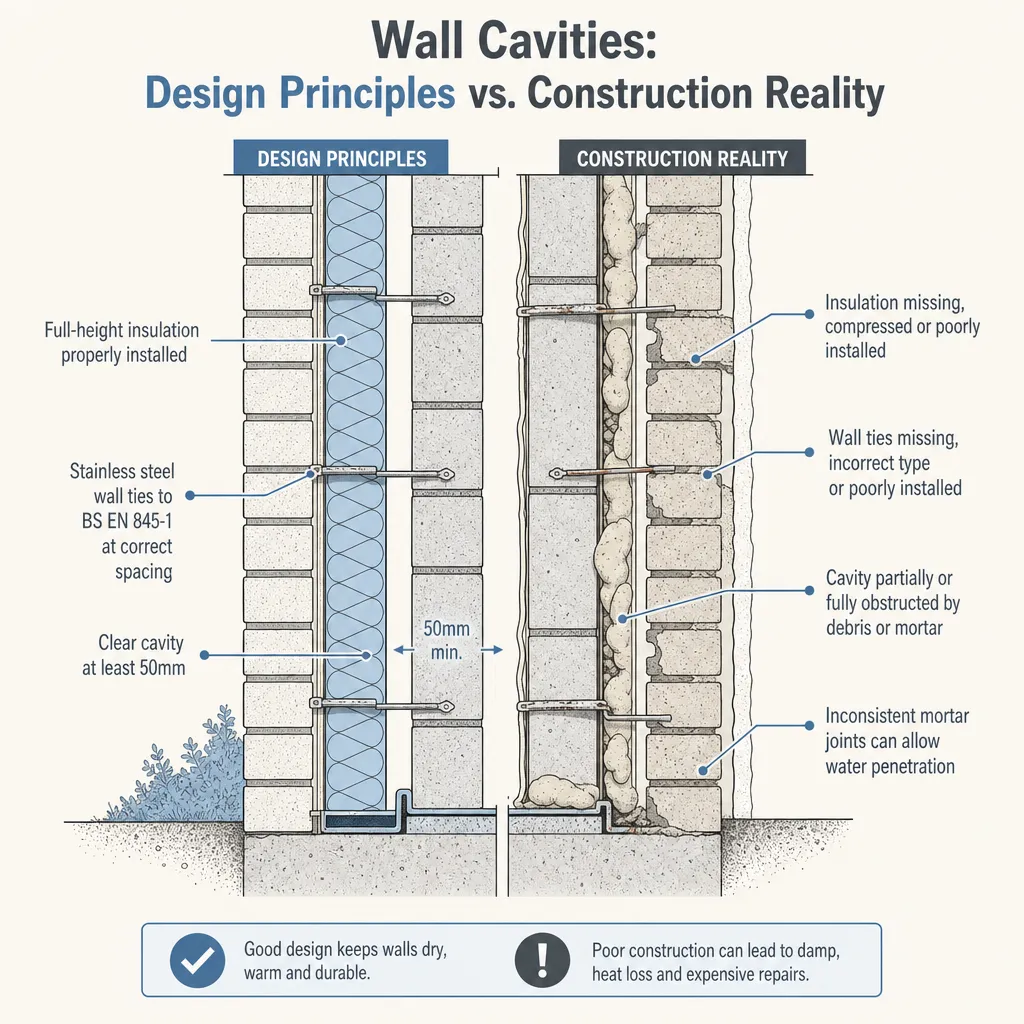
Wall Cavities: Design Principles vs. Construction Reality
A UK cavity wall is designed to resist weather, control heat loss, and structurally link two masonry leaves.